By the general acclaim of those who interacted with him on a regular basis, Carlos Mendoza was a mensch. It didn’t matter. Consensus rarely pinned on him the bulk of the Mets’ on-field woes that stretched back more than 365 days in the course of the year-plus his ballclub circled the drain. It didn’t matter. Managers are said not to matter as they did in the era when they cut larger-than-life figures and were perceived as their organizations’ primary strategists, tacticians, and maybe molders of men. That didn’t matter, either. Following one last languid loss [1] to fall amid a blizzard of life-lacking Ls, Mendy the Mensch is no longer the manager [2] of the Mets.
I feel bad for the human being who wore the uniform. I’m hopeful the implied shakeup his dismissal represents will impact for the better the team he leaves behind. I have no idea if his interim successor, 2009 cameoist [3] Andy Green — 871st Met overall and 139th Met third baseman ever, for those of me keeping score — will make any difference over the impending half-season. If managers don’t matter, not even the ones considered splendid individuals skilled in the execution of baseball administration at the level that bridges the clubhouse and the front office, then what is there to expect from Andy Green taking over a 34-47 lost cause? What was there to expect from Carlos Mendoza after the Mets’ cause started getting lost not quite midway through the season before the current one?
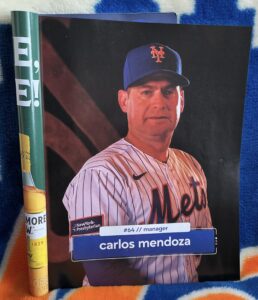 [4]
[4]Page 9 of the 2026 yearbook. Gonna need to print a revised edition.
As we’ve found ourselves saying more than a few times upon the departures of those connected with our most recent magical spurt, we will always have 2024 to think of Mendoza at his finest. Surely he was a difference-making manager when those Mets rose from nearly dead and soared close to a World Series. As the champagne flowed in Atlanta, in Milwaukee, and at Citi Field after the vanquishing of Philadelphia, only the most hard-bitten cranks would have grumbled we’d gotten where we’d gotten in spite of Mendy or irrespective of Mendy. When your team wins, your manager is exactly what your team had to have.
When Mendoza wasn’t being that, he came off as a good guy overseeing a bad team, giving inadequate answers when asked to explain subpar play, probably because it’s hard to articulate impactfully over the sound of a swirling drain. He wasn’t the one committing the costliest errors, making the rally-killing outs, or giving up the backbreaking hits. Nor was he the one acquiring the players whose collective shortcomings consigned more than a year’s worth of Met box scores to the Horror section of Baseball-Reference. Mendy was stuck in the middle with us, not happy with what he was watching, though he put on a more stoic face than we ever could regarding the unrelenting stream of contemporary Met miseries.
He was the manager. It turned out to really not matter.