Contrary to popular perception, the Los Angeles Dodgers do not merely have to throw their gloves on the field in order to defeat the New York Mets. Friday and Saturday, I’m pretty sure all it took was the Dodgers checking in on the MLB Ballpark app. From all appearances, L.A. clicked “win” prior to first pitch and confirmed their result in advance. The Dodgers truly looked like a team looking at their phones while playing a three-game series that didn’t seem worthy of their bother. They’d take an extra base if they didn’t have to slide. They’d score an extra run as long as the plate was left vacated. They’d stick out their bats on the assumption a baseball would meet it and produce satisfactory contact. They’d wait for the Mets to inevitably err.
On Sunday, the disinterested Dodger approach did not yield them a victory, proving…well, little beyond teams going nowhere occasionally outdo over the course of nine innings teams going to the airport. The Dodgers’ ultimate destination is their fourteenth consecutive postseason. They won this series. They won the two series that preceded it on their Northeast Corridor road trip. They also won the last World Series, the one before it, and all the playoff series required to reach the past two championship rounds. They are in first place by a dozen games. An 8-3 loss to the Mets hardly precluded the likelihood of a happy flight home. Until they’re overly weighed down by the massive expectations they pack every year, I imagine all the Dodgers’ flights are reasonably happy.
Yet for a few innings on Sunday, Mets fans’ spirits could soar. Tyrone Taylor [1] hit a three-run homer to transform a 3-1 deficit into a 4-3 lead. Taylor’s swat in the sixth held up as heroic enough to rate an attempted ice bath while Steve Gelbs interviewed him postgame. It should surprise no one that the designated cooler dumpers, Francisco Alvarez and Juan Soto, missed their target, but did get the grass nice and wet. Marcus Semien [2] also added a three-run homer in the seventh to assure us the scoreboard wasn’t an optical illusion.
Once late-period Freddy Peralta [3] was done slogging through four pitch-laden innings yet giving up only three runs (the analytical interpretation of his line was “could have been worse”), the Met bullpen did its yeoman best. Cionel Perez, midseason’s answer to Austin Warren, shut down L.A. for two innings. One would think Cionel’s too low-profile to attract trade-deadline interest, but Perez has emerged as one of those Met relievers who doesn’t strike fear into the hearts of those rooting for him. Brooks Raley followed with a seven-pitch seventh. We intuit he’ll be gone by next week. Luke Weaver pitched into and fielded out of a spot of trouble. I’ll be sorry to see him leave if he does. By the time Devin Williams came on to close, the ninth wasn’t a save situation and Dave Roberts was pinch-hitting for Shohei Ohtani and Freddie Freeman, less waving a white flag than dabbing his forehead with an apathetic handkerchief.
For self-esteem purposes, this was a big Met win [4]. No last-place team, no matter how miserably their year is going, should have to endure an ohfer in a season series versus a league behemoth. The Mets had played and lost to the Dodgers five times in 2026 prior to Sunday. One final shot at the champs yielded pay dirt. Or wet dirt, pending on how many ice cubes from that cooler piled where. Wet dirt is generally known as mud, which is where the Mets have been stuck since before their trip to Los Angeles in April. That was when we fretted all those West Coast swings were going to be the death of us. Maybe they were, but based on the way our team has played in and closer to Queens since, it’s safe to say geography wasn’t our primary problem.
We received another self-esteem boost if we chose to accept it on Sunday when Carlos Beltran [5] declared his allegiance to the orange and blue in Cooperstown. Beltran’s plaque now hangs in the National Baseball Hall of Fame and Museum, where his likeness is adorned by a Mets cap. That makes us 3-for-18 in terms of players in the Hall — and 0-for-2 among those inducted as managers — regarding what they’re wearing while bronzed. Tom Seaver’s Mets cap was an obvious historical and sartorial choice. Mike Piazza’s hat selection felt accompanied by billows of righteous white smoke, having risen in those halcyon days of not automatically assuming the Dodgers were going to get the best of us every time we saw them. When Beltran and the Hall let it be known over the winter that he and they thought the curly NY was appropriate for eternity, I was mildly surprised. Statistically, it wasn’t wrong. Spiritually, it was a coin flip, less between the Mets and Beltran’s first team the Royals than any of his seven teams and going sans insignia. Carlos was a modern ballplayer, elevated by free agency and agency in general. He went where he wanted to go. In the end, he wanted to go into immortality as a Met.
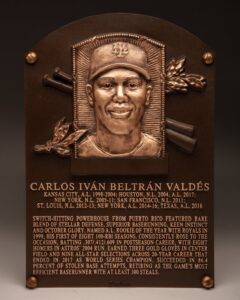 [6]“To the Mets fans,” Beltran said as part of his induction speech [7], “thank you for believing in me. You challenged me. You let me know when I needed to be better, and that was a lot of times. I got to hear those boos, let me tell you that. But I also appreciate your support along the way.” Clearly, the superstar who became the finest all-around center fielder we ever experienced [8], heard and processed his share of cheers at Shea and Citi. A player of Beltran’s caliber choosing us in 2005 was a rocket ship for our self-esteem. It surely helped turn our team into a contender and division champion. Though he’s done earning Gold Gloves and Silver Sluggers in our garb, I believe the decision to be a Met on his plaque says something meaningful (beyond cementing his current role as a front office advisor). We remember who plays for us. It’s nice to be reminded that those played for us remember who cheered for them.
Sixty Hall of Famers, including the three newest, were on stage at Cooperstown on Sunday. Eight have “New York, N.L.” on their plaques if not on their heads. Jeff Kent [9] joined Beltran (and Andruw Jones) as an inductee. Kent is portrayed as a San Francisco Giant, and fairly so. It was as a Giant, two teams after his Mets days, that his offense detonated, allowing him to pave a Hall of Fame path. Yet Jeff did take a moment to remember where his career gained a modicum of early traction. “New York was somethin’ that I was not prepared for,” our mid-’90s beacon of hope [10] admitted. “You learn about pressure and accountability and responsibility fast in that city, and if you don’t, it’ll chew you up. But I am, without a doubt, grateful for every minute of it.” Kent also acknowledged the influence of long-ago Met lockermate, fellow Hall of Famer and ceremony attendee Eddie Murray (let’s say Murray sat stoic with pride while being shouted out), and his manager from 1993 to 1996, Dallas Green, who Jeff said accepted “no excuses for failure” despite the rampant epidemic of failure that beset Flushing during their shared era.
Few are those who enter the Hall of Fame in the 21st century without a word for multiple home teams. “Every organization shaped your career,” Beltran told the crowd spread out on the grounds of the Clark Sports Center. “New York shaped my life.” It was as a Met, Carlos continued, that “I experienced my greatest success and some of my greatest challenges. Playing for the Mets made me a better man […] The Mets cap represents for me growth and a place where I became the best version of myself.” Give or take a year like 2026, who among us wouldn’t attest to something like that?