As I saw one trade after another announced in the leadup to 6 PM Monday, my impulse was to frame so many forced Met exits happening at once as some kind of massacre, à la the one that happened late on a Wednesday night a little over 49 years ago, the date of another trade deadline. Then I remembered the real massacre, in a contemporary baseball context, had already occurred. It commenced in late March and just kept going. Its bloody aftermath has been visible at the bottom of the National League East standings for months.
August 3, 2026, is not going to be mistaken for June 15, 1977, on any scale, yet the one similarity the fusillade of transactions we just experienced has to the blast of bulletins that assaulted our fandom as Shea Stadium reverted to Grant’s Tomb, is the Mets team suddenly expunged of Tom Seaver and Dave Kingman (and Mike Phillips) was summering in the cellar. Trading Seaver absolutely ended an era, but it didn’t push those Mets over a competitive cliff. They had already tumbled and were going to keep plummeting whether they maintained their ties to the Franchise or not. Maybe instead of going 64-98, Tom’s pitching and Sky King’s slugging might have powered them to 70 wins. The Mets flopping toward the end of the 1970s were beset by structural problems that no two icons, nor the assortment of players their departures returned, were going to reverse in the short term.
We were still entitled to miss them like crazy. Those trades, especially of Seaver, massacred our hearts and souls as Mets fans. They didn’t make much difference to where our team was going between June 16 and the end of the 1977 season. Our team was already going nowhere but down.
These trades of late July and early August in 2026 were surely coming, just as we knew — even if we couldn’t fathom — that Seaver and Kingman were leaving. Maybe some kid somewhere within the confines of Metsopotamia has lost his or her favorite player and is now questioning whether naming his or her cat Huascar was such a swell idea, but chances are the critical mass of regret, even among the relatively innocent sharers of our fandom, is minimal on this day after. The regret we feel now, whatever our age, was already forged in the fires of a Mets team we took on faith in advance as being no less than perfectly all right posting a record of 47-66 to this point. It’s the exact same record the 1977 Mets held after having played 113 games, and the 2026 Mets didn’t even have to trade Tom Seaver to get there.
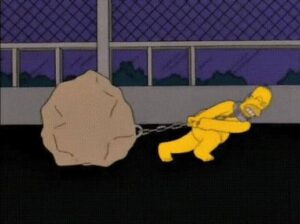
Between now and the end of the 2026 season, I’d guess the Mets will probably be a little worse than they’ve already been. It would hard to be a lot worse. Considering that four of the seven major leaguers they’ve traded since Thursday night were their four most dependable middle and setup relievers, four arms sought by legitimate playoff contenders, and the Mets were still 47-66 despite having used those arms often and effectively…well, what’s the harm in the evanescent present? Probably that games we were losing by scores of 2-0 will now be lost by scores of 4-0 or 6-0. A bad bullpen can undermine a good team. A good bullpen can do only so much for a bad team. We could have kept every able reliever and the 2026 Mets would be who they are appear to be, the way Homer Simpson was quite obviously Homer Simpson when he took the Stonecutters oath.
HOMER: And by the sacred parchment, I swear that if I reveal the secrets of the Stonecutters, may my stomach become bloated and my head be plucked of all but three hairs.
MOE: Um, I think he should have to take a different oath. ‘Cause he’s already kind of heavy, you know…
 [1]
[1]David Stearns goes about remolding the Mets.
Luke Weaver of the Pirates, Huascar Brazobán of the White Sox, Brooks Raley of the Phillies, and A.J. Minter of the Twins each helped the Mets as much as he could, even if as a unit they couldn’t help the Mets be tangibly better. Thanks for the innings, boys. The temptation is to say “thanks for nothing” to Freddy Peralta of the Rays, and, honestly, I don’t have a “but…” rejoinder to such a graceless shove out the door. He did seem like a good dude, though, and I won’t begrudge him a future rediscovery of the touch that made him so attractive to us in January, especially if it has anything to do with keeping the Rays ahead of the Yankees. Clay Holmes and Tyrone Taylor are now Cubs. Holmes was a miniature success story as a Met, building himself from reliever to starter to de facto ace, only to be cut down in his Met prime by a batted ball, then sent packing before he could resume his Met prime healthy. I won’t detest seeing Clay Holmes pitch well in October, regardless of uniform.
Taylor is the only one in this septet to have made a notable positive impact on a postseason thrust that worked out. Tyrone engineered one hell of a plate appearance in the eighth inning of Game 161 of 2024, lasting eleven pitches and ending his time up with a double that chased Spencer Schwellenbach, setting the stage for all the Mets Classics heroics to follow. Taylor’s legacy — besides the awesome personality everybody talked up once he began making consistent solid contact — also includes a three-run homer that turned a Subway Series game in our favor and 27 regular-season pinch-running assignments, slotting him one ahead of Wally Backman and Ron Gardenhire to nab eleventh place all-time among Mets who ran when called upon. Andy Green hadn’t used Taylor to pinch-run very much lately, possibly because to insert a pinch-runner, the manager needs to have a runner on base.
One thing that struck me about each of the guys the Mets traded was they all swore they really didn’t want to leave. They’d all been big leaguers long enough to understand the parameters of the trade deadline, that veterans on expiring/reasonable contracts with teams that have no chance of reaching the playoffs are prime candidates to move on. But they liked being Mets, even 47-66 Mets. I don’t know if there’s some implication to be mined that maybe a team that’s been trundling downhill since the middle of June in 2025 constituting a splendid place to come to work needs to toughen up in some way. No more hot water in the showers until you win five in a row! Nevertheless, I’m glad they didn’t renounce their Metsdom, even as their tasks will now include stepping right up to beat the Mets.
None among the traded was here all that long, and none was homegrown. It was the trade deadline. We were out of it. This wasn’t our first ruined rodeo. This was very much business. No Seaver aftershocks that project as resonating five decades after the fact. No regular recriminations similar to what one might still be feeling since Alonso left or wondering “WTF?” when I see Marcus Semien lofting a pop fly to shallow right, no matter what Brandon Nimmo is or isn’t doing in Texas. Some nights I lie awake deconstructing how the miserable 2025 stretch dive became the 2026 launch pad implosion. Couldn’t have we kept the guys who’d played a role in getting us close to the playoffs last year and figured a way to improve that team rather than blow the whole thing up, only to be surprised all we were left with was smithereens? The guys we traded or let walk during the winter were here a long time and a few were homegrown. They were intrinsic to what triumphs that qualify as recent. A little piece of me is always going to miss Pete Alonso and Brandon Nimmo. A significant piece of me has already forgotten Brooks Raley and A.J. Minter.
After attending and kvelling from [2] Saturday’s 1986 reunion, I caught up on the in-game interviews our most glorious alumni granted Steve Gelbs. As usual, one of the most insightful respondents was Bobby Ojeda. Gelbs asked him about team chemistry. Yeah, Bobby O said, team chemistry shouldn’t be overlooked, but y’know what builds team chemistry? Winning. Lots and lots of winning. I’ve listened to the eventually traded 2026 Mets attest to how much they enjoyed being here, and I’ve heard some version of the same from those who are still here, and I’m concluding that chemistry is an elusive concept in this game. The 2026 Mets came outfitted with players who had accomplished fine feats elsewhere. The players who joined in the offseason were, for the most part, wanted by other teams, too. Most everybody in our dugout seems to dig most everybody else in the course of nine innings, or at least not outwardly despise one another so much that it’s obvious. Yet they never meshed collectively and hardly any of them achieved much individually. This team needs better chemistry, better players, better results. You didn’t need to be a previously acclaimed president of baseball operations to figure that out.
The bullpen that will attempt to finish out 2026 now includes Bryce Conley*, Jefry Yan, Nate Lavender, Chayce McDermott, and the presumably recovered Dedniel Nuñez. May the 4-0 and 6-0 losses be few and not on your head. Cristian Pache is the new spare outfielder. May as many nice things be said of him as were said of Tyrone Taylor. Whether the gang of prospects who are now in the Mets organization following the torrent of deadline deals will meaningfully alter the quality of baseball and quantity of wins down the road sits in the remain-to-be-seen bin. The kid from the Cubs, Jefferson Rojas, is said to be a comer with the bat. The kid from the Pirates, Sammy Stafura, not only brings a slick infield glove but a genuine lifelong affection [3] for the Mets. His favorites when he was growing up in Westchester were David Wright, Jose Reyes, and Ruben Tejada. It’s the inclusion of Tejada that sells the authenticity. We love that sort of detail when we don’t know anything else about somebody who is insinuated without warning within our psychological ecosystem. We loved when we learned David Stearns grew up a Mets fan. If David Stearns was better at molding the Mets, we probably wouldn’t have been trading Luke Weaver for Sammy Stafura or anybody in early August. Somebody being a Mets fan makes for a marvelous morsel of introduction. Somebody making the Mets like they oughta be is what will make us adore him for decades on end.
Here’s to the new Mets, hopefully not the same as the current Mets, maybe someday as good as select editions of the old Mets. Maybe not quite the ones that featured Seaver in 1969 and Ojeda in 1986, but maybe somewhere in that realm. Hoping is what keeps us going. I’d say winning, lots and lots of winning, as well, but we haven’t done a ton of that this century. Yet at 47-66 here I am, still hoping.
*Bryce Conley was designated for assignment 38 minutes after the above was posted. Life, like the transactions wire in the wake of deadline day, moves pretty fast.