I’m happy the Mets have won five of six when they’ve won the five of six, right here, right now. I have no choice in the when of the matter. No use asking where this was when the Mets were in the portion of the season that determined their fate. Five out of six would have been nice every six days from Opening Day forward. These five of six will do in the present.
But the one they got Sunday, when they pounded the Pirates [1], 11-1, in Pittsburgh, would have been really apt to have occurred eight days earlier, when the 1986 Mets reunited at Citi Field. The Mets lost lifelessly that Saturday [2]. The 2026 Mets did a lot of lifeless losing for months on end. Those months took or perhaps gave us a break this week. Again, we’ll welcome the life-filled winning now that it’s arrived, even if we are tempted to contact customer support to ask why it took so long in getting here.
Still, this most recent win — with its five hits from Bo Bichette [3], its four ribbies from Luis Robert, Jr. [4], its seven dominant innings from Sean Manaea [5], and its dollop of feelgood icing via the major league debut of unheralded Jack Weisenburger [6] — would have fit very well inside 1986. We beat the Pirates seventeen of eighteen games that year. Our one loss, the opener of a twi-night doubleheader at Three Rivers, was an undercard to the main event, a fight between Bill Robinson and Rick Rhoden, which naturally became a battle between every Met and whichever Pirate wished to be whupped. Robinson, then our first base coach but once upon a time Rhoden’s teammate in Pittsburgh, was sure Rhoden was scuffing the ball and let the opposing starting pitcher know it. You had to scuff the ball if you wanted to beat the Mets in 1986. Rhoden didn’t care for the accusation and responded with a profanity and a push. The two went at it, and they were not alone.
“The brawl that ensued,” reported Marty Noble in Newsday, “included separate confrontations between Jim Leyland and Ed Lynch, and Kevin Mitchell and Sammy Khalifa. Roger McDowell and Pirates reliever Jim Winn were among the four people restraining Darryl Strawberry. Lee Mazzilli [still a Buc that June] said he was punched in the head by Strawberry.” Davey Johnson referred to the melee as “another real one” for the ’86 Mets, who ten days earlier went at it with the Dodgers, and in July would take on the Braves and the Reds in conflicts that eluded the box score, save for the impact of ejections. The Pirate fight was the only one of the four that took place in a 1986 Met loss.
Seventeen other times, the Mets slapped the Bucs around in the baseball sense. The Mets slapped the Bucs around on the scoreboard in that twi-nighter’s nightcap. The Mets slapped almost everybody around in the baseball sense all day and all night in 1986. It was beautiful. Winning the pennant and World Series were great, too. No wonder those guys get invited back every ten years.
Although Sunday’s romp felt comparable to any number of the Mets’ 108 wins from 1986, it had no numerical doppelgänger from four decades back, no 11-1 win from the season of Baseball Like It Oughta Be. There was, however, one win that came very close, a 10-1 thumping of the Braves at Shea on July 12. Deliciously, it came one day after the 11-0 throttling of Atlanta that encompassed Mets vs. the World III, the one in which David Palmer, frustrated that his former batterymate Gary Carter had whacked him for a first-inning three-run homer and punctuated it with a resounding curtain call, attempted to send a message to the next batter. The next batter was future preacher Darryl Strawberry. Darryl today delivers the Lord’s message. In those days, you didn’t mess around with Darryl Strawberry and expect to be greeted with forgiveness.
Palmer hit Strawberry in the rear end. Straw charged the mound’s front end and the pitcher on it. The pitcher, perhaps seeing his life flash before his eyes in the person of No. 18, flung his glove at Darryl. First Palmer threw to the wrong target, now he was throwing the wrong object. This brawl was short-circuited, Jack Lang wrote in the News, when “plate umpire Jerry Crawford grabbed Palmer and Braves’ catcher Ozzie Virgil tackled Strawberry. Keith Hernandez came off the bench and got into the middle” of the scene, seeking Palmer for himself. The heart of the order stuck together.
Nobody was ejected. Palmer continued to pitch. Carter nailed him in the second inning for a grand slam. Maybe he should have asked Crawford to toss him in the first.
The next day was the 10-1 win at Shea that will serve as our precedent for Sunday’s 11-1 win at PNC Park, the one I sort of wish could have happened on 1986 Reunion Day. That 10-1 win on July 12, 1986, works perfectly in this scheme of things because it happened on Old Timers Day. The Mets were celebrating their 25th anniversary in 1986. Technically it was their 25th season, so the math never looked right on the 25th-anniversary sleeve patch, marking 1962 to 1986 as it did. The next time they went commemoration-crazy was for their 40th, which they held off on making a logo for until 2002 rather than going for it in 2001. The 1962-2002 motif made aesthetic and arithmetical sense. The mood around it wasn’t terribly celebratory, however, because the 2002 Mets weren’t much to celebrate. It really helps to have a festive backdrop when you’re commemorating.
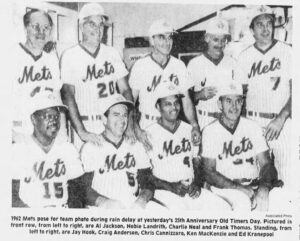 [7]Not that the Mets from 1962 through 1994 needed a milestone to bring back players from their past, and I don’t mean as Recdivist Mets. They used to hold Old Timers Day every year. Still, 1986’s loomed as distinct because of the quarter-century theme. The Mets were old enough to have a substantial history behind them, yet young enough so that almost everybody who constituted it was still around to honor it. A whole host of Original Mets were on hand. Al Jackson. Charlie Neal. Frank Thomas. Jay Hook. Craig Anderson. Chris Cannizzaro. Ken MacKenzie. Generations-spanning Ed Kranepool re-met his Met mentors. And first pick in the 1961 expansion draft Hobie Landrith [8] was there, presumably to ensure there’d be no passed balls. That, famously, was Casey Stengel’s reasoning for selecting a catcher before choosing anybody else when the existing National League teams exposed everybody they didn’t want to keep. But back at Shea a couple of dozen years later, Hobie stuck a pin in Stengel’s logic balloon:
“The Mets got me primarily for my defensive skills. but I had more passed balls when was with the Mets that one year that I did all my other years. Because in the Polo Grounds, they painted the Chesterfield sign on the scoreboard with this glossy green paint and I’d always lose the ball in that sign.”
The record shows the most passed balls charged to Landrith in any one season was 10, in 1956, when he was a Cub. And photos show that by 1962, Chesterfield’s advertisement of yore had been supplanted twice, first by Knickerbocker, as the Giants shifted their primary come-on from cigarettes to beer, then by Rheingold, the Mets’ first signature sponsor. Also, when Jay Horwitz transitioned from head of PR to alumni director in 2018, he got in touch with Landrith, who told Jay it was the first time anybody from the Mets the Mets had called him since they traded him to Baltimore for Marv Throneberry. Maybe Hobie’s invitation to 1986’s affair came by mail.
Old Timers Day in all their permutations aren’t cherished for the flawless accuracy of the participants. Sometimes their stories came closer than you’d suspect to real life. Tug McGraw, retired for two years as of 1986, remembered giving up “a grand slam single once” when he was a rookie. The hit in question was indeed a single and it did drive in four runs, but it wasn’t of the Robin Ventura ilk. A future Shea Stadium postseason icon did hit it, though: Donn Clendenon. And three Pirates were indeed on base for Clendenon. The Mets of 1965 weren’t much progressed beyond the Mets of 1962, so when Tug said “the ball had gone past about seven people,” which was why every runner in sight scored on a single, well, his recall 21 years after the fact wasn’t too far off when you read Jack Lang’s game story from the next day. Maybe not seven people, but there were two errors on the play. One of them was on McGraw.
“A lot of similar stories flowed around the Old Timers clubhouse, like draft beer at a stevedores convention,” Mike Celizic wrote in The Record of Hackensack. “They were told by pot-bellied men of middle age, most of them silver-haired and through bifocals. But for an hour, they stood on the green grass of Shea again, signing autographs in brand-new Mets pinstripes.”
On some level, that’s the attraction of every Old Timers or Alumni or Reunion congregation. This one’s attraction was that it attracted so many who made the Mets the Mets, whether they lost 120 games or were on their way to winning 108. “This is the reunion of reunions,” Bud Harrelson said. “It’s like dying in your own arms.” The 1962 Mets who were invited to don their specially made racing stripe unis were delighted for the opportunity to tell their tales to whoever would listen, especially each other. “I’m not saying being on the ’62 Mets was like being in a foxhole,” MacKenzie said, “but when we all get together, it’s like guys who spent a lot of time together in the same foxhole during a war.”
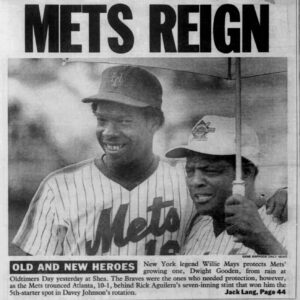 [9]Regardless of rank or decoration, every Met Old-Timer was treated as a returning hero. A couple of Met Old-Timers transcended the event but didn’t overwhelm it. Hall of Famer Willie Mays was there. Hall of Famer Duke Snider was there. They took the field in the company of Doc Gooden. The trio was introduced as “two Hall of Famers and a future Hall of Famer.” As with Landrith’s or McGraw’s memory, one applies a grain of salt to that script. It was a day to believe only the good in Metsdom. Keith Hernandez took in the backstory of the franchise he had joined just over three years before and grew reflective for (bearded [10]) Dan Castellano in the Star-Ledger:
“The 25th year means a lot to me. When a history of this club is remembered, I want this club to be remembered with the 1969 club. When I’m 50 and come back for Old Timers Day, it will be a prideful day.”
When Hernandez was 50, during the 2004 season, Old Timers Day was on hiatus, so good thing he made the lower-wattage 30th-anniversary gathering in 1992, one of the last the Mets held until they pulled out all the stops for the 60th in 2022 (nobody had to call Keith to make that one, as he was already up in the booth). The 25th, which got Keith thinking long-term, featured a plethora of ’69 and ’73 alumni, natch, but also Mets who might have slipped through the cracks of a less diligent organizing committee. Ron Hunt. Joe Torre. Roy McMillan. Bob Apodaca. Carl Willey. Everybody was introduced to a crowd that didn’t let pregame rain stop them from applauding. An Old Timers game was planned, but the field, notoriously slow to drain, was deemed a little too wet for the safety of the retired players. As was, Jerry Koosman slipped emerging from the dugout to tip his cap.
The field was deemed fine for the active roster of July 12, 1986, and those Mets stayed on their feet, using them to kick the rears of the visiting Braves for a second day in a row. Rick Aguilera [11] filled the nominal role of Sean Manaea, going seven strong innings. Aguilera (the only living member of the 1986 World Series roster not to make the 40th-anniversary reunion) had struggled most of the season to that point, and fifth starter represented a bit of a hole in the rotation. The start on Old Timers Day pointed Rick toward the consistency that quelled one of the last concerns Davey Johnson had about his pitching staff. If this outing wasn’t as heartwarming as 28-year-old Jack Weisenburger’s reaction [12] to coming up from Triple-A and throwing two innings of shutout relief in front of friends and family on Sunday…
“It’s a moment you dream of. When they told me I was coming to the big leagues, it didn’t hit me, and then I got here and I see my parents, my brother, and my wife — it’s the best thing to happen to me.”
…it was certainly something to feel good about. “That’s a shot in the arm for him and for us,” Davey said of Aggie.
Lenny Dykstra came closest to Bo Bichette’s 5-for-5 on 8/9/2026 by going 4-for-5 on 7/12/1986. Gary Carter and Darryl Strawberry each chipped in three hits, neither inspiring any of Atlanta’s four pitchers (none of them position players) to make contact with anything but New York’s bats. The Mets collected fifteen hits in all in Pittsburgh in their 11-1 win Sunday. The Mets collected fifteen hits in all at Shea in their 10-1 win that long-ago Saturday. Yeah, too bad this 2026 echo of 1986 wasn’t in the cards when the 1986 Mets were in town for their fortieth. Too bad little of 2026 has evoked 1986 other than the anniversary connection. This current team has been fun for almost a week. That lauded team has been fun for eternity.
Doing themselves proud was nothing new for the 1986 Mets by July 12 of that championship season. Those Mets raised their record to 33 games above .500 and stretched their lead in the NL East to 12½ games. They certainly did their predecessors proud, particularly the first batch.
Hook: “You look at this team now and they have super talent.”
Cannizzaro: “I knew sooner or later they would be this good.”
Landrith: “Player for player you take this roster and I don’t think there’s a team that can stack up against them.”
No inaccuracies there.