In the course of three starts in his second term as a Met, Robert Stock [1] has reminded me in some way, shape, or form of five different Met pitchers who came before him.
Rick Anderson, a 29-year-old career minor leaguer, was called up as a stopgap starter in June of 1986. Hard to believe the 1986 Mets had stopgap situations, but 162 games represents a long stretch. The Mets needed someone to take the ball for one night, and boy did Anderson — or “Uncle Andy” as his younger Tidewater teammates called him — take it. He gave the Mets seven strong innings versus the Phillies on June 10 at Shea, and was in line for a win until Jesse Orosco gave up the tying run in the eighth. The Mets lost in extras, and Anderson returned to the Tides. He’d be back later in the season, helping out around the edges en route to a championship, starting second games of doubleheaders and, deliciously, the September 18 hangover game that followed the raucous division-clincher the night before. I thought of Anderson vis-à-vis Stock on August 2 this year, because a) with zero expectations, Robert threw five innings of one-run ball versus the Marlins in a tough-luck loss; and b) this was the day after the 1986 Mets reunited at Citi Field for their 40th anniversary, an occasion for which the Mets gathered just about their entire World Series roster, but didn’t find seats for the so-called bit players, like Rick Anderson, whose 15 appearances and 2.72 ERA were as much a part of the official record as anybody else’s stats.
Don Schulze and Tom Edens were, technically, defending world champions in the summer of 1987. More accurately, they were enlisted to help defend the 1986 world championship earned by others, including Rick Anderson (since thrown into the trade to Kansas City that brought back David Cone). The Mets encountered all kinds of stopgap situations in ’87 when it came to starting pitching. Because the starts they yielded weren’t viewed as chances of a lifetime for some deserving busher, and because they kept coming around once the rotation developed hard-to-patch holes, there was little of a charming Uncle Andy nature to them. Still, the ball had to be taken, and it was up to men like Schulze and Edens to do the best they could with it. Schulze had knocked around the Midwest for several seasons, pitching to an 11-21 record as Cub and Indian. Edens was initially drafted by the Royals before the Mets exchanged brief third base solution Tucker Ashford for his services. Tom was spending his fourth year in the Met minors in 1987, the same organization keeping Schulze’s arm warm in case it was needed. Why would either of them have to be on call when the Mets had Gooden, Ojeda, Fernandez, Aguilera, Cone… What’s that? Each of those fellas is missing significant time? Here came Don Schulze to the major leagues, first pitching not badly at all, à la Stock’s start against the Marlins, then not that well, à la Stock’s second start against the Pirates on August 8. By the time Robert’s three-inning, eight-run outing at PNC Park was over, I was groping to remember Edens’s name along with Schulze’s. Tom’s two starts as a Met added up to eight innings in which sixteen hits and four walks needed to be navigated. The defending champions won neither game.
Gabriel Ynoa is the answer to a trivia question that nobody has ever asked: “Who was the Mets’ fifth starter down the stretch of their run to the Wild Card in 2016?” We got to the playoffs (all one game of them) that year on the strength of an array of unlikely contributors, but it was a surprising mélange of starting pitching that thrust us forward. Two All-Stars: Noah Syndergaard and Bartolo Colon. Two heretofore unheralded youngsters: Seth Lugo and Robert Gsellman. After that, it got tricky. A 1987-style epidemic of pitching shorts deprived the rotation of Jacob deGrom, Steven Matz, and Matt Harvey. Zack Wheeler was still recovering from the Tommy John surgery that kept him from being a part of the 2015 fun. Thus, twice in September, Terry Collins assigned pressure-packed, must-win starts to Ynoa, a rookie who’d made 25 starts for Las Vegas, but only six appearances, all in relief, for New York. The bulk of his work could not be described as eye-opening, but Gabriel was healthy and available, thus he was deemed a crunch time starter. In his first opportunity, Ynoa hung in as best he could, into the fifth inning of a 3-2 win over the Twins, throwing 76 pitches over four-and-two-thirds, striking out eight. I remember being disappointed at the length of the outing. This was at the tail end of conventional thought that a starter wasn’t doing the absolute minimum if he wasn’t going five. Little did I know that on this day, Collins was ahead of the quick-hook curve. When he tabbed Ynoa to try his hand five nights later, I was surprised again — just as I was when I realized the 2026 Mets didn’t send Stock down after he imploded in Pittsburgh. As was the case ten years before, the Mets simply didn’t have an immediate better option. That time, in 2016, the reliever-turned-starter pitched about as long as a reliever might, going two innings versus the Phillies and giving up one run, before giving way to five more penmen en route to a 10-5 Mets victory. Bah gawd, did Terry Collins just invent The Opener?!?!
Mike Birkbeck made one undistinguished (if lengthy) start in a Met season circling the drain, 1992: seven innings, seven runs, twelve hits in a 7-5 loss to the Braves. When he disappeared from the Shea scene ASAP, I figured I’d think of Birkbeck only when I meant to summon the memory of Tom Filer, another journeyman who made a single start as 1992 got worse and worse, in the vein of trying to remember which indistinguishable righty was which between Don Schulze and Tom Edens. Yet three years later, as the 1995 Mets sorted themselves out following the strike that left them groping for an identity, Mike was a Met again, landing in that select cohort of Mets Once Removed. Birkbeck, now 34, had signed with Atlanta prior to the 1993 season, but never rose above Richmond. He came back to the Mets free of major league affiliation between his removal and redonning of the orange and blue. It’s kind of like being a Recidivist Met — which Stock qualifies as, having started without distinction twice for the Mets in 2021 before seeking other if not necessarily greener pastures — but rarer. Rarer still is a journeyman righty the Mets give up on coming back and showing himself worthy of retention. Mike made four honest-to-goodness quality starts in May and June of 1995, compiling an ERA of 1.63. Those Mets didn’t seem to be going anywhere, but how about this guy honing his skills on our time, adding a little stability to our rotation, maybe serving as a mentor to those kids Pulsipher and Isringhausen who will be here soon? Birkbeck had other plans. He got an offer to pitch in Japan, and the Mets chose not to impede his yen to explore his international interest.
Robert Stock reminded a little of all these guys as he took the Citi Field mound to face the Nationals on Friday night. The one Met pitcher I didn’t think much about was Robert Stock. Just Robert Stock types. “Nobody,” Dr. Faye Miller told Don Draper when she pretty much instantly identified his inclinations on Mad Men, “wants to think they’re a type.” Stock is, in fact, an individual, with a story that’s all his own [2], but when you’re a longtime fan, unless you’re convinced you’ve uncovered a sui generis within the broader Metsian species, you’re satisfied to think in terms of types. He’s another Rick Anderson. He’s another Don Schulze. He’s another Tom Edens. He’s another Gabriel Ynoa. He’s another Mike Birkbeck. Maybe another Tom Filer.
Actually, he’s the only Robert Stock, and he’s our fifth starter. We do have some intriguing arms down on the farm, but none has been deemed table-ready at present. We’re not in a race, except maybe for fourth place if we use this weekend to pick up ground on the flailing Nationals; we’ve pulled to win 5½ back in case you’re not keeping track. At a moment when the entirety of our bullpen has been picked out of a hat, why not stick with a fifth starter for a third time around?
This is where it would be delightful to invoke the best of Anderson or Birkbeck, and tell you Stock went deep Friday. He did not. He pitched four-and-a-third innings, throwing 84 pitches. This is 2026, so I should probably get over measuring worth by distance. Robert went as far as he was allowed to go these days, and where he went, results followed. Only three hits, albeit with three walks. No earned runs, which is to say a Nat did cross the plate, but an error, committed by Francisco Lindor, was involved there. We’ll give Lindor a fielding pass since it was his hitting, via a sixth-inning homer, that tied the score at one. By then, Stock’s taming of the mysteriously dangerous Washington attack was the stuff of past tense. We’d moved on to Nate Lavender to finish the fifth, then Jonathan Pintaro to take care of the sixth. Pintaro protected the 2-1 lead that materialized when the Mets built a run on the heels of Lindor’s homer. Jonathan got us through the seventh. Jared Young bolstered us in bottom of that inning with a home run, then Bo Bichette delivered an additional ribbie. Pintaro handed the lead in the eighth to Daniel Duarte, who transferred it to closer Kodai Senga. We know he’s the closer both because he comes in to preserve ninth-inning leads and because he now has a whole A/V production trumpeting his entrance.
The contents of the bullpen hat had it. Our relievers shut down the Nats, with Senga telling their batters sans interpreter to beat it [3]. Our starter didn’t last long enough to earn the 4-1 W [4] over the team that wears a W (it went to Pintaro), but he didn’t pitch himself out of the Mets’ immediate plans as his type of historical comp tended to do. It doesn’t appear Robert Stock is quite that type.
Guys like this may not feel comfortable confined to the categories we create for them, but we need something to go on, so we go on the scouting reports and our desire that they be fulfilled. When we met the guy, we decide he answers to the description we use because it’s handy for us. We immediately project onto him and invest within him our hopes. Hope number one is he’ll hit home runs. Hope number two is he’ll hit home runs consistently.
Hope number three is he’ll get out of this slump, because the reality stemming from the second hope tends to overwhelm the promise inherent in the first hope. You learn every would-be Met slugger can hit a few home runs. You also learn few are the Mets sluggers who keep slugging without pause or professional growth. After a while, hope morphs into a Met tenure that may take its time defining itself.
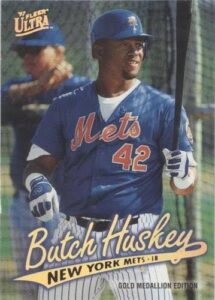 [6]After slugging 26 home runs for Single-A Columbia in 1991 and 25 for Double-A Binghamton two years later, Butch Huskey rose in our anticipatory consciousness, meaning Butch had the misfortune of becoming a gabbed-about Met prospect when we really needed our sons of Swoboda to shine. The last ounces of promise had been drained from the 1980s up-and-comer classes, when we just assumed the Met minor leagues would keep churning out stars. It’s how we got 1986. It’s how we kept going after 1986 to such an extent that we couldn’t believe there were no more 1986es imminent. By 1993, the organization a reputable business magazine flatteringly labeled the IBM of baseball had gone offline.
On September 8, 1993, Butch Huskey made his major league debut. The Mets had been dreadful for months. On this night, the Mets were no-hit by Darryl Kile. It wasn’t that different from most Mets games in 1993, except for the lack of token resistance to National League pitching. Still, not an auspicious entry for the 21-year-old we were prepared to pin hopes on. He struck out three times versus the Astro ace, then ten more times in 38 additional at-bats to finish his cup of coffee. He went back to the minors for most of the next two years, belting 28 homers at Triple-A Norfolk in ’95, enough to make his return to the bigs a bit of an event that August. The Mets had begun to feel exciting. Butch’s presence was intrinsic to the sense that we might have something here.
It took a while. It took a 1996 that wasn’t exciting as a whole. A few individuals had marvelous Met years. Butch Huskey wasn’t one of them. A hellacious Spring Training won him the right field job. An icy April lost it. An injury to incumbent Rico Brogna made Butch the first baseman. The hitting picked up. Come 1997, when John Olerud planted himself at first base, Butch was tried at the position he played (shakily) in the minors, third base. That didn’t work. It was back to right field, where the defense was adequate and the power began to show consistency. The Mets were on the rise at last. A lousy start begat a surge into the team’s first playoff chase in seven years. Butch powered it as much as anybody, clobbering 24 homers and driving in 86 runs. He was less consistent and less productive in 1998. That May, we got Mike Piazza, so we weren’t necessarily as focused on Butch Huskey as a primary power source.
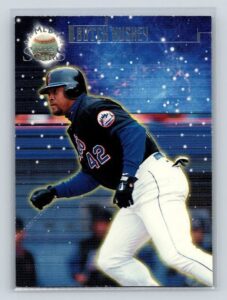 [7]Butch was as the forefront of what became the third successful era in Mets history, back when we had eras. He was here for the start of it, if not the heart of it. He didn’t last to 1999, so it would be easy to dismiss his contributions to building a contender. It would also be incorrect. Occasionally it’s mentioned with disbelief that Bobby Valentine’s Mets went to the World Series in 2000 with Benny Agbayani in left, Jay Payton in center, and Timo Perez in right. I had no problem believing it. I saw the Mets come within an eyelash of a Wild Card going down the stretch with Tony Phillips in left, Brian McRae in center, and a platoon of Lenny Harris and Butch Huskey in right. That team won 88 games, same as the Mets the year before. You should always remember the players who were making the inroads ahead of the next step up.
Sammy Stafura, the kid who grew up a huge Mets fan and then had his dream come true when he was acquired by the Mets in the Luke Weaver deal, was visited this week [8] by Max Goodman of nj.com in Coney Island and asked to name his all-favorite Met team. Not his all-time Mets team, but the player at each position he loved most. I don’t know to what extent Sammy’s answers reflect his deepest allegiances. He seemed a little put on the spot by the inquiry, but the Brooklyn Cyclone gave it his best shot. I loved his answers, not because they necessarily matched mine (understandable, as I’ve got 40 years of fandom on Sammy), but because when he got to third base, he said “J.D. Davis.” Not David Wright, the Captain, No. 5 in the rafters, the Met of Mets to all Millennials, but J.D. Davis, who had basically one good season as a Met, and then disappointed slowly and steadily until he was traded three years later. J.D. Davis’s one good Met year came while Sammy Stafura was in his Gen-Z adolescence. J.D. Davis made the impression, perhaps, that David Wright didn’t. That’s how it is when you’re a fan, whatever your age.
Somebody somewhere at some point named Butch Huskey as his favorite Met third baseman or first baseman or right fielder. That same somebody reserved the right to change the answer pending experience that introduced more favorites, but fandom doesn’t always ask to see stats. Fandom sometimes just knows.
Huskey wasn’t a capable third baseman. He acquitted himself all right at first base. He could handle right field. We just wanted him to hit. Sometimes he did. Once in a while his hitting met our expectations. Mostly, we were satisfied with Butch Huskey of the New York Mets. I know we got that.
With Butch Huskey’s sudden passing [9] at age 54 being announced Friday, a lot of Butch Huskey was bound to pass through a Mets fan’s head. The good. The less good. The slumps that sent grown adults scurrying to Dallas Green, then Bobby Valentine, to ask what they were going to do about Butch Huskey. The answers get lost to the mists of time. The good stays with you more than the less good. So does the 42 on Butch Huskey’s back, which was a mammoth deal in 1997, because MLB retired 42 leaguewide in honor of the 50th anniversary of Jackie Robinson breaking the color barrier. Bud Selig declared 42 raftersbound in midgame ceremonies at Shea Stadium. The commissioner specifically said Butch Huskey could keep wearing it. Huskey wore 42 for Robinson. It’s wonderful that baseball got around to recognizing Jackie as they did. It was just as wonderful we could recognize Jackie’s influence on Butch for as long as he was a Met.
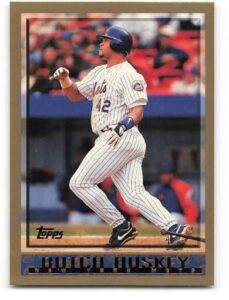 [10]Butch Huskey was that Met you waited for. That Met you were excited by. That Met you were a little let down by, pending the pitches he couldn’t get around on or the balls in the corner he couldn’t get to. That Met whose departure by trade you accepted as a fact of baseball life. That Met you all but stopped thinking about once he was in another uniform, because the Mets went on without him, and you went on with the Mets as you always did. It always matters who’s on the team and it always doesn’t matter who’s on the team. The Mets are on the team. If you did think about Butch Huskey while he played on with the Mariners, Red Sox, Twins, and Rockies, you wished him only good. When you realized he was retired, you’d occasionally hear about him in a Met context. He was at Mets Fantasy Camp or a Mets FanFest. Facts of baseball life could trade him from the Mets, but they couldn’t keep him from being a Met for the rest of his life. Some guys just pass through here. Some guys you’ll eventually decide are always Mets.
Somewhere down the road, once 42 was left to history, the name Butch Huskey would flit through your mind. You didn’t often remember being let down. You remembered being excited. You remembered the home runs. You remembered a certain essential Metsiness. The guys who embody that are the guys who stay with you for good.