Tuesday night at Citi Field was a game for icons. Dolly Parton’s music played to seemingly unanimous approval, one of those ballpark as public square moments that reminds a person that when something or somebody needs to be commemorated or celebrated — even if the subject isn’t baseball — a ballpark is the place to do it. Besides, anywhere Dolly’s voice pervades instantly turns into the Grand Ole Opry. The opening beats of “9 to 5 [1]” and why we were hearing them [2] a few minutes before the Mets took on the Brewers moved me to the edge of tears. I probably would have let them flow, except I chose to collect myself given the iconic occasion that drew me to the ballpark.
The Prince-Chasin Game was Tuesday night. It’s the hardiest of perennials [3] on our mutual calendar. Sixteen consecutive non-pandemic Augusts, always a Tuesday night. Stephanie and I join with Rob and Ryder Chasin, father and son, two Mets fans we know because the son invited us to his Bar Mitzvah [4] at Citi Field in the ballpark’s first offseason. He read some words I wrote, and even though none of them meshed concision and evocation like “tumble outta bed/and I stumble to the kitchen/pour myself a cup of ambition,” they formed the basis for a recurring RSVP.
There was that festive Saturday afternoon in November 2009; these sixteen August Tuesday nights from 2010 forward; the Tuesday night in August 2020 when we did our best to replicate the annual get-together ritual via Zoom; and a couple of handfuls of occasions of brief proximity mixed in. These are people we’ve known for seventeen years but have spent not quite thirty days with. No wonder that Bar Mitzvah seems like it was barely a month ago. Ryder is no longer 13. He’s literally going on 30. Funny how the years yawn and stretch and ultimately come to life.
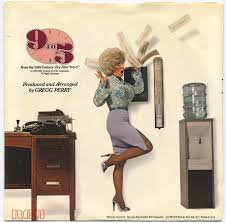 [5]Dolly’s critique of capitalism’s flaws wound down. “That’s a nice tribute,” Ryder said. If I tried to respond immediately, I would have incurred an ocular rain delay. I took my time before adding, “yes it is,” and awaited composure’s slight return.
The Prince-Chasin Game proceeded per precedent. Ryder and I caught up on baseball. Stephanie and Rob caught up on up all else. The Milwaukee Brewers didn’t catch up to what Zac Thornton [6] was throwing, not enough to make a dent in the scorecard Ryder was keeping. The Mets similarly failed to move the pencil productively versus Kyle Harrison The early innings were mostly me yapping and Ryder being his usual ideal audience for it. I noticed the Mets leaving the bases loaded and a couple of double plays killing rallies on each side. The Brewers nosed ahead in the fourth on a two-out single. Well, I thought, they do have the best record in baseball.
But do they have an icon? In their lineup every day? ’Cause we do, even if we needed a few reminders his iconhood tends to hide in plain sight. The first reminder, and the first reason Ryder’s pencil had to do some jaunty scorekeeping, came in the bottom of the fifth with one out, when Francisco Lindor [7] tied the game at one on his solo homer to left. The scoreboard noted Francisco had also just tied Dave Kingman for sixth-most on the all-time Mets home run chart. No. 6 may not be an iconic slot on such a list, but c’mon, this is Dave Kingman, the embodiment of Mets slugging for a generation. The fact that Sky King had been passed by five later-vintage Mets indicates his home run total (unlike the home runs that comprised it) wasn’t all that towering and his bifurcated Met tenure wasn’t all that lengthy. Parts of three seasons from 1975 to 1977. Three more seasons from 1981 to 1983, though his last few months of 1983 were limited to special guest at-bats once Keith Hernandez arrived to play first base and consign Kingman to both the bench and the past.
Nevertheless, Dave Kingman was home runs in a Mets uniform, and now his accumulation of 154 was matched by a Met who’s been here roughly as long and does so much more that it’s easy enough to forget that he’s also a premier slugger. He doesn’t look it, but his bat says different. The on-field similarities end there, what with Kingman having brought one awesome dimension and not much else to bear as a Met, and Lindor, at his best, deploying every tool you could ask for.
We’d ask for a couple more later.
In the sixth, Ryder and Rob got up to derive some use from their tickets’ built-in concessions credit. That’s the Mets’ concession that their product in the second half might need some added attractiveness. As Ryder noted when he and his dad explored the team store, “Nothing says ‘winning season’ like ‘new Mets clearance section.’” I was asked to “babysit the book” for an inning. I get approximately one inning a year with the short pencil. I’d almost forgotten what to do with it. Started filling in boxes from the inning before. No eraser, so just a crossout that made it look like a raccoon invaded the page. The top of the sixth gave me a DP to find a box for, which was fun, if inartful. The bottom of the sixth let me scrawl “HR” for Luis Robert, Jr. [8] before I remembered there’s lines to be traced and diamonds to be darkened, even if there is go-ahead excitement to be expressed. Also, the Brewers had changed pitchers, something I forgot to write down for at least three batters. If this is how I babysit, don’t leave your kids with me.
Thornton went six, giving up only the one run. He will not be in the Mets’ clearance section anytime soon. Nate Lavender [9] continued to beguile batters in the seventh and eighth. The 2-1 lead he protected figured to set up our closer Kodai Senga, except the only Kodai sighting we’d be treated to Tuesday came pregame when he took part in congratulating the Mets customer service award winners for the month (“please make some noise for the sales associate who changed the price tags on our stack of Freddy Peralta shirseys…”). Instead, the evening’s save opportunity was bestowed on Peter Principle [10], a reliever who’s reliable when it’s not the ninth inning and there’s not a one-run lead. Principle, wearing Austin Warren [11]’s uniform, had command issues and gave up the lead. He was replaced by that avatar of placidity and stability, Jefry Yan [12]. Yan has a new signature move: throwing the ball and hoping the team icon makes the play of the year once the ball is hit.
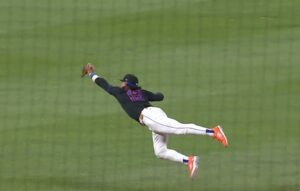
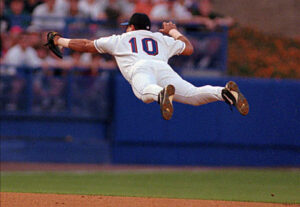 [13]Yan knows what he’s doing. The two-out bases-loaded liner he gave up to David Hamilton, so clearly ticketed for left field that it, too, had a concessions credit embedded in it, had the misfortune of meeting the glove attached to the diving shortstop, who could have been mistaken in the moment for Rey Ordoñez. Except we knew it wasn’t Ordoñez, because innings earlier, this shortstop had tied Dave Kingman for sixth place on the Mets’ all-time home run chart. Not many Mets who stuck around as long as Rey hit as few home runs as he did. Only six Mets have hit as many home runs as Francisco has. Hardly any Mets shortstop makes the kind of play Lindor did to save Yan’s and our respective bacon. There was Rey-O, now there was Fran-L. (Sorry if you didn’t see it on SNY [14].)
 [15]
[15]
In the bottom of the ninth, Lindor prepared to extend his iconography to manufacturing the winning run the way another icon of the Met shortstop pantheon, Jose Reyes, might have. Lindor beat out an infield hit. There were two out, but Bo Bichette [16] was up, and he was certainly capable of the kind of hit that Francisco could score on, provided Francisco had a big enough lead. Sitting in Field Level in short right field, I could see what Francisco was thinking. Everybody could see what Francisco was thinking, including the Brewers. Trevor Megill picked Lindor off first.
Nobody ever suggested icons who aren’t Dolly Parton are perfect. Lindor’s been in the Met GOAT conversation when he’s been at his peak and he’s been many fans’ idea of a goat in the Bill Gallo sense when he’s flailed. When he’s going well, I’m in his amen corner, which generates a sound a lot like “My Girl”. When’s he’s not, I start to calculate how long a contract that runs through 2031 really is. I didn’t believe the scuttlebutt that he was a serious trade candidate this summer. But I didn’t rule it out as a concept. In a year when much has been put on remainder, it’s been hard to value what has remained mostly stellar — if not exactly steady — for six going on eleven seasons.
The Manfredian thing was Lindor didn’t have to get a lead off first in the ninth to get to second. He’d be on second to start the home tenth. After Jonathan Pintaro [17], a.k.a. the Jared Young of the bullpen, did his understated best to keep the game tied, Francisco indeed made it to second for Bichette’s next attempt to drive him in. Leading off, Bo flied out. Carson Benge [18], who rated three lines distributed in three boxes for three singles on Ryder’s scorecard, was intentionally walked. Megill didn’t intend to do the same with Robert, but another base on balls materialized, and Luis took first, sending Lindor to third and Benge to second. The bases were loaded for Christopher Morel [19], whose entrance into the game I missed while Stephanie and I were using our own use-it-or-lose-it concessions credit in the eighth. The Citi Field lists OPS as its primary lineup stat. I glanced up and saw Morel’s might as well be Jorge Polanco’s. I winced. I winced again when Morel grounded to third. I stopped wincing when I realized contact is contact, and the ball that was being thrown home was sailing wide of the plate. The enduringly iconic Lindor scored the winning run of a most gratifying [20] extra-inning Met victory over the team with the best record in baseball.
The four of us among the Princes and Chasins high-fived one another immediately. We don’t get to do that every August when a game ends. A few minutes later, we exchanged goodbye hugs. That we do every twelve months. Nine or ten innings with the Chasins always fills our emotional scorecard. And winning 3 to 2? What a way to leave the ballpark.