On Saturday afternoon, Nolan McLean [1] was pretty darn beautiful, with an array of hitters and fielders supporting him in his attractiveness. Nolan went seven, giving up just a first-inning run. Juan Soto [2] returned with a big RBI single. Jared Young [3] — the Jonathan Pintaro or perhaps Daniel Duarte of the starting lineup — quietly chipped in run-scoring hits. Francisco Alvarez [4] put his slump on hiatus for insurance purposes. A.J. Ewing [5] caught a long fly ball at the wall, something Astros outfielders couldn’t pull off with ease. All told, it was a nice day for a 6-2 win [6] over Houston at Citi Field.
Saturday’s game was the fifth-ever 6-2 win the Mets have ever pinned on the Astros, including one we won when the Astros were the Colt .45s. We hadn’t beaten them by a score of 6-2 since 2007. Taking care of Houston routinely and handily is hardly a standard occurrence through Met lore. The games that stand out go 16 or 24 innings or have Gil Hodges removing Cleon Jones. Friday night’s game, on the other hand, felt more like what a Mets-Astros game tends to be.
When the 61-75 Mets lost to the 68-68 Astros on Friday night [7] by a score of 3-1, I experienced a sense of what might be called déjà vague. A 3-1 loss feels like the official result of Mets-Astros games from all those years the Mets and Astros were National League rivals, the way Warren C. Giles intended them to be when the Astros were the Colt .45s. A 3-1 loss implies our starter pitched well, but theirs pitched better, and our offense napped. That would apply to a Mets-Anybody game. It definitely has that Mets-Astros feel.
According to Baseball-Reference’s Stathead tool (if you can swing a subscription, it is a wondrous research resource [8]), Friday night’s 3-1 Mets loss to the Astros was the seventeenth in franchise regular-season history. I would have guessed millionth. Appropriately, the first of them occurred in 1968, The Year of the Pitcher, also on a Friday night, also in Flushing. Larry Dierker and Tom Seaver were the starters. Neither of them, a year from becoming twenty-game winners, was involved in the decision. Seaver went ten and struck out ten. The Mets left eleven on base, which sounds like the sort of thing a team might do in the course of losing, 3-1. The game went twelve and was decided by a Bob Aspromonte two-run double that drove home Rusty Staub and Lee Thomas. Aspromonte and Staub were future Mets. Thomas was a future Phillies GM, the executive who engineered the Lenny Dykstra trade twenty-one years later. Few would unironically refer to it as the Juan Samuel trade. The Mets’ one run that warm August night came courtesy of J.C. Martin’s first home run of the season, his first as a Met. He liked the sensation so much, he hit another later in that series, a set in which the Mets dropped three of four. The Mets lost ten of eighteen to the Astros in 1968, but were successful enough against other opponents to finish ahead of Houston for the first time in the clubs’ shared seven-year history. The ninth-place Mets ended the season 73-89, the tenth-place Astros landed in the cellar at 72-90.
When 1968 was over, the Mets’ all-time record was 394-737, leaving them 343 games below .500. When Friday night’s 3-1 loss at Citi Field was over, the Mets’ all-time record sat at 4,959-5,302, leaving them 343 games below .500, which is to say that these past 58 seasons of Mets baseball have boiled down to a win-one/lose-one proposition 4,565 times over. Thus, if you woke up this Saturday feeling like you and the Mets have been standing still, alternating the spiritual equivalent of 3-1 losses to the Astros with something better since April 8, 1969, you were essentially correct.
 [9]
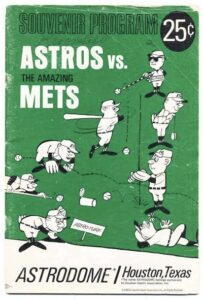
[9]A little teasing, one expansion brother to another.
But the Mets haven’t lost thousands of 3-1 games to the Astros, never mind a million. Only that one on August 16, 1968, and sixteen others. The next one, in April of 1971, was another Dierker-Seaver matchup, this time at the Astrodome. Dierker got the win. Both men pitched complete games. Tom was nicked for two RBI singles in the first and a leadoff homer in the third from his future teammate Joe Morgan. Had we’d been told in 1971 that Tom Seaver and Joe Morgan would someday be teammates, we’d have been elated that the Mets were going to get Joe Morgan.
The next 3-1 loss to the Astros came in April of 1976. Larry Dierker was still an Astro. Tom Seaver was still a Met. Joe Morgan was a Red. None among them was involved here as Mike Cosgrove outlasted Jerry Koosman. A 1-1 tie came unknotted in the bottom of the seventh in Houston, when Kooz walked Enos Cabell and gave up a two-run homer to Cesar Cedeño, whose true future Met notoriety would wait nine years for the stretch drive when he was a Cardinal filling in for Jack Clark and settling what had been a scoreless duel between Doc Gooden and John Tudor. Cedeño hit a tenth-inning home run off Jesse Orosco at Shea, which at the moment of impact positioned the Cardinals to move into a first-place tie with the Mets once Tudor went out for the tenth and completed his three-hit 1-0 shutout. Gooden’s mistake was going a mere nine. Back in 1976, Koosman went six against the ’Stros in his first loss of the season. He’d recover and win 21 games. The next Met to win at least that many was Gooden, with 24 in ’85.
Maybe the reason I’m convinced Mets history is littered with 3-1 losses to the Astros is 1979, which, in fact, was littered with 3-1 losses to the Astros. Not one, not two, but three times that year the Mets lost, 3-1, to the Astros. The Mets lost 99 games that year, so maybe one thirty-third of all defeats coming to the same opponent by the same score doesn’t qualify as “littered,” but a year with 99 losses certainly evokes the concept of trash. For the record, Joaquin Andujar — a 1985 teammate of Cedeno’s with St. Louis — defeated Andy Hassler on June 19 under the Dome; J.R. Richard toyed with Met batters and overshadowed the best efforts of Kevin Kobel on August 22 at Shea; and Richard provided an encore with another complete game victory on September 1 in Houston. Richard was on his way to superstardom in 1980, the apogee of a career that came to a sudden halt when a blood clot caused him to physically collapse, after which he never pitched in the majors again.
Heading into the game of July 16, 1983, at the Astrodome, the Danny Heep Trade was practically a steal for the Mets. The erstwhile Astro had held down right field with distinction until Darryl Strawberry was deemed ready to be summoned from Tidewater, then refashioned himself as a power-hitting specialist off the bench with one pinch-homer per month since the night of Darryl’s promotion. All we had to give up to obtain this very valuable piece from Houston was a pitcher who had never lived up to his talent in New York, a righty named Mike Scott. Not that the Mets couldn’t use pitching in 1983, but our minor league pipeline was filled with it. Walt Terrell. Scott Holman. Ron Darling. That Gooden kid at Lynchburg. So let Scott go to Houston. Let him beat Mike Torrez, 3-1. And let him strike out Danny Heep as a pinch-hitter in the eighth, even. No symbolism there.
Despite Scott earning MVP honors in the 1986 NLCS against Heep’s Mets (when one of Scott’s two wins was by a score of, yup, 3-1), we know that playoff had a happy ending. As the Mets went about the rest of their 1980s business as a perennial contender, they avoided 3-1 regular-season losses to the Astros. That wore off in 1992, when two 3-1 losses to the Astros transpired within an eight-day span. One was recently referenced here [10], the July 4 doubleheader nightcap at Shea in which stopgap starter Tom Filer gave it his all (7 IP, 5 H, 2 BB, 1 ER), only to leave with a no-decision. The loss would go to Anthony Young, who allowed single runs in the eighth and ninth. That made nine consecutive defeats for the starter turned reliever. There’d be a little too much of that over AY’s next eighteen decisions. On July 12, the wrong side of 3-1 landed in the lap of Sid Fernandez, who produced a line at the Astrodome that was a tad reminiscent of those days when he was still getting his act together: six innings, four walks, three runs. El Sid, a Shea stalwart since 1984, had one more year as a Met left. Though it’s a little cognitively dissonant to associate Fernandez with teammates like Anthony Young and Tom Filer, Sid — whose entire Met career is usually boiled down to one (very clutch) middle relief performance — was a long-timer. He, Hojo, and Doc were the last three of the World Champion 1986 Mets still at it in orange and blue during the 1979-like season of 1993, a year when the NL East was won by their former compadre Lenny Dykstra and the Philadelphia Phillies molded by foresightful Lee Thomas.
Some good news: The Mets played the Astros, and Mike Hampton got the 3-1 win. Some bad news: this didn’t happen in 2000, the only season Hampton was our bulldog of a lefty. It was August 12, 1995, at the Astrodome. The losing pitcher, Dave Mlicki, gave us great news on the night of June 16, 1997, at a different road venue, Yankee Stadium. In Houston, he went six and gave up three runs. Just as Hampton the then-Astro was a future Met, Mlicki the then-Met was a future Astro, pitching for them in 2001 and 2002, at which time his name was Subway Series gold in our collective memory.
On July 12, 1996, at Shea Stadium, Shane Reynolds defeated Bobby Jones, 3-1. It may not have been the Macarena, but from a Met perspective, that sounds like the most 1996 thing imaginable. The Mets lost 91 times in 1996. The whole year (save for those 41 Todd Hundley homers and 21 Lance Johnson triples) was one long 3-1 loss to Shane Reynolds. Noteworthy from a future-leaning perspective, Billy Wagner notched the third save of his career. None yet for the Mets.
 [11]
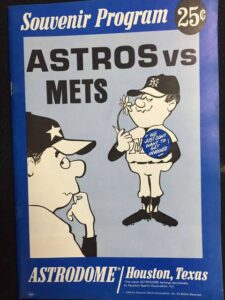
[11]Met involvement was more full-throated on Saturday than Friday.
Entering play on May 4, 2002, the reconstructed Mets were living up to Steve Phillips’s dreams. They were 18-11 and in first place in the NL East, tied with the defending world champion Diamondbacks for best record in the entire league. The Diamondbacks had won the World Series the November before by overturning the Yankees’ apple cart in the ninth inning of the seventh game. That doesn’t have much to do with the Mets-Astros contest at Minute Maid Park on May 4, but I always smile thinking about how the 2001 World Series ended. I don’t generally smile at any thought of the 2002 Mets. May 4’s 3-1 loss — Carlos Hernandez out pitching Jeff D’Amico, with Billy Wagner notching his 150th career save (and Octavio Dotel grabbing the hold) — was the epitome of, “It was all downhill from there.” The 2002 Mets, having just begun the six-game losing streak that would knock them out of first place, would never be as many as seven games over .500 again.
Yet on August 1, the 2002 Mets were still sort of, kind of a Wild Card contender, having risen from some midsummer doldrums to 55-51, a mere 4½ games behind the Dodgers for the senior circuit’s sole bonus berth. If the Mets could get hot…they wouldn’t. A 3-1 loss to the Astros, this time at Shea, signaled another death knell. The Mets completed their appointed 2002 rounds by going 20-35 and finishing last for the first time in nine years. Roy Oswalt got the win. Pedro Astacio took the loss. Yet another save for Billy Wagner.
Ten years later, the Mets had lived a lifetime inside a decade’s time. The dreadfulness of ’02 gave way to the pits of ’03. A glint of sunlight was eclipsed by another miserable crash in ’04. Everything was overhauled for ’05, and the Mets grew respectable en route to becoming a Billy Wagner-aided powerhouse in ’06, which they stayed for as long as they could in ’07, which wasn’t long enough. One feisty, ultimately disappointing year followed in ’08. Then they tore Shea down, opened up Citi, and the team got the collapsing out of the way early. Went nowhere but down in ’09. Bounced back marginally but to no great effect in ’10. Twenty Eleven shuffled personnel, but the sub-.500 path remained sticky. This brought us to August 24, 2012, when the Mets were their typically lousy second-half selves, grinding us down with a 57-69 record. Yet compared to their opponents, the Houston Astros, our Mets were elite. The Astros had endured their own long and winding road since 2002. They’d been to a World Series. They contended annually. Then they fell into disrepair, somewhat intentionally. Their tanking was underway in earnest. After beating the Mets, 3-1, at Citi Field, Houston improved to 40-86. Their leadoff hitter that Friday night was Jose Altuve, the one hint that their tanking was leading somewhere.
Before Houston would rise anew, they’d switch leagues. We’d experienced that once in our lives, when the Milwaukee Brewers shifted from the AL to the NL in 1998. It was weird at first. It’s still a little weird, though mostly when the Brew Crew trots out Robin Yount during the National League playoffs to urge the current team on. Yount predated Interleague play and only saw the inside of an NL ballpark during All-Star Games and the 1982 World Series. The important thing, I suppose, is the Brewers are in the National League playoffs a lot. (I wonder if we can hire one of their sharp-as-a-tack executives.) And the Astros, who orbited out of our circuit in 2013, now feel like an AL team, except when they invite Jeff Bagwell and Craig Biggio to inspire contemporary postseason success. Like old Brewers icons, they have that opportunity a lot. In 2014, Astro postseason success was still a pipe dream. Houston came to Queens on the final weekend of that year, looking not as awful as they’d been in the early 2010s. Their final record was 70-92, nowhere close to good, but a perceptible step up from the triple-digit losing they’d recently made a habit of. They also showed the Mets they could still beat them like they used to in the NL, 3-1. Altuve raised his AL-leading batting average to .342 that late-September Friday night. His teammates included 2020 Met Jake Marisnick and 2021 Met Jonathan Villar. Batting cleanup for them was Dexter Fowler, who thirteen months hence, would take called strike three to end Game Four of the NLCS, sending the New York Mets to the 2015 World Series. We didn’t appear on our way anywhere at the end of 2014, either, but teams have a way of getting good when you least expect it.
 [12]
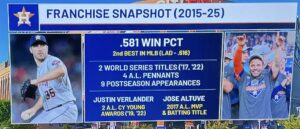
[12]Tanking seemed to work for them.
Teams also have a way of getting bad when you least expect it. The 1992 and 2002 Mets have already proven that in this extremely specific retrospective. When the 2025 season began, the Mets carried high expectations by the bushel. They had just signed Juan Soto in the offseason that followed a surprise run to the 2024 NLCS. No wonder we were stoked to commence 2025 action wherever it took place. It happened to be at Daikin Park, the former Minute Maid Park (itself the former Enron Field, a name that didn’t go down as smooth as Minute Maid). The Mets and the Astros lifted the lid on what we considered a very promising campaign with a very familiar score: Astros 3 Mets 1. Soto got a hit in his Met debut. Framber Valdez gave up no runs in seven innings. Clay Holmes, suddenly a starter after years of relieving, took the Opening Day loss. Josh Hader notched the first save of the new season. The 2025 Mets shook off the misstep and eventually built the best record in all of baseball. Then they stopped doing that. Holmes became a pretty good starter. Soto put up very good numbers. Otherwise, the expectations blew out of the bushel over the year’s final three-and-a-half months.
It’s the tail end of August 2026. Holmes has been traded to the Cubs, and is doing very well for a playoff-bound team. Soto just came off the IL. Hader just got another save, again for the Astros, again against the Mets, again to close out a 3-1 win for them over us. Our starter pitched well, but theirs pitched better, and our offense napped. The principal dancers in this iteration of eternity’s foxtrot of frustration were Hunter Brown, looking real good, and Christian Scott [13], looking not quite the finished product. Of course Scott’s not finished. He’s on a long comeback trail from Tommy John surgery amid his third major league season segment, which one tends to forget when his polish is more in evidence. Christian is 27, but seems younger. We like youth in years whose competitive aspirations have been reduced to maybe not finishing last. Friday night’s 3-1 loss left the Mets two games behind the Nationals for fourth place. The Mets have avoided sole possession of fifth for the past 23 years. That was rarely the goal. I don’t know if it’s the goal right now, but it’s something. The Astros are in first place in the AL West with not a great record, but some years your fortune is less about a great record than the misfortune of others in your division. The AL West race, pokey as it is, shouldn’t be on our radar unless we choose to seek it out, but we live in a world full of Interleague play these days, days when our fellow National League expansion baby from 1962 is a sibling once removed.
We also still live in a world of the Astros beating the Mets, 3-1. We probably always will to some extent. Seventeen times it’s happened, though, not a million, no matter what it can feel like when your team has fallen to 60-75. Good thing there’s usually a next day and a chance to climb to 61-75.