Sunday we turned back time, logistically one hour, mentally about 57 years and a couple of weeks. When we heard that Jerry Koosman had passed away at the age of 83 [1], we instinctively wound our ballological clocks to October 16, 1969, a Thursday afternoon, and a final pitch. Koosman threw it. Davey Johnson hit it. Cleon Jones caught it. Jerry Grote caught Koosman in mid-leap, with Ed Charles rushing from third to make it the most scrumptious of scrums. The Mets were world champions. It’s not like we as Mets fans haven’t closed our eyes and traveled back to that moment before.
It’s hardly trivia that Jerry Koosman [2] was on the mound when the Mets won their first World Series. Kooz would have been the ace of that rotation had the role not already been filled handsomely by Tom Seaver. Of course when Jerry Koosman pitched in October, there was no other guy you wanted out there more, no other guy you could have more confidence in, truly no other guy who the record shows made sure his team couldn’t be beat. He did OK in other months, too.
Jerry Koosman’s time of year was the fall. He loved that cool weather. Opposing hitters must have hated how comfortable he felt as the temperatures dipped. His teammates buttoned their warmup jackets and enjoyed feeling comfy cozy behind him. Kooz was gonna take care of the other team, one way (getting them out) or the other (getting them off the plate). The Mets were gonna win, too. Kooz started four World Series games and two NLCS contests as a Met. The Mets went 6-0 in those October dates. His time of year, his kind of climate. Or as highlight film narrator Curt Gowdy described the “New York weather report” in the immediate aftermath of Jerry Koosman’s final pitch of 1969, “cloudy, with falling confetti.”
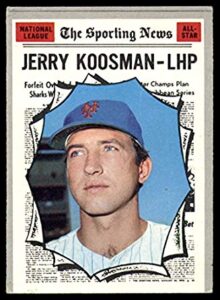 [3]We enjoyed many sunny days with Jerry Koosman on the mound from 1967 to 1978. It took him about a season to establish himself as the best lefty the Mets ever featured, and nearly six decades since his hellacious rookie season, he retains that title as well as his rock-solid spot fronting our franchise’s Mount Pitchmore. Tom Seaver and Jerry Koosman emerged as stars in successive seasons, ’67 and ’68. Then they led the charge to take over baseball in ’69, a mission completed when they squelched the heavily favored Orioles in back-to-back games to close out the Fall Classic.
Seaver’s greatness continued obvious and unabated into the 1970s. Koosman’s could be a little stealthier: not enough offense on his behalf, a couple of injuries derailing his prime, detours to the bullpen even. But he was resilient, coming on as strong down the stretch in ’73 as he did in ’69, and peaking personally with a 21-win campaign in 1976. The Mets would shortly thereafter go down the tubes, trying to drag Koosman with them, saddling him with won-lost records unbecoming of someone who consistently pitched well enough to win. Eventually, he took his talents elsewhere, flourishing for his home state Twins (another 20-victory season in ’79) and persevering later for the White Sox and Phillies. The man was a horse, pitching nineteen years in the major leagues, completing 140 starts and posting wins on 222 occasions. Throw in the not incidental October outings, and his was a Hall of Fame-caliber career, even if he is not in the Hall of Fame.
The Mets did right by their top lefty, inducting him into their Hall in 1989 and retiring his number, 36, in 2021. His teammates attested, over and over, to how much he meant to them. Kooz was the one who’d brush back whoever needed brushing back. Kooz was the one to get you where you needed. Kooz, as well, was everybody’s idea of a sweetheart off the mound. We who rooted for him could feel it when we watched him. This guy was ours for a generation, then an eternity.
We turned the clock back on Sunday. We wanted to see Jerry Koosman pitch again. We closed our eyes and watched him nail down the World Series. It is a sight to behold every time.