The blog for Mets fans
who like to read
ABOUT US

Faith and Fear in Flushing made its debut on Feb. 16, 2005, the brainchild of two longtime friends and lifelong Met fans.
Greg Prince discovered the Mets when he was 6, during the magical summer of 1969. He is a Long Island-based writer, editor and communications consultant. Contact him here.
Jason Fry is a Brooklyn writer whose first memories include his mom leaping up and down cheering for Rusty Staub. Check out his other writing here.
Got something to say? Leave a comment, or email us at faithandfear@gmail.com. (Sorry, but we have no interest in ads, sponsored content or guest posts.)
Need our RSS feed? It's here.
Visit our Facebook page, or drop by the personal pages for Greg and Jason.
Or follow us on Twitter: Here's Greg, and here's Jason.
|
by Greg Prince on 7 January 2014 4:08 am A warm if non-baseball observation to pass along in the midst of a brutal cold snap: the Nets belong in Brooklyn. I confirmed it Saturday night.
It was my second trip to Barclays Center. Last season’s was for novelty’s sake. This one was more for basketball. I’m pleased to report that no matter the cynical aspects attached to relocating a professional sports franchise in the midst of a planned real estate development, the Nets being plopped onto the O’Malley-lusted intersection of Flatbush and Atlantic feels right from a sports fandom perspective. I don’t know that it will work ultimately for the citizenry of the neighborhood or provide a platform to make the Nets legitimate title contenders, but I decided I like having them there.
I especially like my romantic notion that the Nets sort of came home to me when they moved to Brooklyn from New Jersey. I grew up with them in Uniondale until they vamoosed. I’d vaguely missed them all these years being in some inconvenient state, never mind the altogether wrong Basketball Association. Now they’re a train ride away.
When I told my sister of our plans to catch the Nets and Cavaliers in Brooklyn, she asked, very seriously, if it was safe. I wasn’t surprised. For a generation of Long Islanders raised on tales of how lucky they were to have been moved out of their ancestral borough, it was a reflexive response. My parents loved Brooklyn in the rearview mirror, but except for visits to relatives or doctors, they wanted no part of it in real time when we were kids.
In certain precincts of my family, it will always be 1957 when it comes to broaching Brooklyn. The Dodgers will always be going one way and we’ll always be going the other way, neither party having any desire to stick around. For me, “the Brooklyn train” was always the one you didn’t want to be on out of Long Beach, because it meant changing at Jamaica if I was going to Manhattan…and where else would I be going? Now, with the Nets at the other end of the ride, I embrace the Brooklyn train. It takes me to my basketball team. The hop across the platform, coming and going, is a small logistical surcharge to pay.
Barclays Center is wonderfully gleamy in that simultaneously gorgeous yet offputting way contemporary sports palaces insist on greeting you. You can’t escalate to the not-so-cheap seats without passing the amenity-laden levels. I didn’t come for amenities, but I don’t care for having them fill my peripheral vision, reminding me that tonight they’re not accessible to me. More importantly, the sightlines are swell. I have no problem following the bouncing ball.
Like Citi Field, Barclays has plenty to sell you to eat, and based on my first visit last February, the grub is just as good (and just as expensive). But Barclays, unlike Citi, is in the middle of somewhere, so Saturday night, Stephanie and I braved the slush as well as our unfamiliarity with the area to enjoy dinner as people who aren’t necessarily sports fans do an hour-and-a-half before a game — in a restaurant.
I liked that a great deal. I’ve done it in other cities before baseball games. We used to do it that way en route to seeing the Liberty at the Garden during our passionate WNBA phase, though we’d usually settled for the Ranch 1 on 28th Street. Saturday night we walked 10 or so minutes into Park Slope for miso soup, sushi and sashimi. Then we walked 10 minutes back to Barclays. It reminded me of Bob Hartley and Cliff Murdock reminiscing about that place they used to go for burgers and beers before Loyola games on The Bob Newhart Show. It put me in mind, too, of the stories old-timers told about meeting at the Nedick’s by the old Garden on Eighth Avenue between 49th and 50th. It made me think of G.O. Cards getting a high school kid like Long Beach’s own Larry Brown into Knicks games before anybody knew what the NBA was exactly. It made me think of my dad going there for college doubleheaders when he was at NYU and the Violets played big-time basketball.
The Nets and Cavs were 45 minutes or more from tipping off and I was thinking great basketball thoughts, maybe even some that actually happened.
Basketball and I used to be real close. I mean we were like best friends when we were kids. Then basketball and I went our separate ways. It’s a little awkward when we cross paths nowadays. We usually act as if we’re strangers with no shared history whatsoever. Once in a great while, though, I can get together with basketball and find we’re still capable of hitting it off as if the intervening decades hadn’t changed a thing.
That was me and basketball Saturday night, the only Saturday night home game all year on the Nets’ schedule. Too bad. To my mind, so informed at the age of six, basketball games should be played at home on Saturday night. First game of any kind I ever went to was the Knicks on a Saturday night late in 1969 when my parents had season tickets and the Knicks were owning the league. I loved the Knicks like I loved the Mets in 1969. I loved the Knicks of that era so much that I could never keep loving them once that era was over. I know people who’ve treated post-glory Mets teams that way, failing to embrace those who came after Carter and Hernandez and Strawberry and so on. I could never drift from the Mets just because they weren’t populated by great players anymore, but in a nutshell, that’s how I was with the Knicks once Willis Reed began the inevitable parade of championship retirements. There’ve been attempts at rapprochement between us over the decades, but relations between the Knicks and me are best described as estranged.
Yet I will always cherish what Saturday night at the Garden meant when I was six and seven. Saturday night at the Garden in 1969-70 was the epitome of sports and class. I got it immediately. I learned to applaud passes and appreciate picks and shout “CHARGE!” and chant “DEE-FENSE!” I can still hear John Condon’s voice announce who just scored and who was just fouled.
Saturday night at Barclays Center in 2013-14 — when the canned music never lets up and everything is a sponsorship opportunity — offered no more than a shadow of those formative evenings when I figured out how much fun it was being an informed fan, but a shadow is better than a void, just as Brooklyn is better than Newark, East Rutherford or Piscataway for my Nets needs.
It wasn’t an amazing game (the Nets won) and it wasn’t an amazing crowd (our section’s loudmouth bemoaned the failure of his “DEE-FENSE” to catch fire), but it felt right, just as getting off a train in Brooklyn did, just as dining casually near the arena did, just as sensing a fast break coalesce did. When you watch the NBA on TV, you get the idea that the only fans who exist are the amenity-catered VIPs on celebrity row. Up in the balcony, as it were, you’re reassured to know you’re among people who care enough to shout when your team doesn’t have the ball.
Y’know what else felt good? The train back to Jamaica. Most of us boarding at Atlantic Terminal had been to the game. We were couples on dates; families of four; a mother chaperoning a handful of children; a father and a son; bunches of buddies. Especially buddies. Buddies going to a basketball game in Brooklyn, now buddies coming home from a basketball game in Brooklyn…going home to Long Island. Basketball talk. Barclays Center talk. Talk about what’s out the window or what’s planned for tomorrow. The Nets aren’t good enough to be fashionable, but many of us had bought in. There were expensive Nets jackets and Nets caps purchased at Modell’s and underneath my parka I was wearing a Nets hoodie I ordered from Nets.com when it was discounted for Black Friday. The text certified the team that had relentlessly branded itself Brooklyn in 2012 was founded in 1967, which was absolutely true if you followed the ABA trail clear back to the Teaneck Armory before it wound through an array of stations you could imagine called out by an LIRR conductor near you: Commack Arena, the Island Garden, the Nassau Coliseum, the Rutgers Athletic Center, the Brendan Byrne Arena, the Prudential Center and Barclays Center.
Last stop, Barclays Center.
I wanted that hoodie because it commemorated my idealized good old Nets days, no matter that red, white and blue had turned black and white. I wear it as much as I do because I’m hoping to see some reasonably good new Nets days. Or just a few more Saturday night games over the next few winters.
Maybe there was a soul in the Long Island-bound crowd who was such an enormous Nets fan that he would have sought out the action in New Jersey on a Saturday night like this, but I’m guessing no. Or conceivably a Nets franchise that had stuck it out off Hempstead Turnpike post-1977 could’ve cultivated a rabid basketball following in Nassau and Suffolk, yet if two beautiful ABA championships won on the wings of Dr. J didn’t tangibly raise the roundball temperature on the Island, then probably not, either. Professional basketball, at least in these parts, seems to require being surrounded by something other than parking lots and parkways.
This, I determined Saturday night, was the way to go. The Brooklyn train. The Brooklyn Nets. Our team. My team for those occasions when I would decide to reacquaint myself with my long, lost childhood buddy. Maybe this team with whom I intermittently get into pickup games is never going to be the team around here, but when has that ever stopped a fan like me?
by Greg Prince on 3 January 2014 8:34 pm Watching MLB Network the other night, I heard several Hall of Fame candidates referred to as “slam dunks” for election. No, I thought, absolutely not…and I don’t say that to diminish anybody’s chance for Murray Chass-approved immortality.
There are no slam dunks in baseball. I mean that literally and figuratively. Let us not use phrases from other sports for our sport. If other people in other places want to co-opt slam dunks, they can go ahead and go for a theatrical two. The most famous instance of slam-dunkage taken off the basketball court and injected into another facet of life was when CIA director George Tenet told George W. Bush there was a “slam dunk case” to be made for the presence of weapons of mass destruction in Iraq. They never found any WMDs in the long war that followed, so it could be the lesson is if you go up for what you think will be an easy slam dunk, next thing you know shattered glass could come raining down on everybody, literally and figuratively.
Is two-time A.L. MVP Frank Thomas a “slam dunk” for the Hall of Fame? Is 3,000-hit collector Craig Biggio? Is, ahem, 300-game winner T#m Gl@v!ne? The answer is no. They can’t be, for baseball doesn’t have anything like a slam dunk. But if we play along and exchange “slam dunk” for what it’s intended to imply, we’d ask if those guys are a “sure thing”.
Well, there are no sure things in baseball, either. I mean that literally, figuratively, spiritually and conceptually. I mean it any way I can.
What is a sure thing in baseball, exactly?
• A seven-game lead with 17 to play? Check with your local 300-game winner to see how that turned out.
• A seven-run lead with six outs to go? Check with that same local 300-game winner and ask how that went from the visitors’ dugout — better yet, check with the home team catcher who capped the ten-run, eighth-inning rally that fully erased the theoretically impenetrable seven-run lead.
• A 100-MPH fastball down the middle? Sounds impressively hurled, but we don’t know what will happen to the ball after it’s released or even how it might be called by the umpire if it gets by the batter.
• A sizzling liner back through the box? A properly positioned defender could spear it by skill or by luck.
• A deep drive toward a short porch? Wind has been known to weigh in with its two cents.
How about a good old can of corn? You know, an easy fly right into the center fielder’s glove…no surer thing than a thing they have a name for, right?
Consult with Brant Brown from 1998 or Dave Parker from 1986 and get back to me. Besides, a can of corn isn’t proactive. A basketball player attempts to slam dunk. A can of corn is the end result of a pitcher trying to get an out by any means necessary and a batter failing to succeed at his immediate goal of recording a base hit — and he still might be rewarded if the can of corn isn’t so jolly green cooperative after all.
Baseball’s beauty is that you don’t know, you can’t know, you won’t know, certainly not until there’s something definitive to know. Perhaps you’d prefer that pitcher or this catcher (especially this catcher) gain induction into the Hall of Fame, but you’ll only find out on a need-to-know basis. And who knows right now?
Heaven knows.
As long as we’re attempting to cut down brainless phrases at the plate, let’s force out “no-brainer”. Baseball makes us think. It’s the thinking fan’s game. Our brain should be in the lineup so often that it makes Cal Ripken appear more sluggard than slugger. Don’t diminish our collective thought process by benching our individual brains. Even if thoughts seem obvious to you, they may not present themselves similarly to everybody. That’s why nobody to date has made the Hall of Fame with more than 98.84% of the vote. That Terrific number was reached 22 years ago when 425 BBWAA voters deployed their various noodles and noggins and of course voted for Tom Seaver, while five writers processed their ballots out some other part of their respective anatomies and somehow forgot to cast a “yea” for the Franchise.
You’d have to be out of your mind to have not voted for Greg Maddux this time around, I suppose (just as could have been said for startlingly non-unanimous choices like Cobb, Mays and Aaron), yet I’d be sorry to see anybody top Seaver’s almost-perfect percentage, no matter how deserving that player is of election by acclimation. But that’s my heart and not my head speaking.
Nevertheless, I wouldn’t discount the heart wanting what the heart wants in baseball. Benny Van Buren, manager of the Washington Senators, advised Joe Hardy’s teammates that you gotta have heart, and he led his team to the American League pennant somewhere in the middle of the 1950s when you might have sworn those damn Yankees won it just about every year. I can’t look it up Hardy’s WAR on Baseball-Reference, but sometimes in this game you gotta have faith, too.
by Greg Prince on 31 December 2013 11:03 am When I turned 41
It seemed a very good year
To say I was “Seaver”
When I turned 45
It seemed a very good year
To’ve been a lifetime Believer
When I turned 47
It seemed a very good year
To be an upward glove-heaver
Today I turn 51
Is it a very good year?
Or a take-it-or-leaver?
51 they give coaches — none who’s fixed Ike
51 they gave Maddux — untalented Mike
51 they gave Rick — you don’t remember Rick White?
It was once worn by One Dog (that might ring a bell)
Then landed on Rojas (whose saves went to hell)
And it means I’ve passed 50 (well, isn’t that swell?)
It’s only a number
It’s only an age
Perhaps I’ve found wisdom
That will make me sound sage
So I will try my hand
At some coachly advice:
Never bring in Mel Rojas
Don’t even think twice
by Greg Prince on 30 December 2013 12:33 pm This just in, from the press box at Shea Stadium, where a 5-4-3 triple play hit into by the Pirates’ Bill Mazeroski just went unnoticed for the umpteenth time: the Oscar’s Cap Awards for 2013, recognizing the ongoing presence of the Mets in popular culture, both lately and eternally, have been announced.
The Oscar’s Caps, or OCs, were inaugurated last December in loving memory of Jack Klugman and the Mets cap he wore in so many scenes of the classic ABC sitcom The Odd Couple, on which he portrayed tidiness-challenged New York Herald sportswriter Oscar Madison for five glorious seasons. Oscar’s Caps are placed atop every example we notice of the Mets infiltrating the popular culture in the preceding year, the kinds of moments destined to join the pantheon occupied by Oscar (Klugman’s and Walter Matthau’s), Chico Escuela and the slightly fictional version of Keith Hernandez among many, many others.
Oscar himself probably would have preferred a hot tip on a fast horse or a hot date with Crazy Rhoda Zimmerman, but we’d like to think he’d appreciate this homage, too.
Some of what we present here is brand new, materializing within the popular-culture Metgeist of 2013. Some of it is from a little before or courtesy of the wayback machine. That’s the stuff we simply hadn’t taken note of until it was brought to our attention over the past 12 months, whether organically or through the kindness of friends and well-meaning strangers.
Maybe we knew about it in the distant past but only remembered it this year. Or maybe we didn’t know about it at all until now. If we missed it the first time around, it’s probably because we were busy watching a Mets game.
Good thing for repeats, huh?
With that loose-limbed explanation of what we’re up to, we proudly present our Oscar’s Caps for the year just concluding.
METROPOLITAN AREA
• Marnie Stern’s ode to “Shea Stadium” captured the essence of the place in 2008: “Bigger than big/That’s how you start it.”
• Shea Stadium was fully animated in the late-1990s Fox program Godzilla: The Series. In the episode “What Dreams May Come,” a monster named Crackler ran amok in New York City, destroying everything in its way, including otherwise indefatigable Shea.
• Alice In The Cities (1974) has scenes filmed at Shea Stadium, including game action and Jane Jarvis on the organ.
• Hot Times (1974) includes an adult scene in Shea Stadium’s parking lot.
• “Take me out to the ball game/I want to sit in the stands and scream/I wanna root for the losing team/Like that day/The stadium was Shea/And I lived in a rally cap/And the underdog would say…”
—The So So Glos, “Son Of An American,” Blowout (2012)
• “Shea Stadium, the radium, EMD squared/Kicked out of the Palladium, you think that I cared?”
—Beastie Boys, “Sounds of Science,” Paul’s Boutique (1989)
• Hang A Crooked Number, a novel by Matthew Callan (2013), includes tangential (thus essential) Mets content. It takes place primarily in a fictional minor league affiliate, namechecks Tom Seaver and Jerry Koosman and keeps Shea Stadium alive.
• In 2012’s indie flick Gimme The Loot, graffiti artists want to tag the Home Run Apple at Citi Field, just as was done to its predecessor at Shea in the ’80s.
• Action Bronson’s “Rolling Thunder” 2013 lyric: “I stay in Flushing like I’m Dillon Gee.”
BIG HEADS
• In The Simpsons’ “Love is a Many Splintered Thing,” February 10, 2013, Mary Spuckler has a picture of herself in a carriage ride in New York with a Mr. Met-like figure.
• Jon Stewart was reacclimated to The Daily Show after his summer hiatus, 9/3/2013, with the help of Mr. Met (blocking John Oliver from Stewart’s dressing room as Stephen Colbert performed some sort of exorcism/intervention).
• Spotted in the audience at The Colbert Report on 9/24/2013 as the Emmy-winning host thanked his staff (filling all the seats for the occasion): Mr. Met.
NOT SUCH A BIG HEAD
• As detailed in our thorough examination of the Harvey Day phenomenon, on the eve of his start in the 2013 All-Star Game, Matt Harvey served as correspondent for Late Night With Jimmy Fallon, asking New Yorkers their opinion of Matt Harvey, and going largely unrecognized in the process.
Y’KNOW WHAT WOULD LOOK GOOD ON THOSE HEADS?
• Nas, seen performing postgame at Citi Field over the summer, included this homage in his theme song to the 2012 film Tower Heist: “I’m straight up NYC/Like a Mets fitted”.
• Vincent Irizarry as Corporal Fragetti sported a Mets cap in Heartbreak Ridge (1986).
• Some kid wore a Mets cap on the Nickelodeon show Hey Dude (1989-1991).
• Minority Mets owner Bill Maher offered guest Jay-Z a blinged-up black Mets cap on HBO’s Real Time, August 2, 2013. Jay-Z declined not, he claimed, because it was the Mets, but because it was too sparkly. The show biz mogul added that when his uncle took him to his first baseball game as a kid, it was a Mets game…but that he was lured to dark side anyway.
• No cap, but Eddie Murphy wore Mets varsity-style jacket in Coming to America (1988).
• No jacket, but Vince Vaughn wore a Mets t-shirt in the commercial for Delivery Man (2013).
I READ/HEARD/SAW THE NEWS TODAY, OH BOY
• “The restroom attendant greeted us with a nod. His job, as far as I could see, entailed sitting on a stool and listening to the Mets game on a transistor radio.” So wrote Tom Perotta in Bad Haircut: Stories From The Seventies (2012).
• High schoolers Neil and Jon watch the Mets’ 1980 season opener on Channel 9 in Let Me Wear Your Coat by John Basil (2012).
• Girls, “On All Fours,” 3/10/2013: Bartender at party to Adam: “Did ya hear that? The Mets are up, 3-2.” (Adam says, “No.”)
• The back cover of 1982’s The Nylon Curtain features Billy Joel reading a newspaper (the Times) in which the headline, “Expos Top Punchless Mets,” is clearly visible.
• A newspaper headline spotted on How I Met Your Mother in 2013 blares “Mets Mathematically Eliminated”.
• Loudon Wainwright III’s song “Hometeam Crowd” from 1972: “When the Mets don’t win/I get upset/I got a bullet hole in my TV set.”
• From Lobo’s “Happy Days in New York City” (1969): “Now it took eight years to do it/And they don’t know what they’ve done/For the city’s beginning to smile again/The Mets have finally won”.
WHAT WOULD YOU RATHER DO?
• A Flintstones episode of yore reportedly had Barney and Fred cutting work to attend the “Metrocks” game.
• “I get baseball tickets,” neighbor Dr. Arnold Rosen told Don Draper in the Mad Men episode “Favors” on June 9, 2013 (set in 1968), “mostly the Mets.” Don, for some strange reason, isn’t impressed.
• On The Odd Couple, Season 1, Episode 6, “Oscar’s Ulcer,” first aired October 29, 1970: Felix enters a restaurant and approaches Oscar, who’s not supposed to be out enjoying himself. “You said you wanted your freedom,” Felix scolds his roommate. “Freedom to you means either a hot tamale or a night baseball game. The Mets are out of town.”
ALL-STAR CAST
• “Do you know how many seven-year-old opera fans there are in this world?” Floyd Unger asked good ol’ Oscar after Floyd regretted hiring Felix at Unger Gum and Felix’s big initiative was producing bubble gum cards for opera fans. “These kids will be trading in 50 Beverly Sills for one Ron Swoboda.” (“Shuffling Off to Buffalo,” The Odd Couple, Season 4, Episode 18, first aired February 8, 1974.)
• Bobby Bonilla appeared on New York Undercover in 1994.
• Kirk Nieuwenhuis appeared on the Fox reality cooking show Hell’s Kitchen on July 18, 2013.
• In 2012’s otherwise abysmal Parental Guidance, Artie Decker (Billy Crystal) is a minor league baseball announcer who channels Bob Murphy when he says, “Back with the happy recap after these words.”
• Coolio featuring 40 Thevz “Dial A Jam” lyric: “a pitcher like Catfish Hunter, Nolan Ryan and Doc Gooden rolled into one, son” (1995).
• Go To Hell, Mike Piazza was a movie script written in 2001 that emerged in 2013. It was intended as a vehicle for Ben Stiller, whose protagonist character blamed all of his life’s woes on Piazza.
• Jimmy Chance of Raising Hope, in the episode titled “Hi-Def” (11/22/2013), needs to come up with a baseball player whose name he can turn into a “Strawberry” pun…and arrives upon “Strawberry Bonds”.
HANG ON, HELP IS ON THE WAY
• On Nurse Jackie — starring Mets fan Edie Falco — the May 19, 2013, episode entitled “Walk Of Shame,” a drunk and ranting Mets fan was brought into the Emergency Room after smashing his face against the side of a bus. He was enraged by the sight of a Yankees logo on the bus, so (naturally) he bashed the logo with his face. He was wearing blue and orange, sort of a Mets jacket without any licensed MLB logos or insignia. At one point he shouted to an EMT, “Girardi is your mother’s bitch!”
• The Arkansas Connection by David Evans is promoted to potential readers as such: “Frank Munro, manager of the New York Mets, leads a turbulent life trying to win with a team of dysfunctional underachievers. […] Meanwhile, Bobby Sherward, a doctor-turned-right fielder who sustained a concussion from the fly ball and lost the Mets’ final season game, decides that his future is in medicine, not baseball.”
• Sometimes You See It Coming by Kevin Baker (2003): “John Barr is the kind of player who isn’t supposed to exist anymore. An all-around superstar, he plays the game with a single-minded ferocity that makes his New York Mets team all but invincible. […] Barr leads the Mets to one championship after another. Then chaos arrives in the person of new manager Charli Stanzi, well-known psychopath. Under Stanzi’s tutelage, the team simply falls apart.”
• In the pilot for the 1965 series My Mother The Car, Ann Sothern, reincarnated as a 1928 Porter automobile, tells a disbelieving Jerry Van Dyke, “I’ve heard of something called the New York Mets. If they’re possible, I’m possible.”
• In 2012’s Heft by Liz Moore, one of the characters is a high school senior being scouted by the Mets.
FUNNY YOU SHOULD MENTION THAT
• RLTV’s Second Act profile of comedian Jeff Hysen — who regularly and thoughtfully provides Oscar’s Cap tips to FAFIF — shows the star at home with his Mets coffee mug. (Learn more about how a comic who’s played clubs from coast to coast gets some of his punchlines in order here.)
A big tip of our cap to all Faith and Fear readers who contributed Mets popular culture sightings from 2013 and before. If in 2014 you see something of a Metsian nature on TV, hear something Amazin’ in a song or see something trimmed in orange and blue in a movie, a play or a book, say something to us! We’ll add it to our bulging file of pop culture Metsiana and recognize it in this space around this time next year, if not sooner.
by Greg Prince on 29 December 2013 6:43 pm  These kids, the kid in all of us and the calendar are ready for baseball to get here sooner than later already yet. The 8-8 Jets are done. The 7-9 Giants are done. My 2-10 USF Bulls remain on extended bowl hiatus since 2010. In other words, all of my parochial football interests, such as they are, have officially expired. If you still have some other team competing for a larger prize on the professional or collegiate level, that’s your business — and you should feel free to keep it to yourself — but I am, as ever, ready for some baseball.
So is the calendar.
Old friend Baseball Equinox is upon us. For those of you who aren’t familiar with our trusty time-keeping device, the Baseball Equinox endeavors to measure the precise midway point between the final out of the last Mets season and the scheduled first pitch of the next Mets season. Usually the initiative produces results that are, per Mona Lisa Vito in My Cousin Vinny, dead-on balls accurate. This year, however, there’s a Vincent Gambini-size gap in my temporal certitude.
I’m a little fuzzy on the exact spot in the cosmos where the hope of baseball commences to eclipsing the despair of no baseball because the last game of 2013 was tardy when it came to getting to first pitch. The delay was for a good cause, laid on in deference to the induction of Mike Piazza into the only Hall of Fame No. 31 is likely — thanks to rigorous observers of the human condition like Boston Globe grand panjandrum Dan Shaughnessy — to enter for a while. I believe the start of the game against the Brewers, which lasted two hours and twenty-three minutes, was pushed back to 1:40, which would, in turn, place last pitch at around 4:03 PM, September 29.
Or did it start and therefore end a scooch later? It’s a relatively infinitesimal difference, but when you’re dealing with the moon, the stars and the desire to drift toward the sun as soon as possible, the details should be sought and respected.
Sliced finely or approximately, we know this much: some Met who won’t be Matt Harvey is supposed to throw a pitch to some National who will probably be Denard Span on March 31, 2014, at 1:10 PM, and ceremonies may gently nudge that golden moment, too. So let’s say that at about 2:36 AM Eastern Standard Time on Monday, December 30, 2013, we will hit our mark, and the Baseball Equinox that brings us as close to next season as we are to last season will be in full effect.
A minute later, the past falls further behind in the loss column and the future grows close enough to start checking the out-of-town scoreboard.
Between 2:36 this morning and 1:10 on the last Monday afternoon in March, there will be markers. There will be whatever Piazzaless sham the Baseball Writers Association of America perpetrate a week from Wednesday. Three Saturdays from now, on January 18, the Queens Baseball Convention will arrive at McFadden’s Citi Field, and you should be there to greet it and enjoy it with me, with Jason and with a whole lot of good people. SABR Day comes to the Mid-Manhattan branch of the New York Public Library on January 25, and that’s a worthwhile outing, too. In the middle of February, the pitchers and catchers return to their version of Capistrano, and by the end of that month in St. Lucie, the Mets will be playing those pretend games that will seem of utmost importance until it dawns on us they don’t count even a tiny little bit.
I’m all for anything that breaks up the monotony that lies inevitably on the other side of the Baseball Equinox, but winter will inevitably continue to see its own shadow between 2:36 this morning and 1:10 the day the Mets alight in Flushing for keeps. It’s not really baseball until it’s really baseball, as I’m sure you know what I mean.
The Baseball Equinox means we’re truly on our way. It’s about time.
by Greg Prince on 25 December 2013 4:41 pm If you are a spiritual descendant of Virginia of “yes, Virginia…” fame this Christmas Day, you may want to take the following observation with a grain of salt or at least an ounce of nog.
When the Mets were done hosting Queens schoolchildren last week and the player who took on the role of Santa Claus was permitted to shed his holiday apparel and resume his civilian identity, I noticed an intern balled up the jolly just-worn costume and stuffed it in a Hefty Bag (or quite possibly its store-brand equivalent), presumably to have it laundered and eventually hung in a closet with care for the next time somebody playing St. Nicholas would search for it there.
So no, Virginia, Santa Claus didn’t wriggle down into the Acela Club through the Promenade chimney. Yet Virginia, that doesn’t mean the essence of St. Nick doesn’t exist as certainly as love and generosity and devotion exist…even at Citi Field.
It used to be John Franco portrayed Santa Claus for the Mets as regularly as Sal “Big Pussy” Bonpensiero did at Satriale’s on The Sopranos. Then, in 2004, Franco was cast out of the Met family. Unlike Big Pussy, however, he returned from his stint sleeping with the Astros. Nevertheless, somebody had to fill Santa’s boots once John was gone.
Thus was invented a stubbornly perennial point of Met reference whose mythology was long ago outpaced by reality, but when in doubt, as they say, print the legend.
The “Santa Claus curse,” which came up in Metropolitan circles yet again this December, seems to be based mostly on one episode, that of Kris Benson playing Santa at the team’s party in 2005, and then being traded before Spring Training in 2006. The deKringling of Kris seemed to be based mostly on Anna Benson taking her elf role to showy extremes; given the photos Mrs. B left behind, it’s no wonder the story gets repeated annually like it’s a New York Sun editorial from 1897.
There’ve been a couple of other post-Franco Santas who found themselves ex-Mets before the next batch of bundled boys and girls could be bused into Flushing — Mike Cameron, Jeff Francouer — and there’ve been some injuries or declines experienced by others who swaddled themselves in red velvet. Add ’em up and you’ve got yourself a curse…unless you stop to think of all the Mets who haven’t been Santas and try to figure who among the non-Clauses in the past decade hasn’t wound up aching, slumping or dispatched.
A curse or just baseball business of a Metsian nature as usual?
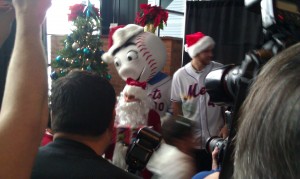 Murph inhabits the ho-ho-(w)hole role. At this year’s holiday party, Daniel Murphy, a fellow whose name has arisen in trade rumors, donned the beard, the hat and the ho-ho-(w)hole get-up. If the swap speculation come to fruition, well, there’s your “curse” at work. If not, we’ll always have the Bensons. Anyway, for the second December in three, Murphy showed his versatility, doing his best to play a representative Father Christmas the way he has worked to succeed in left and at first, third and second. He gave kids gifts and, with the uniform of the day tucked safely in the Hefty, he gave a few of us bloggers answers to a random assortment of inquiries.
One of his responses showed why Daniel Murphy performs as a Franco-level Santa Claus.
The question in question came from young Clayton Collier of Metsmerized Online. I wouldn’t point out that Clayton is shall we say fresh-faced relative to somebody like me except for an exchange we had during some pre-event small talk. The subject of the recently partially demolished Astrodome had come up, including the time it hosted displaced residents of New Orleans after Hurricane Katrina. This line of conversation led me to recall Barbara Bush’s infamous implication that those folks were ultimately better off living in a sports arena than their own homes in their own city. Clayton was incredulous that this was actually said, earnestly explaining he didn’t really remember Katrina very well because he was only nine when it happened.
That was in 2005, back when the Bensons were in their glory, so to speak.
As I paused to do the math, Clayton added, “sorry if that makes you feel old.”
“No problem,” I said, having completed my chronological calculations. “I felt old before you were born.”
Young Clayton asked youthful Daniel a question middle-aged me didn’t think would get much of a response: “What’s Eric Young, Jr., like at second?” My cynical instinct was that Murphy wouldn’t want to say much pro or con about his theoretical competition. He had already competently fielded questions about the possibilities of being traded (he doesn’t want to go but it’s nice to know he’s “valued” around baseball) or shifted back to first (he prefers second, but if he’d have to reacclimate to one of his former positions, “at least they’d give me a bigger glove”). What benefit, I wondered silently, is there in a player who always seems to be standing on shaky organizational ground either dismissing a teammate or inflating that teammate’s reputation at his own expense in the midst of an offseason where he himself is just trying to stay put?
I couldn’t see anything more than a self-preservational route out of the question from Murphy, therefore I expected to hear something along the lines of “I can only take care of what I do” or some other benign form of jockspeak.
But if you don’t ask, you’ll never know. So Clayton asked — and Murph surprised me.
“He flipped a double play in Chicago against the White Sox that was sweet,” the incumbent second baseman said of the player who could very well replace him. Murphy, who was given most of that game off, went onto describe the play that I could vaguely envision once he mentioned it. “He got a low throw, I think, from the third baseman and he took it and he turned that thing over easy. It was impressive not because you didn’t think he could do it, but he hadn’t been there like all year. And he really wasn’t taking a whole, whole bunch of ground balls. He did some work there and turned some double plays, but to just go out there in the best league on earth, flip a double play with a guy bearing down on you…that’s what I would say is impressive.”
Yes Virginia, the guy who’d been dressed as Santa Claus actually said “whole, whole”. Actually, he said a whole lot with his answer in my estimation.
As impressive as Young’s instincts and agility from June were, Murphy’s lack of hesitancy in volunteering how good he thought EY’s DP was rated a sincere “atta boy!” on my scorecard. That showed grace, class, dignity, whatever you want to call it.
Seriously, put a circle around it.
Murph has been a true team man since 2008, playing wherever assigned without a hint of public complaint. Now, minutes after schvitzing as Santa, he was giving the gift of praise to somebody whose very presence might soon make him the former Met starting second baseman or perhaps a former Met altogether. Yet Daniel Murphy honestly assessed Eric Young’s skills and shared his impressions with a handful of strangers who, from a strictly transactional standpoint, weren’t people to whom he really needed to say anything substantive at all.
If this year’s Met Santa Claus is cursed with anything, it’s a generosity of spirit — and I’d call that a blessing.
I had a few other Met thoughts the other day and expressed on The Happy Recap Radio Show. Check ’em out, starting at around the 22:00 mark, here.
by Greg Prince on 20 December 2013 4:28 pm Carlos Beltran shouldn’t feel so bad about Mets ownership’s attitude toward him a few years ago as he counts his Yankee dollars in the present. The unfortunate Trailways Toss of his reputation — a.k.a. throwing Beltran under the bus over knees not healed and hospitals not visited — seems to have hastened a change in organizational philosophy where he used to get paid.
Instead of badmouthing their players while still under contract, the Mets now tend to wait until they’re securely out the door.
Progress!
Perhaps amid the yawning winter chasms between games and signings you’ve picked up on the tendency of “Mets people,” as they’re usually identified anonymously, to whisper sour nothings about the not-so-dearly departed to reporters and columnists. Marlon Byrd was safely ensconced in Philadelphia by the time Andy Martino of the Daily News revealed the organization’s opinion that one of their two best hitters of 2013 meddled too much in his teammates’ approach to swinging and taking. Shortly after Justin Turner was not tendered a 2014 contract, someone from within the Mets let it be know to ESPN’s Adam Rubin that the quintessential role player did not, in fact, run hard enough to maintain his spot as a modern-day Hot Rod Kanehl/Super Joe McEwing.
Should have Byrd kept his beak out of the Mets’ ongoing hitting philosophy implementation? Should have Turner hustled to first as fast as he hoofed it to the fridge in order to deliver a whipped cream pie on camera? Maybe and sure. But should have “Mets people” just kept these jabs to themselves? Why ding Byrd’s or Turner’s reputation? Just as pertinently, why become the club known for taking post-employment swipes at former associates? (Related: why weren’t the players given a chance to answer these assessments or decline comment to the respective writers?)
Since this has been bugging me a little as a fan and since I was on the same patch of Acela Club carpet the other day as Sandy Alderson, I figured I’d ask the GM if these backhanded waves goodbye to ex-Mets serve any kind of positive purpose. I don’t see how they would, but nobody this week claimed I was the best general manager in major league baseball, so maybe somebody who was indeed rated as exactly that would have more insight.
No, Alderson told me and the bloggers who joined me at the Mets holiday party on Tuesday, there’s no purpose to that sort of thing. And he indicated he’s not too happy that that sort of thing transpires. From “time to time” he expresses his disapproval internally, but as was the case nine months ago when I asked him about the impact continual leaks might have on getting things done (like trying to sign Michael Bourn, for example), he more or less said it comes with the territory. It’s New York; there’s a bounty of media. It’s hard for what amounts to office gossip to not find its way into circulation, sanctioned or otherwise.
The look on his face told me he’s definitely not in favor of it, though.
As long as I was there, I followed up with what difference it might make to a player like Ike Davis if Ike knows he’s being shopped around yet winds up still a Met in the middle of February. You’d figure that in an industry where the average annual player salary rose this year to $3.39 million, money would salve feelings just fine. But people are people…even Mets people.
According to Alderson, “healthy competition” will ensue if some player who’s been vigorously talked up as trade bait instead remains a Met when Spring Training rolls around. Still, I imagine knowing your employer is actively looking to ditch you is at the very least awkward and maybe worse for the fellow at the heart of the chatter. But I also imagine in the high-stakes world of major league baseball, it’s something these guys deal with.
“Positive resolution” would be the best possible outcome, said the GM who uses very classy phrases, not simply resolution by way of release or whatever. Besides, with the whirl of transactions and an unsuspected onslaught of injuries (because that never befalls the Mets), you never know who will be playing what for you. If Ike Davis lands at Tradition Field — if it’s still called that — instead of another camp, I hope someone will fill him in on the tale of Ray Knight, the Met the Mets tried desperately to, shall we say, positively resolve in the spring of 1986 following a dreadful 1985 but couldn’t.
Six-plus months later, Knight was accepting the World Series MVP trophy at Shea Stadium for the home team.
This season starts March 31, so any and all comings and goings are up for grabs until then when it comes to shaping an Opening Day roster. Still, with nerves wracking every minute the Mets can’t present us with a finished product, I asked Alderson if there’s kind of an internal alarm clock for someone in his position. When do you kind of, sort of need to know you’ve got the bulk of your team in order?
The general manager compared the process to the difference between a first-time marathon runner “who wants to quit after five miles” and someone who understands what it takes to persevere at the “21-, 22-mile mark”. When you’ve put together more than a few teams, he explained, you “know how to traverse late December and January.” True, the “anxiety level” ratchets up along the way, but experience helps inform the “ebbs and flows”.
So yes, Alderson is attentive to everything going on out there and continually reassesses what it means to the Mets — particularly when a division rival makes a move.
An aside that probably means next to nothing in the standings: I don’t know if Alderson is truly “the best GM in baseball,” as noted Cardinal enthusiast Will Leitch just framed him for New York magazine, but the guy certainly comes off as a mensch when you talk to him. He may not tell you what you want to hear or offer up a full pail of information brimming with signatures attached to contracts, but he always answers your question thoughtfully and respectfully. I’ve asked him probably a dozen since he came to Flushing and listened to dozens of my blolleagues come at him from multiple angles on conference calls and events like Tuesday’s, and though we’re not BBWAA members, he never scoffs or haughtily dismisses.
If Sandy Alderson’s Met tenure ends with no definitive improvement in the National League East, then that amounts to no more than a well-meaning footnote. For now, though, while he and his group are still building what we hope is a long-term winner, it’s not bad.
Only tangentially baseball-related, but you might enjoy it anyway: an article I wrote about how we never fully lose the places that are important to us even if they are no longer physically where we left them.
by Greg Prince on 18 December 2013 10:39 am I assigned myself two missions as I arrived at Citi Field Tuesday morning to cover my fourth consecutive Mets holiday party for Queens schoolchildren. One I had planned, the other developed on the fly.
The ad hoc mission involved getting out of the bitter cold after an overly literal, presumably underinstructed windbreaker-wearing guard on the other side of the Hodges entrance glass told me I couldn’t come inside until 11 AM. It was 10:30, freezing and snowing. As I peered through the pane and saw the familiar Citi Field sight of plenty of good seats still available, I shivered in surprise at the maroon-clad lady’s clinginess to rules. I’m pretty sure she relished telling me to get temporarily lost.
The following is not fanciful dialogue. It happened immediately after I tapped on the door to get her attention and interrupt the conversation she was enjoying with her colleague.
“Yes?” she asked.
“I’m here for the holiday thing,” I said.
“You’re media?”
“Yes.”
“Media can enter at eleven.”
So sitting quietly at the other end of the heated “VIP” lobby until I could be officially checked in for the Acela Club event to which I was invited by a much nicer branch of the Mets organization was not an option. Nor was picking up a walkie-talkie and seeking a supervisor’s sign-off to allow a slightly early arrival through Gil’s golden gate. I would’ve settled for being advised that the exceedingly unbusy team store was open and I could kill time/warm up in there (a conclusion I came to for myself after 15 minutes of walking around and nearly slipping on a patch of precipitation).
“You can wait in your car until eleven,” she suggested.
“I took the train here,” I said.
“Then you’ll just have to wait outside,” she responded, almost gleefully shutting the door on me before getting back to her chat.
As was the case at the Great Bar Mitzvah Caper of 2009 — when the designated entry point was the Rotunda, the lousy weather involved rain and the misguidedly vigilant guard’s windbreaker was green (whatever happened to blue and orange?) — the 30 or so minutes of Citi finickiness eventually passed, giving way to a lovely time in the Acela Club for the appointed mission. Back then it was to meet a fine young man who would go on to become one of the better parts of my future Met seasons.
Tuesday, actually, it was kind of the same thing. At that ’09 coming-of-age celebration, I met 13-year-old Ryder Chasin, who is now 17 and one of the splendid writers you’ll read from any age. In this Acela episode, the “kid” I was coming to say hi to was 23-year-old Zack Wheeler.
I look forward to him enriching my Citi Field experiences for years to come, too.
Since the Mets media relations department — incredibly nice folks who would never knowingly sanction your being pointedly instructed to go sit in a car you didn’t have with you — granted me media access to the holiday party, and since Zack was going to serve as Santa Daniel Murphy’s elf, I figured this was the moment to assess the cut of Wheeler’s jib. I couldn’t judge Zack Wheeler’s pitching from a little cluster of blogger-player Q&A, but I could attempt to gauge whether this fella, hailed since his acquisition as the future ace or co-ace of my favorite baseball team (despite its tendency to stick unpleasant people in windbreakers and hand them the keys to the offseason kingdom), has ace stuff away from the mound. I know Wheeler can throw a fastball. But can he throw off sparks?
Why does it matter to me? Because aces oughta give me the impression they are or can be larger than life, and not just in the Bartolo Colon sense. Our ace of aces was and is the gentleman whose name adorns the Seaver entrance at Citi Field. If you haven’t already, treat yourself to Pat Jordan’s visit with Tom Seaver at Sports on Earth. Tom’s 69 yet spiritually every bit the ace he was at 24. You just know it. Then go read what Dirk Hayhurst had to say about working with Pedro Martinez on TBS’s postseason studio show. When Pedro wasn’t absented by injury during his Met tenure, that man had stage presence like none I’ve ever seen. Hell, he had stadium presence. Per Hayhurst’s heartfelt testimony, he’s still got it and he’ll always have it.
Hindsight helps assess who’s been an ace and who’s been not quite that, but the personality and pitching pieces tend to fit retroactively, nonetheless. Doc Gooden may have come off as a callow prodigy at his peak and his off-field actions surely revealed deeper personal issues, but beyond the rehabilitation and behind the eyes I swear still saw the ace within when I got to sit directly across from him for a spell this summer. He knows what he did on the mound; I know that if he could restart from scratch he would do it all over again, except better. R.A. Dickey, I think we learned, was an ace just waiting for his pitch to come in. If Johan Santana didn’t require a healthy left shoulder to ply his craft, I’d bet we’d have lived through a lot more September 27, 2008s and June 1, 2012s than repeated trips to the 60-day disabled list.
You watch these guys, you listen to these guys, you read about these guys…you just feel it. I won’t invoke the widely discredited laugh line from Moneyball about “the good face,” but you know, I once heard a scout describe what he took that phrase to mean, and it wasn’t really silly. It spoke to a certain alertness and awareness that expressed engagement with the game. You’d take talent and performance into account before signing somebody, but you’d also take stock of everything you could possibly detect. It may be a bit of a reach to peer into the window of the soul like it’s the window of the Hodges entrance and say you see anything you can count on, but I really do believe — despite my logical insistence that the ace of the staff has to be whoever is pitching on a given day — that some guys are aces and other guys are trying to get by on lesser stuff, both inside and out.
Matt Harvey just spent five-sixths of a season as a state-of-the-art 21st century ace. Now he’s consigned to getting his canoodle on while we try to get by without him. That’s why I wanted to take the measure of the cut of Zack Wheeler’s jib. We’re gonna need the cut of Zack Wheeler’s jib to be razor sharp in 2014. Even when Harvey returns, hopefully in full 2013 form, we’re gonna need Wheeler to give great jib in 2015 and the years to follow.
After meeting the man and exchanging a few sentences with him, by jib, I think he’s got it.
I’m no scout or soothsayer, but I got a better feeling out of meeting Zack Wheeler than I did Jon Niese at the holiday party of 2011. Niese didn’t throw off sparks. Niese was the only player to date at one of these things whom someone from the media relations staff didn’t have to rescue from a barrage of questions. Usually you give the blogging contingent a chance to make inquiries, we won’t run out of things to ask. With Niese we did because he wasn’t much of an answerer. Not impolite (and certainly community-minded), but not really what I hoped for from a starting pitcher who was being talked up at the time as “ready to take the next step,” if I may invoke that cliché.
Everybody’s different and not every pitcher is going to parry with Pat Jordan or awe Dirk Hayhurst (or, for that matter, canoodle the good face of Anne V.). Wheeler’s not necessarily his predecessors or his most glittering contemporary, yet I trust him to take some of that next-stepping soon. I particularly liked what he answered when I asked him a process question concerning when he knows he has his “A” arsenal versus when he thinks he’s gonna have to figure things out as a game goes along. I used as an example how well he pitched at San Francisco last July, and midway through my question, I realized that was an extreme example because, duh, it was the Giants who decided they could spare him when they traded him for Ol’ Mercenary Head, a.k.a. Carlos Beltran.
Thus I amended my question as I asked it to encompass that extenuating circumstance, and Zack was more than happy to volunteer that he was really “pumped up” that day and wanted to “shove it against ’em”. They were the ones who gave up on him, after all. He hadn’t forgotten and he wasn’t shy about remembering it now.
The words might have differed coming out of different mouths, but I could hear echoes of Seaver or Martinez saying essentially the same thing. I couldn’t imagine it coming from someone like Niese. Maybe Niese would think it, but he’d never say it. That shouldn’t be a mark against Niese’s or anybody’s jib, however, for every starter, like every person, is a creature unto himself. Likewise, every Mets starter should ideally pitch like an ace but you can’t demand every Mets starter be an ace…any more than you can demand common sense be deployed by every Mets employee in an off-color windbreaker.
Just maybe, though, should fate play our cards right, we could end up with two of a kind in our long-term rotation. And wouldn’t that be a heckuva way to come out of the competitive cold?
by Greg Prince on 14 December 2013 6:31 pm As mind-blowing concepts went, none could explode the goop inside this onetime 15-year-old’s coconut quite as much as what I learned was about to take place on the first Saturday of August 1978. There was going to be a baseball card show at Shea Stadium.
Think about that:
• Baseball card show.
• Shea Stadium.
Now think about it as if you’re 15; as if baseball card shows are a relatively new and exotic concept; and Shea Stadium is Mecca. (No “as if” necessary on that last one.)
The Mets were in St. Louis. My parents were weekending in the Catskills. I asked my recently college-graduated sister if she and her boyfriend might take me to this overwhelming confluence of activity. Her boyfriend, a former Shea Stadium vendor — experience that left him chilly toward all things baseball — said sure, why not? He lived nearby, he knew the terrain and he was curious in his own way about it.
Depending on one’s perspective, the Shea Stadium Baseball Card Show that took place the first Saturday of August 1978 was either a rousing success or a crushing bore. My perspective was it was fantastic. There was a baseball card show inside of Shea Stadium. That’s pretty much all I needed. You bought a ticket labeled SHEA STADIUM SHOW. You traipsed amid what passed for the Shea Stadium ground-level concourse, which is to say inside Gates A and B directly in front of the stilled escalators. Sales tables were set up from left to right.
That was about it. I remember buying one item that day: a 1978 Topps No. 450, which featured Tom Seaver as a Cincinnati Red. It would be nice to think that was an error card, but late 1970s reality dictated otherwise. Thanks to the quarter I handed over to some vaguely sleazy fellow, I now had every Topps Seaver…the only kind of Seaver back then, come to think of it…since 1968. And I bought it at Shea Stadium, the same place where both the photograph on the card and the legend of its subject was crafted.
A rousing success!
No, it was a crushing bore, according to my sister’s boyfriend who hated baseball, but not because he hated baseball. His interest in the trip was purely observational, and like everything else that transpired at Shea Stadium, he observed that the card show represented a black mark against the human spirit. That’s it? he asked. That’s all a baseball card show is?
My sister’s boyfriend, though only 22 himself, was a veteran of gatherings of a certain strain of cinema buff: sci-fi, superheroes, westerns, “B” movies. And when those guys got together, he said, it wasn’t just about selling. Yes, there was a “dealer’s room,” but they had areas devoted to screenings and seminars and speakers. It was more than a show. It was an event. It was everything a fan could want if the fan couldn’t get enough of the stuff he sought.
Sounded great to me. It still does. And more than 35 years later, my now brother-in-law’s vision is coming true, thanks to another former Shea Stadium vendor.
I doubt my sister’s husband — who prefers to be known on this blog as Mr. Stem — has ever come across the author of Send The Beer Guy — who prefers to be known on his blog as Shannon Shark — but unwittingly, the two have shared a vision. Shannon, who you probably know from his tireless patrol on Mets Police, came to pick up the vision first expressed by Mr. Stem and ran with it. The result is coming to the ballpark that sits adjacent to the site of 1978’s SHEA STADIUM SHOW.
But it will be so much more.
On Saturday, January 18, Shannon and his co-conspirators Keith “Media Goon” Blacknick and Darren “The 7 Line” Meenan, will present the first Queens Baseball Convention, or QBC ’14, at McFadden’s Citi Field. It is shaping up as the Saturday for which we’ve all been waiting if not all our lives, then at least all our winters.
QBC is described on its site as an amalgamation of fanfest, Comic Con and Hofstra 50th anniversary conference. You don’t have to read too hard between the lines to realize QBC implicitly spells M-E-T-S. Perhaps the greatest thing about this event is it’s about our team but it’s not being put on by our team. Our team has occasionally caravanned in through the Metropolitan Area but has never put on a wintertime fanfest. When we consider that fact, we tend to kvetch and moan about their hot stove negligence. Shannon & Co. did more than complain. They got to work putting on one for us.
Hence, for one Saturday in January, starting at noon, a corner of Citi Field will come alive with the sound of baseball. With Ron Darling and Ed Kranepool on hand to share their insights and autographs. With a special salute to the memory of Gil Hodges. With Sandy the Seagull winging his way over from Coney Island. With a mob of minutiae mavens. With the jazziest jerseys. With new media and old media (including a couple of bloggers you know well if you read Faith and Fear). With trivia for adults, games for kids and the spirit of Mets fandom shaken awake from hibernation nearly a month before Spring Training.
With a 1978 Topps No. 450 for sale, for all I know.
Plenty is planned and plenty more is being planned. Shannon’s agenda is to stuff QBC ’14 so full and stack QBC ’14 so high that the Carnegie Deli would’ve been proud to have served it to Mo Vaughn in 2002. Knowing Shannon, he will succeed. He and Keith and Darren and everybody pitching in is dedicated to creating both an unprecedented experience and the template for future QBCs. I’m very excited to be in on the ground floor…a more inspiring ground floor, frankly, than the one from which that vaguely sleazy fellow sold me the ’78 Seaver for 25 cents.
Not that that wasn’t great when I was 15. But as I approach 51, my reblown mind is capable of recognizing that this will be greater. This is a genuine “by the fans, for the fans” endeavor. I’m proud to be one of the fans pitching in to put it on and thrilled to be one of the fans who will be taking it all in.
So don’t just stare out the window and wait for spring. Give your 2014 Queens Baseball battery a jump start by Convening with your fellow fans. As a certain song might suggest, everybody’s comin’ down to meet the Q-B-C of Flushing town. Step right up and greet it, too.
Information on Queens Baseball Convention tickets and events is here.
by Jason Fry on 13 December 2013 9:45 am Oh, you suddenly wacky Mets.
No sooner had I fallen back into despair and trotted out my Sandy as Charlie Brown, Jeff as Lucy cartoon than it was announced that the Mets had signed Bartolo Colon — who’s equal parts huge, old and good — to a two-year contract that, like Curtis Granderson not long before, also counted as Real Money.
If Colon does something bad to a knee in February and is damaged goods after that — a fate not exactly unknown among hefty old dudes — the deal’s a disaster. If he keeps on walking nobody and pitching ably for two years, it’s a steal. If he pitches well enough for half a season or one season or a season and a half and is then flipped elsewhere for a decent prospect, it’s a Sandy Alderson special. And will probably be a pretty shrewd one, going by past results.
But is it more evidence of the changed narrative that I was happy about last week?
I dunno. Or I keep changing my mind. Or something. The Mets have me suffering from both emotional and logical whiplash.
On the one hand, they’re actually spending money — they’ve added the non-gigantic Chris Young, Granderson, Colon, and will add a shortstop if Sandy can pull it off. That’s a far cry from your winter consisting basically of Marlon Byrd and a bunch of Triple-A guys who barely got a baseball card.
On the other hand, the Mets still aren’t spending as much money as they’ve previously said they will.
Let’s go to Howard Megdal, who keeps track of these things. In June, Alderson told Joel Sherman (who wrote a fine column the other day, BTW) that he saw 2014’s payroll at between $90 million and $100 million. Now, it seems to be $85 million. (I’ll spare you a couple of years’ worth of fiscal goalposts moving around before that.) That $85 million cap is one reason (though not the only one) that we keep hearing about Daniel Murphy being traded and Ike Davis being the misfit first baseman most likely to become someone else’s problem.
The problem isn’t the dollar amount (though it’s that too) so much as it is that the amount seems to be a constantly moving target.
If the 2014 payroll is $85 million, the Mets essentially have to move Davis or Murph or both for financial reasons if they plan to make any more moves worth caring about.
If the 2014 payroll is $100 million — the upper end of what we were told this summer — Stephen Drew comes into play without the necessity of a trade. A lot of things come into play.
But it’s no longer summer, so the payroll’s no longer $100 million. It’s $85 million. Or maybe that’s wrong now too. We’ll all have to await what Sandy says next time he’s enduring an hour with Mike Francesa or cornered by beat writers with microphones.
Money doesn’t fix everything, as a near-infinite number of self-help books and pop songs warn. It can bring its own problems, as evidenced by Mets teams that spent gobs of it and were still terrible. But a lack of money fixes nothing, and the problems it brings are predictable ones.
And not knowing how much money you have? That’s a ridiculous way to run a business — though it turns out to be an excellent way to leave a fanbase reflexively suspicious and anxious.
I pin blame for the magical bouncing payroll on the Wilpons. You can pin it on Sandy if you like — or on sunspots, the Rosicrucians, or mole men from Europa. I don’t really care anymore. All I know is I’m tired of it.
The Mets haven’t done what I feared they’d do this offseason, which was strip the team even further, shrug and wait for Matt Harvey‘s elbow to heal. They’ve spent money, and a lot of it by their recent standards. That’s changed the narrative, yes. But I still don’t know what the payroll is — or more to the point, I don’t think the general manager knows what the payroll is. That narrative is familiar, and it’s the one that really needs to change.
* * *
Here’s a Mets narrative that really has changed for the better, one you might not have noticed.
The Mets are touting their Kids Club, which now has two membership levels.
There’s a free level (blue) where you get a free ticket voucher good for any Sunday game, three buy-one, get-one-free ticket offers good for any Sunday game, and a membership card and lanyard that you can use to “check in” at Kids Club Sundays, with rewards ranging from an autographed player photo to a duffle bag depending how often you come.
There’s also a $24 level (orange) that gets you a t-shirt, four free ticket vouchers for any Sunday game, all of the above and some other neat stuff besides.
It’s a pretty great deal. But the key change is the “any Sunday game” part. Joshua used to be a Kids Club member, and in previous years the club had a fatal flaw: You could pick your free ticket from about a dozen dates scattered across various days of the week — and nearly all of them were night games.
Taking the subway back from Citi Field after a typical night game gets us home between 11:30 pm and midnight. My kid just turned 11, and having him go to bed that late is only now becoming a possibility — and even then, we have to accept a high likelihood that the morning will be a mess. A couple of years ago, preventing such a disaster would have meant leaving around the third inning, which isn’t exactly the stuff of happy baseball memories.
So the ticket part of the old Kids Club was basically worthless — if the couple of available day games didn’t fit your family’s schedule, tough. The effect of this was to undermine an otherwise nice program for children in a way that would be blindingly obvious to anyone with a child. It was baffling and infuriating.
Now, all that’s gone. There are 13 Sunday games on the 2014 schedule, they’re all day games (pending ESPN shenanigans the Mets can’t control), and you can get a free ticket to any of them.
The difference is, well, night and day — a Kids Club that’s simple, fan-friendly, and how it always should have been.
* * *
Here’s something else to lift your spirits. It’s Pat Jordan on Tom Seaver, and a little bit of Tom Seaver on Pat Jordan, and it’s smart and funny and quietly moving.
|
|