The blog for Mets fans
who like to read
ABOUT US
Faith and Fear in Flushing made its debut on Feb. 16, 2005, the brainchild of two longtime friends and lifelong Met fans.
Greg Prince discovered the Mets when he was 6, during the magical summer of 1969. He is a Long Island-based writer, editor and communications consultant. Contact him here.
Jason Fry is a Brooklyn writer whose first memories include his mom leaping up and down cheering for Rusty Staub. Check out his other writing here.
Got something to say? Leave a comment, or email us at faithandfear@gmail.com. (Sorry, but we have no interest in ads, sponsored content or guest posts.)
Need our RSS feed? It's here.
Visit our Facebook page, or drop by the personal pages for Greg and Jason.
Or follow us on Twitter: Here's Greg, and here's Jason.
|
by Greg Prince on 29 August 2013 11:17 am 1. Daisuke Matsuzaka receives the ball back from Travis d’Arnaud.
2. Daisuke Matsuzaka is thinking.
3. Daisuke Matsuzaka is still thinking.
4. Like most Mets fans, I’m thinking, “When is Daisuke Matsuzaka going to throw the ball?”
5. Daisuke Matsuzaka sure takes his time.
6. Daisuke Matsuzaka’s reputation has preceded him to Citi Field. SNY was prepared Wednesday night with a chart of the pitchers who take the longest time between pitches. FanGraphs calls it “pace,” which in the case of Matsuzaka means you can pace from here to Pretoria — or at least to Astoria — while Matsuzaka thinks between pitches.
7. According to SNY’s chart, only Josh Beckett takes longer than Daisuke Matsuzaka to deliver, although Brooke Buck probably has them both beat in that regard.
8. SNY put a clock on Matsuzaka. And they put Matsuzaka’s face on a clock while the clock ticked away and Matsuzaka didn’t pitch.
9. They didn’t call it the Matsuclocka, but they should have.
10. Earlier in the game, as hard to believe as it is that a nine-inning game that took 3:32 to play had an “earlier,” Howie Rose explained Daisuke Matsuzaka’s famed gyroball: In the time it takes Matsuzaka to throw one pitch, you can leave your seat, buy a gyro, eat it and return to your seat.
11. Howie’s first-inning exasperation provided an opening for Josh Lewin to invoke “tzatziki sauce” for perhaps the first time in major league broadcasting history.
12. Red Barber almost certainly never mentioned tzatziki sauce while sitting in the catbird seat at Ebbets Field, but he did keep an egg timer handy. It was there to remind the Ol’ Redhead that when its three minutes of sand ran out, he should tell his listeners the score of the game.
13. It was a good idea. Red’s listeners might have just been tuning in or not been paying close attention. Or they might have gone off to purchase and consume a gyro while waiting for Daisuke Matsuzaka to deliver his next pitch.
14. From Red Barber’s egg timer to SNY’s Matsuclocka. Who says baseball is timeless?
15. I’ve heard three different pronunciations for gyro and inevitably the person from whom I’m ordering one corrects me, whether I say “Jigh-roh” or “yeer-oh”. A guy I know from Cleveland once insisted it was “yuh-roo,” but he was from Cleveland.
16. Daisuke Matsuzaka came to us from Cleveland’s top farm club. The Indians are in a playoff chase, but they couldn’t use him. The Mets somehow found work for him.
17. Though I wasn’t the least bit excited to have Daisuke Matsuzaka join our ranks, he does hold an incidental place in the history of Faith and Fear in Flushing. Matsuzaka was on the cover of Sports Illustrated’s 2007 baseball preview issue, the same one that asked readers to choose the blogs they’d like linked on SI.com’s team-specific pages. For the Mets, the choices were Metsblog, Mike’s Mets, Metsgeek and Faith and Fear in Flushing.
18. I remember Matsuzaka being on that cover because a few years later I came across the issue in a pile of papers and wondered why I had saved it. “Oh yeah…” I realized as I flipped through the pages.
19. It was quite a thrill to see our name in Sports Illustrated, but perhaps it was a sign that the jinx associated with that magazine has merit. Matsuzaka was in the minors most of 2013, Metsgeek is now defunct, Mike’s Mets is sadly dormant, we lost the poll to Metsblog and I somehow got talked into recapping Matsuzaka’s endless start Wednesday night even though it was Jason’s turn.
20. In exchange for taking this game, Jason has agreed to take my place at my next colonoscopy, which seems like a fair trade.
21. “As long as the Mets’ trainers aren’t involved” was his only condition.
22. The last time SNY employed a clock on a Mets telecast, according to Gary Cohen, it was to measure how fast Jose Reyes ran from first to third. In the time it takes Daisuke Matsuzaka to deliver a pitch, Jose could march from here to Astoria — or even to Pretoria.
23. I wish Jose would jet from Toronto to Flushing. My pal Joe recently visited Rogers Centre and thoughtfully brought me back a Jose Reyes figurine. The team gave them away previously but later made extras available in the team store (a smart thing to do, dear Mets). Figurine Jose made me miss our all-time shortstop all over again. Reyes looks good in Jays blue, but he’d look even better with splashes of orange.
24. If I can’t have Reyes, I’d welcome back Ruben Tejada…to pitch instead of Daisuke Matsuzaka, I mean.
25. I’d consider welcoming back 42-year-old Steve Trachsel, who, despite all reflexive references to his Matsuzakan pace last night, actually learned to get the ball and throw the ball after a while (albeit a good long while).
26. Twelve years ago — or the rough equivalent of eight Daisuke Matsuzaka pitches — I attended a game in which Steve Trachsel two-hit the Pittsburgh Pirates in two hours and twelve minutes. Granted, it was the end of the season and granted, it was against the Pittsburgh Pirates during their Matsuzaka-like schlep across the sub-.500 desert, but it was as impressive as it was unbelievable.
27. That night the Mets clinched their fifth consecutive record of .500 or better. This year the Mets appear destined for their fifth consecutive record below .500. And if the third-place Phillies don’t get around to falling behind them again, the fourth-place Mets will set a dubious franchise record: five consecutive seasons finishing in the same spot in the standings, though if the spot was first, we wouldn’t call it dubious.
28. Five years of losing baseball. Five years of finishing next-to-last. It’s pretty glum in these parts, but I guess we already knew that. You look at a lineup that went around the horn from third to first with Josh Satin, Justin Turner, Wilmer Flores and Ike Davis, you don’t need a whole lot of statistical support.
29. Plus Daisuke Matsuzaka thinking about throwing his next pitch every fifth day.
30. But even the morning after a desultory 6-2 loss to the Phillies, there is hope if you grope for it.
31. All sorts of Mets farm clubs are headed to the playoffs. That’s gotta be worth something down the road.
32. Hard-throwing Vic Black is the new orange-and-blue reliever in waiting, per various reports regarding the Pirate to be named later from the other day. Black may be an unproven quantity, but you need bullpen depth if you have multiple pitcher injuries and a healthy Daisuke Matsuzaka.
33. The Houston Astros were eliminated from playoff contention last night, August 28. So at least we’re not them.
34. The Pittsburgh Pirates, behind the slugging of new right fielder Marlon Byrd, took another step closer to breaking their 21-year winning-record and playoff-appearance drought. We’re not them yet in either sense of the word, but they present provisional proof that nothing dismal lasts forever.
35. Wilmer Flores might someday learn to field a ground ball at second base. Last night was his first time trying in the major leagues. Give him time. We have nothing but time right now. We have ample opportunity to test anybody anywhere — Ike every day at first, Satin getting comfortable at third, maybe even Tejada playing short should he ever be recalled. We have Daisuke Matsuzaka on the mound getting around to throwing 110 pitches in four-and-a-third innings. And we have a month to go.
36. A month to go between each of Daisuke Matsuzaka’s 110 pitches, according to FanGraphs.
37. A suggestion for filling some of that time, offered on the assumption that you treasure outstanding sports announcing…and I assume you do if you’re a Mets fan who immerses yourself in Gary, Keith and Ron on TV and Howie and Josh on the radio.
38. Watch Glickman if you have HBO. It’s a beautifully done documentary on the extraordinary life and career of Marty Glickman, the man who practically invented modern basketball announcing, perfected the art of calling professional football, taught a slew of successors the ins and outs of the booth and, oh by the way, was denied a chance to run in the 1936 Olympics in Hitler’s Berlin not because he wasn’t fast but because he was Jewish.
39. I heard Marty Glickman’s voice growing up — he did the Giants games my father listened to every Sunday on WNEW — but didn’t know until years later that he was a world-class track star on the level of his teammate Jesse Owens. He never let the anti-Semitism he encountered from Nazi-appeasing U.S. Olympic officials slow him down, and his run as a broadcaster went on nearly forever…or about as long as Daisuke Matsuzaka takes between pitches. Glickman broke into the business while still in college before World War II and called his final Jets game, alongside Dave Jennings, more than a half-century later.
40. Marv Albert learned at the hand of Marty Glickman. Howie Rose learned at the hand of Marv Albert; one of the best parts of Howie’s book is Albert relating in the foreword, “I felt a duty to pass along to Howie what had been passed down to me by Glickman…” Earlier this year, Gary Cohen told Greg Hanlon of New York Capital, “I got an AM radio when I was nine years old, and every night it was Marv Albert, to Lindsey, Ralph and Bob.”
41. There is nothing explicitly Metsian in James L. Freedman’s Glickman, but Marty’s vocal DNA can’t help but crackle through the Met airwaves. So if you need an additional reason to watch this wonderful movie, there you go.
42. Meanwhile, Daisuke Matsuzaka continues to think.
43. It looks as if he’s decided to pitch.
44. And 44 seconds into his thoughts, by the Matsuclocka’s reckoning, Matsuzaka delivers…
It’s just off the plate for ball three.
by Greg Prince on 28 August 2013 12:40 am I went to a baseball game Tuesday night and Jonathon Niese broke out.
I didn’t go to see Niese. I never go with the express purpose of seeing Niese. I went for the Gary, Keith & Ron bobblehead. That was the inanimate object I craved, not Niese. Grass grows, paint dries, Niese pitches. It’s not usually very interesting, but not everything can be interesting. You still need grown grass, you still require dry paint and now and then a little Jon Niese goes a long way.
This time around, Jon Niese was dynamic, omnipresent and went everywhere. He threw a complete game shutout at the Phillies, who suddenly don’t travel so well now that they’re as lame as us; he scored the first run (through Tim Teufel’s stop sign, no less, because he’s been around this offense enough to know better than to count on his teammates); he drove in the three put-away runs on a double Kyle Kendrick unsportingly dismissed as “lucky” after surrendering it; and he made me yammer delusionally on the way out about how, sure, we’ll be missing Harvey next year, but if you have Niese pitching like this and Wheeler pitching like he did last night and Gee pitching like he has the entire second half and Mejia pitching like he did before he went down…well, we have no hitting and we’re gonna have to rely on some Matsuzaka-Marcum type at least once every fifth day, but, uh…
It wasn’t worth finishing the thought. Still, any attention diverted from the looming absence of Harvey Days in 2014 (no matter what the Daymeister himself is Tweeting) is a welcome distraction. Jon Niese distracted us for two hours and nineteen minutes with his one-man show. Ideal length for a well-rounded win.
Swell bobblehead, too. Kudos to Lynn Cohen and her Pitch In For A Good Cause efforts. Always a pleasure to run into so many familiar faces at these events — besides the ones that bobble, I mean. I attended the game with my Crane Pool comrade Paul, whose last name I have yet to memorize, but it’s the Mets and it’s the Internet, so nobody’s too much of a stickler for details. Our conversation across the evening encompassed, among others, Charlie Neal, Chris Cannizzaro, Ron Swoboda, Kevin Mitchell, Chris Jones and, inevitably, Matt Harvey, but we didn’t dwell on The Bad News.
I didn’t dwell too long on Citi Field’s inability to have hot dogs ready to serve in a section where vouchers for hot dogs were part of the deal (I was told I could wait 10 minutes after having waited 10 minutes in line) or the lack of diet cola in the next section. I wasn’t put off by the presence of the U.S. Open invading our sovereign territory despite my annual instinctive resentment that other things attract people to Flushing Meadows besides baseball. As we rode the Super Express toward Woodside, a lovely woman from another country asked how the Mets did. I told her they won. She expressed good tidings. I then pretended I knew who any of the tennis guys she mentioned having seen were. It just seemed sporting. More so than Kyle Kendrick, at any rate.
by Greg Prince on 27 August 2013 4:14 pm I remain amazed, even in my 45th season of rooting for one baseball team, how quickly its personnel turns over. On Opening Day, I applauded 25 active players who were introduced in Mets uniforms. Only four of those men have retained that status uninterrupted since: Daniel Murphy, Dillon Gee, LaTroy Hawkins and Scott Rice. Matt Harvey’s on the DL. Marlon Byrd is on his way to Pittsburgh with John Buck. Of the three guys arriving to take their place, two — Robert Carson and Anthony Recker — we’ve already seen in 2013; and one — Matt den Dekker — is brand new to these environs.
They come. They go. They return from injury, from demotion, from paternity leave. Or they don’t come back at all except perhaps as visitors. Byrd and Buck were everyday presences in our lives as fans for close to five months. Now they are literally yesterday’s Mets news. Perhaps Dilson Herrera will be tomorrow’s Mets news. He’s the 19-year-old middle infielder who is the player already identified as half of what we’re getting from the Pirates. There’s also a player to be named later (though “later” is kind of a funny name for a ballplayer). In the meantime, den Dekker and d’Arnaud and Flores and whatever pitchers whose ulnar collateral ligaments aren’t partially tearing will become the objects of our affection for the next 33 games. It’s fandom’s version of life going on.
Byrd and Buck were total strangers before April 1. They became part of the family until this afternoon. I enjoyed Byrd’s power, poise and professionalism. I reveled in Buck’s April. Now they join a team that’s on the verge of finally making the playoffs after a 21-year absence, which is fitting, given that these two players have been around approximately a decade apiece without ever having gotten a sniff of October. Breathe it in, boys. You deserve it.
Maybe we’ll be on the other side of this type of deal again one of these days. Marlon and John will probably be retired by then. Maybe Dilson will still be around.
A better day from the past: October 17, 1999 — relive it with Jason and some other familiar faces, courtesy of SNY.tv
by Jason Fry on 26 August 2013 11:32 pm The Mets lost 2-1. Nobody cares. Nobody would have cared if they’d lost 130-1, or if they’d won 130-1. That’s because the Mets and all of us were staggered by today’s asteroid-hits-the-mammals news out of Citi Field.
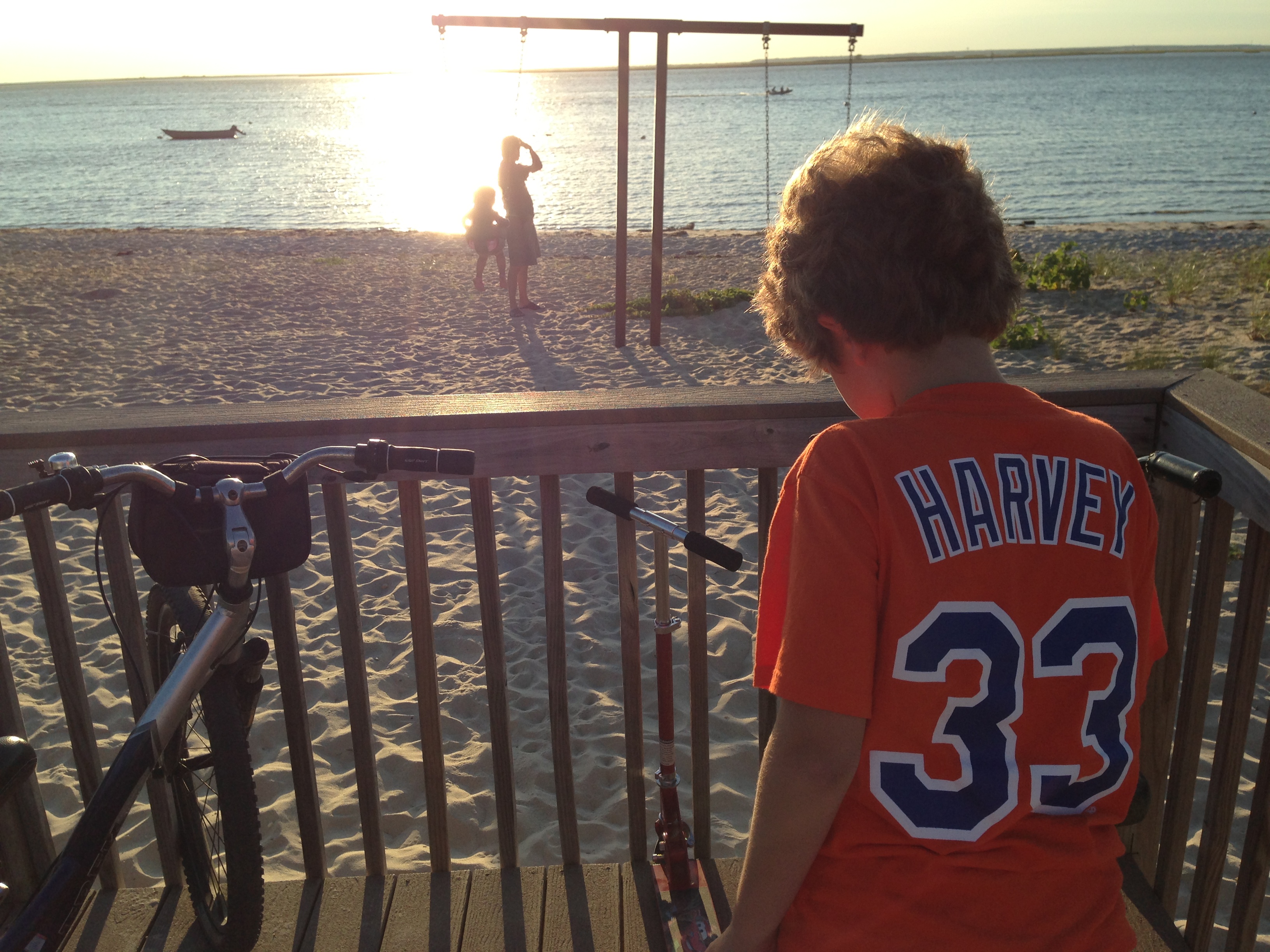
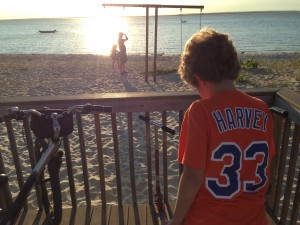
And here’s a bit of news: I know why Matt Harvey got hurt. Look at this picture I took two days ago of my kid here on Long Beach Island. A couple of seconds after I snapped it, I looked at my iPhone and thought, That’s goddamn depressing — it’s like Joshua’s watching Harvey burn on a Viking funeral boat.
Weird, weird foreshadowing. I think I knew his elbow was hurt right there.
 What’s that you say? There’s no possible causality there? Agreed. But there isn’t much more causality in blaming Terry Collins, or Dan Warthen, or Sandy Alderson, or Bernie Madoff, or anybody else. The Mets have been careful about Harvey’s innings, about his pitch counts, and about a whole lot else — sometimes to his annoyance and ours. Pitching is inherently destructive to ligaments that were never designed to do what they’re asked to do. It is unnatural and dangerous — whether you’re a bite-and-scratch journeyman like Jeremy Hefner or a lightning-armed demigod like Matt Harvey. What’s that you say? There’s no possible causality there? Agreed. But there isn’t much more causality in blaming Terry Collins, or Dan Warthen, or Sandy Alderson, or Bernie Madoff, or anybody else. The Mets have been careful about Harvey’s innings, about his pitch counts, and about a whole lot else — sometimes to his annoyance and ours. Pitching is inherently destructive to ligaments that were never designed to do what they’re asked to do. It is unnatural and dangerous — whether you’re a bite-and-scratch journeyman like Jeremy Hefner or a lightning-armed demigod like Matt Harvey.
Here’s Rob Neyer on overuse — go Google Harvey’s college coach or high-school coach or his Little League manager and blame them. As Greg noted, we’re not doctors. But speaking of doctors, only a handful of them know more about pitchers’ elbows than Frank Jobe, the man who opened up Tommy John’s all those years ago. As Terry Collins explained earlier today, the Dodgers held a retreat on pitchers’ workloads and injuries that included Jobe, and at the end Jobe had this to say: “No matter how hard you try, if they’re going to break, they’re going to break. And there’s not a pitch count or an innings limit you can designate to ever save them.”
Weirdly, Tommy John surgery is now a specter that looms over the game because it allows pitchers to return. Lots and lots of pitchers before 1974 tore their UCLs. The difference was it was a death sentence then, or a ticket to junkballer purgatory: Guys developed a “sore arm” and disappeared, with whatever potential they’d once had vanishing with them, rarely if ever remembered. (Go look up Dennis Musgraves.) Now, pitchers return from their date with the elbow doctor — as injury expert Will Carroll notes in the Neyer piece above, a third of MLB pitchers have had Tommy John surgery, and that count’s probably low because it misses guys who got cut in high school or before, as they increasingly do. Rather than dismiss sore-elbowed pitchers and forget about them, we wait in impatience and agony for them to return.
When he eventually agrees that the surgery is needed (as I hope he does soonest), Harvey will be gone for a year. A year is a long time, but it’s not actually forever — it just feels like it now. As Jesse Spector notes, Stephen Strasburg’s elbow surgery — which was every bit as shocking and horrifying to Nats fans as the Harvey news is to us — was three years ago Tuesday. Nor is Tommy John surgery the awful spin of the wheel that it used to be: Strasburg’s rebuilt elbow has logged 383 Ks in 339 1/3 innings.
It sucks, there’s no getting around it. I tried to think of worse news that a Mets fan could have heard today, and this was the best I could do: Matt Harvey and Zack Wheeler got into a fight with broadswords and severed each other’s right arms at the shoulder. OK, that would have been worse. But that at least wasn’t remotely a possibility. A pitcher going for an MRI and receiving terrible news, unfortunately, is a possibility after every single outing.
Maybe it’s just the eternal Weeble wobbling of being a Mets fan, but here’s a faint glimmer of a silver lining: The Mets probably weren’t going to compete in 2014 either. They were headed into the offseason trying to figure out how to fill a ton of holes in the offense to match their solid young starting pitching. That’s a product of the failure of Ike Davis, Lucas Duda and Ruben Tejada to develop into complementary players, as it looked like they might a year ago. The free-agent market doesn’t look great for filling those holes, even if the Wilpons actually agree to write checks. Those holes could be filled by trading away young pitching, but what looked like a surplus yesterday looks more like insurance today. And while a healthy Harvey would have had no limits on his innings, Zack Wheeler and whatever new rookie arrived (Noah Syndergaard? Rafael Montero?) would have faced those limits. (There’s an echo of Strasburg again.)
So with Alderson’s timeline trashed, perhaps the Mets can use 2014 to get the hitting and the pitching in sync. Perhaps they can use 2014 to figure out who plays first: Ike Davis, Lucas Duda, Wilmer Flores, Josh Satin, or none of the above. Perhaps Tejada uses 2014 as a last chance to emerge or become somebody else’s problem. Perhaps Juan Lagares uses it to grow at the plate the way he has in center field. Perhaps it’s a good thing for Travis d’Arnaud to see his average rise along with his confidence handling a pitching staff. Perhaps 2014 sees another outfielder step forward from the minors. Perhaps we wind up pleasantly surprised by the hitting, as we had been by the pitching before today’s news.
And maybe Harvey returns, triangular scar and all, in late September for a cameo, and we go into that offseason talking about how the hitters have stepped up more than we thought they would, and how great it was to see Harvey back and throwing hard even if it was only for a rusty five innings and 80 pitches, and how we can’t wait for 2015.
I know it’s not what we wanted to dream about, but here we are. Let’s hope it’s a dream deferred, not denied.
If that didn’t cheer you up a teeny bit, here’s a fun SNY feature on the Grand Slam Single, including contributions from Jason. That game remains the second-biggest thrill I’ve ever had at the ballpark.
by Greg Prince on 26 August 2013 6:19 pm Matt Harvey this afternoon told reporters, “I’m not a doctor.” At last I can confirm I have something in common with someone I heretofore assumed was everything and could do anything.
Matt’s not a doctor, so he can’t say much about the partial UCL tear heard ’round the world except that his right forearm had been feeling tight and now he was in the middle of a press conference talking about how he won’t be pitching for a while. I’m not a doctor, so I would be talking out my hat if I pretended to know that the tightness in question was a five-alarm harbinger of the elbow injury that now sidelines him for god knows how long, or simply the kind of business-as-usual situation that afflicts those who throw baseballs for a living along with those whose sacred charge is to nurture their careers. I’m also not one of the best pitchers on the planet, never mind also not being the fulcrum upon which the fortunes of a Major League Baseball franchise pivots.
Harvey is all that. He’s an out-of-the-box icon to those of us of who wrapped our hearts in orange and blue long before we ever fell under the spell of the Mystic Mystique. He made being a Mets fan exponentially better in 2013. He was going to make being a Mets fan outstanding in 2014. He and we were going to have a long and beautiful mutually beneficial relationship. Well, it was going to benefit us and we planned to bathe him in gratitude for eternity.
We might still make beautiful baseball together, but there’s going to be a gap while Matt’s elbow is tended to and there’s going to be uncertainty in the interim. Surgery is not certain. A return date is not certain. His eventual effectiveness for when he pitches once more…we can only hope.
Only hope is all we as Mets fans can ever do.
You could’ve pulled Harvey after five innings every five days for four months and then sent him home with an icepack and it might not have helped. I’m still not a doctor, a trainer, a physical therapist or remotely athletic, but I’d hazard a guess that it’s impossible to prevent hard-throwing young arms from experiencing tightness. And I doubt that Bobby Ojeda was wrong when he analyzed Matt Harvey’s situation as such: pitchers pitch in pain — they call it discomfort, but it’s pain; it’s the price of admission to being a professional. You can invoke Tim Leary all you want, but unless every start is Wrigley in April, you never can tell and you can’t fully shield them from the physical dangers lurking sixty feet, six inches from home plate.
Last night on Breaking Bad, the removal of airplane ashtrays and the proliferation of children’s bicycle helmets were bemoaned as a sign of the discouraging times. “I look at that,” creepy Todd’s creepy uncle lamented, “and I say what the hell happened to this country?” I sometimes feel that way about pitch counts. Tom Seaver threw 18 complete games as a rookie and 20 seasons with no significant time missed until he was 35. Seaver likes to say they had pitch counts when he was coming along, except the pitch count for him was specific to him, not Koosman, not Ryan, not anybody else. Seaver as a young Met icon was never put on the shelf unless you count the 25,000 Tom Terrific bobblehead likenesses handed out Sunday. I’ve got one of those on my shelf right now and I bathe the actual Seaver in gratitude every chance I get.
Nevertheless, telling a pitcher in his early twenties to go out there and “throw like Seaver for as long as Seaver” probably isn’t an answer. I’m not sure what exactly is. Harvey’s injury could have been prevented with infallible prescience, a commodity that tends not to exist in the Mets organization or life its own self. Presumably Sandy Alderson and Terry Collins would have a better handle on this than us mere civilians, but they had a young pitcher who was as strong as a horse, as stubborn as a mule, as determined as a bulldog and as talented as Matt Harvey.
When he looked just a little off for a couple of starts, it was as unreasonable to assume something was going terribly wrong as it would be to expect Superman to be at the top of his game in every single panel on every single page. When he looked extraordinarily mortal against the Tigers, you figured something along the lines of “fatigue,” which is how Harvey identified it afterwards. The Mets were going to limit his innings anyway. This was just a sign that the limit was nigh. Or so it seemed. Maybe his internal maximum had already been surpassed without us knowing it. Maybe it was just one of those things that was going to happen sooner or later, not necessarily because one of these things inevitably happens to the Mets in our minds.
Come to think of it, the Mets as a team might want to put an innings limit on their seasons from now on. Perhaps try capping them at around July 25.
by Greg Prince on 25 August 2013 8:54 pm I do believe the Mets just got themselves barnstormed. Big, fancy hittin’ show done pulled into town and rolled over our humble, local baseball enterprise. Raised lots of money and entertained a whole lot of folks, so I guess it was all in a good cause.
It’s better to look at the weekend just past — particularly its final inning — as a Globetrotters @ Generalsesque exhibition series than to divine from it any competitive conclusions. There was nothing competitive about any of it. If you look at what the Detroit Tigers did to the New York Mets Friday, Saturday and Sunday, you won’t want to go back to the ballpark ever.
Ever.
Late summer’s considerable charms and the company of my buddy Joe notwithstanding, what a lousy afternoon to spend at Citi Field. Miguel Cabrera homered so deep into the Acela Club, Rawlings Splattered Prosciutto is now an official Market Table Selection. Dillon Gee held steady against incredible odds after that top-of-the-first keynote address by the delegate from Michigan — the Mets even led briefly as Travis d’Arnaud typeset a Rick Porcello pitch in all caps — but the ultimate outcome never didn’t feel inevitable.
That’s not lazy Mets fan fatalism taking the place of incisive analysis just so I can finish writing this in time for Breaking Bad. Prior to the top of the ninth, I had watched the Tigers spank baseballs and the Mets who delivered them for 26 innings…and pitching’s our strong suit. The only missing element from the pastiche of paw prints was a passel of Tiger runs. They’d scored but 13 times on 34 hits from the outset of the Matsuzaka experiment Friday to the middle of the eighth Sunday. I attributed their relative restraint to most of their players being aged, immobile and infirm.
But then — after the home team’s adorable attack of former and apparently current Met Lucas Duda walking, being bunted to second and taking third on not much of a wild pitch somehow failed to light up the various Citi Field matrix boards — the Tigers got what they came for.
Ohmigod, did they get what they came for. It was as if the basepaths had one of those nauseous headaches that you know is only going to go away if you reluctantly allow yourself to throw up. LaTroy Hawkins and Scott Atchison gave the Tiger bats a sudden case of bulimia, simultaneously making those of us in the stands not rooting for the Tigers want to puke. In a flash, the game went from a teasingly tense 4-3 deficit that was going to bother us all the way home once we lost to a cleansing 11-3 rout that made it clear we were never going to win.
No, it didn’t feel good to watch the Mets get trampled by seven Tiger runs on seven Tiger hits and perhaps an actual rabid Tiger, but at least it reflected reality. The tally for the weekend wound up being Detroit with 20 runs on 41 hits versus New York’s 4 runs on 17 hits. And even the cumulative score makes the weekend appear closer than it actually was.
Given the Tigers’ other-league status, this one didn’t hurt all that much. They barnstormed into town, they made us ooh and aah and they left politely. Perpetually annoyed by the Braves and preparing to be incited by the sight of the Phillies, I’m not going to waste an ounce of animus on the Tigers (I even made sure to thank of one of their well-behaved fans for his team’s good deed last October). The Mets on the other hand…except for being stuck with being stuck on them, I can’t stand them anymore again.
Duda’s rematerialization from the agate type of the Basic Agreement rated warm applause from many in the crowd, probably for the same reason I once heard my fellow theatergoers give Mark Linn-Baker a hearty hand: they recognized him from having seen him on TV a lot. Duda’s familiar, but I wasn’t in the mood to welcome him back. I was more like Terence Mann with the insecticide sprayer in Field Of Dreams when Ray Kinsella shows up unannounced at Mann’s apartment in Boston:
“Out! Back to April and May’s horrible 17-29 start! Back! There’s no place for you here in the future! Get back while you still can!”
The same warning goes to Ruben Tejada if he’s thinking about showing his face in Flushing anytime soon.
To be fair, I also never want to look at erstwhile Renaissance Met Omar Quintanilla ever again. Have you ever seen a shortstop make more unnecessary leaps for line drives 20 feet over his head? He will strain something before he catches something. His seatmate for the next bus out of town can be Justin Turner, taking up space at third, jogging to first and too nice for me to actively dislike as a person but not good enough for me to endure as a player. Actually, I’m getting cranky about just about everybody who isn’t a consensus building block for Better Days Ahead. I’m in that dangerous mode of loving the Mets so much that I’m on the verge of despising almost everybody in a Mets uniform.
I can deal with a random opponent being as good as the Tigers were this weekend. I can’t take much more of the Mets being this bad. I mean, yeah, I’ll take it, because they’re the Mets but…uh…
Ah, you know what I mean.
by Greg Prince on 25 August 2013 1:38 am Late summer is the season of easy denial. If the atmospheric conditions are generous, there’s not a damn thing wrong when you step outside and obviously there never will be. Warmth is a given. Cool dribbles in as needed. It’s not at all hot. It’s surely not cold. It’s Baby Bear weather.
It’s just right.
What’s all wrong, of course, is late summer is over at approximately the instant you realize you’re in it. I’ve been feeling late summer for literally two days. I spent part of the first of those days staring at a reassuringly calm Atlantic Ocean. I spent part of the second of those days staring at the offensively comatose New York Mets. Nature’s been kinder of late in these parts than the Detroit Tigers. Good luck if you think you’re gonna sneak anything past the heart of either of their orders.
 Late summer, 2013, Long Beach, New York. (Not pictured: Mets losing yet again.) Maybe this flawless climate will last another week. A line of thunderstorms, a shot of humidity — never mind the slightest whisper of a tropical depression — and the idyll is pulled out from under you. Even if you’re lucky enough to make it to the end of August meteorologically unscathed, you can’t expect to extend your unbeaten streak. Late summer’s done once the sun sinks over Labor Day. You know what unfolds thereafter even if you don’t want to.
Your baseball team can ease you toward September or it can just remind you how fleeting the gentle breezes of these perfect days really are. You don’t quite dread the onset of autumn when the autumn promises possibilities. We used to have possibilities. Someday we will again. This September we will not.
So we are left with late August and you are advised to embrace its intangibles before they are unattainable. Stroll onto its boardwalk. Stroll into its ballpark. Mark down as victories the acts if not necessarily the outcomes. My boardwalk’s not yet complete, but it’s going the distance, block by block. My ballpark? On Saturday it provided me complimentary coasters and somebody else’s 19th win. A barrage of hits for the visitors: few of them sent far but nearly all of them struck hard. The Tigers scored three runs. Baserunning and umpiring cost them three more. They only needed one.
There was no beating the weather or Max Scherzer. You take what you can get.
The Mets ended Saturday 58-69. After exactly as many games a year ago, they were 58-69. Late August wasn’t going anywhere then, either, except away. The Mets stuck around for 35 more games because they were obliged. I trust they’ll live up to their obligations again this year. They’re mighty sporting that way.
This team hasn’t exactly unraveled the way it has in recent second halves, probably because there wasn’t much about them that was raveled to begin with. It’s awfully discouraging if one chooses to be discouraged — and to be perfectly blunt, I usually do. Today, however, I choose my chances; Tom Seaver’s second bobblehead in as many years; and however much late summer I can stuff into my soul for the inevitable rainy, windy, baseball-devoid days ahead. The Mets are again in the midst of pulling in the competitive patio furniture as September approaches. It’s not how we’d prefer to spend our late summer days with them. But I can’t stand the idea of spending my late summer days without them.
It wouldn’t be just right.
by Jason Fry on 23 August 2013 11:55 pm Watching Daisuke Matsuzaka get spanked the Tigers, I found myself depressed.
I wasn’t depressed because Matsuzaka got pummeled, though that wasn’t much fun — the Mets put up a bit of a fight early, then trudged through the rest of the game. Matsuzaka said after the game that he found himself after the Tigers’ initial barrage, and the play-by-play acknowledges that the results were much better, but I think it’s a charitable interpretation. The Tigers look like a superb, playoff-bound team, and it’s a hallmark of such teams that they play about as hard as they have to in unequal August contests. The Tigers put it in cruise control and were content to occasionally check the rearview mirror for Mets creeping up on their bumper, which the Mets never did.
And I wasn’t depressed because Miguel Cabrera hit an enormous home run that he then pimped like some mutant offspring of Carlton Fisk and Joe Carter, with an outside-the-dugout celebration that lasted a good 45 seconds. That made me mad, because no one on the Mets, in the ballpark or even on Twitter seemed terribly bothered by said display. I get that Cabrera is a majestic, monstrous hitter, but you don’t need to be Tim McCarver going on about Bob Gibson to wonder if a pitcher ought not to put up with this level of disrespect. Get off my lawn, Miguel Cabrera. Get off my lawn, modernity.
It wasn’t the presence of Matsuzaka that bothered me, either. After I got over the initial surprise, it struck me as a perfectly sound, potentially smart move. The Mets don’t want to disrupt their young hurlers who are approaching innings limits and see some value in letting their minor-league teams pursue their postseasons at full strength. I agree with both those ideas. Matsuzaka is accomplished enough and young enough that letting him audition is a low-risk, potentially high-reward venture. All good. And did I really want to see, say, the itinerant Chris Schwinden return to get pounded every fifth day? That would be no.
I think what’s depressed me is that the season’s truly over. No more debuts of note. No goals to reach that are really worth fighting for, not with the wild card long gone and the chances of reaching .500 slim at best. I know Max Scherzer faces Matt Harvey tomorrow, but ehh. It’s a curiosity. The only time I’ve been excited by the prospect of playing the Tigers was October 2006.
Daisuke Matsuzaka makes sense, with his tarnished glories and his maybe-healing elbow. But he makes sense because the season has shrunk to innings to be eaten, and games to be crossed off. It was inevitable that we’d get to this moment, but I’m still not happy to realize it’s arrived.
by Greg Prince on 23 August 2013 5:51 am Find Cuppy, which should be familiar to any recent visitor to Citi Field, is one of those things that’s so absolutely stupid that it begins to grow on you to the point where you kind of look forward to it. For the out-of-town or inattentive, between half-innings early in every Mets home game, public address announcer Alex Anthony directs our attention to CitiVision to introduce us to the contestant who is going to sit behind a video camera and zoom in on the promotion’s sponsor’s mascot.
That’s Cuppy. He’s an oversized cup of coffee with eyes. He’s almost always waving hysterically from the Party City Deck or the Shea Bridge. Now and then he’s visiting Left Field Landing. (I once saw him wandering the bowels of the stadium, but that’s a whole other story.)
Sometimes we root our contestant home successfully. Sometimes he or she just can’t focus fast enough. Sometimes Cuppy’s so elusive to the guest camera operator that it seems safe to infer Cuppy is out having a smoke. Eventually Alex reveals Cuppy’s whereabouts, a valuable sponsor’s prize is presented regardless of who or what gets found and we return to our ballgame…better known as the non-commercial interlude between Find Cuppy and the bit where the auto parts company sponsors Anthony Recker laughing hysterically at Dillon Gee’s knock-knock jokes. (“Knock knock.” “Who’s there?” “You, if by ‘there,’ you mean Las Vegas.”)
I find Cuppy himself not at all endearing — perhaps because I never developed a taste for coffee — but the mild absurdity of the exercise has drawn me in. Consider the hopes and dreams of the people filling whatever portions of the stands at Citi Field are filled during a given game. Think how many want or wanted to be ballplayers. Think of how many think they could manage or umpire or broadcast.
Who thinks it would be fantastic to operate a video camera at a baseball game? Somebody must, because people do that for a living, but you’d sort of figure that would be less aspirational than vocational. If your dream is to operate a video camera at a baseball game, you’re probably not imagining doing so; you’re probably working to make it happen. And it’s a fine thing if you are — it would be hard to enjoy the game from the comfort of our homes without you.
Wednesday afternoon, however, I was getting by superbly without the aid of Citi Field’s cameras, plugged instead into my radio as I tooled about the greater Astoria area. Howie Rose and Josh Lewin occasionally rely on a video replay. I occasionally rely on them. We go well together. My only problem with their word picture Wednesday was I kept taking my eye off the ball at crucial moments of the Mets-Braves game they were telling me about. I had the radio off when Josh Satin homered. I had the radio off when Jason Heyward went down. But I had it on as the bottom of the ninth commenced.
The timing and setting couldn’t have been more fortuitous.
By the bottom of the ninth, I was on the third floor of the Museum of the Moving Image, a place Stephanie and I last visited in 1992. We said we’d come back one day and 21 years later we were as good as our word. Swell place, highly recommended in-season or offseason. The best part Wednesday was how well 101.9 FM came in (the FAN simulcast has been a radio reception dream). I had no difficulty hearing Justin Turner double with one out and represent the winning run. Ditto for the Wilmer Flores grounder that moved Turner to third. I allowed myself to believe the Mets were on the verge of prevailing in this stubborn 1-1 tie.
They had to. I had an extra karmic boost going for me, I figured. See, I had stumbled upon a wall that replicated a bank of video monitors. That’s par for the course at the Museum of the Moving Image. What made this bunch of screens stand out was they were 100% Metcentric, displaying nothing but baseball from Citi Field. Yet they weren’t transmitting the game that was transpiring mere miles away in Flushing; rather, they were beaming what was identified on the wall as the bottom of the second inning from the afternoon of June 10, 2010, the first half of a day-night doubleheader. Officially, this is the installation that caught my eye:
A simulation of a live TV control room, taking visitors inside the room where director Bill Webb called the shots for the broadcast of a game between the New York Mets and San Diego Padres.
It was part of Behind the Screen, the museum’s core exhibition, “a one-of-a-kind experience that immerses visitors in the creative and technical process of producing, promoting, and presenting films, television shows, and digital entertainment.” Most of it had nothing to do with baseball. But this bit of business had everything to do with baseball…Mets baseball! In a non-baseball museum!
I sat down, waved over Stephanie (who no longer finds it peculiar that I discover Metsiana no matter where we wind up) and we watched 21 pitches in the life of a long-ago game from every angle possible.
You’ve heard Mets announcers dating back to Tim McCarver sing the praises of Bill Webb or Webby. This was a chance to discover what all the fuss is about. The job he does is indeed fussworthy. In this simulation, you are taken inside the truck with Webb and his associates. He is mic’d so you can hear him literally direct his army of camera operators. We see what he sees: about a dozen different takes on the action and inaction at Citi Field. One monitor is fixed on Gary Cohen and Keith Hernandez. Another is on the mound. Center field’s camera stays on the batter. Everybody else — every screen is numbered and identified by the operator who’s at the controls — is keeping an eye on just about everything else.
So I’m listening to Howie let me know that Fredi Gonzalez has opted to intentionally walk John Buck and pitch to Travis d’Arnaud. But that’s got only a third of my attention. Because I’m also listening a little to Gary mention how much the fan base appreciates these Mets’ — these 2010 Mets’, that is — renewed commitment to fundamentals, which is when the “PROGRAM” monitor displays leader of men Jerry Manuel thinking hard in the Mets dugout. I’m mostly listening to Webb deploy his battery of cameras. If Webb wants Alex Cora or Jeff Francoeur or Mike Pelfrey, that what Webb gets and that’s what Webb shows.
As you might gather, the afternoon of June 10, 2010, provides an Amazin’ time capsule. Granted, you weren’t nostalgic for this particular game or season or team, but you can’t pass it up. It’s practically a Mets Classics outtake. Blessedly, it’s not Endy Chavez drag-bunting on the Rockies for the 83rd time. It’s something you haven’t seen in more than three years if you saw it all, so it’s fresh and invigorating. It’s our baby ballpark with charcoal walls, far-away dimensions and now-ancient ads; the gaudy gold Caesars billboard in the left field corner might as well be Abe Stark’s “HIT SIGN WIN SUIT” in right at Ebbets Field. We’re reminded of problems that are no longer our problems via tight shot on Jason Bay. We’re reintroduced to Mets we’ve mostly forgotten about. “Now batting,” says 2010’s Anthony, “the catcher, Henry Blanco.”
Gonzalez’s plan to pitch to d’Arnaud doesn’t help Atlanta’s cause and Travis walks to fill the bases. Meanwhile, Mat Latos can’t quite retire Blanco to get out of his inning, either. Webb is now and again impatient. The maestro occasionally barks at his orchestra. Tony on Camera 6 absorbs a scolding for missing something deemed obvious. Rob on Camera 1 is sardonically welcomed back, asked whether he thought he needed an invitation to join us. Mostly Webb gets it done. He commands a low-level picture from the first base side that encompasses all the umpires and it appears, complete with graphic identifying the day’s men in blue. Gary and Keith discuss Stephen Strasburg’s major league debut from the night before and the statistics that perfectly complement their conversation magically materialize.
Finding Cuppy is a breeze compared with what the director and his crew pull off. I would have guessed the nearly seamless SNY production we are treated to almost daily is harder than it looks, but this installation teaches us what an achievement it truly is to sort through a dozen moving images plus a baseball in flight and create from all that a coherent visual narrative on the fly. No wonder Bill Webb needs a second truck for all his accolades. The talented professionals who obtain him his pictures deserve an SUV’s worth themselves.
Finally — and that’s Webb’s word, as Blanco’s at-bat takes 10 nearly interminable pitches to resolve — something happens. With David Wright (the only 2013 face plainly visible in this trip to 2010) on, Blanco strokes a ball to deep left. It’s going, going…it’s outta here! Henry Blanco muscles the Mets a 2-0 lead…which is more than Juan Lagares can do with the bases loaded in 2013, sadly. But never mind what’s going wrong in the present. In the recent past, Webb has a home run to manipulate. We see Blanco. We see Latos. We see everybody because, like the director, we have every screen available to us. And when my vision sets upon one of them, I get so excited that I momentarily forget the Mets and Braves are right this very minute dragging toward a tenth inning.
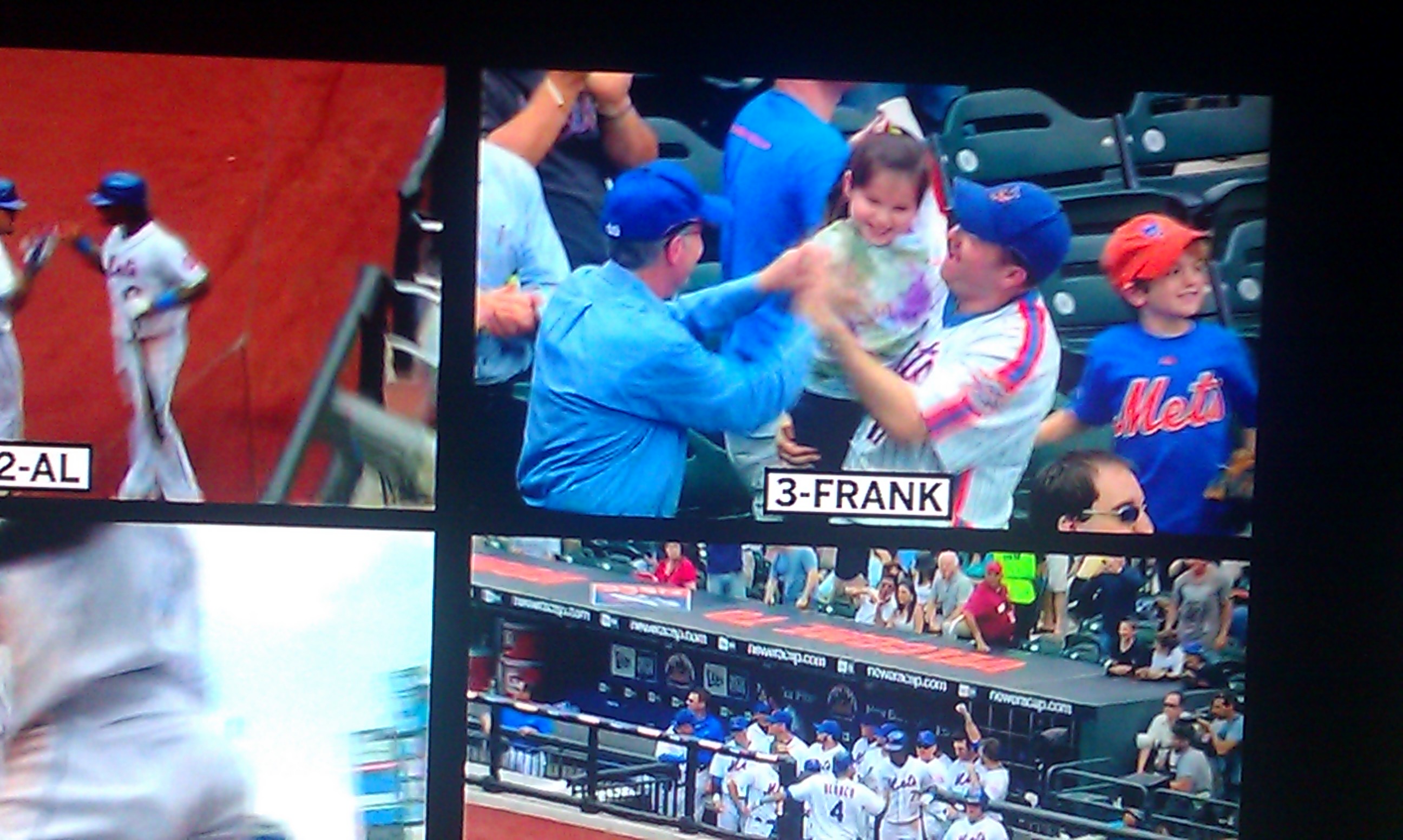
“Hey!” I tell Stephanie. “Look! Somebody’s wearing a Faith and Fear shirt!”
A beat passes.
“Hey! That’s Jason!”
Sure enough, my blogging partner, sporting those iconic retired numbers, is on camera. He and his son Joshua are celebrating Henry’s homer. At first I think they or somebody near them caught it, but no, that’s impossible, they’re seated behind first base. They’re just happy it was hit; they’re good Mets fans that way. Wow, I think, Jason and Joshua were on TV! How come I never saw this? How come I never heard about it?
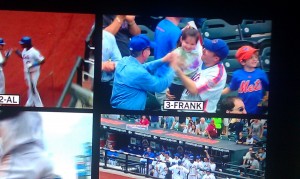 The back of an iconic shirt (top center). Then I realize they weren’t on TV. They were on Bill Webb’s bank of monitors. Camera 3 — Frank — picked them up, but Webby declined to put them on the air. If you didn’t eventually go the Museum of the Moving Image, you wouldn’t have known they were captured by SNY.
But I did, so I do.
The 2013 Mets received no karmic boost from my find — and I managed to miss the radio call of all the fun associated with Jerry Layne’s sound judgment. As for the 2010 Mets, their three-year-old 2-0 lead eventually dissolved into a 4-2 loss that never matched the excitement produced by Blanco’s blast, according to the man who exulted in it with his kid. Later came the night portion of the twinbill, when Jon Niese didn’t quite throw the first no-hitter in New York Mets history but came pretty close. Hence, the bottom of the second inning from that June afternoon got obscured pretty quickly. Yet its moving image and everything that went into transmitting it lives on in a loop. You should go take a look at it sometime. It’s more fun than looking for an oversized cup of coffee.
by Jason Fry on 22 August 2013 12:48 am In the bottom of the ninth, with one out, the score tied and the winning run on second, I was deliriously certain that Wilmer Flores would single, making the Mets walkoff winners and getting himself mobbed at first. When Flores grounded out instead, I was not particularly disheartened: The Braves walked John Buck (not sure why) and I was certain Travis d’Arnaud would single, making the Mets walkoff winners and getting himself mobbed at first. When d’Arnaud walked to load the bases, I was certain Juan Lagares would single, making the Mets walkoff winners and getting himself mobbed at first.
None of that was actual certainty; I’ve watched enough baseball to know better. But with Lagares at the plate against Luis Avilan, I was certain about one thing: Daniel Murphy had as much chance of batting in the bottom of the ninth as I did. Only Murph was in the on-deck circle at Citi Field and I was sprawled on my couch with my kid.
There was no scenario in the universe that would allow Murph to bat in the bottom of the ninth — Lagares’s AB was guaranteed to result in either a run, in which case the game would be over, or an out, in which case Murph’s next job would be to go out to his position for the top of the tenth. But there he was with his helmet on, taking practice swings and sizing up a pitcher he couldn’t hit against.
It’s silly, but it’s the rule — there has to be a guy in the on-deck circle even if he’s there for no conceivable purpose.
I decided we really need a name for this player waiting for a bus that cannot arrive, and so of course turned to Twitter. Here were my off-the-cuff ideas:
- the virtual batter
- the designated bystander
- the donut warmer
- baseball Godot
Not great, but the idea was to get brighter minds to weigh in. Which they did. Here are a few refinements:
- the sliding coach
- the Invisible Man
- dead man swinging
- Schrodinger’s batter
- the Vice-President
- Prince Charles
I think I like those last two the best, and would give the nod to “Prince Charles,” which makes you think a bit and has a certain Dada charm. (Tip of the cap to Patrick Donnelly.)
What I didn’t like and couldn’t guess was that Murph wouldn’t bat again — and not because Lagares delivered. (He didn’t.) In the top of the 10th, Andrelton Simmons singled with two out off Scott Atchison, prompting Terry Collins to call for Scott Rice to tackle nouveau Met-killer Freddie Freeman. Rice got Freeman to hit a comebacker, which hopped off his glove and trickled down the backside of the mound. Rice pounced on the ball and heaved it to Josh Satin at first, beating Freeman by less than a beard but more than a whisker.
Jerry Layne called Freeman safe.
Enter Terry, exit Rice, enter Greg Burke, exit pitch thrown to Chris Johnson, with the ball last seen vanishing into the left-field stands for a three-run homer as Craig Kimbrel waited vulturelike in the Atlanta pen. In other words, ballgame. Before Johnson even reached third base, Murph turned to bark at Layne, who promptly ejected him, bringing Terry back onto the field for his own eventual ejection, after which he stalked off without his just-flung cap. (It was one of those stupid orange-billed things; I’d have abandoned it too and gone off to get a real Mets cap.)
So. A few things regarding Mr. Layne, how we reached this unhappy place and where we’re headed.
1. It wasn’t that bad a call. It was a bang-bang play, and Layne got his bangs in the wrong order. A few years ago, before crystal-clear HD, we would have shrugged, tried to parse Rice’s reaction and written grumpy things about Burke.
2. Still, Layne got the call wrong. And the job of an umpire is to get the call right.
3. Technology has put umpires in a very bad place. There’s already instant replay in at least half the park — if I’m at Citi Field my head reflexively turns to find an overhead set after a close call. Pretty soon everybody in the park will have instant replay on his or her seatback or phone. I bet you umpires already know they’ve blown a call about 45 seconds after the play — because that’s how long it takes for the replays to be shown from multiple angles until a definitive judgment is rendered by the broadcast crew. That judgment is visible to a good chunk of the crowd and swiftly communicated to the dugouts and the field through renewed booing or surly silence. The umpires know; these days everybody does.
4. Baseball needs to fix this. The Mets lost today’s game because Jerry Layne blew a call. It’s more complicated than that, of course: They couldn’t get a hit with a runner in scoring position, and Jon Niese was understandably rattled after breaking Jason Heyward’s jaw with an errant fastball, with the stunned silence afterwards horrifying to witness. But it’s not wrong to say the Mets lost today’s game because Jerry Layne blew a call. So what was my reaction? I fussed and cussed a bit, but didn’t freak out too much — because I now expect some umpire somewhere will blow a crucial call pretty much every day. This level of numb acceptance is really bad for the sport.
5. Baseball is determined to fix this. Next year, apparently, managers will have a set number of challenges, like football coaches do today. When Terry came out to remove Rice, Justin Turner even helpfully piped up about this on the mound. Replied Collins, both philosophically and crabbily: “Yeah, well, that doesn’t help us today.”
6. Baseball’s idea for fixing this is stupid and half-assed. I’m not in favor of anything baseball does to make itself more like football, but I’m particularly opposed to a challenge system, because it takes an alarming amount of what sucks about football and rolls it up into one little red hankie — it’s bureaucratic, tedious and ultimately arbitrary. The idea is to get calls right, not to force managers to add game theory to their list of skills. If umpires blow more calls than a manager has challenges, nothing has been solved. If an umpire blows a call and the manager doesn’t challenge it, nothing has been solved. And does anyone really believe that a manager out of challenges will stand in the dugout in stoic acceptance of a blown call? It’s ridiculous, and surely the baseball brass know this.
7. If you’re gonna have an eye in the sky, use the damn thing. Guys at MLB headquarters watch every game. They buzz the on-field umps after a close call and consult an umpire on duty at headquarters. The on-field umps tell everyone to sit tight for a minute. The headquarters ump affirms the call or overturns it. Play resumes. Would there occasionally be judgment calls about where to put runners and other problems? Sure. But players would quickly learn to complete a play that might wind up disputed, and the new uncertainties would be better than what we have now.
8. But we’d still be looking for that first no-hitter! They’re not going to retroactively deprive us of it. Just deal.
9. Didn’t Angel Hernandez look at video of a blown home-run call and still blow it? Yes he did. Angel Hernandez is such a bad umpire that he can’t even watch TV correctly. This doesn’t really have much to do with the argument made above, but I’ve worked Angel Hernandez’s incompetence into far less relevant conversations, so there was no way I was missing this opportunity.
|
|