

Welcome to Flashback Friday: Take Me Out to 34 Ballparks, a celebration, critique and countdown of every major league ballpark one baseball fan has been fortunate enough to visit in a lifetime of going to ballgames.
BALLPARK: Dodger Stadium
HOME TEAM: Los Angeles Dodgers
VISITS: 1
VISITED: June 22, 1996
CHRONOLOGY: 17th of 34
RANKING: 12th of 34
“I was in California. Everything is new, and it’s clean. The people are filled with hope.”
—Don Draper, 1963
Perhaps it was overexposure to “Who Will Save Your Soul?” the monster soft rock hit of the spring of 1996, but the word that hit me immediately upon settling into my seat at Dodger Stadium was jewel. “This place is a jewel,” I kept thinking. I may have even said it out loud.
 I don’t know if the Dodger soul can ever truly be saved, what with its theft from Brooklyn — an inside job — on October 8, 1957. Per Jewel, Walter O’Malley told the Borough of Churches that, in essence, 68 seasons as Brooklyn’s representative in the National League had been swell, sweetheart, but it was just one of those things. You can reflexively blame O’Malley; you can be fashionably revisionist and pin it on Robert Moses; you can shrug and reason that a westward move too attractive to pass up, but as long as you’re aware that the backstory of the Los Angeles Dodgers is that they used to be the Brooklyn Dodgers, you can never quite fully give anything they do your unabashed blessing. No, that soul will, at best, forever hang in limbo.
But I was on vacation the Saturday I alighted at Dodger Stadium, so I was willing to put ancient sins aside and simply revel in the sparkly bauble Walter O’Malley left behind.
Admission to Dodger Stadium served as the climax to the three-ballpark Southern California road trip I simultaneously dreaded and embraced. I wanted it, of course, but I feared the logistics from a driving standpoint, driving no longer being my thing by the summer of ’96, and L.A. being the capital of American car culture. But as noted in previous entries regarding that week’s sojourns to Anaheim and San Diego, I dealt with it and regained my automobile comfort level for as long as it took me to get to those ballparks. The Angels were Wednesday. The Padres were Thursday. By Saturday, it was no big thing for Stephanie and me, enjoying the courteous loan of my sister’s and brother-in-law’s apartment in Marina Del Rey, to jump on the Santa Monica Freeway and head east toward downtown Los Angeles.
Dodger Stadium’s biggest surprise was, in a way, its location. I knew the name Chavez Ravine from all the trips the Mets had taken out there, but I never quite grasped where in the context of L.A. it was. When you see the ballpark on TV, it seems splendidly isolated, nestled among hills, trees and parking. But it’s not. It’s right there in the heart of the nation’s second-largest metropolis…like it’s in the opening credits of L.A. Law or something. Yet when you’re at the stadium, you put all that behind you — literally. The trend in 1990s ballpark construction veered sharply toward showing you the city you were in while you were watching the game. It was a welcome trend. But creating an urban oasis for the pastoral pastime? That wasn’t so bad, either.
Nice to be surprised by Dodger Stadium, though I don’t think I ever went into a ballpark for the first time with more preconceived notions about it or its fans. A quarter-century of being fed the same lines repeatedly will cement your notions in advance, and goodness knows Ralph, Lindsey, Bob and their successors hit the same notes over and over over the Met years:
• Dodger fans show up late.
• Dodger fans don’t pay attention to the game.
• Dodger fans leave early.
But the Met announcers had also always made much of the beauty of the ballpark, that it was, at a time when this wasn’t the rule, constructed for baseball and nothing else. It was a universally shared sentiment. Roger Kahn, who knew a little something about Dodger stadia, appraised it as such in his 1976 pulsetaking, A Season in the Sun:
“Dodger Stadium is a triumph of baseball design. The grass is real. The shape proclaims baseball.”
I was ready to have that preconceived notion confirmed and I wasn’t disappointed. Yes, that shape. It was absolutely perfect. Nowhere else I had been — modern classic or vintage masterpiece — seemed as spot-on in terms of appearing ready for its baseball closeup. The old salesman adage about underpromising and overdelivering was on immensely satisfying display at Dodger Stadium. A jewel?
A diamond.
Even today when visiting broadcasters set up shop in Chavez Ravine they heap praise on how the place is so clean, how a stadium opened in 1962 still looks so modern, how it’s kept up like nothing else. You can curse O’Malley for Bumnapping Brooklyn’s team and Bumrushing Brooklyn’s trust, but you have to grudgingly tip your cap in his direction (down below) for setting an incredible standard with Dodger Stadium. Not that the standard was much followed. Shea came to be a mere two years later and generated more grunge than Seattle at the height of Nirvana. None of Dodger Stadium’s contemporaries held their promise as long, and no park from the ’60s and ’70s was ever nearly as promising.
Damn that O’Malley, getting exactly what he wanted in Los Angeles and making it work to near perfection for decades, even long after he was gone. They gave him the land, he built his own palace and it’s thrived for nearly a half-century. Would that have happened in the downtown Brooklyn location he craved? Could have he created his own kind of miracle in Flushing had he been open to Moses’s crazy notion that the Dodgers could move to Queens? Would have leasing from the city allowed him the flexibility to build as he envisioned in an era when multipurpose facilities were fancied as a sporting panacea?
We’ll never know, and to be honest, I wasn’t thinking about it on our Saturday night at Dodger Stadium. I just knew it was, as Steve Garvey told Roger Kahn in 1976, date night. Garvey analyzed the different kinds of crowds the Dodgers drew depending on the date. Friday crowds were loudest — and harshest if you played badly. Sunday afternoons were for families and positivity. Monday and Tuesday night “you get the fans who really know baseball.” We had our own Garveyesque classification:
“Saturday. Date night. That just about what it sounds. Medium. If the guy and the girl are getting along, they’re with you. If he spills mustard on her skirt, it’s something else.”
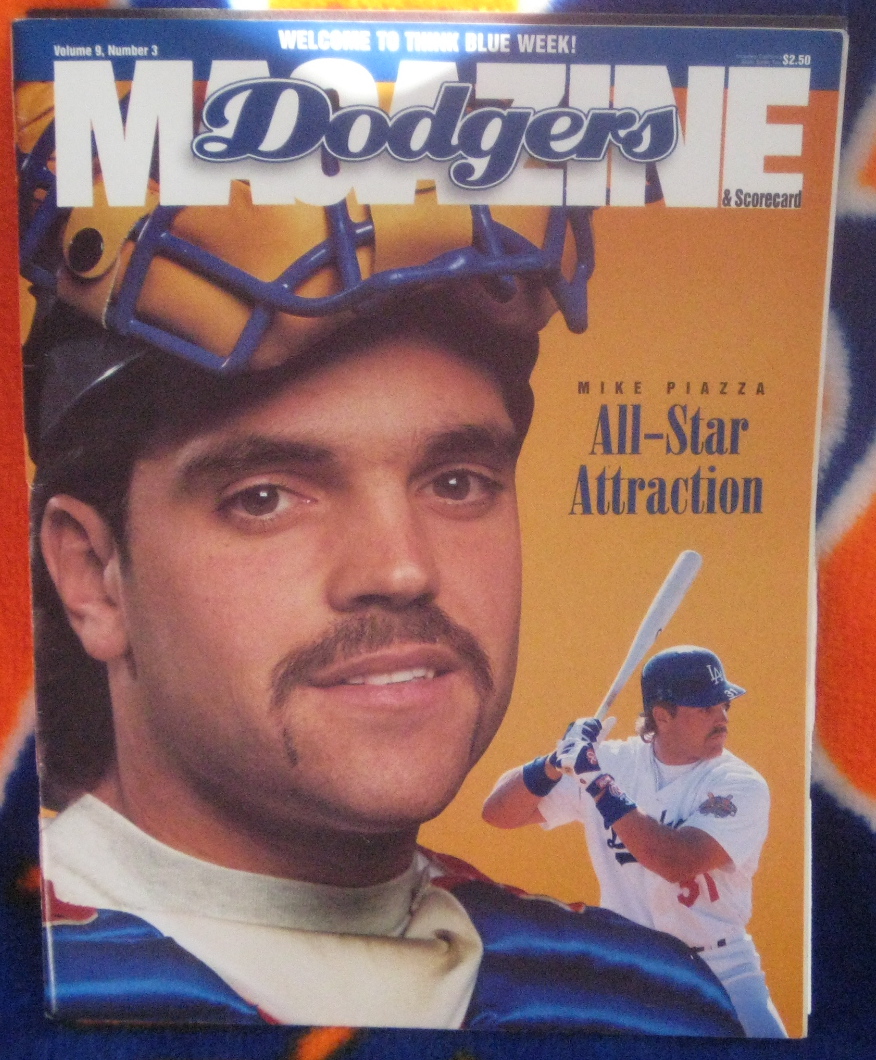
I don’t know if the All-Star first baseman’s analysis held precisely to form two decades hence, but Stephanie and I consciously dated the Dodgers on our Saturday night downtown. We’re always with the home team as long as the visitors aren’t the Mets, but I decided to go all in. I went for the legendary Dodger Dog (no mustard spilled). I nodded approvingly when a customer at a souvenir stand asked if he could buy an Astros cap (Houston being that night’s opponent) and was told in no uncertain terms, “This is Dodger Stadium. We only sell Dodger caps.” I bought a Think Blue t-shirt in honor of THINK BLUE week as proclaimed by the HOLLYWOOD-inspired letters on the Elysian Hills over the outfield fence. And I cheered heartily as youthful Dodger superstar Mike Piazza homered and caught a complete game shutout.
Ramon Martinez vs. Shane Reynolds offered us some vintage Dodger Stadium pitching — maybe not Gooden vs. Valenzuela or Koufax vs. Hendley, but exactly the kind of thing for which I showed up early and stayed past the end. Yet another of those articles of faith I’d absorbed on Channel 9: the mound is higher out here than anywhere else. Of course the pitching’s outstanding. Of course I was into it.
And of course the L.A. crowd got there when it got there and left when it left. In my two hours and twenty-four minutes of temp Dodger rooting (albeit while wearing my Mets cap), I couldn’t adjust to the local custom of ignoring the game at hand. As a beach ball bounced merrily through our section, I briefly betrayed my Brooklyn birth certificate and snarled, “Ramon Martinez is pitching a shutout — watch the game!”
But the Los Angelenos didn’t listen. They were getting by fine without me and they would continue to do so once I flew home and reverted to my sense of vague antipathy toward them. Dodger fans gotta be Dodger fans, I guess, and I imagine they’re only more so in this accursed epoch of the constantly deployed personal digital device that nobody is capable of laying off in the middle of a baseball game. Still, I think I was glad I saw Dodger fans acting as I’d been led to believe they would. What’s the point of schlepping across the country and not seeing what you expect?
The Los Angeles Dodgers I’d grown up slightly envying were reaching the last mile of their own singular freeway when we made our 1996 pilgrimage. Less than a week after we’d left L.A. (and my Southern California driving chops left me for good), manager Tommy Lasorda suffered a mild heart attack and was replaced on an interim basis for a month by Bill Russell before stepping down from the job he’d held twenty years. Lasorda took it over at the end of 1976 — the year of Kahn’s Season in the Sun visit — from Walter Alston, who took it over in Brooklyn in 1954 — the year Kahn left the Dodger beat at the Herald Tribune. An O’Malley, Walter’s son Peter, was still running the club in 1996, but a sale was imminent. I was reminded this week by Lee Jenkins’ dissection of the Frank and Jamie McCourt divorce mess in Sports Illustrated that when Peter O’Malley was in charge, he held the line on ticket prices for a very long time. The article made me remember that Dodger tickets were substantially cheaper than Angel tickets and Padre tickets on our trip…and, at the risk of buying into overbearing myths, these were the Dodgers we were talking about.
If the Los Angeles Dodgers cultivated a pristine image worthy of pre-divorce Steve Garvey, it didn’t endure without a foundation of genuine merit. Those Dodgers, original sin against Flatbush notwithstanding, were something special when I was a kid. They didn’t win their division every year — and didn’t win two World Series I really wanted them to win in 1977 and 1978 — but they were probably, as Kahn said they themselves were fond of telling you circa 1976, “the best organization in baseball”.
The Dodger Way. Dodger Dogs. Topping 2 million in attendance annually when that was an achievement. The first team to top 3 million. Those celebrity seats behind home plate. Vin Scully. Vero Beach. Danny Kaye. Koufax and Drysdale in retirement but talked about as if they were still in rotation. Fernandomania in full bloom. Cey, Russell, Lopes and Garvey together almost forever. Alston and Lasorda, the two polar opposite managers who spanned more than four decades between them. The parade of Rookies of the Year, particularly that Piazza kid.
Those were the L.A. Dodgers I came to see. Roger Kahn wrote in The Boys of Summer that a reporter needs to subscribe to the maxim, “Do not preconceive.” I did anyway. I wasn’t disappointed. Nowadays the Dodgers seem like just another team. They were sold to nefarious Fox. Fox sold them to the combustible McCourts. They plaster ads all over their premises just like anybody else. They run through managers just like anybody else. They stopped producing Rookies of the Year after Todd Hollandsworth was deemed the best of an underwhelming freshman lot in ’96. They traded Mike Piazza…and thank goodness they did.
I’m glad I got the last gasp of the L.A. Dodgers I’d fancied from afar; the L.A. Dodgers I sort of looked up to in the middle of the 1970s; the L.A. Dodgers I’d never fully blamed for the disappearance of the Brooklyn Dodgers because I hadn’t done all that much reading on them until the late 1980s when I finally picked up and dove into the copy of The Boys of Summer I’d purchased for 50 cents at a college flea market five years before. That was when I began to fully comprehend the crime against humanity perpetrated by Walter O’Malley in 1957 (even if it and Horace Stoneham’s loathsome complicity are ultimately the two main reasons we have the Mets). The Dodgers I knew best were the Dodgers from A Season In The Sun, the version Kahn visited when they were at their L.A. peak.
This morning, of the ’70s, Dodger Stadium lay empty. The aisles and seats had been swept clear of litter and gum, deposited by the 52,469 customers the night before. Toward the right lay the ball field, green and white and a reddish tan. To the left, from O’Malley’s office, lay hills that had been barren. They are irrigated and showed the green of watered pines.
“What a pleasant office you have,” I said.
“Not so pleasant,” O’Malley said. “Outside my window there’s a groundskeeper standing in center field with a hose, and I wonder, if he’s going to use a hose, why the hell did I put $600,000 into an underground sprinkler system?”
“Why does he use a hose?”
“Because we brought him out from Brooklyn and he used a hose there,” the owner of the Los Angeles Dodgers announced, impatiently.
Walter O’Malley died in 1979. Chances are nobody who was alive in Brooklyn in 1957 would even think of using a hose on him where he likely wound up.
Speaking of Brooklyn ballclubs, congratulations to our very own Cyclones for defeating the Jamestown Jammers and making it to the New York-Penn League Championship Series this weekend. Now go tame those Tri-City ValleyCats!






My one and only visit to Dodger Stadium included a fight — after which they played “Bad Boys,” to my amazement — but I was mostly watching the out-of-town scoreboard, because it was the day the Mets came back and beat Curt Schilling, with Roger Cedeno safe at the plate and drumming his heels happily on the ground. In that pre-devices age what I really wanted to do was rush back to the hotel and figure out how they’d pulled that one off.
Re Dodger Stadium looking so great, though, I imagine the climate sure helps. California is full of ancient cars that still look great because they hold up better without snow and salt. Lovely park, but a built-in advantage there….
“Bad Boys” –Theme from “Cops”. By then Fox owned the team. Rupert Murdoch…synergy…nah, couldn’t be.
Climate — good point, but I was at the other two stadia the same week and they didn’t look/feel nearly as clean.
Schilling and the ninth inning — STILL effing great.
Every time I watch the Amazin Again VHS, it always hits me after the Schilling Game: if we lose a single one of these comeback games, we don’t make the playoffs in 1999. It just makes those big moments even bigger.
Dodger Stadium is now stuck in mid-renovation thanks to the recession and the McCourt disaster. It’s still a gorgeous setting, but the stadium is showing its age, especially if you sit in the upper levels. Hopefully the McCourts will be forced to sell (why can’t that happen with the Wilpons?) and whoever buys the team can finish the renovations.
It’s now the only mid-century ballpark left believe it or not, and it should be preserved and updated.
[…] Me Out to Jacobs Field by Greg Prince on 17 September 2010 11:00 am Welcome to Flashback Friday: Take Me Out to 34 Ballparks, a celebration, critique and countdown of every major league ballpark one baseball fan has been […]
[…] was frigging Olympic Stadium. Before that, the spate of Vets. Before that, Shea, and before that, Dodger Stadium, the only thing in the league besides Wrigley actually built for […]