

In the opening weeks of a Mets offseason we hope doesn’t linger beyond the forthcoming winter, we have learned a new phrase, “uncapped downside scenario,” courtesy of David Stearns, who for his next press conference might want to assign one of the staff interpreters to translate his fluent POBOese into English. To be fair, Stearns was talking about the 2026 Mets, so we could pretty easily infer the meaning of his words without the services of Alan Suriel or Hiro Fujiwara.
We have also been told we can forget the identities of three coaching staff members (not necessarily coaches), Jeff Albert, Danny Barnes, and Kevin Mahoney, the respective former titles of whom — director, major league hitting; quality assurance coach; and batting practice pitcher — represent three jobs that I don’t believe would have been included in an official team communiqué a decade or so ago. Director, major league hitting, and quality assurance coach come out of the same executive glossary that gives us uncapped downside scenario. And authorizing a missive to announce the batting practice pitcher wasn’t properly grooving them down the middle or, for all we know, throwing too many meatballs seems rather postmodern, too.
Twelve teams entertained their fans by played more baseball following the last game of the 2026 regular season. We’ve made do in the shadow of other people’s playoffs with linguistic gymnastics. Still, especially in October (no matter how Metless), how can you not be romantic about baseball?
For example, how can you not be romantic about baseball when baseball gave us not only Ralph Kiner in the Mets broadcast booth for 52 seasons but Ralph Kiner in a comic book? Ralph Kiner was a big enough deal in his Pittsburgh Pirate playing prime to rate the cover of the August 1951 Sports Action #8. Directly within awaited “the stirring story” of the “the Pirate slugger whom the experts pick to smash Babe Ruth’s home run record this season!” Ralph had just come off seasons of 54 and 47 home runs, so why not a larger-than-life 61 or more? Alas, Ralph’s total dipped to 42 in ’51, still good enough to again lead the National League.
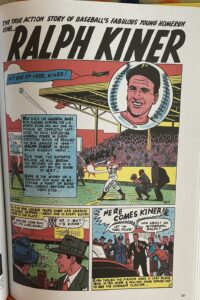 Ralph’s reign as the idol of young America is lovingly captured amid the sumptuous Atlas Comics Library collection of Sports Action titles, recently released by Fantagraphics Books, an imprint of Marvel Publishing. A comprehensive introduction from medium maven and Friend of FAFIF Dr. Michael J. Vassallo, explains sports-themed comics were “a niche market even in their heyday,” yet there they were on the newsstand alongside all the day’s periodicals. A kid drawn in by the drawing of Ralph on the cover in the late summer of ’51 may have very well had that very comic book within reach as Bobby Thomson swung for immortality and the Polo Grounds fences a few weeks later. It was a time when baseball stars were national heroes, and you can feel that exalted status jumping off the pages of Sports Action. The very same issue that put Ralph on a pedestal also gave iconic treatment to future Met Warren Spahn and one of Ralph’s eventual New York broadcasting counterparts, Phil Rizzuto. Other installments bring us into comic contact with incandescent legends like Jackie Robinson, hallowed names like Hack Wilson, and stalwarts like Red Schoendienst, hailed in the February 1950 Sports Action as “the most under-rated second sacker in baseball!” yet not so under-rated that he wasn’t selected to sparkle among this galaxy of stars. (Red, Hack, and Jackie, like Ralph, Spahnie, and the Scooter, are all in the Hall of Fame.)
There are a lot of sports covered in Sports Action. Knute Rockne rumbles in to represent college football. Man O-War gallops over from horse racing. And if you prized fighters, you had to be sweet on Sugar Ray Robinson, “the man other fighters fear!” Exclamation points were not in short supply at Sports Action As this collection shows, sports were something to get excited about, your cynicism checked at the door. As one fan in the stands says while watching high school-age Ralph attract scouts’ attention, “Kiner looks great today!” Few ballplayers ever looked better than they do in Action Comics.
Comic books helped you see your favorite ballplayers before television totally took hold as the baseball delivery vehicle of choice. Radio still does that. We wouldn’t have bordered on verklempt during the final broadcasts of Howie Rose in September if baseball over the airwaves (absorbed traditionally or through a digital device) didn’t continue to transmit a certain romance about the game. TV existed in 1951, but the signal event of that year — in baseball, in America — lives on because of a radio call. Kid, put down that Ralph Kiner comic and listen up:
“Here’s Bobby, waiting. Branca throws…”
I know you’re expecting Russ Hodges over WMCA (later home of the Good Guys and, for five seasons, flagship station for the Mets) to inform you several times consecutively that the Giants win the pennant, but on YouTube you can hear how the deciding game of the 1951 National League playoff went down the way it was heard in much of the country, via Gordon McLendon on the Liberty Network. It’s a longer broadcast excerpt than you’re used to hearing from Hodges, and it’s a treat. Brother, does McLendon bring the drama, not just to the swing of fate, but to “the final count, the last mile, the last half-inning,” everything from the bottom of the eighth through Thomson’s trip around the bases.
The Dodgers, after increasing their lead to 4-1, “may have just served the death warrant”. Those Brooklyn fans who ventured up to Coogan’s Bluff “roar, roar, roar.” They’re beginning to celebrate, “perhaps a little bit precipitantly”. On the “valorous” Giants side, Bill Rigney is “the basket boy” (for the manner in which he caught popups, with fielding prodigy Willie Mays taking notes); Hank Thompson is “Donkey”; Eddie Stanky is “Leo’s pride and joy” as well as “a dangerous clutch man”; and Whitey Lockman is “the Carolina Towhead,” because “Whitey” isn’t enough of a nickname. Well before the conclusion of this echoing evergreen candidate for Greatest Game Ever Played, McLendon marvels, “Boy, I’ll be seven sardines in a size-six can if this isn’t a honey.”
Kid, don’t put down this column, but do listen to McLendon take you on a tour of what baseball sounded like at the peak of its National Pastime powers. Baseball always sounds special in October, what with so much on the line. I love seeking out the hometown broadcasts from the postseason combatants in Octobers when the Mets are at liberty (which is most of them). I love tuning into the national radio broadcasts for their touch of gravitas. And I love hearing about what it’s been like on the inside of those booths.
Henry Lenz, longtime Friend of FAFIF (we do attract a nice crowd), turned on the mics, so to speak, at a Substack he dubbed Still Rolling, a multimedia journal devoted to his career as a radio engineer for CBS and his affection for the vehicle that has taken so many of us to so many ballgames with just our ears and our imagination.
“There’s something timeless about Baseball on the Radio,” Henry shared earlier this season. “Long before high-definition screens and endless replays, the game lived in sound — the crack of the bat, the rise in the announcer’s voice, and the pictures your mind created on its own. In my case, not just listening — but having the rare privilege of sitting behind the sportscasters & microphones, helping bring those moments to life.” The All-Star Game. The World Series. The little matter of an earthquake disrupting the Fall Classic. He was an essential part of bringing audio to enormous audiences annually.
Henry worked closely with many of the greats, in baseball (Vin Scully!) and in news (Walter Cronkite!), and is generous with his recollections, one of which will transport you to the night we knew we’d never forget the name Bill Buckner. Roll on over to Still Rolling and don’t hesitate to raise the volume…unless you’re sneaking his Substack under your pillow, transistor-style.
One of the greats in the art of telling you what’s going on in a game is Mike Breen, a New York radio veteran who’s become synonymous with the NBA on TV. He’s also one of the great celebrity Mets fans, not just because he’s a celebrity and a Mets fan, but because (as you could tell when sat in with Gary and Keith in late August) he adores the Mets so sweetly and innocently, and the fact that his fame opens the doors for him (like getting to sit in with Gary and Keith) hasn’t depleted a scintilla of his wonder at getting to be around his favorite ballclub once in a while. Mike, like our pal Henry, has an Amazin’ story from being on what we’ll call Radio Row at Shea on October 25, 1986. Absorb a basketball voice’s baseball reflections at Like It Oughta Be, Mark Simon’s essential championship anniversary newsletter.
Video has its own place in the romantic scheme of baseball, of course. YouTube recently sent us a Valentine of sorts, when it hosted the posting of The Lighter Side of the Mets, a digitization of a VHS celebrating the Mets for their inherent wackiness. This was produced in the late 1980s, when the kicking of a ball around by any given Met was viewed as an artifact of the past and an aberration in the present. The Mets hadn’t won a World Series in two going on three years, so nobody had yet linked the name Buckner to a potential uncapped downside scenario (writer Tim Josephs makes such a curse case here). I ate up the Lighter Side presentation for how many Original Mets it got on the record while they were still hale, hearty, and immersed in baseball. Bob Murphy narrates. Tim McCarver is heard. Plus a couple of dollops of youthful Mets broadcasters Gary Cohen and Howie Rose are in evidence.
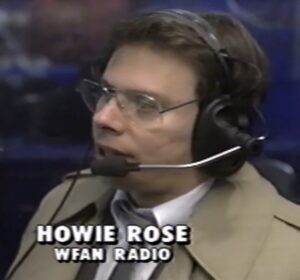 Howie’s name keeps coming up here, doesn’t it? Why shouldn’t it? He’s been in our ears for decades and on our minds all year. We were dismayed when he announced his impending retirement in March, daring to relish other aspects of his life in his seventies. We were delighted when we learned he fulfilled his 62-year-old wish and got to meet a Beatle — Paul McCartney — in May. We didn’t mind getting a little damp in service to saying goodbye to him on a rainy September weekend. Paul, when he led Wings, advised us to listen to what the man said. When Howie spoke, that’s what we did.
I heard another valued voice on that final Sunday Howie was going to be on the job. Just as my tickets were being scanned, somebody still getting her bag checked by security called out to me. It was Stefanie Brand, a fine person in her own right, but someone I was compelled to introduce to my Stephanie as “Dana’s sister”. In turn, Stefanie introduced me to the person she was with as “Dana’s friend”. If you’re still defined by your relationship to Dana Brand in 2026, even if it’s just for a minute, you must be doing something right.
We chatted for a bit while standing in the Rotunda, not too many feet from where I last bumped into Dana, in 2011. That wasn’t supposed to be our last meeting. Dana Brand wrote regularly and eloquently about the Mets from the mid-2000s to the early 2010s before passing without warning. Fifteen years since he’s gone, and I continue to miss him. Had he been around on September 20, I know he’d either have trekked to Citi Field for Howie Rose’s final game or sat next to a radio to listen to what the man was saying. Then soon I’d be reading what this man I was lucky to know thought about what he saw/heard.
The next best thing I could do was, once I got home from Closing Day 2026, was pick up Dana’s 2007 book Mets Fan and turn to his essay titled simply “Howie Rose,” the conclusion of which, frankly, haunts:
“I hope I get to listen to Howie forever. I think he’s exactly my age. Despite the rigors of the job, and all the travel, people who are lucky enough to get to be baseball announcers seem to want to do it until they literally no longer can. So Howie’ll be working a lot longer than I will be. I’ll listen to him when I’m retired. I’ll envy him and enjoy him.”
Dana’s thoughtful appreciation of Howie reminded me that Richie Ashburn — still very much in his prime as a Phillies announcer when he appears in that Lighter Side video warmly recalling his 1962 Mets experience — died in a Manhattan hotel room amid a Mets-Phillies series he was working in 1997. He was lucky enough to talk baseball on the air and did it until he literally no longer could. I remember sentiments from around that time from baseball announcers who by then had been around forever — which absolutely described Ralph Kiner and Bob Murphy — to the effect that they did not want to meet their end like Ashburn had. Maybe that’s something that imprinted on Howie, who by then was in his second decade associated with Mets broadcasts and in his second year as the voice of the Mets on Sportschannel. He’d go on to experience the rigors of a baseball schedule and a hockey schedule over and over. He gave up the travel. He never let go of the romance. The romance is what keeps us attached to this game and this team in whatever capacity we choose to hold on.
Dana, like Howie, was clear-eyed about the thing he loved. “I like how Howie can get annoyed,” Dana wrote in Mets Fan. “It’s good to have a baseball analyst or announcer who can call crap for what it is, who can say, like Howie says, ‘Oh come on…’” As the author noted, we wouldn’t have gotten such bracing honesty from one of Howie’s mentors. “In Murph’s world,” Dana insightfully added, “people could not be called out for their crap. He might say ‘my, my,’ or ‘what a shame,’ but he wouldn’t do what Howie does. Howie will complain, forthrightly, about what should be complained about.”
As an English professor, I’m certain Dana would have had a ball parsing “uncapped downside scenario”. As a Mets fan, I’m confident he would have called out David Stearns on quite a bit of the crap that led to the uncapping. Sometimes we can’t help but be attracted to what we disdain, maybe because we think we can somehow take a sad situation and make it better, maybe because we just embrace the opportunity for catharsis. As another announcer, Joe Garagiola, famously said of baseball, romance is a funny game.






Thank you for including me in this column Greg! In my ‘CBS Radio’s Field of Dreams’ Substack episode, posted back on April 13th, I shared my stories of Vinny, Jack Buck, Willie, Mickey & the Duke and Mookie & Bill :) And Spahn danced with my date in Cooperstown one year and Rizzuto always brought a box of cannoli’s for our broadcast crew!
Timeless tales, Henry. Beautiful stuff.