The blog for Mets fans
who like to read
ABOUT US
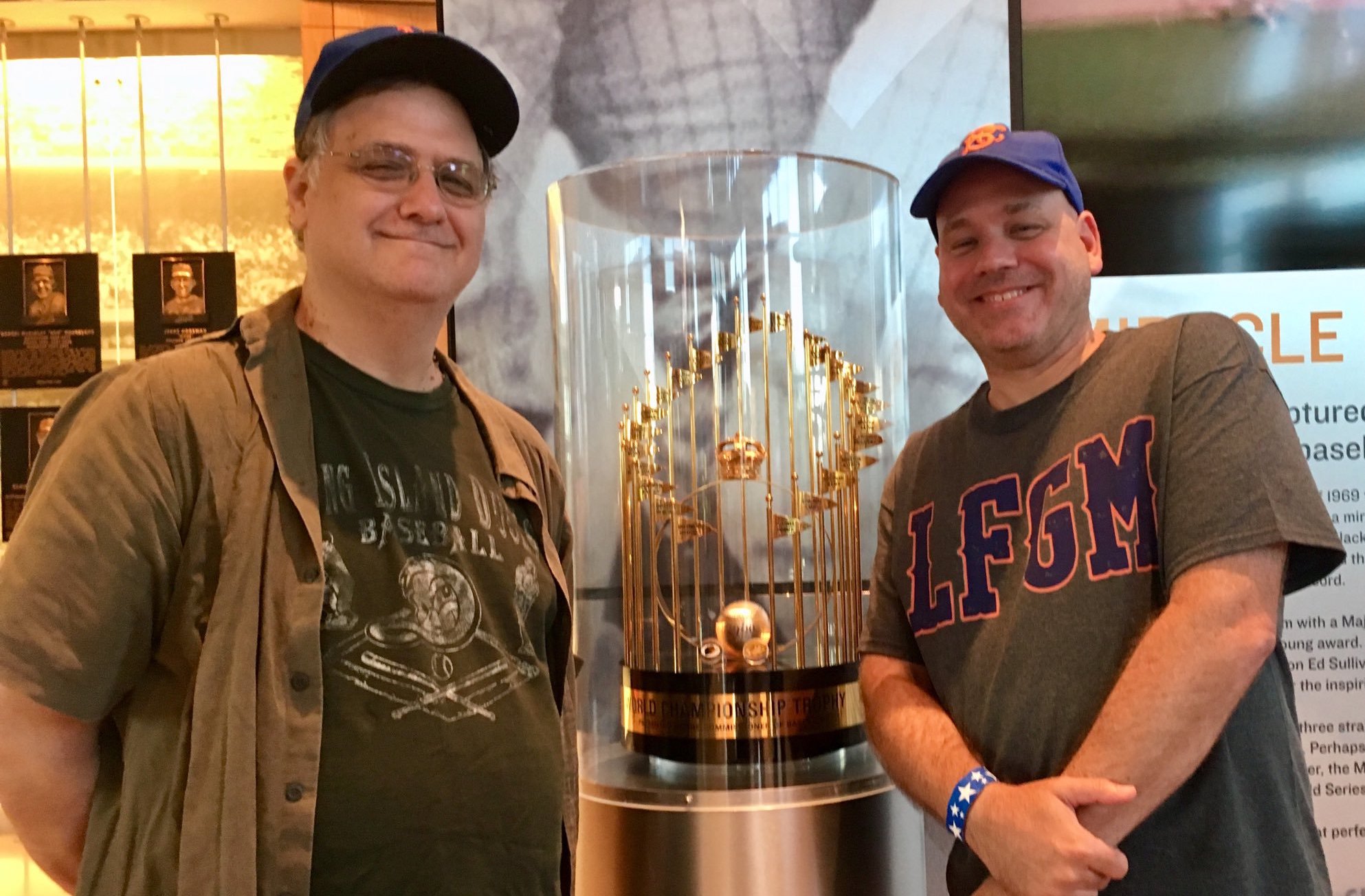
Faith and Fear in Flushing made its debut on Feb. 16, 2005, the brainchild of two longtime friends and lifelong Met fans.
Greg Prince discovered the Mets when he was 6, during the magical summer of 1969. He is a Long Island-based writer, editor and communications consultant. Contact him here.
Jason Fry is a Brooklyn writer whose first memories include his mom leaping up and down cheering for Rusty Staub. Check out his other writing here.
Got something to say? Leave a comment, or email us at faithandfear@gmail.com. (Sorry, but we have no interest in ads, sponsored content or guest posts.)
Need our RSS feed? It's here.
Visit our Facebook page, or drop by the personal pages for Greg and Jason.
Or follow us on Twitter: Here's Greg, and here's Jason.
|
by Greg Prince on 8 January 2013 4:54 pm Richard Ben Cramer, a journalist like no other I’ve read, clearly kept his ears open as well as his eyes. Cramer, who just passed away at the age of 62, listened. Listening is so much more effective than talking. Too many people who ask questions — journalists and otherwise — spend too much time holding the ball on their side of the conversation. Shut up, I kind of want to say politely, and let your subject answer.
Cramer did that. Cramer had to have. You don’t deliver as much sound as he did to a story without a very active ear. A good eye, too, and Cramer had that working at all times. The man heard what was going on and he noticed what was going on. It was a combination that could cut glass when set to the printed word.
I love to read baseball. I love to read politics. Richard Ben Cramer was so sharp at writing both that I could read him on either subject all day and all night — and I literally did. Cramer’s masterwork on politics, What It Takes: The Way to the White House, accompanied me on a cross-continent sprint the year it came out, 1992. I had to fly all night to Vancouver and fly all night the next night back to New York. What It Takes checked in at 1,047 pages, though who was counting? Today they’d make me buy it its own ticket. I’d have bought it one then if that’s what it had taken for me to take What It Takes where I had to go. It was the epitome of I-can’t-put-this-down storytelling.
What It Takes is a hexagon-shaped profile of approximately half the serious presidential primary field of 1988, when no incumbent was running, thus everybody in both parties was giving the race a spin. Cramer burrowed his way into a half-dozen heads that carried the loftiest of electoral aspirations. In so many words, he wondered what kind of a person thinks he’s fit to be leader of the free world? So he set about finding out, not just by getting to know his subjects — Messrs. Bush, Dole, Dukakis, Biden, Hart and Gephardt — but just about everybody who’d ever known them. Any one would’ve been a biography for the ages. But six? Via who knows how many hundreds of conversations and filtered through a half-dozen psychographic dialects that remained true to their subjects while never letting you forget they were gathered together under one hardcover roof?
Amazin’.
Which, you might say, is where the reader enters the What It Takes story, on October 8, 1986, Game One of the NLCS at the Astrodome. It was the beginning of the George Bush campaign trail and it just happened to cross paths with the Mets’ pursuit of a pennant:
Tonight, George Bush will shine for the nation as a whole — ABC, coast to coast, and it’s perfect: the Astros against the Mets, Scott v. Gooden, the K kings, the best against the best, the showdown America’s been waiting for, and to cut the ribbon, to Let the Games Begin…George Bush. Spectacular! Reagan’s guys couldn’t have done better. It’s Houston, Bush’s hometown. They love him. Guaranteed standing O. Meanwhile, ABC will have to mention he was captain of the Yale team, the College World Series — maybe show the picture of him meeting Babe Ruth. You couldn’t buy better airtime. Just wave to the crowd, throw the ball. A no-brainer. There he’ll be, his trim form bisecting every TV screen in the blessed Western Hemisphere, for a few telegenic moments, the brightest star in this grand tableau: the red carpet on the Astroturf; the electronic light-board shooting patterns of stars and smoke from a bull’s nose, like it does when an Astro hits a home run; the Diamond Vision in riveting close-up, his image to the tenth power for the fans in the cheap seats; and then the languorous walk to the mound, the wave to the grandstand, the cheers of the throng, the windup…that gorgeous one-minute nexus with the national anthem, the national pastime, the national past, and better still…with the honest manly combat of the diamond, a thousand freeze-frames, a million words worth, of George Bush at play in the world of spikes and dirt, all scalded into the beery brainpans of fifty million prime-time fans…mostly men. God knows, he needs help with men.
So George Bush is coming to the Astrodome.
Disaster in the making.
“The thing is,” Cramer continued, “it couldn’t just happen. George Bush couldn’t just fly in, catch a cab to the ballpark, get his ticket torn, and grab a beer on the way to his seat. No, he’d come too far for that.” Meaning? Meaning there’d be six or seven pages on all the logistical ins and outs it took to get a sitting vice president to the mound of National League playoff game; five more on how Bush embraced the job he was compelled to settle for six years earlier; the introduction to the Astrodome scene of his explosive eldest son, George, and the element of danger he represented as he expressed his displeasure over the less-than-royal treatment his dad’s operation had allowed to transpire in his direction (“SEATS AIN’T WORTH A SHIT. I GUESS THE BOX GOT A LITTLE CROWDED…”); then back to the elder Bush and a hearty helping of the veep’s well-honed love of all things jockish, including a nugget about his friendships with Tom Seaver and Nolan Ryan…all of which builds up to the “disaster” of a bulletproof vest-encumbered first pitch which Cramer foretold:
[H]is eyes still following the feckless parabola of his toss, which is not gonna…oh, God!…not gonna even make the dirt in front of the plate, but bounce off the turf, one dying hop to the…oh, God!
And as he skitters off the mound toward the first-base line, and the ball on the downcurve of its bounce settles, soundless, into Ashby’s glove, then George Bush does what any old player might do in his shame…what any man might do who knows he can throw, and knows he’s just thrown like a girl in her first softball game…what any man might do — but no other politician, no politician who is falling off the mound toward the massed news cameras of the nation, what no politician would do in his nightmares, in front of fifty million coast-to-coast, prime-time votes:
George Bush twists his face into a mush of chagrin, hunches his shoulders like a boy who just dropped the cookie jar, and for one generous freeze-frame moment, buries his head in both hands.
I love to read baseball. I love to read politics. What were the odds the two would converge this way?
Don’t care for politics? Cramer wrote baseball straight, too. His Joe DiMaggio: A Hero’s Life explained to me once and for all why my dad and his generation revered Joltin’ Joe beyond mere statistical measurement and more than hinted at why that reverence wouldn’t fly today. He was less iconoclastic toward Cal Ripken, Jr., at the height of streakmania in 1995 for Sports Illustrated, but every bit as characteristically sharp in observing the scene around him:
It’s a stinkin’-hot night at the ballpark — near 100°, the air is code red — and the Orioles are playing the cellar-dwelling Blue Jays. Still, it’s got to be a big night: It’s Coca-Cola/Burger King Cal Ripken Fotoball Night. That is, it’s the sort of ersatz event that is a staple of baseball now that payrolls are fat, attendance is slim, and the game — well, no one trusts the game to be enough. These new Orioles yield to no club in the promotional pennant race. There’s Floppy Hat Night, Squeeze Bottle Night, Cooler Bag Night. There’s an item called the NationsBank Orioles Batting Helmet Bank, and there’s the highly prized Mid-Atlantic Milk Marketing Cal Ripken Growth Poster. They are all a stylistic match for the graphics on the scoreboard that tell you when to clap or the shlub whose bodily fluids are draining into his fake-fur Bird Suit while he dances on the dugouts for reasons known only to him.
Still, as a celebration of the Hardest-Workin’ Man in Baseball, the hero of this Old-Fashioned Hardworkin’ Town, the Cal Ripken Fotoball is my personal favorite, perfect in every detail. There is the F in the name — gives it klass, and it’s korrect, because there’s no photo on the ball. There’s a line drawing of Cal’s face, with a signature across the neck. The signature is of the artist who made this genuine-original line drawing from a genuine-official photo of Cal. And then there’s the plastic wrapper — says it’s all Made in China. I like that in a baseball. And one key word: NONPLAYABLE. In other words, don’t throw or hit it, or this fotobooger will come apart.
Hours before game time, I wanted to ask Cal about his Fotoball. I wanted to ask how it feels to be the icon for baseball and Baltimore. But he’s hard to catch in the locker room. He has his locker way off in the corner, where his dad used to dress as a coach. The official-and-genuine Oriole explanation is that the corner affords him room for two lockers — one extra to pile up all the stuff fans send him. But it’s also unofficially helpful that there’s an exit door in that corner, and anyway it makes Cal plain hard to get to. (One day early in the season I was blocked entirely by the richly misshapen and tattooed flesh of Sid Fernandez.) And if you’re lucky enough to catch Cal, you’re still not home free: Even local writers — guys Cal knows — find that out. “Angle your story,” he might say, without looking at the writer, his eyes still on the socks in his hand. “Yeah…but what’s the angle?”
So the writer must explain what he means to write. “Cal, it’s just about all the second basemen you’ve had to play with — you know, 30 different guys to get used to.”
“No,” Cal says to his socks. “Doesn’t do me any good to answer that.”
See, these days, just a handful of games from Lou Gehrig’s record of 2,130 consecutive starts, he’s playing writers like he always plays defense, on the balls of his feet, cutting down the angles: How is this gonna come at me? Where should I play it? Positioning (forethought, control) has always been his game. And streak or no streak, Cal still has to play the game his way — that is, correctly: He’s got to click with his second baseman.
Fifteen years after I first read that, I wrote this, about a Mets promotion called Collector’s Cup Night. It’s a piece people remind me of to this day. I realized today, as I sought out his writing, that my Collector’s Cup was a direct descendant of Richard Ben Cramer’s Fotoball. He paid attention and he wasn’t so occupationally immersed in his habitat that he was incapable of making note of its occasional absurdities. To him, it was a Fotoball. To me it was the notion that we were actively Collecting Cups. His Ripken story was about far more than a silly sponsored promotion, but a little slice of it served as a quiet inspiration to some writer somewhere. A multitude of his slices have over time, actually.
Richard Ben Cramer’s writing was just that sharp.
by Greg Prince on 7 January 2013 4:47 am The New York Mets have thus far this offseason, when not trading reigning National League Cy Young Award winners, procured the services of the following players with non-Mets major league experience:
Josh Rodriguez, infielder, 28 years old, 7 MLB games (2011);
Jamie Hoffmann, outfielder, 28 years old, 16 MLB games (2009, 2011);
Anthony Recker, catcher, 29 years old, 27 MLB games (2011-2012);
Carlos Torres, pitcher, 30 years old, 44 MLB games (2009-2010, 2012);
Greg Burke, pitcher, 30 years old, 48 MLB games (2009);
Brandon Hicks, infielder, 27 years old, 55 MLB games (2010-2012);
Andrew Brown, outfielder, 28 years old, 57 MLB games (2011-2012);
Collin Cowgill, outfielder, 26 years old, 74 MLB games (2011-2012);
Aaron Laffey, pitcher, 26 years old, 148 MLB games (2007-2012);
and Brian Bixler, infielder-outfielder, 30 years old, 183 MLB games (2008-2009, 2011-2012).
Among them, these 10 players, born between 1982 and 1986, have played a combined 659 games in the major leagues since 2007. By comparison, I recently turned 50 and have attended, by my count, 582 games in the major leagues since 1973.
It would be easy to say, “I’ve never heard of these guys,” and, in fact, I will say it: I’ve never heard of these guys, even if that’s not exactly true. Josh Rodriguez was in the Mets system last year and I’m pretty certain I noticed his name during a Bisons telecast or two. And six of these fellows — Torres, Burke, Brown, Cowgill, Bixler and Hicks — are certified by Baseball-Reference to have played against the Mets in games I watched and sort of remember.
But mostly, I’ve never heard of these guys. It’s as if John Hughes had lived to write and direct Moneyball.
***
Monday, January 7, 2013
New York Mets Spring Training Complex
Port St. Lucie, FL 34986
Dear Mets Fan,
We accept the fact that you’ve had to sacrifice several seasons of contention for whatever it is the Mets did wrong. But we think you’re crazy to make us report to camp early to tell you who we think we are. You see us as you want to see us, in the simplest terms and the most convenient definitions. But what we found is that each one of us is…
• a minor league free agent
• a waiver claim
• a cash-considerations purchase
• an agate-type acquisition
• and somebody you’ve never heard of.
Does that answer your question?
Sincerely yours,
The Afterthought Club
(We see Bixler walking across the baseball field as he thrusts his fist into the air in a silent cheer and freezes there. Cue Simple Minds.)
***
R.A. Dickey could rightly be invoked in this space as the unheralded December transactionee who delightfully surprises the smirk off our cynical faces, therefore proving rushed judgment should always be held in abeyance. Swell — but I’d heard of Dickey before we signed him in the kind of ink-conserving deal that brought us these fill-in-the-blanks. Of course I’d heard of Jason Bay, too, so glowing advance notices are not ironclad guarantees of anything.
Listen, if any given underknown quantity in this bargain-bin bunch works out by way of a key strikeout or a rally-extending hit, we’ll praise him as a good get at least until his unproductive outweighs his beneficial. If a very big moment transpires, the likes of me will swear years later that, no, this guy wasn’t totally worthless, he blasted that homer/won that game that time. And if he rolls out a success story even a twentieth the size of Dickey’s, well, we know who we’re nominating for Executive of the Year.
For now, though, I’ve never heard of these guys.
Then again, they’ve never heard of me.
by Greg Prince on 6 January 2013 2:30 pm There really are Mazzys. They look nothing like their namesake Lee Mazzilli, but who besides Lee Mazzilli ever did? I won my third consecutive Mazzy for writing about the Mets Saturday night. The first two were notes in blog posts, which was plenty nice as it was. The third was handed to me like it was a real thing. It was a real thing. It’s not every day somebody wants to hand you an award. When somebody does, you accept it graciously and you say thank you very much.
So thank you very much to the Mets Police — chief Shannon Shark and enforcer Media Goon — for the honor and, even better, the merging of blogger whimsy with reality-based event-planning and making an evening out of the Mazzys. That meant not just a lighthearted awards program that focused on blogging yet touched on many matters Metsian (R.A. Dickey won two, even though he in 2013, like Mazz in 1989, will be wearing Jays blue), but the gathering of several dozen Mets fans who would otherwise have been paying homage to our 1962 batting coach Rogers Hornsby by staring out the window and waiting for spring.
Congratulations to my fellow Mazzy recipients. Congratulations to all who were nominated. Congratulations to all who weren’t nominated but could’ve been. Congratulations to Mets fans everywhere is my philosophy. We are a 108-54 tribe, no matter what kind of record we are saddled with in any given year.
The Mazzys were bestowed in the hamlet of Woodside, which was perfect for my LIRR needs and just uncold enough around 5 PM Saturday to dream. It wasn’t really still January, was it? Pitchers and catchers must, at the very least, be long-tossing somewhere. And if Stephanie and I are in Woodside, that must mean we’ll be changing for the 7 to Flushing, right? Right?
Maybe not, but this was OK, too.
Mets Police picked Donovan’s as site of the Mazzys. Good choice based on locale, reputation and the room they assigned us; not so good based on our food practically never showing up. There were drinks, there were awards, there were greetings for old friends, there were introductions to new acquaintances, there was passionate Mets talk laced with reverence for our Piazza-packed past, wariness of our Dickey-deprived present and vague hope directed toward our undefined future…but there was no sign — none — that our complicated order of one cheeseburger and one turkey burger was en route. I began considering the efficacy of dipping my Mazzy in ketchup on the chance it would taste like chicken. It took three inquiries before we could tease the following status report from the kitchen:
“Your order is up.”
I’m not sure what that meant exactly, but it didn’t seem to indicate the presence of burgers was nigh. Half the room was paying its checks and zipping its coats while we were embroiled in tense hostage negotiations with the waitress — “Listen, can just we pay for the drinks? We have a train to catch.” She eventually agreed to release the burgers in aluminum receptacles so we could take them to go. We made our train, got lucky at Jamaica and found our dinner still warm when we broke it out of its plastic bag at home. I turned on the Packers and Vikings and then turned them off almost immediately, palpably insulted that after we put on our Mets stuff and took a trip to Woodside, baseball season had somehow failed to ignite.
My Mazzy, meanwhile, found a home between esteemed bobbleheads of Keith Olbermann and Buddy Harrelson. I’m sure the three of them will have plenty to discuss as they, too, stare out the window and wait for spring.
From medium-rare to well-done: Matthew Callan’s Amazin’ Avenue review of The Happiest Recap: 50 Years of the New York Mets as Told in 500 Amazin’ Wins (First Base: 1962-1973). And if you’ve ever wanted to read a book written by a Mazzy-winning author, have I got a link for you…
by Jason Fry on 4 January 2013 12:00 pm We’re into the mid-’90s, and the makeover of The Holy Books … well, it’s dragging a bit.
I’ll sum up the problem with a string of numbers: 45, 22, 19, 20, 17, 35, 8, 9, 10, 8, 13, 13, 9, 17, 9, 14, 16, 14, 13, 15, 13, 12, 15, 12, 10, 13, 4, 14, 20, 13, 24, 20, 19, 25, 19, 24, 26, 20, 22, 17, 29, 21, 29, 24, 28, 22, 27, 26, 21, 22, 23.
That’s the number of Mets to make their debuts each season in club history. To me, the ebb and flow makes for an interesting portrait of how baseball’s changed over time. The Mets of the ’60s used a lot of players — the 45 shouldn’t count, as every ’62 Met was making his debut, but 1967’s 35 new Mets remains the franchise high. But in the ’70s and ’80s the numbers were relatively small. Joshua’s initial interest in the project (and greed for his promised $50) carried him through the ’60s well enough, and in the ’70s and ’80s he was able to reorder each year’s handful of Mets in no time — 1988’s four new Mets (the franchise low) took about six seconds. But starting in the ’90s the annual total rises into the twenties and mostly stays there, and by now the kid’s sick of sorting cards and inserting cards and checking the order of cards, and he’s wondering if $50 was really such a deal.
 Plus the bad Mets of the early ’90s have a lot less mythology about them than their counterparts from the early ’60s. Tales of Marv Throneberry and Elio Chacon and Roger Craig are still a cottage industry half a century later, but there wasn’t much to say about Darrin Jackson and Tito Navarro and Mickey Weston then and there isn’t much about them to recall about them now, or at least not much that might cement a boy’s straying fandom. Plus the bad Mets of the early ’90s have a lot less mythology about them than their counterparts from the early ’60s. Tales of Marv Throneberry and Elio Chacon and Roger Craig are still a cottage industry half a century later, but there wasn’t much to say about Darrin Jackson and Tito Navarro and Mickey Weston then and there isn’t much about them to recall about them now, or at least not much that might cement a boy’s straying fandom.
Dad: Darrin Jackson had Graves’ disease. I don’t know what that is. No, it probably didn’t make sense to trade for him. Except it let us get rid of Tony Fernandez, who wasn’t any good because he suffered from kidney stones and a lack of interest in being a Met, which should be called Alomar’s disease.
Son: This is really inspiring, Dad! Never mind R.A. Dickey — let’s go get Opening Day tickets!
Sometimes you’re better off saying nothing.
And the cards? We’ve gone from the beautiful Pop-Art cards of the ’60s with their painterly portraits to the goofy explosion of clashing colors that was the late ’70s, through the industrial-looking ’80s, and now we’re in the mid-’90s, when baseball-card design turned crass and high-tech and weird. Cards are gold, and silver, and embossed, and have lenticular layering to produce lame 3-D effects, and are tarted up with little distorted mirror images, and festooned a multitude of other bad ideas. (Kevin Lomon’s ’95 Fleer Update card is the single worst-looking piece of cardboard in The Holy Books.)
We’ll fight through it — the kid perked up a bit at the sight of Edgardo Alfonzo, and soon enough we’ll reach Mike Piazza, and players he actually remembers, and then we’ll be in sight of the finish line.
But as the above indicates, for me the memories have mostly been about baseball cards — and those memories have taken me back to a place that’s not entirely good.
I started buying baseball cards again by accident in the late ’80s, as you can read about here. (Short answer: It was Rickey Henderson’s fault.) At the time my folks lived in St. Petersburg, Fla. It’s a decently lively town now, but this was the late ’80s, when the city still had the rather cruel nickname of “God’s waiting room.”
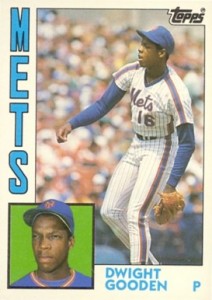
Like every other place then, it was going through the baseball-card boom, and it was my chief hunting grounds. I was working on a long, long list of cards I wanted, and my top two targets were the most expensive Mets rookie cards of relatively recent vintage: the ’83 Darryl Strawberry and the ’84 Dwight Gooden. They were pricey to the point of being unobtainable — I wasn’t even thinking about a ’68 Ryan yet, or a ’67 Seaver, or high numbers, or any of the other things I’d spend too much money and time obtaining later.
I found a Straw with a bit of a wrinkle at a card show in a half-deserted mall that mostly sold prosthetic limbs — a happy defect that took it down to half-price or so. But the Gooden? Oh boy. The Mets had just left for Port St. Lucie, and despite his recent cocaine woes Dwight Gooden was a sure-fire Hall of Famer, a Met and a hometown kid. The Internet was still for physicists, and auctions were conducted by members of the horsey set holding up paddles — if you were in St. Pete and wanted a Gooden rookie, you were going to pay for it.
The central St. Petersburg of a quarter-century ago contained many forlorn, sun-blasted stretches of asphalt occupied by dumpy cinder-block buildings in which indifferent commerce sometimes occurred, and one of those sad buildings was a baseball-card shop run by a guy named Ray and his mostly invisible wife.
Ray was an asshole. He was given to scheming and complaining and was truculent unless he thought he was about to con you out of something, in which case he would feign being friendly for a minute or two before getting distracted and going back to being Ray. In other words, he was like 90% of the people who became baseball-card dealers during the years when price guides were bibles and cards were investments and buyers and sellers alike were mostly unbearable.
Ray hated customers and kids and baseball cards and baseball, and the only thing that changed was the order in which he ranked those hatreds. Meanwhile, I thought I liked Ray. I actually hated him, for all the obvious reasons, but I hadn’t figured this out yet. I thought I liked him because I knew he was teaching me how to tolerate unpleasant people who had something you needed, which I sensed was a valuable skill. That much I was right about.
Anyway, I needed Ray for three reasons:
1. His shop was the closest baseball-card store to my parents’ house at the far southern end of St. Petersburg.
2. His shop was also the best baseball-card store in the area. Ray hated baseball cards, but he had a ton of them — I suspect he’d bought out some other dealer, who’d stuck him with boxes and boxes of unsorted commons from all sorts of years, including hopelessly obscure sets nobody else had and nobody particularly wanted but me.
3. Ray had a 1984 Topps Traded Dwight Gooden.
I would get a little money together and go see Ray, hoping to cross off a few things from my endless want list. If Ray were there, I’d ask him about various sets, which he’d claim he didn’t have because he didn’t want to get up out of his lawn chair behind the counter. Eventually I figured out I could rouse him into vague motion by pretending I needed an obscure card he thought was expensive. If I could get him to pull down three or four boxes of cards in search of things, he’d get pissed off and bark at me to just come behind the counter and look myself, which is what I’d wanted in the first place. I’d put together whatever stack I could afford, then police Ray’s slow-motion checking through the latest price guide, correcting the errors of price and condition that somehow inevitably went in his favor.
And then I’d ask him about that Gooden rookie.
When I’d do this Ray’s eyes would gleam, he’d grin, and then he’d begin to fidget. The card was sharp but miscut, which should have knocked a fair amount off of its value. Ray knew this, or rather Ray would admit this in the face of ruthlessly presented evidence, but he would always respond vaguely that it was no big deal because he knew a guy who could get the card fixed somehow, and in the meantime he wanted to be paid as if it were a perfectly cut Dwight Gooden rookie card. I refused to do this, as did everybody else, and so for a year or two the Gooden rookie sat in one of the carousels atop Ray’s display case, awaiting its visit with Ray’s vague associate and mocking me with its unavailability.
Until one day, for my birthday, I opened up a small package and found … a Gooden rookie. I exulted, hugged my mother, then pulled back and looked at it more closely.
“Tell me,” I said, “that you didn’t buy this from Ray.”
My mom swore she hadn’t, but that miscut was like a fingerprint. She confessed and I hugged her again, a little annoyed that Ray had extracted undeserved money from my mother but mostly grateful that my search was over.
When Joshua and I came to the mid-’80s in the Holy Books makeover, I saw that a few cards I’d selected weren’t particularly attractive choices: Why did I pick Topps ’89 cards of Rick Aguilera and Randy Myers in which they’re staring at the Topps photographer like they’re at the DMV? I knew there were better cards for both, so I took a peek on eBay — and discovered I could get the entire ’88 set, plus the traded cards, for $3. Including shipping.
That was good — and yet it was disappointing to discover the ’88 Mets, those winners of 100 games, had become a collector’s afterthought.
In The Holy Books, Dwight Gooden is represented by his ’92 Topps card, on which he’s called Doc. I’d never liked the formalizing of the nickname — it smacked of rebranding, of hubris, of tempting fate. I decided I could and would do better by Dwight Gooden. But what card would be best for him?
I went back to eBay, wondering … and wondering if I wanted to know.
Ray’s baseball-card store is long gone. I don’t know what’s there now — maybe it’s an artisanal coffee shop where perky baristas are happy to see customers.
I assume Ray is dead, though I wouldn’t be astonished to learn he’s hawking Skylanders figures on eBay from his lawn chair and ripping people off with handling charges.
Dwight Gooden is 48 years old. He retired with 194 wins, and when we hear his name in the news our first instinct is to worry.
And a 1984 Topps Traded Dwight Gooden rookie? Perfectly cut, with four sharp corners, it will cost you $7.50 on eBay. Including shipping.
by Jason Fry on 2 January 2013 10:46 pm Greg has always appreciated The Holy Books — my three binders of baseball cards, with each Met represented by a single card organized by the year of their Mets debut — while making simultaneously gentle and pointed inquiries about their administration. His biggest objection? It’s been that The Holy Books are organized alphabetically within each year — Ashburn to Zimmer in ’62, Carson to Valdespin in ’12. Wouldn’t it make more sense, he finally asked, to have the Mets in simple chronological order?
I believe he first made the suggestion years ago, in the middle innings of some dull affair during which something neglected at Shea Stadium broke and Jason Phillips did something inept. I don’t know that for sure, but it seems like a good bet on both accounts, and how best to organize binders full of old Mets cards is the kind of thing one logically turns to during such games.
My initial objection was that without play-by-play information for early games, I couldn’t figure out the true chronology. (And, really, you need pitch-by-pitch data.) But Retrosheet and Greg’s own digging took care of that one.
Then I argued that alphabetical order was important to being able to find someone, which we both knew wasn’t true. (Quick, what year was Nolan Ryan’s debut? Cleon Jones’s? Terry Leach’s?)
Finally, I quit dodging and offered the real reason: It made more sense, but it was just too much damn work.
But shortly before his 50th birthday, Greg sent along a massive Excel spreadsheet — there were the Mets, in perfect chronological order. And though he presumably didn’t know it, he’d caught me at the right time.
My kid is now 10. That means Joshua is old enough to be perform moderately delicate manual labor and keep track of a spreadsheet. Yet he’s too young to have an adult’s perspective on time and money — he thinks he has oceans of the former and he would like more of the latter. So I offered him a deal: $50 to convert The Holy Books to my co-writer’s long-desired format.
I also had a hidden agenda. Joshua is dangerously close to breaking up with the Mets, for which I can’t blame him: His favorite player was Jose Reyes, who won a batting title and was allowed to walk. He got interested in R.A. Dickey’s story, exulted when he won 20 and the Cy Young Award, and then … well, you know. The kid’s had it. We all have, except he’s 10 and he has other things to do with his life.
On the one hand, this is fine. When I turned 10, the Mets were two years into their nadir as the North Korea of the National League. I stuck it out for another year and half before walking away during the strike, and didn’t return until I started hearing about Straw and Keith and this amazing young pitcher named Dwight Gooden. That might not be too far removed from what will happen to this incarnation of the Mets. I survived it, finding my love of baseball and my team quick to rekindle.
On the other hand, it’s not fine at all. Joshua lives in a Mets house, and some of my fondest memories of parenthood have centered around him learning the game and the team and the players, both from me and from his mother. I don’t want to lose that and risk not getting it back amid the many distractions of busier-than-ever youth.
And so I thought this might help — a project that would double as a Mets history lesson.
We’ve worked side by side. I remove a year’s worth of cards. He puts them in chronological order. I read the Prince spreadsheet and he checks. He puts them back in the pages. I check again. And while we’re doing this, we talk Mets.
As you probably figured, revisiting the early years has been simultaneously exasperating and entertaining. Joshua’s early questions centered around whether such-and-such player had been good, and he grew a little perplexed at the fusillade of nos. Elio Chacon? No. Charley Neal? No. Gus Bell? Not any more. Jay Hook? No. Choo Choo Coleman? No. Harry Chiti? Goodness no.
But those nos had some amusing asterisks.
Elio Chacon wasn’t any good, but he also didn’t speak English and kept crashing into Richie Ashburn on pop-ups. So Richie learned how to say “I got it” in Spanish. It’s “Yo la tengo.” So there’s a pop-up, and Chacon runs out…
The Mets acquired Harry Chiti for a player to be named later. Harry Chiti proved so bad as a catcher that…
Richie Ashburn was actually pretty good. Good enough that he won a boat. Except Richie lived in Nebraska, and…
Jay Hook had studied engineering, and he could tell you why a curve ball curved. But…
The two Bob Millers aren’t the same person. There was Bob G. Miller and Bob L. Miller. The traveling secretary was worried how hotel switchboards would figure out which one a caller wanted. Then he had an idea…
Joe Pignatano came to the plate in the eighth inning of the final game of the ’62 season. He didn’t know it was the last at-bat of his career. There were two men on and nobody out…
And so on we’ve gone, through the Larry Burrights and Hawk Taylors and Danny Napoleons and Lou Klimchocks of the early Mets, leavened with questions about Gil Hodges and Yogi Berra and Warren Spahn and even the occasional flash of hope from Ron Hunt and Tug McGraw and Nolan Ryan and Tom Seaver. I’m not going to say it’s saving my kid’s fandom — that would be a lot to put on David Wright, let alone Joe Moock. But it’s been fun, and it’s been a bit of light in the darkness — and in a winter of greater-than-average discontent, I’ll take it.
Greg tells the Joe Pignatano story — and a whole lot more of them — in very entertaining style in Volume 1 of The Happiest Recap. Go get yourself one!
by Greg Prince on 1 January 2013 12:13 pm At 3:59 PM EST this afternoon, New York Mets baseball will step outside, see its own shadow and scurry back indoors for what will seem like another couple of centuries of winter, but fret not. It will be at that very moment that we have reached the Baseball Equinox, that juncture on the Spherical Horsehide Calendar when we are equidistant between the final out of the Mets’ 2012 season and the first pitch of the Mets’ 2013 season. Thus, when the clock strikes 4, it means we are (give or take a rain delay or ceremonial glitch) closer to next year than last year.
Hell, next year is this year now. And we can’t be stopped from having real, countable baseball inside it. The Mets have already prepared us for this great upturn in our fortunes by signing some dude from the American League to maybe pitch out of the bullpen and…well, they haven’t done much else yet that you don’t already know about, and what you know about remains up for grabs in the short and long terms…but isn’t knowing Opening Day will eventually get here with or without Aaron Laffey worth flipping away from the conclusion of the Capital One Bowl just to make sure you still get SNY?
Meanwhile, the Marlins are “willing to listen” to proposals for Giancarlo Stanton, which doesn’t necessarily mean the Mets have a prayer of landing him, but given the Marlins’ history of listening, it should at least guarantee we’re a lock to avoid fifth place.
See? This new year gets happier all the time.
by Greg Prince on 31 December 2012 2:24 pm It appears they let anybody turn 50 years old today. Even me.
As Sid Fernandez, Benny Agbayani, Rick Trlicek and a handful of others who — Trlicek-style — avoided distinguishing it could confirm, 50’s a number, just like any other number. Yet when you reach a number that’s considered enough of a milestone to rate commemorative-patch treatment, well, attention must be paid.
Goodness knows it got my attention the year I was 49 but barely noticed because I was laser-focused on turning 50. And now I have. It will take me a while to find out what the big deal is. I’m guessing it will sink in, so to speak, when my doctor tells me to make an appointment for one of those tests you get not because you’re ill but because you’re old. One year you’re 49 and wondering what’s up with Collin McHugh. The next year you’re 50 and you’re wondering what’s up with your colonoscopy. (And, probably, Collin McHugh.)
I’ll let those of you who are on the pre-Sid side of 50 in on a little secret. I’ve only been in my fifties for about half a day, but it’s not so bad to get here. That bit about “older and wiser”? It really does happen. I hit a spot in my mid-thirties when I realized how much I didn’t know about life. About a decade later, it began to dawn on me that I knew more than I realized and was learning more all the time. That’s not the same as saying I’ve figured out what to do with any of it, but, to borrow a phrase from another sport, I’m amazed sometimes how I’ve gained the ability to see the entire field. I understand “stuff” more than I ever have before. There’s plenty of stuff I don’t, but that’s part of the beauty of getting here, too. You know enough to know you don’t know everything and you know things you didn’t know you knew. You really start to put it together in your mind at some point.
Then nature apparently makes up for that great revelation by calculating ways to gradually chip away at that mind you’re so proud you’ve honed for a half-century. Plus going for those tests. And not really wanting to climb all the way to the top of Promenade if you can help it, though I’ve never been a big fan of that, anyway. There’s a tradeoff in there somewhere between wisdom absorbed and youth eroded. Like d’Arnaud for Dickey, a Mets fan can’t have everything at once.
Of course we’re all younger than we used to be if you follow the stereotypes associated with once ludicrously old-sounding ages like 40 and 50. My mother threw my father a surprise 50th birthday party 34 years ago next month. I was in charge of sending out the invitations from a store-bought pack whose cards said on the front, “Here’s Looking At You.” I decided to embellish what Hallmark or whoever printed by adding “Kid!” to the message…“Here’s Looking At You Kid!” I’d heard it on TV and, besides, as I understood it, middle-aged people loved being flattered at how young they seemed.
This did not go over well with my 49-year-old mother, who informed me with her usual understated approach to intrafamilial relations that these people whose invitations I had desecrated with my personal touch were, in terms Ben Franklin would use, the cream of their colonies.
They’re mature!
They’re distinguished!
They’re in business!
You don’t go around calling an adult “Kid!”
It’s an insult!
What kind of idiot are you?
From there followed the massive deployment of Liquid Paper to remove the offending passage. Moral crisis averted. Aesthetic disaster another story.
The party went on, as those mature, distinguished middle-aged people seemed frothy and uninsulted by the blotched-out “Kid!” while the whiskey sours and vodka tonics flowed. But they sure did seem older to me than I do to myself now. Times change. Social mores change. Commonly held values change. Technology changes (which is good, ’cause I’m pretty sure were low on Liquid Paper). Yet I’m still me, recognizable internally — prospective colonoscopy appointments notwithstanding — from 50 to when I was 16 and finding ways to allegedly ruin surprise parties that had nothing to do with ruining the surprise.
So either I don’t feel 50 or I do feel 50, because this — rambling recollections about the old days sprinkled with semi-superfluous Mets references — might very well be what 50 is…for this kid, at any rate.
Finally, per Ralph Kiner, happy birthday to all you new years out there.
by Greg Prince on 30 December 2012 4:56 pm Just got out of HR. I was doing my exit interview with my forties. It was required as I’m leaving age 49 and starting my new position, in my fifties, at midnight.
HR asked me what I did with my forties, which officially began on December 31, 2002 and end tonight at 11:59 PM. I said I started a Mets blog with a friend of mine when I was 42 and I’ve enjoyed doing that a lot ever since.
Then HR asked me what else I did with the past ten years. I mentioned a few other Mets-related things, which led me into a tangent about some games I went to, some others I watched on TV and a bunch of people I got to know because of the Mets.
HR interrupted and asked if there was anything else I wanted to talk about from my forties, specifically anything that had absolutely nothing to do with the Mets.
I said no, not really.
And with that, HR made some notes in my file, shook my hand and wished me luck in my fifties.
So I guess that was it for the past decade of my life.
by Greg Prince on 29 December 2012 7:22 pm If four things don’t go exactly right Sunday, a team called the Giants will be done being defending champions. I’ll be sorry if/when they are eliminated from playoff contention, though mostly because a Super Bowl run is a great way to kill time en route to Spring Training. But while the halo above the New York Football Giants may be on the verge of vanishing, the San Francisco Baseball Giants can continue to winter in contentment as holders of the most super title of them all.
If I didn’t say it properly in late October — and I didn’t, really, given that my mind was on impending low-pressure systems and the havoc they were projected to wreak regionally — congratulations to the 2012 World Series champion San Francisco Giants, partly for their four-game sweep of the Detroit Tigers, more so for being so into each other as they prevailed.
Just got through watching the highlight film from the most recent Fall Classic (MLB Network + DVR = December Salvation) and was particularly taken by the togetherness the champion Giants evinced. They were playing for each other, they were loving each other, they were showering each other in heartfelt brotherhood as much as they were champagne. Hunter Pence, who’d been a Giant for about 10 minutes, had taken to firing up his teammates in the dugout prior to every game and it was a touching sight seeing something you only imagined working in movies working in real life. Marco Scutaro, also in his eleventh Giant minute, oozed affection for his temporary teammates. Angel Pagan, comparatively a Giant of McCoveyesque tenure, was reveling in everything San Franciscan: the players, the fans, the sourdough bread probably.
If it was the Braves or Cardinals or some even less appealing 2012 postseason agglomeration, these testimonials would rate the ceremonial sticking of the index finger down the symbolic throat, but the Giants really seemed to mean it. It was beautiful. Then again, why shouldn’t they be the teamiest team in all of teams? The results said they were the best team going.
Teams don’t always have to manfully embrace and pump each other up to find success, just as power and pitching aren’t personality-driven assets. But gosh darn it, it’s swell to connect good outcomes with good outlooks. I was particularly moved by this Giant view of the world since I had, not long before October, read Odd Man Out by Matt McCarthy, a reasonably engaging book from 2009 detailing a one-year minor league lefty’s experiences trying to make it at the lowest rung of professional baseball. Odd Man Out had its Ball Four behind-the-curtain charms, and the narrator — a young man who was fairly certain his future waited in medicine rather than on a mound — seemed sincere enough in his desire to share details of his season as a Provo Angel. But somewhere along the way, it veered from clever and insightful to just plain depressing.
McCarthy received not altogether flattering publicity when the book came out. His former teammates did not enjoy being portrayed as craven misanthropes all out for themselves (plus there was some question about the accuracy of his recollection of balls, strikes and whatnot). The author’s message was that in the low minors, everybody is essentially out for himself, which wasn’t all that surprising. There’s no loyalty to the Provo Angels, per se. The idea is to get the attention of the organization and advance to the next level and the one after that. If someone else on your team is succeeding, it doesn’t help you one iota. The minors aren’t like high school or college. They’re a business. Cynicism trumps innocence, home and away.
I suppose I knew that, but I didn’t enjoy having it confirmed from the inside. Hence, watching the 2012 World Series film and being reminded that the certified best professional baseball team of the past year behaved in a manner 180 degrees opposite was downright heartwarming. To play like a champion in San Francisco meant checking divisiveness at the door and being one for all/all for one. Giants fans likely wouldn’t welcome even a vague comparison to something smacking of Los Angeles, but their plotline was pretty Hollywood in the end. You had these well-compensated holdovers and you had these well-compensated acquisitions, except nobody acted like a mercenary and nobody seemed to be in it solely for himself. Maybe it’s easy to exude togetherness when you finish first, but when the fourth game was over and the trophy was awarded, I really bought the fairy-tale ending.
The 2012 World Series film is, after all, a documentary.
If you want to listen to some Metsian togetherness, check out the Gal for All Seasons podcast that features Faith, Fear and Coop!
by Greg Prince on 27 December 2012 2:57 pm Contrary to the tiresome claims every modern-day sportswriter makes about rooting for stories over teams and having no rooting interest otherwise, Oscar Madison of the New York Herald clearly had a favorite ballclub. If he didn’t wear his heart on his sleeve or in his widely read columns, his allegiance was evident on his head. We could read who Oscar loved by reading Oscar’s cap…a Mets cap.
The cap said it best, though when we had the opportunity to listen in on Oscar’s conversations, whether with his fussy roommate Felix Unger (a talented photographer, portraits a specialty, who didn’t seem to much care about sports) or anybody else, we would hear the Mets come up occasionally as well.
He might tell a Little Brother he and Felix were mentoring that he — Oscar Madison, a columnist and not a coach — taught Tom Seaver how to throw a curveball.
He might lament to Felix that he never aspired to own the Mets as much as he did a racehorse, but would settle for this sleek greyhound named Golden Earrings (which was all well and good, unless you lived at 1049 Central Park West, which didn’t necessarily seem like an ideal kennel for the pup, no matter the shape of Oscar’s room).
And like anybody who loves the Mets, he could be brutally honest about their failings. He went on his short-lived radio show, Oscar Madison Talking Sports, and felt compelled to criticize the team. Things got so heated that a couple of Mets fans came to his apartment and expressed their displeasure with his analysis the best way Mets fans knew how before Twitter: by swatting him with their caps.
Yet with true verve and panache (to borrow a phrase found in one of Oscar’s rare theatrical reviews…well, it ran under his byline, at any rate), Oscar kept his Mets cap on around the house, kept a Mets pennant hanging limply from his wall and even framed a photograph of Wes Westrum for inspiration. Oscar was so matter-of-fact about his affinity for the Mets, that it got to a point where you almost didn’t notice it.
But years later, as the news has come down that Oscar Madison has, regrettably, finally accepted his buyout package from the Herald, we pause to properly tip our cap to Oscar’s cap. We appreciate that he wore it so regularly and so jauntily — particularly from 1970 to 1975 — that he made it seem natural. We looked at Oscar’s cap and thought, almost without thinking about it, that yes, of course, a Mets cap…why wouldn’t a person wear one of those? Oscar made the Mets cap so much a part of the landscape that not wearing one is what would’ve made a person look like an oddball.
Oscar wasn’t odd. He was ours. And as we dig out his old columns and marvel at his versatility (did you know he once organized a wrestling match that fostered better Sino-American relations?) let alone his flair for living (when not chronicling sports from his living room typewriter, he followed his gourmet muse to create the nouvelle cuisine dish goop melange), we honor him by inaugurating a new Faith and Fear in Flushing accolade in his name.
It is called the Oscar’s Cap, and it is given annually — starting now — to those shining examples in the concluding year’s popular culture anywhere the New York Mets played a featured or supporting role. Oscar’s Caps are awarded in film, television, music, theater, literature…any medium we come across in 2012 where we weren’t expecting the Mets to appear…yet they did.
There are two categories of Oscar’s Caps: Contemporary — given to those works that appeared on the popular culture horizon for the first time during the year in question; and Retro — given to those works that were created in the recent or distant past but, for whatever reason, came to our attention for the first time during the year in question. Essentially, we had to suddenly see something about the Mets or hear something about the Mets or notice something about the Mets or be clued into something about the Mets pertaining to their presence within the popular culture from before 2012. Why we didn’t know about those appearances and incidences before 2012 and only stumbled into them over the past twelve months is hard to fathom, but as we’re often busy thinking about the Mets in the sporting culture, we can’t necessarily catch everything the first time around in the popular culture.
That, after all, is why they sometimes run repeats of the best stuff into perpetuity.
In the realm of Contemporary Popular Culture, 2012 Oscar’s Caps are awarded to the following:
• ABC’s The Middle, which used vintage footage of Shea Stadium under construction to help evoke mom Frankie Heck’s excitement that Super Bowl XLVI was coming to Indianapolis, not far from the Hecks’ home in Orson, Indiana.
• The Broadway revival of On A Clear Day You Can See Forever, whose penultimate musical number, “Come Back To Me,” includes the lyrics “Don’t get lost at Korvette’s/Or get signed by the Mets.”
• NBC’s 30 Rock, whose guest stars included Mr. Met in two episodes (“The Tuxedo Begins” and “Meet the Woggels”) and which dressed a wedding party in 7 Line gear because Mets t-shirts are what the bride and groom told Liz Lemon they were wearing “when we Met”.
• John Grisham’s novel, Calico Joe, whose title character, 1973 Chicago Cubs first baseman Joe Castle, gains a fan in Paul Tracey, “the young son of a hard-partying and hard-throwing Mets pitcher” named Warren Tracey.
• The film Men In Black 3, in which Griffin watches the final out of the 1969 World Series unfold and explains to Agent J and Agent K that “this is my favorite moment in human history,” for “a miracle is what is not possible but happens anyway.”
• DJ White Owl’s “Kings From Queens,” a name-checking, hip-hop ode to the 1986 Mets that recalls the days “before Johan threw that no-hit game/before David Wright brought the Mets that fame/before Citi Field, Ike Davis, Jason Bay/we were glued to the tube watching every double play.”
• Joshua Henkin’s novel, The World Without You, whose characters include Lily, a Mets fan since 1986 who “has no patience for Yankees fans, especially the newly minted New Yorkers, the arrivistes,” and a dog named Kingman.
• Wayne Wilentz’s jazz piano composition, “A Song With Orange And Blue,” a 50th-anniversary musical tribute that swears “It’s no lie/Tommie Agee could fly” and celebrates (among others) “Choo Choo and Charlie/Valentine, Darling/the Hammer, the Doc and the Straw.”
• HBO’s The Newsroom, whose senior producer, Jim Harper, spends a portion of a Sunday night party watching the Mets-Phillies game of May 1, 2011, on his laptop, before word leaks that Osama Bin Laden’s been killed; later, ACN executive Reese Lansing admonishes News Night’s brain trust that the show’s ratings have tumbled “from second to fifth place in the course of five days, a feat I previously thought was only accomplishable by the New York Mets.”
• CBS’s Elementary, whose Dr. Joan Watson is a Mets fan who won’t go out until she sees the outcome of a Mets-Reds game that has reached the ninth inning, despite being informed by Sherlock Holmes that, based on all available evidence, the Mets will lose, 3-2.
• Fox’s The Simpsons, whose titular family’s trip to the Big Apple is advocated by Bart, who informs Homer, “But you love New York now that your least favorite buildings have been obliterated: old Penn Station and Shea Stadium!” (to which Homer shakes his fist and grumbles, “lousy outdated relics…”); later in 2012, Homer downloads the Lenny Dykstra’s Prison Break app to his MyPad.
• ABC’s Jimmy Kimmel Live, which portrayed “young Jimmy Kimmel” in a Mets t-shirt in a flashback exploring the late-night host’s Brooklyn upbringing.
• NBC’s Saturday Night Live, whose Fox and Friends segment included a slew of on-screen “corrections” that rolled by rapidly, including one that made clear “Mr. Met has never announced a preference for any religion over the other”; earlier in 2012, SNL aired a commercial for the Charles Barkley Postgame Translator App, which translated David Wright’s benign thoughts regarding a tough loss to “I don’t know why they’re celebrating beating the Mets — everybody beats us!”
• Fox’s The Mindy Project, on which Dr. Danny Castellano has on his office wall a framed, matted portrait of Shea Stadium.
• Adam Sandler, who, during the 12-12-12 concert that raised funds to aid victims of Superstorm Sandy, reworked the lyrics to Leonard Cohen’s “Hallelujah” to include his selective-memory assessment that “the Mets have sucked since ’86”.
Finally, though his Mets commentary is generally unscripted and presented outside the realm of fiction, the 2012 Oscar’s Cap of Lifetime Achievement is awarded to Jon Stewart, host of The Daily Show in recognition of his long having used his news & entertainment platform to articulate true Mets fan angst. Stewart’s work was best exemplified in his December 4 interview of R.A. Dickey, when Stewart asked his Cy Young-winning guest — who was then in protracted contract negotiations with the team — “How will the New York Mets screw this up?”
In the realm of Retro Popular Culture, 2012 Oscar’s Caps are awarded to the following:
• Any Wednesday, the 1966 film in which John Cleves (Jason Robards) and Ellen Gordon (Jane Fonda) are engaging in an extramarital affair and seeking a discrete night out. Ellen suggests, “Hey, you know what’d be fun? We could go to the Shea Stadium. The Mets are in town!” but John rebuffs her because he and his wife “had a season’s box right behind the dugout. The Mets shock easy.”
• East Side, West Side, the 1963-64 George C. Scott inner city drama on which Mets catcher Jesse Gonder hit fungoes to kids.
• Friends With Benefits, the 2011 romantic comedy romp during which a televised Jose Reyes home run at Citi Field and a 2010 “WE BELIEVE” pay phone advertisement featuring “ACE” Johan Santana appear.
• Bye Bye Braverman, the 1968 comic drama that yielded a couple of shots of Shea Stadium and World’s Fair relics in the background of scenes filmed at Cedar Grove Cemetery off the Long Island Expressway.
• Lawrence Block’s 2011 anthology, The Night and the Music, wherein Matt Scudder takes kids to a Mets game; Jon Matlack is rocked and the Mets lose, 13-4.
• Car 54, Where Are You?, which gave the Mets quite possibly their first pop culture mention when, on October 8, 1961, Officer Toody’s small talk that “they’re tearing down the Met” is answered by Officer Schnauzer’s rejoinder, “The new ballclub? They haven’t even played a game yet!”
• Pom Wonderful Presents: The Greatest Movie Ever Sold, Morgan Spurlock’s 2011 documentary on product placement, which includes Citi Field in a montage of stadiums and arenas that are named for corporate sponsors.
• Paul Auster’s 1985 novel, City of Glass, which contains characters who discuss Dave Kingman and George Foster; its protagonist, Quinn, works under the pseudonym William Wilson and comes to realize that his fictional name is the same as the actual name of “promising young player” Mookie Wilson.
• Mo’ Better Blues, Spike Lee’s 1990 jazz-inflected drama, which features Giant (Lee), who bets against the Mets in the September 29, 1989 doubleheader versus the Pirates because “the Mets need some more black ballplayers” (the Mets swept both games); there is also a lengthy flashback scene that takes place on September 20, 1969, when Giant’s dad is watching Rod Gaspar bat against Bob Moose at Shea Stadium (Bob Murphy’s call of the eventual no-hitter is audible).
• Moscow On The Hudson, the 1984 Robin Williams vehicle in which Vladimir Ivanoff (Williams) meets a fellow Soviet defector who now sells hot dogs on the streets of Manhattan while wearing a Mets cap.
• Youth-leaning variety program Hullabaloo, during which, on April 4, 1966, Soupy Sales and his sons Hunt and Tony sang a rollicking version of “Meet The Mets”.
• Married To It, the 1991 film that attempted to explore the perils of matrimony through the eyes of three couples whose attempt to identify “the best day of the ’60s” led Leo Rothenberg (Ron Silver) to insist, “No contest. October 16, 1969, bottom of the ninth, Davey Johnson batting for the Orioles…” Leo and the other two husbands (played by Beau Bridges and Robert Sean Leonard) transition at once into reciting play-by-play details of Johnson’s fly ball to Cleon Jones, who catches it for the final out of the World Series — an event labeled in 2012’s Men In Black 3, it is worth reiterating, as at least one space alien’s “favorite moment in human history”.
Special thanks to Faith and Fear readers, Hofstra 50th Anniversary conference attendees and Crane Pool Forum compatriots for their help in compiling the 2012 Mets Pop Culture Review. And appreciation always to Jack Klugman for immortalizing Oscar Madison.
|
|