The blog for Mets fans
who like to read

ABOUT US

Greg Prince and Jason Fry
Faith and Fear in Flushing made its debut on Feb. 16, 2005, the brainchild of two longtime friends and lifelong Met fans.

Greg Prince discovered the Mets when he was 6, during the magical summer of 1969. He is a Long Island-based writer, editor and communications consultant. Contact him here.

Jason Fry is a Brooklyn writer whose first memories include his mom leaping up and down cheering for Rusty Staub. Check out his other writing here.

Got something to say? Leave a comment, or email us at faithandfear@gmail.com. (Sorry, but we have no interest in ads, sponsored content or guest posts.)

Need our RSS feed? It's here.

Visit our Facebook page, or drop by the personal pages for Greg and Jason.

Or follow us on Twitter: Here's Greg, and here's Jason.

27 Minutes Outside Citi Field

Ebbets Field was always in reach. There were obstacles — money, the policeman’s shoe, a leap, the greasy garageman — but a boy could contend with them and triumph, if he had wit and persistence and a touch of courage. It was easy and absolutely irrational to relate getting to see a Dodger game with getting to be a Dodger. Which, in the fine irrationality of boyhood, is what generations of Brooklyn children did.
—Roger Kahn, The Boys Of Summer

Why is Mets security being wasted on the Mets? Why isn’t it being dedicated toward the national interest?

Take that pesky couple that crashed the state dinner a few weeks ago. They got by the United States Secret Service. They got by the staff of the White House Social Secretary. But Tareqe and Michaele Salahi would have been stopped stone cold outside Citi Field. Or at least they would have been effectively delayed.

My proof? The last time I visited Citi Field, November 14, for a social event at least on par with that which President Obama threw for Indian Prime Minister Singh — the Bar Mitzvah of budding Mets superfan Ryder Chasin. As previously noted, it was a lovely affair…once it got going. That is to say the celebration was slated to begin at 1:30. Most people would be arriving via chartered bus from Connecticut where the actual synagogue service was held in the morning. Stephanie and I, however, were only able to attend the afternoon portion of the de facto doubleheader. We came, as we always do, via train, from Long Island, arriving unfashionably early, a little after one. It was a raw, gray Saturday, so we looked forward to going inside and warming up.

The invitation (which looked like a big ticket to a Mets game) said we should enter through the Jackie Robinson Rotunda. I wasn’t sure if this was just a charming affectation or actual instructions. It’s not that I doubted the Chasins. I doubted the Mets. Is it possible they’d actually a) have someone on duty in the middle of November in front of their own ballpark? b) have someone duty in the middle of November in front of their own ballpark who was sentient of an event about to take place therein?

Yes and yes, it turned out. So much for doubting the Mets. There was a young man in a red windbreaker stationed by the Rotunda. Hi, we said, we’re here for the Bar Mitzvah. I waited for the blank stare, but it didn’t come. He knew what we were talking about. He also knew the starting time was 1:30 and it, somebody must have told him, was inviolate.

“You can come in at 1:30,” he said, looking at his mobile device. “It’s…1:03 right now. You have 27 minutes.”

So much for not doubting the Mets.

***

There was a pause as we digested the notion that we were not allowed inside to an affair to which we were invited guests because we were early. We were not allowed inside on a blustery day when it had been raining. We were not allowed inside even though we were, on this particular occasion, a well-dressed couple about as not on the make as two people can be. We were not the Salahis before the world discovered the Salahis. We were not bucking for a reality show scam while conceivably putting the federal government at risk.

We were there a little early for a thing — not a 7:10 First Pitch with a 4:40 Gates Open, mind you, but a private party — and we were kept out.

“Is there a restroom we could use?” I asked, as if to appeal to the man’s sense of common decency (and because we could both use a trip to the restroom).

“Only the Porta Potties,” we were told, as if we had been excessively tailgating.

You’ve got a whole building of them right behind you, I was tempted to say, but held off, as we held it in.

It was clear as the sky was murky that this was the Mets way in all seasons. Policy rules all. Orders must be followed. Flexibility is on permanent hiatus. Not, “Let me use this walkie-talkie and check with my supervisor” or “Everything isn’t technically ready yet, but I don’t see why not” or “Sure, go ahead.”

The Mets, in the person of this guy in the red jacket, adhered to their clipboard. The clipboard said 1:30. Damned if they were gonna let anybody scam them out of what it said on that clipboard.

This is an organization wedded to its clipboard logic.

***

I grant you ours was not a situation that will affect millions of Mets fans when baseball is played again at Citi Field. It was just us at that moment. Just two people who had a reason to be there and got there less than half an hour before the proceedings commenced. They could have pointed us to another entrance; or noted the Acela Club won’t officially be open for this party for another 27 minutes so you can use the bathroom there but you can’t eat or drink yet; or said you can wait in the Rotunda considering it’s rather chilly out here, just don’t break anything.

Instead the Met way was to tell us to cool our heels and buzz off ’til the exact appointed moment of entry. Our choices were to huddle in the doorway in proximity to this guy and whichever of his red-jacketed compatriots were on the beat, or wander around the perimeter of Citi Field for 27 minutes before we could walk in like people.

So we wandered, which, weather and bladder issues aside, was not an altogether displeasing alternative to getting out of the cold and using a restroom. It would give me a chance to commune, one final time in 2009, with the place that had become, stretching back to April 3, my recurring bane, my destination of choice and the focus of the most puzzling question of my current baseball life:

Why can’t I bring myself to out and out like this place?

***

A Fonzie’s dozen of the many thoughts that floated across my mind during Citi Field’s first year:

1) If the Mets really want to be inspired by the lessons of Jackie Robinson, they’d learn to slide directly into home plate.

2) Daniel Murphy should not have been permitted to play left field in such close proximity to the Endy Chavez silhouette intended to define LEFT FIELD.

3) The ads behind the scoreboard look terrible, but they blend in quite nicely with the VINA AUT GLASS motif from across the way.

4) Visiting my brick and routinely recognizing the bricks that surround it reminds me of going to see my mother at Pinelawn and becoming familiar with the final resting places of others who just happened to be entombed in the same courtyard.

5) The seats had the leg room that was promised, but most of them outside the special Swells sections were noticeably hard on the butt. And to think the one item they emphasized at the Citi Field Preview Center was how great the seats themselves would be.

6) Overhearing former Shea planholders rue their resettlement into outer reaches of the Promenade was like something from an immigrant drama. “In the Old Country, I was in Row A!”

7) I wondered why there was a plethora of attendants overseeing the Fixin’s bars. Then I attempted to pump the ketchup or the mustard and realized it was not a one-person job.

8) Caesars Club smells like a high-end shoe store.

9) Before I realized ’47 was a brand name, I didn’t understand why the ’47 store wasn’t called the ’62 store — or why the Mets would allow any retail that even fleetingly evoked T#m Gl@v!ne.

10) Whatever happened to taunting the opposing pitcher? “Shush! Ian Snell is trying to pitch and he needs absolute silence!” And sustaining a respectable “Let’s Go Mets!” was like pulling teeth. Or pulling pork.

11) The acoustics are weird. I wind up listening in on individual conversations I want no part of, yet I detect no buzz whatsoever.

12) If you’re not a stickler for watching baseball, Citi Field’s a dandy destination.

13) All ballparks lose their charm when the Mets suck in them.

***

The Bar Mitzvah, besides the fun and joy it held in store once we were let in, provided me a unique opportunity. This was my 40th trip to Citi Field in 2009. There were 36 regulation games, one exhibition game, one open workout and one corporate-sponsored event connected to my work. Now a Bar Mitzvah. It wasn’t like Citi Field wasn’t giving me plenty of chances to get to know it. Yet I still feel like we’re strangers.

You might say I prepared specially for this 40th meeting. Four days earlier was Stephanie’s and my 18th wedding anniversary. Because she’s somebody I’d marry at every possible turn, she found my suggestion of how we could spend part of that day not just acceptable, but embraceable. We accepted a gracious invitation from the premier New York City historian Peter Laskowich to take one of his handcrafted tours. A month earlier we had joined him for the weekly walk and talk he gives in and around Grand Central Terminal; in June I was up and uncharacteristically at ’em on a Saturday morning as he led a group uptown, from Madison Square Park to Coogan’s Bluff. The latter was the one that ended overlooking the site of the Polo Grounds, which is my idea of a happy ending.

Our November 10 terrain was different. It wasn’t Manhattan. It was Brooklyn. Its underpinning wasn’t Giant black and orange. It was Dodger blue and white.

It was the other side of my heritage.

***

When I was a kid, my parents liked to joke they were a mixed marriage. Sure they were both Jewish, but one was a Litvak and the other was a Galitzianer. They each laughed. I never got it. Only recently did I bother to look into it. Litvak refers to Jews with roots in Lithuania, Russia and northern Poland. Galitzianer indicates Jews from southern Poland and the old Austrian-Hungarian Empire. The distinctions — theological, temperamental, culinary — are lost in the America of the 21st century, but apparently they were big a deal in Europe.

The Litvaks. The Galitzianers. Sooner or later, the rivalry melts and you’re part of an assimilated team playing together on common ground.

And then there’s us, the Metropolitan-Americans of today, more than a half-century removed from our roots. We are not Giants. We are not Dodgers. We are Mets. We are the repository of a melding of two great spiritual traditions. On April 11, 1962, as Richie Ashburn waited on the first pitch a Met would ever see, it was clear cut which of our bloodlines stemmed from where. It hadn’t been five years since there were New York Giants and Brooklyn Dodgers. The New Breed knew precisely from whom they were birthed. They were the product of a very mixed marriage that we who postdate 1957 couldn’t possibly fully appreciate as we approach 2010.

I’ve always tried to appreciate it though. I’ve always veered toward the black and orange myself. The New York Giants are the lost tribe in whom I’ve found my baseball background. I’ve been reading about them since I was nine years old, when the last active member of the tribe, Willie Mays, was becoming a New York Met. I’ve been hooked on the myths, the legends and the realities of what was New York (N.L.) before the current iteration took hold. I’m a New York Mets fan in my heart, a New York Giants fan in my soul is the shorthand I use.

So I’m not a retroactive Brooklyn Dodgers fan, exactly, but they have to be in there somewhere.

They have to be, even if they were the sworn enemy of the New York Giants. Litvaks and Galitzianers didn’t like each other as a rule, either, yet the progeny of Litvaks and Galitzianers married and, after a while, the labels amounted to little more than nostalgic wink.

They have to be, even if they aren’t a lost tribe. They never got lost. The less you heard about the old Giants, the more you kept hearing about the old Dodgers, who didn’t win as many pennants but long ago clinched first place in the romance column.

They have to be, even if the practiced exclusion of the Giants from the Mets’ backstory, culminating in the building of a Mets stadium that serves as homage to the Dodgers’ old ballpark without the slightest explicit nod to the Giant’s old ballpark — which happened, oh by the way, to be the Mets’ first home — is one of the things I held most vehemently against Citi Field in its first year, almost as much as red-jacketed security men who were in love with their clipboards and their inflexibility.

The Dodgers are in there somewhere with me. They have to be. They’re the D in the Met DNA. They’re from Brooklyn, just like me (though I was from there for about ten minutes before settling in my Long Island homeland). They’re the blue. It’s not a matter of black and orange versus blue and white anymore. It’s all about the blue and orange. I’ve read my share on the blue. Now it was time, under the guidance of Peter Laskowich, to experience it as best as I could up close.

On November 10, four days before my return to Citi Field, I was going to bone up with a trip to where Ebbets Field used to be. I wanted to sense what Ebbets Field was so maybe I could appreciate a little better what Citi Field is.

***

One thing you need to know about a Peter Laskowich tour: it’s never limited to what you think it will be. Grand Central was everything from geometry to psychology. Baseball in Manhattan was economy, demography, topography and destiny. Baseball in Brooklyn? It was America. It was an education and it was a little improv street theater, too, when Peter, outside the old Dodger offices on Montague, eased up on his erudition for a moment to tell a buttinski Yankees fan passerby (the kind who points at his cap as if that settles all arguments) where to get off when he started insisting, uninvited, that Yogi Berra tagged Jackie Robinson on Jackie’s steal of home in the ’55 Series.

Peter carries the pictures to prove otherwise.

Plenty of baseball, of course. This is not intellectual mumbo-jumbo smothering the reason you came, don’t worry. Peter gets to the baseball. He surrounds it with context, he leads you down one relevant path after another, he tells you to get out your Metrocard and, next thing you know, you’re where it happened.

You’re at Ebbets Field. Well, where Ebbets Field was. As with my two visits to the Polo Grounds, you just as soon use the present tense and forget that what you came to see isn’t really there anymore.

Approaching Ebbets was a third of the fun. We exited the 2 at Sterling Street and walked a block in what Peter ascertained was the wrong direction. An older man passed our hardy little band.

“Where’s Ebbets Field?” Peter asked him.

“Over there,” the man pointed.

That’s experience at work, I thought. The old guy knew Ebbets Field was there, even if it wasn’t.

It was a bit of a hike from the Sterling stop, even after we got reoriented. That was intentional, Peter explained. The Giants had ingratiated themselves with the city’s powers that be by the early 20th century, so much so that they could influence the placement of public transportation close to or far away from ballparks. It was no accident that the Polo Grounds was easily accessible (it had its own express line) and that Ebbets Field was a schlep from anywhere but the neighborhood. The Giants were New York. The Dodgers were Brooklyn, and Brooklyn was only reluctantly a part of New York.

What mattered, though, was the neighborhood. The neighborhood may have been a whole lot different from Charlie Ebbets’ time. It may have been a whole lot different from the time Walter O’Malley kissed it goodbye. But it was still the neighborhood and Ebbets Field was in the middle of it. I’d always read that, I’d always ascertained that, but until Peter led us to the corner of Sullivan Place and Bedford Avenue, I never quite got the depth of it.

I get it now.

Peter mentioned a statistic about a very large percentage of the Dodger trade coming to Ebbets Field on foot. Most of the fans lived within a half-hour’s walk of the park. The Dodgers were the neighborhood’s team. Ebbets Field was theirs. It was tiny. It fit right in. I could see it.

I could also see why everybody who was ever a part of it gets so choked up about a ballpark disappearing into the mists of a housing project that carries the name if not the spirit of the former structure. They did that uptown once the Mets left. The Polo Grounds became the Polo Grounds Houses. By then, Ebbets Field was already morphing into the Ebbets Fields Apartments (or “Ebbett’s,” as a sign offering rental information called it).

You couldn’t fool me, though. I could see what had been. Peter was a big help, pointing to where the visitors clubhouse was and how the visitors weren’t treated royally, particularly when they were visiting from Harlem. He showed as well the way home Gil Hodges and Duke Snider — when they were young, before they had wives — took after games. They, like the fans, walked home. The kids would follow along. Nobody bothered them too badly, Peter said. If you did, you feared Gil and Duke and the rest of the guys wouldn’t be such good sports about letting you tag behind them. Yes, Peter was a big help offering context and history.

But I could see it without his guidance. A baseball fan knows. Bedford meeting Sullivan, Sullivan meeting McKeever, McKeever meeting Montgomery, Montgomery coming back around to Bedford. An infinitesimal urban footprint. The boundaries of a major league ballpark for 45 summers. The home of the Brooklyn Dodgers. Where you walked to. Where you walked home from. From where O’Malley walked away. The heart of a neighborhood.

I could see Ebbets Field there. I really could. Four days later, I tried to see it in Flushing.

I really couldn’t.

***

I thought visiting the site of Ebbets Field and studying pictures of Ebbets Field would give me a greater appreciation of Citi Field’s exterior aspirations. Instead, it left me vaguely embarrassed by them. As aesthetically impressive as all those bricks and arches are, it’s not the heart of any neighborhood, not literally, not figuratively. After treading the actual sacred ground in Brooklyn, Citi Field’s Ebbets impulse felt a little creepy. Less an homage than a stalker’s obsession with recreating something that can never be duplicated. A 2009 state-of-the-art facility at the end of a parking lot masquerading as a 1913 bandbox off Bedford two solid weeks after Halloween ended.

Ultimately it made me think of Ned Flanders insisting his new brown-haired girlfriend put on a red wig to make her look more like his late wife Maude.

***

It took me most of the season to adjust my field of vision from the 7 after 111th Street, to quit lingering over the parking lot and to focus on the current ballpark in residence. I was quite heartened that on November 14, my instinct was to look for Citi Field, not Shea. I was also proud of my progress when we landed in Mets Plaza and I announced to Stephanie, “We’re home.”

The security guy knocked that sentiment right out of me. Peering hard at Citi and trying to find Ebbets didn’t help either. The rest of our perimeter walk just kept saddening me. I thought a ballpark in November would be the cure for the offseason blues. Many was the time my mood was brightened en route to LaGuardia in January just by passing Shea on the Whitestone Expressway.

Maybe that was the problem. I never got out and walked around Shea in November (I tried to drive up to it once or twice but couldn’t negotiate the locked gates). I got up close and personal to Citi Field during those 27 minutes, yet the closer I got, the more impersonal it felt. It felt abandoned somehow. Somewhere off the first base VIP entrance we even found a sizable patch of weeds or some such discouraging landscape overgrowth, as if this was the ballpark somebody had ditched for the West Coast.

Forty-one days had passed since the last game at Citi Field. Maybe it was going to feel deserted, but I didn’t imagine it would be so desolate. The chop shops were busy this Saturday, though they don’t constitute a neighborhood. The Mets want to raze them and create a Ballpark Village or something more pleasing and profitable. Would a few bars give Citi Field a neighborhood feel? Maybe. Wouldn’t be the same as a neighborhood.

Shea Stadium didn’t have those problems. Shea Stadium never engendered neighborhood pretensions. As a result, its concrete fit into its cement surroundings much better than our version of The Ballpark in Arlington. That, to me, is the real model for Citi Field: the Texas Rangers’ place, whatever it’s called this week. The Rangers built on a spot surrounded by nothing in particular and revved up the sepia-toned baseball theme to cover up its nothingness. For Arlington, Texas, it’s not bad. For Queens, the concept’s a little off.

The one area where you have a shot at Citi Field feeling like it’s in the middle of somewhere is the Bullpen Plaza entrance. It’s where you can stand outside and see a little something. But that’s all you see: a little. You see the Plaza, but not much field. You see some Promenade seats. You don’t get a great sense of the possibilities of a baseball game from 126th Street. I didn’t in November, anyway.

The rest of our perimeter tour wrought little delight. The back of Citi Field didn’t feel any friendlier. The Mets pictures you see on the Northern Boulevard side are still a nice touch, just as the mélange of ads is ugly as sin. As we made our way through the rear parking and reached the third base side — faux McKeever — Stephanie asked me if I wanted to round the bases. It took me a couple of seconds to realize she meant Shea.

Markers signifying home, first, second, third and the pitcher’s plate, when folks are stopping by and posing for pictures, make for a nice, understated tribute. When it’s November and nobody’s strolling by, they’re a collective downer. This is it? This is 45 seasons? Four lousy bases and the rubber? No sign, no plaque, no statuary, no foul lines, no sense of place? Yup, that’s right.

But who can pass up the Shea bases? We rounded them, and then we headed back to the Rotunda. My watch said it was almost 1:30. It took nearly 27 minutes to kill 27 minutes, but we had just about slain them. I could see a photographer and videographer were waiting out front. They had every good reason to be let in for the Bar Mitzvah, but the security guy made them wait, too.

Maybe there’s nothing wrong with Citi Field that an entire organizational and ownership facelift wouldn’t cure. Whether it’s the season or the offseason, I can never escape the notion that somebody has drilled it into the Met workforce that loving, liking or tolerating the Mets should be made as needlessly difficult as possible.

Gads, what an operation.

***

Magnanimous as hell, the guard said now we could go in. Go up that escalator there and take the first elevator to Excelsior. Before we did, we took advantage (until another red jacket told us to move along) of a private moment with the Jackie Robinson Rotunda. We took pictures of each other at the 42, which still makes me think of Butch Huskey before it makes me think of Jackie Robinson.

Had I been asked for input on creating the First Thing You See inside the Mets’ new ballpark, a lavish Jackie Robinson tribute would not have occurred to me. Nor would it have occurred to too many Mets fans. That whole Mets ballpark thing would have sent us in another direction…say toward the Mets. Still, as the Metsiness of Citi Field is filled in as promised (assuming the Mets keep their promises), I think I’ll come to like the JRR more. I already like it as an exit, as backhanded as that sounds. As an entrance, it’s just one more place you’re rushed through by men in red jackets. You’re whisked up an escalator and you practically run into a brick wall if you’re not careful. When it’s an exit, you come out of the dark and into something light, airy and pretty grand. On the way in, the intention, I think, is to have you respect it. On the way out, I can feel myself mentally lingering. It’s a great transition from baseball back into the real world: Rotunda, archways, plaza, stairs to the 7, train… home.

I respect the Rotunda’s cause and I like aspects of it. I downright love the picture of Robinson and Branch Rickey in particular (taken at those Dodger offices on Montague Street). I love that the two of them together are teaming to throw off the institutional racism that choked off baseball’s claim to being the National Pastime. Rickey’s showing some courage. Robinson’s showing loads more.

The rest of it…it’s not so much that it’s not about the Mets that bothers me. It’s that it’s not all that exciting, which seems antithetical to a ballplayer considered perhaps the most exciting to ever suit up. Again, respectable; important. It’s all about convincing us what a great human being this uncommon person and ballplayer was.

Am I shallow for not really focusing on all that on the way into a Mets game?

I read a description of the Rotunda recently, by Michael Kimmelman in the New York Review of Books, that I think explained to me why it doesn’t really hit its visceral mark:

Vague words like “teamwork,” “determination,” “persistence,” and “courage” are now emblazoned around the Citi Field rotunda like slogans from some corporate retreat. These platitudes dovetail with the sense of business people, however well-meaning, who are disconnected from the game and its true followers.

A big sign that says JACKIE ROBINSON, WHO PLAYED NEARBY, BROKE THE COLOR BARRIER IN BASEBALL AGAINST FORCES OF HATRED AND IGNORANCE MOST OF US COULDN’T IMAGINE AND BY DOING SO PAVED THE ROAD TO A BETTER AMERICA might get the point across without pussyfooting around.

I’d rather see a banner commemorating the Grand Slam Single when I walk into the Mets ballpark, like we used to see at Shea, but I get the idea of the Rotunda, and it is indeed respectable. When it was dedicated in April, I noticed how Rachel Robinson marveled at the permanence of the displays, how Fred Wilpon obviously meant for Jackie Robinson’s image to hover this year, next year and all years. It seemed to mean a lot to her (and him). It seems to mean a lot to enough people who do stop and dwell over those Nine Values and everything else. I’d still take the Grand Slam Single, et al, but I get the Jackie Robinson Rotunda. Like Robin Ventura’s blast, it’s not a home run, but it doesn’t hurt anybody to score it generously.

***

Following security’s instructions, we found our elevator in the dark. Citi Field was incredibly dark on this November day. Darker than you’d imagine. Everything was still where it was on October 4, which was a little surprising. You’d figure a ballpark would stay busy, have something to do when you’re not around, but if it’s not multipurpose, it doesn’t. It has, essentially, a summer job.

The same sense pervaded us when we got off our elevator on Excelsior. It was dark enough that I was briefly lost. I knew where Acela was, but I took us in a wayward direction. We wandered through a dark Caesars Club and toward first base before I realized we were off course.

It all sort of felt like home, but home in that sense of having been away for months and noticing nobody bothered to vacuum while you were gone. Still, everything was more or less where you left it, and you could take comfort from that. It wasn’t cheery — at least not until we reached the Bar Mitzvah celebration itself — but it was still Citi Field.

Just as I remembered it.

So Young, Yet So Overgrown

Citi Field in the offseason…not exactly the happiest place on Earth, at least from this corner.

And There Happens To Be a Housing Project Right Here

Mets fan in my heart, Giants fan in my soul, but the Dodgers are rattling around in there somewhere. With the help of the intrepid Peter Laskowich, I lit out in November to try to understand Citi Field a little better by interfacing with the spirit of its architectural progenitor. I don’t know if I do, but you can’t stand outside the former site of Ebbets Field and not feel something.

Mets Yearbook: 1968

Programming reminder: Thursday night, 7:30, SNY marks the 21st century debut of the 1968 highlight film, the fourth in the sensational Mets Yearbook series. Could it possibly be as great as last week’s foray into 1975 when we got to Meet The Mets of chatty Dave Kingman, promising Mike Vail, genius-in-waiting Joe Frazier and Dairylea Day? Tune in and find out.

Image courtesy of kcmets.com.

One Fan's Renewed Enthusiasm

Last week, when sharing Amazings NY's missive to Mets management regarding their decision not to renew a longstanding season ticket commitment, I mentioned that if anyone wanted to weigh in from the other end of the spectrum, I'd be happy to offer their thoughts to our readers on why they will be happily purchasing a ticket plan in 2010.

Well, somebody took me up on it.

Danny Abriano of Rational Mets Musings wanted us to know that he is indeed down for another 15-gamer. He and his dad were Saturday ticketholders in Loge at Shea from 2001 to 2006; a friend then picked up his father's spot for the last two seasons at the old place. It was, in his telling, all good. Citi Field represented a bit of a seating shock (Section 527, Row 2) and Saturday in the new park meant one-third of the games he was buying became weeknights, but Danny decided the revised arrangement wouldn't be a hardship so, now with two friends, he went with the flow.

You can read about the ups and downs he experienced in Citi's inaugural year at his blog, but here's the money passage where 2010 is concerned:

We will keep our ticket plan. And like the days I spent at the ballpark with my father from 2001-2006, the three of us will go to the ballpark together to cheer for the Mets. We'll sometimes get there early to tailgate a little, head to Shake Shack for a burger and then settle into our seats. Every time we attend a game, we'll have our momentary escape from our jobs and our love lives and any nonsense that may be going on at the moment.

We'll enjoy the day or night, enjoy each other's company, and hope the Mets win. We'll do those things because that is what being at a baseball game is all about. It's not a place to bicker over nonsense (like the rotunda or the media's controversy du jour). It's about enjoying the ballgame. If there are 2 strikes on a batter and Johan is in his delivery, we'll stand up and cheer (the fairweathers behind us can complain all they want). If one of the Mets drives in a run, we'll stand in unison and slap hands and beat the hell out of each other in celebration. Unlike tons of other Mets fans who have been canceling their tickets in droves, we will be there. And come April, we'll be filled with optimism just like we are every season. That optimism will likely turn to sadness and disappointment sometime between April and late October. But if it doesn't, oh what a season it will be.

There are plenty of good reasons to withhold your business from the Mets this offseason. But there are plenty of people who have perfectly valid reasons for continuing to patronize them…or maybe enable them. Whatever path one chooses, here's wishing Danny — and the rest of us — well in the pursuit of baseball happiness.

***

As the wind whips off the Hudson next Wednesday night, December 16, find warmth at the River in Hell's Kitchen where Chris and Will from Blue & Orange will be hosting the Hot Stove Huddle. Scheduled guests include SNY.tv's Ted Berg and, as breaking news permits, Newsday's Ken Davidoff. It starts at 7:00 PM and sounds like more fun than the Winter Meetings.

The Forgotten Forty

Big-time spoiler alert. If you want to take the test that I'm about to write about, don't scroll too far down from here just yet, because I'm giving away a whole bunch of answers.

Otherwise, go ahead.

The test in question is something I'd heard of but had never bothered to investigate until I was too intrigued by the topic at hand to give it a whirl. It's called a Sporcle. What the hell is a Sporcle? Its home page describes its tests as “mentally stimulating diversions”. They give you a category, they name some parameters, they give you a set time to name as many as you can.

Then you want to do it again.

I try to avoid mentally stimulating diversions, lest I become any more diverted from whatever than I usually am (or, god forbid, get mentally stimulated), but I was sent too good a link the other day to pass up:

Can you name every player to play for the Mets in the 1980s?

Given enough time, sure. For example, in my lifetime, I have no doubt obsessed on each of the (Sporcle said) 153 men who played at least one game as a Met between the beginning of the 1980 seasons and the end of the 1989 season. Even the ones whose tenures blinked if you missed them have come up in my voluminous research (a.k.a. Met-ally stimulating diversions). There's no telling when one name or another among all 153 has or will come up in my thinking.

But that's not how Sporcle is played. This Sporcle gave me precisely 14 minutes to name as many as 153 Mets from the '80s as I could. These happened to be fourteen minutes during which a Stouffers meal I had stuck in the microwave was dinging that it was done and Stephanie was attempting to hold a brief conversation with me. I politely ignored both as I thought to myself, “Mets who played in the '80s…Mets who played in the '80s…”

I had fourteen minutes but I can't say I used each of the 840 seconds efficiently. My mind wandered. It also kept circling back to names I'd already named. I kept wishing Sporcle came with a pause button so I could turn off the stupid microwave timer. By the final 1:00, I just sat and watched the clock knowing there were names to be named that I was not going to name right now.

My final total was 113 of 153. That sounds pretty good, I guess, but I considered the rules relatively forgiving. I didn't have to list them in any particular order. When I typed in a name, it would appear on a line next to a number signifying how many games that Met played for the Mets in the '80s. Also, if a last name happened to be shared by more than one '80s Met, you got credit for all of them with just one name. Thus, if one of the first guys you thought of was a Gold Glove first baseman, you were automatically filled in for a relief pitcher of fleeting familiarity.

I'm happy to report there was no real I could just kick myself! omission on my part. I managed to name each of the first 44 on the list, from the Met who played the most games for them in the '80s to the Met who played the 44th most. I was also satisfied to come up with plenty of Mets the less than obsessive fan would classify as obscure. There are no obscure Mets, just those who don't often reveal themselves. I got almost three-quarters of the list. I'm not ashamed either for missing who I missed or for knowing as many of them as I do.

What piques my interest in this Sporcle is who I missed. When your clock runs out on Sporcle, your missing answers are automatically filled in. I wondered immediately why those forty didn't leap to mind. I wonder why they remained out of my grasp for a full fourteen minutes. Why were they provisionally more obscure than their 113 decade rostermates?

I'm not sure, but I'm going to try to figure it out right here, right now. What follows, in the order they were listed by games played as Mets during the 1980s, are the forty I missed and why, maybe, I should have thought of them.

Kelvin Chapman The only Met from the first column I didn't name. I think of him as an overmatched 1979 Met, not as a useful 1984 (or less useful 1985) Met. I know a Mets fan named Kevin Chapman, but couldn't think of Kelvin Chapman.

Pete Falcone The Oliver Perez of the early '80s. It was said he had concentration problems on the mound. I used to look at frozen concentrated orange juice and figured it was beyond the comprehension of Pete Falcone.

Junior Ortiz He was going to be the long-term post-John Stearns answer when we got him at the trading deadline in 1983. The other trading deadline acquisition of note that season was a Gold Glove first baseman. Later another catcher supplanted Junior Ortiz in making us forget Stearns. Still, I just mentioned Junior Ortiz in snarky passing last Friday. This is what happens when I take a few days off from blogging.

Tom Hausman Borderline inexcusable. I mention Tom Hausman prominently in my book, at least as prominently as anybody has ever mentioned a 1980 Met middle relief stalwart in any book.

Jerry Morales I'm in love with the Jerry Morales story! The Jerry Morales story is Joel and I go to a game in 1980 and we agree our seats are so good that we can see everything except for a ball that's hit into the right field corner. Soon enough, a ball is hit into the right field corner, and the rightfielder — Jerry Morales — doesn't dig it out until about 1982. Forever more, the right field corner is known as Jerry Morales Territory.

Gary Rajsich One night in '82, Gary Rajsich walloped a three-run homer off Bruce Berenyi of the Reds and made an incredible catch. Months later, a guy I knew said, “I was at the Gary Rajsich Game,” and I knew exactly what he meant.

Mark Carreon I never really bought into Mark Carreon as any kind of answer to any kind of role on the Mets and was always forgetting he was on the bench. Not surprised I forgot him here.

Claudell Washington Three home runs in one game against the Dodgers. That should be enough to get you remembered in a fourteen-minute span.

Mark Bradley I took a crummy picture of him with a 110 camera at Al Lang Field in 1983 before a game that was ultimately rained out. Later in the season, Tom Seaver, according to Howie Rose, stood on the mound with his hands on his hips and stared at Bradley after Bradley did not exactly charge an extra-base hit. Seaver would tell Rose he didn't remember it, but if he did it, he shouldn't have.

Dan Norman Had no problem naming the other three members of the Seaver Four. Perhaps Dan got left out here because he peaked on June 15, 1977, when he was still no more than a scouting report.

Mike Cubbage More a scowling interim manager than a pinch-hitter at the end of the line in the mind's eye.

Carlos Diaz He was quite the lefthanded specialist in 1983. Some days of the week that would be enough to make me think of him 26 years later. Some days, not so much.

Jeff Innis The Mark Carreon of the bullpen. He pitched a lot, but I never remembered he was here. Holds the inactive record for Met who pitched the most games without pitching for anybody else. Had a most pronounced sidearm motion. And I still forget him.

Ronn Reynolds Everybody's got a few of those prospects who you're sure is the guy they have to give a shot to even though you have no reason to back that assertion up. Ronn Reynolds was one of mine. I still have no reason to back it up, but he didn't play enough to make me back down.

Jerry Martin Ohmigod, I hated this guy. Nothing personal. All business. But ohmigod, I hated this guy.

Charlie Puleo Kind of a latter-day Mark Bomback in that in 1980 Bomback was unknown but more effective than anybody else on the staff for a while. Puleo's latter day vis-à-vis Bomback was 1982. He was 5-2 by Memorial Day. Also, he was traded for Bomback. Later he was traded for Seaver. By then Puleo was 9-9, Seaver was an injury-riddled 5-13 and Bomback was done.

Ed Glynn The Flushing Flash! That's all.

Tucker Ashford To shake up the 6-15 Mets in early May 1983, the Mets called up two minor leaguers. One was Darryl Strawberry. One was Tucker Ashford. I'm pretty sure Strawberry was the first or second name I typed for the Sporcle.

John Pacella The hat! That's all.

Wes Gardner During SNY's recent airing of Don't Stop Us Now, the 1984 highlight film, I was reminded of what high esteem the Mets held their first groomed-to-close closer. Wow, what crummy scouting.

Jose Cardenal Cardenal's name crossed my mind during this exercise, but I consigned him to 1979 and out. D'oh! in that the main reason I remember Jose Cardenal was that we let him go in 1980 and finished next-to-last. The Royals picked him up and he played in the World Series for them that very year. Like I said, D'oh!

Jeff Musselman I just bitched and moaned about the trade that brought him here a couple of months ago. I consider it more an indictment of Musselman than my memory that he didn't occur to me again.

Phil Lombardi Came over from the Yankees in the Rafael Santana deal and seemed not at all the prospect he was cracked up to be.

Bruce Bochy The size of his head and his helmet was all that came to light during his severely limited 1982 Met tenure. I hear he went onto manage some teams on the West Coast.

Greg Harris The ambidextrous guy!

Rick Anderson The only 1986 Met I didn't name. Uncle Andy didn't make that year's World Series roster either.

Kevin Kobel Name occurred to me, but I placed him exclusively in 1979, when a letter from a four-year-old appeared in the Mets yearbook proclaiming the lefty as the kid's favoritest player ever, or words to that effect. By forgetting his 1980 (7.03 ERA), I feel I did both Kevin and his Kobelphile a historical service.

Lou Thornton As a pinch-runner, Lou scored the winning run in what was a huge pennant race game in 1989. Then he just kept running until he was gone.

Rusty Tillman His would be a great name in a children's book. Alas, he performed more like a real-life Kerry Jerome Tillman.

Julio Machado Ohmigod, I LOVED this guy! The first thing he did was brush back Tom Pagnozzi. Then he struck him out. Then he was convicted for killing somebody. But I LOVED this guy!

Tom O'Malley Did nothing as a Met in the '80s. Hit a big pinch-homer as a Met in the '90s.

Wally Whitehurst Some players give you hope. The ascension of others depletes it.

Bill Latham Those awesome 1985 Mets came out of the gate 5-0. Bill Latham started the sixth game.

Jeff McKnight It would take too long to explain why here, but earlier this year I wrote song parody called “Stuck With Jeff McKnight” to the tune of the Starland Vocal band's “Afternoon Delight”. It began as such: Gonna tweak the roster/But not do it right/Gonna purchase the contract/Of Jeff McKnight. Pretty much describes the Mets' player procurement philosophy from 1989 to 1994.

Juan Berenguer I knew a guy during his frequent callups who couldn't come close to pronouncing Berenguer. “Beren-jower” he always said. That guy grew up to be Mike Francesa. (No he didn't, but that pronunciation drove me up the freaking wall every time.)

Craig Shipley He's Australian.

Mike Bishop I think it's fair to say that if I had gotten 152 of the 1980s Mets, Mike Bishop would have been the elusive 153rd.

Rick Sweet I had outsized hopes for this guy. Just play Rick Sweet every day, I urged George Bamberger through the television. Bambi didn't listen and, you'll notice, he's not our manager anymore.

Blaine Beatty Aaron Spelling wanted to name the John Forsyth character in Dynasty Blaine Beatty, but it didn't test well, so they went with Blake Carrington.

Tom Edens What gets me is I got Don Schulze and I got the “other” Bob Gibson, but I didn't get Tom Edens. In the summer of 1987, they were all the same pitcher. Of all forty I missed, Tom Edens is the one whose omission actually bugs me the most.

Omar's Alchemy's Short Shelf Life

I don't hold against Billy Wagner his sudden rediscovery of his inner Brave any more than I'd fume at Brian Schneider at this point for remembering what a Phillies fan he'd always been. This is what ballplayers who aren't Chris Coste do when they go to a new ballclub. They find a reason to have always wanted to be where they suddenly are. I'm sure Billy comes closer than most to meaning it when he says stuff like, “I remember Bob Horner hitting four home runs in a game.”

Billy wasn't quite 15 then and not actually on the Braves when Horner's four homers went to waste in an 11-8 loss to the Expos in 1986, so I don't know whether he hung Atlanta starter Zane Smith (4 IP, 8 ER) out to dry the way he did Oliver Perez when Ollie gave up a ton of runs against the Pirates in '08. Perhaps there's a school paper somewhere in Southwest Virginia with a damning quote along the lines of:

Zane Smith honestly has got to step up and know that we've just used every guy in the bullpen the night before. He can't come in and come out there and decide that he doesn't have it today, and so be it.

That's actually what Billy said on April 30, 2008 about Ollie after Ollie didn't have it. Kind of turned me against Wagner based on my concept of what a teammate should be. Not that Ollie wasn't particularly Ol-ful that day, but there's a difference between taking it up with your starter and taking it to the press.

Wagner would now and again spout off like that. Part of his roguish charm, I guess. There's a lot to sort through in the Billy Wagner Met legacy, some of it that was helpful to the greater cause, some of it that was less so, yet seeing him rematerialize as a free agent this winter brought to mind one particular image:

When Billy Wagner first got here.

There was an eleven-day period covering late November and early December 2005 when most of our problems were solved. We traded for an established first baseman with power. We obtained a catcher with legitimate offensive credentials. And we signed one of the best closers in the game.

Delgado. Lo Duca. Wagner. It was fantastic. It has to represent the best eleven-day period any Met hot stove has ever cooked up. In three significant swoops, the Mets weren't so much made over as successfully built upon, which made it an all the more incredible feeling. We went from a pretty good team with five pillars from 2005 — Pedro, Floyd, Reyes, Wright and, despite a lousy introduction to New York, Beltran — to a potentially very good team with eight pillars. All it cost was a barrel of money; four minor leaguers who were never missed; Mike Jacobs; and one first-round draft choice (which the Phillies received as compensation for losing Wagner and turned into top pitching prospect Kyle Drabek, a kid there's no guarantee the Mets would have taken had they kept the pick).

I don't know if it was a plan, but it sure sounded like one. Better yet, it worked like one. Thanks in large part to contributions from that trio of acquisitions, the Mets raced off to their fastest start ever in 2006, 10-2 with a five-game lead on April 17. After twelve games, Delgado had five homers and 14 RBI; Lo Duca was batting .368; and Wagner notched four saves. Two other off-season finds, Xavier Nady and Duaner Sanchez, were sizzling as well. The Mets never looked back from that launch of launches and 2006 became, in the best sense of the phrase, 2006.

It all made sense then. Omar Minaya made sense then. Between the end of '05 and the start of '06, he had jettisoned some solid veteran performers from the year before, the kind I was convinced would have gotten two-year contracts or three-year extensions from previous regimes. Mike Piazza, Mike Cameron, Kris Benson, Marlon Anderson and Roberto Hernandez were among the jettisoned. A case could have been made to have kept any or all of them, but Minaya cut cords sentimental and otherwise. Sense trumped sentiment. Julio Franco was a Minaya favorite and Endy Chavez had once been Met property, but bringing them in for '06 made sense. Even where it seemed debatable (starter Jae Seo for reliever Sanchez), deplorable (Benson for Jorge Julio and John Maine) or largely inconsequential (Darren Oliver, Chad Bradford), it all clicked. Omar's most useless pickup, it seemed for the first month of 2006, was flailing pinch-hitter Jose Valentin. By June, Valentin was as valuable as anybody, taking over at second base and filling the last glaring gap on the field and in the lineup. Just about every addition Minaya made worked and just about every subtraction Minaya made worked.

What happened to that general manager?

I have no idea, not really. We know there was an ill-fated cab ride that sent too many dominoes tumbling, and we know some guys aged better than others. We know that the wizardry of 2005-06 was not repeated the following winter, when trusting Omar became an ever dicier proposition, and it has yet to be reconjured. Omar was a free spender with decent judgment of the obvious when he got here, signing Pedro and Beltran in '04, but he was an absolute baseball genius the second year. There was Delgado just before Thanksgiving, Wagner just after it and Lo Duca not a week later. There were also those smaller moves. What followed was a divisional romp and the appearance of the Mets being set for years to come.

Then Omar Minaya became, in the worst sense of the phrase, Omar Minaya. Not every subtraction was a bad idea; not every addition was a disaster by any means. But the ratio grew frighteningly out of the Mets' favor, and Omar the Alchemist wasn't in residence any longer. He revealed himself an increasingly clueless Met GM…or a Met GM whose clues led him down ever more futile paths. Thus far this winter, we've been led to Alex Cora, Chris Coste and, now, 38-year-old, seven-team catcher Henry Blanco. Blanco will join a backstop scrum that encompasses Coste, Omir Santos, Josh Thole and, for all we know, Junior Ortiz. Then again, Henry Blanco can't be much less effective than Brian Schneider was as a Met. If he is, there's not much point to his existence.

There will be more players to whom the GM leads us before the 2010 season commences. Some will actually inspire confidence, a commodity yet to emanate from Flushing. We know from Cora. We have a sense of Coste from his frequent visits. And Blanco…well, that guy's been around, hasn't he? Omar, according to Adam Rubin's book, tried to sign him for 2005, but Henry turned him down. As did Craig Counsell. Undeterred, Minaya went out and nabbed Pedro Martinez and Carlos Beltran.

Talk about your Plan B's.

Meanwhile, in December 2009, Billy Wagner's a Brave, which is fine. Carlos Delgado may or may not get a one-year Met reprieve, which may or may not constitute wishful thinking on the part of both parties. Paul Lo Duca's a former big leaguer who wants another shot somewhere, which appears improbable, but good luck to him. Y'know, a couple of days before Wagner appeared on TV trying on the uniform of his new team, I caught a moment of Lo Duca decked out in the uniform of his old team. MLB Network was running an All-Star Game marathon over Thanksgiving weekend. When I saw they were airing the 2006 contest, I tuned in. I was briefly excited because I remembered how six Mets made the N.L. squad that year. Pedro didn't show because of an injury and Reyes, voted in at shortstop, was sidelined, but the Met presence was formidable nonetheless. As the game was about to get underway, they set the defense: Beltran in center, Wright at third, Lo Duca catching.

Ichiro Suzuki stepped in to lead off. Paul Lo Duca was clearly visible behind the plate. Paul was hitting .302 at the time. He'd finish at .318. The Mets were in first place by twelve games, exactly where they'd wind up at season's end. That was three years ago.

Like I said, I only caught a moment of it. I couldn't bear to watch anymore.

Wanted: Evidence of a Plan

Let’s get the caveats out of the way early on this one.

It’s December 2, not even officially winter. The hot stove is barely beginning to glow. And Greg and I have long been proud to think that we don’t overreact to things. As the timing of the Johan Santana trade made clear, you don’t know anything about the offseason until it’s completed, and no club tips its hand about its plan.

But after a comically dysfunctional season that can’t be revisited for fear of violating the Geneva Convention, we’re all a bit on edge. And two recent transactions related to the Mets leave you wondering: Is there a plan here?

1. Alex Cora gets a one-year, $2 million deal with a $2 million vesting option for 2011 that kicks in if he starts 80 games.

Alex Cora played gamely with two busted thumbs for a good chunk of a lost season. By all accounts he was a leader in the clubhouse, mentoring several younger players through a horrifying season. By all accounts he’s also a wonderful guy. I have no reason to doubt any of this, and I’m glad that it’s so.

Alex Cora is also 34 years old and has a career on-base percentage of .313. And for that, he gets $2 million?

The vesting option doesn’t particularly bother me because it sounds like the kind of laudatory chrome that’s just there to make someone feel better about themselves — if Alex Cora starts his 81st game, I bet Omar Minaya’s watching it from his couch while Wayne Krivsky or someone else telegraphs his I-gotta-fix-this concern for the SNY cameras. But the $2 million bothers the hell out of me. Alex Cora couldn’t be had for close to the league minimum and incentives? A non-roster invite to camp? A ticket to Florida and free hot dogs?

What mystery team out there was bidding Alex Cora’s price up? Who, exactly, were the Mets competing with? Was it the same team that bid them up on Luis Castillo and Oliver Perez?

I really don’t understand it. Perhaps Omar isn’t aware that mirrors reflect, and spends his winters madly competing with Ramo, the GM of the mysterious Stems, who somehow always covets the same players poor Omar wants.

“JEFF! NO MATTER WHAT I DO, THIS RAMO GOES HIGHER! HE LOVES ALEX CORA, YOUKNOWWHATIMSAYIN? LOVES HIM! AND I HEAR RAMO WANTS TATIS BACK! TATIS IS STILL OURS, RIGHT? RIGHT? MY GOD! JEFF, WE NEED TO GIVE TATIS A 2-YEAR, $10 MILLION DEAL BEFORE RAMO CAN STRIKE! WAIT! JEFF! I HEAR RAMO IS ALSO OFFERING TATIS 2 YEARS AND $10 MILLION! THREE YEARS! THREE!”

2. Billy Wagner signs a one-year, $7 million deal with the Braves. As compensation, the Red Sox get the Braves’ first-round pick (20th overall) in next year’s draft and a sandwich pick between the first and second rounds.

The Mets traded Wagner to the Red Sox late last season and got back Chris Carter, a decent left-handed bat who’s shown no real ability to play any position, and someone named Eddie Lora. Carter could platoon with Nick Evans, I suppose, except Jerry Manuel’s never heard of Nick Evans. (Jerry’s never having heard of Eddie Lora is more forgiveable.)

So the team shed $3.5 million for someone’s 2011 DH and a roster filler? Wouldn’t the draft picks have been more useful, considering the sorry state of the farm system? Oh, that’s right, though — the Mets treat the amateur draft like Bud Selig’s laughable slotting guidelines are the law of the land and they have the budget of the Pittsburgh Pirates. Except the Mets spent just $3.1 million in the 2009 draft, last in the majors, and the PIrates spent the most in MLB, so never mind that.

$3.1 million, by the way, will pay for one and a half on-base machines like Alex Cora.

It isn’t accurate to call the Mets cheap, because they give Alex Cora $2 million to be nice to Kevin Burkhardt and ground out. It isn’t accurate to call them profligate, because their plan for restocking the farm system seems to involve experiments with binary fission. The only thing I can say with any certainty is that nothing the Mets do seems to reflect a coherent plan.

I’d like to be proved wrong. I really would. I would like to be told as the World Series parade rolls by that I can’t shred this blog post and throw it up the air, because I promised I’d eat it.

You know what? I will eat it. Hell, let’s make it easier than that. If on Opening Day anyone can give me a plausible argument that the Mets’ offseason plan was put together according to a sound overarching strategy that should leave us feeling optimistic about 2010, I will print out and eat this blog post. On Opening Day. I will eat it to celebrate a 0-0 record. I will eat it before Alex Cora refuses to take his first walk and before the first Met disappears to the limbo of the Eventually To Be Disabled List.

C’mon, Omar. Prove me wrong. Before Ramo does.

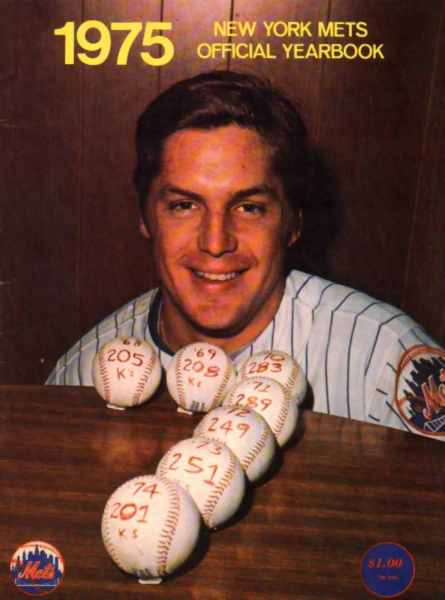
Mets Yearbook: 1975

SNY’s excellent Mets Yearbook series returns Thursday night, December 3, at 7:30 with the 1975 highlight film. Find out if Tom Seaver strikes out 200 batters for an eighth consecutive year.

And speaking of seeing Tom Seaver, if you haven’t seen the Alaska Goldpanners’ fabulous footage from the future Franchise’s first major league start, 4/13/67 at minty-green Shea Stadium, you gotta check it out right now. Thanks to Kerel Cooper of On The Black at bringing this archival gem to the Metsosphere’s attention.

Image courtesy of kcmets.com.

Six Seats Suddenly Available

As the Mets go about their alphabetical roster restocking — Alex Cora…Chris Coste…Chuck Cottier? — they'll have to do it without five of their longtime ticketholders. A Mets fan and FAFIF reader sent us the note below the other day explaining why he and his friends will not be renewing their seats.

I don't know whether this group, whose letter was signed “Amazings NY,” has reconsidered its decision based on the subsequent securing of clubhouse wise man Cora or eternal Phillie Coste (or, for that matter, the definitive deletion of Brian Schneider), but I kind of doubt it. Since we ran a letter like this a little while back, I thought it was fair to run this one, too. That said, if anybody wants to send us a “I just bought season tickets for the first time, it will be worth every penny” missive, we'll be happy to consider it for publication.

In the meantime, edited only for clarity, here is the story of Amazings NY and why you won't see them regularly at Citi Field in 2010.

***

First off, I never blogged or used the Internet to voice my opinion before. Maybe you can run this on your blog if you see fit.

We are a syndicate of five lifetime Met fans related through blood, marriage or friendship who have been season ticket holders since the early nineties when our paychecks finally allowed us some disposable income. Our full season 4 seats steadily improved over the years. In the past decade we added 2 more seats for half a season. Over the years we had a few additions and subtractions to the group, [but] the core never changed. We went together, we went with our own families. If no one went we gave the tickets away. Sold a few. There were no worries.

It was a sweet setup. For a couple of grand a year, we went when we wanted and had a blast. There were good years and bad years, but we were certainly part of the “Flushing Faithful”.

This year [2009] everything changed; to keep our seats, the prices quadrupled. The seats were so expensive that we could no longer treat them as whimsically as we had in the past. We had to commit to games well in advance, we would sell the seats we weren't using. We could not afford to give them away as we always had (apologies to friends and coworkers who had benefited). Then the season went south; OK I understand a team can have injuries, but look at the Yankees and Phillies, they finished the season with essentially the same teams as they started the season (losing Chien-Ming Wang was more likely a blessing than a curse). Were these Met injuries a freak of nature or did this uncover a team of poor design? Probably both. But this is a discussion for another day.

It was a hard team to watch. Not because the team was losing. We're Met fans, we have agonized over losing seasons before. Sloppy play at every level (Ryan Church missing third base, Luis Castillo dropping the last out against the dreaded Yankees). This time was different. There were no prospects to root for. They put Daniel Murphy in a position to fail, as opposed to most teams which take care to place rookies in a position to succeed. Watching washed up mercenaries are hardly a draw. Remind me how Sheffield fits into our future? Fernando Tatis? Livan Hernandez? Where were the players to root for? Luis Castillo makes me ill. He is the only non-Yankee in the 2009 Yankee highlight reel.

Was it incompetence or was the team disingenuous as they communicated the injuries to the fans? Either way it was pathetic and another example of ownership and management's disregard for their fan base. The new stadium is beautiful, and a great tribute to the Brooklyn Dodgers and Ebbets Field. Another slap in the face to the lifetime Met fan.

So our season ticket renewals came in two weeks ago. They are offering our seats to us at a 6.5% discount to last year. The same seats we could not sell for half their face value for the last three months of the season. The Mets have put their fans in a position to carry all the risk. There is little upside to the seats with their nosebleed prices. Did they offer a credit for last years dismal showing? Of course not. Where is the goodwill? The Mets have left their season ticket holders out to dry.

The Mets will have to wake up to some cold facts: This is no longer the maiden season in Citi Field, that the Mets lost 92 games last year, they are not a likeable team, and the Met fans endured the team choking in September the two preceding seasons. Any young New York baseball fans are going to naturally gravitate to the world champion Yankees. We are living through the worst recession of our lives and Bernie Madoff and his buddies will not be there to keep demand up for high-priced tickets.

So our syndicate after 17 years is not going to renew any of our 6 season tickets. The lack of goodwill on the part of the Mets has morphed into ill will on the part of these season ticket holders. Interestingly, I have a handful of season ticket holding friends, all of whom came to the same conclusion.

My fear is that there will be a Knick-ization of the Mets. My dislike for the Knicks' ownership, management and players has led me to attend a total of one Knick game in the last ten years. I am someone who at one time watched every Knick game. So the precedent is there and it scares me.

I probably don't speak for everyone, but I would rather root for Mets who came up through the organization, than the high-priced mercenaries who never live up to expectations. Yes I'm talking to you Pedro, Oliver, Luis…let's rebuild a farm system. Trade high priced players at the trading deadline for prospects when we're not contending. Have you seen the Atlanta organization? They have 5 legitimate top starters: Jair Jurrjens, Derek Lowe, Tim Hudson, Tommy Hanson and Javier Vazquez. The Florida Marlins have an exciting young core with Hanley Ramirez, Dan Uggla, Chris Coghlan (NL Rookie of the Year), Jorge Cantu (100 RBIs). Josh Johnson and Ricky Nolasco both had more than 190 strikeouts and Chris Volstad has looked spectacular at times. The Phillies have gone to the World Series the last two years. Are we looking at fourth place in the NL East?

I urge the fans: Do not renew, do not buy tickets. Let the Mets carry some risk, let the Mets show some goodwill to their fans. Trust me, you will be able to buy the tickets on the secondary market at half the price. Once you renew, if prices drop, you won't see it.