The blog for Mets fans
who like to read
ABOUT US

Faith and Fear in Flushing made its debut on Feb. 16, 2005, the brainchild of two longtime friends and lifelong Met fans.
Greg Prince discovered the Mets when he was 6, during the magical summer of 1969. He is a Long Island-based writer, editor and communications consultant. Contact him here.
Jason Fry is a Brooklyn writer whose first memories include his mom leaping up and down cheering for Rusty Staub. Check out his other writing here.
Got something to say? Leave a comment, or email us at faithandfear@gmail.com. (Sorry, but we have no interest in ads, sponsored content or guest posts.)
Need our RSS feed? It's here.
Visit our Facebook page, or drop by the personal pages for Greg and Jason.
Or follow us on Twitter: Here's Greg, and here's Jason.
|
by Jason Fry on 4 July 2009 6:23 am I was supposed to be home in time for the game.
Instead, the flight back from Boston was delayed by the Northeast's apparently daily rain showers. The plane didn't take off until 6:30 or so, and it was after 7:30 when I was able to get MLB At Bat up and running. I navigated my way to the audio with my fingers over the screen, not wanting to see the score. Heard unfamiliar voices — ack, I'd hit the feed for the Phillies broadcast. Tried again, and there was an unhappy-sounding Wayne Hagin doing his usual roundabout version of play-by-play. (Wayne. Tell. Me. What. Happened.) He didn't sound like a man who was conveying good news, and he wasn't.
Phillies 4, Mets 0.
By the time I got out of the taxi it was Phillies 7, Mets 0. When I turned the damn thing off the Phillies had the bases loaded and no one out and Livan was finally done serving up BP. (The Mets somehow got out of that one without further damage. But while the battle might have been won, the war was on its way to being lost.)
I went for a walk, got something to eat, sat on the Promenade and watched the sunset. Pretty nice night; not one that I was going to let get ruined by the inevitable. Tonight, I make no apologies for my desertion. I know fans are supposed to go down with the ship, but by then the Good Ship Mets was on the bottom of the North Atlantic, prowled by treasure hunters in submersibles. There's only so much a fan can take.
I've talked to a fair number of folks in recent weeks about the curious case of the 2009 Mets. They know everybody's hurt and the team hasn't played particularly well, to say the least. But, they point out, the Mets are right in the hunt. Had they won tonight, they would have been tied for first with the Phillies and the Marlins. Their question is generally some variant of “How can you give up on a team in that situation?”
Strictly speaking, I haven't. But I gotta believe? There's plenty of evidence that I shouldn't and not a heck of a lot of data points that are helpful for making the counterargument.
I didn't lose faith because the Mets have been reduced to Cora's Irregulars by injuries. If anything it made me cheer more enthusiastically — at first. You can't expect a ragtag team of Coras and Evanses and assorted Fernandos to replace Reyes and Delgado and Beltran, and I haven't.
But you can expect them to play sound fundamental baseball, being major-leaguers and all. Tonight they repeatedly let Phillies take extra bases because guys weren't covering bases or pursuing balls that got past them. And it's not the first time shoddy and/or dopey defense has been on display. And you can expect them to have good at-bats and do something against 33-year-old sacrificial-lamb emergency starters. But nope, they made Rodrigo Lopez look like Bob Feller.
I know, I know, the Mets have played three games against three teams in three cities in three days. They've gone from a haunted hotel to one full of Furries to a park filled with furies. I'm sure they're tired. But everybody's tired now — you think flying home after getting swept by the Braves didn't leave the Phillies a little peckish? But few other teams look as tired as the Mets, who already have a staggering number of losses that can be pinned on gag-job collapses, clinics in how not to play baseball, and nights where the whole team seems to be collectively sleepwalking. I gotta believe? Well, I'll try, but it seems increasingly clear that this season is one long bad dream, and the insanely low number in the GB column just a mean-spirited twist in the nightmare.
Happier daydreams awake in the pages of Faith and Fear in Flushing: An Intense Personal History of the New York Mets, available from Amazon, Barnes & Noble or a bookstore near you. Keep in touch and join the discussion on Facebook.
by Greg Prince on 3 July 2009 7:19 am Welcome to Flashback Friday: I Saw The Decade End, a milestone-anniversary salute to the New York Mets of 1969, 1979, 1989 and 1999. Each week, we immerse ourselves in or at least touch upon something that transpired within the Metsian realm 40, 30, 20 or 10 years ago. Amazin’ or not, here it comes.
I didn’t think it was a bad trade. I had mixed emotions, to be sure, but those were tinged by sentiment. For the purposes of winning baseball games, I didn’t think it was a bad trade.
I was wrong. I was wrong to think sending Lenny Dykstra and Roger McDowell to the Phillies in the middle of the 1989 season wasn’t a bad trade.
It was a bad trade. It’s probably not given long enough shrift as one of the more deleterious trades the Mets have ever made. Maybe that’s because it’s got so much competition. Ryan for Fregosi usually stops all conversation, but Nolan Ryan didn’t help a division rival win a pennant and Jim Fregosi didn’t keep the Mets from winning one themselves.
This is hindsight talking, but hindsight took the early bus where this one was concerned. It might not have seemed altogether ludicrous — may have even looked beneficial — that Sunday in Philadelphia when two stalwarts of a past champion dressed in the visitors clubhouse but left the Vet with the home team. The Mets of 1989 were past champions and very much acting the part for the first 2½ months of the season. That’s why drastic action was deemed necessary.
The Mets entered ’89 as favorites to hold the N.L. East in their pocket as they had been favored regularly every April since 1985. But our sluggers were sluggish and the club limped to a 3-7 start; they’d sit in last place more than two weeks in. A mini-surge captured them first place soon after in a very tight, very fluid divisional race. But traction was elusive. After 60 games, they were 30-30, in third place, four games out.
The previous December I read Roger Angell describe how old the Mets looked in the sun, on the field in Game Five of the ’88 NLCS, the day after Mike Scioscia became Mike Scioscia. Within days of that issue of the New Yorker hitting newsstands, those Mets — which is to say the past champion Mets — began to be taken apart the way we would watch Breeze Demolition take apart Shea Stadium twenty winters later. The first piece to be extracted was Wally Backman, traded unceremoniously to the Twins for three minor leaguers who never made it to the bigs. Wally Backman remains the Met who epitomizes the “he comes to kill you” ethos every Met fan sentient back then recalls with such wistfulness. But he was given away for three instrumental breaks; Jeff Bumgarner, Steve Gasser and Toby Nivens cannot be said to have added up to a song.
That was the only trade of note the Mets made heading into ’89, but shipping Backman off to Minneapolis was move enough. It cleared the way for the future, for Gregg Jefferies. After his earth-moving callup in ’88 (109 ABs, none before August 28, actually earned him Rookie of the Year votes), a position would have to be found for Jefferies, who was more hitter than player. Wally’s position was deemed Gregg’s. What had been the property of Backman and Tim Teufel now belonged to the heir apparent. Angell was right. Keith Hernandez was aging — 35. Gary Carter was aging — also 35. Darryl Strawberry wasn’t old (27) but his maturity was never a given. McReynolds, HoJo…nice players, but Jefferies was the star in waiting. This was the beginning of the overhaul of a team that had won to a team that would win again.
Yet Jefferies struggled, and the old guys got older, and plenty else wouldn’t click, and something had to be done. Enter…or should we say exit Lenny Dykstra and Roger McDowell. It wasn’t their fault the Mets were a stagnant .500 team, but there was doubt they’d ever exceed what they had been. Randy Myers throwing peas, with converted starter Rick Aguilera chipping in, made McDowell’s hotfoots superfluous in the bullpen. He was a sad 1-5 by mid-June. Dykstra was part of a center field platoon and not particularly amenable to going halvsies with Mookie Wilson any longer. There was no particular dropoff in his production in 1989, but management looked at Lenny and saw a part-time player who swung for the fences far more than his frame suggested would be ideal.
If you could trade two players rapidly devolving into spare parts and get a player not long removed from being considered one of the true comers in the game, how could you not? Enter Juan Samuel.
Geez, this guy was good. The Phillies were nothing special from 1984 through 1987, but Samuel was. Struck out more than should be tolerated, yet for four seasons put up hellacious numbers. Stole as many as 72 bases; drove in as many as 100 runs; collected 28 homers and 15 triples in the same season. Sadly, none of those were his most recent stats when the Mets got him. Juan Samuel had a down 1988 and was doing no better in 1989. But Davey Johnson had his eye on him since he came up in 1984 and Davey got his man, a two-time All-Star second baseman, and inserted him in the lineup every day…in center.
To be fair, he made the switch as a Phillie, but this was the emerging Met way: get somebody who played one position as a rule and jam him into another. Howard Johnson would try shortstop until short could stand it no more. Gregg Jefferies bounced between third and second. And center field at Shea, once the province of legends Dykstra and Wilson (suddenly a utilityman), was bequeathed to a converted second baseman.
A second baseman who couldn’t play center. He was a terrible centerfielder. Didn’t get good breaks. Didn’t know what he was doing. And he didn’t make it worthwhile by hitting up a storm. No longer on turf, Samuel stopped tripling. He stole 31 bases in 3½ months, but didn’t get on enough for it to make a difference. Batted .228 as a Met. His OBP was .299, a stat that may not have been in vogue twenty years ago but was glaringly weak enough to change Davey’s habit of penciling Samuel in as his leadoff hitter by August.
Individually, he was a bust and as far as helping the team…well, the Mets were three over, two out, in third place on June 18, the day of the trade. A week later, after sweeping the Phillies at Shea, the Mets moved a percentage point ahead of the pack. But that was it. They would never see first place again in 1989. It can’t all be laid at Juan Samuel’s feet (which indeed proved useful when he unleashed a karate kick on Norm Charlton in a rollicking brawl versus the Reds), but let’s just say the Mets didn’t lose it in spite of him.
The sour taste Mets fans of long memory might still have from Dykstra & McDowell for Samuel probably stems from the future success of Lenny Dykstra and the sense that the ’86 ways that began to fade with the dismissal of Mitchell and Knight and accelerated with the exile of Backman really began to evaporate when Dykstra left. Those are legitimate reasons for wanting to spit out the residue of Juan Samuel’s tenure. But let’s not forget that not only was Samuel ineffective as a Met, he was damn near insubordinate toward the end. As the season drew to a close, Davey Johnson wanted to consider what he had to look forward to for 1990. The manager penciled Samuel in to start a game at second base. Having proved an inadequate centerfielder (and Jefferies having shown himself utterly unreliable up the middle), Davey figured it was worth a try.
Juan Samuel refused to play second base for the Mets. Said it wasn’t fair to him, that he wasn’t properly prepared, that that’s not what he’d been doing the entire season. So he didn’t play second. By December, he was traded to the Dodgers for Mike Marshall and Alejandro Peña. (And, for what it’s worth, 1989 would be Davey’s last full season as Mets manager.)
Roger McDowell’s visibility as a reliever would recede after leaving the Mets. He bounced from Philly to L.A. to Texas to Baltimore, never making it back to the postseason before lighting his last major league match in 1996. His greatest post-Met fame would come in TV appearances that had nothing to do with saves or holds. He was a mainstay in the annual MTV Rock ‘n’ Jock Softball soirees (they kept inviting him back long after his sinker stopped sinking) and he endures in Seinfeld reruns as the notorious “second spitter” in “The Boyfriend,” a.k.a. the two-parter with Keith Hernandez.
Lenny Dykstra, however, was the gift that kept on giving as a reminder of where the Mets had been and where they were unwillingly going. We should have known something was up when he made his first appearance at Shea as a Phillie five days after the trade. After accepting a large ovation from his old fans, he stepped in against Bobby Ojeda and tripled. He’d score moments later on a Dickie Thon homer.
The man they called Nails didn’t light the world on fire as a Phillie otherwise in 1989. He left the Mets a .270 hitter and finished the year at .237. His OBP dropped from a so-so .362 with the Mets to a positively Samuelian .297 for his new team. The Phillies tried to give him away in the offseason. They found no takers. Frank Cashen was among those who said thanks, but no thanks.
And wasn’t Philadelphia thankful? Not unlike the renaissance Ray Knight experienced in 1986 after proving untradeable off an awful ’85, Dykstra blossomed in 1990: batted .325, led the National League in on-base percentage at .418 and hits with 192, made the All-Star team and finished ninth in MVP voting. The next two years were injury-riddled (due partly to driving drunk in ’91), but he was back in form in 1993, leading the league in hits, walks and runs, finishing behind only Barry Bonds for Most Valuable Player honors and spearheading the Phillies’ pennant drive. Lenny hit the tenth-inning home run that would win pivotal Game Five of the NLCS in Atlanta, and he came close to snatching the World Series from Toronto by posting four steals, eight ribbies and four homers, including a three-run job in Game Six that was snowed under by Joe Carter’s later heroics but was incredibly and characteristically clutch in its own right.
While Lenny Dykstra was doing all that in 1993, the Mets were finishing last, 44 games under .500, 38 in back of Philly. Juan Samuel was a Cincinnati Red and bitter memory by then. Even though Dykstra never had anything close to a big season again (retiring after 1996), the critical mass created by his ’93 performance and Samuel’s total disappearance made the deal one of utter infamy for Mets fans. Dykstra may have been cited in the Mitchell Report. He may be fighting myriad lawsuits. His businesses, so successful before the stock market tanked, may be in trouble. But he’s one who got away, one of too many. It wasn’t a Ryan, an Otis, a Kent or a Kazmir with Dykstra. He achieved something tangible with the Mets. He won a ring here. So did Ryan, but Ryan was unfulfilled potential through 1971. Lenny had already paid dividends and we let him go when he still had miles left on his warranty.
Samuel goes down as a bad acquisition, sure, but also a harbinger of dreadful things to come. First off, from the time Mookstra vacated center in deference to Juan until Carlos Beltran accepted several Brinks Trucks to play there, the Mets had no serious full-time, long-term centerfielder. Other than one hot year from Lance Johnson and some good months from Jay Payton, it was essentially vacancy signs and poor planning 410 feet from home plate. Samuel also signaled a new era of reliance on misguided reclamation projects. You can draw a line from Samuel to Baerga to Alomar (though I could swear Robbie didn’t need reclaiming until he got here)…maybe this is one of those “it always happens to us” default modes to which Mets fans tend to revert, but, honestly, we always seem to grab once-great players without wondering why they were so available for the grabbing. That’s also how George Weiss insisted on stocking the 1962 Mets, incidentally.
Twenty years ago the Mets weren’t meeting reasonable expectations and they floundered. They did something about it. It didn’t work where Juan Samuel was concerned. But they would do more. We’ll be back in a few Fridays to consider their other major move of the summer of 1989 — and how 1986 ended for good.
Flash back to how a Mets fan became the Mets fan he is today with Faith and Fear in Flushing: An Intense Personal History of the New York Mets, available from Amazon, Barnes & Noble or a bookstore near you. Keep in touch and join the discussion on Facebook.
by Greg Prince on 3 July 2009 3:48 am Wednesday they rode the bus. Thursday they broke the Bucs. This weekend?
First place or bust!
Let's get a little giddy for the giddy-up the Mets showed after falling behind 5-0, shedding Tim Redding, shredding almost their entire roster and blowing a ninth-inning lead that seemed fated to be converted into the regulation loss to end all regulation losses. It was a Wes Westrum kind of day developing in Pittsburgh, one from which you're left muttering into the mirror, “Ohmigod, wasn't that awful?”
But it didn't develop as such. It was a cliffdweller, all right, but this time the Mets merely teetered on the edge instead of plummeting deep into the confluence of the Allegheny and Monongahela. Somehow they formed the mighty Ohio of comebacks — twice.
Next stop: Philadelphia, where our temporarily unreeling N.L. East contender challenges the sputtering defending champion, with two other mediocre teams futzing around in there somewhere with us. The Mets, the Phils, the Fish, the Braves…four clubs separated by two games, they'll all meet again on their long journey to the middle. Until then, we've won two one-run demi-thrillers in a row after feeling the cold hand Tuesday night and wondering if we'd ever see the sun.
It rained in Pittsburgh. It rained Pittsburgh baserunners, some of whom, as is Pirate custom, you'd never heard of before. Who's Garrett Jones? He's who Nyjer Morgan was last month. He's who Steven Pearce was last year. He's Humberto Cota and Tike Redman and everybody else who's taken a black and gold bite out of our blue and orange ass these last few seasons. The Buccos haven't had a winning record since 1992 because they're constantly bringing up Garrett Jones and Steven Pearce and Nyjer Morgan and Humberto Cota and Tike Redman. Why won't someone tell our parade of Tim Reddings that this is not what they mean by Lumber and Lightning?
Well, Redding lasted not long and my attention was diverted by the things that keep day games going on in no more than one ear. But then I heard weird sounds like Murphy driving in two and Evans driving in two more and Tatis doing that thing that isn't grounding into a double play. And Church…he was all over the place. Timmy! was gone and the Misches and the Dessenses and the Stokeses had morphed from mopping up to setting up and all it was going to take was the one credibly great pitcher called on all day to end it.
And he very nearly did, damn it.
Frankie Rodriguez finally had his Bradmando Fragner moment. He legitimately blew one in Baltimore, but that seemed inevitable enough so as to be excused as, if you'll pardon the expression, popping his Met closer cherry. This one was rotten tomatoes and they just kept coming. Freddy Sanchez dives into first, the stupidest play in baseball, and he's safe. Adam LaRoche, who told Carlos Beltran to stuff it a month ago, turned his indignation on Rodriguez. OK, score tied, joke's over. Get them out now, Francisco. But K-Rod couldn't stop with the funny business. He gets two outs, but then he allows two hits. Winning run is on third, Brandon Moss lines a rising bullet toward right…but it's not a hit! Luis Castillo not only catches it but does a little “look what I found” with the ball (cocky bastard, ain't he?).
Next chapter, the Pirates are the Pirates: their closer du jour hits Tatis. Tatis is in such pain he steals second. Church singles and Tatis is showing signs of dead duckery, but McCutchen doesn't so much airmail the throw home as send it on the space shuttle. Mets strangely lead 9-8. Even stranger, Frankie comes out for the tenth after throwing what must have been a hundred pitches in the ninth. The choice facing Jerry Manuel was Rodriguez's right arm falling off or Bobby Parnell's right arm being used. These days you'll take your chances with the former.
And it worked. The Mets won a game they didn't deserve to lose nearly as much as the Pirates did. They're all big juicy W's in the standings, however, so what a game! Back on the bus and off to Philadelphia for a most improbable roll to maybe the top of the division.
On a steel horse we ride…
The Mets experience two definitively happy endings and lots of semi-enjoyable middles in Faith and Fear in Flushing: An Intense Personal History of the New York Mets, available from Amazon, Barnes & Noble or a bookstore near you. Keep in touch and join the discussion on Facebook.
by Greg Prince on 2 July 2009 2:43 am Jerry Manuel somehow fails to consult with me, but I could have told him taking the bus to Miller Park was an excellent idea. Stephanie and I did exactly that less than two years ago. We were staying downtown, so it was simple. The express rolled right by our Wisconsin Avenue hotel and we just hopped on — a quick ride and a boon to team spirit. Despite some later logistical missteps, I'd highly recommend the bus as transportation if you're staying in Milwaukee (provided you can live without tailgating).
Yovani Gallardo pitched for the Brewers that hot August night in 2007. Pitched well, too: seven innings, five hits, seven strikeouts, hit a homer and recorded the win. He was dynamite this fine Wednesday afternoon as well: seven innings, five hits, twelve strikeouts. But he didn't take Mike Pelfrey deep, which was an oversight on Gallardo's part, because if he wasn't going to help his own cause, none of his teammates were. The Mets, on the other hand…the team that rides the bus together encounters no fuss together.
Or something like that.
Our bending, breaking but by no means clinically dead Mets outlasted an extremely effective Gallardo for the second time this season. In April, they did it behind Johan Santana when all Johan had to do was flash his red blinkers, and traffic halted in his midst. Man, those were the days. While Johan was still sitting and wondering whether anybody here, including himself suddenly, can play this came, Big Pelf stood tall, metaphorically as well as vertically. There was a walk here, a balk there and the general sense that things were going to go to hell per usual, but Pelf stiffened and the Brewers were stymied. Yovani Gallardo has struck out 19 Mets across 13 innings in 2009 and has only a no-decision and a loss, both by 1-0 scores, to take on his bus home. Forty years ago, Steve Carlton struck out 19 Mets in 9 innings and no doubt wanted to throw Ron Swoboda under a big yellow conveyance. But let's not get ahead of our route to glory just yet.
At least once a year when I was in elementary school they showed us a safety film admonishing us to commit “no horseplay” while riding the bus. That phrase always cracked me up, but after Tuesday night, I wasn't laughing. The Mets distracted the driver with their incredibly juvenile antics and all but drove off a cliff with their latest 1962 homage in the fourth inning. It's little wonder Jerry Manuel was moved to hold a closed-door meeting afterwards — though the Mets being the Mets of late, I wouldn't assume the closed-door part was intentional. Prior to the team's very first home game ever, according to Leonard Shecter in Once Upon the Polo Grounds, “Casey Stengel slammed the door of his newly built office, and when he tried to get back into it there was no key that fitted the lock.”
Today, Pelfrey was the key. Tomorrow? One ride at a time. I could see the Mets accidentally locking themselves in visitors clubhouses around the National League before I could see the Mets riding the victory bus repeatedly based on their recent horsespit play, but with the Phillies losing Wednesday night, they're all of two games from first place, with the current first-place team the next stop on our timetable after Thursday's detour to Pittsburgh. We all have ironclad reasons not to take the Mets' chances seriously (the five-game losing streak; the 9-18 June; the prevalence of the lame and the halting; our collective experience), but y'know what? Screw it. The Mets won a 1-0 game. They're 1-0 in their last one. It's summer and, for the moment, not raining. Per Leo McGarry to Jed Bartlet when Bartlet doubted his chances of being elected president on The West Wing, “Act as if ye have faith and faith shall be given to you. Put it another way, fake it 'til you make it.”
Or, for our purposes, keep on busin'.
***
With Thursday's game an early afternoon affair, that leaves you plenty of time afterwards to hop the F train to JLA Studios in Brooklyn (highly convenient to Manhattanites) for an all-baseball edition of Varsity Letters, starting at 7:30. Learn more about it here. Jason and I have both read at VL and can attest to the quality of these events. Consider it highly recommended from your friends at FAFIF.
To be enjoyed via any mode of transportation unless you're steering it (in which case, pull over first): Faith and Fear in Flushing: An Intense Personal History of the New York Mets, available from Amazon, Barnes & Noble or a bookstore near you. Keep in touch and join the discussion on Facebook. Check out the latest review, from 1969: The Year Everything Changed author Rob Kirkpatrick, here.
by Greg Prince on 2 July 2009 2:40 am 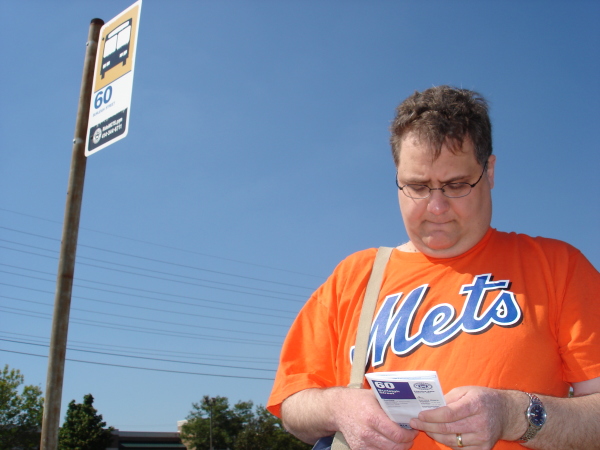
In 2007, Stephanie and I visited Milwaukee. We took a bus to Miller Park, just like the Mets did to break their five-game losing streak Wednesday. We each encountered no problem en route to our date with the Brewers. This candid shot was taken the next day when I got a little ambitious and guided us to the outskirts of town for a trip to Steak ‘n Shake, a place I’d ride to the ends of the earth for, actually. Afterwards, we took the bus here and there, ultimately getting really lost (mini-debacle detailed here) before finding our way back to the hotel.
However they choose to roll, I wish the Mets better luck with their next transfer point.
by Jason Fry on 1 July 2009 4:16 am A grim exercise, for posterity: With one out in the Brewers' fourth, Johan Santana walked a 29-year-old journeyman starting pitcher. He got Corey Hart to fly to center, but Fernando Martinez fell down, literally landing on his face to put runners on second and third. Santana walked J.J. Hardy and went to an 0-2 count on Ryan Braun … to whom Johan then threw a meatball. The ball sailed over Gary Sheffield's head and bounced off the wall. Alex Cora had a play at the plate on Hardy, but his relay throw got past Omir Santos. Santana, backing up the play, saw Braun stray too far down the third-base line — and promptly threw the ball over David Wright's head. Cora fell down in a vain attempt to corral it. All four runs scored.
Oh my God, wasn't that awful?
Young baseball fans learn by about their eighth birthday that baseball can be shockingly cruel. There is no mercy rule for bad teams, battered teams or unlucky teams. Quarter is neither requested nor given.
But my goodness, has any team and any fan base staggered through half a season with this many horrifying, stomach-punch, throw-the-beer-at-the-set, call-the-FAN-in-a-lather, kick-the-dog, bag-on-the-head losses?
Let's review:
April 12: Daniel Murphy's dropped fly ball against the Marlins keys a Santana loss.
April 21: Murphy plays left field wearing ice skates against the Cardinals.
May 2: Sean Green walks in the winning run against the Phillies.
May 11: Jose Reyes' seventh-inning error (behind Santana, of course) opens the floodgates against the Braves.
May 17: Mike Pelfrey balks and mutters the name of the pitch he's throwing, tipping off the Giants, while Joe Morgan and Steve Phillips all but call Carlos Beltran a member of Al Qaeda.
May 18: Ryan Church misses third base.
June 1: The Mets are up 5-0 in the third; the Pirates score five in the 8th.
June 10: After Jayson Werth does a heck of a Ron Swoboda imitation, Chase Utley's second homer of the night beats the Mets.
June 11: Ken Takahashi, meet Raul Ibanez.
June 12: Luis Castillo drops the ball.
June 14: Yankees 15, Mets 0.
June 18: Frankie Rodriguez gags against the Orioles.
June 26: Three errors in the second lead to a 9-1 Yankees win.
June 27: The Mets manage one hit against A.J. Burnett.
June 28: Frankie walks Mariano Rivera with the bases loaded.
June 30: You just saw it. (Greg didn't — he was at Yankee Stadium. Tough night when you're better off at Yankee Stadium in the rain.)
July 1: God only knows. God only fucking knows.
Turn off the FAN, put in earplugs and seek solace in Faith and Fear in Flushing: An Intense Personal History of the New York Mets, available from Amazon, Barnes & Noble or a bookstore near you. Keep in touch and join the discussion on Facebook.
by Jason Fry on 1 July 2009 1:31 am Oh my fucking God, y'all.
by Greg Prince on 30 June 2009 8:52 am It was a perfectly admissible argument that Howard Beale advanced in the days that followed. It was, however, also a very depressing one. Nobody particularly cared to hear his life was utterly valueless.
—Narrator, Network
Goddammit, this is a dark fucking period.
—Dewey Cox, Walk Hard
Things can’t get worse, they got to get better, a wise man once wrote.
He wasn’t writing about the Mets.
Things might get better. They’ll probably get worse first. We are several city blocks from just around the corner to the light of day. We are stumbling around in the dark, groping for the “on” switch. We seem likely to continue doing so for some time.
At this point, even a mad prophet of the airwaves couldn’t tell you much encouraging about the Mets. What they’re communicating by their very conduct accurately tells their story. On a night when they gathered almost as many hits as they had in their previous four contests combined, they allowed all that and a fistful more to the Milwaukee Brewers, who at first didn’t know what do with such a bounty but ultimately did plenty. Our sole pleasant surprise of the past month pitched like the midnight pumpkin he might very well turn into. Fernando Nieve didn’t have it; his catcher, Brian Schneider, did (ringing two-run double to make the game briefly competitive) until he didn’t (running the wrong way between first and second when a bloop fell into right facilitating a 9-4 force; he also grounded into a first-pitch, game-ending double play just when things were developing a hint of intrigue). And of course when something Metlike happened to a Brewer, namely Casey McGehee pulling a Luis Castillo on an even easier pop fly than that which was dropped on June 12, he made up for it minutes later with a death blow grand slam. That’s what you call atoning for your sins. (Luis, however, handles ground balls with renewed focus and aplomb since his game-costing error, so good for him.)
At least the Mets now have a double-digit dinger dude, as Gary Sheffield became the first Met to go deep 10 times in ’09. Sheff’s also the first Met this year to raise his homer total as high as his uniform number. That took only 75 games.
***
Monday night’s game was grim, but it was the Brewers and I saw it on TV, thus it was not particularly painful except as a reminder that we are currently party to a seriously deteriorative baseball narrative. Sunday night’s festival of futility, however…that was grim and that was dismal.
You could call it grismal and you wouldn’t be wrong.
I viewed Sunday night’s loss to the Yankees from inside Citi Field, which was as instructive as it was painful even if it meant limited exposure to Miller, Morgan and Phillips. You probably had to see it for yourself in person to truly understand how hopeless this game was and how hapless these Mets have become. They played nine hollow innings against the Yankees and conveyed very little sense that they had a genuine chance to win despite never trailing by more than three runs. Mind you, this was a game in which the opposition’s starting pitcher, a fellow with an ERA higher than Oliver Perez’s, didn’t out-and-out toy with them as his teammates had Friday and Saturday. CC Sabathia and A.J. Burnett had the night off. The Mets continued their paid sabbatical. For 27 innings they were barely present on the same field as the Yankees. They certainly didn’t belong on it.
Over the weekend, Burnett keyed a one-hitter, Alex Rodriguez passed Reggie Jackson on the all-time home run list and Mariano Rivera recorded his 500th save. The Yankees left Citi Field with more souvenirs than most Mets fans can afford from the team store. They did it without all-time Met tormentor Derek Jeter for two nights, though he materialized just long enough to back his Ford Edge over our petunias. Jeter had the flu — and he makes me sick — but he played hard and he won. The Yankees hadn’t won a Subway Series in six years but the whole thing felt familiar and expected. Same as it ever was and all that. But worse.
Will Leitch suggested in New York magazine last week that the Subway Series hasn’t been a colossal deal since 2002 when Shawn Estes wasn’t knocking Roger Clemens on his chemically enhanced ass. An embarrassing episode in retrospect, to be sure, but a footnote in real time to the final score of Mets 8 Yankees 0, a homer by Estes and another by the never-quite-avenged Mike Piazza inflicting better and more practical damage on the Rocket’s rear end. Yet it would have been nice to have left a bruise on the area Clemens presumably reserved for Brian McNamee’s syringe.
We won that game, we lost that battle. Seven years later, when Frankie Rodriguez walked Mariano Rivera — how is that not a typo? — it didn’t matter in terms of the tangible result. Mets were losing 3-2 before, they were losing 4-2 after and they were going to lose regardless. But holy fuck. K-Rod walked Rivera. He walked Rivera after intentionally walking Jeter to load the bases with two out. It’s not enough that our $37 million closer can’t be the Met who finally whittles Captain Cock…y down to size. He can’t throw three fucking strikes to fucking Mariano Rivera (career RBI total prior: 0)? The Subway Series began with Luis Castillo undermining Francisco Rodriguez’s best efforts. It ended with Rodriguez as his own worst enemy. The dropped pop fly and the bases-loaded walk to the other team’s closer made for gruesome bookends this year, just as Estes’ legendary non-HBP of Clemens has found its soulmate in Rodriguez’s BB of Rivera.
***
Dave Mlicki, Matt Franco and our 17-13 overall record between 2004 and 2008 notwithstanding, nothing good comes of the Subway Series. Nothing. I did not care for its arrival at Citi Field, and not just because of the sweep that was laid on us there.
The damn thing felt much bigger at Shea Stadium. The final moments of the final Mets-Yankees game ever played there, one year ago Monday, was hot-wired electricity incarnate. It was lightning in a 20-ounce Pepsi bottle. It almost always was. Every Subway Series game I attended at Shea, exquisite or atrocious, crackled. This one just oozed slowly. But maybe the Subway Series is Norma Desmond in Sunset Blvd.: It’s still big, it’s the ballpark that’s gotten small.
Citi Field does not feel big game ready, which may not matter considering the dim prospects the Mets have for playing big games in the immediate future. For all of Citi’s attractive qualities, it does not strike me as a setting or a stage. It’s a fine place to chill, to chat, to chew — Blue Smoke’s spare ribs have emerged as this nation’s finest natural resource — but on this occasion, for the purposes of raucousness, intimidation and drama, it did not meet the standard set by Shea Stadium. I don’t say that to puff up the memory of a fallen idol either. Citi is lovely, absolutely lovely. But Shea meant business.
Put a ton of Yankees on the Disabled List, give us back our stalwarts and pretend for a moment that we did the emphatic sweeping. Would I be telling you what a boiling cauldron of emotion Citi Field was over the weekend? Maybe, but I’ve been to thirteen home games the Mets have won this season and I’ve rarely sensed those kinds of sparks.
I feel other things. I feel good when I’m there and they win; I feel warmed by it. In fact, I was so delighted by how they escaped the Cardinals last Thursday that I found myself growing tactile in a way I hadn’t to date. I took my traditional postgame stroll through Field Level to the first base side staircase in Jackie Robinson’s Rotunda. I tipped my cap to the picture of Mr. Robinson and Mr. Rickey. I tapped my cap on the Mr. Met disc that thanked me for coming. And as I stepped outside, I patted one of the bazillions of bricks that comprise the exterior.
A tip, a tap and a pat…I would have bestowed those at Shea without thinking because when the Mets won there, I generally left giddy. Last Thursday I did it practically by instinct at Citi from the same sensation. I thought I had made it past whatever barriers were keeping me from fully embracing my post-Shea existence, even if I still tend to think the whole thing is a mostly unnecessary cash grab. My well-embedded cynicism had all but melted in the matinee sun and I was feeling a real kinship for the ol’ new ballpark.
Then Sunday happened and I wasn’t terribly impressed by Citi Field, not when it lay flat on the tracks of a third consecutive Subway Series loss. Mets fans were not consistently vociferous and Yankees fans, all told, weren’t that obnoxious. And they’re Yankees fans, y’know? It was a close enough game Sunday, at least on the scoreboard, so that a crowd like that should have gotten fired up. Yet there was little fire. Maybe that’s a symptom of a boutiquey building that works better for noshing and shopping than it does for blood, but there’s a conspicuous lack of blood inside Citi Field. The Mets aren’t bringing it and neither are we collectively.
***
I’d love to lean on the injuries for everything that ails the Mets, but sooner or later, whoever wears the uniform has to represent. Those players may not be as talented as those for whom they’re substituting, but they’ve gotta be full-fledged major leaguers sooner or later. They’ve got to make the plays they’re capable of making. They’ve got to compete every night. They’ve got to do with their heads what they can’t do with their physical assets. I haven’t seen it since Carlos Beltran went down. First they sagged, then they drooped, now they’re barely Slinkys. The general manager finds help nowhere. The manager muses it would be nice to stick around .500 from now until mid-July.
Thanks to this 9-17 month, the Mets are well ahead of Jerry Manuel’s schedule.
The Yankees are off our radar for now* and the rest of the season is underway. Monday night began a stretch of 88 games against the National League, thirteen in fourteen days, twelve of those versus teams with records now better than that sported by the sub-.500 Mets. The firm of Delgado, Reyes & Beltran will not participate in these proceedings. Oliver Perez took one short stride toward returning when he threw three innings without incident in Coney Island on Sunday. John Maine, however, isn’t even ready to take baby steps. There appears to be no significant internal help to be had between now and the All-Star Break.
That means, barring some unforeseen Minayan maneuver, the field will be filled by David Wright and a cloud of dust. On the nights it’s Johan Plus Eight, that’s great. The rest of the time? When you learn you can’t necessarily count on Fernando Nieve, what is there to believe in? Maybe Liván. Maybe Pelf, 6′ 7″ and still experiencing growing pains. We have to assume Frankie’s walk of Rivera was some kind of celestial joke and he’ll go back to being who he was for most of the season’s first three months. If we can’t have that much, this whole season could go up in Blue Smoke before we know it.
It hasn’t yet, of course. Through June 29, we’re 37-38, in third place, three games behind the Phillies with 87 games to go. That’s not so bad, right? I guess not.
But here’s something that gives me chills:
Five years ago, on June 29, the day Stephanie and I moved into our current home, the Mets beat the Reds 7-5. We didn’t have the cable hooked up yet, so I listened to Gary and Howie describe the exploits of Jae Seo (before he became an anachronistic jersey sighting) and Braden Looper (before he became a perennial annoyance) and beamed approvingly. Through June 29, we were 37-38, in third place, three games behind the Phillies with 87 games to go.
Same as it ever was is really going around these days.
*Actually, the other locally based team will temporarily return to my radar tonight as I have been graciously invited to inspect their new facility. Chronic curiosity where baseball stadia are concerned compels me to follow through despite the presence of that stadium’s title occupants. I’ll report back Wednesday unless I turn into a pillar of salt.
Avoid the temptations and settle down with Faith and Fear in Flushing: An Intense Personal History of the New York Mets, available from Amazon, Barnes & Noble or a bookstore near you. Keep in touch and join the discussion on Facebook.
by Jason Fry on 29 June 2009 6:22 am Truth be told, I never had any use for “Friends.” It just didn't work for me — I found the characters dull or actually irritating, and so never cared what happened to them. But I did think the method for naming the shows — each show is formally known as “The One With…” or “The One Where…” — was clever. That's how we all describe episodes of our favorite shows anyway, so why not keep things simple?
So, what's the Friends-style description of this particular episode of Subway Series, the finale of Season 13? (Remind me not to ask for the Complete Season DVD. Easily the worst one since the 2003 DVD, the one with Jason Phillips and Roger Clemens on the cover. If either one of those DVDs shows up under the Christmas tree I'll know I pissed Santa off something fierce.)
Let's review some candidates.
The night started off as The One Where Taqueria Forgot How to Make Skirt Steak. El Verano Taqueria has become my favorite Citi Field food choice, ranking above even my beloved Shake Shack, and with the added benefit of a line that's usually about five minutes at the worst. Tonight it was more than 20 minutes, which I attributed to lines full of Citi Field newbies and general crowdedness. But when I got to the front of the line, I had to wait at least five minutes for an order of skirt steak. Huh? You have basically three menu choices and orders coming in every 30 seconds and you manage to fumble things that badly? How is that even possible? When I joined Emily, Greg and Jim in the Promenade it was 2-0 Yankees, I'd had to hear that awful news chronicled by the despicable Morgan and Miller and Phillips, and so I was already thoroughly pissed off. Still, this was a problem for one person, not 20,000.
Was it The One Where Daniel Murphy Got Too Cute? Well, yeah, Murphy needs to realize that you treat Derek Jeter like some malign force of nature to be contained or avoided. Don't think about outfoxing him if you're wearing a Met uniform, because it just doesn't work. (Oh, how I wish it were otherwise.) But let's give Murphy a pass — he was being aggressive and he's been a lot better at first than any of us would have guessed.
How about The One With Fernando Martinez Batting Instead of a Pinch-Hitter? That would seem to fit — and underline the point that one double doesn't disprove the amply demonstrated theory that young Mr. Martinez is hopelessly overmatched at a big-league level right now. I think everybody in the ballpark knew Brian Bruney would tempt him into a strikeout, and everybody in the ballpark was right. Still, this one's unfair — Ryan Church was a late scratch, so what option did Jerry have?
We could call it The One Where We Didn't Hit Chen-Mieng Wang. Yeah, except everybody saw that one coming, too. I had Wang penciled in for a seven innings of four-hit, shutout ball. Pessimistic, but not by much.
Besides, all this is overlooking the obvious. There's only one way we're going to remember this game, and we're going to remember it forever.
It's The One Where We Walked in a Run With an American League Closer at the Plate.
Ugh.
***
ADDENDUM: An added head-scratcher at Citi Field tonight was the number of Mets fans wearing inexplicable Met uniforms or t-shirts. McREYNOLDS 22 was old and eccentric, MILLER 25 more so, but neither is obviously crazy if you're a history-minded fan But what to do with the guy woman in the SEO 26 jersey? Or the one heading down the rotunda steps in CEDENO 19? Or the one that took the cake, on the 7 train home: a t-shirt that said BURGOS 40.
BURGOS 40? Really? With all the others, you can at least think of a point in time during which someone might have gotten a little too excited and headed to Modell's. McReynolds was a capable player until he got done eating half of Arkansas, Miller was feisty and gritty if not particularly talented, and Roger Cedeno was decent everywhere except the outfield for a couple of months. Heck, even Jae Seo had a good game or two. But Ambiorix Burgos, owner of one win as a New York Met? Ambiorix Burgos who got hurt and then made news during his rehab from Tommy John surgery first by assaulting his girlfriend and then by being charged with hit-and-run in a case in which two women died? (And who then turned himself in to Dominican Republic officials wearing White Sox gear?) You're a Mets fan, and this is a shirt you a) actually bought; b) kept through all that; and c) decided to wear to show your bona fides against the Yankees?
There's only one explanation for the wearers of SEO and CEDENO and BURGOS shirts: These people are plants, Yankee fans sent to Citi Field in disguise to make us look bad. Which is unsportsmanlike and not terribly necessary: This weekend, the people down there on the field wearing Mets uniforms with their actual names on them had that covered.
ADDENDUM ADDENDUM: The wearer of the BURGOS shirt offers a winning explanation/defense in the comments. I recant my accusation that he's a Yankee plant and tip my cap to him instead. And somehow now even though our lineup is as crappy as it was last night and we're in as much or more trouble standings-wise, I'm more cheerful about things.
Need an antidote to what just happened? I'd suggest a liberal dose of Faith and Fear in Flushing: An Intense Personal History of the New York Mets, available from Amazon, Barnes & Noble or a bookstore near you. Keep in touch and join the discussion on Facebook.
by Greg Prince on 28 June 2009 6:31 am This season is 45% complete and not 1 Met has a home run total as high as his uniform number. It's not like we were counting on Elmer Dessens to lead the way either.
Gary Sheffield wears 10; he has 9.
David Wright wears 5; he has 4.
Luis Castillo wears 1; he has 0.
The Mets wear glum expressions of late; they have reason.
Right now the Mets aren't doing much of anything effectively, starting with staying healthy. But what they're really not doing is hitting home runs. They're not hitting them in their home park and they're not hitting them in a whole lot of other venues.
After 73 games, no Met has reached double-digits in home runs. This seemed distressingly uncommon, so I availed myself of Baseball Reference and Mets By The Numbers and checked a couple of 2009's notably offense-deficient predecessors for guidance.
In 1980, the year the Mets were at their most legendarily powerless — when the Daily News measured them every morning against Roger Maris and both maxed out at 61 — it took 84 team games for Lee Mazzilli to hit 10. He wore 16 and would lead the team with 16. Steve Henderson, whose 1st home run that year came in the Mets' 55th game (and what a game it was), wore 5 and eventually hit 8, making him the only 1980 Met to outhomer his uniform number.
In 1972, when no Met collected as many as 100 hits (in 156 games, due to the strike), it took 102 team games for John Milner to hit 10. Milner wore 28 and would lead the team with 17, but 3 Mets (Rusty Staub, Ed Kranepool and Jim Fregosi) outhomered their single-digit uniform numbers. Jim Beauchamp wore 5 and hit 5 after switching from 24 in deference to Willie Mays.
If Gary Sheffield is healthy enough to make it to Philadelphia, I like his chances of his getting to 10 in Citizens Bank Bandbox. Should Carlos Beltran's bone bruise heal before long, I'd think he'd stand a good shot of doubling his currently frozen total of 8, which would top the 15 on his sorely missing back. David Wright, provided an anvil doesn't fall on his head, is gonna hit at least 2 more home runs between now and October 4…probably more.
Alex Cora wears 3 and has homered 0 times. But he did single Saturday night against A.J. Burnett, 1 of the 9 hits the Mets have collected in their past 3 games, 1 of the 7 singles the Mets have recorded in those very same 26 innings, 1 of 1 hit — singular — the Mets accumulated in losing to the Yankees by a wide margin for the 2nd consecutive night.
Good pitching beats good hitting. What it does to virtually no hitting is almost unspeakable.
***
ADDENDUM: We're 0-4 versus this particular opponent on Saturday nights. One loss was a World Series game whose first pitch was dictated by Fox. The other two were parts of day-night makeups, including one in which Roger Clemens committed an act of assault for which he should have served time. This one, however, was scheduled voluntarily by the Mets. One thing may have nothing to do with another, but I'd ask management to never, ever go out of its way again to play the Yankees on a Saturday night. The phrase “just asking for trouble” leaps to mind.
Pick yourself up, dust yourself off and start reading a copy of Faith and Fear in Flushing: An Intense Personal History of the New York Mets, available from Amazon, Barnes & Noble or a bookstore near you. Keep in touch and join the discussion on Facebook.
|
|

 Comments closed | |





