The blog for Mets fans
who like to read
ABOUT US

Faith and Fear in Flushing made its debut on Feb. 16, 2005, the brainchild of two longtime friends and lifelong Met fans.
Greg Prince discovered the Mets when he was 6, during the magical summer of 1969. He is a Long Island-based writer, editor and communications consultant. Contact him here.
Jason Fry is a Brooklyn writer whose first memories include his mom leaping up and down cheering for Rusty Staub. Check out his other writing here.
Got something to say? Leave a comment, or email us at faithandfear@gmail.com. (Sorry, but we have no interest in ads, sponsored content or guest posts.)
Need our RSS feed? It's here.
Visit our Facebook page, or drop by the personal pages for Greg and Jason.
Or follow us on Twitter: Here's Greg, and here's Jason.
|
by Greg Prince on 22 June 2009 9:33 pm Roster update, per Mr. Rubin of the News and the Mets' dumb luck:
• Lefty Pat Misch and righty Elmer Dessens are mounting their white steeds and heroically galloping to the rescue of an overworked bullpen. They could contribute most effectively by tying Bobby Parnell to his locker so he couldn't come when Jerry Manuel inevitably calls, but presumably they are being whisked to Citi Field to pitch.
• The not particularly belabored Ken Takahashi will refamiliarize himself with the charms of Buffalo Bisonhood.
• Wilson Valdez seeks a new assignment, having been designated for exactly that.
• Veteran Major League outfielder Fernando Martinez returns, four days older and wiser from when he was last a Met, his .194 batting average having almost nowhere to go but up.
• Carlos Beltran has been placed on the 15-day Disabled List with a bone bruise to the right knee that, unlike the Mets' day-to-day Active List, has grown noticeably deeper.
Actually, I guess that's a bigger deal than Pat Misch and Elmer Dessens combined, but I figured by saving the bad news for last you'd have a few extra seconds to enjoy thinking Carlos Beltran might be OK.
Hope you reveled in the respite.
I read something about a hopeful prognosis that Carlos might be out only a couple of weeks, but these are the Mets we're talking about. Their prognoses for injured players bring to mind Pat Morita in the World War II flashback scene of the Japanese restaurant episode of The Odd Couple: “They told me I'd be making love to Betty Grable on White House lawn by Christmas.”
From Pat Morita to Pat Misch: 0-7 over four seasons with the Giants. Gave up 11 home runs in 52.1 innings in 2008. But that's the old Pat Misch. Actually, I feel like the Mets have been giving us The Old Pat Misch (wink, wink) all season long. But let's remember not too many weeks ago we wondered who the hell Fernando Nieve was.
I saw Al Leiter outduel Elmer Dessens on a day so hot Dessens had to be taken to Mount Sinai for dehydration. But he was pitching well before that. This was nine years ago. Elmer Dessens, 48-62 lifetime, was 29 then. He's nine years older now.
Let's Go Mets…whoever you are.
by Jason Fry on 22 June 2009 4:00 pm A couple of weeks ago Prospect Park's ballfields were too soaked for Little League play, and so Joshua's game was relocated to Washington Park, a place Emily and I had never heard of. It turned out to be at Fourth Avenue and 3rd Street, a couple of blocks from the Gowanus Canal, and we arrived to find ourselves in a rather oddly configured space. There was a middle school at 5th Street and Fifth Avenue, separated from Washington Park by 4th Street, which dead-ended in a traffic circle after half a block instead of going all the way through to Fourth Avenue. Above 4th Street was a playground, separated from the spongy, nouveau artificial turf of the Little League field by an old, dignified-looking stone house with a red roof.
The field was full of Little Leaguers, attended to by parents and coaches and ice-cream hawkers and Sandy the Seagull, there to drum up awareness of the Cyclones' upcoming season. The next hour was amiable chaos, as separate Little League games spilled over into each other, kids were dissuaded from climbing chain-link fences, and parents cheered and carped at teenage umpires and remembered not to do that and cheered some more. Joshua and his Screaming Eagles teammates were annihilated (I'd put it more kindly, but it's true), but they had fun and we took our son to the bathroom in that stone building and then cut up to 3rd Street so we could hit Fourth Avenue and walk down to the subway and head home to Brooklyn Heights.
On the way, I saw a historical marker outside that old stone house; still wondering about this rather odd pocket of Brooklyn, I stopped to peek at a leaflet. A quick glance made me realize we were in no ordinary place; further study revealed we were somewhere extraordinary. Reviewing everything that's happened in the vicinity of the Old Stone House, you'll swear I'm making it up. But it's all true.
The Old Stone House was built by a Dutch settler named Claes Arentson Vechte in 1699 in what was then rich farmland below the hills of Park Slope, near the Gowanus Creek and its treasure trove of foot-long oysters. On August 27, 1776 the house stood at a crossroads through which units of the fledgling Continental Army needed to retreat to reach the fortifications at Brooklyn Heights on the western end of Long Island, across Gowanus Creek. Unfortunately, they were cut off: The Vechte house — then owned by Claes's grandson Nicholas — had been occupied by some 2,000 British troops and Hessian mercenaries, and used as an artillery position against the Americans. As their fellow soldiers fled towards the Heights, some 400 soldiers of the 1st Maryland Regiment attacked the Vechte house six times, wresting it from the British twice before breaking off the assault and fleeing for the Heights themselves. 256 Marylanders were killed, and buried by the British in a farm field — a mass grave now lost somewhere beneath the gritty businesses of Third Avenue. (A marker affixed to the American Legion Hall at Third Avenue and 9th Street remembers them.) Two days later, an unseasonable fog would help George Washington — who'd watched the battle at the Vechte house from Brooklyn Heights and admired the Marylanders' bravery while lamenting the loss of life — escape across the East River with his 9,000 remaining men. At the time, the Battle of Brooklyn was the largest in the history of North America.
The history of the Old Stone House doesn't end there, however — and there's a reason you're reading about it on this blog. By the late 1800s it was part of a park that was lower than the urban landscape now surrounding it. The park was used for skating in the winter, though it had hosted baseball exhibitions as far back as the 1850s, including games between the legendary Brooklyn amateur club known as the Excelsiors and their opponents. In 1883, the Washington Base Ball Park rose around the Old Stone House, which would be used as a “ladies' house” and for storage at the ballpark. Washington Park was bound by Third and Fourth Avenues and 3rd and 5th Streets — the exact parcel of land that now includes the playground, Little League fields, the stub of 4th Street and the middle school.
The new park's tenant was Charles Byrne's Brooklyn Base Ball Club, of the Inter-State League. Their first game at Washington Park came on May 12, 1883, with Brooklyn beating Trenton, 13-6. Byrne's team would jump to the American Association in 1884 and take on a variety of nicknames, including the Atlantics and the Bridegrooms. For the 1888 season, they fielded a team strengthened by their acquisition of another American Association team — the Metropolitan Club, generally referred to as the New York Metropolitans, or sometimes as the New York Mets. Founded in 1880, the Mets had shared the Polo Grounds in northern Manhattan with the National League's New York Gothams, later to be known as the Giants. But their owner had miscalculated after the 1885 season, leaving the Polo Grounds for a cricket ground in Staten Island, very near the stadium where the Staten Island Yankees play today. Buying the attendance-starved Mets let Brooklyn protect its fan base. It also gave Brooklyn a ready-made star in Mets slugger Dave Orr, whose Washington Park fans would chant for him to knock it into the Gowanus.
In May 1889 Washington Park burned down, though the Bridegrooms' uniforms and gear were safe, as they'd been stored in the Old Stone House. Reconstructed under the watchful eye of the club's secretary, Charles Ebbets, it reopened less than two weeks later. Brooklyn won the American Association pennant in 1889, and opened the 1890 season as a new member of the National League. Brooklyn moved to Eastern Park (in what's now East New York) for the 1891 season; Washington Park would soon be torn down and the Old Stone House buried as part of an effort to raise the park's elevation to match that of its neighbors. (The house would be dug up and reconstructed in the 1930s with stones from the original house, becoming part of J.J. Byrne Park — the name by which many Brooklynites still refer to the site.)
In 1898 Charles Byrne died and Charles Ebbets took over the Brooklyn club, by then often known as the Superbas or the Dodgers. One of his first orders of business was to leave Eastern Park and return to the Gowanus area. Brooklyn's new home for the 1898 season was a second Washington Park, built catty-corner from the first one across Fourth Avenue. Brooklyn would call this new park home through 1912, the last campaign a 58-95 disaster whose final days were witnessed by a 21-year-old outfielder named Charles Dillon Stengel. Casey, by the way, hit .316 in 17 games.
In 1913, Stengel and his Brooklyn teammates moved to their new home, a state-of-the-art park known as Ebbets Field. But Washington Park would have an odd and short-lived encore — it was completely rebuilt in 1914 as the home of the Federal League's Brooklyn Tip-Tops, and at the time looked very much like Chicago's Weeghman Park, today known as Wrigley Field. The Federal League shut down after 1915 and the third incarnation of Washington Park was torn down in 1926, though the left-field wall can still be seen on Third Avenue, between 1st and 3rd Streets. (It's part of a Con Ed facility.)
With the Tip-Tops extinct and Brooklyn's National League team off first to Flatbush and then to California, professional baseball was gone from a site that had been hallowed by a critical early battle of the American Revolution and then steeped in the freewheeling excitement of the sport's formative years. But baseball isn't gone: Stop by the Old Stone House on a Saturday and you might well see kids in uniform trying to launch a coach's pitch on the same arc followed by long-ago drives struck by the Mets' Dave Orr while Charles Ebbets watched. Retrace one of Orr's blasts and add a couple of bounces and rolls and you'll be in territory that Casey Stengel once patrolled, beneath a second ballpark's outfield walls. One of those walls remains; spend an hour in Washington Park and you'll learn how much else does, too.
Stay historically minded with Faith and Fear in Flushing: An Intense Personal History of the New York Mets, available from Amazon, Barnes & Noble or a bookstore near you. Keep in touch and join the discussion on Facebook.
by Greg Prince on 22 June 2009 3:56 am It's getting so bad that I'm beginning to think Brian Schneider deserves to be traded to a contender.
Strangely enough, our lone power bat of the weekend actually is on a contender, through no fault of his teammates. Your depleted, disabled, demoralized, depressing New York Mets have lost 12 of 18, yet sit no more than 2 games from first place in their division. Will wonders and helpful American East League combatants ever cease?
Can't speak for the former and we know we have the latter working on our behalf for only another week. Bon Rayage to our friends from Tampa Bay as they set sail for three dates at home versus their October 2008 nemeses the Phils. If the Rays, who zapped us Sunday, can do what the Orioles did — sweep Philadelphia — all will be forgiven from this soggy weekend. Then it's the Blue Jays' turn to reinforce the lessons of 1993. After a fashion, however, we'll probably have to stop relying on others to get our job of staying close to top of our division done.
In case you're wondering, even though we've been playing dead, we're not dead yet. Not just the Phillies are in range, but so is the National League Wild Card; it's never too early to not sneeze at any possible ticket into the postseason. Sadly, it's not as close as it was recently. We are 2½ out of the Consolation Prize, but we're fifth in that particular derby, trailing…oh, it doesn't really matter at the moment 'cause we're talking a pretty fluid situation. Other than Washington and probably Arizona and San Diego (and Pittsburgh, since Carlos Beltran noted how they couldn't shine the Mets' shoes after they took three straight from us), everybody in the N.L. is not just alive for a playoff spot. Everybody is conceivably viable.
Well, sure. It's June 22. There are 95 Mets games left and a similar amount for everybody else. It would be folly to count us out no matter how many Mets pitchers couldn't make their sinkers sink, their fastballs move, their strikes not turn into runs — and no matter how hard Jerry Manuel tugs on his relievers' arms in an effort to make them fall off. We're not healthy at the moment — Jose Reyes, in particular, is not close to returning, which I should have known after Omar Minaya hinted he might be — but someday we might be healthier. John Maine and Oliver Perez are set to go the Amy Winehouse route and, if all goes to plan…who am I kidding? There is no plan. There can't be a plan where the Mets and their nicks, cuts, scrapes and dire bodily circumstances are concerned. I will believe none of these rehab reports or derive any satisfaction from the alleged progress they yield until somebody's actually back on the team and back on the field. That goes for Reyes, for Maine, for Perez, for Delgado…you know, I'd all but forgotten Angel Pagan was on the DL, too. You know when I'll count on Angel Pagan? When he's playing left or right or, MRI forbid, center for the big league club and presumably getting hurt again.
We're two out of first and only 2½ from the Wild Card with a long way to go. Keep telling yourself that. It's the only thing I've got these days.
Hope you've got Faith and Fear in Flushing: An Intense Personal History of the New York Mets, available from Amazon, Barnes & Noble or a bookstore near you. Keep in touch and join the discussion on Facebook.
by Jason Fry on 21 June 2009 5:48 am We were supposed to go to the game.
That was the plan: meet up with a gang of Met-minded folks for our inaugural viewing of the Mets from the Pepsi Porch. And it seemed like a sound enough one: Joshua's Little League team started the morning and ended their season with a win in Prospect Park, beating both their opponents and the rain and sending us back to Brooklyn Heights to rest, take care of weekend duties and hope the weather permitted the Mets and the Rays to inflame their rivalry to pilot-light level. Even if there wasn't built-in intensity, there would be Johan Santana and beer and tacos and the Pepsi Porch and fellow fans and baseball right there in front of you. What's not to like?
But come 3 p.m. the radar map was covered with the grassy bruises of storm systems arrowing for New York City. The question wasn't if there'd be a stoppage, but when that stoppage would come and if it would ever be followed by a startage. We hemmed. We hawed. The kid expressed a love of the Mets, but a reluctance to sit around for an hour or more under some form of Soft Drink Overhang while the tarp was on the field. That seemed eminently sensible. And so we bailed.
It's odd watching a game from which you've excused youself. You feel happy because the weather's crappy and you're not in it, of course. (Because if you didn't go and the weather isn't crappy, what's your excuse?) But mostly you feel guilty — you want Johan Santana to throw the first Met no-hitter and Danny Meyer to give whomever's in your seats free Shake Shack for life so you're punished, to the extent that watching good things happen to the Mets can ever be punishment.
And hey, Johan gave it a run, retiring 13 Rays before the first hit and offering reassuring evidence that whatever happened at Leni Riefenstahl Stadium was some kind of horrid workplace flub, like the time you dropped the water barrel while it was descending to mate with the cooler or accidentally printed three copies of a 680-page PDF just before heading for lunch. Johan gave it a run, but was on the short end when the rain finally asserted itself and gone when it lifted.
Rain delays are their own psychological experiment, particularly when the hope is that you'll get another crack at erasing a small deficit. For some reason they seem to inspire hope. The starting pitcher who's held you down will not be able to return. This will lift the morale of the forces of good, who have undoubtedly spent the rain delay engaged in soulful team-building exercises. By the time word arrived that the tarp was off the field, I had the game all but won. Joshua felt differently, and the bottom of the ninth was an uncharacteristic scene in our house: The six-year-old grousing like a bitter railbird while his cynical father remained blithely confident.
Alex Cora was a smart, smart hitter who might not be the most talented guy in the lineup, but could always be relied on to do whatever he could to make the right outcome as likely as possible. And, indeed, Cora maneuvered his way into a 2-1 count against J.P. Howell. He grounded out, but he did what he could. Joshua flung himself onto the couch and bemoaned that this was the worst game ever. (He was asleep when Luis Castillo dropped the fucking ball.)
No, no, I said, there was just one out. Things were still possible. Fernando Tatis then tried to prove me right, drawing three straight balls and then trying to squeeze one more ball out of Howell, which he couldn't do. He flied out to right. Joshua returned to lamentations.
Kid, relax. There's a baseball expression called “a bloop and a blast.” A little dunker from Carlos Beltran and a dinger from David Wright and we would play on through the rain. And Carlos Beltran drew a 2-0 count before singling solidly off Howell, prompting Joshua to briefly perk up.
And then, well, you saw it. David Wright arrived saucer-eyed and overanxious and left after a near-vertical hack at Howell's final pitch. And there was nothing whatsoever I could do to sugarcoat that, because it had been pathetic and now we were done. Except that as Wright trudged off the field and the rain came down, we were not in the Pepsi Porch and awaiting the joys of the 7 train alongside legions of other tired, wet, exasperated Mets fans.
Which is to say that while I still felt guilty, I wished I'd had reason to feel a hell of a lot guiltier.
It's Father's Day! “Father” starts with “f,” which means you should buy a book with lots of words that start with “f” and is about manly things. You've just described Faith and Fear in Flushing: An Intense Personal History of the New York Mets, available from Amazon, Barnes & Noble or a bookstore near you. Keep in touch and join the discussion on Facebook.
by Greg Prince on 20 June 2009 2:07 pm You know how Frankie Rodriguez gets a save and then points skyward? I used to think he was giving thanks to the Heavens for instilling in him the talent and fortitude to close out baseball games for the New York Mets. I now realize he was just saying “hi” to the folks in Row 17 of Promenade.
“Hi” back, Frankie. Thanks for the save.
And thanks to a nice man and great Mets fan named Michael Garry who showed me how the upper half lives Friday night, for I got an unexpected and by no means unfulfilling taste of the last row of Citi Field for the first time. The last shall be first, or something like that, which is fine when the Mets win. When the Mets win, every seat in the house is one of those unfillable Field Level niches — Metropolitan Box! Field Box! Baseline Box! Let's Name More Overpriced Boxes We Can't Sell At Full Price! — for which I'm continually receiving mets.com e-mail come-ons. From high atop Citi Field, way back in Section 537, you can see a lot of empty green way the hell down in the territory you'd infer would be the first to fill in. But that's not how it works in 2009. People don't particularly care that a visit by the A.L. champion Rays has been deemed Gold by the Mets marketing department. They care that they have enough silver in their pockets to get home after a night at Citi Field.
When the invitation from Michael was extended my way via his co-worker and my blood brother Jim Haines to tag along on their office outing, I assumed we'd be seated more or less where we were. When your ballpark suddenly accommodates 41,800 instead of 55,300, group sales isn't quite the Mezzanine field trip it used to be. The intimacy the Mets hail in hyping Citi Field takes on a whole new perspective when it sends you to the last row in left field. For example, you get an intimate view of the out-of-town scoreboard. Not the scores, just the board, because we're staring at its back. Fortunately its back is dotted with hi-def monitors, so you're not exactly at a loss trying to follow a Mets win. Michael wasn't far off when he joked this was a different kind of suite level. Except for the fact that nobody in a maroon jacket was going to stop you from gaining access to Row 17, it did feel oddly exclusive up there.
I won't pretend the sky and a majority of the outfield weren't welcome sights when we moved down a whole bunch of rows for the bottom of the eighth, but this season at Citi Field is about getting to know the place, and getting to know Row 17, spiritual descendant of Shea's Row V, had its small, unanticipated rewards. For example, I found my attention occasionally drifting to the Willie Mays Bridge, of which we had an uncommonly great view. Jim and I marveled at how there was a steady stream of pedestrian traffic each way throughout the game. Where were all these people coming from and going to exactly? One of the innovations I heartily approved when this place opened was the potential for walking around. I partook a couple of times until I realized I was missing the game. I like access to snacks and the opportunity to stretch my legs as necessary, but mostly I like to watch the Mets when I go to a Mets game.
The Mets were going somewhere at least. We got a great view of the monorail route Brian Schneider's homer took to shockingly deep right-center. By dialing up his first dinger, BriSchnei killed my private statistical notation in which every individual Met's home run total could be expressed as Schneider Plus, as in, “That was Gary Sheffield's eighth home run of the year, or Schneider Plus Eight.” Oh well, I imagine I'll find something else to carp about with him. Nothing but hearts and flowers, however, for Fernando Nieve, who has never done anything wrong in a Mets uniform. We had hopes as high as Row 17 for Eric Hillman and Alay Soler and a lot of two-start wonders over the years, but let's ride the Nieve wave as long as we can. If he can generate six splendid innings every time out, I'll hike up to top of the park every time he starts and call that slightly claustrophobic corner of Citi Field Fernando's Hideaway. And we'll point right back at Frankie for a job well done, even if he can't possibly see us behind that scoreboard.
What you won't find in any boxscore or seating chart is the revelation that the longstanding dark night of Jim, me and Mets games has reached an end. Ten consecutive night games we'd attended dating back to 2005 dealt us ten consecutive losses, darkening our mutual mood to a stark jet black. A sample of what it was like for us leaving Shea Stadium on those occasions:
September 22, 2006: “I find myself growing snippy and impatient after schlepping to Shea for another subpar game.”
May 15, 2007: “It was more annoying than entertaining.”
September 28, 2007: “Jim and I were owed at least one beer for our trouble, so we stopped in a watering hole he knew not far from where he grew up. And after letting loose an ear-steaming monologue probably far more entertaining than anything I am capable of piecing together at the moment, I noticed I had become another cliché: my head was literally on the bar and I was figuratively crying in my beer.”
May 30, 2008: “I know they kind of suck and am learning to accept it. Jim knows they kind of suck yet it still bothers him. It leaves him questioning why he likes baseball, why he watches baseball, why he allows the Mets to disturb his biorhythms, why do they HAVE TO SUCK SO MUCH?”
June 27, 2008: “[S]omehow it came to pass that on the very day our beloved New York Mets crushed the despised New York Yankees in Yankee Stadium and swept, in however delayed a fashion, their entire season's slate of games in The House That Uncouth Built, I concluded the night more anguished than ebullient. Timing is everything.”
September 26, 2008: “Not so deep down, though, I kind of wish the Mets and all their nonsense would just go away.”
Jesus, either we or the Mets are incredibly depressing. I don't know how our mutual and preternaturally optimistic friend Matt from Sunnyside puts up with us.
But our relentless Met fatalism was not a problem last night, not from the back of the house, not on the leisurely amble down the left field ramps, not as Jim as I merrily strolled the path to the Row 17 of parking lots, a.k.a. the Queens Museum (at $18 less than the $18 it costs to park adjacent to the facility so aptly named for a bank, it's totally worth the extra strides). The walk to Jim's car — swell guy to give me a lift, by the way — was an angst-addled march into the dimly lit recesses of the Mets fan's soul on those defeat-tainted occasions of the past few years. One time we walked past the well-lit and surprisingly active USTA Billie Jean King National Tennis Center and the idea that anybody was enjoying anything athletic sickened me. How dare tennis balls be struck with glee when baseball is making us so goddamn miserable? Last night, it was game, set and match Mets. I was so happy, I could have hopped over the nearest net.
It marked an encouraging change from all those nights when I could have been carried away in one.
***
Our heartiest congratulations to Friend of FAFIF Roger Kowalski — Kowalski to you — for winning the Mo Maniacs contest and the sweet season tickets it brings. He and Sal the Sign Man (whom I don't know but see on my train sometimes) were chosen as the Mets fans best suited to hyping up the crowd down in the Mo's Zone. Veterans of Sundays in the left field Mezzanine know Kowalski is totally the man for the job. Matt Artus of Always Amazin' shares the details here.
If you missed METSTOCK: 3 Hours of Pizza and Baseball Thursday, an enterprising blogger covered it like it was the newsworthy event it was. Go to Section Five Twenty-Eight and enjoy the observations of Paul V. And if you're wondering what all the fuss is about, Faith and Fear in Flushing: An Intense Personal History of the New York Mets is available from Amazon, Barnes & Noble or a bookstore near you. Makes a great last-minute Father's Day or Graduation Day present, I hear. Keep in touch and join the discussion on Facebook.
by Jason Fry on 20 June 2009 4:14 am It's been a while since we treated Brian Schneider like an All-Star. But can you blame us?
Schneider arrived from Washington as either the first or second incredulous “Who?” we offered after hearing the Mets had exiled Lastings Milledge (along with his mouth, rap career and casual schedule) to the Nats for the former Expo and Ryan Church, then chiefly known for his misadventures in religious studies. Installed as the Mets catcher by default, Schneider immediately began bumping his helmet into metaphorical boom mikes: He allowed an alarming number of passed balls and runners scoring in his vicinity and was hurt sufficiently often that we got to shiver in the wan light of the Robinson Cancel-Raul Casanova-Gustavo Molina era. Schneider's final line for 2008 — .257 AVG, 9 HR 38 RBI in 110 games played — all but stands up in its seat and yells “average catcher.” The only thing he does that's demonstrably better than average is throw out runners, and even there a historical-minded fan is mostly left wondering why today's catchers nab so few. When Schneider got hurt again this year, none of us seemed particularly interested in giving him another take. For fans who aren't particularly stat-minded, the anger that greeted Ramon Castro's departure had less to do with whether or not Omir Santos is incredibly lucky — rather, it was that Castro was going instead of Schneider.
Nothing that happened tonight really changes that — Brian Schneider is still a thoroughly average catcher with a doofy Toyota ad that's been shown enough to burn out untold ganglia in what passes for my brain. But he hit a baseball exceptionally hard at exactly the right time, driving a 2-1 Andy Sonnanstine fastball 415 feet or so into right-center. That was the key blow for a Met win over the Tampa Bay Rays, about whom I care about even less than I do the Baltimore Orioles. If not for a cameo by former Met nemesis Pat Burrell, whose new uniform and facial hair make him seem vaguely like Tom Hanks in the latter stages of “Castaway,” who could work up much antipathy about this one? I suppose you could yell at Dan Wheeler for not being useful as a Met five years ago, or hiss at the Rays for foiling Rick Reed's attempt at closing the Clubhouse of Curses in a previous millennium when they were the Devil Rays. I'm not exactly feeling the hate either way.
(Actually, I have reason to be irked at the Rays: Last January in Vegas, I put $20 on the Rays — then a 150-to-1 shot — to win the 2008 World Series. Fucking Phillies.)
No, most of tonight's displeasure seemed to be directed at the very real possibility that another Met lead (built on the thoroughly unlikely one-two punch of Schneider's power and Fernando Nieve's pitching) would unravel: Since being handed J.J. Putz's old gig, Bobby Parnell has spit the bit rather determinedly; Sean Green looked emphatic (in his IT-guy-who-just-pwned-somebody-in-Halo-way) in getting himself out of trouble, but then the trouble was of his own making; Pedro Feliciano needed to make an acrobatic play to retire Carl Crawford; and Frankie Rodriguez didn't look quite right just yet, greeted in the ninth with a long flyout from Dioner Navarro.
But we won, as we somehow have more often than not in this thoroughly weird season. Reyes and Delgado and Maine and Perez and Putz are hurt, the bullpen is iffy, the defense is suspect, and the Mets regularly do something so dunderheaded that you're left staring at the TV or the field with your mouth hanging open. And yet somehow we stay above water and the Phillies continue to stagger, and though our internal standings show us about 12 back and sinking fast, the real-world standings insist that we're just two games out. It doesn't seem possible, and probably it isn't over the long-term. But you never know. Maybe we're living through the best lousy year ever.
Our thanks to everybody who came out to Two Boots for Metstock. For the uninitiated, Faith and Fear in Flushing: An Intense Personal History of the New York Mets, is available from Amazon, Barnes & Noble or a bookstore near you. Keep in touch and join the discussion on Facebook.
by Greg Prince on 19 June 2009 7:39 pm 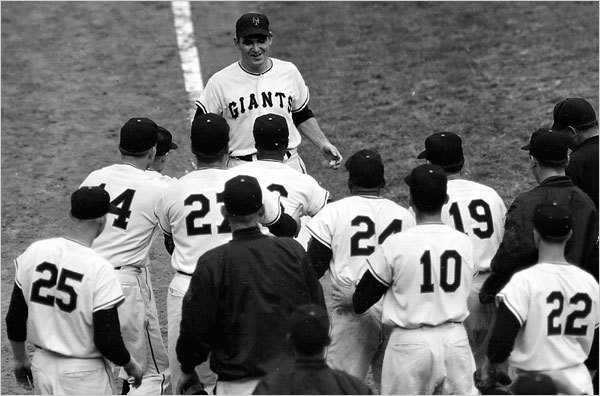
First home game World Series home run hit in Mets history? As we were reminded during the otherwise forgettable Interleague interlude from Baltimore, it was by Tommie Agee against eventual Hall of Famer Jim Palmer, leading off Game Three of the ’69 Fall Classic, Shea Stadium’s first World Series contest ever. But in a way, Agee was the next link in a chain that had gone untended for 15 years. The last National Leaguer to hit a home game World Series home run while wearing an NY on his cap before Agee? Agee’s fellow Alabaman, Dusty Rhodes of the New York Giants in 1954. He was born James Lamar Rhodes, but as Arnold Hano explained in A Day in the Bleachers, he was known as Dusty “because all ball players and most little boys named Rhodes are called Dusty.” Dusty was called on to pinch-hit for Monte Irvin in the bottom of the ninth of Game One, two men on, one man out, score between the Giants and the Tribe knotted at two. A lefty swinger could angle the ball just right at the Polo Grounds, and that’s exactly what Dusty did against eventual Hall of Famer Bob Lemon, dropping one down the right field line, just inside the foul pole, just over 257 feet from home plate, giving the Giants a 5-2 victory. You want crazy angles? The Polo Grounds came by them organically. “The Polo Grounds was a lovable freak,” Leonard Shecter would later write.
Dusty was lovable, too, as evidenced by the affection his teammates poured on him as he touched home plate to end Game One and as evidenced by the nice things the men who played ball with him had to say upon learning of his passing at the age of 82 Wednesday. Monte Irvin on what was no small consideration back then: “Even though he was born in Alabama, he was like a brother to all the black players. Dusty was color blind.” Willie Mays: “I’ve never had a greater friend.” His Times obituary, from which the above AP picture is borrowed, included Dusty’s quote about himself: “I ain’t much of a fielder and I got a pretty lousy arm, but I sure love to whack at that ball.”
Keenly self-deprecating or uncannily accurate, Rhodes took another couple of whacks the very next day. First, as a pinch-hitter, he lined a two-run single into center to give the Giants a fifth-inning 2-1 lead. Remaining in left, he smacked what would prove to be the final home run in Polo Grounds history, “a long loud blast onto the right field roof,” as Noel Hynd put it in The Giants of the Polo Grounds. It came off yet another eventual Hall of Famer, Early Wynn, to start the bottom of the seventh inning of Game Two, putting the Giants up 3-1, which was how the final New York (N.L.) World Series home game to be played until 1969 ended. The Giants would go to Cleveland and sweep the Indians. Rhodes would finish the Series with a robust 4-for-6 and 7 RBI in just three games. His OPS, though nobody calculated such things then, was a staggering 2.381. His place in New York baseball history should be just about as lofty.
by Greg Prince on 19 June 2009 4:00 pm Welcome to Flashback Friday: I Saw The Decade End, a milestone-anniversary salute to the New York Mets of 1969, 1979, 1989 and 1999. Each week, we immerse ourselves in or at least touch upon something that transpired within the Metsian realm 40, 30, 20 or 10 years ago. Amazin’ or not, here it comes.
Is nothing sacred? Duffy Dyer’s 1969 World Series ring was stolen. If you know who took it, tell the thief to give it back.
This is Duffy Dyer we’re talking about. Duffy deserves his ring.
I read in last Sunday’s News that the most revered piece of jewelry imaginable, a ring identifying someone as a 1969 Met, was taken from Dyer’s locker in the Dominican Republic last summer when he was out on the field coaching some San Diego Padre prospect. That’s what Duffy Dyer does nowadays. According to Anthony McCarron’s article, coaching’s what Duffy Dyer’s been doing pretty much forever, or at least since he stopped catching.
Which I would have guessed was five minutes ago, but it’s longer.
Duffy Dyer was going to catch for the Mets forever by my reckoning. Duffy Dyer was a fact of life when I was growing up. Second games of doubleheaders; two-week stretches when Jerry Grote would go on the Disabled List; nights in July for no particular reason. Suddenly Duffy Dyer was catching and, most likely, hitting eighth.
Duffy Dyer hit .231 in consecutive seasons, 1971 and 1972. Then he fell off. That was Duffy. How could anybody who went by the first name Duffy in the last half of the twentieth century (when only Ed Sullivan’s Chyron operator called him Don) bat higher than .231? He batted .257 in his first full season, which was 1969, but of course every Met reached for the stars that year. For Duffy Dyer, the stars shone a little shy of .260.
But who noticed? He was the backup catcher. Backup catchers didn’t have to hit, especially on the Mets (even though Dyer’s pinch-hit three-run blast on Opening Day 1969 was the first home run the Montreal Expos ever surrendered; last home run surrendered by the Expos was hit by Met catcher Todd Zeile, FYI). Pitching and defense was our early ’70s calling card. Defense started with the catcher and extended to the backup catcher. And backup catchers stayed in one place. Duffy stayed with the Mets from a callup cameo in 1968 clear through to 1974. It never occurred to me the Mets could continue National League play without Duffy Dyer on their roster. He was the 410 sign, the orange foul poles. He was part of the scenery. His job was to catch Seaver and Koosman and everybody else. His catcher’s ERA in 1969 was 2.07 for a pitching staff that generally allowed just under 3 runs per game. If he hit .231 and the like, well, what did you want from the man?
Duffy Dyer spent one year as the Mets’ de facto starting catcher, 1972, when Jerry Grote and everybody else was out hurt. Dyer hit 8 home runs that year, a figure that would be the rough equivalent of Sammy Sosa hitting about 800 homers in 1998, juiced or not. The Mets were so strapped for hitting in 1972, Duffy batted fifth 10 times. In every other one of his Met seasons, Duffy batted as high as fifth never.
And he threw. Boy could he throw. In ’72, 79 runners attempted to steal a base against Duffy Dyer; 40 of them were cut down. Too bad whoever stole his ring wasn’t trying to take it to second. Duffy would have nabbed him. When Grote was healthy that year, incidentally, he threw out 20 of 38 would-be thieves. Who consistently throws out more than half of enemy baserunners like that anymore? Who tries to steal bases that much either, come to think of it?
Having flexed each of his muscles in ’72, Dyer dipped to .185 in ’73 and dropped behind Ron Hodges on the backup catcher depth chart. Duffy got an at-bat in the 1969 World Series. He received no such consideration in 1973. He had outlasted J.C. Martin, who saw more memorable action in the ’69 World Series, as well as a flock of transitory backup catchers (Francisco Estrada, Bill Sudakis, Joe Nolan, Jerry May), but Ron Hodges was Duffy Dyer’s Kryptonite. Hodges’ ascension in 1973 made Duffy, hitting .211 the next year, dispensable. He was traded in October 1974 to Pittsburgh for speedster Gene Clines.
I had high hopes for Gene Clines. I had lost hope for Duffy Dyer. The net effect was negligible however you sliced it. Clines was a bust in New York. Dyer toured Pittsburgh, Montreal and Detroit through 1981. I never missed him, just as I never particularly missed Ron Hodges, Luis Rosado, Butch Benton, Alex Treviño, Ronn Reynolds, Junior Ortiz, John Gibbons, Clint Hurdle, Ed Hearn, Barry Lyons…just as I don’t miss Ramon Castro. Backup catchers, unless they hit you a home run that wins you a playoff series, don’t really stick in the mind as long as they used to stick on a roster.
But reading about Duffy Dyer’s stolen ring brought back a sense of certainty that’s been missing around the Mets for ages. It was only parts of seven seasons, but damn, Duffy Dyer stuck around. You didn’t have to think who backed up Grote. Duffy Dyer did. Couldn’t hit. Could surely catch and throw. That he put in seven seasons with three other teams didn’t stop me from immediately thinking “Met!” when I read about him in the Daily News. On some level in my mind, Duffy Dyer is always the backup catcher on the Mets. Jerry Grote is always the starter. Every catcher who’s come along since they stopped being a tandem, from John Stearns through Omir Santos, strikes me intrinsically as a temporary condition.
McCarron’s article reveals what an honorable baseball career Duffy Dyer’s been conducting his entire adult life. He’s caught and coached, managed and scouted. He’s been in the majors, the minors and the independent leagues. These days he roves for the Padres. He’s also instructed Mets fantasy campers. I met one St. Lucie alumnus Thursday night who told me he empathized with Luis Castillo because he dropped an easy pop fly in one of those fantasy games that wasn’t so easy if you didn’t know the correct way to catch it. Who taught him exactly how to handle the next one that came his way? Duffy Dyer, that’s who.
My first thought upon hearing this anecdote was where was Duffy Dyer when we could have used him a week ago? My next thought was Duffy Dyer was there quite often when we needed him when I was a kid. My final thought was whoever has Duffy Dyer’s 1969 World Series ring — give it back.
He’s Duffy Dyer. C’mon.
Faith and Fear in Flushing: An Intense Personal History of the New York Mets, is available from Amazon, Barnes & Noble or a bookstore near you. Keep in touch and join the discussion on Facebook.
by Greg Prince on 19 June 2009 6:01 am I can't decide whether having had a wonderful time in spite of the Mets losing a tough ballgame is a sign of a healthy outlook on life or proof that I've got my priorities all screwed up.
Well, I did have a wonderful time at METSTOCK: 3 Hours of Pizza and Baseball and I'm pretty sure that save for one severely unpleasant detail toward the end on TV, everybody else there did, too. A few things did not go as arranged — one author, one camera crew and one rousing victory cry apiece did not materialize — but mostly it was what I had hoped it would be. It was an evening to revel in our fandom in a setting that couldn't have been more perfect. My thanks to Skyhorse Publishing editor deluxe Mark Weinstein for pulling this off and for filling in ably for Stanley Cohen by reading a lovely passage from A Magic Summer. My thanks to blolleague and old friend Jon Springer for putting those Amazin' numerals together so intriguingly over the past decade at MBTN.net and presenting a literal fistful of them as he read from Mets By The Numbers. My thanks to our hosts at Two Boots Tavern, worth a visit at 384 Grand Street on the Lower East Side even if nobody's reading aloud to you. You'll come for the pizza, you'll stay to both finish your pizza and carefully eyeball every bit of baseball memorabilia that's everywhere you turn.
My ultimate thanks go to all who attended, listened to my spiel and said hi. It was an incredible mix of people I know very well, people I know pretty well, people I know a little and people I'd never met. It says something good to me that all those people would come out at the end of a long and soggy day to celebrate their love of the Mets, listen to a couple of writers talk and root, root, root for the road team. We didn't win, and that's a shame, but as is proven time and again where our affection for the Mets is concerned, you can have the great pizza; you can have the cold beer; you can have the three diagonally positioned 1967 Bill Hepler baseball cards on the wall; you can have tales of Jeff McKnight's revolving identities, of impromptu October ticker tape blanketing a city and of a 14-year-old unknowingly snubbing Lee Mazzilli in a Catskills resort elevator; you can have a room full of true believers who all attempt to lift each other up until they all go down together on a bases-loaded walk and a bases-loaded single in the bottom of the ninth…but you can't have everything.
We couldn't have the win. In promoting this event, it was haughtily suggested the Mets would stick it to the Orioles as they did in 1969, yet on Thursday night, Huff beat haught. Of course that was unplanned and unfortunate, but that ninth inning — you had to be there. Dozens of Mets fans intermingled all doing what they probably would have been doing in the privacy of their living rooms if we weren't promoting togetherness and three Skyhorse books. With our forces combined, it was a sight to see. Such energy. Such focus. Such a shared sense of purpose.
Such a shame it had to turn from “YEAH!” to “NO!” but that's baseball for ya. Great part is we'll all be back somewhere Friday. Maybe in a place like Two Boots (though there is no place quite like Two Boots), maybe at Citi Field, maybe in our living rooms. We'll all remember how disappointing it was to watch Frankie Rodriguez legitimately blow his first save of the year but we'll conveniently forget that that's the price we pay for our inextricable involvement in this lifelong affair we call being a Mets fan. Come 7:10 Friday we'll see a Mets team that has a chance to win a game. That's what we see when we look at the Mets. That's what we see when we look at ourselves.
It doesn't look so bad on us, y'know?
The spirit of METSTOCK lives on in Faith and Fear in Flushing: An Intense Personal History of the New York Mets, available from Amazon, Barnes & Noble or a bookstore near you. Keep in touch and join the discussion on Facebook.
by Greg Prince on 18 June 2009 2:05 pm See what happens when you don’t built an insipidly high left field wall? You might see more than one home run per homestand. Matt Wieters hit a ball that would have been caught at the track by most Met leftfielders had it been struck at Citi Field. At worst it might have gone for two bases. Probably it wouldn’t have carried even close to the sixteen-foot-high fence. I’m thinking it falls in front of most Met left fielders for a bloop double.
But it doesn’t work that way at Camden Yards, America’s most beautiful ballpark, where — hush, hush — fly balls carry. The Baltimore rookie Wieters hit one Wednesday night that carried, as Tim Redding grumbled later, a full six inches beyond the left field wall. With a better jump and/or leap Fernando Martinez might have caught it, but I’m pretty sure the same has been said about Ron Swoboda going after Don Buford’s leadoff shot in the same city forty years ago. We lost Game One in ’69, we lost game two last night. We recovered then. We’ve got a whole new chance tonight.
Was it all about Wieters’ Camdenized fly? Not really, considering Aubrey Huff huffed and puffed and blew Pedro Feliciano’s delivery halfway to Eutaw Street in the seventh. Feliciano has been pitching effectively, so it’s tough to get down on him for bringing his gopher to show ‘n’ tell. In fact, it’s tough to get down on anybody for last night. It was one of those losses in which two teams played and one of them scored more than the other. Most Mets losses this season have felt like exercises in agony. This one felt like we could’ve won but didn’t, oh well.
Can’t get down on Redding who wasn’t super sharp but was reasonably competent. Fernando Tatis did ground into a rally-killing, bases-loaded DP, but it took a nice play to execute it and the Mets. Nobody on our side did anything egregious in the field and Alex Cora wove a seventh-inning stop & fling that was quite nifty, albeit after it was already 6-4 O’s.
Sometimes you lose and don’t want to release anybody.
***
Tonight’s rubber match will provide fine background scenery for METSTOCK: 3 Hours of Pizza and Baseball at Two Boots Tavern, 384 Grand Street in Manhattan, full details and directions can be found here. We start at 7:00. You’ll be hearing readings from three Amazin’ books: Stanley Cohen’s A Magic Summer; Jon Springer’s and Matt Silverman’s Mets By The Numbers; and my very own Faith and Fear in Flushing: An Intense Personal History of the New York Mets. Each, like METSTOCK itself, is brought to you by Skyhorse Publishing. Please come on down and join us for reading, signing, schmoozing, eating, drinking and watching some baseball. (A little rain only enhanced Woodstock, and we, at least, will be indoors.)
My book — available from Amazon, Barnes & Noble and fine local retailers — exists because of one factor more than any other: this blog. Without this blog, I would have been just some guy who was a Mets fan for a long time and had some stories to tell. With it, I’m that very same guy but with what is known in the business as a platform. I am, in the context of chronicling the relationship we all have with this team (simultaneously loving it and not being able to stand it), marketable. Putting aside that the Mets are a better story in 2009 than 2004 and that daily blogging has made me a far better writer now than I was then, I could have written a book like this five years ago, I’m pretty sure. But publication, distribution and promotion…hard for me to imagine all that would have been achieved without having this blog to prove I wasn’t just some guy who was a Mets fan for a long time with some stories to tell.
Besides mentioning that as a pretext to thank you, the FAFIF reader, for helping us build that platform, I bring it up in the context of something I read yesterday, by a well-known sportswriter despairing of the reaction his profession receives from readers these days:
All I hear is “You guys suck ass” and “If you idiots were doing this and that …” but I’m at a loss. What have we done so poorly? No, we don’t nail every story. And yes, we make mistakes. But — and I’m being 100-percent serious — what do you want from us?
I’m betting that’s not all the writer in question, The Bad Guys Won! author Jeff Pearlman, hears, but criticism tends to ring louder than praise, and incivility is easy to generate from behind a keyboard and a screen name. I’m not going to attempt to answer the question he posed in his headline — “Why do you hate us?” — because I think the question is misleading, misguided, slathered in self-pity and overly broad (though one of his other pieces yesterday, in which he essentially stuck his tongue out at readers so as to say “nyah-nyah, I knew it!” regarding Sammy Sosa, did not leave me feeling charitable toward the trade he practices). But Pearlman’s post did make me think about platforms.
Traditionally, sportswriters have had platforms while sports fans have not. On a given morning in the past, I might have read a great or terrible column on the previous night’s Mets game and have had no outlet for my reaction other than to nod or sigh. I might have had a thought on the same subject before I ever read what a professional wrote and I would have kept it to myself because there was nowhere else to take it. It used to annoy me no end that the version of events that got into print was so often unrecognizable in terms of what I had watched the night before and that the Met narrative I read day after day did not add up to the one I’d been constructing in my head for decades, one informed by my own observations and experiences.
I feel that way less and less, and not because professional sportswriting has so improved. I have an outlet now. I still read great columns and terrible columns, but they no longer carry the same sway in my mind, perhaps because they no longer carry the same sway in an at-large sense. Yeah, Wally Matthews is going to get more attention than anything Jason or I write, but more and more I can laugh that off. It’s just Wally Matthews (or whoever) being silly again. I don’t have to treat the bad columnist’s word as significant just because it appeared in a newspaper or on a newspaper’s Web site. We’re all doing this now. That one person has a press credential and one doesn’t doesn’t make anybody’s opinion or observation more or less valid.
Beat writers have a specific job and it’s worthy of our respect and admiration. I’ve never bought into “they get to see games for free” as reasons to dismiss the obstacles they are prone to run up against. No job, even a job you love in a field you voluntarily entered, is without its drawbacks. Beat writers — and the Mets have several consistently good ones covering them — bring a valuable perspective to what we the fans know and might want to know. I wouldn’t have that Redding “six inches” quote above if an AP reporter hadn’t written it down.
But we the fans have a valuable perspective, too. We know our teams in our own way and we know why they’re our teams. We the fans think about it plenty and we the fans are, I find, fairly discerning people, not simply “die-hard blind loyalists” to use a Pearlman phrase. We know what it’s like on this side of the wall. We get the whole Mets experience in a way beat writers and columnists don’t or won’t.
And as long as sportswriters are blogging like regular people, I’d contend there isn’t as much of a wall between us as there used to be. Matthews writes something. Pearlman writes something. I write something. You write something. Whaddaya know? We’ve all written something.
Prior to blogging, my not quite fully formed gripe with the sports media was that I rarely read, saw or heard anything that reflected my understanding of my team. Thanks to blogging, I read it regularly. I get to write it, too, and some of it wound up in a book that you might have read…which is nice, by the way.
The left field wall at Citi Field is taller than I’d prefer, but I’m glad at least one barrier where the Mets and me are concerned continues to crumble.
You won’t need a referral from your primary care provider to visit the Doctor’s Channel for eighty seconds. Why would you want to do that? Click here and find out.
|
|






