The blog for Mets fans
who like to read
ABOUT US
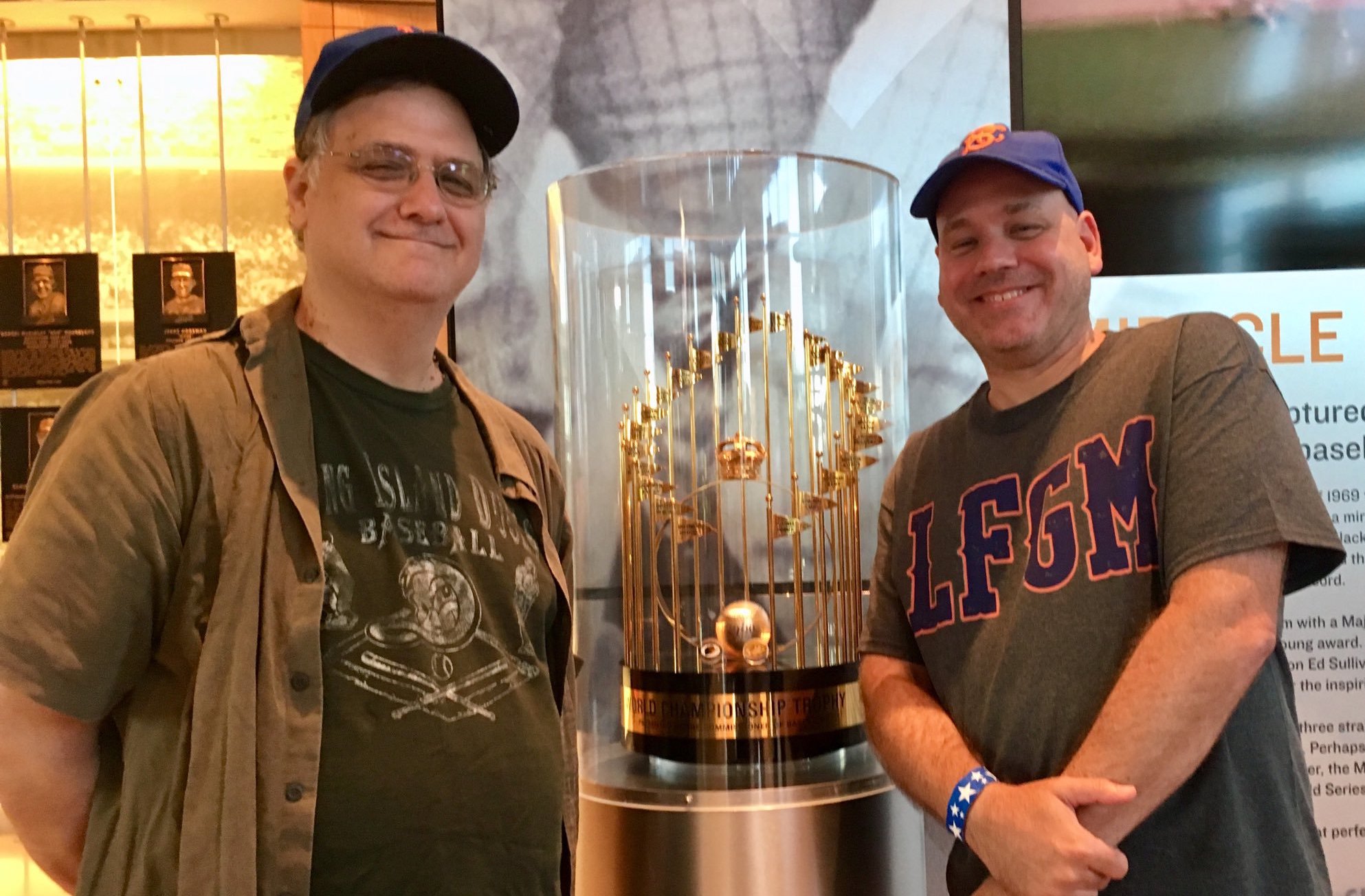
Faith and Fear in Flushing made its debut on Feb. 16, 2005, the brainchild of two longtime friends and lifelong Met fans.
Greg Prince discovered the Mets when he was 6, during the magical summer of 1969. He is a Long Island-based writer, editor and communications consultant. Contact him here.
Jason Fry is a Brooklyn writer whose first memories include his mom leaping up and down cheering for Rusty Staub. Check out his other writing here.
Got something to say? Leave a comment, or email us at faithandfear@gmail.com. (Sorry, but we have no interest in ads, sponsored content or guest posts.)
Need our RSS feed? It's here.
Visit our Facebook page, or drop by the personal pages for Greg and Jason.
Or follow us on Twitter: Here's Greg, and here's Jason.
|
by Greg Prince on 23 April 2009 11:34 am How is it every time I look up I'm immersed in high batting averages? Even if the batting average has been devalued as a key determinant of offensive effectiveness, you'd figure a lineup in which six of the regulars are over .300 — Beltran and Castillo ranked 1 and 2 in the entire National League at the close of business Wednesday night — and a guy hitting .278, Delgado, is among the Top Five in RBI…you'd figure that team would be on fire, that it would be in first place or at least have a record that indicated they'd be there soon.
You'd figure wrong. Go figure.
Go figure 'cause I can't. The 2009 New York Mets are a page of imposing numbers in search of a bottom line. They don't add up, not on paper, not at all.
There's something missing, starting with wins, of course, but extending right into the way they play the game, every game, right through the most recent one, a bland loss to the Cardinals in which — despite the eternally suffocating presence of Joel Piñeiro — St. Louis didn't seem particularly imposing, just better equipped to prevail. Could have said the same thing about San Diego last week, could have said the same thing about Florida the weekend before that. There but for the grace of Johan, you could say that about every series the Mets have played.
Sometimes, as Freud theorized, fourteen tepid games are just fourteen tepid games, with 148 left to play, smoke 'em if you got 'em. And sometimes you can see your team has no core, no center, no sense of purpose. They're all swell sorts and they're all talented guys, but they're not much of a team.
The Mets aren't much of a team right now. They have appeared lackluster and wan for their last three losses, even when they seemed in command of the score Tuesday. Wednesday, at least, was not 1962 reincarnated, but if the present they are showing us is the immediate future we can anticipate, it's going to be a long, blah summer.
Nice stats, though. And nice guys. Ramon Castro's the belle of the clubhouse, we've been told since 2005. Could he block a plate? John Maine's a sweetheart. Doesn't move anybody off a plate, though, as Ronnie noted from the booth (though I could swear John used to). Doesn't emerge from trouble either. I was a little disconcerted after Maine batted in the fifth, trailing 5-1, and Mr. Darling recalled his own rookie season experience of being left in to fend for himself in a game when he was losing and he said it turned his season around. Next inning, Maine was perfect. Gary and Ron toasted this as a turning point for Maine '09, clear into the sixth…which was when John loaded the bases and had to be removed.
An isolated incident, but indicative, somehow, of the way this team (and it's not the broadcasters' fault), congratulates itself on achieving nothing in particular. Hey, John Maine retired three guys in a row! We're great! Well, sometimes a three-batter sequence is just a three-batter sequence. I'm not in Maine's head. Maybe he learned something Wednesday night the way Darling did in 1984 and he's on his way after coming back from injury. Or maybe he and we are stuck at square one. Maybe we'll keep not sliding into plates blocked by opposing catchers and maybe we'll keep not blocking plates being slid into by opposing baserunners and maybe we're going to keep congratulating ourselves for the way 80-pitch drills in Spring Training produced high batting averages the first two weeks of the season, but I wonder if maybe Jerry should have tried that exercise with runners in scoring position, because the Mets display a disturbing habit of stopping hitting in those situations.
On the other hand, Daniel Murphy didn't fall down and didn't drop anything in left field, so there's another little victory that won't show up in the standings — as opposed to the latest lifeless loss that is ingrained there with all the others that have occurred and however many more seem likely to come if the modern-day equivalent of Donn Clendenon or Ray Knight isn't dropped into this house of empty stats soon. This team needs something or somebody to push it to another level, preferably up.
Don't despair! There's still Faith and Fear in Flushing: An Intense Personal History of the New York Mets, available from Amazon, Barnes & Noble or a bookstore near you. Keep in touch and join the discussion on Facebook.
by Jason Fry on 22 April 2009 6:00 pm One of my signs of spring is that I have to figure out once again how to work my portable radio.
No, I'm not an idiot. (Or perhaps I am, but this isn't the thing that proves it.) It's that my portable radio is a little lozenge of silver plastic whose various buttons had writing explaining their functions when the radio was new. But that was around 1999 — the writing wore off long ago in the slow-motion tumble dry of living in various man-purses and backpacks, and now there's nothing whatsoever to indicate what the buttons do. So every March I wind up remembering this through trial and error. On/Off? No, AM/FM. Hmm. Volume? Nope — that's the tuner. OK, think I've got it. Ready for another year!
As the silver plastic and worn-away lettering might indicate, my portable radio was cheap — I think it was like $10 on Canal Street long ago. But it's endured pretty well. It has a soap-on-a-rope cord that goes around your neck, though this means that if you get walking quickly the radio starts to move with your stride and smacks you in the breastbone with each step. (Moral of the story: Walk slow. Enjoy the world.) Pop in a pair of earbuds and you can listen to the game relatively unobtrusively, or drop one earbud to conduct a conversation of sorts (at least at a Lame Husband level of competence) or make a phone call. I mastered all this long ago, making it part of my Mets routine.
Except its day has passed.
I was trying to solve another problem when I bought the MLB At Bat app for my iPhone. My old job was in a newsroom, and I had a TV on my desk, one that was usually on CNN but could be quietly switched to SNY for afternoon games. My new office has no TVs and radio reception is iffy if you're not right by a window, so I figured that MLB At Bat's animations of pitches and game summaries might be the thing for keeping track of the game. (Shades of my old Motorola SportsTrax, which let you keep track of every game and offered audio cues to your own team. The grand slam noise was quite something.)
I didn't realize that MLB At Bat also has Gameday Audio — for every team. Or that videos of key plays get queued up as the game goes along — it's like watching a little TV when you've got WiFi, and pretty good even on 3G. So I can listen to the FAN whereever I can get a cell signal. Or switch to the enemy broadcast. Or listen to Rangers-Mariners just because. Or review how the game has unfolded if I get to it late. Or check if the pitcher is hitting his spots by peering at the pitch chart for this at-bat. Or check for video of how the Nats scored a run, if the Nats should score a run. It's not just that all this fits in my pocket — it's that it was already in my pocket. I'm still getting used to this — it's like a little piece of the Jetsons come true.
You can guess the rest: My faithful little silver radio has barely emerged from the backpack this spring. On the cusp of May, its buttons remain mysterious.
I'm normally the guy who's all for Progress without asking too many questions, whether Progress means Carlos Gomez or Citi Field. But I confess to a twinge of sadness here. The radio did its job well for good seasons and bad, chronicling the adventures and misadventures of Carlos Beltran and David Wright and Pedro Martinez and Mike Piazza (catcher) and Pat Mahomes and Kevin Appier and Tsuyoshi Shinjo and David Newhan and Mike Piazza (first baseman). But then Radio came to Spring Training '09 and saw he'd been replaced by a rookie who could do everything he did as part of warmups. The kid was like Albert Pujols crossed with Johan Santana, skills-wise, and that was that. Radio hadn't just been Wally Pipp'd; he'd been reinvented right out of the game.
MLB At Bat is one of those technological moments that are promised incessantly but actually happen pretty rarely: an instantly obvious Before and After. The moment I saw what it could do, I realized from now on this was how I'd keep track of the Mets when there was no TV. But I see the tiniest of reasons to keep the old silver bullet on the roster. MLB At Bat gobbles battery power like I inhale Shackburgers, and doing something else on the iPhone (like, say, using it to talk with somebody) shutters and silences it. I imagine these things will be taken care of matter-of-factly soon enough, wrinkles erased by application of software Botox, but for now they're enough to give the old radio a stay of execution. And that makes me happy.
by Greg Prince on 22 April 2009 12:51 pm Who says the Mets don't honor their heritage? Tuesday night they went to St. Louis, where they played their first National League game just over 47 years ago, and paid homage to the 1962 Mets by dropping a game below .500 and appearing en route to 40-120.
The Mets leftfielder fell down.
Twice.
A Mets baserunner failed to slide into home.
Twice.
The Mets catcher was called for interference.
A Mets baserunner was picked off first.
Mets hitters continually left runners on base.
The Mets starter disintegrated with a comfortable lead.
A Mets reliever was overwhelmed by adversity.
Twice.
A feller named Casey — who materialized on the roster as part of a series of transactions (Pelfrey aches; O'Day DFA'd; Figueroa brought up; Figueroa pitches well; Figueroa DFA'd; Fossum brought up) that recalled Harry Chiti being traded for Harry Chiti — was right in the middle of it…looking approximately 71 years old.
Which is fine if you're the manager, not so beneficial if you're coming in with the bases loaded and walking a man on five pitches.
Carlos Beltran echoed Charlie Neal. Ollie Perez showed less head than Bob Moorhead. J.J. Putz channeled Choo Choo Coleman (and deserved the J.J. hook). Dandy Dan Murphy is revealing himself to be nothing less than the reincarnation of Marvelous Marv Throneberry. Ramon Castro is Spanish for Joe Ginsberg. Ryan Church is hinting he's really Jim Hickman.
¡No la tendrían! They clearly didn't got it Tuesday night in St. Louis. Nobody there, at least on the Mets, could play this game.
How very Original of them.
Also original: Faith and Fear in Flushing: An Intense Personal History of the New York Mets, available from Amazon, Barnes & Noble or a bookstore near you. Keep in touch and join the discussion on Facebook.
by Greg Prince on 21 April 2009 5:15 pm I sense those who really, really love Citi Field off the bat are, in essence, Homer in the episode of The Simpsons when he angered at the high prices and crappy merchandise he continually encountered at the Kwik-E-Mart. But it was all Homer knew, so he put up with it. “If he discovers the discount supermarket next door,” Apu thought to himself, “all is lost.” Citi Field is unsurpassedly awesome if you never went anywhere but Shea or haven't taken a baseball road trip that didn't involve the Vet.
We hopeless romantics in the crowd liked to believe Shea Stadium and the New York Mets represented one another perfectly: too often a ramshackle 71-91 proposition that discouraged you for months at a clip, yet pulsating with enough heart, soul and electrical current built into the recesses of its infrastructure to produce a 97-66 charge we'd never forget. In that sense, Citi Field is a perfect reflection of the Mets as we've come to know them of late: promising a ton, delivering somewhat less and leaving you with the impression that they think they deserve all kinds of credit for coming relatively close to their goal.
Meet 88-74 Park.
That's Citi Field to me at this early stage of its existence (and who wouldn't want to be judged at the ripe old age of six games?). It's pretty good, sometimes very good, ultimately not the most incredible place I've ever been. An 88-74 Mets season — 1997, for instance — can be a great deal of fun, offer occasional surprises and feel extremely invigorating. An 88-74 Mets season — 1998, for instance — can also put you on edge, fail to provide exactly what you need and come up a little short here and there. But 88-74 isn't dreadful by any means. It's definitely above average. An 88-74 Park, unlike an 88-74 Mets season — 2007, for instance — probably won't collapse on you.
Just as you sometimes know by instinct that you've passed through the turnstiles of a remarkable season, you also know when you've come upon a singular ballpark. I knew when I arrived outside Pac Bell in the summer of 2001 and inside Comiskey Park in the summer of 1989 and on the other side of the warehouse at Camden Yards on a brilliant spring day in 1994 that I was somewhere fantastic, the kind of place I'd dream about in my idle moments for years to come. I just knew. When I stepped foot inside Keyspan Park for the first time, I began to wonder, quite seriously, if it would be feasible to move to Coney Island, work the afternoon shift at Nathan's and then spend my evenings watching the sunset reflect on the Atlantic as those circular neon lights beamed to full power (this became my retirement plan for a while, actually). After one trip to PNC Park, I honestly decided that if I ever became what they call financially comfortable that I'd buy season tickets for the Pirates and fly in for weekend series just to sit there for a few hours every couple of weeks. I never became financially comfortable but I haven't fallen out of love with PNC Park.
I haven't fallen in love with Citi Field, not at first sight, not after several sights. I can see us falling into an abiding like over time, getting used to each other, depending on each other for company, feeling each other out until we feel we're reasonably certain we can trust each other. But I'm not in love with Citi Field. Half of that is me, obviously. I brought way too much baggage to its Rotunda gate to let down my guard so easily. Half of that, though, is it.
This is not a lovable ballpark. It's likable enough, as a future president once said of his secretary of state to be, but it's not warm and fuzzy. Maybe the old place wasn't going to be your lifetime sweetheart if you weren't predisposed to see it and feel it that way, but nobody after the giddiness of April 17, 1964 wore off would have referred to World Class Shea Stadium. World Class Citi Field is what we heard for three years. It was overkill. High-functioning would have been enough to draw us in. After Shea's many foibles, functional would have been plenty to sell us. We would have gotten it. “Come to the ballpark that works” would have been an excellent pitch. “The bathrooms won't flood, we'll have paper towels, we won't stick our hands out for tips, we won't take your bottlecap, we'll ready your pretzels and we won't assault your senses with loud, warped nonsense over the PA.” If that was Citi Field's stated rationale from jump street, I would have jumped in with both feet.
The things I liked about Shea Stadium I loved. And the things I didn't like about Shea Stadium I loved to complain about. They fixed a lot of what was wrong with the Shea experience at Shea inside Citi Field. I'm elated to give up my old complaints. I realized Saturday I could stop hiding spare bottlecaps on my person before heading to the game. They weren't going to take my bottlecap! I didn't have to keep a single between my fingers should an usher and a rag emerge from a shadow to show me a seat that was numbered clearly. I could clap my hands on my own steam, not because “everybody” was instructed to. I'm happy to stop complaining about what I hated from Shea Stadium. I appreciate that somebody somewhere figured out a few simple ways of making going to a game more pleasant and, just as importantly, less unpleasant.
And the food is indeed to die for rather than from. Nobody doesn't love the food. I've never encountered so many answers to “how was the game?” that started with “I had the pulled pork sandwich.” It's a 180 from “Olerud lashed a double, scoring Rickey and Fonzie, we all went crazy and oh, by the way, I didn't get ptomaine poisoning.” Mind you, I wouldn't stand in an interminable line for a kidney unless I absolutely, positively needed one, so I haven't sampled some of the more celebrated menu items where innings go by while your burger is created, but I am enchanted by what I've chewed to date. I particularly like the World's Fare Market because its goods are not just delicious but just a grab away. Stephanie and I split a Mets cupcake from the WFM at the preseason workout, so now when I'm going to Citi Field, she asks, “Can you bring home one of those cupcakes?”
When was the last time anybody asked you to bring back food from a Mets game? Unless it was for a fraternity prank?
Food ain't really why you go to a ballgame, so I wouldn't say I love it as much as I like it. There's lots to like. Because I think you should have freedom of movement in general in this world, I like that last Saturday when I wanted to meet up with some of my favorite fellow bloggers before the game, there was a place to do it, down 42 way, without fear of being moved along. I like the Rotunda just fine, I certainly respect the reasoning behind it even if it feels like we've been assigned social studies homework when all we're trying to do is go to a baseball game. I'm really, really liking that bridge, where I spent several minutes leaning back and chatting with a friend I bumped into prior to heading to my perfectly lovely green seat Saturday. I like the vantage point; I like that it represents a landmark between left and right fields, thus a You Are Here for where you are; I like the view behind me (the old Apple), before me (the field) and above me (the stands, the sun, the planes).
I like that the bridge and its environs inadvertently forced me into an odd situation when my friend and I parted ways. The national anthem had begun. I wanted to get moving, stop by the dividerless men's room — don't like that — and the World's Fare. At Shea, if I had places to go before first pitch and the anthem was underway, it was little more than background noise in the concourse. Out there, at Citi Field, most people stopped whatever they were doing, removed their caps as instructed (I could do without the stage direction) and stood at attention. I found myself walking around and realizing what was going on and stopped myself. Even though I really had to go to the bathroom, even though I wanted to make my purchase, even though I needed to hustle up to the Promenade, it felt right to pause among my fellow Mets fans for the bombs bursting in air, et al.
Lots to like, enough to doubt. I have my doubts that we're going to see enough of the field to fully inform us, whether it's because of obstructions or blind spots (formed by the obstructing nature of certain angles of the building). I doubt we're ever going to be sated by the Mets Quotient of the Mets' home park. This is a separate post (hell, it's ten separate posts, several of which I've already written), but there are so many ways to emphasize the nearly half-century the Mets have already put on the wall, yet the Mets have been bizarrely determined to leave their wall blank for as long as they can. I doubt many Mets fans care as I do, but I doubt we'll ever see any substantial evidence that the Brooklyn Dodgers had company representing New York National League baseball before there were Mets. I saw three older men in NY Giants caps in the Rotunda. I exchanged the briefest of simpatico with one of them. His expression was one of dismay, but I could be projecting my feelings onto his face…though I don't think I was. And whatever happened to the setting highlight to be known as “Coogan's Landing” anyway?
I can't speak definitively to the sense that fans aren't or will never be as raucous as they were at Shea. I've been to two games, one of them terrible, one of them gripping. It's not a decent sample. But I am convinced we have raised a generation of Mets fans that requires an electronic tickle to get a decent LET'S GO METS! chant going (and, by the way, that rather statist LET'S GO METS sign above CitiVision puts me in mind of The Office when generally unsmiling Dwight was placed on the party planning committee and he mirthlessly hung nothing more than a plaintive IT IS YOUR BIRTHDAY. sign in the conference room). I feel liberated from a surfeit of dopey audio cues for when to cheer, but the audience for Mets-Brewers on Saturday seemed unmoved to act and react when its team could use a shove. Only when the video board got involved did they roar. The wave, however, started organically; oy.
While the Promenade's Upper Deck/Mezzanine hybrid is aesthetically pleasing, it's not paradise up there, not quite, not yet. I'm not complaining about the revolution in legroom, but I feel a bit disconnected from everybody else. Yes, there are those I'd have paid a premium from whom to be disconnected in the Upper Deck, but there was a “we're all in it together” vibe in the parking lot formerly known as Shea Stadium. I'm not quite feeling it in two dates at the Prom, though it's only two and neither game has been an exhilarating 10-9 slugfest. It is disconcerting how far above and below I am from adjacent rows, though the cupholders are nice. It is more comfortable, though I don't remember feeling exquisitely squeezed at Shea. Ah, let's err on the side of comfort — and structural integrity, too. Still, it is my habit to semi-consciously bop along to “Lazy Mary” and feel the ballpark earth move under my feet. When I did so Saturday, it literally didn't feel right. When you shook your groove thing at Shea, Shea shook with you. It didn't take a ten-run inning to turn Shea into a shake shack. It took simply getting up and stretching. It's probably safer this way, but I kind of missed the specter of instability.
I watched the Saturday game and nothing but the Saturday game, which is to say I did not roam as I did Thursday. I could see Johan just fine. If I had gotten up to check out the mini-food court on Promenade, I wouldn't have seen anything. There are no monitors back there, which seemed strange when I noticed this afterwards. It's also a little offensive that after being told a club existed on every level — Excelsior! Empire! Caesars! Is this a ballpark or Plato's Retreat? — that every level's club requires a special ticket, and I never seem to have one. This is one of those situations where if you didn't situate it so tantalizingly in my midst I wouldn't want in, but you did and I do, if just for a look-see. A little too much exclusivity at the top of the park. A little schleppy getting down the stairs when all was over. And to echo Dana Brand's comprehensive spiritual overview on another matter I noticed but couldn't quite identify why it bothered me, the disembodied clang of Cow-Bell Man was downright spooky. (While the sudden reappearance of “Sweet Caroline,” pretty obviously detested by half the house, is simply mystifying.)
I'll confess to one change of opinion from where I was during the runup to World Class Citi Field, and I point to it, à la Terence Mann in Field of Dreams, as someone who was the East Coast distributor of Shea Stadium attachment. I wanted them to keep Shea alongside Citi. I had this idea that it was too beautiful to lose and marginally functional enough to maintain in some small way. As I sat and stared down toward the mound while Santana and Gallardo exchanged zeroes, I realized, no, that was silly. Romantic but silly. These people here, at Citi Field, they weren't looking back toward Shea. Even I'm doing it less and less. Nevertheless, and perhaps this should be filed under the Mets and their expertly hidden history, I am amazed at how intent the Mets were on making Citi Field the UnShea. Lots of good reasons to do that, as catalogued above, but they really must have hated where they were. Yeah, there's the Apple and the Skyline, but that's found art at this point. Otherwise, I don't think there are five words officially sanctioned at Citi Field that you'd hear as a matter of course at Shea Stadium. Even the rows have numbers instead of letters. If they could sell dogs hot instead of hot dogs, they'd do it.
The New York Mets are a long-running series that its producers determined needed a major recast. Out went one of its old characters, in came a new one. They gave the old character a memorable farewell story arc. The new character is going to need time to establish itself. Mike Farrell took over for Wayne Rogers, Kirstie Alley replaced Shelley Long and Citi Field is succeeding Shea Stadium. It's a different character and we will discover its character. As pretty as it is, I don't know what it's all about, probably because it's not about anything yet. When Stephanie and I were planning our wedding, we discussed a First Dance song. I played her one she didn't know but that I thought fit the occasion perfectly, “You're A Special Part Of Me” by Diana Ross and Marvin Gaye. Her response was, “That song means nothing to me.” Right now I feel the same way about Citi Field. It's not a special part of me. That's not a knock, it's a fact. I've just been introduced to its melody. The lyrics will come eventually.
Sometimes it'll be great. Sometimes it'll suck. One way or another, it'll be the Mets.
Good reading between homestands can be found between the covers of Faith and Fear in Flushing: An Intense Personal History of the New York Mets, available from Amazon, Barnes & Noble or a bookstore near you. Keep in touch and join the discussion on Facebook.
by Greg Prince on 21 April 2009 1:10 pm 
This? This was the big deal? Doc wrote this (photo courtesy of the Post) and the Mets were wailing, “OUR WALLS! OUR BEAUTIFUL BLANK WALLS! YOU HAVE DESECRATED OUR BEAUTIFUL BLANK WALLS WITH YOUR NAME THAT MEANS NOTHING, ABSOLUTELY NOTHING, TO THE SACRED MEMORY OF THE BROOKLYN DODGERS WHO PLAY THEIR HOME GAMES AT WORLD CLASS CITI FIELD…oh wait, we were thinking of something else” over this?
Oh good lord.
The Mets have made good on the Gooden signature, swearing they will remove it from the Ebbets Club (eyes rolling) with care and find a proper place to display it for the people and embellish it with the John Hancocks and John Hudeks of other Mets greats, perhaps (perhaps) aware that few have merited the appellation “Mets great” as Doc Gooden did when he was 1984 Rookie of the Year, 1985 Cy Young and 1986 World Series Champ.
I have Dwight Gooden’s autograph, incidentally. A friend with whom I worked in 1994 was in Florida on assignment and he took a very wide turn to visit Port St. Lucie. He parked his rental car and saw Doc signing for a small knot of fans. He whipped out a piece of motel stationery and asked him to make it out to Greg.
“That’s Greg with one ‘g,'” my friend said.
“I know how to spell Greg,” Dwight with one “g” reassured him.
So I’m all set in terms of Doc Gooden’s signature, but I’m glad another one will be in evidence. And if he ever wants to drop by and desecrate one of my blank walls, I’ll happily take another.
by Jason Fry on 20 April 2009 4:13 am After we lost that mildly disgusting 2-1 game to the Marlins, a friend offered sympathies. My response: “I don't know if you do this, but for me early April is Baseball Honeymoon — I'm so happy that my nights and days have normal structure again that losses don't particularly rattle me. And then it's April 26th and I'm like, 'Goddamnit, how the hell are we 5-13? This sucks!' But until then, I'm good.”
The 6-6 Mets are mathematically safe from a 5-13 record, and I'm still in my Baseball Honeymoon. But it's the equivalent of the day on your honeymoon during which you catch yourself thinking not about the beach or wedded bliss, but about packing and the long flight and unpacking and the stack of annoying mail and the bills that will need to get paid and going back to work. The real world is about to come crashing through the bubble.
Today's 4-2 loss to the Brewers didn't leave a particularly visible mark: I lucked into superb seats for my Citi Field regular-season debut, basked in sunshine instead of huddling in the expected rain, spent my time in the amiable company of a friend I don't get to see enough of, crammed myself deplorably full of Shackburgers and tacos and beer, and snagged a Super Express 7 for an easy trip home. What's not to like about a day at the ballpark, particularly after the months of slush and football?
Well, that 4-2 score. The Mets wore their classic pinstripes! Great, they lost. Jose Jose Jose Jose treated us to the first of many Citi Field triples! Great, they lost. Nelson Figueroa pitched scrappily and cannily in an emergency start! Great, they lost. (And poor Figgy got DFA'd by way of reward.) A right fielder got mugged by the sun — and it wasn't Gary Sheffield! Great, they lost. Omir Santos looks like a cult hero! Great, they lost. You can make yourself hoarse talking up character-building losses; better to grope for something to say about mundane wins.
(Citi Field Observation of the Day: At his superb blog, Dana Brand has been wrestling with Citi Field and his reactions to it in a series of heartfelt posts that are by turns hopeful and agonized. The one that really struck me was his thoughts on the crowd and the noise, which so far he doesn't find equal to the Shea experience. Part of this, as Dana notes, is undoubtedly because people are spending time exploring the stadium instead of watching the game. But Dana also notes that people don't seem to stand up a lot at Citi Field, and that the parade of passers-by — nicely described as “the constant and familiar racket” — is missing, because now those people circulate behind the seats. Particularly poignant is his description of Cow-Bell Man being heard but not seen except when he'd pop up at the top of a stairwell before working his way back down and up to a new section. Dana's right — so far the fans do get to their feet less, and the constant circling of people and crowd reactions to them is basically gone. I'd noticed the lack without quite grasping what was missing. The question, though, is whether it's truly a lack, or just something to get used to that we might even come to appreciate. Cow-Bell Man and the grass-roots Let's Go Met agitators are now back in the concourse, to less effect, but so are the mooks displaying their Yankee gear, the people on cellphones trying to locate their friends 33 sections away so they can say “Yeah, I see you waving!” and the legions of dimwitted, drunk and potentially homicidal who would emerge from a tunnel and stop in front of you to stare like stunned cattle at the field. When I mentioned the lack of fans getting to their feet to my seatmate, she cocked an eyebrow and said, “Well, now they can see.” I'm not sure what side of this one I come down on — ask me around Independence Day. But it's definitely one to think about as we get used to the new place.)
Anyway, the Mets had good at-bats and hit balls hard though often in evil luck. They're 6-6, and those six losses have seen a total margin of defeat of just eight runs, which is what your average pinstriped middle reliever surrenders during a bathroom break up at Leni Riefenstahl Stadium. A bit of regression to a friendlier mean and the Mets look just fine, particularly since I'll go out on a statistical limb and bet against the Marlins playing .917 ball the rest of the way. But stripped of the novelty of new parks and new seasons, losses like this eat at you. What's acceptable and almost forgivable in April is distressing and dispiriting in June, and calamitous in September.
It will repair your losses and be a blessing to you. No, not The Collected Works of Whitman or a DVD of Bull Durham with deleted scenes. (Don't bother looking, it doesn't exist.) I'm talking about Faith and Fear in Flushing: An Intense Personal History of the New York Mets. Get yours from Amazon, Barnes & Noble or a bookstore near you. Keep in touch and join the discussion on Facebook.
by Greg Prince on 19 April 2009 12:08 am Johan games are different from any other Mets games, very different. For instance, in most Mets games, the other team scores earned runs; in Johan games, the other team earns nothing. In most Mets games the ball is put in play by the offensive team after it is pitched by a Met; in Johan games the offensive team barely puts the ball in play, and only Johan's catcher seems to touch the ball. In fact, in Johan games, if an offensive player hits the ball intentionally, he's out; sometimes unintentionally, he's out.
Also: in Mets games pitched by Pelfrey, Perez, Maine and all other Mets pitchers, the other team scores. In Johan games, the pitcher prevents you from scoring.
In most Mets games, the manager makes trips to the mound, maybe several. In Johan games, the manager plants himself in the dugout and watches Johan.
Now I've mentioned other Mets games. Johan games and other Mets games are the two most popular spectator sports in this city. And as such, it seems they ought to be able to tell us something about ourselves and our values.
I enjoy comparing Johan games and other Mets games:
Other Mets games can be messy and uncertain.
Johan games are things of beauty.
Other Mets games tempt you to wander through a park. The baseball park!
Johan games keep you sitting in your seat or occasionally standing in front of it.
Other Mets games begin 0-0 and can go in any direction from there.
Johan games begin 0-0 and stay very close to that figure for most of the day.
In other Mets games, you wear an expression of doubt.
In Johan games, you wear a smile.
Other Mets games are concerned with down — I hope we don't go down too easily.
Johan games are concerned with up and down — when the other team comes up, they will be going down very quickly.
In other Mets games, you receive agita.
In Johan games, Johan makes it easy on your digestive system.
In other Mets games, specialists come in to attempt to register crucial outs.
In Johan games, Johan stays in and retires everybody.
Other Mets games have strategy, anxiety, worry, angst and a faint hope that maybe things will work out all right.
Johan games have Johan.
Other Mets games are played with opposing batters reaching base and with opposing runners crossing the plate.
In Johan games, nobody on the other team gets to go out and play for very long.
Other Mets games have the seventh-inning stretch.
Johan games have seven strong innings from Johan.
Other Mets games have no time limit: we don't when they're gonna end — might have four hours.
Johan games seem rigidly timed, and they will end in far fewer than three hours.
In other Mets games, during the game, in the stands, there's kind of a contemplative feeling; you think about Citi Field, whether you like it, whether you don't like it, but there's always something interesting to think about.
In Johan games, during the game, in the stands, you can be sure that all you want is the Mets to score one run and Putz and Rodriguez to finish another job extremely well done.
And finally, the objectives of the two games are completely different:
In other Mets games the object is for the Mets, also known as aggravating, to figure out a way to win, to overcome their miscues, to cover up their flaws, to generate multiple tallies, to conduct themselves with more competence than they usually muster, to catch and throw with skill and to outhit their own pitching lest they surrender another early lead and blow another winnable game and fall further behind the surging Marlins.
In Johan games, the object is to go home! And to be victorious! I know we'll be victorious once we go home from watching Johan pitch!
(Thanks George.)
The difference between Faith and Fear in Flushing: An Intense Personal History of the New York Mets and other baseball books? Find out when you secure your copy of FAFIF: AIPHOTNYM from Amazon, Barnes & Noble or a bookstore near you. Keep in touch and join the discussion on Facebook.
by Greg Prince on 18 April 2009 2:26 pm How can I be sure, the Rascals asked in 1967, in a world that’s constantly changing? I can be sure via the Mets. That’s their appeal. That’s baseball’s appeal. The constancy reassures. It resonates. It comforts. If the good old Mets can come through anew, maybe we’ll all pull through.
We welcome free agents and acquirees. We need those guys. We require replenishment. But transitioning is best achieved gradually. It wasn’t issues related to labor and management that made me break out in hives at the thought of replacement baseball in 1995. It was the wholesale dumping of names like Brent Knackert, Eric Ludwig, Chris Walpole, Alex Coghen and Bubba Wagnon into Port St. Lucie that sent me reeling (and take a pocket schedule out of petty cash if you recall any of them). Roster turnover is healthy, but only if achieved organically. A little here, a little there. Avoid wholesale changes, which angry up the blood. Keep the juices flowing by jangling around personnel gently as you move.
One of the subtexts of my fandom is continually observing and slightly despairing how Mets don’t stay Mets forever, that the Mets seem to shed their players too quickly, that we are asked to grow accustomed to unfamiliar faces too fast. This is the franchise where our three retired stalwarts of exclusive longevity are not Tom Seaver, Darryl Strawberry and Edgardo Alfonzo but Ed Kranepool, Ron Hodges and everybody’s go-to example of a Met when the Mets were really and truly Mets, Bruce Boisclair. Time’s always flying, I’m always noting, which may be why it angries up my own blood to watch Mets management ignore, ignore, ignore as much of their own history as possible (informed sources say this particular strain of our fan angst has filtered up to the players, thus explaining their sluggish start).
Therefore, it delights me to have noticed Mets have begun sticking around a little. Many from recent years have been dispatched, often with cause, but it seems some of our guys have been Our Guys for quite a stretch. Did you know that we have nine 2006 Mets on the 2009 team? Reyes, Wright, Beltran, Delgado, Feliciano, Perez, Maine, Castro and Pelfrey were all here as part of our most recent run to the postseason. For the longest time, it felt as if all we did was launder players on their way elsewhere. Now we have a foundation of longtimers wearing our laundry. It seems indicative not of stagnation, but of stability. It’s nice to find yourself watching some of the same guys long enough to grow accustomed to their faces and other things.
Two examples struck me Friday night, a night when, like Jason, I found myself more interested in the game than the setting. First was Carlos Delgado, a Met in his fourth season, a Met who has been a Met so long that he has more than 100 Met home runs, a Met so long and productive that he’s actually eleventh on the all-time Met home run list. Would it surprise you to know Carlos Delgado has hit more homers as a Met than, among other Met icons, Rusty Staub, John Milner, Bobby Bonilla, Cleon Jones, Tommie Agee, Keith Hernandez, Gary Carter, Lee Mazzilli, Ron Swoboda and Robin Ventura? That’s in three seasons and change, including a year-and-a-half that was generally considered abysmal.
Yet it wasn’t a home run that got me focusing in on Delgado’s Met tenure Friday night. It was that double to lead off the ninth, the one that sparked the winning rally. It was where Delgado hit it — the other way. Carlos Delgado and the other way have been a small obsession of mine since he arrived in 2006 and we were introduced by about a dozen National League managers to the Delgado Shift, a most insidious innovation. C’mon Carlos, I’ve been saying to my television for now four seasons, hit it the other way. Nothing was more frustrating than those balls in the non-hole between first and second, sometimes picked by a shortstop.
Carlos Delgado is going the other way consistently now, particularly in the vast prairie that is the Citi Field outfield. Carlos Delgado is an old Met thriving on a new trick. Carlos Delgado continues to threaten the well-being of the other side. It would be good to see it from anybody in a Mets uniform. It’s great to see it from somebody who’s worn it on a going basis.
The other veteran Met who’s been catching my eye of late is Pedro Feliciano. Pedro Feliciano is the Chris Parnell or Tim Meadows of our Saturday Night Live year after year. When the cast of Mets gathers upstage to wave at the crowd, Feliciano is somewhere toward the back. He was only in one or two sketches in the show. Is he still on the show? How come he hasn’t departed to be in some atrocious Rob Schneider movie?
Yeah, he’s still here. He’s developed a character of sorts: The Lefthanded Specialist Guy. His catchphrase is “Prince Fielder coming up, here comes Jerry Manuel, and the call goes out to Feliciano.” Something like that almost every night. I look at Feliciano out there, going after his lefty, usually getting him, sometimes remaining a little too long in the sketch…then he disappears behind his more celebrated castmates. Pedro Feliciano has pitched for every Mets skipper since Bobby Valentine. He slipped out of the organization and into Japan for a bit but he’s never seen action for another Major League team. Pedro didn’t make me squirm appreciably less than his 2008 bullpen mates, but if one had to survive from that crew…well, it’s hard to blame a bad show on The Lefthanded Specialist Guy.
Of course it’s fun to welcome new cast members and hope they’re ready for prime time. Will Omir Santos emerge into something more than a bit player typecast in the Chip Ambres role, or might he get his big break? Brian Schneider’s on the 15-Day Disabled List and it’s not reflexive cynicism to assume Ramon Castro is on nothing more than the 15-Day Active List. The Mets have needed another catcher since the demise of Lo Duca. I don’t know if Santos is the one, but boy, how about that at-bat in the ninth? There are groundouts and then there are great groundouts. His was perfectly placed.
And finally, there was the newcomer who feels extraordinarily familiar, Gary Sheffield. Whenever a player answers, yes, it has always been a goal of mine to play for this particular team, I assume he’s lying or at least not particularly truthtelling. Yet when Sheffield said something to the effect that he’d always wanted to be a Met, I bought it to a certain extent. As every schoolchild knows, there has been a kinship between Sheffield and the Mets, that his Uncle Doc was our family physician back in the day, that this Kid Gary hung around the Mets before he turned pro. Since then, there wasn’t a lot to love about him — particularly in his Marlin, Brave and Yankee incarnations — but I always watched him at the plate in a way I watched few others. Part of it was his distinctive stance, approach and talent, part of it was the never completely extinguished wish that a guy who copped to sort of, kind of wanting to be a Met somewhere back in time might, in fact, someday become a Met.
Now he is a Met, baggage and all. I was mildly enthused when he signed, not expecting a whole lot, dreading a Bonilla ’99 situation in my darker moments. But there’s been no sign that he’s been anything but just fine to have on our side to date. Certainly he would want to hit that 500th homer. I wondered if it would be a Crash Davis pursuit: hit his dinger, hang ’em up, pass through like nothing more than an Asheville Tourist. Maybe Gary Sheffield isn’t a 2009 Met come the middle of 2009.
Maybe. But on April 17, he was. His 500th homer as a Met in black felt fair. Maybe he should have been here all along. Maybe he and Doc should have played together as Mets; maybe, in the mythology we fans like to construct for our would-be heroes, they would have kept each other on their respective straights and narrows. Gary Sheffield wouldn’t have “worked out” with Barry Bonds and Dwight Gooden wouldn’t have had to have waited to Go to Mo’s to come home. Who knows? What is discernible is Gary Sheffield smacked a huge pinch-homer and it was a big hit for all of us on one Friday night in April. Luis Castillo won the game, but Sheffield attained the new ballpark’s first curtain call. Triumph sometimes breeds the best kind of familiarity.
Get familiar with Faith and Fear in Flushing: An Intense Personal History of the New York Mets, available from Amazon, Barnes & Noble or a bookstore near you. Keep in touch and join the discussion on Facebook.
by Jason Fry on 18 April 2009 2:58 am Sorry, Luis Castillo's singles don't look like line drives in the box score. You can pretty much reverse-engineer whatever the number in the H column is back into little slap jobs or worm killers or humpbacked liners. But sometimes they're enough. Sometimes they wind up in the western side of J.J. Hardy's glove, too far for conversion into yet another Met out and yet another Met LOB, and Luis Castillo's rather thoroughly caged fury is anger enough for sweet victory.
I think I will always find it faintly ridiculous that anything the Milwaukee Brewers might do can affect the Mets. For me the Brewers will always be a team from the distant AL that plays somewhere cold and changes their uniform design too often and features guys I know are good but only glimpse once in a while on This Week in Baseball. They're the San Diego Padres at an even greater remove. Yet I find when I push past the feeling that they're in the wrong league that I'm more familiar with them than I thought and can even generalize about them fairly successfully. Like they always have vaguely anonymous but terrifying young hitters, those young hitters tend to field like they went out there with bats in their hands (with the exception of Mike Rivera and whomever Bill Hall was channeling on that nice bunt pickup), and they get a volume discount on hard-throwing red-haired middle relievers who wear plus sizes. Those are your Brewers; they've been a part of our lives for a solid decade and I suppose I ought to just get used to them. I'll keep trying.
What I can get used to, finally, is Baseball 2009 in general and the Mets playing at Citi Field specifically. This was the first night of the year in which baseball didn't seem like a novelty but a normal part of the evening — 6:45, almost time to watch the Mets. In a way that day's nicer than Opening Day, because it's the day you realize baseball's here to stay (relatively) and you can put your feet up and let the narrative of the season unfold as the spring and the summer swell in accompaniment. And this was the day I stopped trying to scout Citi Field on every pitch, staring out at its dimensions and tracking its bounces like I'm the one who has to play them. (Though didja see that ball that carried away from Castillo and had to be corraled by Church? Seems like there's a crosswind that gives balls an additional kick towards the right-field corner, doesn't it?) This was the day I started to just enjoy the game for itself, new park and all.
And after another shaky middle there was plenty to enjoy. Like the swing of Carlos Delgado, now thoroughly resurrected and possibly more dangerous than before, what with the left-field line now a target as well. Like Gary Sheffield, whose milestone moment could have been an annoying asterisk, but who won me over with his determination to learn right field as best he can even if it's an assignment he arguably shouldn't have been given. (Points also to Ryan Church, by the way, for tutoring the man trying to take his playing time.) And yes, like Luis Castillo, pudgy and underwhelming though he still is. Not even I am cynical enough to resist a well-told tale of redemption.
Speaking of well-told tales, you won't be able to resist Faith and Fear in Flushing: An Intense Personal History of the New York Mets, available from Amazon, Barnes & Noble or a bookstore near you. Keep in touch and join the discussion on Facebook.
by Greg Prince on 17 April 2009 8:32 pm 
| Weather.com says the temperature at this hour in Corona is 66 degrees and they’ve got a great forecast for this evening in the area. Don’t believe a word of it. In case you think World Class Citi Field improved all the amenities, the climate at night in April still veers to the Shealike. Windier maybe.
My salvation for my first game came in the form of this nice, warm hunter’s hat Dave Murray, a.k.a. Mets Guy in Michigan, sent me a few years ago. He said every kid in the Wolverine State is issued one at birth, and why would a fine Massapequa boy like Dave exaggerate? As this Sharon Chapman-snapped photo shows, it (as opposed to the results Thursday night) allowed me to keep smiling. Dave divines its utility extended beyond warmth and that it would make me feel welcome in his adopted homeland.
Other hunters knew not to shoot you, and deer in the Jackie Robinson Rotunda had no idea you were sneaking up on them. Now, if you went without shaving for a couple days and mutter “the Lions freaking suck” under your breath over and over, you’d fit right in! |
|
|
|
|