The blog for Mets fans
who like to read
ABOUT US

Faith and Fear in Flushing made its debut on Feb. 16, 2005, the brainchild of two longtime friends and lifelong Met fans.
Greg Prince discovered the Mets when he was 6, during the magical summer of 1969. He is a Long Island-based writer, editor and communications consultant. Contact him here.
Jason Fry is a Brooklyn writer whose first memories include his mom leaping up and down cheering for Rusty Staub. Check out his other writing here.
Got something to say? Leave a comment, or email us at faithandfear@gmail.com. (Sorry, but we have no interest in ads, sponsored content or guest posts.)
Need our RSS feed? It's here.
Visit our Facebook page, or drop by the personal pages for Greg and Jason.
Or follow us on Twitter: Here's Greg, and here's Jason.
|
by Jason Fry on 16 April 2009 2:56 am We're all of us — players, announcers, staff and fans — trying to figure out how Citi Field plays. But this much is for sure: It plays weird.
Two days after the inaugural saw a lead-off home run, a normally reliable outfielder drop a fairly routine fly ball, a speedster overslide second, a fine spot of middle relief spoiled by a two-out balk, and a cat on the field, there was poor Edward Mujica playing Human Turnstile at home plate on one of the nuttier plays I've seen, a 10-second tragicomedy starring one perplexed reliever, two small Dominican middle infielders and baseballs going here, there and everywhere.
Ball gets by Hundley! Here comes Castillo to the plate! Hundley throws it past Mujica! Mujica and Castillo are tangled up! Reyes coming around third! Throw by Gonzalez gets by Mujica! Reyes scores!
If you're scoring at home that's … oh, just draw a big hairball or a cross-eyed clown face or something. Mujica looked tired and dispirited when it was over, and who could blame him? David Wright looked vaguely confused, and who could blame him? If you'd told him 10 seconds before, when there were runners on first and third, that he would not hit the ball, that no throw would be made anywhere but to home plate, and that when the next pitch was thrown those runners would be gone … he might have concluded the Rapture was nigh because, really, how much less likely was that than what actually happened? (And, of course, everybody was wearing 42 and Oliver Perez was good. Because things weren't confusing enough.)
That cheerful bit of tomfoolery aside, we got to see balls find various other parts of the yard, from Adrian Gonzalez' Modell's special to Carlos Delgado's second-deck blast off poor Luis Perdomo, facing his first batter in the big leagues. (Sorry, kid.) Daniel Murphy had a rough night in left, letting a runner tag up from first and doing whatever that was involving Reyes and Wright and a runner who should have been out at home, while Gary Sheffield (the man on the other flank of a presumably jittery Carlos Beltran) was blissfully unexposed. I think I speak for all Met fans when I say I felt a lot happier once Ryan Church and Jeremy Reed were on patrol.
Anyway, Mets win. Rachel Robinson looks better at 86 than I did at 26, no cats were frightened in the course of events, and no fans in the front row wound up in a Padre catcher's headlock. (Though if Nick Hundley had throttled that douchebag who spent three entire innings waving on his cellphone, I would have sent him a case of beer.)
All in all, not a bad night's work. Though after these first two games, can Thursday possibly be any stranger?
by Greg Prince on 15 April 2009 6:08 pm There was a lovely ceremony this afternoon to dedicate the Jackie Robinson Rotunda, featuring Rachel Robinson, Governor Paterson, Senator Schumer, Fred Wilpon and other dignitaries. It was more moving than you’d expect. Shea Stadium became the home office of Jackie Robinson’s legacy on this date in 1997, thus it’s right and fitting that his place in this sport, this city and this nation is preserved and embellished at Citi Field. The Mets have done a great job here.
I also want to compliment the Mets on rededicating the area outside the Rotunda as the new Casey Stengel Plaza, which was necessary once the original got lost in the shuffle of construction. No single personality represents New York baseball in all its major league forms than Casey Stengel. No individual was more responsible for creating the Mets Mystique than Casey Stengel. He made us an entity rather than a commodity. I’m so pleased the Mets haven’t forgotten to honor Casey Stengel.
As long as we’re handing out kudos, how about that Joan Payson Pavilion they’ve built? What a great way to remember the woman who set the tone for the franchise, who didn’t just finance it but loved it. She imbued the organization with a sense of fun and family from the get-go and it’s wonderful that the Mets have remembered her in the new place.
And what about Gil Hodges Hall? Could anything be more inspirational than the way the Mets have paid tribute to the manager who molded a roster of youngsters and journeymen into champions? Gil is remembered universally as one of the great leaders the game ever produced and it’s reassuring that generations who attend Mets games will be reminded of his influence every time they roam down his Hall. (It’s touching that Tom Seaver requested his statue appear there rather than out front as planned.)
You’ve got to love the William Shea Club. Not every organization would have the presence of mind to maintain a promient reminder of someone whose role in its creation is not easily explained but was absolutely essential. I also like the cheeky decor of blue and orange speckles, but that’s an aesthetic choice.
The Polo Lounge, upstairs from the Ebbets Club, is a nice nod to the team’s heritage. Great pictures from the Polo Grounds and fine displays devoted to the New York Giants and Original Mets. Nice to see New York’s National League club hasn’t forgotten any of its forebears.
Oh, and what about what they’ve done beyond center field? The salute to Negro League teams that played in New York and the semi-pro circuit that thrived in Queens and Brooklyn, the players who were born and/or grew up in the five boroughs…Koufax, Greenberg, Carew, Palmer, Frisch, Lou Gehrig even. It’s about time somebody captured all that. Certainly gives us something to talk about should we stop at Murph’s next door for a quick one before heading back to our seats (though I hate to leave it since they have that great montage of Mets play-by-play calls serving as the bar’s soundtrack; the waiters wearing plaid vests in homage to Lindsey is priceless).
Tell me this club doesn’t know how to honor its own self, which is really a way of honoring the fans. I get chills from the Walk of Distinction on the left field side, where they’ve reproduced plaques for every Met who’s in Cooperstown, with a few more arriving soon (Henderson this summer, Piazza eventually…yeah, I’ll even suck up Gl@v!ne being included when the time comes). The Mets Hall of Fame is coalescing so nicely in the administration building, too, with all the trophies and memorabilia. Plus the Seasons for the Ages permanent exhibit in right, commemorating each of our seven playoff clubs — funny that some of us worried the Mets would forget about stuff like that.
No, you have to hand it to the Mets. They got it right. They didn’t stop at Jackie Robinson and the Ebbets Club. They gave all of us a reason to feel a surge of pride in our team every time we enter Citi Field.
Doesn’t that sort of thing make you feel good all over? Isn’t this your ballpark like it oughta be?
Turn the sound down on the Mets game tonight at 9 and tune into SportstalkNY when I join host Mark Rosenman to discuss Faith and Fear in Flushing: An Intense Personal History of the New York Mets. Read about its cinematic qualities at Sport and Cinema, find out who else will be appearing at Metstradamus and, if you haven’t ordered one for yourself or a Mets fan you like, get the book from Amazon, Barnes & Noble or a bookstore near you. Keep in touch and join the discussion on Facebook.
by Greg Prince on 14 April 2009 6:26 pm I wasn’t able to get into last night’s historic Home Opener, but I do have a dispatch from someone who did. Special FAFIF correspondent Creamy the Cat had a great field level view of the proceedings and filed this report.
Everything you’ve heard about Citi Field is true. There’s not nearly enough foul territory.
Sorry if I offend any of you hardcore baseball fans out there, but I’m the type who likes to get up and roam around in the course of a game. I know they’ve allowed greater access for concessions and such — and I’m very interested in what they’re serving at that Catch of the Day seafood stand — but I’m not the kind who attends a Mets game and can satisfy myself with just watching or walking. Sometimes I need to go full out into a sprint.
That’s what I loved about Shea. Lots of foul territory. I could just kind of go about my business and nobody would bother me and I wouldn’t bother them. Not that I’m above bothering people. Listen, I’m a cat. I don’t really give much thought to people, but they have a tendency to get in my way.
Citi Field? Not much room from the line to the wall, so I get a little skittish when I feel closed in. Gotta run. It’s what I do.
Haven’t been in the outfield yet, though it does look pretty expansive. Yeah, I could run wild out there. Yet as a cat, it also looks like I could get lost. We’re creatures of habit, you see, and we like to get into a groove. The last place, I liked the symmetry. I knew where I was. 371 feet in the alleys, perfect for your alley cats. 338 feet in the corners, perfect for curling up and snoozing. Simple.
This place? Where the hell am I? How am I supposed to find my way around? If I ever get out there in the outfield, forget it. I’m going to be running in circles. It might bug some of the people. Again, not my problem, but we’re all mammals, right? Surely humans like knowing where they’re going.
Why do people make their lives more difficult than they have to be? Shea had a pretty big outfield, I thought. Looked big enough from the grass. Just do something like that. This thing at Citi is huge and unpredictable. Somebody said quirky. Is that something to strive for? I’ve been out on 126th Street. There’s nothing unusual about the terrain. So why’d they have to built an outfield fence that’s as crazy as one of those barking dogs from the chop shops? People…ya gotta wonder sometimes.
As a cat, I’m a little color-blind, so you’ll have to tell me if I’m just imagining that the Mets aren’t doing orange and blue anymore. I remember Shea had lots of that, which I understood to be intrinsic to the whole Mets thing. Not seeing a lot of that from my perspective. Maybe it’ll be there. I’m on the creamsicle side, I’m told. I wouldn’t know. I’m a cat.
Mets look only so-so so far. I saw Pelfrey. Good guy. He made eye contact with me. Got right down on the grass, which is my wheelhouse. I’d never seen his face before. Only the guys who make headfirst slides usually come to down to my level. But Pelf, he was real friendly. Quite sudden though. Kind of scared me out of my drowsy state. I’m a little skittish. Have I mentioned that?
Say, who the hell is Jody Gerut? And what’s this I hear about him naming his next son Citi? Wise guy. I’m a cat. I have excellent hearing. I hear things. Good sense of smell, too. That’s why I’m so up for that Catch of the Day. And two claws up for the sushi still being available. Look for me up at the World’s Fare Market, some time soon.
From where I sat, I thought the call on Feliciano was bush. Yeah, he flinched. So what? It’s a good day when all I do is flinch. I leap straight up when someone breaks my concentration. Feliciano…nice name. Must have some feline in his background.
Not as much standing water as at Shea. Thank goodness. Water’s for bowls, not puddles. I don’t care for baths. I’ve got a tongue for that, thank you very much.
DID YOU HEAR THAT? No, not the plane. Planes I’m used to. Somebody must have unwrapped a hot dog. Crinkling puts me on edge.
Still finding my way around. Wish the place was better marked. Cats are pretty good about marking things. I’m trying to figure everything out. One minute I’m in foul territory — not a lot of it, like I was saying — next minute I’m in something called Delta Club Gold. What the hell is that? I get in there and I’m afraid somebody’s going to ask for my ticket, and I don’t have a ticket. I’m a cat, for cryin’ out loud, and believe me I do my share of that. I don’t have Delta Club Gold money. Even if I did, I don’t have a pocket. Couldn’t get out of there fast enough. The rest of the night was kind of a blur.
Too bad the Mets lost. But I’ll be back for another game soon, probably when Chicago comes to town. My family has always loved going to those Mets-Cubs games. I forget why. I’ll have to grab a pocket schedule — in my teeth. Like I said, no pocket. I’m a cat.
Cats don’t read much, but you might enjoy Faith and Fear in Flushing: An Intense Personal History of the New York Mets, available from Amazon, Barnes & Noble or a bookstore near you. Keep in touch and join the discussion on Facebook.
Eddie Kranepool Society has information on a Doctor’s appointment of sorts here.
by Greg Prince on 14 April 2009 3:01 pm 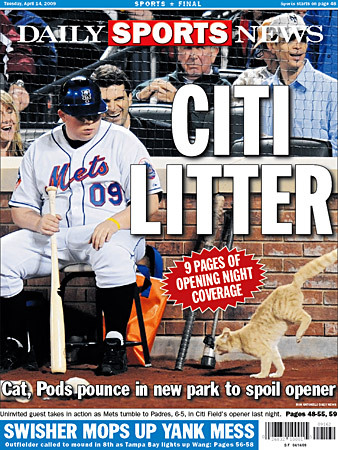
“There’s a kitty! There’s a kitty!” somebody watching far from Citi Field yelled with delight last night. No need to identify who it was (ahem).
As one who has herded cats and moved them into a new home, I can tell you they get even more disoriented than longtime fans trying to find their way around unfamiliar ballparks. But give everybody time and each species eventually finds its comfort zone.
In any event, good to see the Met tradition of running around cluelessly lives on. It’s just too bad Reyes overslid second.
by Jason Fry on 14 April 2009 3:28 am We sure know how to stage a circus, don’t we?
Everything was right about the inaugural game of Citi Field except whatever it was exactly that happened down there on the field. The Mets have done a bang-up job with the food and get higher-than-expected marks for the architecture, but now they need to do something about the scriptwriter.
It’s not just that the bad guys didn’t win, though obviously that’s the primary objection in these parts. It’s the head-scratching way they lost it. The big flag was cool and the return of Piazza and Seaver made for a fairly obvious but nonetheless satisfying bookend to the end of Shea (Tom Terrific threw a strike this time), but once the current players took the field this one was a farce. Sitting next to Joshua on our couch (Emily was representing us at the main event, up below the BOS-OAK section of the out-of-town scoreboard), I told him that Mike Pelfrey should throw a strike for the first pitch because there was no way Jody Gerut would swing at it amid the camera flashes and the sense of the moment. He didn’t, and the ball was carted off for posterity — but Gerut did club the third pitch in the history of Citi Field into the right-field stands. Joshua didn’t quite understand my astonishment — you can’t explain to a six-year-old that there’s no way the first home run is also the first hit and proceeds the first out, because he has no idea that violates all the generally agreed-upon rules of drama. (Jody Gerut ought to know better, damn him.) But that’s what happened nonetheless.
The Mets certainly didn’t look comfortable in their new home, not with Carlos Beltran skidding around on the grass and Ryan Church letting a fly ball clank off his normally sound glove and Mike Pelfrey, well, falling off the mound — though once he was OK the sight of the infielders sputtering with laughter behind their gloves was pretty funny. (As was the fans’ sarcastic applause for Daniel Murphy’s first put-out, a good-natured jab Murphy accepted with a grin. He’s going to do just fine in New York.)
Walter Silva didn’t like the script either — not after David Wright proved the new apple does indeed also rise, and road-tested how Citi Field does delirium. Sitting at home, I found myself fretting like a worried mother hen, wondering if the VIP crowd and smaller house and new configuration and obstructed views would combine to mute Citi’s first big moment. When Wright’s drive settled safely into the outstretched arms above Casey’s number, the place seemed properly loud and joyous — but I had to fire off a quick SMS to Emily for reassurance.
J: Seemed loud. Was it loud?
E: O yes
But let’s get back to screenwriting and how to properly build drama and weave a plot. How sadistic a writer do you have to be to follow Wright’s blast with a leadoff three-base error from the Heroic Right Fielder Who Should Never Be Replaced On Defense by Gary Sheffield? How much of a tease do you have to be to then follow that up with not one but two infield grounders that pin the runner on third and leave the Mets with their collective head all but out of the lion’s mouth? And then, after all that, for it all to come to naught on a balk? Where’s the drama? Where’s the justice? Where’s the Valium?
The West Kamchatka roster seems to consist entirely of players you never heard of, guys you thought had maybe retired, and disgruntled ex-Mets. Can we say for certain that Edward Mujica and Edwin Moreno aren’t the same person? David Eckstein and Brian Giles are still around? Someone’s really named Chase Headley? There’s a Nick Hundley? (I know — they’ve never heard of me either.) And then Duaner Sanchez, whom Carlos Beltran let off the hook by being too aggressive on 3-1, and Heath Bell, still just as funny-looking but a lot more effective. (By the way, I can’t say as I really blame Heath for being bitter, seeing how the Mets’ genius doctors once failed to discover that he had a broken bone in his forearm.)
Very well, vengeance is Heath’s. The park’s open. The mayor got a ball. One poor fan got to wear a Padre catcher for an unwanted hat. The feral cats have decamped from Shea’s ruins and snuck Felix Heredia into their new, more spacious catacombs. The Padres are 6-2 and we’re 3-4, and with Oliver Perez and Jake Peavy slotted in 8-2 and 3-6 doesn’t seem impossible.
It was the first night. We have to get comfortable with the new place. Even more importantly, so do the Mets.
Faith and Fear in Flushing: An Intense Personal History of the New York Mets is available from Amazon, Barnes & Noble or a bookstore near you. Keep in touch and join the discussion on Facebook.
by Greg Prince on 13 April 2009 2:00 pm Jack Fisher throws one to Jesse Gonder
Forty-five seasons commence
Ryan Church hits one to Cameron Maybin
Forty-five seasons conclude
Mike Pelfrey throws one to Brian Schneider
We've only just begun
***
“I obviously have great memories of Shea on the field and in the clubhouse, but this is quite an upgrade,” David Wright told reporters before the first exhibition game at Citi Field on April 3. “And I think it’s good for us mentally, too, to get a clean slate. There’s a lot of energy and excitement surrounding the new field and with that comes a new attitude where we can put the last couple of years aside and focus on this year.”
This year is already in focus, but considering the home season is only now at hand, there's one last chance to reflect on there where we used to stand without any other structure obstructing our view. So many images from the final week in the life of Shea Stadium stay with me…
There's too many Cubs fans.
There's the threat of rain.
There's rain.
There's a broken bat that bats a ball after the ball has broken the bat of Johan Santana.
There's Johan Santana coming back three days later and missing bats altogether.
There's invigorating cameos from Robinson Cancel and Ramon Martinez.
There's quiet disappearance for Damion Easley.
There's Pedro Martinez dramatically exiting.
There's Jose Reyes scoring.
There's Daniel Murphy standing on third.
There's David Wright not doing anything about it.
There's an evening in the picnic area that goes from sublime to ant-covered.
There's a Carlos Delgado grand slam going to waste.
There's Marlins crawling under our skin.
There's Carlos Beltran homering.
There's Wes Helms and Dan Uggla doing the same.
There's that damn bullpen gate.
There's booing and shrieking and laughing and crying.
There's Shea Stadium, its final bows. A 3-4 week. A win shy of continuation. A benediction for the ages. A sweet-sorrow parting. Those images will fade but they will never fully dissolve. I'd say the same for the 36 seasons I went to Shea.
But now, the next place.
Bring on Citi Field. Bring on that clean slate David Wright has been talking up. Bring on the now. What's past is past. The past endures, but in a spot set a little further back from where it sat before. It's not first row center anymore. No point pretending that it is.
The single most undeniable fact of Met life in 2009 is, as of this evening, our team plays its home games at Citi Field. I like watching our team play. Hence, I now greet the opening of Citi Field with nothing but enthusiasm. I count the hours until it transforms from the subject of speculation to a matter of record. I can't wait for the list of all-time Mets home parks to total three because it means our team is playing ball and has last licks, just as it did at the Polo Grounds, just as it did at Shea Stadium. I'm psyched to be going to my first Citi Field game that counts this Thursday. I expect I'll be taking plenty of mental notes all season regarding what's great and what's not — but mostly, I'm going to be watching our team play baseball. Ultimately, that's what Citi Field is for.
I can't promise, given my tendencies, that I won't occasionally backslide into Shea nostalgia, but I'm otherwise turning in my well-worn sentimental-indignation card. I spent the past three seasons praising and preserving the memory of Shea Stadium so it wouldn't evaporate into dust without a proper bon voyage. I bemoaned the impending arrival of its successor for reasons both genuinely heartfelt and probably petty. I didn't want Shea to vanish without expressing my appreciation for what it meant to me, what it meant to all of us. Consider it expressed. There is nothing left for this Mets fan and Friday Night Lights viewer to do except embrace Citi Field in the most Metsian way possible — clear eyes, full heart, hope we don't lose.
C'mon Big Pelf. Let's Go Mets.
Faith and Fear in Flushing: An Intense Personal History of the New York Mets is available from Amazon, Barnes & Noble or a bookstore near you. Keep in touch and join the discussion on Facebook.
by Greg Prince on 12 April 2009 9:59 pm No two words are any more Amazin' in the Met lexicon than Game Six. The '86 playoffs. The '86 World Series. The '99 NLCS. You can throw in the 2006 version while you're at it.
But there was another sixth game not that long ago, in 2005, to be precise. It wasn't in October. It was April — April 10. It was the 0-5 Mets taking on their archnemeses, the perennially defending Eastern Division champion Atlanta Braves. And it was a doozy. John Smoltz could not be touched in any meaningful fashion for seven innings: 103 pitches, 15 strikeouts, 6 scattered hits, no walks, no runs. His opponent was Pedro Martinez. Pedro Martinez was everything the Mets thought they were signing. His only troubling inning through seven was the fourth: a one-out walk to Chipper Jones, a two-out RBI double to Johnny Estrada. Smoltz led 1-0 heading to the eighth.
The eighth was Smoltz's undoing. Jose Reyes singled. Miguel Cairo sacrificed him to second. Carlos Beltran walloped a two-run homer to right. Pedro now led 2-1. Exit Smoltz. Enter Cliff Floyd, homering off Tom Martin. After a Doug Mientkiewicz double, David Wright homered off Ramon Colon. Suddenly Pedro had a 5-1 lead and he was a possessive dog with your shoe from there: a complete game, 9-strikeout 2-hitter. The Mets were in the win column and the first note of a hopeful new era was successfully struck.
That was the sixth game four years ago. It was a classic. And it might not have been as good as today's sixth game, even if we did lose this one.
Marlins 2 Mets 1 isn't what we wanted to pack up prior to the Super Home Opener (FYI, we didn't win our last game prior to entering the Polo Grounds or Shea Stadium either), but this isn't the sixth game of the World Series or the League Championship Series. It was the sixth game of a season, that has 156 remaining. We're 3-3. We can live with being on the wrong end of 2-1. It's not often you don't feel like a chump for saying that.
Today's sixth-game classic was brought to us by Johan Santana and Josh Johnson. Each was better than the other. Johnson got the win. Santana, who's done quite a bit of breath-taking versus the Marlins, took the loss that had to be assigned based on the score. But neither outshone either. They both sparkled in that way you want to show every baseball fan who has ever bemoaned the demise of starting pitching and every non-fan who wonders what's the big deal about a game in which almost nobody scores.
Santana hooked up in a perfectly respectable 2-1 game with Aaron Harang on Monday. It wasn't a duel, though. This was a duel. This was the best pitcher in baseball and one of his most talented counterparts. This was the master working change, slider and fastball versus the kid going away, away, away and hitting his spots hard. They made their opposing batters look clueless, yet somehow nobody (outside of the vapor-locking security guard who touched a live ball) seemed particularly foolish in this. These were good and occasionally great major league hitters being overmatched by unquestionably stupendous major league pitching. Isn't that how baseball at its purest is more or less supposed to work?
Sure, the decision rested in the hands — or off the glove — of Daniel Murphy, but that's just a break. The Marlins got the break the Mets didn't. Without it, maybe the Mets get the first break in the ninth when Carlos Beltran, who looked awful all day, finally got to Johnson for an RBI (driving in Delgado who'd had no luck prior…but got a bit of a break when Bob Davidson didn't call give Johnson strike three). But it happened. We've seen Murphy stumble a bit toward the left field fence and come down with the ball. This time we saw it bounce away. That's baseball.
You wish this was baseball every day. You wish a 2-1 double gem wasn't a diamond in the 162-game rough. You wish your guy could strike out 13 in seven innings more often. You wish your guy could go the distance the way their guy did, too. You wish you could watch both lineups hang tough against state-of-the-art pitching the way ours did in the ninth, running out everything and finding places to hit the ball toward the way Delgado and Beltran (and Wright and Church) did at the end. You wished, as a Mets fan, that Brett Carroll would have as much trouble with Ryan Church's sinking line drive as Daniel Murphy did with Cody Ross' deep fly. It wasn't to be. Santana and Parnell — it seemed an injustice to turn this afternoon over to a reliever, any reliever — combined on a 14-K 3-hitter and allowed no earned runs (a mere coincidence Doc Gooden was in the stands?). Johnson went all the way, giving up one run on five hits, yet quoting even that stellar line diminishes his accomplishment.
We lost the sixth game of the year. But if you watched it intently, consider yourself a winner for 2 hours and 4 minutes.
Faith and Fear in Flushing: An Intense Personal History of the New York Mets is available from Amazon, Barnes & Noble or a bookstore near you. Keep in touch and join the discussion on Facebook.
by Greg Prince on 12 April 2009 1:50 pm Face it, folks. It's not just in a parallel universe where the Marlins are the National League East's team of tradition. Consider the senior circuit's ballpark seniority rankings in the wake of the intertwined events of September 28, 2008 and April 13, 2009:
1) Wrigley Field, built 1914, home of the Cubs since 1916
2) Dodger Stadium, built 1962
3) Shea Stadium, built 1964
3) Dolphin Stadium, built 1987, home of the Marlins since 1993
Look Who's No. 3! Joe Robbie Pro Player Whatever It's Called This Week Stadium (and I should probably go easy on the name-calling since I wouldn't necessarily bank on Citi Field being Citi Field forever). While everybody else but the Cubs and Dodgers have bullrushed the modern, the Marlins stay with the staid, try only the tried and remain acquiescent to their aqua playpen, at least until their new place is ready in a few years. Everywhere else we go on a regular basis, including the steakhouse Lonn Trost built come June, is relatively brand spanking new and emits a certain degree of unsettledness to the home viewer.
Not the Traditional Three. You know you're gonna get that ivy at Wrigley, those mountains backdropping Chavez Ravine and revolving home plate signage that stays with you from the Fish tank. Perhaps because South Florida, even in reasonably flush times, doesn't turn out many sponsors for its ballclub, you tend to see the same advertisements over and over in the course of a game. For years, there was a Publix ad I couldn't get out of my head (there was always a deal on Tropicana). More recently there's one for a hospital that uses a pineapple in its logo. How it got to Miami from Honolulu, or why a pineapple denotes sound Floridian medical care, I'm not sure, but it sure says Marlins to me.
Dolphin Stadium is the only ballpark I've seen with ads for the Spanish-language Univision network, which is understandable given the area's Latin-American demographics, yet a little mystifying since from what I can tell Univision doesn't broadcast any Marlins games. In fact, no over-the-air outlet broadcasts any Marlins games if I've read the team's Web site correctly; a whole bunch of their games are not even cablecast in South Florida (yet we grow a tad cranky if we have to go forty minutes relying solely on evidence of things not seen, a.k.a. Howie and Wayne).
Univision has two billboards that rotate through Marlins games. One is for the Miami affiliate, Channel 23, which was English-language and showed hour upon hour of cartoons when I was a kid and my family would hightail it to a Collins Avenue motel for Christmas week every year. My mother would remind me “we're not paying good money for you to sit in the room and watch TV, go out and get some sun!” but I was steadfastly fascinated that Channel 23 had the bizarre Brutus brand of Popeye while we in New York received the Bluto or “normal” version, so I stayed inside and pale. Channel 23's current accent is emphasized in its Dolphin Stadium billboard: NOTICIAS 23. As we steered toward a potential whitewashing of the men in teal, I kept thinking…
NOTICIAS 23
Marlins 0
…though Mets 8 Marlins 4 will do just fine.
The other Univision advertisement seems designed to sell advertising to local businesses asking themselves about “A solution for growth today?” The answer provided: “It's right here in plain Spanish.”
Univision's message may be intended for the Greater Miami-Fort Lauderdale commerce community, but it describes pretty well how the Mets solved their challenges Saturday night. Simply, it was Livàn Hernandez, the Cuban pitcher you weren't necessarily expecting on the roster two months ago, and Luis Castillo, the Dominican second baseman you probably wanted no part of two seconds before he collected his fourth hit of the game. You might require a down payment of 400 hits before accepting you're saddled with Castillo, as unpopular as any regular in recent memory or any language, but he was nothing but a solution Saturday.
I watched Luis interviewed by Kevin Burkhardt after it was all over, following his reaching base five times, and I felt very good for he who has been despised and dismissed and probably will be again. He may not be much good in the long run, but he couldn't possibly be as bad as he's been almost every game he's played since becoming a Met in August 2007. He seems like a genuinely nice fellow lost in a horribly deep forest. His inner peace is not my responsibility, but I hope he gets a few more hits for his own good this afternoon so he can be greeted by nothing more virulent than silence Monday night. Boo the Padres, boo the prices, but don't boo Castillo on Citi Field's very first night of official existence. Wait 'til Wednesday, at any rate.
Hernandez, meanwhile, gave us the upside of Livàn. Like Luis, he's been around forever and is not a mystery. His jersey blouses out toward the belt, his pitches max out somewhere south of fast and he generally puts in a respectable night's work regardless of results. There will be Livàn starts when it seems possible the opposition might put up a tally in the low UHFs, but last night wasn't one of those nights, as he kept the Marlins on mute clear into the seventh. The bullpen could do with some tightening (it looked looser than Livàn's uniform top), but that's why big leads — thank you Jose, gracias Ryan — are such buenas noticias.
Ain't that good news? Hombre, ain't that news?
Available now, in English only for the time being: Faith and Fear in Flushing: An Intense Personal History of the New York Mets, from Amazon, Barnes & Noble or a bookstore near you. Keep in touch and join the discussion on Facebook.
by Greg Prince on 11 April 2009 11:26 pm In a parallel universe, I am a Marlins fan.
In a parallel universe, I moved back to Florida after graduating from college and grew detached from the Mets.
In a parallel universe, I was elated when we got an expansion franchise.
In a parallel universe, I fell in love with the Marlins in their very first year of existence, as soon as Charlie Hough threw our first pitch.
In a parallel universe, I took great pride in our finishing ahead of the Mets in our inaugural season of 1993.
In a parallel universe, I experienced conflicted feelings in 1997 when my old team, the Mets, put up a good fight for the Wild Card against my new team, the Marlins, but ultimately I was overjoyed when my Marlins went to the playoffs instead of the Mets.
In a parallel universe, one of the happiest moments of my life came October 26, 1997 when Edgar Renteria drove home Craig Counsell with the winning run in the seventh game of the World Series, making my Marlins champions of the world.
In a parallel universe, Bobby Bonilla maintains my undying gratitude for putting us on the board in the seventh inning of that seventh game versus the Indians.
In a parallel universe, I developed a love-hate feeling for Al Leiter and Dennis Cook, guys who helped my Marlins win that first championship after they moved on and thrived with my old team as our owner conducted an insidious fire sale.
In a parallel universe, I came to resent the Mets' whining about being overshadowed by the Yankees considering they still had a pretty immense payroll and my Marlins were always being stripped for parts.
In a parallel universe, I couldn't root for the Braves to beat the Mets in the '99 NLCS, but I couldn't quite get behind the Mets either because it annoyed me how many of their fans routinely showed up in our stadium for our games.
In a parallel universe, I never liked Mike Piazza because he could have insisted on staying a Marlin but left us cold.
In a parallel universe, I didn't watch the 2000 Subway Series because I always hated the Yankees but found it impossible to root for the Mets, lest their stupid ex-New Yorker fans be even more of a pain in the ass to me at Pro Player Stadium than they already were.
In a parallel universe, I love our stadium, even though I see its limitations.
In a parallel universe, I'm thrilled that with the demise of Shea Stadium, we have the only orange seats left in baseball.
In a parallel universe, I think teal is beautiful.
In a parallel universe, I see those sacks of Soilmaster in the dugout that the camera picks up on TV and find them kind of a charming throwback to simpler days when fans were allowed to stand behind a rope in the outfield.
In a parallel universe, I'm relieved we got the new downtown ballpark approved because it means my team won't be going anywhere, but I have to admit I've grown attached to where we were born.
In a parallel universe, I had a great big laugh at the Mets' expense when we clinched our Wild Card spot against them the last weekend of 2003.
In a parallel universe, I felt kind of bad that Moises Alou couldn't catch that foul pop in Wrigley Field during the '03 playoffs, since he was such a big part of our '97 championship, but otherwise I enjoyed the Bartman play almost as much I enjoyed the Buckner play, back when I was still a Mets fan.
In a parallel universe, Josh Beckett shutting out the Yankees to seal the 2003 World Series is as big a thrill as any I've experienced as a baseball fan.
In a parallel universe, I tell Mets fans I know that we had no problem winning in the Bronx in October when we had our shot — and that losing to my Marlins seems to have kept the Yankees out of any World Series since.
In a parallel universe, I'm not shy about mentioning that our two world championships — in the face of horrible ownership — in a span of seven seasons is as impressive as anything the Mets ever did.
In a parallel universe, I cackled when Carlos Delgado chose us over the Mets in 2005.
In a parallel universe, I loathed Delgado for being traded to the Mets in 2006.
In a parallel universe, I remember 2006 fondly for our confounding expectations and competing for a playoff spot well into summer.
In a parallel universe, I'm still convinced Joe Girardi got a raw deal.
In a parallel universe, I can't tell you what a big kick I got out of the way we eliminated the Mets on the final day of 2007.
In a parallel universe, I can't tell you what a second big kick I got out of the way we eliminated the Mets on the final day of 2008…as they closed Shea Stadium, no less.
In a parallel universe, I seethe that Hanley Ramirez and Dan Uggla don't get nearly the attention they deserve — and insist that they deserve a lot more than the overrated Jose Reyes and David Wright get.
In a parallel universe, I can't help but point out over and over that even with Johan Santana being paid more than any fistful of Marlins, we still have better starting pitching.
In a parallel universe, I'll take Fredi Gonzalez over Jerry Manuel.
In a parallel universe, I have mixed emotions watching the Mets with Luis Castillo, Gary Sheffield and now Livàn Hernandez, players who helped win me World Series in '97 and '03.
In a parallel universe, I eventually resent the way guys like those and Leiter and Cook and Bonilla and Alou and Mr. Marlin Jeff Conine all become Mets.
In a parallel universe, I root for whoever winds up in a Marlins uniform and against whoever the Marlins play, including the Mets, even if I grew up with the Mets.
In a parallel universe, I am a Marlins fan, no matter what anybody says about my type and my team.
In this universe, however, I am a Mets fan. And I can't fucking stand the Florida Marlins.
by Jason Fry on 11 April 2009 3:27 am We play at least two of these every year, the template as familiar as those sacks of fertilizer in the dugout:
1a. Up by a couple early, Marlins yank us back come the middle innings.
1b. Down by a couple early, yank Marlins back come the middle innings.
2. Long slow grind, possibly interrupted by a rain delay.
2b. Bad feeling breaks out. (Optional.)
3. Miscellaneous tomfoolery/strangeness puts one team or the other ahead.
4. Heroics make things even once again.
5. Extra innings loom, or begin in apparent innocence.
6. A seemingly unlikely Marlin rally results in them dogpiling while dispirited Mets leave field and I say terrible things.
Two different new Met relievers got rough initiations into the primal suck that is Soilmaster Stadium and the Florida Marlins, favorite team of around 8,000 souls provided the weather is perfect, which it never is. Both Bobby Parnell and Darren O'Day looked stunned; I was not. No, I was numb, waiting with the dull, sour expectation I imagine (though this is unconfirmable) is shared by veteran skydivers when the reserve chute doesn't open either. A two-out bunt, a bloop and a sharp single that went against the defense for starters; an infield single, walk and another sharp single for enders. Utterly and hideously familiar.
When Hanley Ramirez hit the home run for the early Marlin lead, I was possessed by a terrible thought and scooted over to the fridge to look at the schedule, where I exhaled in relief to find we finish up the 2009 regular season against our expansion brethren, the Houston Astros. But then I thought better of that: Like there isn't some way Hanley Ramirez will engineer a trade to the Stros for the final week, even if it means asking for his release and paying his own salary, or disguising himself as a Round Rock Expressman. And with our luck he'll bring Jorge Cantu with him — the oddly smash-faced Marlin first baseman was all that stood between Matt Lindstrom and ruin in the top of the ninth, as Cantu speared a Carlos Delgado ball that nearly went through him and smothered Alex Cora's bid for the go-ahead RBI. And then, of course, he finished us in the bottom of the frame.
John Maine had an encouraging start and Jeremy Reed a heroic moment consigned to a lower-case h by the outcome, but I can barely remember that now, because I'm seeing teal.
I'm normally an advocate of cities doing whatever shady deals are required for new baseball stadiums, in part because I assume governments will otherwise do something even stupider with all those civic dimes. But I was rooting hard against the Marlins ever getting a new park, for the exceedingly simple reason that I loathe the Marlins' very existence, from their ghastly colors to their claiming the state name for their own despite sharing that territory with another team to their succession of wretched owners to their vapid, no-show fans. (And they gave Jeff Torborg money to do something other than disappear.)
For years I've devoutly hoped that this hideous franchise would soon be forced to leave this awful city and its apathetic residents in their natural, thoroughly deserved state of baseball-lessness. Now, it looks like it's not to be, and oh how it steams me to think the Mets will now never escape. They'll forever be slogging down to a Miami stadium whose seats will be sprinkled with 15,000 fans, 7,000 of them New York expats who don't realize that they're putting their hand back on what we all know will wind up being a very hot stove.
It's not that I think we'd never have soul-killing displays of futility against the San Antonio Last Stand or the Portland Yoga or whatever the Marlins might have pulled up stakes to become. But somehow I always imagined those would bother me far less — if only because maybe they'd have a room somewhere reserved for the bags of fertilizer.
|
|






