The blog for Mets fans
who like to read
ABOUT US

Faith and Fear in Flushing made its debut on Feb. 16, 2005, the brainchild of two longtime friends and lifelong Met fans.
Greg Prince discovered the Mets when he was 6, during the magical summer of 1969. He is a Long Island-based writer, editor and communications consultant. Contact him here.
Jason Fry is a Brooklyn writer whose first memories include his mom leaping up and down cheering for Rusty Staub. Check out his other writing here.
Got something to say? Leave a comment, or email us at faithandfear@gmail.com. (Sorry, but we have no interest in ads, sponsored content or guest posts.)
Need our RSS feed? It's here.
Visit our Facebook page, or drop by the personal pages for Greg and Jason.
Or follow us on Twitter: Here's Greg, and here's Jason.
|
by Greg Prince on 5 September 2008 8:04 am Welcome to Flashback Friday: Tales From The Log, a final-season tribute to Shea Stadium as viewed primarily through the prism of what I have seen there for myself, namely 387 regular-season and 13 postseason games to date. The Log records the numbers. The Tales tell the stories.
9/5/98 Sa Atlanta 5-7 Jones 14 70-69 W 5-4
Before there was Melvin Mora scoring on a wild pitch, before there was Todd Pratt outlasting Steve Finley, before there was Benny Agbayani letting the dogs out, before there was Bobby Jones flirting with two helpings of history, before there was a pennant clinched on my watch, there was hope and there were dreams. Hope that I would be at Shea for a great and important game. Dreams that it would resonate across a lifetime of rooting and caring.
In 1999 and 2000, I cashed in that hope and those dreams and witnessed some of the greatest baseball drama that could be scripted if only someone had dared. I experienced highs that time will never diminish. I can still feel the air, smell the breeze, taste the intensity from those moments. When I think of Shea Stadium in the inevitable past tense, I will remember those years and those Octobers and those who gave me a boxed set of genuine thrills with unsurpassed depth and fondness.
While I was waiting for all that, I got by with Tony Phillips. Tony Phillips was a here today, gone tomorrow Met outfielder of mostly last resort. I barely remember Tony Phillips, to be honest. But he did give me the kind of moment — if not exactly the moment — I’d been waiting forever for.
For these purposes, I define forever as 139 games across 26 seasons. Until September 5, 1998, I’d experienced nothing like it. In the years that followed, much, much bigger and indisputably better moments would unfold and the work of Tony Phillips on one sunny Saturday would be overshadowed. But you can’t know what’s coming later. You can only appreciate what you’ve got once you get it for the first time.
This was the first time I received the opportunity to partake of the ideal Met scenario.
• The Mets play some blood foe of theirs in a showdown in September with a lot on the line.
• The Mets win, of course.
• Barring it being the first no-hitter in Mets history, it should be a tight game and hinge on some great, dramatic swing by a Met in the late innings. A home run would be nice.
• It takes place at Shea, the weather is wonderful, the crowd is big and, of course, I’m there, preferably in good seats with somebody I’m close to.
• And the Mets win, of course. Did I mention that?
It took me 139 games across 26 seasons to execute this scenario. But it did happen. I got a game that meant something and I got to be there to witness it. Winning may be everything, but the window dressing fell into place as well. That’s what it made it fit the parameters of ideal.
The blue-skied, Saturday afternoon opponent was Atlanta, rapidly becoming our archrival. Unfortunately, they were surrogates in this battle. The Braves were en route to their umpteenth consecutive division title, the last eleventy-twelve of which were won in the National League East, where they clearly had no business. This left us fighting for a Wild Card against other ambitious second-place teams, mostly at this point, the Cubs. We had no more games against the Cubs, so every game against everybody counted. Games against the Braves tended to count even more.
This was a Stephanie game, her third of 1998. She always did better at the beginning of them than at the end. She’d kind of hit a wall once the novelty would wear off and the baseball would set in. But I always considered bringing the two loves of my life together an accomplishment. Before I figured out she does better in the shade than in the sun, we basked in what I called the brother-in-law seats, first row of mezzanine boxes aligned with third base. My brother-in-law’s brother bought them on the heels of the unexpected excitement of 1997. He and their parents were the ones who wanted them and used most of them, but they insisted on sticking my non-fan brother-in-law’s company on the box’s identifying nameplate.
Shea’s print shop, it shouldn’t surprise you, spelled the company name wrong.
Occasionally two of the four seats fell into my hands. This was one of those occasions. The other half of the box went to one of my sister’s husband’s business associates, Michael, considered a “crazy” Mets fan like me (as if that’s a bad thing), and his friend. Michael and I had shared the box enough to have developed a nodding acquaintance through 1998. Nice enough guy, though not so nice when a freebie was up for grabs. A Pepsi Party Patrol cannon, then a new feature, shot a t-shirt to the approximate location of my neck. Everybody around me lunged. Michael brought his left elbow down hard on my right shoulder. He’s competing. I’m groaning.
Shirt happens.
I could live with the bruise. I wasn’t too sure we could survive Bobby Jones, who had been in a shame spiral since the ’97 All-Star Game. Hadn’t been the same since somebody noticed he was good. But Bobby matched Kevin Millwood zero for zero for four innings. This was a duel. This was September baseball. This was also the September of Mark McGwire. In the middle of the first inning, our attention was directed to DiamondVision. Big Mac had a moment earlier swatted No. 60. Forty-three thousand cheered. Nice moment in context.
Not nice: The Braves took a lead in the fifth, 1-0. The Mets got two in the bottom of the frame on a John Olerud home run. Then Bobby Jones did whatever it is Bobby Jones didn’t used to do and the Braves took a 4-2 lead in the top of the sixth. He was aided and abetted by Tony Phillips, our stopgap left fielder who couldn’t handle a fly ball that allowed two runs to score. Damn. In the bottom of the sixth, Phillips left the bases loaded by flying out. Damn more!
In a tight spot, the Mets brought in Turk Wendell who was pitching lights out for a month. This was a big moment. Stephanie acknowledged it by deciding this would be a good time for us to go get ice cream. I love ice cream, but not with runners on base. But she was oblivious to Turk and his rosin bag act. She sat there all day and now she wanted and, arguably, deserved dessert. I dragged her there, I couldn’t say very well say No Turking Way to my wife. I grabbed my headphones and followed the action to a short concession line. We got ice cream. Turk got out of it.
After we stretched and I took the elbow to the shoulder (Michael didn’t actually get the shirt, so my pain was really in vain), Brian McRae drove home a run in the bottom of the seventh to make it 4-3. Still, the Braves were a tough mountain to climb. We didn’t touch their rookie reliever John Rocker and we faced Rudy Seanez in the bottom of the eighth.
But there was hope. Matt Franco walked. Ralph Milliard pinch-ran. And up came…Tony Phillips. We were in a playoff race, a Wild Card race, a pennant race if you could call it that. And we had Tony Phillips, he of the misplayed fly and the LOB coming up.
Tony Phillips hit a two-run homer. Tony Phillips! Tony Phillips fulfilled my mini-fantasy. We were up 5-4 in the eighth. We were behind the Braves and now we were ahead of the Braves. Ice cream polished off, Stephanie and I high-fived. Michael the shirt guy joined in as did his friend. Everybody was ecstatic.
John Franco came in and didn’t blow it. The Mets hung on, 5-4. They kept pace with the Cubs in the Wild Card stakes. The Shea P.A. blared “Wild Boys” by Duran Duran. Who knew the Wild Card had a theme? In the parking lot, we noticed North Shore Animal League had set up its adoption van. Who knew you could get a kitten here? Better to settle for ice cream and Tony Phillips.
Big game. Mets win. I’m there. Was that so much to ask for?
by Greg Prince on 4 September 2008 7:00 pm If my ducks are in the row I believe them to be, then I can say something I've never been able to say before. From here on out, the Mets' record at Shea Stadium and my record at Shea Stadium will require no delineation. They will be one and the same for as long as scheduled regular-season games will be played there.
Fifteen games remain. I am going to all fifteen — eight this homestand, seven the next. Like the Mets in this pennant race, I'm all in.
Forward my calls, would ya?
Hung up on The Log as I am, I set out toward what I considered a longshot goal entering 2007: Get to 400 games at Shea lifetime. From 1973 though 2006, my attendance was 336. As mentioned last week, I hit 400: 387 regular-season, 13 postseason. Sure as shootin', those numbers are true and the accomplishment, if I can call it that, is legitimate. But the construct bothered me just a little bit. I wouldn't trade my 13 postseason games at Shea for anything (though I wouldn't mind a few more in a few weeks), but “my record” has always been expressed in regular-season terms. That's how baseball individually and collectively works, with the singular exception of the 1998 Yankees who were lauded for going 125-50 in the only 175-game season ever recorded. It would be more in the spirit of “my record” to hit 400 before taking into account the mostly glorious afternoons and evenings attached to the 1999, 2000 and 2006 NLDS and NLCS rounds.
Once the inclusive 400 became a reality, the regular-season version didn't seem altogether out of reach. Having cobbled together a collection of tickets for 11 of the final 15 games already, I dared myself to ratchet it up. Somebody had an extra for the Nats. That would give me 41 for the year, more than half of the home schedule. Somebody else could make available the Friday Phillies game. That would make it 42 in 2008, 400 forever. That would accomplish the mission.
But what if there were a freaky postponement and no makeup? Not likely given the crowds expected and the competitive contours of the campaign, but who knows? Besides, 13 of 15 is so close to 15 of 15. There were two Saturday games unclaimed. So I went to StubHub and claimed them.
There are exactly 13 lines left on the last regular-season page of The Log. I guess I'll have to write small to fit everything in. When I do, the regular-season Shea Stadium total will be 402 and holding. A number like 410, the deepest part of the park, would have really been a blast, but this is plenty. This is more than plenty. In any season that wasn't Shea's last, this would be borderline excessive.
This is 44 regular-season games in one stadium in one year. This smashes the 2001 standard of 38 that was built on a Tuesday/Friday package and grim resolve. I never thought I'd approach 38 again, but I fanned up the last week of last season and got to 35. After the way that went down (way down), I'd be excused by the arbiters of sanity if I Shea'd goodbye right then and there. Instead, I used my head as a battering ram and charged full speed through Gate E 29 more times in the first five months of 2008.
Now it is my intention to up that hefty total by more than half in one month, as if 29 isn't enough.
The only series I didn't show up for this season was the Arizona set when this franchise and its supporters were sharing in a nervous breakdown (I showed up for Texas but the lightning kept the Rangers from The Log). Just about every milestone I marked a must for the Final Season — final Opening Day, final Subway Series, once more against each division rival past and present, once more with many of those who accompanied me here way and not so way back when, once more (or for once) sitting everywhere where one can sit — I reached. The tickets for the final game were long ago secured. Everything else is gravy.
But gravy is good. And so are the Mets. I don't know if I could commit to this improvised pennant pack if there were no pennant chase, if this were 2003 redux. I imagine I could bring myself to Shea goodbye in far more abbreviated fashion if the Mets had already checked out for the year.
They haven't: no way, no how, no surrender. They have earned the right to be cheered up close and personal by as many voices and as many times as humanly possible.
They are making these Final Fifteen, along with the seven that lie ahead on the road, count like crazy. Twenty-two games from now we will know what it amounts to. We will know if we've fallen for the biggest tease since the close of business on September 12, 2007 or we will know that one year is nothing — nothing — like the last. We will know if we let our hearts go too fast or if we should be ashamed of ourselves for ever doubting our one true love. We will know whether we are first or second; whether Shea lives on for at least a couple more glorious afternoons and evenings; whether finality has come to Flushing for certain.
I will know Shea Stadium about as well as I can know it, as if I don't it by now. I will know it under the lights, I will know it in the rain, I will know it in the shadows, I will know it — if the weather and baseball gods have any sense of decency — in the sun. I will know the four primary levels of Shea Stadium before they are obliterated and their renamed, truncated and unpopularly priced successors are entrenched. I will know those cramped concourses and those winding ramps and that serene exit system. I will know where the concessions are and where the restrooms are and where everything I need to enjoy or endure a Mets game is until I have to learn it all over again somewhere else.
I will know, should my plans proceed as best-laid, the only magic numbers there is any chance in hell you will catch me tracking here: 15, 44, 402, 415. I will know The Log has been completed, save for a little white space on one page reserved for additional postseason action should it come to that, though I presume to know nothing about that.
Just as I presume to know nothing in advance about how this final September at Shea Stadium will feel once I am immersed in it.
In the spirit of the bipartisanship that is so often talked about every four years, I cross party lines to share some thoughts on my New York Baseball Giants fetish at the excellent Bronx Banter. Master Banterer Alex Belth is hosting a veritable Giantspalooza over there today, and has a sweet article on the New York Baseball Giants Nostalgia Society up on the SNY site as well.
by Greg Prince on 4 September 2008 1:00 am Top of the first. After Reyes pops out, Murphy's on first, Wright's up. Howie says Wright has lashed one down the right field line.
ALL RIGHT! GO MURPH! SCORE!
Murph winds up on third, Wright's on first.
WHY DIDN'T MURPHY SCORE? WHY IS WRIGHT ONLY ON FIRST? HOWIE MADE IT SOUND LIKE A DOUBLE!
Delgado up.
TOTAL DOUBLE PLAY COMING UP. I CAN'T BELIEVE WE HAD FIRST AND THIRD, ONE OUT AND WE WON'T SCORE.
Delgado singles, scoring Murphy, Wright going to third. Beltran up.
BELTRAN'S BEEN ON FIRE…WHICH MEANS I'M EXPECTING TOO MUCH FROM HIM HERE. HE'LL STRIKE OUT. AND I'LL BET DELGADO LOAFED TO FIRST.
Beltran walks to load the bases for Church.
CAN WE STOP WITH THE CHURCH REHAB PROGRAM? HE'S SUCKED SINCE HE CAME BACK. WHERE'S TATIS? GEEZ JERRY!
Church launches a grand slam.
YEAH! YEAH! ALL RIGHT RYAN! YEAH! NOW OF COURSE HE'S GOING TO GO BACK TO SLUMPING BECAUSE A HOME RUN DOESN'T MEAN ANYTHING FOR THE LONG TERM, IT'S JUST A LUCKY SWING.
Castillo grounds out. Schneider up.
GOD IT WOULD HAVE BEEN NICE TO HAVE KEPT A RALLY GOING. THAT'S THE PROBLEM WITH HOME RUNS. THEY STOP EVERYTHING DEAD. OLLIE'S NOT GOING TO BE ABLE TO PITCH WITH A LEAD. SCHNEIDER SUCKS. WE ARE SO SCREWED.
Schneider homers.
ALL RIGHT! GUESS IT WOULD BE TOO MUCH TO ASK PEREZ NOT TO MAKE AN OUT, BUT THAT WOULD ONLY BRING UP REYES AND HE NEVER DOES ANYTHING WITH TWO OUT AND RUNNERS ON.
Perez flies out.
SIX-NOTHING…NOT BAD. WHAT A SHAME WE'RE NOT GOING TO SCORE ANY MORE AND AFTER SUCH AN UPLIFTING WIN LAST NIGHT WE'RE GOING TO HEAD INTO THE PHILLY SERIES WITH SUCH AN AWFUL LOSS. THE BULLPEN IS SO DUE TO IMPLODE.
Not quite three hours later, the Mets complete a smooth 9-2 victory over the Brewers.
SWEEP! FANTASTIC! WOO-HOO! BUT I HOPE OUR TACKING ON LATE RUNS DOESN'T FIRE UP THE BREWERS FOR OCTOBER IF WE SEE THEM AGAIN. IT COULD BE AN '88 DODGERS SITUATION COMING BACK TO BITE US. AND WHAT'S WRONG WITH ME FOR EVEN THINKING ABOUT OCTOBER? I HOPE WE DON'T LOSE TOO BADLY TO THE PHILLIES THIS WEEKEND.
by Jason Fry on 3 September 2008 4:24 am One of the unfortunate side effects of being a Met blogger is no matter how hard you try to keep yourself from doing it, you rehearse posts in your head as the game nears its climax. Thinking about Daniel Murphy and Jose Reyes, about Endy Chavez at the plate and in the field, about David Wright in the field though not currently at the plate, about Nelson Figueroa and Duaner Sanchez and Brian Stokes and Pedro Feliciano and Joe Smith and finally Luis Ayala, I kept falling back on “valiant,” which they'd surely been. One problem with “valiant” is that it's pretty shopworn; another is that it generally implies defeat. But that's where we seemed to be in the 10th, with Ayala pitching on essentially one leg, barely able to follow through and increasingly unable to hit the strike zone. There was Brad Nelson (whose physique is classically Brewer) nearly hitting one out for the tie, and the accursed Gabe Kapler working a walk, and then Rickie Weeks almost ending the game with a screamer down the line. There's no “W” in “valiant,” I thought gloomily, and you can't spell it without the “L.” I realized there was a title for a blog post in there somewhere, and was prepared for the grim task of finding it.
Except Ayala somehow wiggled free, managing to bait an overeager Weeks into swinging at a final pitch in the Miller Park dirt. Just another heart-in-the-throat New York Met win.
Early in the game, I told Emily I hoped Jonathan Niese didn't read the papers, because then he might not know that the Met brass were divided on whether the lefty-devouring Brewers were really the best matchup for him. They weren't: At first Niese's biggest enemy was a self-inflicted case of nerves, and he briefly got his Bannister on in tiptoeing out of trouble in the second and third, but that fourth inning was concentrated essence of ugly, a tattooing that he won't soon forget. One start isn't a career, of course, but against the Brewers Niese was more Brett Hinchliffe than Nelson Figueroa. Speaking of Mr. Figueroa, there he came riding to the rescue out of a bullpen whose members have somehow morphed from untouchables to untouchable. Figgy would have even held Niese's unlikely lead under intense pressure if the Brewers hadn't dropped their second parachute of the game into the Bermuda Triangle between short, left and center. (Fortunately, they balanced that with two horrible slides that led to key outs and amusing rants from an increasingly agitated Keith Hernandez.)
I mean, seriously: If you pegged our bullpen to begin this series with zero earned and six hits over 10 innings against that Brewer team, please tell me you're reading this after buying your Million for Life ticket. And if you did buy that Million for Life ticket (which costs $30 — isn't that too much for the suspension of disbelief required to play the lottery?), use the proceeds to buy some beers for some Mets, will ya? Like every member of that bullpen. Like Carlos Beltran, who ought to plow into the home-plate ump every night. Like Endy, delivering sac flies and rifle throws when one of each were required. Like Daniel Murphy, who increasingly deserves one just for being Daniel Murphy. Like Jerry Manuel, who left Nick Evans in when the situation seemed to call for Murphy, preserving him for later. And, of course, like Ayala, everybody's favorite one-legged temporary closer. Which, finally, brings us back to this post's odd title. Hey, if Luis Ayala can coax three strikes out of a busted groin and a vanished release point, I'm sure he can contort “valiant” until it's got the right consonant.
by Greg Prince on 2 September 2008 4:00 pm The latest indignity to be visited upon the ghosts of Shea past is being unleashed by the ghosts themselves if the Daily News' überdependable Adam Rubin is to be trusted. Rubin reported Sunday that Davey Johnson and Mookie Wilson turned down invites for the September 28 closing ceremonies at Shea. Our winningest manager and our longtime centerfielder, both crucial actors in the drama of 1986, are said to hold grudges against the Mets.
Rubin didn't specify their complaints. Things have always been a little prickly for Davey Johnson since he was fired as skipper in 1990, but he was warmly received on Old Timers Night in 1992 and was on hand when the Mets honored Gary Carter's Hall of Fame induction in 2003. He skipped the 1986 reunion two years ago but Mookie Wilson was front and center that night, despite having been let go as a coach following the 2002 season. Davey was recently busy with the Olympics and Mookie was last seen wearing a Cardinals ski cap during the '06 World Series as he rooted on stepson Preston. I have no idea if there are clues to be divined from any of this. I also don't much care.
I loved and love Mookie Wilson. I adored and adore Davey Johnson. But y'know what? If this is as simple as stubbornness on their part, feh on both of them. Not for all time, not for their track records as Mets, not for the past, but for this. If there's some greater issue pending, some kind of litigation between them and the team, then settle it now or briefly put it aside. It it's just bitterness or resentment or a slight that continues to rankle, get the fudge over it and get yourselves to Shea Stadium on September 28.
There comes a time when it's not about the Mets. There comes a time when it's about the Mets fans. Mookie, Davey, Nolan Ryan and Doc Gooden (also pegged an unlikely attendee, though I will continue to hold out hope until they pry the seat from my cold dead ass) are in the wrong here if indeed the Mets sent them an invitation to partake in the farewell of all farewells and they declined. Short of true human tragedy blocking their attendance, they have no business declining.
Instead of simply making like Riff Raff from Underdog — grabbing us by our ankles to shake the spare change from our pockets per usual — management has been uncharacteristically doing the right thing in advance of Closing Day. They've been reaching out to the individual Mets who made Shea Stadium what it's been for 45 seasons. They screwed up their official countdown horribly for too many of its first 55 dates, but they're fast compensating judging by the last homestand (20 to 16 revealed by Maxcine Agee, Bobby Ojeda, Darryl Strawberry, Keith Hernandez and Lee Mazzilli). Now they're trying to bring it all the way home. They're trying to make September 28 about more than nonrefundable deposits for 2009. They're trying to pay homage to the Mets from 1964 on.
So how dare any of those Mets not oblige? How dare Mets like Mookie Wilson and Davey Johnson not overlook their presumably petty complaints and not show up at Shea? They're not sticking it to the Wilpons if they don't come. They're sticking it to us, those who made them what they are. Without us, they'd still have been talented and accomplished. With us, they are larger-than-life and widely beloved. If that doesn't matter to them, too bad. You can wake up the morning of September 29 and go back to being steamed at whomever you're sore. But don't take it out on us. Don't rob us of our closure. Don't detract from our delusions that you ever cared about us except for the vague sense that we had something to do with your paychecks. Don't make us feel silly for the pedestals we erected and maintain on your behalf and how you apparently can't be bothered to stand tall on them for a couple of moments of cap-doffing and bow-taking.
Whatever beef you've got with the Mets should be transcended by the allegiance you've always gotten from Mets fans.
This goes for any Met who sits it out on September 28, the day the roster ideally expands to hundreds. It's wrong for Nolan Ryan to send his regrets. It's wrong for Doc Gooden to not strike out his demons for a day. It's wrong for Mookie Wilson and it's wrong for Davey Johnson. You don't belong to us, but your exploits did and our memories of you do. There will be one day when the stage where we cherished you has its curtain pulled down. That day is around the corner. It should be a day for celebration, not recrimination.
by Jason Fry on 2 September 2008 2:51 am The ball struck by Carlos Delgado on an 0-2 pitch from Eric Gagne in the eighth kind of floated out to right-center. It wasn't one of those tracers that vanishes at a sharp angle suggesting it was hit by a 20-foot-tall man, as the Other Carlos's shot did off Kevin Gregg a couple of nights ago. No, this one drifted. And drifted. And kept on drifting, until Corey Hart surrendered and watched it settle into the seats: Mets 3, Brewers 2, just like that.
The Brewers' hitters are scary — but so's their bullpen, a blueprint we know all too well. This one looked like trouble early, with a triple bouncing off Daniel Murphy's glove, after which he fell down. That led to a 1-0 lead against Johan Santana, who then gathered himself in the second and was flawless until the sixth, when he somehow balked in a run. I was amazed. So, by the expression on his face, was Johan.
Part of that amazement had to be that the Mets seemed stuck in another offensive brownout, doing absolutely nothing against Ben Sheets. (David Wright looked particularly lost — it was painful watching him get eaten alive by Carlos Villanueva and Gagne.) But Sheets was betrayed, first by his groin and then by his relievers. Murphy continued to build his legend with a pair of cool, steely-eyed at-bats, singling off Villanueva on a full count to move Jose Reyes to third in the sixth, then taking Gagne to 3-2 before doubling to lead off the eighth. Carlos Beltran had himself a pretty good day, aside from taking out home-plate umpire Ed Rapuano, who kicked him in the knee. And Ryan Church rifled an opposite-field double for a key insurance run and a hopeful September sign.
With Santana excused after sixth, though, there was the small matter of our bullpen and its continuing misadventures — slapstick Johan has seen all too much of this year. But none of that was in evidence this time. First old friend Nelson Figueroa led the 10-strong corps of New Orleans recallees (is this an official holiday for Mets by the Numbers?), pitching in with a scoreless inning that gave him a W. Then Pedro Feliciano crushed Prince Fielder (whom I'd like to see in a sumo ring with Robinson Cancel) with sliders, and then Joe Smith turned in what might have been his most impressive performance of the year, carving up Hart with sliders and then outguessing Mike Cameron, a sequence that ended with Cancel catching Smith's final fastball and pumping his fist, his weight shifting toward the dugout before Rapuano even punched Cameron out. And closer-for-the-moment Luis Ayala was spotless in wrapping up a very satisfying Labor Day victory.
But this was Delgado's game, as so many have been recently. Taking the field against the Yankees on June 27th, Delgado was hitting .229 with 11 HR and 35 RBI, and we all wanted Marlon Anderson or Xavier Nady or Mike Carp or Anybody Not Named Carlos Delgado to report to first base ASAP. Since then, Delgado has 20 home runs and 60 RBI. Forget good and great — that's otherworldly.
It would be easy to turn this into a moral that we shouldn't be so hasty in counting out a proud player with a history of impressive numbers — easy, but not terribly accurate. Because if the Carlos Delgado of June 26th wasn't done, he was sure offering an excellent imitation of a baseball player who was. We all could see it: His bat had slowed, he was naked before any pitch on the outer half of the plate, and his defense, while never terrific, had decayed to embarrassing levels. It was terrible to watch a fiercely intelligent man baffled by evidence that he'd gotten old a couple of years ahead of schedule — hardly a unique tragedy in baseball, but deeply sad nonetheless, and a huge blow to the Mets' chances in 2008.
What's happened since then? Your guess is as good as mine. Maybe Delgado's workaday explanation is right, and it really did take all that time for him to make adjustments and eliminate some bad habits. Maybe he really did hate Willie Randolph that much, and Jerry Manuel's combination of pats on the back and challenges (remember the dig about Delgado getting his uniform dirty?) helped him find a higher gear. Given our times, I'm surprised more-cynical hypotheses haven't made the rounds — I'll take it as testament to Delgado's sterling reputation that they haven't.
Whatever the answer is, the results have been extraordinary. Delgado has gone from a guy with about as much chance of playing for the 2009 Mets as I do to the presumptive starter and a $12 million bargain. Not so long ago, he was a black hole in the lineup. Now, he's the New York Met — not Reyes or Wright or Beltran — whose spot you pray will come back around. Because you know there's a real chance he'll rescue us yet again.
by Jason Fry on 1 September 2008 4:00 pm On our last morning on LBI, we had a final breakfast, for which we were joined by longtime Faith and Fear commentor Charlie Hangley and his wife Sarah, who were arriving as we were departing.
Outside the pancake house, a Yankee fan had scoped out Charlie and me and our Met shirts and decided we must know whether the Yankees had won or lost the previous night. As it happens I did know, but I sent a text message to Google via my phone so the Yankee fan would have to wait for ill tidings. (Yes, I'm a bad person.) And then, having told him that the Yankees lost, I jauntily volunteered to find the Red Sox and Rays scores for him as well. (Which I also already knew. OK, so I'm a really bad person.) This took a little while; settled at our table, Charlie and I chatted briefly and fairly amiably with the Yankee fan, who didn't seem like such a bad sort. (Did I feel bad then? Yes. A little.) He was realistic about his own team's bleak forecast, but seemed oddly confident in ours: The Mets, he said with no-big-whoop certainty, were going to the playoffs.
Charlie and I immediately fell over ourselves appending qualifiers and hypotheticals to that, and apparently we did so with the kind of well-rehearsed ceremony generally seen in religious rituals — because a day later Emily was still chuckling about the scene. This show of backpedaling and poor-mouthing amused her, but it must have confused the hell out of the Yankee fan, because Yankee fans don't bother with qualifiers — they chest-thump and bray about their inevitable postseason triumph until silenced by mathematics. (And then they blink for a second and start woofing about rings, baby. This is why I only felt a little bad.)
But while Charlie and I did everything but throw salt over our shoulders at the prediction of a September to remember, at least for me the ceremony was largely unconscious. I'm strangely serene, given that Labor Day has arrived with us holding a lead of a wafer-thin single game.
I'm sure part of it is that last year we were up seven with 17 to play (will that combination of numbers ever not rattle around in our brains?), so I know even more than I normally would that a one-game lead can portend any number of reversals before the final judgment. But still — how am I not gripped by panic? Or at least more worried?
I think it's that this strangest of baseball campaigns has turned weirdly sweet. The first half was one of the more maddening stretches I've ever endured as a baseball fan, a continuation of 2007's lethargic mediocrity which was inexcusable coming as it did after the Collapse. But then Willie got axed (awkwardly but deservedly) and Jerry arrived, and he blew away the gloom and doubt that had hovered over the Mets for a year. And with that change in the metaphysical weather, strange things started happening. The left-field wormhole that swallowed Moises Alou and Brady Clark and Angel Pagan and Marlon Anderson and Trot Nixon and Chris Aguila inexplicably spat out Daniel Murphy and Nick Evans, Double-A roommates who have formed the best platoon of out-of-position rookies one could possibly imagine. Ryan Church endured a second concussion, strange medical advice and forced inactivity, but that allowed the unlikely resurrection of Fernando Tatis, living a “Blues Brothers” plot come to life. (Seriously. Like Jake and Elwood, he's on a mission from God.) El Duque never came off the shelf, but Mike Pelfrey reclaimed his curve ball and found himself. Luis Castillo hit the DL with his bad knees and unfathomably stupid contract for company, but up stepped a revived Damion Easley and Cleveland castoff Argenis Reyes, who shared not just a last name but also a boyhood friendship with his double-play partner. And of course Carlos Delgado, proclaimed by most any judge of horseflesh as ready for the glue factory, turned out to have some thoroughbred left in him.
Put all these unlikely events together and you got a team that not only won again but was fun to watch doing so — in a gleefully improvised, by turns terrifying and thrilling hell-for-leather way. Given how many times the 2008 Mets have already cheated the hangman, why start in now with worrying about John Maine's shoulder, or Billy Wagner's elbow, or the entire bullpen's hideousness, or that sliver of a lead? It feels like we'll think of something — and if that something doesn't work, well, who'd have dreamed we'd get this far? It's Labor Day and our stack is just a single chip higher than what the Phillies have brought to the table, but we're playing with house money. So what the heck — let's double down and see what happens.
by Greg Prince on 1 September 2008 10:07 am 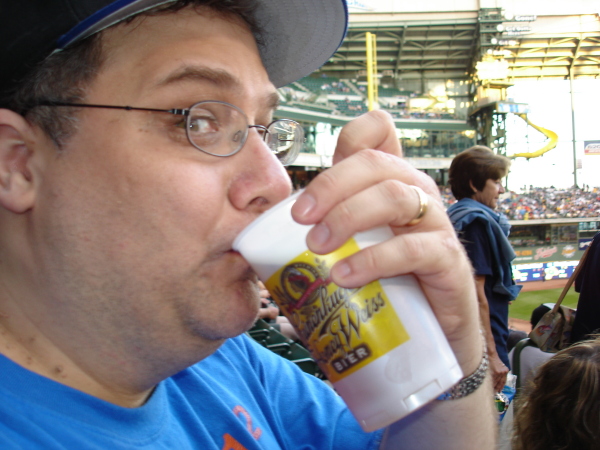
One year ago, I was in Milwaukee where all was benign and friendly, a Mets fan on holiday casually taking in the Brewers and Pirates, more engaged by the bratwursts than the baseball. I even sampled the local beverage scene as a professional courtesy to the good folks of Wisconsin.
It’s a whole different Labor Day Weekend now, the Brewers much improved, the Mets in a divisional battle, our reward, should we prevail, likely another series at Miller Park, next time with C.C. Sabathia staring us in the face.
I’d say the next three days in Milwaukee will be pretty frothy. Wouldn’t you?
by Greg Prince on 1 September 2008 9:32 am The public address system at Keyspan Park Sunday interrupted its incessant drumbeat of sound effects, song fragments and overbearing Cyclone Morning Zoo demeanor (our one-hundred fifth caller who gives us the phrase that pays wins…AN ADVIL!) to announce something of surpassing importance:
The New York Mets are in first place on September First!
The Mets' win in Miami was a final and the Phillies' win in Chicago couldn't change the math. It wasn't yet September, but we knew that when it would be, it would be the Mets by a length. That's a helluva way to start your final month.
The minor league crowd gave it a major league cheer. It was a most pleasant grace note to a lovely late afternoon/early evening on Coney Island. While my friend Frank's 2003 assessment of Cyclone games as “an A.D.D. patient's delight” has only intensified in its accuracy, the oceanfront setting is still heavenly, the competitive guilelessness is still charming and the company — the Princes were invited by the Frys — proved more sublime than ever. Couldn't tell you if I saw any of the Mets of tomorrow yesterday, though the PA did point out that one of the Met homers Sunday was the first ever struck in the bigs by “former Cyclone Nick Evans!” (Everything announced at Keyspan ends with an exclamation point!)
I'd lost touch with the Cyclones. I hadn't been to one of their games since the night Katrina touched down in New Orleans (hmmm…maybe I should just stay away from these things for the Gulf Coast's sake). When introduced to our single-A short-season unit by Jason seven summers ago, I took them moderately seriously. I watched whatever games popped up on cable and tracked their progress in the New York-Penn standings. Their sadly abbreviated playoff run in September 2001 was a compelling B-story to the baseball season at large. But over the years, the Cyclones and their not immediately accessible to me ballpark faded from view and concern. They didn't do anything wrong; I just got out of the habit.
It was good to have the Cyclones and Keyspan back on Sunday. It was good to see Brooklyn again, the Brooklyn one enters from Queens. That's how I knew the borough of my birth as a child, when I was dragged semi-regularly to visit doctors and relatives and such, mostly by my mother. A graduate of Erasmus Hall High School and Brooklyn College, she would tell me how great it was to grow up in Flatbush way back when, how you could leave your doors unlocked and walk the neighborhood at all hours and boy were “we” lucky to get out just as it was “turning”. In 2002, on my last anxiety-riddled attempt to drive the relatively short distance between Long Island and Brooklyn, I meandered down local roads and was shocked at how much I recognized and remembered from those involuntary trips of my youth. I even kind of knew my way around. It left me feeling a bit proprietary about the streets — Nostrand Avenue, Cortelyou Road, Ocean Parkway — where I didn't grow up but very well could have. Sunday's journey, albeit by rail, reawakened that ancestral corner of my mind.
I also flashed back, as the N pulled into its Coney Island terminus, on my first visit to this part of town. It was the summer I was 10, a day camp outing to ride Go Carts. I reluctantly climbed into one, hit the gas as told and immediately crashed into a wall. No wonder I grew up to eventually fear and loathe driving.
But let's not leave this trip to Brooklyn there. Let's leave it where we came in: the Mets in first place, the Cyclones streaking toward a playoff spot, the sense of knowing where one came from almost palpable. If I could just coax those Gwen Stefani hooks into making a sweet escape from my head, I couldn't ask for a better end to summer.
by Greg Prince on 31 August 2008 8:57 am Remember the other night when Charlie Manuel sent Brett Myers to the plate in the thirteenth with what appeared to be explicit instructions not to swing because with the bases loaded and nobody out all he could do to his team was harm? The intentional strikeout that followed looked bush but it paid off moments later when the winning run was delivered.
Jerry Manuel should have taken notes. He should have had, in a manner of speaking, 25 Brett Myers at his disposal last night. He should have had them all stand perfectly still in their hotel rooms. Then he should have called Joe Soilmaster Stadium, asked for Fredi Gonzalez and informed the Marlins’ skipper that the Mets would not be dropping by this evening, congratulations you win, enjoy the postgame concert with Olga Tañon, but don’t bother waiting for a postgame ’cause we ain’t comin’.
Forfeit? Not even try? Wouldn’t not showing up at the ballpark and automatically losing 9-0 be more embarrassing than letting a three-run lead slip away and going down 4-3 in the ninth?
It’s not about embarrassment. It’s fate, baby, it’s fate.
It’s the Thirtieth.
Why waste 116 valuable pitches from the right arm of Mike Pelfrey? Why deploy a generally undeployable bullpen? Why make Mets batters linger amid intermittent showers (though their bats certainly knew enough to come in out of the rain)? Why bother on the Thirtieth of any month?
From the First through the Twenty-Ninth and again on the Thirty-First, I’ll send the Mets out with requisite confidence and huzzahs. But on the Thirtieth, I’m ready to phone it in. It’s just not worth the hassle.
With a little help from my attentive-to-detail friend Ben, who wishes he had been surprised by Saturday night’s result, let’s reluctantly relive what happens when any given page on the calendar creeps to its last or next-to-last box.
Take a deep breath and brace for This Wretched Date in New York Mets History:
August 30, 2008: Mike Pelfrey’s strong effort is wasted first by Duaner Sanchez giving up a solo homer to Mike Jacobs in the eighth and then by Aaron Heilman allowing a walk, a sac bunt, a wild pitch, two intentional passes and one presumably unintentional pass. Mets lose 4-3.
July 30, 2008: Also at the Sack. Also Pelfrey, albeit a momentarily relapsed Pelfrey. Mets lose 7-5.
June 30, 2008: The Ghost of John Maine yet to come is shelled in St. Louis. Mets lose 7-1.
May 30, 2008: On what used to be known as Decoration Day, the Dodgers decorate the Shea scoreboard with abandon. Mets lose 9-5.
April 30, 2008: Ollie pitches and the Pirate bats explode. So does a water main at Citi Field. Even the Ballpark of the Future knows this is a bad day for a ballgame. Mets lose 13-1.
September 30, 2007: Final game of month. And the year. Mets lose 8-1.
August 30, 2007: It’s Philadelphia, so special attention must paid to the course of human events. Alas, the Phillies ensure it is not a good course (of course). Mets lose 11-10.
July 30, 2007: The Mets don’t lose. The Mets don’t play.
June 30, 2007: Rule proven by exception of 8-3 Mets win in Philly. But as Ben points out, it was “a game that saw Jorge Sosa get injured, forcing a week in which we got 0-3 from Vargas, Pelfrey and Williams. Maybe not a big deal at the time, but enormous when you look at the number next to GB at the end of the season.”
May 30, 2007: Following directly on the heels of the extraordinary twelve-inning 5-4 triumph over the Giants — Mets trail 4-3, Armando Benitez walks Jose Reyes, balks him around the bases and Carlos Delgado homers — Mets nap in 3-0 loss to Barry Zito. It’s the night Guillermo Mota returns to middling applause and wary rationalizations, neither of which anyone in his right mind would be proffering in a matter of weeks. It’s also the night from which many of those pesky their record since… pronouncements (the ones we cited ad nauseum to prove how crappy the Mets were playing) dated.
April 30, 2007: In his only appearance in a Mets uniform, Chan Ho Park turns Shea Stadium into the killing fields. Marlins jump to 7-0 lead and Mets lose 9-6. (Oddly, Park pitches beautifully to gain the win for the Dodgers exactly 13 months later, May 30, 2008; no, given the dates, it’s not odd at all).
September 30, 2006: Mets beat Nationals 13-0. But wait, says Ben: “Who got the win? T#m Gl@v!ne. Pretty ho-hum, right? Well, fans like us will remember that down the stretch in 2006, the gentleman who started games a day after John Maine did was Steve Trachsel. Only he didn’t start that day.” As Ben reminds me, that was the week when Trachsel left the team for mysterious personal reasons that, it turned out, regarded the dissolution of his marriage. (If there’s one person on Earth who would be incapable of getting a quickie divorce, it would be Steve Trachsel; also, if he were a chef, he would overcook a minute steak.) “We know the ramifications,” Ben elaborates. “Gl@v!ne took his spot, messed up the NLDS rotation and Trachsel gave the Mets two miserable playoff starts.” Coincidentally, I can’t find my 2006 World Champion Mets sweatshirt anywhere. [As reader Kevin points out, El Duque’s calf injury had a little something to do with altering the rotation as well. But Trachsel…he was just so Trachsel.]
August 30, 2006: Mets win in Colorado, 11-3. It was all good. But wait…
July 30, 2006: Mets win 10-6, sweep Braves at Turner Field, bury the tomahawk, liberate France, the whole bit. Fine. But then the Mets board a plane to Miami, Duaner Sanchez gets the munchies (or something), hops in a cab, makes the accidental acquaintance of Cecil Wiggins…and something happened that changed us in a deep and profound way from that day forward. It’s still changing us as of the night of August 30, 2008 where Sanchez is concerned. Technically, Duaner was broadsided by Cecil the DUI Serpent on July 31, 2006, but it was still dark and he was still up.
The Mets lost on June 30, May 30 and April 30 in 2006.
They lost on April 30, 2005 in eight innings when it was discovered RFK Stadium — out of action since September 30, 1971 (which was a forfeit) — wasn’t handy with a tarp.
They were done in as potential repeat champions on September 30, 1987 when Luis Aguayo homered off Jesse Orosco in the tenth inning at the Vet, a loss far more definitive in determining the ’87 Mets’ misfortunes than the Terry Pendleton game. Now imagine having to look at Terry Pendleton coaching third every day 21 years later.
They were swept a doubleheader by the Expos on May 30, 1977, which got Joe Frazier fired the next day, thus beginning the managing career of Joe Torre. We would not benefit in any discernible way.
They were swept another doubleheader by the Astros on July 30, 1969, combined score 27-8. At the day’s nadir, Gil Hodges strolled to left field, told an unhurried Cleon Jones he was hurting and escorted him to the bench. It’s referred to as a great turning point for the Miracle Mets, but I wouldn’t have wanted to have sat through beatings of 16-3 and 11-5 and then be told there was a moral to the story.
They didn’t win a game on the Thirtieth of any month until May 30, 1963, their second year in business. And even then they had to lose the opener of a doubleheader to the Cubs 12-0 before they could claim a 2-1 victory. But back then, to be fair, they lost most days.
We don’t do that nowadays. Despite going 0-5 on the Thirtieths, we’re in first place. We might even be playing after our final scheduled game of 2008, which comes September 28. The playoffs will start no earlier than October 1. The Mets, should they be so lucky, will be tempting no fate this September 30.
Game Seven of the World Series, however, is slated for October 30 in the American League park.
Mets in six. Don’t say you haven’t been warned.
-30-
|
|






