The blog for Mets fans
who like to read
ABOUT US

Faith and Fear in Flushing made its debut on Feb. 16, 2005, the brainchild of two longtime friends and lifelong Met fans.
Greg Prince discovered the Mets when he was 6, during the magical summer of 1969. He is a Long Island-based writer, editor and communications consultant. Contact him here.
Jason Fry is a Brooklyn writer whose first memories include his mom leaping up and down cheering for Rusty Staub. Check out his other writing here.
Got something to say? Leave a comment, or email us at faithandfear@gmail.com. (Sorry, but we have no interest in ads, sponsored content or guest posts.)
Need our RSS feed? It's here.
Visit our Facebook page, or drop by the personal pages for Greg and Jason.
Or follow us on Twitter: Here's Greg, and here's Jason.
|
by Greg Prince on 24 August 2008 11:12 pm I've never completely understood the adage about not letting the other team's best guy beat you. He's their best guy. He's supposed to be the one who beats you if you are, in fact, supposed to get beaten. When Albert Pujols homered off Aaron Heilman in the fourteenth inning a few weeks ago, it wasn't fun, but it was Albert Pujols. It beat Yadier Molina beating us.
Likewise, I can accept Miguel Tejada or Lance Berkman pulling the trigger a lot less begrudgingly than I can the Astros' support crew doing us in. Brad Ausmus? Before today, he was a Killer B only by first initial. Darin Erstad? Power wasn't his game…before today. Good Major Leaguers continuing long careers, but not the guys who you picture crucifying your chances in the late innings.
But David Newhan? Christ Almighty, as David Newhan himself might think with total sincerity in the matter.
I was familiar with only two elements of David Newhan's biography when he signed with the Mets to become the new and hopefully improved Chris Woodward last year: 1) His father is a sportswriter of great renown; 2) he, like Shawn Green and Scott Schoeneweis, was represented by a card in my Jewish Major Leaguers set that these fine folks put out. As one who writes about sports and has been Bar Mitzvahed, I filed both facts under “couldn't hurt” and waited for David Newhan to perform utilityman miracles.
And I waited.
David Newhan's 2007 was one of the least inspiring of all Met 2007s. To put it kindly, he never quite got untracked. Hit a momentarily big homer against Milwaukee in a game that was ten minutes from devolving into a Brewer blowout. Contributed days later to the unlikeliest of ninth-inning rallies against the Cubs. And if he did anything else after May 17, I must have missed it. Willie Randolph kept sending David Newhan up to bat and, like Ricky Ledee (1 HR, 6 RBI, .222 BA), David Newhan (1 HR, 6 RBI, .203 BA) kept turning right around to reclaim his a seat on the bench. His unremarkable production as a bit Met was not unique. Utilitymen — whoever their father, whatever their lineage — are benchbound precisely because they are generally incapable of cracking a good lineup. It happened to Woodward. It happened to Joe McEwing before him. It happens to almost all of them. They also tend to wander through the desert seeking a 25th-man role on foreign rosters. Thus, David Newhan — erstwhile member of the organizations of the Athletics, the Padres, the Phillies, the Dodgers, the Rockies, the Rangers, the Orioles and the Mets — journeyed on after 2007, candles unlit in the Shea Stadium window regarding his return.
He came back this weekend anyway, not as a Newhan but as a new man — a man apparently bent on inflicting regret on those for whom he did next to nothing. Saturday night? A no-doubt home run off John Maine, his first of the year. Perhaps David, starting at second base, used his '07 pine time to really study Maine's arm angle in anticipation of someday swinging against him. Or maybe he succeeded as he did because Johnny's arm is perilously close to falling off.
Sunday? Sunday David Newhan stepped up as a pinch-hitter for the Astros. In 2007, as a Met, David Newhan batted .171 in pinch-hitting situations. In 2008, he'd tumbled far from that lofty perch. He was 1-for-21 (.048) as a pinch-hitter before facing Aaron Heilman in the seventh. Call it the rise of the new man; call it David Newhan's revenge; call it anybody could have whacked Aaron Heilman today. But David Newhan singled sharply to drive in the tying run for Houston (and might have eventually scored an insurance run had Astro third base coach Ed Romero not waved home dead duck Humberto Quintero).
Two days, two ringing hits, two darts fired at the Mets' slimming first-place lead. The Mets have seemed like a much better or at least much spunkier unit than their 2007 predecessors all summer long, not necessarily because David Newhan isn't a Met anymore but his absence, though largely overlooked, didn't hurt. His presence this weekend, however, sure has.
When I received my 2008 Jewish Major Leaguers update set, I was delighted to find portrayals of Scott Schoeneweis and Shawn Green in blue and orange that was authentic and not Photoshopped. But there was no David Newhan. I asked JML why Newhan as a Met was not included (if for nothing more than completion's sake) and was told that in light of David's chosen spiritual path — he considers himself a Messianic Jew, or what is referred to sometimes as a Jew for Jesus — “Newhan is considered 'out' in terms of current Jewishness.”
Funny, I thought. He was considered “out” by most pitchers every time they faced him last year.
by Jason Fry on 24 August 2008 3:00 pm Well, kind of.
Long Beach Island is so far from New York City in terms of feel that it's always a mild surprise to remember that it's not far at all in terms of distance: They get WFAN down here and SNY is on basic cable. Which makes it not unlike keeping track of the Mets at home, except here the game competes with the sound of the ocean instead of whatever the heck it is one's neighbors are doing.
I hope Emily and I can be forgiven for not following last night's game with razor-sharp intensity: We had to get a comically tired child fed, pajama'ed and into bed, unpack all our stuff and figure out what needed doing this morning so we can get down to the serious business of not doing much at all. (I was proud of myself that within half an hour on LBI I was oozing up Long Beach Boulevard at about 30 MPH, in no particular hurry to get anywhere. It used to take me a couple of days to force the West Side HIghway out of driver's muscle memory.)
Oh, and the fact that it was quickly 5-0 Astros took the edge off a bit, too.
And yet how far we've come: We kept watching, which was partially because that's what we do but also because these days you never think this team is done for until the 'F' appears. And indeed, with nobody out in the eighth it was 8-3, and then there stood Carlos Delgado with two on and two out, one good swing away from making it an honest-to-goodness ballgame again. (And if Duaner Sanchez hadn't been singularly unimpressive in attempting to clean up after John Maine, Carlos would have been the tying run.)
OK, so Carlos didn't get that one good swing — he was just off a hittable fastball from Tim Byrdak and then grounded out, and an inning later we'd lost. But man, what a difference a couple of months makes. Back then, if the Mets were up 8-3 I'd have been trying to figure out how they'd blow it. Now, they were down 8-3 and I thought, What the hey, we have a chance. I was wrong, but if you're measuring how far we've come, it really is the thought that counts.
by Greg Prince on 24 August 2008 6:00 am 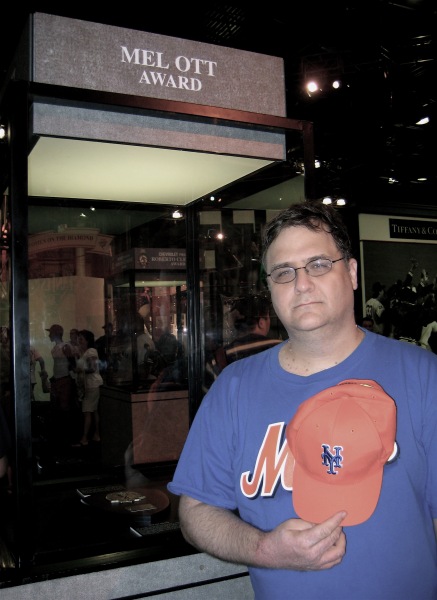
Mel Ott hit more home runs in the City of New York than any Major Leaguer in history. He slugged 511 homers in a Hall of Fame career that spanned 22 seasons, all as a New York Giant, all as a National Leaguer. The N.L. honors him to this day by bestowing on the senior circuit’s circuit clout leader the Mel Ott Award. You never hear about it, but as I delightedly discovered at FanFest in July, it really and truly exists.
Saturday night in the City of New York I witnessed David Newhan hit off John Maine his fifth National League home run ever. Having dolefully watched David Newhan display almost no power and, for that matter, almost no skills in his one season as a New York Met in 2007, I feel I have somehow let down the memory of Master Melvin.
by Greg Prince on 24 August 2008 5:27 am According to the gentleman sitting behind me way up high in Section 3 of the Upper Deck Saturday night…
• The Mets were headed to “Comeback City”.
• There was still “plenty of time left”.
• Every ball should have been thrown “to second!” even if the play was at another base.
• CLAP!
This dude — nowhere near qualifying for the League of Extraordinary Morons, mind you — did like his clapping. The Mets left little to applaud, but he urged them on without pause.
Beat booing.
When John Maine gathered two strikes: CLAP! CLAP! CLAP!
When John Maine gathered two balls: CLAP! CLAP! CLAP!
When John Maine gave up two more runs: not so much CLAP! but lots of exhortation delivered Bill Swerski's Super Fans style (a Chicago accent in Queens is very jarring; I fully expected a call for Manuel to be fired in favor of Ditka).
The Clapper did say please and thank you a lot — as in please get a hit and thank you for retiring an Astro — but he mostly clapped. As the game wore on, he grew rhythmic. It seemed to have no connection to the action, all of which was dismal. By the eighth, I caught his pattern.
HIS HANDS: CLAP! CLAP! CLAP!
MY MIND: one…two..three…go
HIS HANDS: CLAP! CLAP! CLAP!
MY MIND: one…two..three…go
HIS HANDS: CLAP! CLAP! CLAP!
MY MIND: going…going…gone
HIS HANDS: CLAP! CLAP! CLAP!
If I hadn't been nursing a stye above my left eye, I might not have minded The Clapper's booming palms in my left ear. And if the Mets really were headed for Comeback City instead of missing the exit ramp from Futility Freeway, he would have seemed more colorful and less cumbersome.
This was the first game I'd been to in a while where a lousy Mets performance could be sloughed off as just one of those things. Usually a resoundingly noncompetitive loss in which Brandon Backe outdoes Roy Oswalt while David Newhan makes like Lance Berkman would have me ghosting suicide notes for the entire Sterling Equities organization. But I've seen the evil and the good — doctor, my stye! — enough to give the Mets the benefit of one stinker's doubt. We never did approach Comeback City, and there really wasn't plenty of time left when were down 8-1, but it was a decent night in Dairlylea Coupon Country nonetheless. It was an evening to enjoy free sportsbags, complimentary bagpipes (to honor the Irish, the Mets wore the uniforms of the O'Hfers for four innings) and the company of my dear friend Matt from Sunnyside.
That's a name accurate in terms both geographic and disposition. Earlier this season, as I was penning concession speeches, Matt insisted Pelfrey and Delgado and everybody else would come around. The Mets played lame but Matt held firm to his optimism. Poor deluded soul, I thought then. Soon the Mets were winning, Matt's faith was validated and I was recalibrating my fearful estimations for the remainder of 2008. Who, besides The Clapper, seems clueless now?
Other than achy John Maine, I mean.
by Greg Prince on 23 August 2008 3:00 pm The following message was transmitted electronically to supporters of Jerry Manuel overnight:
Friend —
I have some important news I want to make official.
I've chosen Scott Schoeneweis, Aaron Heilman, Pedro Feliciano, Brian Stokes and Luis Ayala to be my closer.
The bullpen and I will appear as running mates this evening in Flushing, New York — the same place this campaign began more than four months ago.
I'm excited about hitting the ninth-inning trail with the bullpen, but the six of us can't do this alone. We need our entire rotation's and offense's help to keep building this movement for first place.
Please let the five relievers who have recorded saves in Billy Wagner's absence know you're glad they're part of our team. Share your personal welcome note and we'll make sure they get it.
Thanks for your support,
Jerry
P.S. — Make sure to turn on your TV at 7:00 p.m. Eastern Time to join us or watch in person at Shea Stadium.
by Jason Fry on 23 August 2008 3:43 am On Thursday night Tom Seaver paid one of his periodic visits to the broadcasting booth, an occasion that should be a happy one for Met fans but somehow never quite is. Why not? Because whenever Seaver visits, you get the definite impression that he treats such drop-ins as if he's Zeus come down to blister a mortal or two with his radiance. When Keith Hernandez — not even a Hall of Famer! — had the temerity to ask Seaver how he lost all those games, the laughter was loud and long, and Seaver was smiling. But there was a slight hinge of hysteria to the guffaws — Keith had danced gleefully onto a third rail, and Gary and Ron didn't seem entirely sure that he'd get off it alive.
But hey, it was definitely funny. Less funny was Seaver narrating footage of himself talking pitching with a gaggle of Met hurlers, including Joe Smith and Mike Pelfrey. Seaver made no bones about being unimpressed with Pelfrey (whose name he apparently didn't know), relating bemusedly that he'd been discussing the pressure point of a change-up grip and the kid hadn't known what he was talking about, making Seaver realize he had to go a lot more slowly. Not exactly a comfortable moment in the booth — thanks for the vote of confidence, Tom!
Seaver gets a pass for these things for two reasons. The first reason is because he is the closest thing to God among those who have worn the blue and orange — the only guy who wears our cap in Cooperstown, as any of us could tell you. But the second reason is because he is one of the most cerebral students of one of the world's most difficult crafts — the ability to throw a baseball over and over again to certain points with certain velocity and spin, an act which is the culmination of a demanding choreography between body parts, some of are making unnatural motions and will require being packed in ice to avoid permanent harm, and all of which aforementioned stuff would be hard enough without another preternaturally gifted athlete standing a bit over 60 feet away waiting for the smallest mistake that will allow him to slam that ball back at you harder than you threw it. Tom Seaver was a superb physical specimen, yes. But he every bit as much of a Hall of Famer from the neck up, studying pitching with a lab scientist's pitiless scrutiny and an engineer's fever to tinker.
And psychologically he was a monster, waiting to devour any hitter who betrayed a weakness. One of my favorite stories is about Seaver pitching against the Pirates in the rain, and waiting to throw the ball until a droplet of water had grown heavy enough so that it would wiggle off the bill of Manny Sanguillen's helmet and into his face while Seaver's pitch was traveling. Few other pitchers would have thought of that, but Seaver regarded such things as a crucial part of his arsenal, and he never had much use for those who didn't devote the same care to that mental side of pitching. Seaver knew his profession was thick with throwers and chuckers, guys with million-dollar arms and heads worth a lot less than that, and always seemed faintly affronted that they had the same job description he did. Pitching, he said last night, “is using what you have to work with on any particular day and it changes within the context of the day. It's the definition of pitching, it's not the definition of throwing.”
Seaver said that in discussing Pedro Martinez (tip of the quoting hat to Mark Herrmann), but it would have applied even more so to Johan Santana tonight. Santana, frankly, didn't look terrific — his location was off and his pitchers seemed to lack the zip and bite they've had recently. Roy Oswalt, his counterpart on the mound, looked better, but wound up with that left-handed compliment for pitchers, the eight-inning complete game.
How? Well, luck certainly had something to do with it. Santana rode the edge of disaster a couple of times (particularly when he batted down Lance Berkman's centerbound scorcher with two on and two out in fifth) and got some help from poor baserunning by Hunter Pence. Oswalt, on the other hand, was nicked for a run on one of the least-wild wild pitches in baseball history and a bloop single, made one bad pitch the rest of the night, and lost.
But it wasn't just luck — far from it. When your fastball's electric and you can throw the ball to a dime-sized target, you can do pretty much whatever you want on the mound. It wasn't exactly that kind of night for Santana. But because of that, I bet Seaver would say it was a victory to savor even more. Johan turned so-so stuff into seven shutout innings, using what he had to great effect. He won from the neck up — which was enough to make even Tom Terrific proud.
by Greg Prince on 22 August 2008 6:00 pm Welcome to Flashback Friday: Tales From The Log, a final-season tribute to Shea Stadium as viewed primarily through the prism of what I have seen there for myself, namely 385 regular-season and 13 postseason games to date. The Log records the numbers. The Tales tell the stories.
7/2/75 W Chicago 1-0 Matlack 2 3-1 W 7-2
When it comes to baseball, I may as well have been raised by wolves. My human family didn’t have much to do with my development in this realm.
Oh, that’s just the romantic version. No wolves were involved in the raising of this fan. More accurately, I brought myself up on baseball. I sat on my own knee and told myself stories of the old days, namely whatever I divined from books, magazines and Ralph Kiner. Mom and Dad and Big Sis, they facilitated at times and didn’t throw up cumbersome roadblocks, but they were not proactive in the process of my becoming a baseball fan, let alone a Mets fan. I didn’t expect them to be, because, when I started this at the age of six, I had no proof that families liked baseball as a unit.
My role model in baseball fandom was Charlie Brown. Did you ever see Charlie Brown’s parents? No, he was out organizing all the kids who didn’t have much use for him into what appeared to be pretty complex sandlot games. Then he came home and went moony over Joe Shlabotnik.
Charlie Brown raised himself on baseball as far as I could tell. So I tried the same trick. No way I could round up seventeen other kids for actual playing ball, but in terms of cultivating lifelong fanhood, I’d say I did a helluva job bringing myself up. I had to be a mother, a father and an older sibling to the boy. Like I said, my family offered benign support; no worse than benign neglect. If I wanted to be the oddball in the house, that was my business.
Once, though, I sucked everybody into this thing of mine. I don’t remember why anymore. Maybe it was an elementary school graduation present. If it was, it was a good one. It was a trip to Shea Stadium on a Wednesday night, a couple of weeks after sixth grade ended, the four of us…the four Princes. It was like what I was beginning to suspect normal families did: four people related to one another piling into a large American-made sedan and driving from their home in the suburbs to the nearest multipurpose stadium to watch the local team.
Worked for me.
Dad parked our 1970 Chrysler Newport in the lot across Roosevelt Avenue. We sat in decent Loge seats on the first base side. And the Mets beat the Cubs which was of surpassing importance to me, incidental, I’m certain, to everybody else.
This is what I recall:
• In the middle of the game, I heard what sounded like terrible thunder. It was actually behind-the-scenes Sheananigans — operations in action. Gates closing, dumpsters dragging, something like that. I sat in Loge last night, probably for the last time ever, and heard the same noises. It’s still thunderous.
• We were behind a large bloc of large men, all out on a firehouse expedition. Every one of these men had huge guts. They liked their Schaefer and they liked their hot dogs and they were upset with the member of their party tasked with fetching the franks because not nearly enough mustard had been secured for their picky palates. So one of them got up and returned moments later with the entire mustard dispenser. Big damn thing. Nobody else on the first base side of Loge would be dressing their dogs, but our heroes were roaring with laughter at the ingenuity of the move. My mother observed this blend of bonding and hijinks with the look of a lady who had stepped in bubble gum.
• I was told I would be receiving a brand new Mets cap to enjoy for the balance of the summer of 1975 at game’s end. As we approached a concession stand en route to the parking lot, by the subway entrance across Roosevelt, I asked if I could have two caps: the Mets model and a red-billed, blue-domed lid bearing the stylish T of the Texas Rangers. I was briefly enamored of the Texas Rangers when I was 12 and couldn’t believe their caps were for sale right there in Flushing, so far from Arlington. I was informed by my mother that I was being greedy and now I would get no cap: no Mets, no Rangers, no nothing. The mustard-stealing firemen apparently tested her goodwill beyond its boundaries. I’ve carried no grudge about the rescindment of the cap or the impugning of my character for 33 years and have not brought it up with scant prompting since.
• We got back to the car and discovered someone had broken off the antenna from the Newport.
The next time the four of us went to Shea Stadium together never occurred. There would be games with my sister until I was old enough to take matters into my own hands, and games with my parents when they picked up the baseball bug from their son, but no complete nuclear family outings out Shea way ever again. I continued to raise myself on baseball in upstairs solitude.
The entire mustard dispenser…I thought it was hilarious.
by Greg Prince on 22 August 2008 3:00 pm Why must my beloved Shea Stadium be strategically infested with morons? And can they remain inside the building once the demolition commences?
My morons from Thursday night stay in the game the way morons do: by drinking and cursing and not shutting nor toning down their yaps for a solitary second. There is nothing wrong per se with drinking or cursing or saying things. But it’s just a bad combination when it’s all stirred together for nine innings when I’m trying to enjoy the Mets beating the Braves.
Excessive drinking never helps matters. One beer, two beers…go ahead. The beverage industry appreciates your patronage and it’s legal. Taken in moderation, alcohol beverage intake has been shown to have beneficial health effects. Maybe you’ve heard of the French Paradox. It suggests drinking red wine can be a heart smart activity. But what of the Shea Paradox, the one in which the more the morons behind me drink, the less I enjoy being at my favorite place in the world?
Go figure.
I found it revealing that my morons (a quartet of them, two laddies, two lassies) told each other stories of how “I was so fucking drunk” over and over and over. Truly every third story for about six innings involved unseemly displays of drunkenness. It seemed to get them thrown out of every venue they’d been permitted in, including — shocker — Shea Stadium. No, not last night, darn it all to heck, but in the past. The most demonstrative of the morons did confess that this one fucking time when these fucking people were fucking mad at him for fucking standing and fucking cheering and they fucking called over a fucking usher who fucking threw him out…well he might have fucking deserved it because he’s pretty fucking sure he fucking wore his fucking Yankee jersey that night and had had like seven fucking beers in the first three fucking innings and he was (his words) pretty fucking obnoxious.
Credit must be given for that much self-awareness, I suppose.
Such behavior is to be expected by kids getting their first taste of hops, barley and freedom, except these were no kids. One of them complained (or fucking complained) that LeBron James is eight years younger than he is. LeBron James is 23, which would make this young man 31. At 31, you shouldn’t be fucking getting thrown out of places with such frequency. Nor should your baseball repartee be limited to, when Nick Evans is at bat, calling out “N-i-i-i-i-ck!” in a “funny” voice six or seven times and laughing hysterically every time.
When I attended Mets-Braves games in the past, I considered the Braves the greatest obstacle to my happiness. After the Mets completed their sweep of Atlanta, I had to rework my rankings regarding nemeses in such a scenario:
1) The morons behind me
2) The Braves, even in their present state
3) The fellow to my left who invaded my foot space with about a thousand peanut shells but was otherwise stone quiet until the score was 5-4
When Delgado drove in Wright (who walks a guy in a slump to get to a guy with four hits, open base or not?), I didn’t much care about the gentlemen and ladies behind me in what was technically Row D but was spiritually Row F. I was too excited by the events of the previous minutes: the Phillie loss going up on the big board; the Met win unfolding before my eyes; the knowledge that there would be no extra innings and that my shotgun acquaintance with the fab four would be ending as soon as I exited, stage left (they were relieved too, ’cause it meant their ringleader could go “fucking smoke”; doing so at Shea earlier this season got him fucking thrown out, you know). I picked up my bag — its strap soaked by those fucking guys’ fucking spilled beer — and put immediate distance between me and them.
After I interrupted our post-win revelry with a rant on what jerks we were stuck sitting in front of, my friend Mike, as civil and cerebral a sort as you’ll enjoy a game with, confessed he hadn’t really heard a whole lot of what they were carrying on about because he is adversely affected by aural nerve damage.
Out of respect for Mike and the gift of hearing in general, I won’t say some guys have all the luck.
Another story on how Chipper Jones loves Shea in today’s News. I’d squeal with delight if I ever heard a Met talk like this.
by Jason Fry on 22 August 2008 3:25 am It's a shame that, provided both are behaving more or less decently, players and fans don't interact more. Baseball's fun to play and fun to watch. (Of course, on a mind-bogglingly gorgeous night like tonight, sitting outside a bus station would be pretty much A-OK. But still.)
Take the bottom of the seventh. Carlos Delgado had just driven in Nick Evans to tie a loopily entertaining Mets-Braves tilt at 4-all. (As you might expect, more on that in a moment.) Now, Julian Tavarez was in and Fernando Tatis was up. He crushed a 1-0 pitch to left, where it zipped into the glove of Omar Infante a couple of steps from the fence. A young guy in the bleacher area's slot in the outfield wall had apparently been yelling something at Infante, grinning to take away whatever edge his words might have carried. Infante let his momentum carry him nearly all the way to the guy's face, brandishing the ball he'd caught. He was grinning too. It was the kind of moment you don't see enough, and it was pretty cool.
But Dame Fortune didn't agree. She began to weave her web.
We have six more to play against the Braves, so your chronicler will recite no eulogies for them, for fear of getting a little spittle in the aforementioned Mistress of Baseball's eye. Nor will you hear any triumphant braying about the prospects of the orange and blue — besides the fact that that shit's for Yankee fans, last September will keep me woof-free until CitiField's days are numbered. But it's simple truth to observe that the Mets just played one of those charmed-life series against their old foes, one in which we got every big hit, every steely-eyed at-bat and every lucky bounce while they got absolutely nothing. We're not this good and they're not this bad, but sometimes baseball rules that you are and they are — and while that's decree is in delirious effect, you enjoy every single marvelous moment.
Where to start? Well, the Braves' defense was appalling all series: Kelly Johnson looked like his glove had been replaced with a cheese grater, while Chipper had one go simply straight through his glove to extend a Damion Easley at-bat. (I swear I remember the same thing happening to us against them — perhaps with Eddie Perez hitting? And no, I haven't forgotten Mr. Infante.) But first base was the real nexus of horrors for Atlanta. Mark Teixeira is gone and Casey Kotchman, his smooth-fielding replacement, missed the final two games to be with his ailing mom (whom we of course hope is OK), leaving Greg Norton and Martin Prado to do their meager best. Prado actually made a nice play on Delgado in the seventh, only to find Will Ohman had been gazing at the proceedings in fascination from the mound and wasn't where he should be, resulting in the ball sailing wide right and the Mets tying the game. In the top of the ninth, with Prado on second, Gregor Blanco grounded to deep second, where Easley made a nifty snag — and a throw so bad it was good. Delgado had to lunge toward the coach's box to corral it, neatly blocking the view of Greg Gibson, who called Blanco out. I presume Blanco didn't argue because he was dazed from pancaking into Delgado's broad back, but what about the famously argumentative Bobby Cox? Maybe it was because he saw Prado had rounded third with an urgency generally reserved for continental drift. Bobby's been around the game long enough to know a lot of things, including the immortal truth that when you're going horseshit they fuck you.
Blanco's erasure paved the way for the ninth, and the feeling that somehow, someway, the Mets would prevail. First, at 10:03 by my clock, Poland the Nats had actually managed a win against Germany the Phillies. David Wright was on second, having turned an 0-2 count into a 3-2 double up the gap. (I love David Wright.) The Inescapable Delgado was at the plate against Vladimir Nunez, and at 10:07, on a 1-1 count, he hit a shoulder-high liner at Infante. Dame Fortune (remember her) ooched that ball into the lights and it glanced off Infante's glove. He fell down. At that same moment, Wright had gone too far towards third and tried to reverse course. He nearly fell down, leaving the two critical players in this little drama on the ground or close to it with the game in the balance.
It was a shorter distance for Wright: He found his feet and dashed his way to a dusty belly-flop home, while Infante contemplated how the distance from left field to the Atlanta dugout had somehow morphed from 300 feet to 300 miles. If that guy from the seventh inning was still at his station, you know he gave poor Infante an earful. And I hope he did — not so much because Infante deserved it but because charmed baseball typically lasts about as long as late August imitates late May. You better enjoy both.
by Greg Prince on 21 August 2008 8:32 pm If you want to feel welcome at Shea Stadium (or its successor facility), here's a piece of advice. Don't be the man on the mound when the Mets clinch the pennant there. All will never be right for you in Flushing again.
Our sample size is two pitchers, so the rule is open to interpretation. But the precedent isn't pretty.
Case 1
Nolan Ryan enters Game Three of the 1969 NLCS in the third inning and pitches seven innings to close out the Braves, undoubtedly the most phenomenal long-relief performance in Mets history. Thirty-nine years later, he is invited back to participate in final weekend ceremonies at Shea Stadium and the New York Post reports he politely declines.
The better news is that the Mets, according to the Post, have invited “hundreds” of former players for the occasion (I didn't know that many ex-Mets sell Lincolns and Mercurys). If management has been saving all of them up for one big Sheagasm, well, great. I dream of a final Sunday like the one that closed Baltimore's Memorial Stadium in 1991 (from Peter Richmond's marvelous Ballpark: Camden Yards and the Building of an American Dream):
[T]hen Brooks Robinson steps onto the top step of the home dugout, pauses for a moment, hefts himself to the field, and jogs to third base.
And now everyone knows.
Then Frank Robinson jogs to right, turns, stops, takes the place he always took, and listens to the ovation. And Boog Powell lopes to first, and then Jim Palmer to the mound. Rick Dempsey to the plate. One by one they take their positions, each man waiting long enough for the man before him to reap his own ovation.
The sound in the stands is an unusual mixture of cheers and gasps and applause; there is no precedent, so no one knows how to react, although many people in the upper row of the upper deck are crying unashamedly.
Dave Johnson and Bobby Grich and Rich Dauer go to second. Lee May, Pat Kelly, Elrod Hendricks. Dave McNally, Pat Dobson, Mike Cuellar. Doug DeCinces. Russ Snyder. Mike Flanagan, Dennis Martinez, Scott McGregor.
For ten minutes they keep coming, and when it becomes apparent that it wasn't just the star Orioles who had returned, but everyone who had worn an Orioles uniform, life really does start to imitate art: Each successive name — Glenn Gulliver, Dave Skaggs, dozens of them — adds an extra chill to the moment.
By now the ovation has settled to a steady roar, like a waterfall, just as insistent; it is thanks for nothing less than thirty-seven years of baseball.
Finally, Cal Ripken comes out alone. And then Earl.
And for that single moment, there isn't anyone in Memorial Stadium who wasn't finally grateful for the ballpark's youth; because of it, the men who played in it — almost all of them — could return to bid it good-bye, all of them alive. Other parks speak of their ghosts. Memorial needed none. It had never happened before that a stadium could be visited by virtually all of its former players.
With that kind of crowd of former Mets, big and small, would anyone in particular be missed if he didn't show? Probably, because we all have favorites and favorites are capable of letting us down, but it should be enough. It should be enough that the Mets asked, for Nolan Ryan — who as a Major League club president should know better — to appear on the last scheduled day of Shea. Ryan's never been particularly sentimental about his time in New York, and one doesn't doubt some bitterness will always reside in the soul of a player given up on young and succeeding for a generation thereafter.
But c'mon, Nolie. Come back.
Nolan's never resurfaced for a Shea Old Timers Day (when we used to have them), not even when the '69ers gathered. Seaver skipped the skippable 25th anniversary wake in 1994, but he eventually returned. Yogi didn't believe anybody made his presence necessary in '94 either, but Yogi's dropped by now and again since (Piazza's catcher home run record celebration, Ralph Kiner Night). Nolan Ryan, the only other Hall of Famer associated with the 1969 World Champion Mets, hasn't been to Shea, to the best of my recollection, since he stopped pitching for the Astros twenty years ago. Other than for being an Astro at Shea at an inopportune juncture in October 1986, I don't remember Mets fans holding Ryan's post-Mets blossoming against him. It won't ruin the final weekend not to have Nolan Ryan around, but it would be that much sweeter if he remembered what he did on the Shea mound on an autumn afternoon when he was young.
Case 2
Mike Hampton pitches a masterful three-hit shutout against the Cardinals in Game Five of the 2000 NLCS. Combined with his previous outing in St. Louis, it earns him the MVP award of the series. He is hoisted triumphantly by his teammates for capturing them the flag.
Then we grabbed him and threw him under the bus, where he has resided ever since.
Mike Hampton returns to Shea tonight. It is not to commemorate the final season of Shea. It is, if he hasn't hurt himself since this morning, to try and stop the 2008 Mets Express from rolling all over his current team, the Braves. Remember when we worried Mike Hampton would sign with the Braves? Remember when we would have liked him to have resigned with us? Remember Mike Hampton throwing that shutout in Game Five? Or the seven scoreless innings in Game One? Or the 15 wins in the regular season?
Or do you just remember he took a lot of money from the Rockies and said something inane about the area's schools?
I've seen Hampton pitch at Shea twice since he left, in 2001 and 2002. Both times he was booed to with an inch of his Fu Manchu. Both times mocking him was great fun. Both times the Mets defeated him. Both times were good times.
Both times, however, I applauded him very softly when he was announced. He won us the fricking pennant, I thought, where's the appreciation?
From here, Mike Hampton never looked comfortable in New York. He was a salary dump by the Astros and a hired gun for the Mets. He was the ace we desperately needed who took a little time to live up to his previous notices (sound familiar?) but when we required a step up in class, he generally gave it to us. He did it in the heart of the regular season, he didn't do it against the Giants or Yankees in the postseason, but he sure as hell did it against the Cardinals. You could argue Alfonzo or Perez or Zeile could have been NLCS MVP, but you couldn't argue with Hampton.
Then he left as a free agent, signed an enormous contract somewhere else and insulted our intelligence some by implying he wasn't lured to Denver by $121 million over eight seasons, the eighth of them playing out as we speak. I recall the Mets making him an extravagant offer that was blown out of the water by Colorado's. I forget the exact numbers, but I don't think we were going beyond six years or much above $100 million.
Real bang for the buck that would have been.
Mike Hampton was never a terribly sympathetic figure in a Mets uniform. For some reason it irked me that one time he sat on the bench in a Cleveland Browns helmet, as if he wished he were in another place, in another sport. The football mentality, if he had one, should have been shown in some other way, like retaliating for Piazza and the bat shard in Game Two of the World Series. But that was all background noise to his Mets legacy in my mind. The main attraction was that NLCS performance, that clinching game, that pennant, still the last one earned by a Mets team at Shea Stadium. That alone should get you a hall pass to say all kinds of silly things about all kinds of silly schools.
If he's remembered by the Shea crowd tonight, eight years later, it won't be with fondness. But listen closely after he's introduced. You'll hear one fleeting round of very soft applause before he is treated like any other Brave.
And if he's languishing again on the DL come September 28, he's welcome back on my watch for the final weekend. He can take Ryan's place.
I have been reminded that the late Tug McGraw closed out an NLCS for the Mets at Shea in 1973. He remained pretty popular in Queens for the rest of his life, though like Jesse Orosco, who finished off the Astros in Houston in 1986, he was traded away one season later.
|
|






