On July 24, 2008, the Phillies’ fans were the fans learning anew how to properly read the National League East standings.
 
Faith and Fear in Flushing made its debut on Feb. 16, 2005, the brainchild of two longtime friends and lifelong Met fans. Greg Prince discovered the Mets when he was 6, during the magical summer of 1969. He is a Long Island-based writer, editor and communications consultant. Contact him here. Jason Fry is a Brooklyn writer whose first memories include his mom leaping up and down cheering for Rusty Staub. Check out his other writing here. Got something to say? Leave a comment, or email us at faithandfear@gmail.com. (Sorry, but we have no interest in ads, sponsored content or guest posts.) Need our RSS feed? It's here. Visit our Facebook page, or drop by the personal pages for Greg and Jason. Or follow us on Twitter: Here's Greg, and here's Jason. |
On July 24, 2008, the Phillies’ fans were the fans learning anew how to properly read the National League East standings. Hey, we moved into our third first place tie in a week Wednesday night. That means we are, every bit as much as Philadelphia, in first place, co-leading the pack, co-kinging the hill, sharing the whole schmear fifty-fifty-like. Hard to believe after Tuesday night, but we're no worse than anyone in our division and statistically better than three-quarters of our competitors. One afternoon win today is all that separates us from claiming sole possession of Eastern supremacy. I have a hard time believing it, and I'm one of those folks who learned young and never forgot that you gotta believe. It's not pinch-me disbelief, just…geez, a team with Endy Chavez batting second, Marlon Anderson batting sixth, Carlos Beltran bunting in front of Robinson Cancel, everybody leaving thirteen runners on, John Maine struggling early and Billy Wagner representing our last best hope vis-à-vis life, death and Shane Victorino…this is a first place team? Even a co-first place team? Sure is. We weren't believing it in Field Level (cap tip to Matt Silverman and the mysterious corporation that occasionally favors him with its swell box) until it was all over. After the monkeyshines of the night before, would you have trusted this team to carry a three-run lead across the finish line? Into fifty percent of first place? Past the hungry eyes of Jimmy Rollins? The Duaner Sanchez Follies — featuring the interpretative arm waves of Luis Aguayo — left us a tad cynical, far more than you'd figure fans of a team that had just beaten its archrival for a share of the big lead would be. Honestly, we were kind of giving up when we didn't enhance our three-run bulge in the seventh, eighth or ninth. But that's our problem. Some people don't overthink these things. Our party was trudging out in “we won?” triumph when we found one of those guys who congratulates everybody else when his team comes out on top. “TIED FOR FIRST PLACE! TIED FOR FIRST PLACE!” he exclaimed as he leaned over a railing dispensing high-five after high-five. “And we can be in first by ourselves if we win tomorrow!” Yeah, I guess we can. Who'da thunk it one night after the world came to an end? Terry Pendleton tied the Terry Pendleton game. Tied it. Didn't win it. When it was lost, 22 games remained to do something. Mike Scioscia tied the Mike Scioscia game. Tied it. Didn't win it. When it was lost, a veritable best-of-three series remained to do something. Brian Jordan's second home run put the Braves ahead, but the Mets had a half-inning to do something. Luis Sojo put the Yankees ahead, but the Mets had a half-inning to do something. Yadier Molina put the Cardinals ahead, but the Mets had a half-inning to do something. The whole September '07 crew of vandals — Greg Dobbs, Ronnie Belliard, Austin Kearns, Joel Piñeiro, Jeremy Hermida, you name 'em — did its damage and it was all there for the taking anyway. The Mets were tied for first after 161 games and had nine innings to do something. By comparison to all of which is cited above, the 2008 Mets, after what was without a doubt the absolute worst setback of a season pockmarked by spectacularly dreadful defeats, have it easy. They have 62 games left on their schedule. They have 62 games left to make up a one-game deficit in the standings. They have 62 games left to erase the impact of a night when everything went wrong at the worst time imaginable. They have 62 games left to learn how to undramatically secure 25th, 26th and 27th outs. They have 62 games left to extend their starting pitchers. They have 62 games left to sort out bullpen contingency plans. They have 62 games left to recognize baserunning situations, such as when to keep running and when to stop running. They have 62 games left to understand the immense value of tack-on runs. They have 62 games to work on the fundamentals of fielding. They have 62 games left to do something. And not do what they did last night — which was evoke images of Terry Pendleton, Mike Scioscia, Brian Jordan, Luis Sojo, Yadier Molina and September of 2007. Don't do that anymore, OK? 1. Every run is sacred. Endy getting thrown out at home plate twice is not cute, no matter what the score is. It's leaving the door open for the wolf. 2. Don't be cavalier about who's closing. It's a tougher job than you think. I take back several weeks' worth of abuse, Mr. Wagner. 3. There is nothing wrong with Johan Santana that wouldn't be cured by his supporting cast not repeatedly and horrifyingly spitting the fucking bit. Fire Joe Morgan already put this far better than I could. Mr. Sperkleman should be very angry about the work of Horflitz and Przyblr on the assembly line tonight. So should Mr. Santana. 4. “If the ball's coming to me, what do I do with it?” is a question every fielder should have in mind at all times. You gotta know who's running, who's heading for second, and where the sure out is if things go awry. It might not be at second base. 5. Sometimes you think that a seemingly cosmetic home run that makes the score 5-2 in the eighth is not a blemish but a premonition of doom. The vast majority of times, you're just being paranoid. There is nothing to do but pray each such occurrence is part of the vast majority of times. 6. Some games you never, ever want to stay up to see recapped on SportsCenter. 7. When every frothing-at-the-mouth psychopath on the FAN is going to be justified in whatever bile they spew, don't listen to the FAN. It'll just make things worse. 8. So Taguchi is actually the Devil. Don't turn your back on that little bastard. Not even for a second. 9. Sometimes even Ryan Howard makes the pickup on the short hop. 10. Being one game out on July 23 isn't worth throwing yourself out a window over, no matter how many games you feel a cosmic gut-punch of a loss should be worth in the standings. (Honestly, if Bud Selig had declared us now five games back because of Rule 639a, would you have been surprised?) 11. It's easier to abide by No. 10 when the highest window in your apartment is only 10 feet off the ground. 12. There's always tomorrow. 13. If there isn't tomorrow, compensate by holding a grudge against Tom Gl@vine until the sun goes dark. He deserves it.
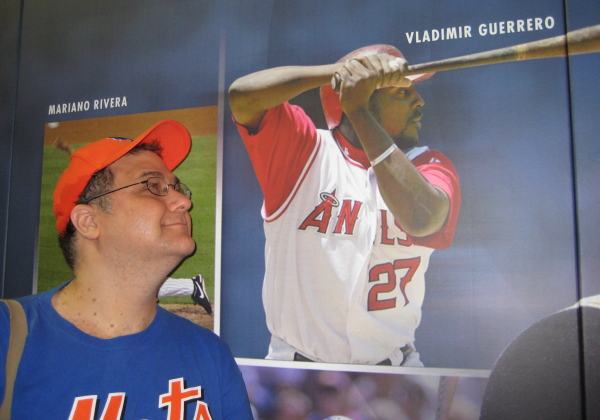
Is it strange that I appear positively beatific staring at an image of Angel Vladimir Guerrero at FanFest last week? I had been thinking prior to this chance meeting that I sort of missed Vlad’s regular visits to Shea. I don’t generally miss anyone who is a lifetime .311 hitter against the Mets. In 360 career at-bats, Vlad has homered 23 times and driven in 58 runs. He made our lives miserable every time he stepped to the plate as an Expo and doesn’t help matters during his Interleague cameos. But I actually miss the Mets trying to get him out. I won’t miss Pat Burrell. I won’t miss Chipper Jones. I won’t miss whathisface from the Ford Edge commercials. But Guerrero, in some way, must be my version of Stan Musial, on whom überblogger Joe Posnanski lavished love in a wonderful piece after the All-Star Game: A lot of baseball fans have forgotten Stan Musial. Anyway, it seems like that. His name is rarely mentioned when people talk about the greatest living players. He’s never had a best-selling book written about him. A few years ago, when baseball was picking its All Century team, Stan Musial did not even receive enough votes to be listed among the Top 10 outfielders. The Top 10. Vladimir Guerrero, as we’ve gone over before, could have been a Met. But he’s not here and that’s neither here nor there. I just have a fan thing for him even if he used to murder us. Is that so wrong? This Mets-Phillies series shapes up as the biggest thing to hit Shea Stadium since Paul McCartney joined Billy Joel on stage. But seriously, I've been thinking about it and I can't come up with a recent Mets series, home or away, that really answered to the name showdown the way this one does. What makes a series a real showdown? Well, let's see… It's late enough in the season to impact the big picture. It's July 22. When it's over, it will be July 24. Both the Mets and Phillies will have 60 games left, including five against each other. It's not so late that this will be definitive, but it's far enough long so that it can have repercussions. Worth noting, however, that after the Mets had booked 99 results in 2007, that the N.L. playoff teams figured to be — based on the standings at that moment — the Brewers, the Dodgers, the Padres and our Mets. None of them made it. It's between two teams going after the same goal. Obviously the Mets and Phillies are both looking at first place, co-leaders that they are. This is different from last September's collapse special when the Mets were trying to run out the clock and the Phillies were maneuvering toward the Wild Card. They entered that set 6-1/2 back with two-plus weeks left. The Mets and Phillies weren't on the same map on Friday the 14th. You could even argue they were barely on the same competitive continent when the lead was cut to 3-1/2 after the weekend sweep. What we have here is two teams residing at exactly the same latitude, the stakes rarefied and juicy. It's between two teams with the same amount to gain or lose. Who benefits more from winning this series? Whoever wins is the cheap and accurate answer. There will be instant analysis that the winner made a statement and that the loser has to scramble, but whoever comes out of this burdened by a one- or three-game deficit relative to the other (with the Marlins mixed in there somewhere) has sixty games to make it up. The Mets won't be shot to hell if they're not in first by suppertime Thursday. Neither will the Phils. Surely, though, they're in the same boat as they climb onto the deck. It's between two teams who share some history. The Mets-Phillies rivalry used to be noteworthy for existing only in theory and maybe geography. That's over. All the “team to beat” tripe is underscored by real on-field intensity, even if its fuse was lit for real in 2007. Is this really the first showdown series for the Mets in a long time? Let's review: 2007: The Mets couldn't be bothered with showdowns up to and including the September Phillie series. That and the one at the Cit in late August were big series for the Phillies, not us, before they commenced. In retrospect, they were enormous for both teams. But you have to know that going in. The Mets had big series post-Phillies in September, but those were dear life affairs, as in hanging on to first, hanging on to any chance of not folding. 2006: I've long maintained the biggest showdown of two years ago was very early, the first game between the Mets and Braves at Shea when Pedro won his 200th decision and the Mets' lead extended to five games in mid-April. We've seen that large leads with months to go evaporate, but there was something different about that night, something different from all the Mets-Braves series that preceded 2006. But it was April. The Mets-Phils series at CBP in the middle of June was significant in that the Mets nailed down the East for all intents and purposes, but it never felt as if Philadelphia was going to make a run. There was a series in August between the Mets and Cardinals that felt portentous, but that's different from a showdown. 2005: The Mets and Phillies met in a Wild Card showdown that spanned the end of August and beginning of September but that's not a divisional showdown. Too many other teams were lurking (with Houston eventually winning the damn thing). We had our hopes up, yet despite Ramon Castro's best efforts, the Mets — losing two of three at Shea — weren't ready in '05. Neither were the Phils. This is a front 'n' center series starting tonight. It should lead Baseball Tonight and any objective sportscast. That's a showdown. 2004: For about two seconds the Mets and Phils showed down for first in Philly (Bobby Abreu vs. John Franco…brrr…), but it was a tad early — first week of July — to take it seriously as death. As the Mets would prove by the beginning of August, the Mets weren't to be taken seriously at all in 2004. 2003: Ahem… 2002: The '02 Mets were supposed to be neck-and-necking with the Braves, but the Mets were done in by their own torpor from May until August. When they garnered a little momentum midsummer and faced a significant series against the Diamondbacks, Bobby Valentine downplayed it (scolding Mo Vaughn for suggesting it was crucial) and the Mets played down from there. By the time the Braves visited Shea again, they were polishing another N.L. East belt and the Mets were putting out feelers to Art Howe. 2001: Real close, but no showdown. The Mets' last best hope for mano-a-mano action for the division was derailed by Brian Jordan on September 23 at Shea. Instead of heading into Atlanta with first place at stake for both teams a week later, it was the Mets who needed wins desperately, the Braves more or less tuning up; they hadn't clinched but deep down, we had to know they would. Tough pair of weekends for the Mets. Outstanding pair of weekends for Brian Jordan. 2000: The last year of balanced scheduling, so the Mets-Braves series weren't as plentiful as they are now. The two rivals faced off in mid-September with the Braves up three games. Two Brave wins (emphatic Brave wins) put to the rest the notion that the Mets could win the East. The final-week series between them at Shea was the essence of anticlimactic. The Braves won the first game and clinched first. The Mets won the second game and clinched the Wild Card. It was the living, breathing embodiment of Everybody Gets a Trophy Day. 1999: All the showdown criteria were lined up perfectly on September 21 as the Mets (92-58) hit Turner Field. Braves (93-57) led by one with twelve to play. The division was as up for grabs as it ever would be in the Bobby V era. So what happened? Turner Field hit the Mets. Chipper Jones, mostly. Three heartbreaking defeats propelled Atlanta to a quick clinch. How quick? The Braves won so many and the Mets lost so many so soon that Atlanta was champ by September 28 when they showed up at Shea for what was supposed to be the ultimate showdown for first. The Mets had actually — no joke — printed up t-shirts that displayed both teams' logos and the fightin' words BATTLE FOR THE EAST on them. I can still see them sitting unsold at concession stands everywhere. They were revived in October during the NLCS, but the message didn't have the same oomph behind it. If we're going to call this Mets-Phillies series a showdown and not find one series that loomed quite on the same level since 1999, can we say this shapes up as the biggest series the Mets have played in nine years? I wouldn't go that far. There can be big series, like the Mets-Marlins debacle from last season's final dreadful weekend, that aren't showdowns. Can we say, then, that there hasn't been a bigger showdown in which the Mets have been slated to take part in almost a decade? It doesn't sound quite correct, but based on the evidence, it might very well be. “In my younger and more vulnerable years my father gave me some advice that I’ve been turning over in my mind ever since. ‘Whenever you feel like criticizing anyone,’ he told me, just remember that all the people in this world haven’t had the advantages that you’ve had.'” Follow me back, if you will, to a week in June three years ago… On Saturday night the eleventh, pinch-hitter Marlon Anderson leads off the ninth inning of an Interleague game against the Angels at Shea Stadium, the Mets trailing 2-1. Anderson lashes a Francisco Rodriguez pitch into the right-center gap. It eludes both Steve Finley and Vladimir Guerrero. To compound the Angels’ problem, Guerrero Finley kicks the ball. Anderson, hustling all the way, just keeps running. He approaches third and Manny Acta waves him in. There’s a play at the plate but Marlon beats Jose Molina’s tag. Marlon Anderson has just delivered the first Met pinch-hit inside-the-park home run in the history of Shea Stadium. He’s tied the game at two in the ninth against one of the best closers in the sport. He’s reserved for us, at the very least, extra innings. The Mets, despite eventually falling behind again, would cash in their last best opportunity in the eleventh when Cliff Floyd clouted a three-run job off Brendan Donnelly. On Sunday the twelfth, I wrote about it; so did Jason. It was such a great game. We’ve recapped, to date, 585 regular-season Mets games at Faith and Fear and that one is still among the best we’ve ever covered. I knew I’d never forget it and so far I’m good to my word. On Monday the thirteenth, it was reported that after seven years of designs, discussions and false starts, the Mets would be really and truly getting a new ballpark. It would be ready for the 2009 season and it had something to do with New York getting the Olympics in 2012. The city’s bid was already falling apart after the West Side stadium fell through and Queens was an audible on the part of the Bloomberg administration. If 2012 really were to bring the Olympics, the Mets would have to step aside for a year and let the park be expanded for the world’s use (the Mets would play at whatever was going to replace Yankee Stadium). Olympics or not, the new Ebbets Field-style ballpark was finally coming. On Tuesday the fourteenth, I celebrated a Met milestone. It was 25 years to the day since another Saturday night like Marlon Anderson’s. In 1980, it was Steve Henderson imprinting his feat on my baseball-shaped brain with a ninth-inning three-run homer that capped a five-run rally and a seven-run comeback that epitomized a Mets season where hope hopped up and hugged us tight. Henderson won it. Anderson tied it. Either way, the Magic was back in that Met Shea way you can wait a quarter-century for to roll around again, but it does roll around. At least it did on June 11, 2005. So much going on. Anderson now. Henderson then. A new ballpark, it was said, soon. An entire three days had passed between Marlon’s inside-the-parker and the anniversary of Hendu’s walkoff. It already felt like it was slipping away. The Mets lost the Sunday after the Saturday. They traveled to Oakland and Seattle for reasons unfathomable and out west, in American League outposts too familiar and unfamiliar, they’d go 1-5. Three years ago, not much different from now, really, good feelings didn’t last for long where the Mets were concerned. But Marlon Anderson’s pinch-hit inside-the-parker would have to. I promised myself it would. For 25 years, Steve Henderson’s home run was the stuff of spoken word, of oral legend. 1980 had been plowed under by history, by more statistically pleasing seasons. One of the benefits of discovering blogging was discovering an avenue for reviving the lost seasons and moments of Mets baseball. I no longer had to sit and stew that nobody ever wrote about Steve Henderson and the Magic is Back summer of ’80. I could do it myself. I could do it justice, just as I could do Marlon Anderson justice as I saw fit. I couldn’t have known Anderson would be gone from the Mets by 2006 nor that he would be brought back in 2007 or that in 2008 instead of being appreciated for his epic pinch-homer, he’d be dismissed for his contemporary fill-in work. I could have guessed that the world would change several times over for the Mets and that the Saturday night of June 11, 2005 would get lost in a larger shuffle. I did, I suppose, guess it. The same weekend the Angels were visiting the Mets, the Yankees were visiting St. Louis. It was the last season of Busch Stadium II — the round one — and the Cardinals were paying tribute to their four decades there with a daily ceremony. In the fifth inning, they’d bring out a special guest, someone associated with their history, to peel off a number to signify how many games remained at Busch. On June 11, hours before Marlon did what he did, the Cards gave the honor to Joe Torre, recognizing his role as a Redbird player and manager. The gesture stuck in my head. The Cardinals were really going out of their way to say goodbye to Busch with thought and with class (even with a Yankee if decorum demanded it). Wouldn’t it be great, if the Mets could do that in 2008 when they’d be saying goodbye to Shea? I imagined it would be. In linking Steve Henderson to Marlon Anderson on June 14, 2005, I imagined it was one night in 2008. I had no idea which night, but I imagined it would be the night Marlon Anderson was brought back to take down a number from the Shea Stadium final season countdown. I imagined the countdown would be a big deal, that it would pause the action on the field for a couple of minutes in each game, that the nonpareil announcing team of Gary Cohen and Howie Rose would stay with the ceremony to describe it to their listeners. I imagined Gary and Howie would explain, through their deep and abiding love for and knowledge of the Mets, why each person involved in the countdown was chosen. I imagined they’d reconstruct that wonderful Saturday night in 2005 when Marlon Anderson lashed that K-Rod pitch between Finley and Guerrero. I imagined that all the Marlon Anderson moments that had graced Shea Stadium would get their due from the Mets. What an imagination I have. As the mechanics of replacing Shea picked up — no Olympics, definitely a ballpark, definitely Ebbets-like, definitely sponsored, definitely Citi, definitely 2009 — I didn’t forget what the Cardinals had done. I watched them on Extra Innings. Their telecasts stayed with each number removal all the way to the end of the season. It was a happening every time they played at home: old Cardinals, old football Cardinals, distinguished St. Louisians, opponents from years gone by, families of legends who had passed on. It was a breath-holding moment when Mark McGwire emerged from exile to pull down the third-to-last number. He received polite applause. Ozzie Smith did the final one, his uniform number: 1. Why couldn’t the Mets do this? Busch and Shea were of the same vintage. The Mets had plenty of history. New York had loads of it. All it would take was a little effort and a little imagination. Better yet, a lot of imagination. We know what happened. Barring a change in policy for the remaining 35 home games, we know we can expect very little sense of occasion from the Mets in the realm of its Shea countdown. To say they don’t care about it is the understatement of the year. Tomorrow, MetsBlog mentioned the other day, the Mets will announce a partnership with Nikon and SNY to “launch a program celebrating and honoring the greatest moments in the history of Shea Stadium”. One can only hope it takes Shea’s 45 years more seriously than the car company countdown has. That Met track record of embracing as little Met history as possible is what spurred me to see the Shea Stadium Final Season Countdown Like It Oughta Be through from “wouldn’t it be nice if…?” to as much reality as a blog can create. It started with Marlon Anderson and the notion that a random ballplayer on a random night in a random season in a particular ballpark turned into something spectacular, and that spectacular events wrought by random individuals deserve to be remembered as long as we take our particular ballpark to heart. It grew into an idea that all the random nights in all the random seasons in our particular ballpark absolutely Oughta Be commemorated with TLC. It came from a conviction that no matter how much blue and orange we spill from our veins, we know damn well the Mets don’t sweat one extra bead of perspiration to make that sort of thing happen. So I did. I and an army of dozens. I wanted to use this occasion to acknowledge the contributions of readers and correspondents and, of course, my co-blogger in nurturing the Countdown Like It Oughta Be. Many names, many games, many episodes that defined Shea Stadium came to my attention and made it into the finished product because a lot of people do care about what we have seen since 1964. I was occasionally amazed that there was vehement disagreement with a particular choice, amazed and gratified that a hypothetical choice mattered that much to somebody. Sometimes I feel a bit like Andy Kaufman reading from F. Scott Fitzgerald’s The Great Gatsby, testing his audience’s patience. They’d think it was funny when he’d say he’d do it, they’d think it was hilarious when he began to do it, they got sick and tired of it as he just kept reading aloud. I’ve articulated my share of “wouldn’t it be nice if…?” ideas here since 2005: One Hundred Greatest Mets of the First Forty Years, March Metness, all the Flashback Fridays and the Shea Stadium Final Season Countdown Like It Oughta Be. There’s inevitably more buzz when I present the idea than there is when I bring the idea to what I consider its logical conclusion. Count me in the follow-through camp. I can’t let an idea that intrigues me go at nice, not here anyway. I have to take it and run with it, hopefully not running it into the ground in the process. I don’t mean to read The Great Gatsby aloud, honest I don’t. The Countdown took on a life of its own for me since I began shaping it in earnest. It skewed my view of “real world” developments. One Met manager who was supposed to play a role at number 41 was fired before his date with Countdown destiny; I didn’t mind Willie Randolph getting the axe, but it actually bothered me (a little) that he didn’t last until he could accompany Yogi Berra to the right field wall as planned. When Gary Carter was opening his mouth in May about replacing Randolph, I cringed partly because I didn’t want him casting a shadow on his participation in final-week festivities. The Countdown took on a more serious casualty this month when longtime newspaperman Red Foley passed away. I’d slotted Foley in to join Robin Ventura in taking down number 15 — it was Red, in his role as official scorer, who technically turned Robin’s NLCS grand slam into a single. For you, this might have been hypothetical. For me, it was serious business. I moved people in, out and around for months. I assigned players to one group at the expense of other groups where I fretted they would be missed. I strived not to be overly obvious but not too terribly subtle either. I wondered what non-Mets should be invited, what non-baseball people should be considered, why nobody left a single comment under my post for number 12 (was my Jets tribute too obligatory or was it just a rainy Monday night?), whether Bobby Valentine was strong enough to carry out the honors for number 11 — for September 11 — by himself (I decided he was), if I could bring myself to bring out a bushel of Braves at number 8 and have them pelted with rotten fruit even though several of those Braves were part of the great post-9/11 healing at Shea (I could; they’re the Braves). A few things I did know as the single digits emerged and the final week of the home schedule faced me. I knew a black cat would have to appear. I knew Bill Buckner would have to return. I knew Murph, Lindsey and Ralph must rate something special. I knew Casey Stengel must be heard from, no matter that he is dead at the present time. I knew the end could not boil down to Tom Seaver because nothing could be more predictable than a Mets countdown boiling down to Tom Seaver, even if under most every circumstance a Mets countdown is rightly bound to boil down to Tom Seaver. Ultimately I decided no number 1 could be removed. Something of Shea should survive and, perhaps out of attachment for the whole exercise, I couldn’t bring myself to definitively end the countdown. It, like Shea, will live on with me. I hope its contents — the condensed history of Shea Stadium — came alive for you for a few minutes here and there across the four months we ran it. That was the idea anyway. And in case you missed it, Marlon and Steve were brought together again at number 54. Next Monday, one reader imagines an alternate ending — not to the Shea countdown but as regards the aftermath of the 2008 season. I'd never make a big thing of it, but I don't really get anybody who doesn't like Coney Island. Yeah, it's dirty and seedy and you know the games are rigged and when you're being hurtled through the air by some ancient ride your mind inevitably goes to maintenance and whether or not it's been deferred. But it's got a ragamuffin charm I find impossible to resist, from the falling-down bars to the crappity photo stalls to the gruff but still careful way the kids' restraints are checked and the fact that so many people crammed into a fairly small place in hot weather pretty much completely behave themselves. (Come to think of it, that's not a bad description of New York itself.) And then there are things that need no qualifier, such as the wooden rattle of the Cyclone and the view from atop the Wonder Wheel (in the sliding car, of course) and knowing Keyspan Park is waiting just down the boardwalk. Today we were heading out to meet friends for a Cyclones game against the Staten Island Yankees. I'm proud to say that the Cyclones won, beating the Potential Minions of the Vertical Swastika by a 7-4 score, with Brooklyn hurler Jenry Mejia definitely opening some eyes by fanning nine in five innings of one-hit ball. But the real victory, of course, came earlier. We heard Ramon Castro put the Mets ahead while on our way to Williamsburg to retrieve stuffed animals Joshua had left at his babysitter's apartment. We heard Mike Pelfrey unravel — with Marlon Anderson and Castro and Carlos Beltran plucking at the threads — about halfway down Ocean Parkway, Brooklynites sitting on the benches on either side, extremely still in the heat. I heard the Reds and Mets grind away at each other futilely while looking for gas after dropping Emily and Joshua at Astroland. (Gas, man. It's expensive these days. Maybe you've heard.) And I heard more blows exchanged without much purpose over my handheld radio as Joshua traded in an enormous handful of green tickets he'd won by shooting clowns. (There were 230 of them — it looked like the kid had pulled up an entire stalk of corn from a farmer's field, or plucked a reed from a waterway. He was very pleased with himself.) I listened intently to the doings in Cincinnati, but at the critical moment I had a problem: I was taking Joshua on the Scrambler. The Scrambler, for the uninitiated, is one of Astroland's better kiddie rides, in delivering relatively adult levels of speed and excitement while accommodating those under four feet tall. It's a bunch of cars attached to booms that are whirled around the center, whipping you in and out and back and forth as you go round and round. (And round and round and round.) You're flung to the very edge of the underside of the boardwalk, to eye level with the stairs coming down from said boardwalk, to just short of the chain-link fence dividing the ride from the midway, and so on. I couldn't help calculating my chances if our Scrambler cab were to become detached at various points of apogee — that maintenance thing gets in your head. I decided Joshua was low enough to be protected by the cab's housing, but I felt horribly exposed. Getting flung through the underpinnings of the boardwalk? Not only obviously fatal but it would also involve splinters. A close encounter with the steps would at least be a quick decapitation. Going through the chain-link fence, I decided, might offer me a puncher's chance. (You should see how much fun I am at parties.) When we boarded the Scrambler, the Phillies had lost, Robinson Cancel was on second base and I was hopeful. (And kicking myself for being in San Diego for the second and third games of the suddenly epochal Phillies series.) But the ride was loud, I only had one earpiece in, and I was hanging on to my kid. First the radio was whipping around from its moorings around my neck, so it had to be stuffed into my shirt, something gravity wasn't inclined to make easier. Then the volume was too low, but the controls had been stuffed down a neckhole. Then the headphones popped out of their jack. And the machine was grinding and everybody was yelling. Luckily, if you've heard enough baseball, you can pick up a fair amount from the pitch of the announcers' voices and the pace of their rhythms. I got that Reyes (Jose) was on first. I then got that Reyes (Argenis) had done something significant, or had something significant done to him, or at least been an eyewitness to something significant. But that was it — this is more or less what I could hear: NOISE NOISE NOISE NOISE NOISE SOMETHING IS HAPPENING REYES REYES REYES IT'S PROBABLY SOMETHING GOOD NOISE NOISE SOMETHING SOMETHING AND THE METS REYES NOISE REYES (It sure helped that there were two Reyeses involved.) Billy Wagner struck out the side to end things as we were exiting Astroland, so I heard that quite clearly and reported it eagerly to anyone who cared within 10 or 20 feet. And then the three of us were off along the boardwalk to Keyspan, with our strides perhaps betraying a slight strut appropriate to fans whose team have just reclaimed first place, and perhaps also a slight hesitation appropriate to fans whose team possesses only a share of that magical status, and will soon have to defend it. The streak is over! Dave Murray, your Mets Guy In Michigan, just witnessed moments ago his first Mets win in person since 1991. Dave's self-termed Streak of Shame had encompassed eleven losses at nine different ballparks, including two that no longer exist and one that has sat abandoned since Robinson Cancel was a growth stock. But it's over. Dave attended today's Mets-Reds game at Great American Ball Park and came away with a great Metropolitan victory that he could pack up and drive home to Western Michigan. He leaves behind in the mighty Ohio an Adam Dunn-sized monkey that previously resided on his back. That burbling sound you heard was it drowning. I spoke to Dave ever so briefly after Billy Wagner struck out Jay Bruce and 17 years of disappointment in precisely that order. Dave was not a little happy. The Mets are tied for first again, their co-leaders the Phillies coming in Tuesday. Pelfrey battled, Sanchez persevered, Castro homered, Delgado continued, Argenis Reyes occupied the middle of things, Jose Reyes tripled a team-record 63rd time and Wagner saved. There are so many positives to bask in from this afternoon in Cincinnati. But Dave Murray seeing the Mets win? That, like Robinson Cancel doubling, happens barely once per decade. The cats here didn't enjoy Saturday night's game any more than the people did. Mike Lincoln's logging of called strike threes on Wright and Beltran brought howls from this human. The living room noises were so disturbing that I'm told by a reliable witness who was in the kitchen that they sent both Hozzie and Avery scurrying for cover — and those are cats who regularly ride out all but the most severe thunderstorms with aplomb. My over-the-top sound effects are yet another sign that the 2008 Mets are back, though I'd rather prove it through sustained applause. When I was wandering aggressively ambivalent Met territory, I could handle with an affectation of smirking indifference David and Carlos B. looking at kill-me-now full-count bases-loaded pitches. These nights, however, I'm taking our setbacks personally again, just as in pennant races of yesteryear when it was every cat for himself. In the wake of the 10-0 run, watching the Mets has re-emerged as serious business, which made surprising to my wife my nodding off during whichever early inning it was that the third-base ump screwed Tatis out of that great catch in foul territory. I had to see it on replay after Stephanie nudged me out of my catnap. She had put down her Redbook long enough to be disgusted by the frighteningly bad call and then wondered how I could have snoozed through it: “I was expecting you to punch the couch or grunt or something.” Later I was expecting the Mets to do something, too. They did. They lost in excruciating fashion, one of those affairs in which a five-run pounding felt like a one-run squeaker. All the Mets needed was one lousy timely hit, one baserunner not held up at third, one crucial pitch…and they got nothing. They seem to be, at the very least, going through a phase. I'm willing to believe 0-2 is the aberration, that 10-0 is the leading indicator. We shall learn more soon. Partial to precedent as I am, let me point to one that is, unlike the 1991 model, actually kind of cheerful. The 1986 Mets (like their '91 and '08 descendants) entered the All-Star Break blisteringly hot. Their first game back, a Thursday night in Houston, was a nailbiter into the seventh. They trailed the Astros 1-0 until they exploded like the Astrodome scoreboard used to. Seven in the seventh, three in the eighth, three in the ninth; Mets won 13-2 and appeared (like their '91 and '08 descendants) unstoppable as all get-out. Then they fell victim to the Astros and incompetent umpiring for three agonizing games in a row. OK, it wasn't so agonizing considering they were double-digits ahead of the pack in the N.L. East, but it rather sucked. They were shut out for the first time all season on Friday night, wasted a four-run ninth that tied Saturday's game when Roger McDowell turned around and surrendered a walkoff homer to Craig Reynolds and were jobbed by a dismal call at the plate in the bottom of the fifteenth Sunday. Also, four of the Mets (Darling, Ojeda, Aguilera and Teufel) managed to get themselves arrested at a lovely club called Cooter's Executive Games and Burgers over the weekend. What's that? These aren't the '86 Mets we're watching? No spit, Spurlock, but the '86 Mets — bail made — got on a plane to Cincinnati right after that and swept the Reds. Featured in that series was the famous fourteen-inning game in which included Dave Parker dropping the surefire last out in the ninth, the brawl between Eric Davis and Ray Knight in the tenth, ejections galore, Gary Carter playing a flawless third, Roger McDowell and Jesse Orosco switching off between the mound and right field and Howard Johnson blasting a three-run homer to eventually win it. According to Baseball Tonight, that 3-1 letdown turned 6-3 triumph was the last time the Mets entered the ninth in Cincinnati trailing by two runs and went on to win…until Thursday night when they were down 8-6 and won 10-8. Moral? I have no idea, but finding some way, any way, to connect 2008 to 1986 makes me purr a little. Quick as a cat, three more points… • Quasi-cultural recommendation: City Center (55th between Sixth and Seventh) is staging a summer revival of Damn Yankees through July 27. Stephanie and I saw it Saturday afternoon and it had, as its signature song suggests, heart. Good tickets are relatively cheap (starting at $25), City Center is, as always, a charming venue and, best of all, the title characters are neither seen nor successful. • If I may be blasphemous this steamy Sunday morning, it's far too hot for a sermon. Keep the Commandments and say a prayer for Dave Murray to break his Streak of Shame. You'll recall our friend from Michigan tried (and failed) to get his first Mets win since 1991 at Shea during the Subway Series in June. He was at Great American Saturday night to extend what has become a seventeen-season, nine-park victory drought to eleven games. He's sticking around Cincy Sunday to take one more shot at ridding himself of it. May Mike Pelfrey guide him to the promised land. • The Reds inducted Cesar Geronimo, Joey Jay and Barry Larkin into their Hall of Fame before defeating the Mets Saturday. The Mets inducted Tommie Agee into their Hall of Fame before losing to the Dodgers on Sunday, August 18, 2002. Those are each team's most recent inductions. Kudos to Gary Cohen for noting during Saturday night's Snighcast how the Mets have completely neglected our Hall for six consecutive seasons and have made no known effort to even convene a meeting to discuss nominees since Agee went in posthumously. May Mets management find a bit of time between polishing the doorknobs to the Ebbets Club and spiffing up the Jackie Robinson Rotunda to someday honor somebody who had something to do with the nearly half-century history of the New York Mets. |

Piazza: Catcher, Slugger, Icon, Star by Greg Prince is available from Amazon, Barnes & Noble and other online booksellers. 
Amazin' Again: How the 2015 New York Mets Brought the Magic Back to Queens by Greg Prince is available from Amazon, Barnes & Noble and other online booksellers. 
Volume I of The Happiest Recap: 50+ Years of the New York Mets As Told in 500+ Amazin' Wins by Greg Prince is available in print and for Kindle on Amazon. 
Faith and Fear in Flushing: An Intense Personal History by Greg Prince (foreword by Jason Fry), is available from Amazon, Barnes & Noble and other online booksellers. |
|
Copyright © 2025 Faith and Fear in Flushing - All Rights Reserved |
||