The blog for Mets fans
who like to read
ABOUT US
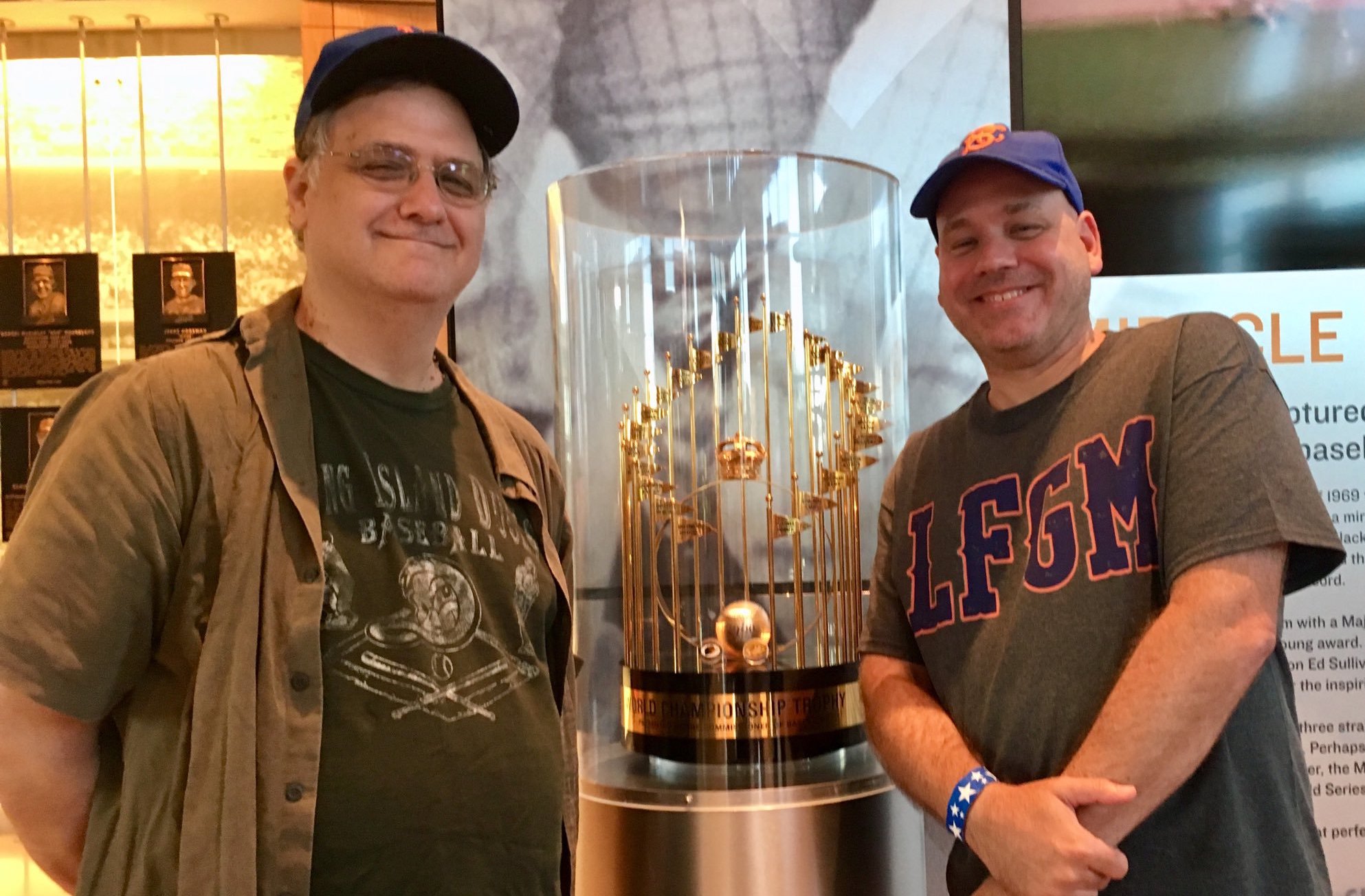
Faith and Fear in Flushing made its debut on Feb. 16, 2005, the brainchild of two longtime friends and lifelong Met fans.
Greg Prince discovered the Mets when he was 6, during the magical summer of 1969. He is a Long Island-based writer, editor and communications consultant. Contact him here.
Jason Fry is a Brooklyn writer whose first memories include his mom leaping up and down cheering for Rusty Staub. Check out his other writing here.
Got something to say? Leave a comment, or email us at faithandfear@gmail.com. (Sorry, but we have no interest in ads, sponsored content or guest posts.)
Need our RSS feed? It's here.
Visit our Facebook page, or drop by the personal pages for Greg and Jason.
Or follow us on Twitter: Here's Greg, and here's Jason.
|
by Greg Prince on 5 July 2008 5:10 pm Perfect. Perfect bookends to a perfect year. Waking up on July 4, 2008 to read that Jose Reyes reportedly engaged in a “heated” confrontation with Keith Hernandez on board the Mets' flight a few nights earlier from New York to St. Louis — Keith didn't like the way Jose reacted to his throwing error during the final Subway Series game and let it be known in the course of that day's telecast — could only remind the overwrought Mets fan that we'd been down the what's-up-with-Reyes? road almost exactly a year before.
It was on the field, not on a plane…and in plain view, not via conflicting accounts…that we saw Jose Reyes tap a weak grounder down the third base line in the eighth inning at Minute Maid Park on July 6, 2007. Reyes thought it would go foul. He didn't run to first. Mike Lamb fielded the ball fair and threw him out by 80 or so feet. Willie Randolph immediately pulled him to teach him a lesson. Jose didn't look too happy about being schooled in so public a fashion, but he said more or less the right thing afterwards.
“It's my fault there,” Reyes declared in accepting his medicine, “but that thing can happen to anybody.”
Funny the things that happen to and around Reyes since then.
On a team for whom no more than half ever seems to go right, Jose Reyes' past year has veered to disaster far more often than not. That's taking into the good and wonderful stuff that's occurred since July 6, 2007: the All-Star laying on of hands by Willie Mays which seemed so appropriate in the emotion of the moment; the leadoff home run right out of the gate to open the second half, a sign — it seemed — that the momentary lapse of judgment in Houston was more molehill than Tal's Hill; the August crime spree of 17 consecutive successful steals, one of them setting the team record for thefts in a single season with more than a month to go; and this season's post-April statistical renaissance, culminating in current batting, on-base and slugging totals legitimately comparable to Jose's sainted 2006.
But who remembers any of that now? Now that Jose is…
• The guy who had to be benched because he didn't hustle;
• The guy who went into the tank in Philadelphia in late August and never climbed out for the balance of 2007;
• The guy who tried to steal third with Wright up and two out and there, hindsight says, went the season;
• The guy who didn't steal anything else except his paycheck the rest of the way;
• The guy whose intrinsic joy for the game was processed in too many quarters as chronic immaturity;
• The guy who celebrated too much or not enough;
• The guy who welcomed his new manager with a top-of-the-first tantrum;
• The guy who got himself picked off second by Andy Pettitte;
• And the guy who not only pulled Delgado off the bag on Melky Cabrera's grounder but took it out on his glove and his wristband on the field for all to see.
Now he's the guy who allegedly got into it with Keith Hernandez. I say allegedly because this was reported by the same beat writer who blew up Jerry Manuel's silly “fertilizer” remarks into a front-page scandal and I say allegedly because calmer, more reliable observers say that while Jose indeed expressed dismay to Keith and Keith took issue with Jose's interpretation, it didn't exactly amount to a Met melee among the clouds (I'm thinking it's telling that this happened Sunday night yet didn't make the paper in question 'til Friday).
But something did happen, and it happened to or around Reyes. Reyes worries about what somebody told him an announcer said. Reyes leans too far toward third. Reyes doesn't listen to Jerry Manuel. Reyes dances to his own beat without regard to consequence. Reyes raises his rabbit ears a little too high. Reyes runs to first now but didn't run then.
It's been quite a year for Jose Reyes since that Friday night in Houston. It is said as he goes, the Mets go. Over the last year, the Mets have gone nowhere.
by Jason Fry on 5 July 2008 2:10 am Well, that one might be shown as a future episode of Phillies Classics.
The rain didn't really show up (I had visions of Gavin Floyd, Xavier Nady and Aaron Rowand), but neither did the Mets' bats. Johan Santana showed up all right, pitching a dazzling game … with the exception of that sixth inning. For all his wonderfulness, Johan seems to have these occasional mini-Leiter episodes, two-batter or one-inning spurts in which his location goes on the fritz and he seems as puzzled as you are by it. (Maybe it was that he was wearing a patriotic-looking cap that clashed hideously with his uniform. Seriously — if you tried to leave the house wearing that color combination, your wife would call you back in a no-quarter tone of voice.)
While we're dwelling on Santana's (very small) faults, he also arrived with a reputation as a Hamptonesque hitter. And when he came up with the bases loaded and none out in the fifth, I was sure his Mike Hampton moment had arrived. He was going to hit a double up the gap, maybe even channel his inner Felix Hernandez, and tomorrow's papers would be all about how Johan had figured out the way to win was also to do the hitting. My baseball radar was off all night. Instead, Santana turned in the kind of saucer-eyed at-bat you'd expect from a pitcher just arrived from the American League. Reyes, Chavez and Wright managed to scratch out two runs when we should have had more (Wright and Beltran looked overanxious all night, I thought), and it was bite-your-nails time. Johan's Leiter episode followed, Chad Durbin was masterful in relief, and Duaner couldn't find that third out. Ballgame.
The other night, in that back-and-forth game against the Cardinals, Wright tripled with one out in the eighth and the Mets up 7-5. Beltran struck out looking and the score stayed 7-5. I briefly mourned the duck who'd been allowed to keep paddling around on the pond, but I figured it was OK. We were going to win, right?
We weren't. We didn't get the run home then, just as we didn't get it home tonight with Reyes on third and one out in the first. There's a valuable reminder in that of the meaning of baseball life, I suppose. If you'll allow me a little Monty Python, every run is sacred, every run is great. If a run is wasted, the baseball gods get quite irate.
And so, I imagine, does Johan Santana.
by Greg Prince on 4 July 2008 6:26 pm 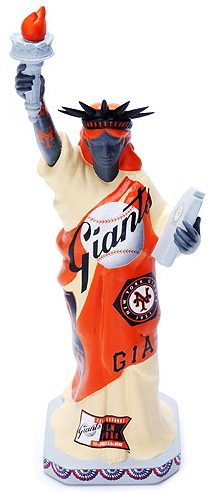
| The New York Giants entered the National League in 1883. The Statue of Liberty was dedicated in 1886. This was the original design.
No, not really. If you haven’t noticed, MLB is putting up baseball-themed SOLs up all over Manhattan to promote the All-Star Game which is being held…somehwere. The NYG version is in front of the Toys “R” Us in Times Square (44th Street). They also managed to remember the Brooklyn Dodgers down on Whitehall Street, home of Topps.
The Mets, you ask? One for the Mets in Penn Plaza, Seventh Avenue between 32nd and 33rd; and one for Shea (in which Lady Liberty appears to be holding a box of commemorative popcorn) in front of the SNY studios, 51st and 6th. A map to where all 42 are lifting their lamp is here, and, because this is Major League Baseball, a way to order miniatures of the statue(s) of your choice is here.
Thanks to Hotfoot‘s Mets Photostream for getting us curious about all this Liberty on the Fourth of July. |
|
|
by Greg Prince on 4 July 2008 5:00 pm Welcome to Flashback Friday: Tales From The Log, a final-season tribute to Shea Stadium as viewed primarily through the prism of what I have seen there for myself, namely 374 regular-season and 13 postseason games to date. The Log records the numbers. The Tales tell the stories.
5/15/82 Sa Los Angeles 1-1 Puleo 1 6-13 W 6-4
7/22/87 W Atlanta 2-2 Darling 4 19-27 W 4-3
8/7/01 Tu Milwaukee 5-0 Chen 1 126-94 W 3-0
With Shea gone, where will the Rick Monday Guy go?
The Rick Monday Guy is also the Billy Smith Guy. Either way, where will he (or they) be if there’s no Shea anymore? Where will I turn to hear a drunken Rangers fan take out his hockey frustrations on an opposing baseball player? How does he exist without Shea?
The Mets were playing the Dodgers. The Mets were actually beating the Dodgers, yet the occasion, a perfectly pleasant Saturday night, wouldn’t have been complete without the Los Angeles centerfielder being informed of one undeniable fact from this one fine fellow in my Mezzanine midst:
“HEY MONDAY! IT’S SATURDAY!”
Not once, not twice but to infinity and beyond. The soul of wit and the personification of repetition were activated in the service of reminding Rick Monday his surname matched one-seventh of the week, one of the sevenths it wasn’t that night. Poor sap, his ancestors never knew what he’d be coming up against.
“HEY MONDAY! IT’S SATURDAY!”
Didn’t Fred Flintstone use a line like that on prehistoric Tuesday Weld stand-in Tuesday Wednesday? Hey, maybe the Rick Monday Guy worked for Hanna-Barbera. Their cartoons were just that clever.
For good measure, the Rick Monday Guy loved the Rangers. Or, more accurately, hated the Islanders. The teams played a predictable playoff series that spring, the Islanders prevailing as they tended to in the early ’80s. This must have been under RMG’s skin, because he linked Rick Monday of “HEY MONDAY! IT’S SATURDAY!” fame with the Isles’ Stanley Cup-winning goalie.
“HEY MONDAY! GO PLAY WITH BILLY SMITH!”
There may have been something mentioned about what exactly Rick Monday could go play with Billy Smith. “Between his legs,” I think the gentleman suggested. I don’t think it was hockey.
While there were no Rick Monday fans per se in Mezzanine, I believe it was the sight of an explicitly clad Islanders fan — we did used to exist in visible numbers, believe it or not — that set him off. There may have been cross words between RMG and the Islanders fan. There may have been a little more action than the Mets scoring four in the first even. It felt a little tense up there. Joel and I hoped we wouldn’t have to square off based on hockey allegiances since he liked the Rangers and I liked the Isles; after all, we thought we were there to watch the Mets. I don’t remember if RMG was eventually hauled off or simply passed out. I doubt the former. Shea made few pretensions toward being family-friendly in 1982.
***
With Shea gone, where will the “can of corn!” guy go?
There was a denizen of Cliché Stadium who in 1987 had to, just had to greet every single fly ball Ron Darling teased from Atlanta batters in the second and third innings with the hoariest baseball banter in the books.
Gerald Perry flies to McReynolds…”can of corn!”
Andres Thomas flies to Mookie…”can of corn!”
Bruce Benedict flies to McReynolds…”can of corn!”
By the next inning, when Glenn Hubbard was skying one to center, Joel and I knew what was coming…”can of corn!” We giggled and snorted and asked loudly enough to be heard, “CAN OF CORN?” Yes, we were familiar with the expression. But no, we had never heard it repeated so incessantly, not even on SportsChannel.
I think we hurt the “can of corn!” guy’s feelings. He turned around and gave us this beaten look. “Well,” he said. “That’s what it’s called.”
After that, he kept his cans of corn to himself.
***
With Shea gone, where will the Todd Zeile petitioner go?
There was a freelance chanter prowling the Mezz in 2001, a young man who was going to solve our summerlong Todd Zeile problem by working us all into a frenzy one row at a time.
This guy comes up to Jason and me, who are minding our own business, and asks if we’ve had enough of Todd Zeile grounding out and being generally useless. Sure, we said. Everybody’d had enough of Todd Zeile, few having had more of him than us in our Tuesday/Friday plan year.
Well, the guy said, this is what we have to do: Start a chant. It’s gonna go like this:
TRADE
TODD
ZEE-EEL!
[clap-clap…clap-clap-clap]
C’mon, he said, if we all do it, the front office will have to listen.
TRADE
TODD
ZEE-EEL!
[clap-clap…clap-clap-clap]
I kind of nodded. Jason said something to the effect of uh, I dunno about that. But our new friend, as if presaging by two years the recall effort staged against California Governor Gray Davis, was sure he was onto something.
TRADE
TODD
ZEE-EEL!
[clap-clap…clap-clap-clap]
The petitioner moved on to another row, seeking more converts. He eventually took up the chant and the rhythm on his own. A few joined in. I might have tried it once for novelty’s sake. Jace was steadfastly having none of it. As if I couldn’t have guessed, clap-clap-clap was not part of his vocabulary.
In the following offseason, however, Todd Zeile was traded.
***
Shea Stadium hasn’t been just about big moments and momentous interactions. It’s been about the jerks, the weirdoes, the strange dudes. It’s been about those you wish would move to another section or get thrown out. They are as much a part of Shea Stadium as the feral cats. No one’s sure where the cats will go when Shea is torn apart. The jerks, the weirdoes, the strange dudes? Citi Field will have some 13,000 fewer seats than Shea Stadium. Something tells me people like these will find their way in with no problem. They always do.
And they almost always sit near me.
by Greg Prince on 4 July 2008 9:09 am 
Though my junkiedom leaves me susceptible to shamelessly obsessing on the “horse race” aspects of politics, I believe it despicable that the political press covers the presidential campaign like it’s a sporting event. Nevertheless, I have to admit I find Topps’ presidential candidate trading cards to be unbelievably cool. Happy Fourth of July. And wherever you stand, don’t forget to stand in a voting booth on the Fourth of November.
by Greg Prince on 4 July 2008 7:21 am ST. LOUIS (FAFIF) — Mike Pelfrey credited the latest in a string of strong performances Thursday night to the guidance he's received from an individual Mets fan.
“Greg's been on my ass all year,” Pelfrey revealed. “He's been pushing me to pitch better for quite a while. It finally started to sink in. I should just pitch better and maybe he'll get off my ass.”
And pitch better Pelfrey has, winning his last four decisions and lowering his ERA by more than a run since Greg saw him on Memorial Day night.
“Yeah, Greg wasn't too happy with me then, all that nibbling I tended to do,” Pelfrey said. “He let me have it but good. I thought he was being a little hard on me earlier in the season when I pitched pretty well. I was like, 'hey, I threw five or six innings, I didn't walk too many, isn't that good enough?' Greg said it wasn't, and he was right.”
The toughlove approach seems to have truly worked on Pelfrey, now pitching the best sustained baseball of his Major League career. Against the Cardinals, he put up seven innings of one-run ball, allowing six hits and two walks while striking out six.
“When I have a lead like I was able to get tonight,” Pelfrey said, referring to the Mets' offensive onslaught, “Greg said I should just relax and throw strikes. As usual he made more sense than all my pitching coaches combined.”
It's been an up-and-down season for Pelfrey who ended Spring Training as the Mets' No. 5 starter by default and showed flashes of progress in April but was held back in May by an inconsistent approach.
“Trust my stuff, Greg said,” Pelfrey recalled. “He was getting tired of the uncertainty that just dripped from my face. I'm a big guy, I throw hard, just go for it…that was his message. Message received, Greg. Message received.”
“Pelf's got all the ability in the world,” David Wright said. “All that was missing was listening to Greg. I know it did me all the good in the world when he told me to lighten up a little and not fight Jerry on taking a day off.” Noting the possible tweak to his back during the final game of the Mets' just-completed four-game split at Busch Stadium, Wright added, “I wanted to stay in, but Greg thought with a big lead I should just get the hell out of there and sit the hell down — his words. With the wonders he's worked with Pelf, you think I'm not gonna listen to Greg?”
Next up on the Mets' schedule is a critical four-game set in Philadelphia against the first-place Phillies. Greg is advising the Mets keep their heads on straight and start winning a few games in a row. “Greg's got a point there,” said shortstop Jose Reyes. “If we start listening to Greg, no telling how far we can go this year.”
by Greg Prince on 3 July 2008 12:34 pm In a game that you lead 7-5 in the eighth but lose 8-7 in the ninth, you've got to have quite the silver-lining detector to come away from it feeling anything but utterly defeated. And yet…
• Yes, that was a horrible way to surrender a night that had been taken back so emphatically, from down 4-0 right away to up 7-5 at long last. But we came back! When do the 2008 Mets come back from three runs down to win? According to Elias, as noted during the Snighcast, never, making us the only team in the Majors not to engineer anything close to a long-range comeback this season. As clunky as our rallies tend to be, it was good to see a couple executed.
• Yes, Pedro Martinez was conked on the head for a how-do-ya-do in the first with four runs, but after the rain delay, it was like one of those old 7-Up commercials in which the showers poured down on him and gave him back a portion of his mojo. Pedro went out afterwards (itself a small victory) and turned the Cardinal offense, save for the mystifying Rick Ankiel — he has more home runs than David Wright? — into Uncola. Granted, swooner that I am on his behalf, it doesn't take much for me to see light at the end of the Pedro Martinez tunnel, but the determination he expressed after the game (“if I was to quit right now, I'd be a coward”) left me with more confidence than his dreadful lines of late should allow. It's not much to hang one's Pedro hat on when the hat carries a size 7.39 ERA, but it beat last Friday's pitch-tipping festival and the Rocky Mountain meltdown the Saturday before that. I find it all vaguely reminiscent of the way Al Leiter stunk up joint after joint in the first half of 2003 before recovering and returning to routinely brilliant form (albeit for a team going absolutely nowhere) in the second half. Pedro hasn't done the hard part yet, but he can't be nearly as bad as he's shown. He just can't.
• Yes, Pedro Feliciano couldn't have had worse timing in the eighth with that first-pitch gopher to Chris Duncan. But Feliciano (and Heilman) wouldn't have been on in the eighth had Duaner Sanchez been available, and Duaner Sanchez would have been available had Yadier Molina not zetzed him on the knee the night before. Maybe there is something to this “roles” talk about the bullpen, which frankly I don't understand. You can't pitch when you're told to pitch? Facing a batter in the eighth is so different from doing so in the seventh? And wouldn't the world be a better place without Yadier Molina?
• Yes, Carlos Muniz (or Muñiz, which is how his uniform has it even though the ñ is never pronounced…like I should take my cues from the back of a Met uniform) gave up the gamewinner to Troy Glaus, but a) you knew Muñiz/Muniz would be Zephyrbound anyway and b) you know that every left-for-dead power hitter the Cardinals have picked up since Cesar Cedeño (as opposed to Cedeno) has done something like this to the Mets. Cripes, Will Clark, ten minutes from retired, hit a home run off Bobby Jones in the 2000 playoffs. Glaus had never done a thing to the Mets before last night. He was due from a cosmic sense.
• Yes, Carlos Beltran is not getting it done, which is why it's wonderful that Jerry Manuel is probably going to give him the finale of this series off. Look what an off-day did for David Wright. For the first time all season, the rested Wright — average up 22 points in the eight games since getting a blow — appears unstoppable at the plate. Is it a stretch to believe one off-day for one player means another off-day for another player will clear out the other player's cobwebs? Is it a stretch to believe the Mets, who haven't been over .500 in almost a month, are in a pennant race because they're only 4-1/2 back?
• Yes, the Phillies won again, allowing them to creep incrementally further ahead, but look whom they've been beating the last two nights: the Braves! Atlanta losing a) keeps us in third place and b) can't help but make a Mets fan smile. We need the Phillies to lose but we want the Braves to lose. You choose need over want in September. Before the Fourth of July, I'll go with what I want.
• Yes, the rain pushed the game into Mountain Time, but instead of intently watching Beer Money (and I'd need a court order to make me do so), I flipped around and found ESPN Classic running You Can't Blame, its series that delves into well-chronicled sports missteps and pretends to take a fresh look at them. I say “pretends” because there's nothing there you couldn't infer yourself if you gave the matter any thought. The YCB I stumbled upon was Bobby Cox, as in, “You can't blame Bobby Cox for steering the Braves into so many playoff losses over the years.” Whether you can or not, an entire half-hour devoted to the sourpuss Braves shrugging off October defeat after October defeat (even the ones at the hands of the one franchise more insidious than their own) was like sitting in a covered section of Mezzanine during a downpour. When the sun shines, we'll shine together; until then, you can stand under my umbrella of Chippenfreude.
• Yes, the Mets lost in painful fashion, replete with the punch-to-the-gut misery that comes from staring at the other team (the whole team) lovin', touchin', squeezin' at home plate at your expense. But y'know what? That was the first time this season, even taking into account the slew of debacles that defined April, May and June, that I really and truly felt awful that the Mets had lost. Not annoyed, not frustrated, not offended, but absolutely awful. There was no meta to this, no running commentary in my head that I'd rather we win but the loss serves some kind of purpose in delineating the depths to which this organization has fallen and thereby we can use this as an opportunity to take a cold, hard look at what needs to be done to clean up this mess. Fudge no, I was just 100% sorry that we'd lost, like a fan is supposed to feel. Even though I can't unquestioningly take seriously as a contender a team that leans on the valiant Damion Easley as its second-base salvation, I was even — Brave-bashing and all — actually concerned we'd lost ground to the first-place Phils. It took me 84 games, but I think I've found my groove again. Me and Pedro, we'll figure this out in the second half.
A very sweet story from Jim Baumbach in Newsday about a very sweet man, the late Jimmy Plummer.
by Greg Prince on 2 July 2008 9:55 am Following the Mets' 7-4 win over the Cardinals Tuesday night, the Redbird players shrugged it off. It was just one game, manager Tony La Russa told them, we'll get 'em tomorrow. Most of them scattered to their homes, but one was invited for a drink at Mike Shannon's, just across the street from Busch Stadium. This Cardinal had had a pretty good game — drove in a run, threw out a runner — and thought it was just two more of his local admirers wanting to show their appreciation. In St. Louis, he never had to buy himself a drink. The fans were so great. The Cardinal accepted the invitation. Funny thing, though. The Cardinal had been to Shannon's plenty of times and where he was taken, it didn't look like Shannon's…and there didn't appear to be any drink either. After a little friendly baseball chit-chat, the tension began to ratchet up.
“So, you think you're pretty handy with a bat.”
“I don't know what you guys are talking about. I was just doing my job.”
“Uh-huh. Doing your job.”
“Yeah, that's right.”
“Your job is what?”
“I play for the Cardinals.”
“Oh. You play for the Cardinals.”
“That's right. I'm the starting catcher.”
“Catcher, huh? So you what? You catch?”
“That's right. I catch.”
“You wear a mask? And a chest protector?”
“And shin guards.”
“Funny, I don't see any of that stuff on ya now. Neither does my associate Rocco.”
WHACK!
“OW! Whad'ja do that for?”
“I thought you were a catcher. I thought you were used to catching.”
“I catch balls!”
WHACK!
“OW! What's wrong with you?”
“Oh, I'm sorry. I thought you said something about catching it in the balls.”
“What kind of crazy mother…”
“What about my mother? What did you say?”
“I didn't say nothin'.”
“Sounds like you were sayin' something about my crazy mother and your balls.”
“What's with you guys? You don't seem like Cardinal fans.”
“What gives you the impression that we are not Cardinal fans?”
“Cardinal fans don't usually hit me with a bat.”
“Let's just say we are very intense Cardinal fans.”
“No way, man. Cardinal fans are nice. Cardinal fans love me. I hit that big home run for them.”
WHACK!
“OW! QUIT IT!”
“I'm sorry. Did you say we should quit it? Maybe you should quit it.”
“I'm not quitting. I'm a hero. They love me in St. Louis. I won the pennant for these people.”
“These people? Are you implying that we are not your people? That we are not happy to see you? That we were not happy with 'that big home run' of yours?”
“You sure don't seem happy about it.”
“Get a load of that, Rocco. Mr. Molina here don't think we enjoyed his big home run. That was what now…two years ago?”
“Yeah, 2006. If you were Cardinal fans you'd never forget it.”
“I see. Now I'm forgetful.”
“I didn't say that.”
WHACK!
“OW! NO WAY YOU'RE A CARDINAL FAN! CARDINAL FANS DON'T HIT CARDINALS WITH BASEBALL BATS!”
“Now that you mention it, my associate Rocco isn't by nature one of your long-term, dyed-in-the-wool, red-wearing Cardinal fans. In fact he's not really from Missouri, to be perfectly honest with you.”
“Southern Illinois?”
“Rocco's actually in town on business. As I am. From New York.”
“New York?”
WHACK!
“Yes, New York. Where you hit 'that big home run' you seem so proud of.”
“I was just doing my job.”
“Oh. Your job. Your job is catching, I thought you said.”
“Well, I come to bat, too.”
“Of course. How silly of me. The catcher bats sometimes.”
“The catcher bats just like any other player.”
“You mean like this?”
WHACK!
“COME ON! THAT REALLY HURTS!”
“Oh, are we inflicting pain on you? Is that something you know about because you've done it before?”
“What, the home run? I'm a baseball player! I'm not supposed to swing the bat?”
“Rocco, our friend Mr. Molina is quite amusing, all this talk of bats. He seems to have a real Adirondack fetish.”
“You guys are from New York. You know how baseball works.”
“We do know a little something about baseball. We do know how it works. We do know how 2006 was supposed to work, too.”
WHACK!
“We know the Mets were on their way to the World Series that year…”
WHACK!
“We do know there was a little 'accident' in Miami…”
WHACK!
“We do know the cops pinned it on some 'drunk driver' who just happened to be careening outta control on I-95…”
WHACK!
“We do know that he just happened to take out our most reliable set-up relief pitcher…”
WHACK!
“We do know that instead of Duaner Sanchez three months later that you got to face who you wanted to face, Aaron Heilman…”
WHACK!
“And we do know about your 'big home run'…”
WHACK!
“And we were willing to say, as you put it, that's how baseball works, that sometimes you have an overwhelming powerhouse of a team and that sometimes you lose a key cog in the middle of a season in a freak automobile accident and sometimes a light-hitting catcher hits an extremely unlikely home run to take away from you the pennant you knew to be yours. That's just one of those unfortunate incidents.”
WHACK!
“THEN WHY ARE YOU GUYS HITTING ME WITH A BAT OVER AND OVER AGAIN?”
“Because, Mr. Molina…Yadier, if you don't mind me being overly familiar…because Yadier, you shouldn't have tried to get cute in the eighth inning tonight.”
“What cute? It was just a line drive! I was just trying to get on base! We were down three runs!”
“And your 'line drive' just happened to smack straight in the direction of our friend Duaner Sanchez's kneecap?”
“Yeah. That's it. An accident.”
“Like the accident in Miami where Duaner missed the rest of the '06 season and all of '07.”
“Yeah! Like that!”
“Tell me, Yadier. You seem to be an expert on 'accidents'.”
“Huh?”
“Yadier, you do a lot of traveling?”
“I'm a ballplayer. We travel a lot, sure.”
“You ever go to Miami?”
“When we play the Marlins, I guess.”
“You have any friends in Miami?”
“Whaddaya…whaddaya mean?”
“You have a friend named Cecil Wiggins?”
“Never heard of him.”
“You sure? About that? You want Rocco to help refresh your memory?”
“Well, now that you mention it…”
“Yes?”
“I, uh…”
“Yes?”
“OH ALL RIGHT! I AM CECIL WIGGINS! THAT'S MY STREET NAME! LA RUSSA PUT ME UP TO IT! I WAS JUST FOLLOWING ORDERS! LA RUSSA'S CRAZY! HE BATS THE PITCHER EIGHTH!”
“So you admit that you took out Duaner Sanchez in Miami in the wee hours of July 31, 2006?”
“Yes. We heard he liked Dominican food so we tailed him. It's La Russa, though, you gotta believe me. I like Duaner. We played winter ball together.”
“And you admit the whole idea was to get Heilman on the mound on October 19, 2006?”
“Yes.”
“Anything else?”
“And to make it so the Mets would have to trade Xavier Nady and sign Guillermo Mota. But that wasn't me. That was La Russa. He's evil. I'm his pawn. We all are. He made McGwire bulk up. He ruined Ankiel's pitching career so he could reinvent him as a hitter. HE'S CRAZY!”
“And tonight?”
“Yes, yes. The line drive at Duaner's knee was intentional. It was supposed to be more than a bruise.”
“So's this, Yadier.”
WHACK! WHACK! WHACK!
“C'mon, Rocco, and don't forget the bat. Jerry says we got two more Molinas to take care of tonight. He's dead serious about this 'gangsta' stuff.”
by Greg Prince on 1 July 2008 9:30 pm When Tony Armas steps to the mound as scheduled tonight at Busch Stadium, — if the roster posted on mets.com is to be believed — he will become the first Mets pitcher to start a game wearing No. 44 since Jason Isringhausen did so at the last Busch Stadium on June 19, 1999.
Isringhausen was pounded by the Cardinals nine years ago, beginning with the first St. Louis batter, Joe McEwing, who tripled.
McEwing would be a Met a year later after he was traded for Jesse Orosco who had been reacquired by the Mets for Chuck McElroy who was acquired by the Mets in a trade involving Brian McRae who was acquired by the Mets in a trade involving Mark Clark who was acquired in a trade involving Ryan Thompson who was acquired in a trade involving David Cone who was acquired in a trade involving Ed Hearn who caught Jesse Orosco's final regular-season save of 1986 on October 4, a little more than three weeks before Jesse Orosco became the first Met to throw the final pitch of a World Series since Jerry Koosman seventeen years earlier and nearly eight years after being acquired by the Mets from the Minnesota Twins for Jerry Koosman.
The second batter Jason Isringhausen faced in his final start for the Mets was Darren Bragg, another future Met. Izzy walked him and then gave up a three-run homer to Mark McGwire.
Isringhausen's first batter retired in his final Met start was Fernando Tatis, a current Met.
When Armas starts for the Mets tonight, Isringhausen will be in the Cardinal bullpen almost nine years since he was traded by his original team.
Isringhausen was traded by the Mets to Oakland the same day McRae was traded to Colorado for McElroy. Going to the Rockies with McRae in that deal was Rigo Beltran who had been acquired by the Mets in a trade involving Juan Acevedo who was acquired by the Mets in a trade involving Bret Saberhagen who was acquired by the Mets in a trade involving Kevin McReynolds who was acquired by the Mets in a trade involving Kevin Mitchell who pinch-hit for Doug Sisk on October 4, 1986, necessitating the insertion of a new pitcher, who was Jesse Orosco who would collect his final regular-season save of that year in short order.
It was Mitchell's final regular-season pinch-hitting appearance for the Mets. His final postseason pinch-hitting appearance for the Mets would come exactly three weeks later, October 25, 1986, in the tenth inning of the sixth game of the World Series. Mitchell pinch-hit for Rick Aguilera who was pitching in relief of Jesse Orosco, who retired Bill Buckner for the final out in the top of the eighth. The Mets trailed 3-2 in the game and 3-2 in games at that point.
Isringhausen was the losing pitcher in his last Mets start. The winning pitcher was Manny Aybar, who six years later wore 36 for the Mets, the same number worn by Jerry Koosman who was traded for Jesse Orosco who, twenty-one years and several stops later, was traded for Joe McEwing who tripled off Jason Isringhausen in the start that bumped him once and for all from the Mets rotation.
Izzy would make eight relief appearances wearing 44 for the Mets after his last start. The last one he made at Shea — the last time any Met pitcher wore 44 at home — was July 27, 1999. He wore 44 that night not for the New York Mets but for the Mercury Mets who lost 5-1 to Pittsburgh Pirates rookie Kris Benson. Benson would eventually be traded to the Mets and then traded from the Mets for John Maine who started for the Mets in St. Louis last night, one night before Tony Armas is scheduled to wear 44 and start for the Mets, three nights after Pedro Martinez started and lost for the Mets.
Pedro Martinez was traded by the Expos to the Red Sox for Tony Armas on November 18, 1997, the same day the Rockies acquired Chuck McElroy, who would eventually be traded by Colorado to the Mets for Brian McRae and Rigo Beltran before the Mets would trade McElroy to the Orioles for Jesse Orosco who the Mets would trade to St. Louis for Joe McEwing less than four months after McEwing tripled to lead off Jason Isringhausen's final start as a New York Met, the final start by any Met pitcher wearing 44 until tonight when Tony Armas is scheduled to wear 44 and start in St. Louis.
While Isringhausen (or perhaps Isringsofsaturn) pitched in the game in which the Mets dressed up as space aliens from Mercury, it was Orel Hershiser who took the loss after starting against Benson. The two opposed one another in the final scheduled game of the 1999 season, at Shea, this time the Mets winning 2-1, their winning pitcher Armando Benitez, acquired by the Mets in a three-team trade that involved minor leaguer Arnold Gooch who, like Juan Acevedo, was acquired by the Mets in a trade that involved Bret Saberhagen who was acquired by the Mets in a trade that, as noted, involved Kevin McReynolds, who made the final out of the fourth game of the 1988 National League Championship Series against Orel Hershiser who earned the save in the twelfth inning in relief of the Dodgers' Jesse Orosco, who stood to be the winning pitcher in the sixth game of the 1986 World Series had the Mets pushed across more than one run with the bases loaded and one out in bottom of the eighth.
The winning pitcher for the Dodgers in the fourth game of the 1988 NLCS was Alejandro Peña, later acquired by the Mets in a trade that involved Juan Samuel who had been acquired by the Mets in a trade that involved Roger McDowell, losing pitcher in the fourth game of the 1988 NLCS and winning pitcher of the final game of the 1986 World Series, the one which Jesse Orosco threw the last pitch of thirteen years before being reacquired by the New York Mets for Chuck McElroy who had been acquired by the Mets on July 31, 1999, the day Jason Isringhausen made his final appearance as a New York Met at Wrigley Field, a 17-10 slugfest in which Isringhausen took the loss in relief. Pitching for the Cubs while Isringhausen pitched for the Mets that day was Rick Aguilera who was the winning pitcher in the sixth game of the 1986 World Series, the game in which Jesse Orosco retired Bill Buckner and the game in which Kevin Mitchell pinch-hit in the tenth inning.
Mitchell singled, as did Ray Knight who succeeded him. Mookie Wilson, who succeeded Knight, successfully avoided being hit by a wild pitch that allowed Mitchell to score the tying run and then grounded to Buckner who misplayed it, which allowed Knight to score the winning run, allowing the Mets, in turn, to play the seventh game which Jesse Orosco would throw the final pitch of.
On deck while Wilson batted was Howard Johnson, who made the final out of the 1988 NLCS against Orel Hershiser. Howard Johnson is the hitting coach of the 2008 New York Mets. One of the players he coaches is Fernando Tatis who made the first out in the last start, prior to what is scheduled tonight, made by a pitcher wearing 44 for the New York Mets, Jason Isringhausen.
When Isringhausen departed the Wrigley Field mound on July 31, 1999 after pitching for the Mets for the last time, he was succeeded by Greg McMichael. McMichael was in his second tour of duty with the Mets, having been traded to the Dodgers in 1998 in a deal that involved Brad Clontz. Clontz would wind up a year later with Pittsburgh and would throw the wild pitch that would end the final scheduled game of 1999, the one started by Hershiser for the Mets and Benson for the Bucs. Clontz's wild pitch allowed Melvin Mora to score the winning run and sent the Mets to a one-game playoff in Cincinnati that would set the stage for their first postseason appearance since the 1988 NLCS, which ended when future Met Orel Hershiser struck out future Met batting coach Howard Johnson.
The Mets would win their first postseason game at Shea Stadium in exactly eleven years on October 8, 1999. Throwing the final pitch for the Mets that night, in mop-up duty, was Orel Hershiser. The Mets' previous postseason win at Shea Stadium occurred on October 8, 1988. The starter for the losing team that afternoon was Orel Hershiser.
The Mets pitcher who preceded Hershiser to the Shea Stadium mound in the third game of the 1999 National League Division Series was John Franco. John Franco saved the first Major League win of Jason Isringhausen's at Shea Stadium on July 30, 1995, one day before the Mets traded Bret Saberhagen to the Colorado Rockies for Juan Acevedo and Arnold Gooch and three weeks before Franco saved Isringhausen's second Shea Stadium win, a game in which Isringhausen's catcher was Kelly Stinnett, who would make the final out of the third game of the 1999 NLDS for the Arizona Diamondbacks against Orel Hershiser and a game in which Isringhausen beat Hideo Nomo who would be traded with Brad Clontz to the Mets in 1998 for Greg McMichael and Dave Mlicki.
Mlicki had been traded to the Mets prior to the 1995 season from Cleveland along with Paul Byrd and Jerry DiPoto for Jeromy Burnitz. DiPoto was traded to Colorado prior to the 1997 season for Armando Reynoso. Reynoso started the first game the Mets ever lost at Yankee Stadium, one day after Mlicki started the first game the Mets ever played and won at Yankee Stadium, eleven years before the final game the Mets would ever play and win at Yankee Stadium, the afternoon of June 27, the first half of a day-night doubleheader, the night half of which was started and lost at Shea Stadium by Pedro Martinez who was traded for Tony Armas who is scheduled to start for the Mets tonight, four nights later wearing 44, the first Mets pitcher to wear 44 since Jason Isringhausen did so on July 31, 1999, the day he and McMichael were traded.
Byrd was traded to the Braves prior to the 1997 season in the deal that originally brought McMichael to the Mets. McMichael was the losing pitcher in the final game of the first series played by the Mets at Yankee Stadium. He was succeeded on the mound that day by John Franco who saved Isringhausen's first two Shea Stadium wins, and he himself succeeded Juan Acevedo who would eventually be traded for Rigo Beltran who would eventually be traded for Chuck McElroy who would eventually be traded for Jesse Orosco who would eventually be traded for Joe McEwing. Acevedo, as noted, was acquired for Bret Saberhagen who was acquired for Kevin McReynolds who was acquired for David Cone who started that final game of the first series played by the Mets at Yankee Stadium on June 18, 1997. Cone was acquired by the Mets in 1987 for Ed Hearn who had, in 1986, caught Jesse Orosco
Orosco, traded back to the Mets in December 1999 from the Orioles, the team Koosman beat to win the Mets' first World Series, was traded to the Cardinals, the team the Mets would beat to make their most recent World Series, in March 2000 for McEwing, the hitter who led off, in St. Louis, the last start by a Mets pitcher wearing 44 'til tonight, in St. Louis, was saddled with a loss in his final decision as a Met on September 30, 1987 as a result of surrendering a tenth-inning home run to Luis Aguayo, now the Mets' third base coach, where he works on a staff that includes Howard Johnson, instructing a team that includes Fernando Tatis, Pedro Martinez and Tony Armas. Orosco was traded away in December 1987 in a three-team deal in which the Mets acquired Kevin Tapani. Tapani would be traded by the Mets to the Twins, along with Rick Aguilera and three others, for Frank Viola. Aguilera, who was inducted into the Minnesota Twins Hall of Fame less than two weeks ago, made his final appearance as a Met at Wrigley Field on July 30, 1989, almost precisely ten years before he pitched for the Cubs against the Mets in Jason Isringhausen's final appearance as a Met, after which Isringhausen and McMichael were sent to the A's for Billy Taylor.
Who, like Bragg and Burnitz and Viola, didn't help very much in the long run.
by Jason Fry on 1 July 2008 4:01 am What became of the crisp Mets who defeated the Yankees Sunday in front of a packed, broiling house that included both Faith and Fear in Flushing chroniclers and their wives? (Emily and I were out in the bleachers, where I got to jump up and scream at Carlos Delgado's drive while the rest of the section — Emily was away getting what had to be our 200th bottle of water — gawped in indecision. Because I rule.) Those Mets, the ones who made us so happy, went whereever they go every other day, leaving some travesty of a major-league team to slump and stagger around Busch Stadium for an interminable amount of time.
Tonight could have been one of those nights one enjoys baseball as faithful companion. Joshua is off with his grandparents this week, so Emily and I took the chance to wander down to the Waterfront Ale House for food eaten after 7 and adult conversation and that rarest of things for parents, leisure. On the way, I stopped on Henry Street to stare at the bright rectangle of someone's TV through a garden-level window (the game was right there, I swear it wasn't creepy) and saw it was 2-0 Cardinals — not ideal, but not insurmountable. When we got to the restaurant both TVs were showing Yanks/Rangers, a fairly routine NYC insult, but Emily got our waiter to change one of them. So far so good. He switched the one behind my back, but I refused my wife's kind invitation to trade places — besides being a diehard in her own right, Emily was the one who'd made the request. It was only fair.
But I got the better part of the deal. Every time I'd turn around to see what Emily was frowning at the Cardinals had another run and John Maine's swipe at his long, sweaty face seemed more disconsolate. Sometimes baseball trots along happily at your heels as you go about your evening, tagging along with you via TV and radio, just happy to be included in whatever you're doing. But other times it's a black cloud that sticks stubbornly to the airspace over your own head, spitting grim tidings like hot summer rain.
As we gathered our things Carlos Beltran walked. It was 7-1 Cards, late to make a run, but then St. Louis has no bullpen. By the time we got out of our chairs Carlos Delgado was at the plate. I saw bat hit ball, saw the shortstop take a crow hop and stick his glove out, and kept right on walking out of the restaurant. It was that kind of night.
|
|