The blog for Mets fans
who like to read
ABOUT US

Faith and Fear in Flushing made its debut on Feb. 16, 2005, the brainchild of two longtime friends and lifelong Met fans.
Greg Prince discovered the Mets when he was 6, during the magical summer of 1969. He is a Long Island-based writer, editor and communications consultant. Contact him here.
Jason Fry is a Brooklyn writer whose first memories include his mom leaping up and down cheering for Rusty Staub. Check out his other writing here.
Got something to say? Leave a comment, or email us at faithandfear@gmail.com. (Sorry, but we have no interest in ads, sponsored content or guest posts.)
Need our RSS feed? It's here.
Visit our Facebook page, or drop by the personal pages for Greg and Jason.
Or follow us on Twitter: Here's Greg, and here's Jason.
|
by Greg Prince on 25 June 2008 7:08 pm CharlieH has alerted us that the late George Carlin is visiting Kiner's Korner right this very minute, right here. It's a rain delay clip identified as having run in the summer of '89 (though a reference in George's and Ralph's conversation makes me think it's from a year later, but whatever). It's also nine minutes of bliss, both men in tip-top baseball-talkin' form. I'd say it belongs in the Hall of Fame, but it's probably too good for Cooperstown. A YouTube where corporate copyright hounds keep their pants on would suffice, because these are nine transcendent Met minutes that deserve to be played in a loop for all and for all time.
As wait-out-the-tarp fare goes, it surely beats Beer Money. When it comes to rain delays and men named Carlin, accept no substitutes.
Kudos to archivist extraordinaire jphilips41 for fighting/flaunting the power and getting this up there. Kudos to the Brooklyn Dodgers fan from White Harlem who stuck by the Mets for many a decade. Kudos to Kiner just for being Ralph.
by Greg Prince on 25 June 2008 6:59 am It’s bad enough the way the Mariners have mocked the Mets with their hitting and pitching the last two nights at Shea, but the very idea that R.A. Dickey would have taken to the mic at the Village Underground late Tuesday and started freestyling about how much bigger he is than Oliver Perez and how he’s got no fewer rings than Carlos Beltran and how the Mets “couldn’t do without me” (referring of course to losing in a large, embarrassing amount)…well, behavior like that would be simply uncalled for.
Though it wouldn’t be wholly unreflective of reality.
Jerry Manuel may get mad good, but by every measure that doesn’t encompass style, I’d say we’re getting outgangsta’d pretty badly of late.
by Greg Prince on 24 June 2008 7:19 am Life is more lively under Jerry Manuel, no doubt about it. He's a fun listen, a great gaggle interview. Let nimrod tabloids have their way with his words. I'll take Jerry's way.
That said, if it were as easy as switching managers for the Mets to materially improve, they wouldn't have had to have switched managers, would have they now? The previous manager wasn't helping matters, but it wasn't like the players were sitting on their talent just waiting for the right man to make like Hellmann's and bring out their best.
Monday night the New York Mets could have been managed by the Hand of God and it wouldn't have mattered. The Hand of God can't swing those bats, not against King Felix, nor against his court of random relievers. The Mets are still the team for whom adversity can be overwhelming on any given night; statistically speaking, it blows them away approximately every other night.
On Monday night, they were, to borrow a phrase from Casey Kasem, ponderous, man — bleeping ponderous. Figured, though. Shea Stadium was torpid, humid and a failure as a proving ground in the Mets' quest (if indeed they really care) to show they are ready to become anything more than a .500 team.
But at least it was refreshingly quiet.
Felix Hernandez was living up to the legend he is building in the wilds of the Pacific Northwest. He toyed with the Mets and outshone Johan Santana, who more often than not has pitched this year like a pretty good, sometimes very good pitcher but almost never like the kind of ace Felix Hernandez was pitching like. (Funny, but wasn't Santana that ace before he was a Met?) King Felix crowned Johan in the second by closing his eyes — Johan's description — and swinging with the bases loaded and two out and driving in four runs, including himself.
Lima Time, apparently, lives.
Maybe it was too weird a night to read anything into. You don't see an American League pitcher slam too often. If form holds, it won't happen again until 2045. You also don't see that same pitcher, already throwing and hitting beyond reproach, field like a novice and get himself rolled right out of the game one out from qualifying for a win (which, trust me, he was en route to). Carlos Beltran showed admirable hustle from third on Hernandez's fifth-inning wild pitch which didn't trickle very far from home. Hernandez, I suppose, showed admirable hustle in trying to cover the plate. He should have covered his ass instead, because Beltran got him inadvertently, right in the ankle. Ouch!
Mets fans are so screwed up right now that they cheered when Felix was writhing in pain (a cosmic no-no, of course). I don't think they were cheering the pain, rather merely approving the idea that Hernandez's invincibility had been pierced, with a run no less. When his limping evinced genuine injury, the cheering didn't stop but at least it lessened. Our karma was in the crapper from there on out.
Santana persevered for seven and saved the bullpen some miles (is that why we got him?). Wright…well, Wright's getting a day off, which is good. David Wright was actually booed, not immediately after the error that extended the second long enough for King Felix to reign around the basis, but upon striking out in the sixth. It wasn't the DP. It was the error still simmering in the mind's eye. Misplaced anger, if you ask me. Does David need a blow? Absolutely. Is David a fielding liability? For one Willie Bloomquist grounder he was, but he's been remarkably improved defensively this season. To blame him for Santana's four runs, even if three were unearned — that's fertilizer thinking.
Hernandez exiting in the fifth didn't make things easier on the lineup, which garnered all of three hits off his Seattle successors, only one before the ninth when it fell to ancient Arthur Rhodes to finish off what little sapling of a rally the Mets fleetingly contemplated nurturing. The sole moment of encouragement was the organic chant of LET'S GO METS! that went up as the home team suddenly decided to attempt to make a bit of a game of it. Understand, this wasn't any LET'S GO METS! This arose from the throats of fans who were not encouraged by public address overkill or DiamondVision cue. It was as if, despite the cheering of Hernandez's physical misfortune and the castigation of favorite son Wright's humanity, somebody somewhere was giving us credit for being intelligent.
I got to my seat as the top of the first was ending and detected a certain flatness in the park. Maybe it was the moisture that literally filled the air. Maybe it was the specter of King Felix figuratively suffocating the offense. But I wasn't hearing the hum I was used to. Eventually it hit me: none was being manufactured. Nobody's urging us every three seconds to clap our hands, nobody's suggesting we make some noise and nobody's accompanying our batters to the plate with a stentorian soundtrack. All my fondest wishes for Shut The Fudge Up Night were actually coming true. Not completely — the sponsored stuff was still carried out, and late in the game, the A/V crew couldn't help itself and just had to dump Kevin James' atonal mangling of our credo in our laps, but mostly they shut the fudge up. It took a bit of acclimation to appreciate 21st century baseball without blare, but it's something to which I could grow accustomed.
***
The game was a donut, no question, but the occasion, it should be remarked, was an absolute cupcake: a treat. I was at Shea Monday night at the invitation of Metstradamus and his brother Fredstradamus (it's true, those are their real names). Fred lives elsewhere and was in town only for a bit, so the 'Damii made the most of a fertile opportunity and convened a Monday night group big enough to rate a scoreboard mention. We were listed as Cincinnati Fred & Mets Bloggers, and that's as fine a Metsopotamian assemblage as I've been in in quite a while. Kindred blog spirits My Summer Family, Pick Me Up Some Mets, Toasty Joe and Riding With Rickey, loyal opposition gadfly Darth Marc (who came in peace), peripatetic blog reader Dykstraw and FAFIF commenter emeritus/transcendent Shea denizen Laurie were all on hand. A couple in our gang even scooped up Bubba Burger boxes (they contain t-shirts and coupons, no meat). Thanks to all of them, along with the 'Damus brothers, for the superb company, the kind words and the questions about my cats.
by Greg Prince on 23 June 2008 6:53 am 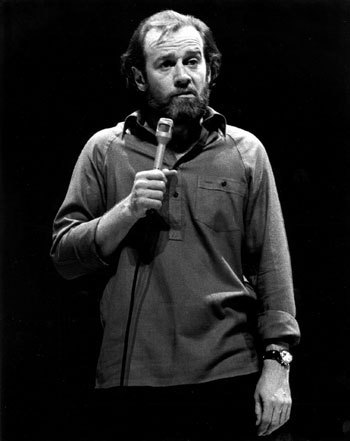
George Carlin, the great American comedian who died Sunday at 71, grew up a rabid New York Giants Brooklyn Dodgers fan* in Upper Manhattan. On October 3, 1951, according to Joshua Prager in The Echoing Green, Carlin, then 14, squeezed his black kitten Ezzard either for luck or out of tension while he listened to Bobby Thomson batting with the pennant on the line. When Thomson connected for The Shot Heard ‘Round The World, “Ezzard took off, thrown unwittingly toward an open window. The kitten clawed a curtain, clung on even as he swung out three stories above a concrete courtyard, and lived.” A wondrous day for Giants fans; an outstanding day for Ezzard. Courtesy of Baseball Almanac, here’s that very same New York kid on what makes baseball baseball.
Baseball is different from any other sport, very different. For instance, in most sports you score points or goals; in baseball you score runs. In most sports the ball, or object, is put in play by the offensive team; in baseball the defensive team puts the ball in play, and only the defense is allowed to touch the ball. In fact, in baseball if an offensive player touches the ball intentionally, he’s out; sometimes unintentionally, he’s out.
Also: in football, basketball, soccer, volleyball, and all sports played with a ball, you score with the ball and in baseball the ball prevents you from scoring.
In most sports the team is run by a coach; in baseball the team is run by a manager. And only in baseball does the manager or coach wear the same clothing the players do. If you’d ever seen John Madden in his Oakland Raiders uniform, you’d know the reason for this custom.
Now, I’ve mentioned football. Baseball and football are the two most popular spectator sports in this country. And as such, it seems they ought to be able to tell us something about ourselves and our values.
I enjoy comparing baseball and football:
Baseball is a nineteenth-century pastoral game.
Football is a twentieth-century technological struggle.
Baseball is played on a diamond, in a park. The baseball park!
Football is played on a gridiron, in a stadium, sometimes called Soldier Field or War Memorial Stadium.
Baseball begins in the spring, the season of new life.
Football begins in the fall, when everything’s dying.
In football you wear a helmet.
In baseball you wear a cap.
Football is concerned with downs — what down is it?
Baseball is concerned with ups — who’s up?
In football you receive a penalty.
In baseball you make an error.
In football the specialist comes in to kick.
In baseball the specialist comes in to relieve somebody.
Football has hitting, clipping, spearing, piling on, personal fouls, late hitting and unnecessary roughness.
Baseball has the sacrifice.
Football is played in any kind of weather: rain, snow, sleet, hail, fog…
In baseball, if it rains, we don’t go out to play.
Baseball has the seventh-inning stretch.
Football has the two-minute warning.
Baseball has no time limit: we don’t know when it’s gonna end — might have extra innings.
Football is rigidly timed, and it will end even if we’ve got to go to sudden death.
In baseball, during the game, in the stands, there’s kind of a picnic feeling; emotions may run high or low, but there’s not too much unpleasantness.
In football, during the game in the stands, you can be sure that at least twenty-seven times you’re capable of taking the life of a fellow human being.
And finally, the objectives of the two games are completely different:
In football the object is for the quarterback, also known as the field general, to be on target with his aerial assault, riddling the defense by hitting his receivers with deadly accuracy in spite of the blitz, even if he has to use shotgun. With short bullet passes and long bombs, he marches his troops into enemy territory, balancing this aerial assault with a sustained ground attack that punches holes in the forward wall of the enemy’s defensive line.
In baseball the object is to go home! And to be safe! — I hope I’ll be safe at home!
*It turns out George was a Dodgers fan then and Ezzard was tossed in disgust not delight, albeit with no harm intended to the cat. My apologies to Mr. Carlin for placing him in the wrong camp on that most momentous day. I guess I just wanted him to be retroactively happy.
by Greg Prince on 23 June 2008 5:43 am There, was that so hard?
Absolutely not, and that was the beauty part. Sunday's win was so simple, all its key elements simply described: more than competent pitching from the steadily progressing Mike Pelfrey, a trademark triple to lead off by Jose Reyes, an RBI single off the bat of David Wright, a Carlos Beltran bomb, nearly spotless bullpen work for 3-1/3 and Beltran's glove ending the thing.
There, there, there: Mets 3 Rockies 1.
That's all we want. That's all we need. Nice, simple wins, our guys outplaying the other guys.
Perfect game? Not necessarily, but you don't need perfection every day. You'd like to see Pelfrey last longer. You'd like to see a genuine rally. You'd like to see more runs tacked on.
Those, however, are challenges for other days, like the night before when Ubaldo Jimenez stymied the Mets between nearly inconsequential three-baggers and Pedro Martinez suddenly vanished into Denver's thin air. Games like Saturdays are simply horrible. They're excusable if they're once-in-a-while events, far less so when you've grown used to them being the rule over too much of 2007 and 2008.
But then comes Sunday afternoon and you don't feel so bad about Saturday night's extremely unenthusiastic and nondedicated loss because Sunday afternoon — even if it's the Rockies, even if it's just one game — has as much a chance to become the new normal as it does to stick out as an aberrant exhibition of quality baseball skills.
What does any fan want? Reasonably good baseball and a chance to think your team will make a go of it. That's general admission, that's all you can ask for. You can't ask for championships or playoff berths and expect them automatically. Just make July viable in our minds when it's the last week of June. And if July is viable, August can loom in the distance as vital. And if August is vital…
Well, you get the idea. Few are the teams and their followers who can count on anything. We were there a couple of years ago and, in hindsight, it was a privilege. But it was unusual, not just for us but for almost everybody. Having a chance, though, that's not too much to ask for. Being decent enough to have that chance…no, I don't think it's too much at all.
Seventy-four games have been played. The Mets have seemed mostly terrible and yet they're .500. They're Stengel-Stengel: 37-37. No need to defend the recent past or explain it away. It's done. They're on the borderline now. They're a game away from being a statistically satisfying enterprise. They're only a few feet from first place, which is probably not worth worrying over at this juncture except that it's good to know it's in sight. That's all you can ask to see, a generous glimpse of the goal, your eyes actually able to size up the prize. You can't drive yourself to distraction over 3-1/2 back when there are 88 to play. But you can indulge in the slightest schedule-studying and let yourself wonder.
• Twenty-two of the past 48 games have been played in California, Arizona or Colorado. That's it, though: no more trips west of Central time. The worst of the travel is over. In fact, only three series outside EDT remain.
• Seattle in for three starting tonight. The Mariners have the worst record in all of Major League Baseball, which means nothing to us. Washington has the worst record in all of National League baseball and anybody see us rolling over the Nationals this season? Felix Hernandez pitches for Seattle at Shea this evening, thunder and lightning permitting. Felix Hernandez coming to Shea in '08 could be like Johan Santana coming to Shea in '07 which, if you watched SNY's reportage on trade negotiations over the winter, you were reminded constantly was child's play for the visiting star pitcher. Just so happens we have Johan Santana on our side in '08. Santana vs. Hernandez tonight. It's a better proposition than Sosa vs. Santana last June.
• Subway Series, four games, including one in the hole of hell as part of a day-night kick in the head Friday. That requisite fatalism stated, it's the Mets and the Yankees. Except for 2003, that traditionally means anything could happen to or for anybody.
• On the road to St. Louis and Philadelphia, eight against the two best teams in the N.L. who aren't the Cubs. Proving grounds, to be sure. Mets gotta prove they're worth worrying about beyond July 7.
• Six at home with two nominal dregs, the Giants and the overly familiar Rockies. We're only recently and maybe momentarily nondregs, so I wouldn't get too haughty about it.
Point is the next 21 games up to the All-Star break are, in more than clichéd or obvious terms, the season. It's not so much that the Mets have to go 16-5 against the Mariners, the Yankees, the Cardinals, the Phillies, the Giants and the Rockies. I never, ever set won-lost goals for my team. It's silly to think in those terms, particularly in June and July. What matters is the Mets don't go 5-16, that they build on whatever momentum they seem to have stirred, that they play some more crisp Sunday-type games and play many fewer soggy Saturday-type games. The caliber of the opponents between now and July 13 varies almost evenly: three very good teams, three rather lame teams. Very good teams don't always trip up the Mets (theoretically, none of them is that much better than us), rather lame teams don't always lay down for the Mets (theoretically, none of them is that much worse than us).
This is a fantastic opportunity for us to see what our team is, if it's definitively stopped being an embarrassment on the field — we've seen too much of what they're capable of off it — and if it's capable of competing in the second half, at the very least capable of giving us hope for a viable July and a vital August. There is both a hint of light for the Mets now and an overwhelming cloud that hasn't fully dissipated. Let's not kid ourselves that we're over a hump. We're not. But we are at the hump. Given the depths with which this team has flirted since March 31, that's all you can ask for.
by Greg Prince on 22 June 2008 12:17 pm Bill Maher refers to the tendency to sit and watch a movie that you come across while flipping channels even though you own the DVD of it and can watch it any time you wish, as Shawshank Syndrome.
There's an even more insidious affliction emanating from your cable system. It's the tendency to sit and watch a movie that you come across while flipping channels, even though you've seen it plenty, you don't like it and you know you never will, yet you convince yourself that maybe if you watch it now, since nothing else is on, that it will somehow get better.
I call this Being Gung Ho For No Discernible Reason Whatsoever, named for the 1986 Michael Keaton film about what happens when a Japanese automobile manufacturer buys the economically endangered car assembly plant in a depressed Western Pennsylvania town. Part comedy, part drama, part social commentary, Gung Ho is total dreck. Its topicality has turned to datedness over two decades. Ron Howard's direction, featuring many nods to the MTV ethos of the day, is hamhanded, another victim of time. Keaton's appeal as a leading man is better covered by a cape and a cowl. His character, a Chevy Chase ironic wise guy but with a heart of gold, makes no sense in the context of his job, which is saving the factory, rescuing the hard-working, blue-collar men and women of his community, relating honestly to the Japanese executives and learning to grow. The cast includes a hodgepodge of the miscast: John Turturro, George Wendt, Mimi Rogers and Clint Howard. Put simply, every time I see Gung Ho — whose title is taken from a phrase that means, literally, “extremely enthusiastic and dedicated” — it gets a little worse…yet I'm somehow a little surprised that it's really as terrible to watch as it is.
But I sit and watch it more often than not, especially if, like last night, I'm sitting up with a nagging headache and, you know, there's nothing else on. Last night I caught about two-thirds of it, declared it a disaster, watched something else until (with my head still kind of bothering me) I discovered Gung Ho had started again on one of HBO's West Coast feeds. Then I watched the part I had missed earlier to determine that, no, neither the movie nor my head nor my judgment was improving.
Why we sit and stare at programming that is obviously and predictably dreadful, that we've seen too many times and that doesn't soothe our aching heads one little bit I'll never understand.
by Greg Prince on 21 June 2008 6:47 am There is nothin' like a honeymoon period, nothin' in this world. There is nothin' you can name that is anythin' like the glow of a team winnin' under an interim manager.
The Mets are now officially honeymooners, with the stars Jerry Manuel…John Maine…Carlos Beltran…and the 2008 New York Mets who — bang, zoom, straight to .500! — sit a mere 4-1/2 games from first place.
The Mets have pussyfooted around the break-even mark previously this year…all year, in fact. They've never been more than four games over it or three games under it. This morning they cool their heels right at it for the twelfth time in '08; thirteen if we count 0-0. It's not much of an accomplishment on paper for the Mets to reach .500. In spiritual terms, however, it's one giant leap for Metkind.
It's not about numbers at the moment. It's not about games out in the loss column (a trifling three) or position in the standings (an encouraging third) or watching the scoreboard (although that's exactly what I just finished doing as the Athletics harpooned the Marlins in eleven, meaning we picked up ground on them and the Phils and the Braves). It's about a feeling and a sense and a sensation that right here at good ol' .500 things are finally starting to look up.
It's the honeymoon, all right. A week ago, the Mets beat a so-so opponent 7-1 and as John Koblin assessed in the Observer, hardly anybody at Shea cared. All observers quoted in his article (including this then-at-the-end-of-his-Met-rope blogger) agreed this baseball team had problems that far transcended baseball games, even baseball victories.
A week later, the Mets beat a so-so opponent 7-2 and all seems marginally right with the Mets' world. If this baseball team has problems, none is so daunting that it can't be cured by a few baseball games, especially baseball victories.
Jerry Manuel has a .667 winning percentage as Mets manager and only a killjoy would point out that's a simple matter of 2-1. Manuel's winning streak is best expressed by acknowledging everything he's touched has turned to gold, everything he says is platinum. For instance, he's come up with a new batting practice regimen of fewer swings per player, taken on the road before the home team hits the cage. In the game that followed, his batters addressed the ball (hello ball…), scored five in the second and then tacked on a couple more later. Asked whether his BP philosophy and, by extension, his stamp on the team was truly taking hold, Manuel cracked a little smile and addressed himself directly to ownership. “Jeff, Fred,” he said, give me “three years” and he will surely make an impact.
That Jerry Manuel's one frisky sonofagun! Not to get caught up in already-stale comparisons, but can you imagine the previous manager of the New York Mets spouting anything but defensive clichés to explain why the Mets looked good out there tonight? We'd be told that that's what his guys do and they played the game well and he has confidence and zzzzz…
It's not the manager's job to entertain, but it doesn't hurt. It is the manager's job to motivate and innovate and articulate, and that's what really helps. Jerry Manuel's got this team playing hard and loving life. Didja see the inmates let out in the exercise yard…I mean the dugout before the ninth? Guys were up on their feet and slapping each other on the back and doing that thing where their mouths open and their teeth are evident but not in a menacing way.
Smiling! That's it! And the grins grew only wider a half-inning later when the 7-2 win was won. It was what we used to call a routine win but it was processed in Denver and through the television screen as much more. This team is waking up and discovering a) baseball doesn't have to be treated as Excedrin Headache No. 162; b) the mediocrity that predominated across April, May and half of June is neither inevitable nor irredeemable where the rest of 2008 is concerned; c) a game is called a “game” for a reason. These Mets right now are, shocker of shockers, kind of fun to watch, definitely fun to get behind.
But honeymoons are supposed to be fun. You're doing something wrong if yours comes off as work. Almost every interim Met manager, at least those appointed when there's been enough season left to salvage, gets one and usually makes a little something of it. The '75 Mets won the first two they played under Roy McMillan and Yogi Berra's replacement was instantly hailed as the new Gil Hodges. Joe Torre reeled off seven of eight in '77 after Joe Frazier was shown the door, the hallway and the parking lot. Hondo Howard goaded the '83 Mets into an 11-10 run. Dallas Green's charges went 5-7 after Jeff Torborg buried 1993 out of the box at 13-25; for 1993, 5-7 was the moral equivalent of 108-54. And let us not forget the patron saint of Met managerial switches, Harrelson in for Johnson, when 1990's 20-22 beginning was wiped away (after a 1-4 getting-acquainted spasm) by a 27-5 cyclone of winning, winning and winning some more.
None of it, not even Buddyball, lasted long enough to make a definitive dent in the schedule. McMillan, Torre, Howard and Green all guided their teams to indifferent or dismal finishes. Harrelson brought the Mets into September in first place, but he was outmanaged and the Mets were outplayed by Jim Leyland and the Pirates down the stretch. None of those other managers achieved anything of lasting value in a Mets uniform. Neither, unfortunately, did skipper Bud Harrelson. The feelgreat story of June and July 1990 dissolved into fractious backbiting by the second half of the year; the beloved sparkplug shortstop of 1969 was a managerial goner before 1991 was over.
(Fascinating aside from a Dave Anderson column I recently ran across in the Times from late September of '90: In comparing the strict and effective discipline of Hodges to the way Harrelson was getting regularly rolled by certain of his players, an old friend of Gil's speculated that if he were still alive and managing, “I don't think he would have tolerated Ron Darling's griping, especially when Darling wasn't getting anybody out.” I guess Darling's Sovereign Bank credo that “wherever I go, I make sure I'm comfortable” extends back to his attitude in the clubhouse during his Met twilight.)
The best, the absolute best we can hope for from Jerry Manuel is an adrenaline shot like the one Buddy administered to the uptight Mets of eighteen Junes ago, when the atmosphere needed cleansing, the air needed clearing, the manager who had come one game from a World Series two years earlier needed supplanting. Harrelson's Mets began to click in earnest on June 5, 1990 when the normally spectacularly useless Tom O'Malley blasted an eleventh-inning walkoff home run versus the Expos' Dale Mohorcic. That was the beginning of the streak that made Buddy Harrelson look like a genius. I thought of that particular adrenaline shot when Damion Easley took Justin Speier deep in the tenth Wednesday night. Easley's not spectacularly useless, but the Mets as a whole had been.
Until further notice in 2008, maybe not so much.
Reporters covering this team, naturally, want to reveal a trend. They want declarations. Every interrogator of Manuel after the game Friday asked, eventually, if we're witnessing the first signs of an authentic Met turnaround, adding the caveat — as if required by law to save them from sounding like impatient dopes — that “we know it's early.” Manuel said many smart things after the game (he used the word “permeate” which made the editor in me swoon), but the most intelligent instinct he displayed was not taking the bait. He's been manager for three games. The Mets have won two. Right now, he's a brilliant tactician and a beautiful mind. Of course he is. He's on his honeymoon. Let him enjoy it. Enjoy it with him.
And don't come a knockin' if his team starts a-rockin'.
***
By the way, though the Daily News quoted me accurately when they found me wandering out of the Mets Clubhouse Store in Manhattan (where I was just browsing) on Friday, I wouldn't go so far as to say I characterized the subject of this story as “a winner” or that I added to his “host of hoorays”. But at least it didn't quite come out as EVERYBODY LOVES YANKEE GREAT per the usual News formula.
by Greg Prince on 20 June 2008 7:55 am Welcome to Flashback Friday: Tales From The Log, a final-season tribute to Shea Stadium as viewed primarily through the prism of what I have seen there for myself, namely 371 regular-season and 13 postseason games to date. The Log records the numbers. The Tales tell the stories.
10/8/99: NLDS @ Shea Mets 9 Diamondbacks 2 SP-Reed
1-0 Mets lead series 2-1
I wondered one night in August of 1999, with the Mets appearing fairly secure in quest of their first playoff berth since 1988, if Shea would feel different once the postseason rolled around.
It had to be, right? But how? Would the ramps magically turn into moving walkways? Would ushers’ jackets get spiffier? Their pulse quicken? Would they expect a fiver to wipe a rag across your seat? Would you have to wait for an usher even if you knew where you were sitting?
These would be the playoffs. Shea would have to be different.
It was a mark of how well the Mets were doing and how often I was going that I dared to put these questions into play. It indicated surprising faith in a team that had blown a playoff spot the year before by losing its last five — I had tickets to what became phantom Game Four of the 1998 NLDS — and a sense that I would break through a barrier I missed the other four times the Mets reached the serious side of October: that I would get in.
I don’t know why I thought that. It wasn’t guaranteed. I wasn’t a season ticket or plan holder. I didn’t even buy a pack (six, seven, eight…I forget what they were up to by ’99). But I’d had such tremendously good luck getting into Shea all year. I went and I barely paid.
No kidding. I was Flushing’s Guest in 1999, more than happy to enjoy the hospitality of anybody and everybody who would provide me safe passage through whichever Gate would take me. Yet on the eve of the National League Division Series, I was ticketless.
That wouldn’t have been right. So the same fates that rescued the Mets from two out of the Wild Card with three to play, took care of it. One of my PR contacts in the industry I covered called me the Thursday night before the Friday night that the Mets-Diamondbacks tilt was to resume. Earlier in the season, I had jokingly (or maybe not so jokingly) asked if he could do something for me come playoff time. He went from being very good at his job to the best in the business when he told me he got his hands on his company’s box for Game Three, and he was overnighting them to me toot de suite. And it was very sweet.
Four tickets? Corporate box? I knew the seats. They were down the right field line. Orange. My first postseason Shea experience (unless we’re counting driving by on the Grand Central when nobody was inside) and it would be Field Level.
Wow!
I immediately contacted Jason and Emily, who had already secured us tickets for Saturday, and asked if they were in for Friday. They were now, they said. The additional ticket went to Chuck (who seemed surprised to get the nod, given that he wasn’t quite as pure a fan as me, but he’d been talking me through streaks and slumps for fifteen years). In the rains/pours way things have of working out, I got another call Friday morning. It was another PR guy, someone who had a pair for Saturday, not very good, but did I want them? No time to think I was being a glutton. I said yeah, knowing someone else in my rapidly expanding Met circle could use them.
In what world did Mets playoff tickets just fall into my lap? Mine, I suppose. In my world, too, I spent Friday afternoon dropping off a ticket here, picking up another two there, looking ahead singlemindedly to tonight, tonight, which would be not just any night.
It was the night of my first Mets playoff game!
It was different. It was different on the LIRR in from Manhattan. Lots of people. Loads of people. It was different outside Gate E where all were milling, where WFAN was giving out enough Let’s Go Mets! placards to do Casey Stengel proud. It was different in terms of the time. Rarely did I show up much before first pitch, especially after work. Tonight I was there to make sure whatever pregame ceremonies were to be taken in would get taken in. Jason and Emily had the same thought. Nobody would have to wait to meet tonight. We had a playoff game to get to.
It was different inside, too. The physical dinginess of the concourses was still dingy, but the bunting was everywhere once you stepped into the seating bowl. The crowds were filling in from top to bottom, from left field to right. The monitor by the food court (had to have my good-luck sushi) had on not some lame closed-circuit feed of Fran Healy testing his mic, but Channel 4. There was Bob Costas setting the scene from Shea Stadium for a national audience. Costas was on the field behind me. He was on TV in front of me. This was where it was all happening in baseball. This was the playoffs.
The playoffs were an event, and as such, attracted its share of phonies. Sitting next to us in our box was a party that seemed to have climbed out of a limo en route to the China Club or whatever spot was hot in 1999. The girl in the group was in a tank top (it wasn’t cold, but it wasn’t that warm), wore a cowboy hat and was guzzling Champagne. Yes, Champagne — plastic Champagne glasses of it. Don’t know how that got by security, but security wasn’t too tight back then. Not as tight as Champagne Girl would be after a few innings.
We got our buzz on from pregame introductions. One Met after another, even the Luis Lopezes and Billy Taylors not on the playoff roster, trotted to the first base line to be cheered. Mike Piazza, announced as out of action with a bad thumb that afternoon (how would we ever get by with Todd Pratt?), was encouraged to a speedy recovery. Melvin Mora who ran to home to get us to Cincinnati the previous Sunday was roared upon. Al Leiter, who secured us this night by what he did once we got to Cincinnati, was bathed in good cheer. Alfonzo and Olerud, they who buried all manner of Snake Tuesday, were returning heroes. Kenny Rogers, outpitched in Arizona, was forgiven quickly. WHACKING DAY banners and signs, homages to the Simpsons snake-beating episode, abounded. And fireworks…fireworks! After the national anthem, an in-house fireworks display was unleashed. Not a Grucci spectacular, mind you, but some flares sent skyward from out by the apple. I’d never seen that at Shea before.
Even Chuck arrived before first pitch. I hadn’t seen that too often lately.
The Mets’ October legacy, if we could recall far enough back to the previous four occasions on which the Mets made the playoffs, was chock full of tension and drama and nailbiting. Shoot, that’s how we got into the playoffs in ’99. Their first postseason home contest in eleven years, however, was no contest. The Mets rolled, the Mets romped, the Mets whacked. A little close at first. An early 3-0 lead was endangered when Rick Reed, who’d rather give up a Grand Canyon home run than walk anybody, allowed Turner Ward to go deep in the fifth, cutting it to 3-2. But before we could so much as clear our throats in anxiety, the Mets busted out the whacking stick. Walks and singles, singles and walks…a base-by-base attack to make a mockery of Arizona relief. Once the dust cleared in the sixth, six had scored and the Mets led 9-2 and the issue was in no doubt whatsoever.
Our box was delirious. So — this was the playoffs: we show up, we’re on Field Level, fireworks go off and the Mets lead by seven. Being in the playoffs, I decided, beat the ever-livin’ snot out of not being in the playoffs.
Amazingly, the crowd began to thin in the seventh and eighth and ninth. Champagne Girl and her enablers bopped out early. We were stunned. “I’ve waited all my life for this,” Jason said. “I’m not gonna miss a minute of this.” Same here. We were there to the delightful end, when Orel Hershiser (say, didn’t he pitch the last time the playoffs were at Shea?) retired Steve Finley, Lenny Harris and Kelly Stinnett to seal the 9-2 deal.
More fireworks from beyond the outfield fence. Nothing, not a damn thing, was anticlimactic about winning 9-2 and edging to within one game of a date in the next round. If the Mets wanted to win their way to the World Series by whacking the opponent this efficiently, they could be our guests.
by Greg Prince on 19 June 2008 4:00 pm Life is too short, time is too precious and the stakes are too high to dwell on what might have been.
—Hillary Rodham Clinton
Yesterday's news, literally, was the Mets' stirring comeback win against the Angels…that's yesterday as in Pacific time, though as I heard somewhere time of day is strictly a matter of perception. Gary Cohen called the extra-inning triumph the biggest win of the year. I'm fairly certain the Mets have collected the biggest win of the year about a half-dozen times in 2008, yet it's unlikely that each simply outshone all of its predecessors and we know for sure that none of them had any legs in terms of what came next. I have no idea whether Mets 5 Angels 4 in 10 was the biggest win of the year. Let's take the Bobby V route and say it was since it was the only game they played Wednesday and today is Thursday.
I hope those were some signs we saw, not just another aberration amid the mediocrity. Wright reaching out and touching K-Rod was a great sign. Wright reaching out and foiling Kendrick — give that man a Gold Hand Award! — was a fantastic sign. Reyes and Easley you can figure out for yourself, signwise. Endy regains his Endyness the more he swings, which is gratifying from a good ol' Endy perspective but really a godsend considering that this batting order, dominated by bench guys and castoffs, looks like something out of 1943. Whatever their merits as hustlers and gamers and, for a night, achievers, it's tough to monitor a procession in which Anderson, Nixon, Easley, Chavez, Castro and Tatis are prominent and not think, “The healthy guys are off to war, these must be the 4-Fs.”
The best sign of them all was watching Oliver Perez endure his standard awful inning and being left in to deal with it. No disrespect to the departed Rick Peterson, he whose jacket was stripped in the conversion to Tuscany tile, but I was thrilled that New Pitching Coach Dude (still trying to learn their names) didn't spend a lot of time pouring ketchup on Ollie's ice cream and that Jerry Manuel didn't pull Perez after the usual inning from hell. Ollie and the Mets survived the Angels' four-run fifth. Maybe it was the DH being in effect, but Perez coming back for a 1-2-3 sixth felt more solid than hardwood flooring. Giving your starter some rope and showing your starter some faith is the way you can manage the game when you're not scared for your job. You make the starter pitch and you don't run through relievers like Skittles.
Damn, it feels good to be a gangsta.
The Angels, though it was hard to notice amid the Sturm und Drang that surrounded this series, are a swell team to watch, rightly praised by Gary and Ron for their aggressive, loosey-goosey style of play. It doesn't take much to convince me the Angels are a quality outfit. They're my nominal favorite American League team since 2002 and Vladimir Guerrero is the only opposing player who puts me in mind of what it was like to watch Hank Aaron when I was a kid. You didn't want Hank Aaron to beat you, but if he did, so what? He was Hank Aaron. I used to refer to Vlad as The Greatest Player Who Ever Lived in deference to the overwhelming hype he received at every at-bat. I wasn't, however, being ironic. I'd prefer he not beat us, but Vladimir Guerrero doing so almost doesn't bother me. There's nothing not to like about him and he will carry no asterisks en route to his Hall of Fame election.
OK, so I consider the Angels a team that hovers above us mere mortals, but that's not my point here. My point is the way they play the game, the Bingo Long zest and all that? If the Mets tried it and got thrown out trying to take extra bases as often as the Angels do, we'd hear without end what unprofessional morons the Mets are. LAA's a perennial contender and Scioscia is as stable leading his team today as he was placid hitting demoralizing home runs against our team twenty years ago and they must be doing many, many things right out there by I-5. But if the Mets were pissing away baserunners the way the Angels did when Willie Randolph won his last game and when Jerry Manuel won his first game, whoever was managing the Mets would be skewered to within an inch of his professional life. Or worse, fired in the middle of the night…since it's always the middle of the night somewhere.
Speaking of he whose shove-off came to light in the wee small hours of the morning, Willie Randolph seems to have led the Mets about as long ago as Salty Parker did, doesn't he? Talk about yesterday's news. On SNY's SportsNite, after a recap of the Mets' rubber-game win, there was a piece on Willie's Side of The Story, essentially how Omar's version of events is full of it. I tend to believe Willie in this latest tapping of the hoary sitcom dueling-flashback device (“you should get down on your knees and thank your maker for a friend like Omar!”), but I tend to believe with much greater fervor that I'm no longer interested in Willie Randolph. As in the case of Peterson, there's something invigorating about not having Randolph around. When his picture shows up on TV or in the paper, it's a downer. It's a reminder of all that went wrong. It's a shame, too, because of the good he did when he did it, but I don't think I quite appreciated how badly this dugout needed a change. As faintly unsettling as it is to stare at these mysteriously appearing coaches and, to a certain extent, Manuel as manager because I'm just not used to seeing them in their newly assigned roles, I'm fairly grateful that what was no longer is.
I can only dream of how special it will be when there's a new GM.
by Jason Fry on 19 June 2008 6:31 am On Tuesday night you had to give the Mets a mulligan, however many they've asked for already this year — they've played like the manager got fired at 3 a.m. on more than a few nights already, but on Tuesday night it was actually true. As various Mets botched grounders and failed to cover bases, we were left to hope that Jerry Manuel's unhappy first minute of on-field managerial duties might be a blessing in disguise, that his showdown with Jose Reyes and Jose Reyes's Petulance might get the attention of Jose and set an example for his teammates.
It was a faint, forlorn hope — but maybe, based on a sample size of one night, not so far-fetched.
Reyes said the right things last night and played like his hair was on fire tonight, lashing balls around Anaheim, swiping bases, playing mostly heads-up defense, and getting a key read on a K-Rod slider in the dirt when he didn't feel confident enough to get a big lead against the Angels closer and his hellacious arsenal. Fernando Tatis was shredded by K-Rod, and with two outs up stepped David Wright — the same David Wright who's been grinding his bat to sawdust of late. Now, if K-Rod threw that identical slider — low and away — to Wright 100 times, he'd probably miss it or tap it to the infield 95 times. This, though, was the time Wright somehow pulled it into left field for a run-scoring hit, causing K-Rod to have a mini-tantrum of his own and leading to that strangest of Met-related emotions: confidence.
Somehow, in the bottom of the 10th, after Damion Easley's bolt off once-upon-a-time Paper Met Justin Speier, I wasn't worried. Not when Howie Kendrick hit an evil spinner to lead off against Billy Wagner — Wright somehow stopped the spin dead with his bare hand and gunned Kendrick out at first. Somehow I wasn't worried when Vlad the Impaler stared out at Billy. Between the beard creeping up his cheeks, his liberal coating of pine tar and his dull, dangerous stare, Vlad looks even scarier than he did when he was an Expo — has he been living under a bridge for the last few years? But no matter — Billy got him to hit a harmless flyball. Somehow I wasn't worried when Torii Hunter stepped in, even though he'd done a number on old pal Johan Santana last night. Billy struck him out, and for a moment all was … not well, exactly, but certainly better.
Let this be the first day of the rest of 2008, boys. Let baseball be fun. Let it be.
|
|






