The blog for Mets fans
who like to read
ABOUT US
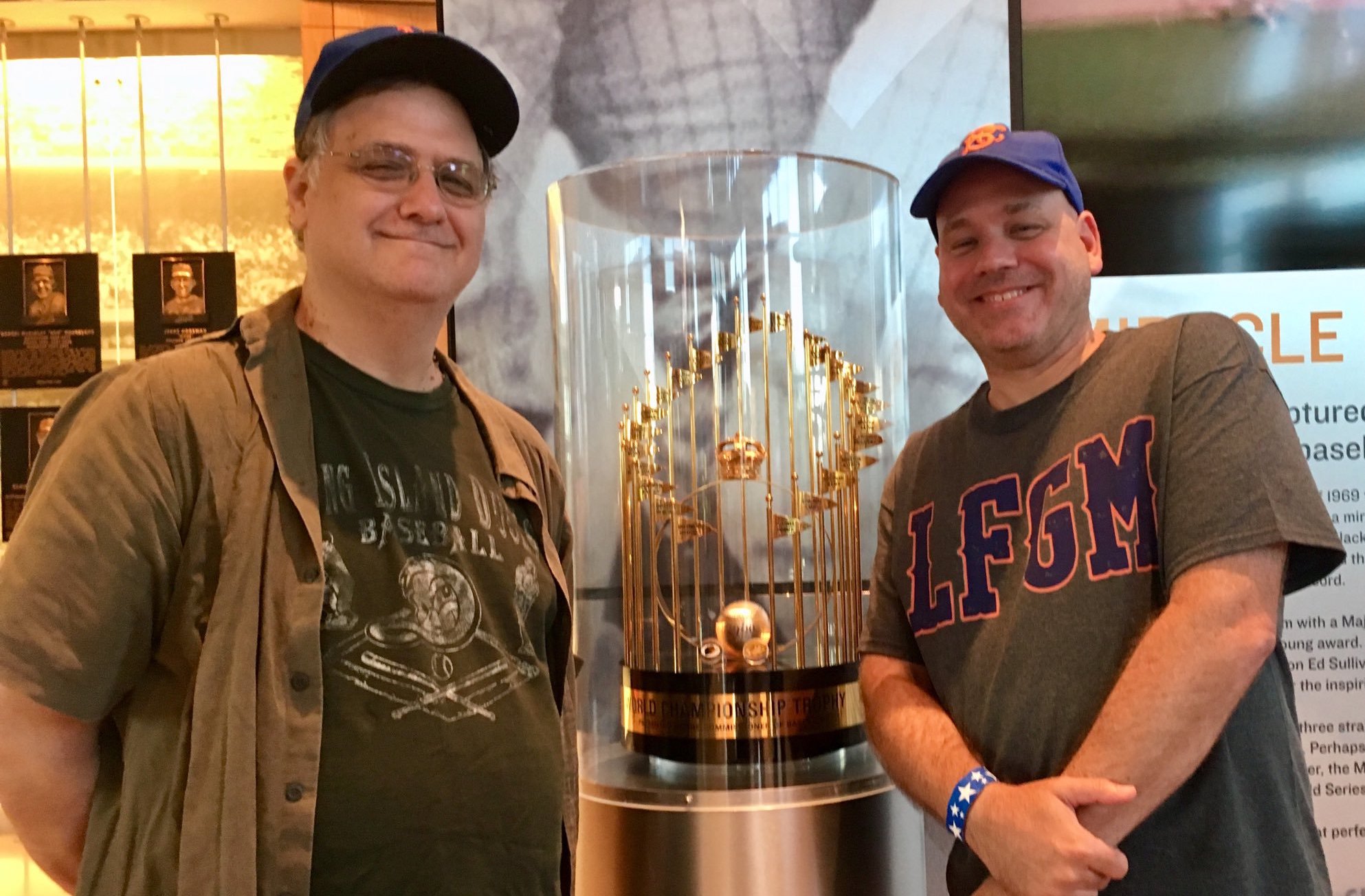
Faith and Fear in Flushing made its debut on Feb. 16, 2005, the brainchild of two longtime friends and lifelong Met fans.
Greg Prince discovered the Mets when he was 6, during the magical summer of 1969. He is a Long Island-based writer, editor and communications consultant. Contact him here.
Jason Fry is a Brooklyn writer whose first memories include his mom leaping up and down cheering for Rusty Staub. Check out his other writing here.
Got something to say? Leave a comment, or email us at faithandfear@gmail.com. (Sorry, but we have no interest in ads, sponsored content or guest posts.)
Need our RSS feed? It's here.
Visit our Facebook page, or drop by the personal pages for Greg and Jason.
Or follow us on Twitter: Here's Greg, and here's Jason.
|
by Greg Prince on 30 May 2008 4:00 pm “It was out of my reach. What do you want me to do — dive for it?”
—Roger Dorn, Cleveland Indians, 1989
“I'm not going to dive just to dive. If I think I can reach it, I am going to dive. If I don't think I can catch it, I am not going to”
—Carlos Delgado, New York Mets, 2008
And in the sixth fourth inning of the third night of the rest of our lives, Carlos Delgado dove. He left his feet. He flew until he landed in dirt. And he caught something in his glove.
Could it be…? Was it really…?
Yes! A baseball! An official Major League baseball, autographed by Allen H. Selig, tattooed by Jeffrey F. Kent Andre E. Ethier, zipping toward the Right F. Corner.
It was stopped cold by Carlos J. Delgado.
The “J” stands for Jumpin' Jehosephat, He Gloved That!
Kent lined Ethier grounded to Delgado in the sense that Long Island Rail Road trains are declared to be operating on time as long as they're not six minutes late, the way that the Mets “draw” 45,000 on frigid Monday nights in early May for the Nationals. You could make a case that Kent lined Ethier grounded to the general vicinity of Delgado, but that would be akin to approximating paid attendance based on tickets sold (or printed). Let's say Kent's liner Ethier's bullet of a grounder was on the express track and Delgado seemed, as ever, to be loitering on the local platform, looking at his watch, fiddling with his PDA, calculating how much longer it would be until his time with the New York Mets is up, or perhaps checking his bank balance — which we assume is more liquid than his movement around first has been fluid.
But maybe we're thinking of the Carlos Delgado who used to play here, the one who started at first base no matter how little he did to rate it, the one who stubbornly stood his ground while the ground shifted under his tired feet, the one whose batting average has been tied firmly to the tracks by some Snidely Whiplash of a slump or, more likely, a perilous decline into physical dotage. He may as strong as a bull and as able as an ox where as compared to your run-of-the-mill 35-year-old, but he hasn't looked a damn thing like a baseball star for nearly two years now.
That Delgado was earning no curtain calls and no discernible percentage of the balloon payment the wicked Florida Marlins cleverly inserted into the final year of the contract they long ago pawned off on the New York Mets, long before they would ever have to pay the $16 million he's due through '08 (to say nothing of the $4 million in chump change the Mets will have to dispense unto him just to not hand him $12 mil on top of that in '09). That Delgado was the starting first baseman 'til Tuesday.
Tuesday he was no longer that guy. He got the night off, to “clear his head,” it was said. Cleared the batting order of its most obvious dead wood as well. The Mets got on without him on Tuesday, and it worked so well, they tried it again Wednesday. It's quite possible his head was cleared just fine Tuesday, so fine that it began to fill up with miff. Those pesky SNY cameras occasionally caught him appearing none too enthusiastic that the Mets were going toe-to-toe, lung-to-gill versus the first-place Marlins and that he wasn't a part of it all. When he got his opportunity, pinch-hitting in a tie game in the ninth, he worked out a walk. He was the winning run, in the event of a homer or a triple. Anything less, and he'd be six minutes late to the plate.
Willie Randolph didn't pinch-run for him, not until another walk pushed him to second. The manager didn't have a surfeit of bench players at that point; in fact, he had none. So he did what you do when you've decided the run on second is too important to waste and the runner on second is too slow to count on. You insert a pitcher to run.
At that development, Carlos Delgado did not evince amusement.
John Maine, whose speed remains the best-kept secret in Metsopotamia, trotted out to second. Delgado turned to trot to the dugout. I've seen pinch-runners trot to bases forever. I've never not seen the runners they're replacing not give them a courtesy slap of the hand. That's the spot when we're all in this together, we're all a team, we all want to win this thing right now — godspeed fleet o' feet substitute…and run! Run like the wind! Make us all winners!
There was none of that standard bonhomie from Carlos Delgado for John Maine. Delgado wore an expression of he's taking me out for a bleeping pitcher? You've GOT to be kidding me. I couldn't tell whether Maine offered his hand only to have it rejected, but I could see Delgado proffer a pat on the back. If a pat on the back could be characterized as condescending, this one could.
Nothing came of the switch. The inning ended on a flyout. Three innings later, the game ended on Fernando Tatis' double. Most of the Mets mobbed their freshly minted hero of a teammate. How could you wear a Mets uniform and not be thrilled at what Fernando Tatis had just done? How could you not be thrilled for Fernando Tatis? What else do you play baseball for, besides an enormous paycheck, if not for twelfth-inning, double-comeback, walkoff wins?
I'm told Carlos Delgado was not spotted in the dogpile. I have to admit I wasn't looking for him. At that moment, I was in the warmest Mets frame of mind I'd been all season. Maybe it was just coincidence that Carlos Delgado was nowhere in the picture.
Delgado used to make me happy, or at least the idea of him did. The 38 homers and 114 runs batted in with which he introduced himself helped not a little, but the concept of Carlos Delgado charmed me as much. He was what we lacked in one shiny-pated package: the big bat, the cool head, the burning desire, the thoughtful slugger, the leader for this new generation of Mets. His first April was prolific and promising: 9 HR, 20 RBI, one of the best team starts the Mets had ever experienced. Coincidence or Carlos? I was intoxicated by what Chris Smith wrote late in the spring of 2006 in New York Magazine:
Martinez is the most compelling personality and the Mets’ one indispensable player. But Delgado is the connective tissue. His arrival has relaxed his old pal Beltran and matured the endearingly spacey Reyes (Delgado has also choreographed an elbow-bumping post-homer dance routine with the 22-year-old shortstop). “There are some guys who carry the load, guys that lead the group,” Delgado says. “And most of the time, the media has it wrong. Because you don’t have to hit .300 to be that guy. I don’t get caught up with that bullshit, about what makes a great leader. Because if you have to ask, you just don't know.”
Wright is a human run-on sentence. Delgado is a meticulously edited series of bullet points. Yet the two men instantly gravitated toward one another, meeting for the first time as teammates during a midwinter Mets promotional appearance.
“The middle of January, guys are normally taking vacations,” Wright says. “But we’re in suits at a team dinner in New York and Carlos has about half the team huddled around him and he’s talking hitting, he’s talking different pitchers, he’s talking who he likes to face, who he doesn’t like to face. In the middle of January! I must have talked to him, from the beginning of spring training until now, like, hours, just what he thinks about. ’Cause he’s a run producer, he’s an RBI machine.”
Good god, Carlos Delgado could hit and he could talk and he scribbled notes in a notebook after sending baseballs far over fences and he was revered and the Mets were in first place from the third game on and the opposition twisted itself into shifts to stop him but Delgado didn't get caught up with that bullshift either. His average was down from prior years, but his power was present. He hit in spurts more than he did steadily, but the stats piled up handsomely and the wins followed. On the night the Mets clinched the division title, I spied some giddy rookie type dumping beer on the head of Reyes or Wright out on the field during an interview. Was that Anderson Hernandez? No, the culprit here had no hair. Was that Michael Tucker? No, Michael Tucker's head isn't as big as the one I saw.
Hey, that was Carlos Delgado! That was Carlos Delgado romping around like a September callup, caught up in the magic of a team celebration! When it came to going to postseason, Carlos Delgado really was a giddy rookie.
A few big hits notwithstanding since 2006, there's been little giddy or joyful about Carlos Delgado. Not his play, not watching it. His team became a leaderless, rudderless vessel. You might not have to hit .300 to be That Guy, but how would have Delgado known prior to 2006? The dude had hit over .300 three times, .301 in 2005. In 2007, it took him 'til the middle of July to crack .250. He never rose much above it. His pop went poof. And on the final, gruesome day of the season, a season when a wrist, a hip, a knee and an elbow all required some kind of attention, he took a Dontrelle Willis pitch off his left hand. The hand, like 2007, was fractured.
“I think at times we can get a little careless. We’ve got so much talent I think sometimes we get bored.”
Carlos Delgado could have said any number of things last September. He chose about the worst words he could have imagined to explain away a team sliding quickly into infamy. As inspirational diatribes go, “sometimes we get bored” fell well short of “we shall fight on the beaches, we shall fight on the landing grounds, we shall fight in the fields and in the streets.” The Mets didn't fight in the fields. The Mets surrendered. Carlos Delgado may have been flattened at the very end by an onrushing D-Train fastball, but he wasn't exactly leaving the impression that he and the Mets were to be mistaken for a herd of Dashing Dans.
The 2008 Mets had been running way more than six minutes late through Monday. Those were Carlos Delgado's Mets as much as anybody's. Carlos Delgado was morphing fast, from connective tissue to careless, bored, used Kleenex. His production had sunk to George Foster rhythms; he couldn't do much, but the occasional longball allowed you to rationalize he could still swing it now and then. Winning without him in the lineup and then seeing him trudge to the plate as a miscast pinch-hitter in the ninth made you squint at the specter of the last days of Dave Kingman, Kong rendered obsolete and ever grumpier by the acquisition of Keith Hernandez. Alas, there is no Mex in the hopper to take over first, Damion Easley's versatility and classy professionalism notwithstanding. Now you just hoped you weren't watching a heretofore quality human being and baseball player sulk himself into a 1999 model Bobby Bonilla lummox. In business, you can manage a brand in decline. You can stick the six-packs of Royal Crown Cola on the lowest shelf and give its space to an energy drink that sells better. RC won't stew on the bench, grumble in the clubhouse, suggest to Jon Heyman that they are on the cusp of an old-fashioned West Virginia ass-off. That's not a contest anybody wants to contemplate.
Two nights benched, save for a cameo snit. Two wins without him…the opposite of what Branch Rickey said to Ralph Kiner where last place was concerned. We could go to pieces with Carlos Delgado or we could begin to get it together without him.
Maybe Carlos Delgado, head cleared and inserted again at first, finally figured that out. Because Carlos Delgado, he dove for Jeff Kent's liner Andre Ethier's bullet of a grounder in the sixth fourth last night. Even with the bases empty, a tenuous 2-0 lead, built on Wright power and awaiting the benefit of opposing catcher's interference, needed all the help it could get to keep Claudio Vargas' goose from being prematurely cooked and to keep the newest era of Met good feeling from dying at the tender age of two days (as eventually we'd be positioned, per usual, to fall victim to the status Kuo).
But Carlos Delgado dove. And Carlos Delgado caught Kent's liner nabbed Ethier's grounder and hoofed it to first for the forceout. And Carlos Delgado got his uniform dirty in the effort. It grew only grimier as he attempted and just failed to beat Russell Martin to the bag for the double play on a liner off the bat of Jeff Kent — among the oldest and sharpest of Shea thorns, dating back to his appearance amidst the primordial ooze of 1992 — in the sixth. That he rolled through the muck to try as hard as he did felt like a moral victory, nearly as satisfying as the actual one that proceeded from there. SNY picked up Willie Randolph gesticulating like Bobby Valentine, as alive as I've seen him in his four years as manager of the New York Mets. “I like it when he gets dirty,” Delgado's manager said after the game. “His uniform has been pretty clean lately.”
Yeah, I'd noticed. Everybody noticed. Howie Rose remarked a week or two ago how he hadn't seen Carlos Delgado leave his feet all year. Pretty clean uniform he's got there, Wayne Hagin concurred. Delgado owns nine pages in the Mets media guide. None of them are devoted to exploits of fielding or running, but it's safe to assume you don't compile nine media guide pages and endure into your sixteenth big league season without at some point giving it your all, without caring like crazy, without getting your gosh darn uniform dirty once in a while.
We're aware that you were brought here for your bat if no longer so much for your intangibles. We're aware that one joint or another has given you trouble on and/or off for three seasons. We know that you'll be 36 in less than a month. We sympathize, to a point, that pride goeth before accepting a platoon. And we understand plenty that bending over gets more difficult with age, that diving for the sake of diving is often tantamount to show.
But Carlos, yes — sometimes we do want you to dive for it.
by Jason Fry on 29 May 2008 2:00 pm Around here we usually do a night-of recap and a next-day amplifier. But some games demand not just one but two recaps — particularly when you're getting Faith and Faith, with Fear skulking around somewhere in the dark waiting for its turn again. Last night's is one of those games — because who wouldn't want to relive this one an extra time or two?
In 2006, Fernando Tatis was dividing time between the Ottawa Lynx and the Baltimore Orioles. But tonight's bolt of heroism would fit perfectly if spliced into the Met highlight tape from that glorious year. Think of it as Baseball Like It Used to Be — and, of course, as we dream it could be again.
Oddly, I had a feeling early on that tonight would be different. I can't tell you if that's because you could truly feel something different at work at Shea, if I was just sick and tired of being sick and tired, or if an absent-only-physically cat was pawing up something special. But whatever the reason, clearly things were going to be slightly crazy — I have trouble recalling a game with so many balls hit like rockets for outs and outta-heres, from Cody Ross's Piazzaesque blow beyond the bullpen to the surface-to-air missile fired by Jacques Jones and caught from behind by Carlos Beltran, not to mention assorted smashes by Beltran and Luis Castillo and frozen ropes that have thawed out of memory.
Normally — by which I mean “in 2008” — I would have sunk into the couch as this game assumed a depressingly familiar shape: Oliver Perez shows some electric stuff but is erratic and gives up the lead, Mets go to sleep, Heilman scrubs the lipstick off the pig, people get booed, last Met in the clubhouse had to talk to the pesky media and turn off the lights. Yeah yeah, I've read that script. But for some reason I stayed upbeat — and for some reason the Mets rewarded that faith.
The much-maligned bullpen did its part by tearing up the depressing script before I could flip any further: Schoeneweis was good and Heilman was great, with a superb fastball and change, good location and a rather un-Heilmanlike stomp as he went about his business. And you know what? It's nice to not have that be the point of this recap — that OK, we lost but Heilman had a great outing and the fans got behind him, so maybe that's the start of something. Not that that wouldn't have been true, but it would have been awfully cold comfort for losing a series to these upstart Marlins. Endy — ENDY! — changed that with a low fastball golfed to right to tie the score, and then it looked like the Mets might reward Heilman with a win, a win that might have come with a slapstick coda as David Wright singled in pinch-runner John Maine and assorted large excited athletes tried to remember to celebrate without dogpiling a precious starting pitcher. (They're made of glass, donchaknow.)
That ending wasn't to be — it was Long March time, to an hour, an inning and a conclusion undiscovered. But hope was still along for the expedition. Billy Wagner came in (in a non-save situation) and looked superb. Duaner Sanchez, whose nice comeback story is shadowed by his ominously inconsistent velocity, pitched awfully well for five hitters but then got his head turned around by Alfredo Amazega, the Anti-Endy. Yet somehow hope still wasn't dead. There was magic in the night still to be tapped. No, with one out and runners on first and third Fernando Tatis wasn't going to roll one to Hanley Ramirez and slam his helmet to the ground after just getting doubled up as the young Fish congratulated Justin Miller for cheating the hangman. No, he wasn't going to hit an ankle-high screamer into Wes Helms's glove and watch in dismay as Wright was trapped halfway between third and a home plate he'd never reach. Not tonight. No, he was going to hit the game's final rocket down the left-field line, then still be digging for third (in case Beltran was nailed at the plate) when this one was put in the books.
When SNY replayed footage of the happy pile of Mets that briefly formed atop Tatis, I leaned closer: Who was the guy who'd wound up second from the bottom, giving Tatis some gleeful pounds? Oh, it's Sanchez. That's right, he looks completely different without his goggles. I didn't recognize him at first, just as I needed help getting reacquainted with the gritty, gutty pay of the last two nights. But I could get used to both sights.
by Greg Prince on 29 May 2008 3:46 am 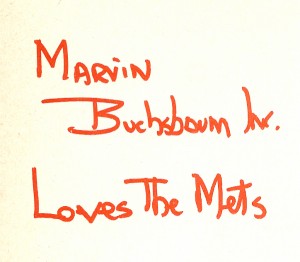
Dozens of advertisements urged on the Mets en route to their championship in the 1969 World Series program, but only one looked like a notice placed by a proud parent in the Playbill for a high school production of Bye Bye Birdie (which, come to think of it, was the unofficial theme of that Fall Classic). I was given the ’69 program a dozen or so years after the fact and have always been intrigued by the quarter-page ad Marvin took out. Was he real? Was he a superfan without portfolio but a little cash to burn? Was he a fictional character? Was Marvin Buchsbaum, Jr. really invented to sell Right Guard? I’ve never known. It’s never mattered. It’s just nice to see such unqualified support.
by Greg Prince on 29 May 2008 3:19 am Tuesday night, the Mets' 162-game gully of godawfulness dried up on a winning note. The oft-cited record from May 30, 2007 forward concluded at 79-83.
Old news. New season from here on out.
The Mets are 1-0 as of Wednesday, May 28. Yeah, officially we have to graft it onto the 24-26 start and we have to make up some serious ground and we have to hustle and scrap and ignore our immediate past and forget the suffocating, invalidated hype and, in best Metlike fashion, hope for the best. But we know how to do that.
We're off to a wonderful start where that's concerned.
Right through the limp loss of Monday night, defeats in progress this season were numbing me, as in, well, that's the way the cookie crumbles, and the Mets' cookie was half-baked anyway. Not tonight. Tonight I would have been very sorry to have seen the Mets lose. More sorry than usual. Actually hurt by it because, gosh darn it, these boys deserved to win this one.
And they did! They did!
Ollie pitched better than three homers allowed would indicate. The bullpen was magnificent, even if Alfredo Amezaga, wearing No. 4, channeled Yadier Molina and eerily silenced Shea in the top of the twelfth. But the Mets, these Version '08.2 Mets, they punch back. Endy punches back with a homer of his own. Duaner never stops punching, whether bunting or pitching. And my main man Fernando Tatis punches most effectively of all, doubling home the tying run, doubling home the winning run. Tell me he's not happy to be here.
Castillo contributed. Reyes contributed. Beltran contributed. They're supposed to contribute, that's their job, but why does it suddenly all look so…contributory now? Why does this feel like a team in a way it hasn't until the very end of May? I don't know. Can't all be Tatis, Easley and Castro. Can't all be the return to Major League status of Schoeneweis and Heilman. Can't all be the 24 hours it took for whatever whoever said to Willie to kick in. Or maybe it could be all that and more.
Will it last? A couple of weeks ago, I skipped giddily from the first Subway Series scattering tales of 1985 and all the momentum that was there for the reaping. None of it was garnered. We'll see. That's all we can do. The Mets, it seems, will play. That's all they can do.
I'll watch. That's what I always do.
I'd be remiss in my own heart if I didn't mention Tuesday was the third anniversary of the passing of my beloved Bernie The Cat. For the fourth consecutive year, we found ourselves playing the Marlins on May 27. For the fourth consecutive year, the Mets beat the Marlins on May 27. For the fourth consecutive year, the Mets took the May 27 series against the Marlins. Never doubt, regardless of whatever Florida's got going on this season, that if it's Bernie versus the Marlins, the Fish don't stand a chance when a hungry cat is prowling about.
by Greg Prince on 28 May 2008 8:06 pm Postgame interviews after a Mets loss are the baseball equivalent of snuff films. I don't see how anybody could possibly enjoy watching them. After a win, especially when winning is typical Met behavior, they're white (or Wright) noise. Yes it was good to get a pitch I could handle. Yes it was good to make that play. Yes it was good for the team to play well.
Yes, it would be good to see what's on other channels.
But now that Mets wins have grown as rare as the Kissing Lincolns penny, I find postgame sitdowns and standups a valuable insight into the souls of those I live through. Free of the strain of deciding whether every word they utter will reflect badly on them or their desire to save (or destroy) Willie Randolph's job, they can just talk about baseball. And who doesn't like to talk about baseball?
I caught two of the stars of last night's game in their afterwards utterances last night. First, there was Johan Santana, sitting before the wall of floating logos that befits the thoughts of superstars and barely employed managers, the left side of him wrapped in enough ice to make it appear as if he took a break from donning his Michelin Man get-up for the team costume party (it was enough that the Mets came to the park disguised as competent). Johan gets the press conference treatment because it is assumed there is an overflow audience straining to hear his every thought.
I keep waiting for Johan Santana to say or do something that requires a briefing room. He's affable, all right, as affable as he's been generally effective. On the starting pitcher personality chart, he's well north of Kris Benson (we know who wears the personality in that family) if miles south of Pedro Martinez (but who isn't?). He can be as dull as a drain pipe off the mound as along as he's cool as a cucumber on it. Last night's game required length and gut. He demonstrated both, culminating in the seventh-inning strikeout of Dan Uggla that thwarted the second-to-last best hope of the first-place Fish.
So what did he have to say about his triumph? I have to be honest, I don't remember. It was indeed affable in tone. It came in complete sentences, which athletes don't always dispense with ease. It seemed thoughtful. Johan looked comfortable taking questions and issuing answers. We're at a point when we're grateful that the wealthy young men in our midst don't curse out their interlocutors. Hey, he's a not bad guy AND he pitches for us! I don't think Santana would do that. He was booed a little in his first Shea start and concealed his contempt reasonably well, which was a good sign. Johan Santana seems sane and centered enough not to threaten to show any reporters his condo, languishing nowhere near the level of solipsism it takes to declare that they pay him to play baseball, not to think (even if Johan's batting average is slightly higher than Carlos Delgado's). He might not permit Pat Jordan to drive him to Shea as Tom Seaver once did, but we live in a different era from 1972.
I don't know what $137.5 million dollars is supposed to buy you these days when starting pitching statistics have been devalued so immensely. The suck-it-up three-run, eight-hit, seven-inning start as the moral equivalent of a complete game shutout is unrecognizable to anyone who remembers Tom Terrific completing 13 games in '72 and being gently admonished for not turning in a typically terrific Tom year. Getting on Johan Santana for being basically a pretty good Koosman to date (and Koosman was pretty good) is counterproductive. It's akin to considering the price of gasoline today and placing it in the context of C. Montgomery Burns calculating the purchasing power of a nickel:
A nickel will buy you a steak and kidney pie, a cup of coffee, a slice of cheesecake and you still have enough left over for a newsreel and a trolley ride from the Battery to the Polo Grounds.
That was then. This is 2008. In 2008, Johan Santana's seven innings are worth their weight in J.R. Watkins Apothecary Liniment (it's what Johan uses).
Not getting quite the roadblock coverage his Santanac majesty merits were the postgame thoughts of Fernando Tatis. Tatis was almost as much the reason the Mets ceased to lose last night as Johan was: a two-out RBI single in the first; a two-out RBI single in the fifth. The difference in the game was two runs. You do the math.
Fernando Tatis once walloped two grand slams in the same inning. That's about all I knew of Fernando Tatis when the Mets signed him to an obscure minor league contract in 2007 (he walloped them off Chan Ho Park, which was about all I knew of Chan Ho Park when the Mets signed him to the same type of deal around the same juncture of the same spring). The universal reaction of the snarky fan whose team signs a Fernando Tatis, a veteran who has slipped undetected from the earth's face, is we're screwed if we actually have to depend on him at some point this season. In Metsland, the secondary reaction was they can't keep Fernando Tatis over Brady Clark, they just can't.
They didn't. Brady Clark was here. Now he's gone. He left a hole on the bench to carry on, as has just about everybody who would fill the boots of Rando's Commandoes. Last night Fernando Tatis was boots on the ground and that commodity you love to see: a professional hitter professionally hitting. He's batting .429 and, for now, doing the 17 on his back proud as few in the past two decades have.
I have a spot in my heart the texture of Palmer's Cocoa Butter for wise old hands attached somewhere up the arm to wise old heads. They are not fashionable to embrace, they are not usually productive for long (as witnessed by the pre-hamstring deterioration of Marlon Anderson), they are not what you market a franchise around. But when they're here and they're hitting, they seem like such a good idea, like such good guys. I look forward to hearing what they have to say because they've been around, because they don't seem bothered to be asked.
There was a clutch of microphones and notebooks around Tatis' locker after his 2-for-3 night of filling in. Never having contemplated what Tatis sounded like, I half-expected some unintelligible mumbling. No, actually, Fernando Tatis spoke clearly and forthrightly, like someone who, at 33, has seen enough to have something to articulate and has been down far enough so that he has nothing to lose by speaking it out loud.
Now that I've built him up, I can't tell you exactly what Tatis said without checking for sidebars. Only one paper, the Post, bothered to use his quotes. Brian Lewis' story captures the sense I got during two minutes of listening:
“I'm enjoying every day. It's amazing for me to be here in the big leagues. When you're not winning, you've got to play hard. You've go to show the other team you want to win, that you play this game the right way, that you respect this game.”
Tatis was patient as the questions grew more pointless. There was one about whether he thought the reserves like Easley, Castro and himself should be out there again (sure, he said, in so many words); another about whether the “energy” on the field felt different in a win as opposed to all those losses (sure, he said, in so many words); still another asking whether it was important for the Mets to win (sure, he said, without adding “DUH”).
On SNY's site, Brendan Kuty mixes in a couple of drops of well-traveled wisdom from someone whose first pro year was 1994, whose only remotely big year was 1999, whose most recent 100-game big league year was 2001, whose injury-plagued stat sheet omits 2004 and 2005 altogether, whose 2007 was spent exclusively as a New Orleans Zephyr:
• “I'm feeling pretty good so far. We needed this win tonight, for everyone here.”
• “You need to work every day. You need to be working every day and you need to be focused on the game and you need to be consistent so that you can help this team.”
• “I'm just happy right now.”
The mind ran away, as it's entitled to after that rarest of good nights…
Tatis can hit. Tatis can stay. Tatis can be the extraordinarily capable supersub this team is missing. Tatis can be the wise voice this team is dying for. Tatis can be Ray Knight for a new century, taking the pressure off our stars who are too callow or too reticent or too insolent or too dim to really handle all these reporters who surround you after every game, win or lose. Fernando Tatis is just what we need!
The mind comes back, realizing it just pulled a long thought foul. In the meantime, I'm glad someone associated with the Mets is happy and he knows it and he really wants to show it. I'm glad someone handles the microphones and the notebooks with aplomb. I'm glad someone who speaks with experience lends substance to thoughts that would be easy enough to scoff away as “good Lord willing” clichés. Listening to Fernando Tatis, I heard a guy who's genuinely happy to be here. That's not a bad thing to hear.
Plus, the .429 is great to see.
by Jason Fry on 28 May 2008 3:43 am Hustle. Enthusiasm. Clutch hitting. Add-on runs. Big moments. Smart plays. Range at second base.
It was all there tonight — all those things that went from our delight in 2006 to our supposed birthright in 2007 to our casus belli in 2008. Whether it was Reyes keeping the horse of a Marlin rally from escaping the barn with a quick throw to Wright at third, or Castillo laying in the dirt on a shot up the middle, or the modern-day Bomb Squad of Easley, Tatis and Castro going 5 for 9, the Mets looked as advertised tonight.
Now let's see it for two nights in a row.
This isn't a Just When I Thought I Was Out moment — there's been too much anger, too many false starts and we're too many games back in the NL East for that. Where my partner has achieved the Zen of Shea Surrender, I'm still mired in alternating anger and despair about what will, barring some unlikely resurrection, go down as the most disappointing season I can remember as a Met fan.
Seriously. There have been Met teams that I knew would be bad or mediocre, and only a fantasist could have been mad at them — your Torborg and Howe teams fit the bill. There have been Met teams that succumbed to tragedy but still left happy memories for a lifetime — the '85, '99 and '06 teams will always be riding down my personal Canyon of Heroes, whatever the record books say. There have been Met teams I disliked anyway, and whose failures left little lasting harm — such as the ones constructed around the flawed centerpiece of Gregg Jefferies. But a team of players I loved two years ago (and so was grudgingly prepared to forgive for '07) playing way, way below their abilities? That's a new one on me, one that leaves me scrabbling around in the dark woods without a map.
Beating the Marlins for one night won't change that or solve anything. But it did offer Baseball Without Rage, and for the next 18 hours or so that'll do.
Johan Santana still looks mortal? Nick Evans looks overmatched? When you're a good team, you pick those nits. The Mets aren't that yet, not by any means, but at least for one night they're winners.
by Greg Prince on 27 May 2008 4:51 pm Remember mediocrity is not a mortal sin.
—Frank Loesser, “Brotherhood of Man,” How To Succeed in Business Without Really Trying
Nobody's been fired, but an entire team was recently spotted quitting.
The New York Mets have tendered their resignation from the competitive rigors of the baseball season. They gave their notice in Atlanta last week. I accepted it last night.
They've agreed to stay on indefinitely in a caretaker role.
When a less vested Keith Hernandez (then of MSG, then not so solidly re-established as icon-in-residence) wrote of the Mets in 2002 that they had quit, he was forced to issue an immediate mea culpa and pretend they hadn't. Mike Piazza uncharacteristically arched his back and hissed that an ex-player just shouldn't use the q-word and Keith, cornered, caved (ironically quitting on his own honest assessment). The 2002 Mets had indeed acquitted themselves like quitters for 5-1/2 months to that point. The ensuing legend-on-legend kerfuffle was but one more disturbing sideshow in a circus of seasonlong embarrassment for one of the worst teams money ever bought.
The 2002 Mets of the misguided arrivals of Alomar and Vaughn and the ill-advised second comings of Cedeño and Burnitz and the 12-game losing streak and the winless home August and Bobby V demonstrating for the assembled multitudes of the press why toking would cut down on your bat speed…the 2002 Mets were all grit and all heart compared to these 2008 Mets.
Thus, I accept their resignation. In fact, I applaud them for getting the paperwork filed so early, thereby giving us ample time to conduct a thorough search for candidates who can more ably fill their positions.
Funny thing is I don't hate these Mets, not like I did the 2002 version or some other aggravating aggregations of players whose presence in the uniforms I hold dear discomfited me. There isn't a single 2008 Met who truly gets under my skin, whom I secretly or vocally wish to fail just once more in the clutch so management will see he's a fraud and he'll be shown the door. They're likable enough as people from what I can tell. None of them, no matter their continuing ineptitude, is hateable. I don't by any means care for their performance as individuals or as a unit, but I don't have it in personally for even one in 25 of them.
Besides, what are the odds anybody here is ever going to be shown a door?
Willie Randolph has made a strong statistical case to move into the slot of erstwhile manager of the New York Mets. As of this morning, he has not been offered the spot. His musing out loud as to why he's not universally embraced gets him called in for a talk. His team sucking out loud doesn't seem to nudge the powers that be toward any kind of action.
There was nothing new at Shea last night in terms of peerless leadership or inspired play — Let's Win None For Willie! — but the landscape was noticeably altered beyond the left field fence. The Keyspan sign is no more, as Keyspan is no more. It's been replaced by a sign advertising its successor utility, National Grid. NG's slogan, visible on the Picnic Area light tower, is “The Power Of Action”.
Such an empty consultant-driven tagline conveys absolutely nothing to the consumer (if the gas company doesn't advertise its name enough, will people make their own gas at home?) just as the 2008 Mets appear destined to do almost as little for their patrons. They have done next to nothing since this season began. If they can maintain their present pace, I suspect they will have lived up to their potential.
They're really ungood. This is not an illusion, this is not a rough patch, this is not one of those potholes a team has to steer around in the course of the schedule. This is an abyss and the Mets are not equipped to rise above it.
They're not. So why bother kidding myself that they are?
As of Monday, as of the traditional Memorial Night singleheader, I've changed my approach to viewing the 2008 Mets. I no longer expect them to turn it around. I no longer wait on that hot streak that will lift their record and their fortunes. I no longer feel let down by their stubborn inertia. I no longer, I think, anger at the prospect of a losing season.
Somewhere in the course of last evening, a soft spring night in Loge alongside my friend and host Gene (the razor-sharp and terribly gracious fellow you'll recognize as albertsonmets), I could hear myself quitting on the idea that my team is any good. It wasn't Reyes' reincarnation as Frank Taveras; it wasn't Pelfrey's living tribute to Rick Ownbey; it wasn't that the 2-hitter singled, the 3-hitter singled, the cleanup hitter bunt-singled, the 5-hitter sac-flied, the 6-hitter grounded to first and the 7-hitter flied out and from a bases-loaded/none-out situation following a leadoff homer exactly one run was scored; it wasn't necessarily that the average Met batter from the fifth through the ninth spent less time working the Marlin pitcher than security spent looking through my bag.
It wasn't any of that specifically yet it was all of that together. It was this season up to last night, how in their wins they're wan, how in their losses they're lame. It was last September and last summer. It was whoever up top who decided, yet again, that it's better to keep up appearances and maintain a veneer of stability by retaining a progressively less successful manager than it is to act and grab a season that's not one-third done by the throat and to try to make something of it before it's too late, before it gets even later than it already is. I really wasn't rooting for Willie Randolph to be fired but I realized, after he wasn't, how badly I was rooting for something to happen.
Nothing happened. Nothing ever does. Not on the field, certainly. Not behind the scenes, apparently. Omar and Willie give a press conference in which they act as if 2006 will be right back after this call to the bullpen. The break's been underway for a calendar year. We haven't come back from it.
The silliest sentiment uttered by Minaya was in response to the umpteenth question about why this team has been so bad. Hey, Omar said in so many words, you guys — the media — picked us to win. Oddly enough, the Mets made some noise on their own that they might do that, but we should have realized it was just inaccurate reporting. We shouldn't have bought the hype that the Mets might do something. Nothing is what they do.
They remain ungood. Their players are continually revealed as ungood. Well-compensated, but mostly not worth it. No point in equating payroll to potential any longer. No point in syncing past performance to immediate expectations. There are players here who earned starry reputations in other cities in other seasons. They're not translating. The 2008 Mets who have been successful Mets in the past, even the recent past, shouldn't be held to those perceived standards, apparently. One or two of 'em might put up some impressive numbers along the way, but they're not that good, no matter how much I imagine they are really trying. The best you can say for any of 'em is that occasionally they're not prohibitively ungood.
Yet I sat there last night in good company in good weather having a good time. I keep coming back to how much I enjoy these nights and days at Shea Stadium, no matter what unfortunate results I am compelled to Log. Last night's lifeless loss came with only the smallest side order of angst. The Mets were typically ungood. I was surprisingly not overwhelmingly unhappy.
To clarify, I wasn't happy; I was just not unhappy. The Mets have dipped below what we'll call the Mientkiewicz Line, the barrier that separates a team from being no worse than passably decent. For three-plus years, since we've been doing Faith and Fear, the Mets have mostly been better than that. When they threatened to seep through the floor, it was distressing. Now that they have, it's not — no overly familiar reference intended — devastating. If they're not gonna be good, if the best they can manage is ungood, then that's what they are.
I'll take it because it's all they're giving me. If I understand that or at least process it that way, then I won't be unhappy. I'll look at my team (and it's way too late to extricate myself from them) and accept that they're only capable of so much. I will do what I did in flashes last night in Loge. I will look out at the players in Mets uniforms and consider them the underdogs, the overmatched, the outmanned more nights than not. I didn't think we'd be back here so soon after 2005, 2006 and even 2007, but that's where I judge us to be. It may as well have been any night in most any year in Shea's distant past last night, not including one of the really great years. This year has nothing to do with being really great anymore.
My hope, then, is this team can somehow ease its southward drift from the Mientkiewicz Line and begin to ascend again. It may not happen right away; if it could, I wouldn't be improvising this rationalization. But if the Mets can do what I always wished they could do when they were definitively acknowledged as not good, what they once in a while did when they were unburdened by expectation, it would make Shea's farewell a lot fonder than it's shaping up to be.
Give me Nick Evans. Give me more Nick Evanses. I don't have to have the Nick Evans of our collective dreams, just a sprinkling of young players to give me some hope that 2009 will be better than 2008. That's how I got by in the lousy years of yore. Let me see Ty Wigginton as in 2002 and Jason Phillips as in 2003 and Jeromy Burnitz as in 1993 and Butch Huskey as in 1995. Give me a taste of some kid who wants to play, some kid who I want to watch. One of them may be David Wright circa 2004 or Mookie Wilson circa 1980. A bunch of them may not. I have no illusions that we have a stocked farm system and that immediate answers lie in the weeds of New Orleans, Binghamton and St. Lucie. But so what at this point. Give me a reason to look forward to next year, not another excuse to dredge up last year.
That's what I used to see at Mets games when I didn't see a team that was competing to win right now. It's great to be at Shea when it's 1986 or 1999 or 2006. When it's not a year like that — and it sure as hell isn't now — it's all right to be at Shea when at least somebody is making you believe that there will someday again be a 1986 or a 1999 or a 2006, even if you only believe it for a few innings on any given night, even if you can't prove it yet, even if hindsight will betray your optimism as folly.
I'm already certain this team as presently constituted is as dead as it can possibly be. I'm willing to take a chance on being fooled that a revised edition might stop seeming, if not being, so incredibly ungood.
by Greg Prince on 27 May 2008 4:47 pm 
It’s not quite the Home Run Apple, but the Keyspan sign has been a component of the outfield vista for a decade. At least it was until the Mets began their latest homestand with a vertical National Grid banner taking its very tall place. Sponsors come and go, signs change frequently, but I had gotten kind of used to no Met ever hitting the Keyspan sign. There will barely be time to get adjusted to no Met ever hitting the National Grid sign.
Keyspan has changed its name to National Grid, but Keyspan Park, as far as can be presently divined, still exists as named.
Citi Field, of course, will always be known as Citi Field.
by Jason Fry on 27 May 2008 2:02 am Willie Randolph's Record Since Last Memorial Day: 77-83
Days Until Contract of Luis Castillo (Key Strikeout, Otherwise an Acceptable Night in a Punchless Way) Expires: 1,222
Days Until Willie Randolph Is Fired: ?
Days Until I Give Up on This Listless, Unwatchable, Eminently Booable Team: -6
Yeah, I'm writing this early. If I wind up with egg on my face, I'll be thrilled. If only.
Let me see….
A lot of vaguely tough talk from Met ownership … on a day in which they did nothing to arrest the freefall of their $137 million team, destined to be routinely booed in a beautiful new ballpark.
Two long balls from Jose Reyes that will look nice on the highlights — and another horrible error that opened the door for an opponent. Jose's electricity/stupidity ratio was even for the day. Congratulations, Jose!
Given an excuse, Mike Pelfrey once again lowered himself to the occasion, demonstrating that he needs some more time in New Orleans. Faced with the possibility of New Orleans, Aaron Heilman didn't screw up. That's progress these days.
The Mets fought back from a 2-0 deficit, briefly took the lead, fell behind and, as is their wont, went to sleep. These days they're dead ringers for one of those minor-conference champions that get their tickets stamped to March Madness. They hang around for a bit, then fall behind by three or so in the first quarter. Then five, then eight, then double digits and you know it's over.
Did that cover it? Of course it did — we're talking about the 2008 New York Mets. Goodnight, sweet underachieving princes….
by Greg Prince on 26 May 2008 9:40 pm The big meeting took place. Willie Randolph is still the manager. Omar Minaya says he will be until he's not, more or less.
Jose Reyes has been on base in each of his past 25 games. Carlos Delgado has hit three home runs since Thursday. A Nationals loss this afternoon extended the Mets' fourth-place lead to three lengths, five in the all-important loss column.
Things are looking up, eh?
Heading out there now to tell them what a good job they've been doing. I'll try not to cause undue harm to small animals along the way.
|
|