The blog for Mets fans
who like to read
ABOUT US

Faith and Fear in Flushing made its debut on Feb. 16, 2005, the brainchild of two longtime friends and lifelong Met fans.
Greg Prince discovered the Mets when he was 6, during the magical summer of 1969. He is a Long Island-based writer, editor and communications consultant. Contact him here.
Jason Fry is a Brooklyn writer whose first memories include his mom leaping up and down cheering for Rusty Staub. Check out his other writing here.
Got something to say? Leave a comment, or email us at faithandfear@gmail.com. (Sorry, but we have no interest in ads, sponsored content or guest posts.)
Need our RSS feed? It's here.
Visit our Facebook page, or drop by the personal pages for Greg and Jason.
Or follow us on Twitter: Here's Greg, and here's Jason.
|
by Greg Prince on 17 July 2008 9:53 am When it was announced that Billy Joel would have the honor of presenting the final non-merengue concert in the history of Shea Stadium, some Mets fans scoffed that he was not worthy, he was not worthy, that he had nothing to do with the Mets nor the history of Shea.
He does now.
I will never look at Shea again, not in the 73 days it is guaranteed life, not in the knock-wood month of October, not in the mind's eye without seeing, hearing and feeling Billy Joel playing his heart out in center field. He earned his piece of real estate there every bit as much as Agee and Mazz, Mookie and Lenny, Cameron and Beltran. He's on my all-time Shea team forever more. If you saw him last night, you'd add him, too.
Billy gave us a dazzling night in Flushing, a night to call our own, a night that belonged to Shea. You know how artists like to ask, “how ya doin' [fill in name of city]?” Billy did that, but he did it to Shea. “How ya doin', Shea Stadium?” He knew. He understood. He called it with the spot-on observation that was so obvious I never heard anybody quite nail it before: Shea Stadium “is where New York meets Long Island.”
If you're more New York than Long Island, you don't care. If you're the other way, you got what he meant. I'm the other way. I saw a comedian the other evening who said people tend to round up their hometown to the nearest big city, but as one who strives for accuracy, I usually don't. I'm from Long Island, I tell people. It's not out of pride, it's just because I am. Nobody knows what it means if you're not from here. I'm not sure what it means. I do know they built a stadium where they did because a lot of us were growing up where we were. They stuck it amid highways and railroad tracks so we could get there. And they gave us a baseball team that many of us attached ourselves to because they played there, because we could bug somebody to take us there, because we could get a little older and find our way there ourselves.
Then we got a lot older and we came to hear Billy Joel. We were not disappointed.
He emptied his songbook. He delved into every single album of original material he ever released. He played numbers I'd assumed he'd forgotten. He resuscitated curios and period pieces. He revved up old favorites and big hits and he made you forget it's been decades since they first breathed. He gasped for air now and then but he never tired.
What a showman. He did it for Shea. He did it to leave his mark where the Beatles left theirs. Billy Joel and his sonic pleasure of a band played three Fab Four songs, mostly as an excuse, I believe, to thank Shea's first musical act “for letting us use their room.” And in case it wasn't enough, he brought friends. To duet on “New York State of Mind,” he dialed up this guy from Astoria you might have heard of: Tony Bennett. To add a few licks to “This Is The Time,” he availed himself of the services of John Mayer. Because he was playing in a ballpark, Don Henley's “Boys of Summer” seemed like a good idea — so Don Henley walked onto the stage and sang it. And because he could, he conjured John Mellencamp for “Pink Houses”.
Tony Bennett…John Mayer…Don Henley…John Mellencamp…all playing with Billy Joel. Imagine the Mets up 8-0 in the third and then just for kicks giving an at-bat to Stan Musial in his prime.
Billy Joel opened with the national anthem and tossed in “Take Me Out to the Ball Game” later, but, no, he didn't pledge allegiance to the Mets. He converted a lyric in “Miami 2017” to acknowledge his surroundings (“they said the Mets could stay/and play one more game at Shea”), gussied up his skyline-shaped video screen with iconic Mets imagery for “Zanzibar” (every “I've got the old man's car” gave us Casey conducting Guy Lombardo's orchestra) and members of his band donned the same jerseys BJ wore at the press conference last winter, but Billy framed his baseball associations in the terms that are probably most relevant to him:
He asked how many of us were Mets fans.
There were cheers.
He asked how many of us were Yankees fans.
Cheers. Boos, too.
“How many out there don't give a shit?”
Biggest cheers.
Tou'Shea.
My section, way down in field boxes good enough to reach out and touch Carlos Delgado if he stumbled into the photographers' well, did have a near-brush with internecine warfare. Some douchebag in a Yankees batting practice jersey was loudmouthing all night in that way people at concerts and ballgames have of not shutting up. I usually chalk it up to rock 'n' roll and alcohol and figure it's part of the cost of doing business. But after “Piano Man,” when you figure it's all over — even the jumping that turned Field Level into a trampoline — Billy has one more surprise: “Souvenir” from waaaaaay back, from Streetlife Serenade. It's a lovely coda for a ballpark then 74 days from its scheduled end:
Ev'ry year's a souvenir
That slowly fades away
As he's just getting into it, some fans who'd had floor seats begin to trickle out to gain a step on traffic. Bad form, but no never mind to me — except loudmouth douchebag Yankees fan interrupts the 37th and final song of the night by yelling at them more than once that YOU'RE NOT REAL FANS!
No, of course not. Real fans shout rudely over the ballad that the man who's given you three amazin' hours you plan to never forget is trying to close the show with.
Maybe it was the Long Island in me. Maybe it was the Shea Stadium in me. Maybe I knew this could not go unanswered. I turned around and barked at him, as quickly as I could so as not to be a douchebag about it myself:
“SHUT THE FUCK UP ALREADY! WE'RE TRYING TO HEAR THE SONG! ENOUGH!”
The next and only sound you heard was Billy Joel. He finished “Souvenir” and gave those of us who know that place as home some excellent advice I'd presciently taken him up on moments earlier.
“Good night, Shea Stadium. Don't take any shit from anybody.”
by Greg Prince on 16 July 2008 2:22 pm 
| We have the first documented evidence of the Faith and Fear t-shirt meeting a Met. The Met is all-time franchise home run leader Darryl Strawberry and the shirt is worn by, as ever, FAFIF’s ambassador of kwanRoss Chapman.To get a shirt like the one Ross is kind enough to sport for all his key photo ops, just click here. To find out how to hit 252 home runs as a Met, check with Darryl. |
|
|
by Greg Prince on 16 July 2008 2:07 pm The sun rose this morning, which was only the second most predictable episode of the past dozen or so hours. Leading the pack was the absolute certainty that the National League would find a way to lose the All-Star Game.
And they did. They made the world wait a little longer than usual, but that only made it — to the extent that one took it to heart — that much more frustrating or annoying or painful. Painful’s probably a bit much. By Thursday, the result will have receded quickly from consciousness and by October 22, when the World Series is scheduled to commence in the American League ballpark, there is technically only a 1-in-16 chance that it will have much resonance around here.
Still, it’s a midsummer irritant and it was utterly predictable. Ever since it was decided It Counts, you can count on the National League to develop sweaty palms and to have slip from their grip leads and opportunities. In 2003, “we” led 6-4 in the eighth and lost 7-6; in 2006, it was 2-1 N.L. entering the ninth, 3-2 A.L. when it was all over; last year it was right there for the taking, the National League rallying from down 5-2 in the ninth to make it 5-4, then walking three times to load the bases with two out, only to let the other side off the hook.
It’s embarrassing in its regularity. It’s always coming and it always makes the league we play in look bad. It’s the only night of the year when you can watch the Phillies’ closer take a loss, the Braves’ catcher be a split second late with a crucial tag and the Marlins’ second baseman extend one too many innings with a case of the clanks and derive no joy from it.
As for the us within “us,” I knew (I mean knew) Billy Wagner would cough up a late-inning lead if given the chance, just as I knew (knew) Brad Lidge would end the evening before J.D. Drew could trot in from right to pitch as Terry Francona swore later was his post-Kazmir contingency plan; McCarver and Buck practically wept with delight that poor Tito was spared the agony of forcing young Scott to throw baseballs for a second inning. Wagner’s been pitching well in games that indisputably count, so this isn’t Mets closer here-we-go-againism talking. It’s just…certainty. You know the Wagners and Lidges and Hoffmans and Gagnes will not get the job done on this particular stage. There’s no logical reason to infer it except it keeps happening so you come to the conclusion it will happen again. As a fan of a National League team with fond if distant memories of when you just knew your team’s league would win these things, you’d prefer to be proven wrong. But for a dozen years, you never are.
But I was proven wrong about one All-Star matter and I’m happy to say so. I thought I’d be saving money at the barber because I’d have pulled all my hair out from being exposed to the deluge of holy hosannas showered down upon Yankee Stadium this week. But I’ve still got my hair and my barber can count on me swinging by at some point in the near future.
Was the YS angle, like the NYY business in general, overblown, overwrought and overbearing? Oh, definitely. That Western civilization will even proceed after the final EVER All-Star game EVER played at Yankee Stadium EVER is a bit of a surprise if you took your cues from Fox. The implication that every baseball player, every baseball fan and every New Yorker is in some kind of awe and some kind of mourning at the very idea that Yankee Stadium will close (and that another Yankee Stadium allegedly just like the old one will open) strikes at the heart of everything we’ve found overblown, overwrought and overbearing as a matter of course since approximately the last time the National League won an All-Star Game.
But so what? That’s my big revelation this morning. So the All-Star Game, nominally involving representatives from 30 teams, was practically pre-empted by a Yankfest wankfest. It was as predictable as Wagner blowing a save and no less displeasing on contact. We’re Mets fans. We don’t need to hear it, we don’t need to see it, we don’t need to be reminded of it. It will only rev up again come September and quite possibly October.
We know that. But so frigging what? We’ve got our own thing.
In the last few days, a few well-meaning columnists have gone the semi-contrarian route and written “by the way Shea” pieces, as in by the way, Shea Stadium is also in its last season. The hook is invariably “while it’s not Yankee Stadium,” as in Shea does not have that kind of history, Shea does not have that kind of aura, Shea does not get this kind of attention. Then a few grafs painting Shea as absurd, some stray quote from a fan or a player (Chipper Jones this week) with “yeah, but” fond memories and a begrudging shrug that “it, too, will be missed by some weirdos anyway.”
It’s well-meaning in its lefthanded way, but it’s foreign to me. I’m one of those weirdos who has been very much focused on it being the final season of Shea Stadium, on the history of Shea Stadium, on the aura of Shea Stadium, on giving every ounce of my attention to Shea Stadium until there is no Shea Stadium left to receive it. I’m not interested in Yankee Stadium, the 33-season wonder that masquerades as having been a constant since 1923. It’s understandable that there are people who are and the past week has certainly provided a platform for those folks.
Let ’em enjoy it or mourn it or sit in awe of it. That’s their prerogative. That they do is irrelevant in terms of your, my and our ruminations on the final days of Shea. That they can’t find two nice words for Shea without adding “while it’s not Yankee Stadium” is kind of rude, but also irrelevant. I don’t take my cues from Fox, I don’t take my cues from ESPN, I don’t take my cues from the local columnists with little feel for their constituency. I can figure out what’s important to me for myself. Shea is important to me. Shea gets my attention. Everything else where last seasons of stadiums is concerned amounts to background noise.
I was on the fence between reflexively holding my hands over my ears and singing a loud la-la-LA! to drown out the YS propaganda that would overwhelm All-Star week (and, naturally, overshadow the Mets’ piddling nine-game winning streak) and actually taking advantage of the fact that the All-Star festivities were unfolding in my backyard. After seeing one DHL bag after another parade by me Sunday and Monday, I decided to give in to curiosity and take part. Stephanie and I bought a couple of tickets to the FanFest and attended yesterday.
We knew it would be all Yanked up, we knew the Mets would be an afterthought, we knew it could get suffocating, but we went. And boy did we enjoy ourselves. The NYY influence — one aisle of the Javits Center was renamed Derek Jeter Boulevard, for crissake — was pervasive but somehow easily ignored. It was a baseball event, not a Yankee Way indoctrination seminar. There was enough to dwell on that wasn’t pinstriped. There was plenty to marvel at and drool over. My favorite: the actual Mel Ott Award, still given to the National League home run leader every year, even if few any longer invoke the name Mel Ott. There was way too much to buy, and I certainly did, somehow managing to pass up the bargain-priced game-used Expos home uniforms from 2004. Though I didn’t have the patience to stand in line for anything except free Taco Bell tacos, I could plainly see the Glider, Ed Charles, mere feet from me, dispensing autographs and eliciting smiles.
Ed Charles! Mel Ott! The Expos! Free tacos! All my baseball fetishes lined up for my indulgence on a Tuesday afternoon. Who knew?
There were loads of Yankees fans, sure, but also loads of Mets fans and fans from just about every team in North America. It was a baseball community for a few hours, people wearing their colors, people nodding at each other, people reaching across the badly named aisles to be a part of something that doesn’t come around very often. The cynic in me left early. The fan in me bought a couple of relatively affordable bobbleheads and hung around.
Baby Ruth set up a booth where you could record “Take Me Out to the Ball Game” on CD. Since there was no real line for it, Stephanie and I, decked out in orange and blue, ducked in and gave it our best/worst. When we came out, we were greeted by a Yankees fan waiting to go next. “Nice,” he said. “Very nice.”
Better to have sung in harmony than to have covered my ears.
by Jason Fry on 16 July 2008 3:45 am Sorry, RSS users and subscribers. Little bit of Technorati business.
Technorati Profile
by Greg Prince on 15 July 2008 11:46 am Don’t know what’ll happen tonight in the stadium with the unfortunate name, but if recent form holds and the National League is getting its ass kicked, its clock cleaned and its bell rung, Clint Hurdle may think back to two nights earlier and wonder why he didn’t act on what he saw.
He saw Reyes. And he saw Beltran. And he saw Pelfrey. And he saw Delgado. And he saw Easley. Hell, he saw Castro and Evans and Tatis and Smith in addition to that humble third-chancer David Wright. The days before those guys he saw a whole slew of relievers who gave up nothing and assorted hitters and fielders who showed him something.
Clint Hurdle will wonder if he’s forfeiting, yet again, the N.L.’s home-field advantage by not having named Mets by the dozens to his temporary team. I saw stars Sunday night and Saturday afternoon and Friday night at Shea Stadium! Why didn’t I take them while I had the chance?
We know it doesn’t quite work that way, that it wasn’t all in the Rockies’ manager’s hands, that somebody voted somewhere that Miguel Tejada is a worthier shortstop than Jose Reyes, that Ryan Ludwick somehow surpasses Carlos Beltran, that anybody can pitch better as we speak than Mike Pelfrey. The rest of the Mets who just pounded the Rockies into pebbles? Let’s just keep them our little secret.
Shea’s enough of a galaxy right now. It’s the heavens — and oh my heavens, you should have seen it Sunday night, free of Joe Morgan and Jon Miller’s input. You should have seen how it sparkled and twinkled…literally. I don’t know if it’s the epidemic of smart cell phones or ever easier tiny digital cameras or the mass realization that you should take a picture, Shea will last longer, but everybody seemed to be clicking away all night. This was McGwire territory, a throwback to when every fan became a paparazzo. Big Mac would stand in and flashbulbs would go off. Big Mac would take and flashbulbs would go off. Big Mac would swing and tens of thousands of blurry prints would be ready at tens of thousands of CVSes the next day. See that? That’s McGwire’s 51st homer! No, right there! It’s kinda small and that guy’s head is kind of in the way…
I don’t think it was any individual among the Mets inspiring this kind of spontaneous memorializing, even if every one of them has contributed to a nine-game winning streak. It didn’t seem to be just for Wright, and it sure as hell wasn’t for Brad “Hippity” Hawpe. It could have been for the hell of it, as in “hey, look over here and let me take your picture.” But I think it was the impulse to capture Shea before Shea is no longer recordable and it was probably motivated not a little by the feeling saturating the old place at this moment in time. When the joint is jumping, you can’t help but be moved.
The summer of 2008, at least through July 13, has become the surprise gift of the decade. I didn’t see 9-0 coming. You can tell me how limp and gimp the Giants and Rockies are, but if it was all about lousy opponents, wouldn’t the other teams in the N.L. West be 50 games ahead of them by now? And didn’t we start this roll (it’s a roll, all right) against the Phillies?
We’re good. We’re very good. We may not be forever, not even starting Thursday, but I can’t look a gift roll in the mouth. What I got to partake in at Shea before the break, three of the six wins on the perfect homestand, was a present attached to a card signed by Jerry Manuel, Dan Warthen and 25 thoughtful players. I mightily appreciate the gesture.
I also appreciate my friend David inviting me to Sunday night’s game. With so much great pitching in the air, we had been talking early in the evening about Sandy Koufax finishing off the 1965 Fall Classic — David recently downloaded the three-hitter that defeated the Twins — and after Pelfrey left the mound to swelling cheers, I suggested eight scoreless innings was as close as we’re ever again going to come to seeing a complete game shutout.
Maybe not, David volunteered: “I’ve got Game Seven of the 1965 World Series on my iPod.”
One-hundred eighty degrees removed the wit of my host was the girl in the tube top who paraded through Mezzanine waving her Yankees cap in one hand and somehow not spilling her beer in the other (Yankees fans literally know how to hold their beer). A couple of times as the game progressed, we heard YANKEES SUCK! chants go up and they seemed more irrelevant than usual. Some dope in a Jeter jersey, I figured. We had given Bobby Murcer a moment of silence and a respectful round of applause and we were en route to as sure a win as we’re likely to see for the rest of the season. So why jeer those not here?
We jeer because of drunken girls in tube tops begging to be jeered at. That was her whole shtick. Waving the cap and telling us how her team is No. 1. “Check the standings, girlie,” I huffed to David, but it didn’t seem worth getting into a lather over. Still, you have to wonder about people who not so much go to another team’s ballpark when their own team isn’t playing in it (baseball’s baseball) but why they would actively elicit enmity. Like I said, I guess there’s some shtick involved.
But she, like every Rockie batter, was a pest easily brushed off our collective shoulders. The Mets won their ninth in a row. Shea Stadium was happy. That’s a picture I think I’ll keep.
by Greg Prince on 14 July 2008 4:00 pm 1: Sunday, September 28 vs. Marlins
The following New York State executive order was issued and communicated on a series of banners carried aloft and paraded by officially certified fans of the Metropolitan Baseball Club of New York, Inc. on the field at William A. Shea Municipal Stadium following the last out of the final regular-season baseball game to be played there.
WHEREAS, William A. Shea Municipal Stadium was established on the Seventeenth Day of April in the Year of our Lord Nineteen Hundred and Sixty Four; and
WHEREAS, Shea Stadium has hosted thousands of events of all sorts; and
WHEREAS, Shea Stadium has been home for forty-five seasons to the Metropolitan Baseball Club of New York, Inc.; and
WHEREAS, Shea Stadium has yielded countless memories to millions of New Yorkers and those who have visited New York; and
WHEREAS, Shea Stadium has played an integral role in the lives of countless persons since 1964; and
WHEREAS, neither Shea Stadium nor the events that have taken place inside and around its physical plant can be considered anything less than a rich cultural contribution to the State and City of New York and the Borough of Queens; and
WHEREAS, the circumstances inherent in those events, those people and Shea Stadium itself have been so carefully chronicled since the Eighth Day of April in the Year of our Lord Two Thousand and Eight in what has been known as the Shea Stadium Final Season Countdown Like It Oughta Be; and
WHEREAS, the Shea Stadium Final Season Countdown Like It Oughta Be has demonstrated beyond any reasonable doubt the historical significance of Shea Stadium; and
WHEREAS, no facility that has encompassed so much history should be permitted to undergo total and complete demolition; and
WHEREAS, the New York Mets organization relies on certain tax abatements and incidents of government assistance to optimize commercial enterprise profit; and
WHEREAS, the State of New York recognizes a responsibility on behalf of private-sector concerns to function in the public interest; and
WHEREAS, this public servant did, in fact, grow up a fan of the New York Mets baseball team and a devoted patron of Shea Stadium;
NOW, THEREFORE, I, DAVID A. PATERSON, Governor of the State of New York, by virtue of the authority vested in me by the Constitution and laws of the State of New York, do hereby order as follows:
1. Upon conclusion of the 2008 New York Mets season or postseason, dependent on the Mets' record in championship season play, the ownership of the New York Mets is required to leave one piece of Shea Stadium standing.
2. The portion of the right field wall on which has been emblazoned the numbers that have signified how many games have remained in the life of Shea Stadium since there were eighty-one on April 8 shall remain standing into perpetuity.
3. That portion of the wall shall be maintained as it appears today, the Twenty Eighth day of September in the Year of our Lord Two Thousand and Eight, painted blue and continuing to display the numeral 1 as it does now.
4. The wall and the number shall stand as part of the foreground of all successor facilities to Shea Stadium on this site in Flushing Meadows Corona Park or whatever structures are erected here in the future should the New York Mets baseball team shift its operations to another locale inside or outside New York City.
5. No plaque or marker shall accompany this section of the wall. It shall be incumbent upon those who witnessed the events that filled Shea Stadium between 1964 and 2008 to communicate to future generations the significance of the wall when asked. All who entered Shea Stadium between 1964 and 2008 shall carry forth a moral obligation to tell the story of Shea Stadium to all who never had the opportunity to experience it.
6. Any person who is not sure what to say to their children or their children's children or anybody's children as to what made Shea Stadium special is encouraged to refer to the transcript of the Shea Stadium Final Season Countdown Like It Oughta Be, available at the blog Faith and Fear in Flushing. But it is the considered opinion of this office that all you will need to do is look into your heart and reach back into your memory and tell those future generations and those individuals who never attended Shea Stadium themselves what you saw, what you heard, what you felt.
7. If you saw the New York Mets at Shea Stadium, let those who never did know what it was like to be here when the stadium shook because a Met hit a home run.
8. If you saw the New York Mets at Shea Stadium, let those who never did know what it was like to be here when the stadium gasped because a Met came close to pitching a no-hitter.
9. If you saw the New York Mets at Shea Stadium, let those who never did know what it was like to be here when the stadium erupted in joy as a championship was secured or a victory was sealed or a nice play was made.
10. If you saw the New York Mets at Shea Stadium, let those who never did know what it was like to anticipate the trip here, to wander through the gate, to walk up a stalled escalator, to emerge into a dark and damp concourse and then be assaulted with more light and color than television could ever relay.
11. If you saw the New York Mets at Shea Stadium, let those who never did know the delight of being a New York Mets fan at Shea Stadium, the frustration of being a New York Mets fan at Shea Stadium, the absolute totality of being a New York Mets fan at Shea Stadium.
12. Whatever you experienced at Shea Stadium, for whatever reason you were at Shea Stadium, pass the word along.
13. If you attended Shea Stadium, idealized Shea Stadium, adored Shea Stadium, loathed Shea Stadium…don't forget Shea Stadium. The portion of the right field wall that shall remain standing with the numeral 1 is intended to serve as no more than a well-meaning cue to bring out your stories of Shea Stadium and allow you to share them for the rest of your lives so they, in turn, can be shared into perpetuity, which is how long this section of the wall shall stand.
14. No commercial enterprise shall be permitted to sponsor this section of the wall where the Shea Stadium Final Season Countdown Like It Oughta Be was commemorated. The idea that something as substantive as a seasonlong retrospective of a cherished institution's history — a history that belongs to all — could be diluted for commercial gain is reprehensible even in theory.
15. The removal of this portion of the wall and/or the numeral 1 shall result in the forfeit of all favorable financial considerations granted by any and all agencies of the State and City governments, the kind on which all professional sports organizations depend to function optimally. All highway and public transit infrastructure relevant to successor facilities to Shea Stadium on this site shall commence to be completely and totally unfunded if this portion of the wall and/or the numeral 1 are not lovingly and carefully preserved.
16. The number 1 is never to be removed from the portion of this wall that shall remain standing. As long as 1 remains posted on this site, Shea Stadium shall never truly be gone. It shall always be, as in the hearts and minds of millions of Mets fans since 1964, the 1.
17. That is how the Shea Stadium Final Season Countdown Like It Oughta Be oughta end.
Given under my hand and the Privy Seal of the State in William A. Shea Municipal Stadium in Flushing Meadows Corona Park in the Borough of Queens in the City of New York this Twenty Eighth Day of September in the Year of our Lord Two Thousand and Eight.
David A. Paterson
Governor and Mets Fan
***
Number 2 was revealed here.
***
On Monday, July 21, we will offer a revealing Q&A that will describe the process by which the Shea Stadium Final Season Countdown Like It Oughta Be was conceived, constructed and executed.
by Jason Fry on 14 July 2008 4:25 am Mike Pelfrey tore through the Rockies like a combine, sending 4-3s and 6-4-3s and the occasional K shooting out in his wake. Mike Pelfrey, mostly known as 79 inches of potential stubbornly untapped. Mike Pelfrey who somewhere in the last couple of weeks we learned to trust and stopped being surprised by. I got chills when the ballpark started chanting “LET'S! GO! PEL-FREY!” but that's not remarkable — tens of thousands of people chanting anything can give you a shiver, and a crowd in the right mood can get behind any individual pitching performance. (Nelson Figueroa heard cheers too.) But there was something else in that chant for Pelfrey. Somehow you could hear that the Shea faithful had come to a conclusion and wanted to revel in it a bit. They brought Pelfrey out for a curtain call not to cheer what he could be, but to celebrate what he's become.
Emily and I took Joshua to Coney Island to hurtle around junior rollercoasters and then to Keyspan Park for our first Cyclones game of the year, an unofficial school outing that saw dozens of sugared-up five-year-olds clambering over seats and dogpiling and covering themselves in ketchup and cotton candy and ice cream and lemonade and yelling at nothing in particular. If you don't have kids, it was as scary as you might imagine. Actually, it was kind of scary (in an amusing way) for those of us who did have kids. The Cyclones, happily not distracted, won. (And Joshua ran the bases with elan, I'm proud to say.) Google told me via cellphone that the Phillies had overcome an early deficit and beaten the Diamondbacks, so there would be no reclaiming first place in the final hour of baseball's first half. But that was OK. There was sunshine and the Cyclones, and an odd bit of nostalgia: Their No. 2 hitter was Angel Pagan, the same Angel Pagan who was the Cyclones' first matinee idol in their inaugural season seven years ago. (And playing for Edgar Alfonzo, the manager then and the manager again.) I knew I was a lot happier about Pagan's presence in a New York-Penn League lineup than he was, but I also knew that was proper: He's needed elsewhere, after all. We caught the first few innings of the big-league game in a friend's car, and heard Howie's voice zoom the second Beltran make contact. He knew we would win. We knew we would win. And we did win.
It's obvious to say that it's a shame the Mets have to disperse for 72 hours, that they'd be better off if they could keep rolling. But I kept thinking something a bit different: Did you ever imagine we'd be sad to have the 2008 Mets take three days off?
Baseball fans fantasize all the time. (I've seen David Wright after hitting a three-run, walk-off home run in Game 7 of the World Series, and I can assure you he and we look very happy.) But did you ever imagine that we'd hear a crowd summon Big Pelf for a curtain call and have it not be for a lightning-in-a-bottle game of his life? That you'd see Carlos Delgado stride to the plate and think of him as dangerous again? That nine wins in a row would have you reaching eagerly for the pocket schedule and thinking about the second half?
I'd say it's a pinch-me moment, but don't you dare pinch me. If this is a dream, I've no interest in waking up.
by Greg Prince on 13 July 2008 11:00 am You know you're going well when your replacement second baseman who wins you the game the night before is replaced by another replacement second baseman and the only thing you are left to replace is the latest win on top of the pile of them. From our heinous roster to Argenis Reyes in a matter of weeks…nice.
You know you're going well when your bullpen, previously sponsored by Much Maligned — I had gotten to thinking the Mets' Much Maligned Bullpen was its official name — is a freestanding entity of valor and accomplishment. At the end of the game yesterday, DiamondVision announced the star of the afternoon was the combined corps of Muniz, Heilman, Schoeneweis and Wagner for their five hitless innings. A cheer went up. Ten minutes ago, Carlos Muniz was the most popular member of that crew and that was only because nobody knew who he was.
You know you're going well when a five-man one-hitter is impressive but only three times more impressive than what you'd grown used to over four straight games. The one hit, delivered by Colorado thorn Brad “Hippity” Hawpe, arrived so early that it dissolved all tension before it could develop, reminding me of my very first win at Shea 34 years earlier, a Jon Matlack one-hitter so matter-of-fact it didn't make the why-why-why? non-no-hitter cut.
You know you're going well when Pedro Martinez leaves with tightness in one or two places, you are told it's precautionary, that it's no big deal and you believe it.
You know you're going well when Jose Reyes hits the Smith on the Citi Smith Barney ad at the base of the scoreboard and Smith doesn't sue.
You know you're going well when Carlos Delgado lollygags as he scores on a Brian Schneider double and it's no cause for criticism and only a little for concern.
You know you're going well when Fernando Tatis is your No. 5 hitter and it's no cause for concern, just jubilation.
You know you're going well when David Wright is all glove even if he is, for a day, no bat.
You know you're going well when you can can't finagle a Build-A-Bear, not being or having a kid, and you really don't mind. It's not like it's something awesome like a foam finger.
You know you're going well when the kid in front of you jumps up and down continuously — not continually, but continuously — for nine innings and you really don't mind that either (though they might want to think about laying in a Ritalin Day next homestand).
You know you're going well when you're introduced to your Shea Goodbye seven-pack seats in Upper Deck, Section 3, Row Q and instead of bitching about the hike, you're impressed with the vista you'll have for the final game. Row Q is covered, even.
You know you're going well when you're reintroduced to the U-Haul sign which had been hiding from everyone below Upper Deck, Row Q since Opening Day and it's like
You know you're going well when your friend Andrea who hasn't joined you for a game in four years or for a win in eight years offers to drive and you guide her to a spot in the Marina and it's a summer festival over there. I don't ever remember the World's Fair Marina being so full of tailgates and football tosses. I remember it being mostly deserted, but that was, literally, in the last century.
You know you're going well when your semi-regular Saturday stop & chat with CharlieH produces from his wallet a 1974 Cleon Jones card, which was highly attractive, though right now I'll take a 2008 Fernando Tatis in left.
You know you're going well when you find Kevin from Flushing standing next to you between Sections 1 and 2 of the Upper Deck, right where you both said you'd be even though it took each of you about a minute to look up and figure out you were who you were supposed to be. Then again, it took the Mets three months to do the same.
You know you're going well when a total stranger recognizes you on the way out from your blog, even though he calls you Jason (which I'll take as a compliment). Thanks for saying hi, Matt.
You know you're going well when you've made it through an entire day at Shea and realized you've not heard one sustained boo.
You know you're going well when you've begun the final page of The Log with a win.
You know you're going well when you remember clearly a pre-All-Star hot streak from 1991 (seven straight, all on the road) and 1996 (four straight before the final Sunday) and the granddaddy of all pre-All Star hot streaks (1990's 26-5), and even though you know those seasons' second halves tailed off, you don't worry 'cause you're enjoying your team and their eight-game winning streak and their sudden half-game distance from first place far, far too much.
You know you're going well. Is there any better feeling?
by Greg Prince on 13 July 2008 2:13 am 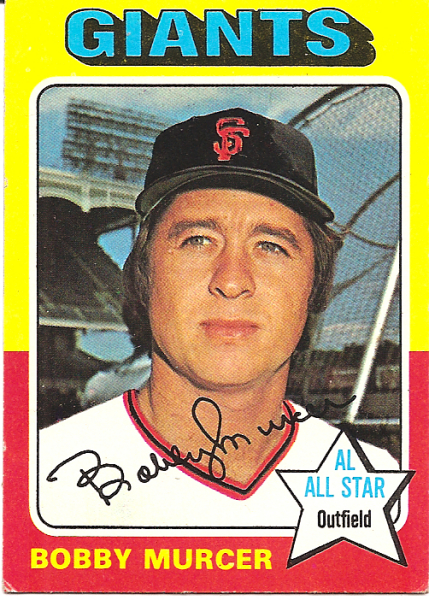
| I got my first real glove on July 3, 1972. The family took me to Mr. Sport on Park St. that Monday night before we headed off to Westbury for the Sonny & Cher concert (opening act: an unknown comedian who got on people’s nerves with all his props and shtick, Steve Martin). I call it my first real glove because I was outgrowing my previous glove. It was from a company I’d never heard of and had no player’s inscription. Since I was in my second year of Pee-Wee League ball, I wanted something substantive, something real, something you’d heard of.
So the salesman found me a Spalding fielder’s glove. Good fit. A little stiff, but time would take care of it. Only problem was the signature: Bobby Murcer.
I didn’t want a Bobby Murcer glove. It wasn’t so much that Bobby Murcer was a Yankee, it was that he was the favorite Yankee of my alternately good friend and sworn enemy who lived in Lido. The sworn enemy part only flared up when there was a severe disagreement between us. Days earlier, we had an argument over a ball that was fair; he said it was foul; even his mother said it was fair. We snarled at each other, ended our two-man game of whatever kind of baseball we were attempting to play and I went home mad.
Now I was wearing a glove with that kid’s favorite player’s name. But it was a good glove. I said yes, I will take it. My father paid $10 for it, or 28 cents a year over the past 36 years.
It became my first real glove and, unless I make a comeback to pick up for Moises Alou, my last real glove. It hasn’t seen any action since 2003, but it is my glove. Every catch I’ve had since I was 9-1/2 has been with Bobby Murcer’s name facing out.
I didn’t do it justice, I’m sure. |
|
|
by Greg Prince on 12 July 2008 3:00 pm Until very recently I'd been hoping that Damion Easley, 1,658 games into a career that has stopped short of the business end of October for 16 consecutive seasons, would be traded or sold or waived to a contender on August 31, that a division leader that's 20 games in front would pick him up, that he somehow would make it into the postseason because he so seems to deserve it.
I've quit thinking like that. I hope he's with the Mets through the end of 2008, because for the first time in 2008, I believe there's a chance the 2008 Mets will be the team on which Damion Easley makes the playoffs.
It wasn't supposed to be a shock to think in those terms, but after three-plus months of dishwater doldrums, I've gone from moping to hoping. Sure it's all about the airtight pitching and the timely hitting and the fundamental soundness of a club on a seven-game winning streak, a club a whisper away from first place. If I were telling myself these Mets had a chance when clearly they played as if they did not, I wouldn't have believed it. Nowadays, to sound the most familiar theme in Metdom, I believe.
I believe in Damion Easley. I believe Damion Easley, active leader in games played without a playoff appearance, has the opportunity to grasp that which slipped through his hands twice since 1992. Easley and the '95 Angels were locks to win their division before Seattle turned them into smoked salmon. Easley and the '07 Mets weren't meant to be either, we know too well. Damion went down in a heap in August and the Easleyless Mets made life hard on themselves in September.
This July, opportunity knocks and it's Easley who knows exactly how to tap on that door. For a guy who didn't play all that much last year and hasn't played consistently until lately this year, boy does he have a knack for the knock. Colorado had to have been blinking and thinking back to early '07 when Easley, left to fend off the final strike of the tenth inning, took Brian Fuentes over the left field wall at Shea. That was the Endy bunt game, but it was just as much the Easley homer game. Damion did it again in Arizona a couple of weeks later, rescuing the Mets with a ninth-inning longball. And in the first triumph of the Jerry Manuel era, wasn't it Damion Easley who homered to break a tenth-inning tie in Anaheim?
I love when it's Damion Easley lifting the team on his shoulders because it means Damion Easley will be interviewed by Kevin Burkhardt after the game and Damion always tells Kevin something interesting. Friday night, in response to a question about how the team is feeling, he answered that the team feels confident. Boilerplate, I suppose, but he added, it's “the earned confidence,” earned through the hard work of a team that had been diddling around for too long, that woke up and got busy living. He didn't say that part quite that way; he didn't have to.
We've earned the confidence to believe in our team. The Mets have earned the confidence to believe in themselves. Damion Easley has earned every big swing he gets. May they lead him to a promised land.
|
|






