The blog for Mets fans
who like to read
ABOUT US

Faith and Fear in Flushing made its debut on Feb. 16, 2005, the brainchild of two longtime friends and lifelong Met fans.
Greg Prince discovered the Mets when he was 6, during the magical summer of 1969. He is a Long Island-based writer, editor and communications consultant. Contact him here.
Jason Fry is a Brooklyn writer whose first memories include his mom leaping up and down cheering for Rusty Staub. Check out his other writing here.
Got something to say? Leave a comment, or email us at faithandfear@gmail.com. (Sorry, but we have no interest in ads, sponsored content or guest posts.)
Need our RSS feed? It's here.
Visit our Facebook page, or drop by the personal pages for Greg and Jason.
Or follow us on Twitter: Here's Greg, and here's Jason.
|
by Greg Prince on 2 July 2008 9:55 am Following the Mets' 7-4 win over the Cardinals Tuesday night, the Redbird players shrugged it off. It was just one game, manager Tony La Russa told them, we'll get 'em tomorrow. Most of them scattered to their homes, but one was invited for a drink at Mike Shannon's, just across the street from Busch Stadium. This Cardinal had had a pretty good game — drove in a run, threw out a runner — and thought it was just two more of his local admirers wanting to show their appreciation. In St. Louis, he never had to buy himself a drink. The fans were so great. The Cardinal accepted the invitation. Funny thing, though. The Cardinal had been to Shannon's plenty of times and where he was taken, it didn't look like Shannon's…and there didn't appear to be any drink either. After a little friendly baseball chit-chat, the tension began to ratchet up.
“So, you think you're pretty handy with a bat.”
“I don't know what you guys are talking about. I was just doing my job.”
“Uh-huh. Doing your job.”
“Yeah, that's right.”
“Your job is what?”
“I play for the Cardinals.”
“Oh. You play for the Cardinals.”
“That's right. I'm the starting catcher.”
“Catcher, huh? So you what? You catch?”
“That's right. I catch.”
“You wear a mask? And a chest protector?”
“And shin guards.”
“Funny, I don't see any of that stuff on ya now. Neither does my associate Rocco.”
WHACK!
“OW! Whad'ja do that for?”
“I thought you were a catcher. I thought you were used to catching.”
“I catch balls!”
WHACK!
“OW! What's wrong with you?”
“Oh, I'm sorry. I thought you said something about catching it in the balls.”
“What kind of crazy mother…”
“What about my mother? What did you say?”
“I didn't say nothin'.”
“Sounds like you were sayin' something about my crazy mother and your balls.”
“What's with you guys? You don't seem like Cardinal fans.”
“What gives you the impression that we are not Cardinal fans?”
“Cardinal fans don't usually hit me with a bat.”
“Let's just say we are very intense Cardinal fans.”
“No way, man. Cardinal fans are nice. Cardinal fans love me. I hit that big home run for them.”
WHACK!
“OW! QUIT IT!”
“I'm sorry. Did you say we should quit it? Maybe you should quit it.”
“I'm not quitting. I'm a hero. They love me in St. Louis. I won the pennant for these people.”
“These people? Are you implying that we are not your people? That we are not happy to see you? That we were not happy with 'that big home run' of yours?”
“You sure don't seem happy about it.”
“Get a load of that, Rocco. Mr. Molina here don't think we enjoyed his big home run. That was what now…two years ago?”
“Yeah, 2006. If you were Cardinal fans you'd never forget it.”
“I see. Now I'm forgetful.”
“I didn't say that.”
WHACK!
“OW! NO WAY YOU'RE A CARDINAL FAN! CARDINAL FANS DON'T HIT CARDINALS WITH BASEBALL BATS!”
“Now that you mention it, my associate Rocco isn't by nature one of your long-term, dyed-in-the-wool, red-wearing Cardinal fans. In fact he's not really from Missouri, to be perfectly honest with you.”
“Southern Illinois?”
“Rocco's actually in town on business. As I am. From New York.”
“New York?”
WHACK!
“Yes, New York. Where you hit 'that big home run' you seem so proud of.”
“I was just doing my job.”
“Oh. Your job. Your job is catching, I thought you said.”
“Well, I come to bat, too.”
“Of course. How silly of me. The catcher bats sometimes.”
“The catcher bats just like any other player.”
“You mean like this?”
WHACK!
“COME ON! THAT REALLY HURTS!”
“Oh, are we inflicting pain on you? Is that something you know about because you've done it before?”
“What, the home run? I'm a baseball player! I'm not supposed to swing the bat?”
“Rocco, our friend Mr. Molina is quite amusing, all this talk of bats. He seems to have a real Adirondack fetish.”
“You guys are from New York. You know how baseball works.”
“We do know a little something about baseball. We do know how it works. We do know how 2006 was supposed to work, too.”
WHACK!
“We know the Mets were on their way to the World Series that year…”
WHACK!
“We do know there was a little 'accident' in Miami…”
WHACK!
“We do know the cops pinned it on some 'drunk driver' who just happened to be careening outta control on I-95…”
WHACK!
“We do know that he just happened to take out our most reliable set-up relief pitcher…”
WHACK!
“We do know that instead of Duaner Sanchez three months later that you got to face who you wanted to face, Aaron Heilman…”
WHACK!
“And we do know about your 'big home run'…”
WHACK!
“And we were willing to say, as you put it, that's how baseball works, that sometimes you have an overwhelming powerhouse of a team and that sometimes you lose a key cog in the middle of a season in a freak automobile accident and sometimes a light-hitting catcher hits an extremely unlikely home run to take away from you the pennant you knew to be yours. That's just one of those unfortunate incidents.”
WHACK!
“THEN WHY ARE YOU GUYS HITTING ME WITH A BAT OVER AND OVER AGAIN?”
“Because, Mr. Molina…Yadier, if you don't mind me being overly familiar…because Yadier, you shouldn't have tried to get cute in the eighth inning tonight.”
“What cute? It was just a line drive! I was just trying to get on base! We were down three runs!”
“And your 'line drive' just happened to smack straight in the direction of our friend Duaner Sanchez's kneecap?”
“Yeah. That's it. An accident.”
“Like the accident in Miami where Duaner missed the rest of the '06 season and all of '07.”
“Yeah! Like that!”
“Tell me, Yadier. You seem to be an expert on 'accidents'.”
“Huh?”
“Yadier, you do a lot of traveling?”
“I'm a ballplayer. We travel a lot, sure.”
“You ever go to Miami?”
“When we play the Marlins, I guess.”
“You have any friends in Miami?”
“Whaddaya…whaddaya mean?”
“You have a friend named Cecil Wiggins?”
“Never heard of him.”
“You sure? About that? You want Rocco to help refresh your memory?”
“Well, now that you mention it…”
“Yes?”
“I, uh…”
“Yes?”
“OH ALL RIGHT! I AM CECIL WIGGINS! THAT'S MY STREET NAME! LA RUSSA PUT ME UP TO IT! I WAS JUST FOLLOWING ORDERS! LA RUSSA'S CRAZY! HE BATS THE PITCHER EIGHTH!”
“So you admit that you took out Duaner Sanchez in Miami in the wee hours of July 31, 2006?”
“Yes. We heard he liked Dominican food so we tailed him. It's La Russa, though, you gotta believe me. I like Duaner. We played winter ball together.”
“And you admit the whole idea was to get Heilman on the mound on October 19, 2006?”
“Yes.”
“Anything else?”
“And to make it so the Mets would have to trade Xavier Nady and sign Guillermo Mota. But that wasn't me. That was La Russa. He's evil. I'm his pawn. We all are. He made McGwire bulk up. He ruined Ankiel's pitching career so he could reinvent him as a hitter. HE'S CRAZY!”
“And tonight?”
“Yes, yes. The line drive at Duaner's knee was intentional. It was supposed to be more than a bruise.”
“So's this, Yadier.”
WHACK! WHACK! WHACK!
“C'mon, Rocco, and don't forget the bat. Jerry says we got two more Molinas to take care of tonight. He's dead serious about this 'gangsta' stuff.”
by Greg Prince on 1 July 2008 9:30 pm When Tony Armas steps to the mound as scheduled tonight at Busch Stadium, — if the roster posted on mets.com is to be believed — he will become the first Mets pitcher to start a game wearing No. 44 since Jason Isringhausen did so at the last Busch Stadium on June 19, 1999.
Isringhausen was pounded by the Cardinals nine years ago, beginning with the first St. Louis batter, Joe McEwing, who tripled.
McEwing would be a Met a year later after he was traded for Jesse Orosco who had been reacquired by the Mets for Chuck McElroy who was acquired by the Mets in a trade involving Brian McRae who was acquired by the Mets in a trade involving Mark Clark who was acquired in a trade involving Ryan Thompson who was acquired in a trade involving David Cone who was acquired in a trade involving Ed Hearn who caught Jesse Orosco's final regular-season save of 1986 on October 4, a little more than three weeks before Jesse Orosco became the first Met to throw the final pitch of a World Series since Jerry Koosman seventeen years earlier and nearly eight years after being acquired by the Mets from the Minnesota Twins for Jerry Koosman.
The second batter Jason Isringhausen faced in his final start for the Mets was Darren Bragg, another future Met. Izzy walked him and then gave up a three-run homer to Mark McGwire.
Isringhausen's first batter retired in his final Met start was Fernando Tatis, a current Met.
When Armas starts for the Mets tonight, Isringhausen will be in the Cardinal bullpen almost nine years since he was traded by his original team.
Isringhausen was traded by the Mets to Oakland the same day McRae was traded to Colorado for McElroy. Going to the Rockies with McRae in that deal was Rigo Beltran who had been acquired by the Mets in a trade involving Juan Acevedo who was acquired by the Mets in a trade involving Bret Saberhagen who was acquired by the Mets in a trade involving Kevin McReynolds who was acquired by the Mets in a trade involving Kevin Mitchell who pinch-hit for Doug Sisk on October 4, 1986, necessitating the insertion of a new pitcher, who was Jesse Orosco who would collect his final regular-season save of that year in short order.
It was Mitchell's final regular-season pinch-hitting appearance for the Mets. His final postseason pinch-hitting appearance for the Mets would come exactly three weeks later, October 25, 1986, in the tenth inning of the sixth game of the World Series. Mitchell pinch-hit for Rick Aguilera who was pitching in relief of Jesse Orosco, who retired Bill Buckner for the final out in the top of the eighth. The Mets trailed 3-2 in the game and 3-2 in games at that point.
Isringhausen was the losing pitcher in his last Mets start. The winning pitcher was Manny Aybar, who six years later wore 36 for the Mets, the same number worn by Jerry Koosman who was traded for Jesse Orosco who, twenty-one years and several stops later, was traded for Joe McEwing who tripled off Jason Isringhausen in the start that bumped him once and for all from the Mets rotation.
Izzy would make eight relief appearances wearing 44 for the Mets after his last start. The last one he made at Shea — the last time any Met pitcher wore 44 at home — was July 27, 1999. He wore 44 that night not for the New York Mets but for the Mercury Mets who lost 5-1 to Pittsburgh Pirates rookie Kris Benson. Benson would eventually be traded to the Mets and then traded from the Mets for John Maine who started for the Mets in St. Louis last night, one night before Tony Armas is scheduled to wear 44 and start for the Mets, three nights after Pedro Martinez started and lost for the Mets.
Pedro Martinez was traded by the Expos to the Red Sox for Tony Armas on November 18, 1997, the same day the Rockies acquired Chuck McElroy, who would eventually be traded by Colorado to the Mets for Brian McRae and Rigo Beltran before the Mets would trade McElroy to the Orioles for Jesse Orosco who the Mets would trade to St. Louis for Joe McEwing less than four months after McEwing tripled to lead off Jason Isringhausen's final start as a New York Met, the final start by any Met pitcher wearing 44 until tonight when Tony Armas is scheduled to wear 44 and start in St. Louis.
While Isringhausen (or perhaps Isringsofsaturn) pitched in the game in which the Mets dressed up as space aliens from Mercury, it was Orel Hershiser who took the loss after starting against Benson. The two opposed one another in the final scheduled game of the 1999 season, at Shea, this time the Mets winning 2-1, their winning pitcher Armando Benitez, acquired by the Mets in a three-team trade that involved minor leaguer Arnold Gooch who, like Juan Acevedo, was acquired by the Mets in a trade that involved Bret Saberhagen who was acquired by the Mets in a trade that, as noted, involved Kevin McReynolds, who made the final out of the fourth game of the 1988 National League Championship Series against Orel Hershiser who earned the save in the twelfth inning in relief of the Dodgers' Jesse Orosco, who stood to be the winning pitcher in the sixth game of the 1986 World Series had the Mets pushed across more than one run with the bases loaded and one out in bottom of the eighth.
The winning pitcher for the Dodgers in the fourth game of the 1988 NLCS was Alejandro Peña, later acquired by the Mets in a trade that involved Juan Samuel who had been acquired by the Mets in a trade that involved Roger McDowell, losing pitcher in the fourth game of the 1988 NLCS and winning pitcher of the final game of the 1986 World Series, the one which Jesse Orosco threw the last pitch of thirteen years before being reacquired by the New York Mets for Chuck McElroy who had been acquired by the Mets on July 31, 1999, the day Jason Isringhausen made his final appearance as a New York Met at Wrigley Field, a 17-10 slugfest in which Isringhausen took the loss in relief. Pitching for the Cubs while Isringhausen pitched for the Mets that day was Rick Aguilera who was the winning pitcher in the sixth game of the 1986 World Series, the game in which Jesse Orosco retired Bill Buckner and the game in which Kevin Mitchell pinch-hit in the tenth inning.
Mitchell singled, as did Ray Knight who succeeded him. Mookie Wilson, who succeeded Knight, successfully avoided being hit by a wild pitch that allowed Mitchell to score the tying run and then grounded to Buckner who misplayed it, which allowed Knight to score the winning run, allowing the Mets, in turn, to play the seventh game which Jesse Orosco would throw the final pitch of.
On deck while Wilson batted was Howard Johnson, who made the final out of the 1988 NLCS against Orel Hershiser. Howard Johnson is the hitting coach of the 2008 New York Mets. One of the players he coaches is Fernando Tatis who made the first out in the last start, prior to what is scheduled tonight, made by a pitcher wearing 44 for the New York Mets, Jason Isringhausen.
When Isringhausen departed the Wrigley Field mound on July 31, 1999 after pitching for the Mets for the last time, he was succeeded by Greg McMichael. McMichael was in his second tour of duty with the Mets, having been traded to the Dodgers in 1998 in a deal that involved Brad Clontz. Clontz would wind up a year later with Pittsburgh and would throw the wild pitch that would end the final scheduled game of 1999, the one started by Hershiser for the Mets and Benson for the Bucs. Clontz's wild pitch allowed Melvin Mora to score the winning run and sent the Mets to a one-game playoff in Cincinnati that would set the stage for their first postseason appearance since the 1988 NLCS, which ended when future Met Orel Hershiser struck out future Met batting coach Howard Johnson.
The Mets would win their first postseason game at Shea Stadium in exactly eleven years on October 8, 1999. Throwing the final pitch for the Mets that night, in mop-up duty, was Orel Hershiser. The Mets' previous postseason win at Shea Stadium occurred on October 8, 1988. The starter for the losing team that afternoon was Orel Hershiser.
The Mets pitcher who preceded Hershiser to the Shea Stadium mound in the third game of the 1999 National League Division Series was John Franco. John Franco saved the first Major League win of Jason Isringhausen's at Shea Stadium on July 30, 1995, one day before the Mets traded Bret Saberhagen to the Colorado Rockies for Juan Acevedo and Arnold Gooch and three weeks before Franco saved Isringhausen's second Shea Stadium win, a game in which Isringhausen's catcher was Kelly Stinnett, who would make the final out of the third game of the 1999 NLDS for the Arizona Diamondbacks against Orel Hershiser and a game in which Isringhausen beat Hideo Nomo who would be traded with Brad Clontz to the Mets in 1998 for Greg McMichael and Dave Mlicki.
Mlicki had been traded to the Mets prior to the 1995 season from Cleveland along with Paul Byrd and Jerry DiPoto for Jeromy Burnitz. DiPoto was traded to Colorado prior to the 1997 season for Armando Reynoso. Reynoso started the first game the Mets ever lost at Yankee Stadium, one day after Mlicki started the first game the Mets ever played and won at Yankee Stadium, eleven years before the final game the Mets would ever play and win at Yankee Stadium, the afternoon of June 27, the first half of a day-night doubleheader, the night half of which was started and lost at Shea Stadium by Pedro Martinez who was traded for Tony Armas who is scheduled to start for the Mets tonight, four nights later wearing 44, the first Mets pitcher to wear 44 since Jason Isringhausen did so on July 31, 1999, the day he and McMichael were traded.
Byrd was traded to the Braves prior to the 1997 season in the deal that originally brought McMichael to the Mets. McMichael was the losing pitcher in the final game of the first series played by the Mets at Yankee Stadium. He was succeeded on the mound that day by John Franco who saved Isringhausen's first two Shea Stadium wins, and he himself succeeded Juan Acevedo who would eventually be traded for Rigo Beltran who would eventually be traded for Chuck McElroy who would eventually be traded for Jesse Orosco who would eventually be traded for Joe McEwing. Acevedo, as noted, was acquired for Bret Saberhagen who was acquired for Kevin McReynolds who was acquired for David Cone who started that final game of the first series played by the Mets at Yankee Stadium on June 18, 1997. Cone was acquired by the Mets in 1987 for Ed Hearn who had, in 1986, caught Jesse Orosco
Orosco, traded back to the Mets in December 1999 from the Orioles, the team Koosman beat to win the Mets' first World Series, was traded to the Cardinals, the team the Mets would beat to make their most recent World Series, in March 2000 for McEwing, the hitter who led off, in St. Louis, the last start by a Mets pitcher wearing 44 'til tonight, in St. Louis, was saddled with a loss in his final decision as a Met on September 30, 1987 as a result of surrendering a tenth-inning home run to Luis Aguayo, now the Mets' third base coach, where he works on a staff that includes Howard Johnson, instructing a team that includes Fernando Tatis, Pedro Martinez and Tony Armas. Orosco was traded away in December 1987 in a three-team deal in which the Mets acquired Kevin Tapani. Tapani would be traded by the Mets to the Twins, along with Rick Aguilera and three others, for Frank Viola. Aguilera, who was inducted into the Minnesota Twins Hall of Fame less than two weeks ago, made his final appearance as a Met at Wrigley Field on July 30, 1989, almost precisely ten years before he pitched for the Cubs against the Mets in Jason Isringhausen's final appearance as a Met, after which Isringhausen and McMichael were sent to the A's for Billy Taylor.
Who, like Bragg and Burnitz and Viola, didn't help very much in the long run.
by Jason Fry on 1 July 2008 4:01 am What became of the crisp Mets who defeated the Yankees Sunday in front of a packed, broiling house that included both Faith and Fear in Flushing chroniclers and their wives? (Emily and I were out in the bleachers, where I got to jump up and scream at Carlos Delgado's drive while the rest of the section — Emily was away getting what had to be our 200th bottle of water — gawped in indecision. Because I rule.) Those Mets, the ones who made us so happy, went whereever they go every other day, leaving some travesty of a major-league team to slump and stagger around Busch Stadium for an interminable amount of time.
Tonight could have been one of those nights one enjoys baseball as faithful companion. Joshua is off with his grandparents this week, so Emily and I took the chance to wander down to the Waterfront Ale House for food eaten after 7 and adult conversation and that rarest of things for parents, leisure. On the way, I stopped on Henry Street to stare at the bright rectangle of someone's TV through a garden-level window (the game was right there, I swear it wasn't creepy) and saw it was 2-0 Cardinals — not ideal, but not insurmountable. When we got to the restaurant both TVs were showing Yanks/Rangers, a fairly routine NYC insult, but Emily got our waiter to change one of them. So far so good. He switched the one behind my back, but I refused my wife's kind invitation to trade places — besides being a diehard in her own right, Emily was the one who'd made the request. It was only fair.
But I got the better part of the deal. Every time I'd turn around to see what Emily was frowning at the Cardinals had another run and John Maine's swipe at his long, sweaty face seemed more disconsolate. Sometimes baseball trots along happily at your heels as you go about your evening, tagging along with you via TV and radio, just happy to be included in whatever you're doing. But other times it's a black cloud that sticks stubbornly to the airspace over your own head, spitting grim tidings like hot summer rain.
As we gathered our things Carlos Beltran walked. It was 7-1 Cards, late to make a run, but then St. Louis has no bullpen. By the time we got out of our chairs Carlos Delgado was at the plate. I saw bat hit ball, saw the shortstop take a crow hop and stick his glove out, and kept right on walking out of the restaurant. It was that kind of night.
by Greg Prince on 30 June 2008 7:16 pm 2: Saturday, September 27 vs. Marlins
As the Countdown Like It Oughta Be reaches its penultimate milepost, there is not a soul in Shea Stadium who isn't prepared for its unveiling in the middle of the fifth inning. Much to Aramark's dismay it is momentarily killing hot dog and beer sales, but tradition is tradition by now. All wait to find out who is next to unveil a magic number in this stirring seasonlong salute to the history of the old ballpark that is scheduled to commence to vanish after tomorrow. The buzz is palpable considering how closely the Countdown has been monitored. All of New York is wondering how this thing will play out. That's why when the public address system plays over and over again a familiar tune with a revised admonition — “EVERYBODY CLOSE YOUR EYES!” — nobody questions the directive; every pair of eyes shuts and every pair of ears perks up. What they hear, crackling over the PA, is a voice. It is ancient, yet, given a moment to be fully comprehended, it is instantly recognizable. Eyes stay closed and the voice begins to speak…
I have been requested by management to give Shea Stadium a benediction, or at least the new parking lot that will provide amazing, amazing, amazing space to all the fine automobiles that the customers will drive to the Mets games even though there is an understandable effort by municipal authorities to encourage you to take mass transit as it is considered splendid at this time to be green, which is exactly what I was when I first came to New York in Nineteen Hundred and Twelve, which was technically Brooklyn though it was more technically Greater New York considering the great consolidation that took place while the National League had twelve teams including one in Louisville but none in Kansas City which is where I come from and everything was up to date and they went and built a skyscraper seven stories high which I thought was high which just goes to show you what kind of road apple I was when I came to Brooklyn and played in the new ballpark in Nineteen Hundred and Thirteen, my second year which wasn't no sophomore jinx for me as I averaged two-seventy-two and they called the neighborhood Pigtown and you wouldn'ta wanted to play there except that was where the money was in those days and the ballpark Mr. Ebbets built was quite fine and now I see they're replicating it in what used to be the parking lot for this here fine stadium that they're tearing down to make new parking and that's progress for ya.
I am not here to argue about other sports, I am in the baseball business and in the baseball business if you don't have advancement you don't have progress and progress is what makes arbitration possible, which is something you didn't have in my day which I might add was many a day ago but I continue to be employed as a vice president by the New York Mets regardless of the fact that I am dead at the present time but I signed a perpetual personal services contract with Mrs. Payson who is also dead at the present time and extends her best regards. Mrs. Payson signed a long-term contract with the consolidated city of Greater New York for Shea Stadium which was quite a sight in its day which I suppose is not a day that has many days left and long-term don't mean what it used to when you open a bright and sprightly new stadium and it's got fifty-four bathrooms so nobody, even the ladies, has to wait and miss a minute of the action which you don't want to do, not at the prices of admission which can go as high as platinum what without Ladies Day as a recognized promotion and gold, which was the kind of watch I didn't even get when I was discharged by the New York Yankees for making the mistake of getting old and losing a World Series when Mr. Mazeroski took my pitcher Ralph Terry over the wall and Mr. Berra couldn't do nothing but just stand there and watch and it was a great moment for the baseball business if not for me and, wouldn't ya know it, Mr. Berra followed me to the amazin', amazin', amazin' Mets and Ralph Terry followed him if not for very long but I had commenced to no longer managing due to my hip breaking in a most unfortunate manner. When I slipped and got hurt in Boston when I managed there, the newspapermen wasn't at all unhappy but my newspapermen when I managed the Mets was always kinder to me.
The New York Mets did me a great favor when they was still the Knickerbockers and needed a manager to help them become the amazing Mets and I was involved in banking in Glendale which isn't for everybody and now I see the Mets have gotten into the banking industry with their new park which will have a name like a bank and a platinum ticket structure though you never can tell until you install the turnstiles and determine what the market will bear. I was fortunate that nobody much expected anything out of my Mets and we delivered even less but they came out to the Polo Grounds which was where I played for Mr. McGraw and learned my managing trade, not that you'd think it did me any good based on our record in the Mets' first year, which wasn't as splendid as you'd like but nobody seemed to mind because they did come out in record numbers to see my amazing, amazing, amazing Mets up there at the old ballpark which was a lot newer when I was, too. Of course I wasn't born old, which you might think the contrary of when you get a look at me now and you could say the same for Shea Stadium with the acres of parking for all the Ramblers which I only mention because they had an official car of the Mets deal the park's first year and later Plymouth paid for that honor and they're still reaping dividends because that was the year we won our first title and the newsreels still show that now and again and it became a very famous title as it ensured that in South America on New Year's Day we'd have our best game. I also heartily endorse annuities as a wise investment.
I ain't no Ned in the third reader, not after a hundred and eighteen years of living and dead combined, so I've seen a few things but I had never seen anything quite like Shea Stadium and not just the bathrooms which is where I wouldn't blame our fans for hiding in when the ballgames began to get away from us which was often and early and sometimes both, but it was a step up from the Polo Grounds which had been around almost as long as I was, maybe almost exactly the same amount if you count it in years before the fire and I mean the fire in Nineteen Hundred and Eleven, not when I got fired for losing a World Series and my old friend George Weiss hired me to manage those Knickerbockers who wasn't yet the Mets and George's wife said she married him for better or worse but not for lunch, which my Edna might have been thinking after George and I each made the mistake of getting old but that won't happen to this bee-yoo-ti-ful Shea Stadium because it's only forty-five years old and it won't see forty-six except of course in the way you're hearin' me now, which in itself is amazing, amazing, amazing.
You see and hear a lot where I am. You see George and you see that lawyer fella Mr. Shea and you hear a real nice broadcast from my men Lindsey and Bob and you have that other Lindsay, the mayor who likes to pour the champagne over your head which is fine if you just won as we did in Nineteen Hundred and Sixty-Nine and you got a big power-hitter at first base like Mr. Clendenon which I didn't or a hammer like Mr. Milner when we won a pennant again in Nineteen Hundred and Seventy-Three which I didn't neither. I had Mr. Throneberry who failed to touch most of the bases and we was always afraid of what he'd drop next and he comes up to me these days and says he doesn't know why they asked him to be here but I hand him a piece of cake and he don't ask me anything else. Up here you know what you're doing. You can play Kanehl anywhere and he don't even have to stick his elbow out for fifty dollars and you always get the right Miller, the righthanded one, up to face the righties though on our team it didn't really matter which Miller or which Nelson we called on because we just wasn't that good. But we got the attendance and I apologize to them all if they feel they got trimmed by our performance. They probably did.
The escalators didn't always work at bee-yoo-ti-ful Shea Stadium but they made for grand staircases when they didn't and our scoreboard didn't always work the way they said it would, especially in the runs column, but it was big and everybody always knew how much we was losing by but ya didn't need a scoreboard 'cause ya had those placards and I'd just look at 'em and see what our fans thought of us which was a lot better than I thought of us. We got the old fans who came to the Polo Grounds and to Ebbets Field and we got the kids who didn't know any better. We got 'em from four years on, we got 'em from ten years on, fifteen years on, eighteen years on. And we got 'em in a group! When you're young, it's great to go into a stadium where your future lies in front of you.
Seems Shea Stadium, which was lovely, just lovely, a lot lovelier than my team, just commenced to being and now it won't be anymore. But you can be sure as I was when Mr. McGraw put the bunt on that it will always be here, sort of the way I am. Of course I once missed that Mr. McGraw pulled the bunt sign in Cincinnati and I got fined for it which is how it should be if you miss a sign and swing away. If ya wanna be a sailor, join the Navy. From where we put our new ballpark in Nineteen Hundred and Sixty-Four you could see the water, too. You could get here by boat, you could get here on the train which is how I traveled most of my career. You could fly into that big, noisy airport that disturbed so many of our opposing hitters that it was a boon for my pitchers except they didn't seem to care for it either and even if they had, my pitchers wasn't quite what you'd call pitchers all the time, at least not in the big league sense. And you could drive, even if it wasn't a Rambler, the official car of the Mets. You could park anywhere. We had lots of parking. It appears apparent that we still will.
I don't mean to be no Alibi Ike and I'd like to be with you fine ladies and gentlemen to pull down my number, but that's gonna represent a stretch as I am, as previously mentioned, dead at the present time, having commenced to being exactly deceased in Nineteen Hundred and Seventy-Five which is no excuse for not being a New York Met, 'cause that's what I am for life and thereafter, just like you, I suspect, just like bee-yoo-ti-ful new Shea Stadium will always be, when you keep your eyes closed, bee-yoo-ti-ful new Shea Stadium.
The transmission crackles to an end. When all realize the voice has been silenced — or perhaps just paused until another appropriate interval when it will speak and speak and speak again — all open their eyes and turn their heads toward the right field corner where they discover the voice's physical envoy, Mr. Met, will do the honors on behalf of the spirit of the voice and peel off number 2.
That Mr. Met is resolutely mute strikes some in the crowd as ironic but nobody says anything about it.
***
Number 3 was revealed here.
The Shea Stadium Final Season Countdown will conclude with the unveiling of Number 1 in two weeks, on Monday, July 14.
by Greg Prince on 30 June 2008 2:22 am When a modern contrivance becomes a grand tradition, mister, you're growin' old. So it is with the Subway Series, quite obviously a cynical money-making scheme — hatched in the aftermath of a bad-for-business labor dispute, designed as a no-brainer crowd-pleaser, schemed to lure in those who couldn't be bothered with a regulation N.L. or A.L. game. After a dozen years of this stuff, the whole concept still sticks a figurative tongue out at baseball's timeless sense of ritual.
But time isn't timeless, y'know? Time has passed since Interleague play introduced itself to us, a pretty darn long time. It's been eleven years since Dave Mlicki laid down the first marker and a decade since the whole shebang came to Shea. It comes back every spring or summer and that, by definition, makes it tradition.
A special tradition, it turns out. The Mets-Yankees series every year stops the clock for me. Even as I am the first to observe and acknowledge it doesn't rock the packed house the way it did at the very beginning when a moment's silence was to be avoided because your sworn enemy might otherwise have the last word (and that was before the lineups were introduced), it's not yet humdrum and I doubt it ever will be. A special tradition deserves to be treated specially.
It deserved my friend Rob, he who gritted and groaned with me through seven innings of the first Subway Series debacle at Shea Stadium on June 26, 1998 and, for good measure, a bonus pounding at Yankee Stadium on June 10, 2000. Rob has waited not just ten years but his whole life, really (including Saturday), to watch the Mets beat the Yankees in person. How could I think of going to the final Subway Series game at Shea Stadium and not think of Rob?
It deserved my friend Richie, he who materialized without warning on the morning of July 10, 1999 with three tickets to that Saturday's Mets-Yankees game, one for him, one for his son, one for me. The day ended with each of us raspy — something about a 9-8 win captured on a pinch-hit, two-RBI single with two outs in the ninth affected our throats adversely yet did our hearts a world of good. I couldn't speak clearly for weeks after. When I next saw Richie at Shea, in August, he said he couldn't either. How could I think of going to the final Subway Series game at Shea Stadium and not think of Richie and his son?
His son, strangely enough, has aged nine years since Matt Franco's day in the sun and had a “gig” today, I learned; he's a drummer now, which is strange, 'cause in my mind he's eleven and eleven-year-olds don't have gigs even if twenty-year-olds apparently do. Thus, that left me with an extra ticket from the four my friend Sharon graciously passed in my direction when she determined her family couldn't make it from deep in the heart of Jersey all the way up to Shea.
Who deserved this fourth ticket? I had put out a couple of feelers to fine folks who, for whatever reason, were unavailable, until I discovered there was one person I never dreamed would want a piece of this action.
Stephanie! After listening to me come home hoarse and cursing over what wonderful or terrible incident had transpired in the boiling cauldron of hatred that Shea became every May or June or July when the Subway Series returned, my low-key wife finally grew curious enough to dip a toe in and discover for herself what all the fuss was about. That, plus she hadn't seen Rob or Richie in quite a while and she'd figured out from television that the ol' Subway Series tension, it ain't what it used to be.
And it ain't. How could it be? How do you match the stunning sense of juxtaposition from 1998 when Yankees and Yankees fans louted among us? How do you keep up the chanting that defined 1999's get-togethers, the constant din of Let's Go Mets! challenged by Let's Go Yankees! trumped in turn by Yankees Suck! made too often moot by the deleterious actions of one the grayshirts on the field? Some said it would never be the same in any June after they did this in October of 2000. I don't think that's it. It's novelty, or the lack thereof. Today marked the 33rd time the Mets played the Yankees at Shea Stadium in the regular season, the 66th time the Mets played the Yankees in the regular season anywhere in New York since 1997. The Mets and Yankees have played each other in recent seasons just about as much as the Mets have played the Rockies. Even allowing for hostility born of proximity, the 66th time isn't likely to be the charm.
And it wasn't. Oh, I don't mean the game itself, which was reasonably tight, or the result, which was absolutely agreeable. I don't give a damn if it's the 666th time they meet (at which time Satan himself will still be playing short for them), the Mets beating the Yankees is capital stuff. It will always mean more than the Mets beating the Rockies and, if we take our full dose of truth serum, more than the Mets beating the Braves, Phillies, Cardinals and Cubs combined.
But we don't chant nearly as much anymore. We chant more than we do against the Braves, Phillies and less inflammatory National League opponents, but there's far less anxiety about leaving a rhetorical vacuum unfilled. The catcalls wear themselves out. There's actually full at-bats that don't elicit any particular passion. Stephanie and I got up to stand in the Carvel line in the sixth and I didn't worry all that much that I was missing the Subway Series.
Then came the top of the ninth. Then came the Subway Series that I know and love and loathe. Then came Billy Wagner out of the pen and it was the second game in '06, the one where Sandman poured enough salt on a 4-0 lead to turn it into an extra-inning loss, all over again. Then came Jeter up to bat and it was…well, it could have been any of dozens of death knells. Sure enough, Ford boy singles just past Luis Castillo and, sure enough, bill.i.am bounced a wild pitch and Captain Intolerable was on second with nobody out and Alex Rodriguez still up.
Now it was that Saturday in May of 2006, the Billy meltdown special, the one I hadn't been to but felt every bit as scarred through the TV and radio as I was for the ones I had absorbed up close. Now it was the Sunday the May before, Jose and David not handling their positions particularly well. Now it was a Friday night in June of '02, Armando Benitez burning off the last of his save-percentage goodwill and Satoru Komiyama welcoming Robin Ventura home with arms wide open, and the Friday night the year before when Todd Zeile, on second, coached Mike Piazza, on third, to get thrown out, at home (while Yankees fans directly behind predicted every misstep with uncanny accuracy). Now it was the first one in '98, O'Neill doing in Rojas, Rob and I sporting mood rings that were stuck on black.
Every Sunday at Shea, they play Bobby Darin's “Sunday in New York,” the ditty about the “big city takin' a nap”. Until the top of the ninth, we were all pretty much asleep by Subway Series standards. Not anymore. I was awake and I was incensed. All day the presence of Skankophiles was no worse than offensive. Now it was worse. Now they were in the way of happiness and vindication. It was these people and their cause who had made Rob miserable since 1998. It was these people who yesterday tripped up Dave Murray, who'd been waiting for a win in these parts since 1991. It was these people who front-ran and ruined junior high for me, who were insufferable to work alongside in my late thirties, who piss me off by their very existence.
I hated these people. If Yankees fans were an actual ethnic group or religion, I'd be on the Justice Department's watch list for likely intent to commit hate crimes. If I talked about a race or a creed the way I talk about Yankees fans, I'd not be accepted in polite society.
Guy in front of me was telling a Mets fan in the top of the ninth, “rings…26 to 2…that's why we're going to win,” and I swear it was all I could do to keep my voice modulated as I snarled “choke on it, choke on it, CHOKE ON IT!” If he'd heard me, I'm not convinced I would have seen how the game ended because I'd be dragged away by walkie-talkie-wielding men in orange golf shirts.
But he didn't hear me and I remembered that the things I say to the television set probably don't belong in public, so I focused on Wagner and Rodriguez and the tall fly ball A-Rod lofted to the warning track. I focused on Endy and knew it wasn't going out. I knew Jeter could nail himself to second for at least another batter, even if it was Posada and even if Posada shouldn't have been guaranteed a stick in the inning but was thanks to the dopey fielding of Reyes and/or Delgado earlier.
This was indeed the Subway Series I knew and loved and loathed. The clock stopped. The world waited. Nothing mattered more than the Mets beating the Yankees.
Billy Wagner got Posada to ground to Reyes who didn't throw it away. Then he struck out Wilson Betemit, he whose seventh-inning shot screwed up air traffic at LaGuardia if not Ollie Perez altogether.
Then it was last year's Saturday game, a cold and wet May afternoon when David Wright unofficially opened Citi Field. It was the chilly Sunday night the May before when Wright and Delgado cleaned up Wagner's lingering mess. It was Piazza buzzing Clemens on a Friday night very late in the last century and it was, of course, Matt Franco when Richie and I and a couple I never saw before or saw again crafted a group hug that would put Dr. Phil to shame.
Not that dramatic this time, but I couldn't resist pounding laconic Rob on the shoulders before high-fiving him to certify that schnieds were abandoned and monkeys could find new perches on others' backs — Rob had seen the Mets beat the Yankees. I couldn't wait to slap palms with Richie and couldn't help but get in the way of him and Stephanie reaching to do the same. I couldn't wait to give Stephanie live and in-person emoting to the bliss of Mets 3 Yankees 1 as opposed to the way I breathlessly and scratchily recounted Mets 9 Yankees 8 several hours after it was over nine suddenly long years ago.
That's tradition, I think. That's a feeling of being part of something significant and ongoing, even if in fact there will never be another regular-season Subway Series game at Shea Stadium, even if I've probably seen the last of Rob and Richie at Shea Stadium. It's not a sure thing, but I generally don't get to more than one game a year with either of them these days and how exactly do you top the last Subway Series game at Shea Stadium, the last Mets win over the Yankees at Shea Stadium? Whatever else they've been to me, Rob and Richie have been two of the Mets fans I've been closest to as Mets fans, and we did that at Shea Stadium. When I asked if they'd mind posing with me for a picture just before we left, I didn't say why. I didn't have to.
by Greg Prince on 29 June 2008 2:00 pm In honor (if we can call it that) of the New York Yankees visiting Shea Stadium for almost certainly the last time ever, here are some superfun facts relating to their history as our guests from long before anybody was annoying enough to institute Interleague play.
• Shea Stadium was considered awesome and thrilling when Yankee Stadium was considered lame and passé. For any self-respecting Mets fan, this would describe any moment at any time right up to and including the present. In 1967, it was a fact of the competitive marketplace, relates Philip Bashe in Dog Days, an engaging account of the Yankee dynasty's fall from grace. Yankee Stadium was painted and freshened up as a reaction to Shea Stadium's modern allure four decades ago, “but 3.7 million square feet of brightly painted walls and seats alone wasn't enough to enliven stagnant Yankee Stadium, which in the absence of a winning club had none of Shea Stadium's Mardi Gras ambience,” Bashe wrote in his 1994 book. “Outfielder Ron Swoboda played for both New York teams during losing eras. Now a TV sportscaster in New Orleans, he compares the atmosphere in each venue in the light of his new home: 'Yankee Stadium was like a funeral; Shea Stadium was like a jazz funeral.'”
• The Bugs Bunny curve was for real. For one day it was. On September 29, 1969, the Mayor's Trophy Game between the National League Eastern Division Champion Mets and the fifth-place Yankees was played at Shea Stadium using what Red Foley of the Daily News referred to as a “new experimental baseball” that promised “10% more hop than the normal ball now in use”. The umpires had sixty of the rabbit balls at their disposal, all designed to enliven offense at the end of the year that came a year after the Year of the Pitcher. Once the five-dozen spheres had come and gone, regular N.L. balls were put in play. As Foley put it, home plate umpire Paul Pryor switched from those “autographed by 'Bugs Bunny'” to the regulation kind “signed by Warren Giles,” the senior circuit president. By then, the Mets were en route to a 7-6 exhibition win in front of 32,720 fans…and on their way to the world championship.
• Maybe there was enough room for another New York team besides the Mets. One of the seminal moments in my life as a fan was an article that ran in the June 1972 edition of Baseball Digest. It was titled “The Battle for New York,” and it traced the history of our city's game from the supremacy of the Giants in the early 20th century to all that went wrong when Babe Ruth came to town to the salvation wrought by Casey Stengel in the 1960s. This piece, which I recently reacquired through eBay, is what
a) made me an after-the-fact New York Giants fan
b) made me despise the New York Yankees more than I already did for ruining John McGraw's good thing
c) allowed me to connect the Giants to the Mets by what author Richard Watson wrote regarding 1964 at Shea Stadium: “Where once McGraw had watched chagrined as the public had veered away to the Yanks, Casey now watched joyfully as the turnstiles clicked and the Mets topped the Yankee attendance records. The man they had shoved aside had returned to shove them out of their number one spot in New York baseball and it was now the Yankees' turn to find out that popularity does not rest on victory alone.” Then, of course, came '69 when triumph married lovability and the Mets “were at the very top of the entire baseball heap. Meanwhile, the Yankees continued to struggle for victories just as they had been doing a full half-century previously” when McGraw's Giants were the toast of old New York.
The kicker, from the vantage point of '72, was that recent Yankee strides toward competitiveness signaled that it was beginning “to look as if New York was again the possessor of two competing ball teams who were both reaching for stardom” and that “there is still enough interest in New York to support two vigorously competing teams.” Yes, you read that right: the Mets were a given as New York's team. The Yankees, whom Watson noted were still negotiating for the renovation of Yankee Stadium and threatening to move to Jersey if they didn't get it? If they tried real hard, they could stick around.
I can't stress enough for purposes of historical context that this was the local Zeitgeist amid which I grew up as a baseball fan, leading me to sincerely view any alterations in the early '70s dynamic between the mighty Mets and their scuffling cousins to the north as merely temporary and clearly aberrational. The Mets are nobody's little brother. They are, in the worldview that was confirmed for me at the age of nine, a singular sensation of an only child.
• Baseball even sounded better here. When the Mets graciously shared Shea Stadium with those who were renovating in 1974, Toby Wright played the organ at Yankee home games. Fans, said the Yankee scorecard, could look forward to “enjoying the improved sound system offered by Shea Stadium”. Improved versus 1973 at Shea or improved versus what the Yankees left behind? I'm going with the latter. Nothing but the best for Jane Jarvis.
• Scoreboard like it oughta be. In Marty Appel's classy memoir Now Pitching for the Yankees, the team's longtime PR man recalled that the Shea Stadium scoreboard was National League all the way: “[It] couldn't handle the letters DH in the lineups, so we settled on an awkward B (for 'batter').” The interlopers might have seen that as a flaw. Those of us who've called Shea home would say it was intelligent design.
• Our house — in the middle of 126th Street. For every Mets fan who gnashes teeth at the sight of a vertical swastika in the stands at Shea, just remember: we started it. Well, kinda. Philip Bashe on the Yankees' sublet years: “Because of Shea Stadium's accessibility, bored Mets fans got into the habit of infiltrating the stands when their darlings were out of town. Bobby Murcer, Thurman Munson and other Yankees favorites suddenly heard boos at 'home.'” Many these days complain it's bush that Mets fans chant “Yankees Suck!” when the Mets aren't playing the Yankees, as if the Yankees somehow stop sucking when they're not around. But there was a moment in time when Mets fans showed up at Shea to tell the Yankees how much they sucked and the Mets weren't playing?
Excuse me, I think I've got something in my eye.
by Jason Fry on 29 June 2008 3:02 am Every so often the Mets win in spite of themselves. The Yankees — and damn them for making me say this — do everything possible to maximize their chances of winning.
Last night Pedro walked six Yankees. Four of them scored. Today Santana walked four Yankees. Three of them scored. Last night Sidney Ponson — he of the island-sized girth and island knighthood — walked four Mets. Today Andy Pettitte walked three Mets. How many of those Met free passes turned into runs?
None.
Seven out of 10 walks converted into runs for the Yankees. Zero of seven for the Mets. Kind of all you need to know right there.
There's some bad luck involved, of course — last night, with the bases loaded and one out in the third, Ramon Castro hit a 3-1 pitch from Ponson hard but right to Jeter. Nothing to criticize there. But overall? The Yankees have been through Giambi's near-death experience and Posada's injury and they look profoundly sound: They work counts, they execute, they have a plan. Sometimes a plan that's undone by lousy relief pitching (Farnsworth did his best to ruin Pettitte's outing today), but it's a plan. The Mets? They get picked off second with their best hitter locked and loaded at the plate trying to tie up the game.
I give up on trying to outguess this profoundly perplexing team — for at least the 10th time in this profoundly perplexing year. This afternoon I got briefly excited to read that Ryan Church should be back tomorrow and Moises Alou could return for next weekend. As if there's any guarantee that Church will remain sound after his body makes contact with a wall, or that Alou will remain sound after his body makes contact with a mild summer breeze. As if there's any guarantee things will change with both of them out there, should that actually occur. After all the evidence to the contrary, what on earth makes me think things will change? I mean, will I briefly get excited when I read that El Duque is long-tossing? I shouldn't, but I undoubtedly will.
We're like rats in a particularly cruel and possibly pointless experiment. We live in a box. There's an orange and blue button in it. About half the time we push the button and a treat pops out of the wall for us to scarf up. About half the time we push the button and get the bejeezus shocked out of us. Periodically the guys in the white coats futz around with the wiring and move the box around, but you know what? I think they've lost track of what they're trying to prove. Because at least from my perspective here in the box, the results don't change. We eat and yelp, we yelp and eat, and since all we've got is a single button to push, we sit in here and try to divine a pattern where there may well be none.
by Greg Prince on 28 June 2008 12:09 pm Sip it, savor it, cup it, photostat it, underline it in red, press it in a book, put it in an album, hang it on the wall, Dan Rather might have reported — the Mets won all three games they played against the Yankees at Yankee Stadium in 2008. Yet somehow it came to pass that on the very day our beloved New York Mets crushed the despised New York Yankees in Yankee Stadium and swept, in however delayed a fashion, their entire season’s slate of games in The House That Uncouth Built, I concluded the night more anguished than ebullient.
Timing is everything.
No denying the beauty and wonder of the afternoon game nor the enormous accomplishment inherent, considering the ten previous attempts since the inauguration of Interleague play, in Metaphorically blowing up Monument Park not once, not twice but thrice in the same year, the third time with an offensive explosion as astounding as they come. It took eleven tries to go three-and-oh on the wrong side of the Triborough, but it happened; it happened at the end of a week that began as Mariner mulch and it happened at the beginning of a day no Mets fan with any sense of history could have anticipated with anything but pathos. The two-ballpark precedent was too strong to ignore, too daunting to embrace and too horrible to contemplate. But the first half of the obstacle course was nothing more than a child’s jungle gym, Carlos Delgado rising up as the righteous kid who put a stop to all the bullying at that playground your mother warned you against wandering into.
Delightful. Absolutely delightful it was to sit on a Long Island Rail Road train en route to a Mets game listening to a Mets game, one whose pinball score was soaring to TILT. Delgado hit another homer? Delgado set an RBI record? Delgado, for the moment, was no longer playing like Delgado? Let me emit satisfied noises from under my earbuds. Let me smile and clap without outward elaboration. Let me make sure to catch several Yankees fans’ eyes with my expressions of satisfaction. Let me make sure to start spreading the news, I’m leaving the train.
“Hey,” I helpfully related with a hearty pat on the shoulder to a total stranger at Woodside, “fifteen-five!”
“Yeah, I know. But thanks!”
The 7 from Woodside was just as nice. An express came immediately and it wasn’t overly crowded. I could stand by a door for maximum AM reception, hear Howie Rose and Wayne Hagin charitably devote half-an-inning to their wistful memories of the doomed Yankee Stadium (funny, neither of them mentioned Mlicki). The proceedings uptown dawdled on just long enough so I could get a “put it in the books!” at the precise second I descended the final step from the back staircase that leads one onto Roosevelt Avenue and off toward sacred ground. I listened to the Mets win a game as I prepared to watch the Mets win a game.
My preparation for the nightcap was sound as it was sudden. Tickets I had no notion of holding magically appeared hours earlier, FedExed into the palms of my hands by someone looking out for my best interests. Jim and I joined forces just after six and secured Subway Series pins before they could sell out. We then beelined to the table where you trade in unwanted old caps on shiny orange Mets models. These are our annual priorities and we took care of them immediately (fretting over hats and pins…we’re like ladies shopping, I said). Through the good corporate graces of a great old friend who joined us a bit later, we had nine-inning access to the usually restricted Field Level. When you’re not down there often, it’s a culinary and souvenir wonderland. Jim had to restrain himself from purchasing a $65 bat. My gastric judgment notwithstanding, I bought from the Broadway Brew House a hot dog the approximate size and price of a Louisville Slugger, a wiener I’m still digesting as of this morning.
What the hell? Everything seemed to be going down so beautifully Friday evening. The Mets mysteriously didn’t play a loop of afternoon highlights or even post a Game One score where anybody could revel in it, but like the fellow with whom I shared bonhomie on the platform at Woodside, everybody knew what had been achieved in the Bronx. From far right field, a ripple of applause went up when the Mets’ bus pulled in to the lot behind the bullpen. The travel team is back! And they’ve got the trophy! The ripple extended around the sparsely populated ballpark as our kids, our Mets, tromped into the clubhouse to change for the nightcap. Boy, did we love our Mets.
What was not to love?
What a day it had been. What a night it would be, Pedro versus Ponson, Monumental momentum arriving in Queens with a police escort, an in-progress sunrise/sunset shutdown operation so effective it would do Derek Bell proud. It was all set up so beautifully…
Too beautifully. Pedro had nothing. Ponson had Reyes swinging at the first pitch and popping it up with the bases loaded and one out in the second, a sign as sure as any bogus vacation-ump interference call that all Subway Series day-night doubleheaders eventually run off the tracks. Sure enough, those who should have been wallowing in deserved misery were granted obnoxious salvation for Friday. We who should have been basking in the cool of the evening were suffering from a case of the cold nine-nothing sweats. As the hour neared eleven o’clock, even Jim’s vaunted impression of Walter Matthau couldn’t turn us back into the Sunshine Boys we’d been before 8:10.
You won 15-6 this afternoon? That was this afternoon. This is tonight. What have you done for us lately?
On June 27 — all of it — it should have been enough that Carlos Delgado drove in nine runs and the Mets smashed the Yankees at Yankee Stadium the way they stomped them there on May 17, savaged them there on May 18 and swept them there for 2008. It should have been enough that we won all three games we played at Yankee Stadium this year. By the end of June 27, however, it wasn’t. There was hardly enough time to sip it, savor it, cup it, photostat it, underline it in red, press it in a book, put it in an album and hang it on the wall before the split felt as if it had been spun into a loss.
I demand a recount.
by Jason Fry on 27 June 2008 11:04 pm Maybe the Mets get blown out tonight. Maybe pitchers dropping throws and middle infielders letting balls go through them aren't so easily dismissed around 11:30 tonight. Maybe we've used up all Bannister-like escape artistry available to starting pitchers. It's baseball, after all.
But for now, let's just enjoy this baseball siesta. Let's bask in the afterglow of a game that went from tense and interesting (Dan Giese throwing darts, Mike Pelfrey watching bloops and dinks and parachutes dent his ERA) to not at all tense and very enjoyable. Pelfrey got progressively less impressive after the first inning (he sawed apart Jeter despite a non-call from Tim McClellan, the Human Rain Delay of umpires), but he wiggled out of trouble. Our wretched-on-paper lineup (Nixon-Anderson-Tatis-Schneider is a lot of dead wood) proved more than equal to their softer-than-usual lineup. (Wilson Betemit? Justin Christian?)
And there was Carlos Delgado. At this point, no one familiar with Delgado or the 2008 Mets would put money on this being the start of the turnaround for either of those entities. (Heck, Babe Ruth hit three dingers in his twilight as a Boston Brave in May 1935, and it meant they lost 115 instead of 116.) But man, wasn't that fun? The double off Edgar Ramirez in the fifth was the smallest blow but the most-heartening development: With a 2-0 count and the game tied, Delgado stepped out to gather himself and all of us watching (from the stands or in front of the set) leaned forward, aware that this was a Big Moment and hoping that Carlos would find a way to convert. The grand slam was the big exhale, the blow that rendered the game safe. And the three-run homer was pure happiness — no sooner had Gary Cohen got out that Delgado had a shot at the club RBI record than Carlos made it so. Baseball's at its best when the tension ratchets up excruciatingly with each pitch and foul and flashing of catcher's signs, but sometimes it's also a lot of fun when everything happens very quickly.
OK. Whew. Exhale. We don't know what the future holds — we never do — but the day's been fun so far and it's a nice summer night. Let's play two!
by Greg Prince on 27 June 2008 4:42 pm 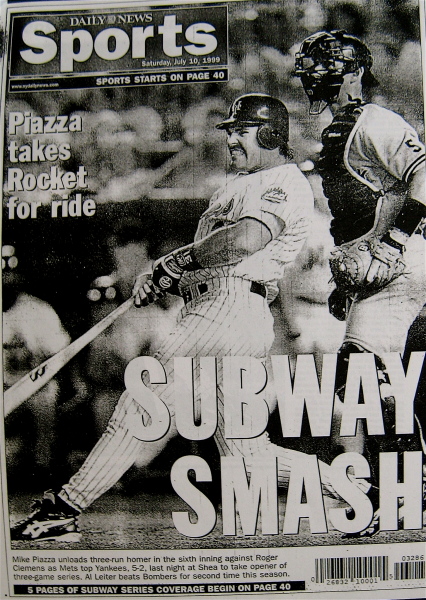
Before he was upstaged the next afternoon by the obviously more legendary Matt Franco, this Mike Piazza fella had himselfa pretty fair Subway Series moment on July 9, 1999.
|
|






