The blog for Mets fans
who like to read
ABOUT US
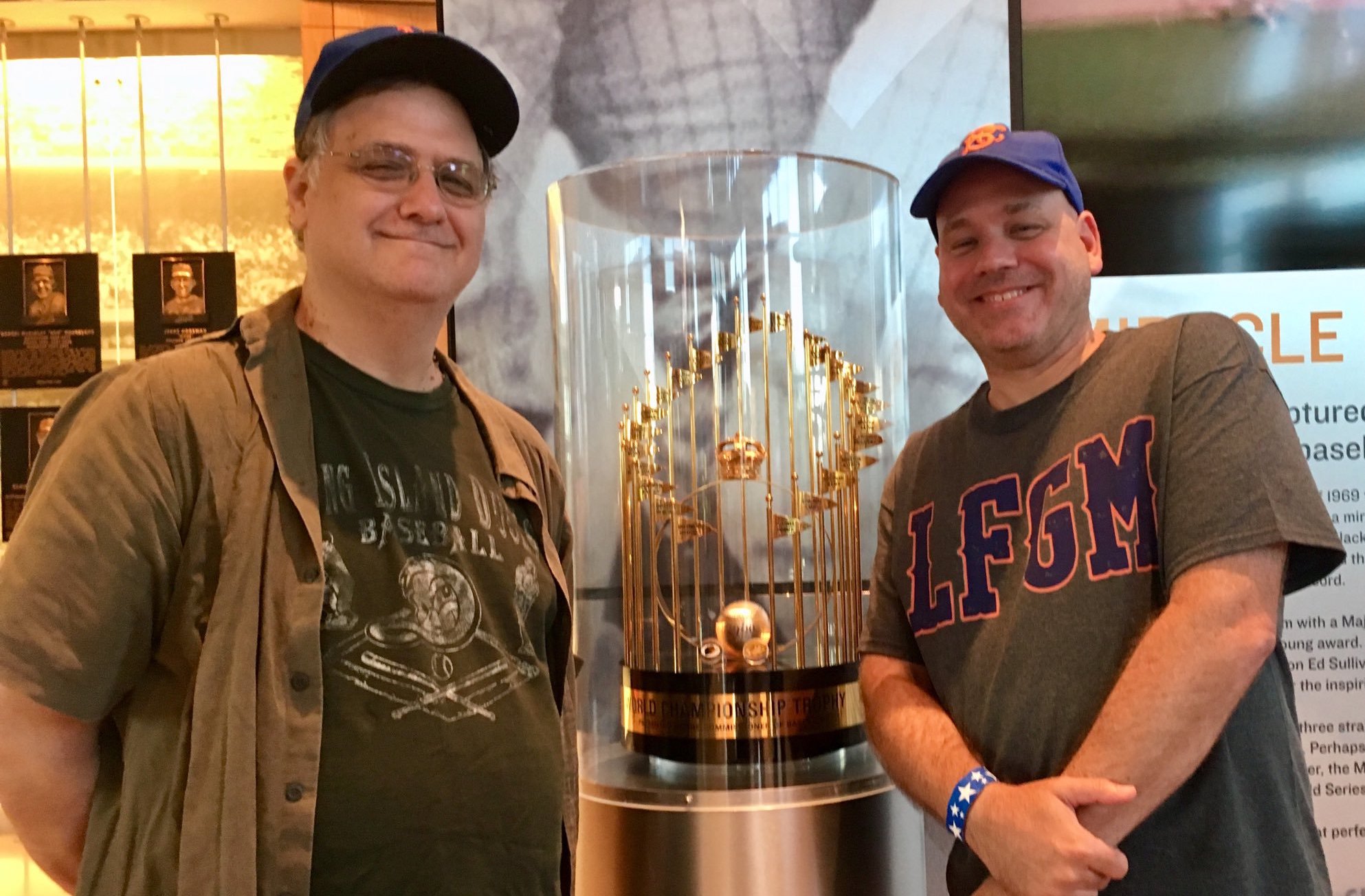
Faith and Fear in Flushing made its debut on Feb. 16, 2005, the brainchild of two longtime friends and lifelong Met fans.
Greg Prince discovered the Mets when he was 6, during the magical summer of 1969. He is a Long Island-based writer, editor and communications consultant. Contact him here.
Jason Fry is a Brooklyn writer whose first memories include his mom leaping up and down cheering for Rusty Staub. Check out his other writing here.
Got something to say? Leave a comment, or email us at faithandfear@gmail.com. (Sorry, but we have no interest in ads, sponsored content or guest posts.)
Need our RSS feed? It's here.
Visit our Facebook page, or drop by the personal pages for Greg and Jason.
Or follow us on Twitter: Here's Greg, and here's Jason.
|
by Jason Fry on 28 April 2008 3:00 pm One of the definitive events in recent Met years happened on April 6, 2006 — Carlos Beltran, after being treated shabbily by the Shea faithful for much of 2005 and booed during a slump in the early part of his next season, hit a home run, circled the bases and then plunked his behind on the bench, obviously angered by the fans' sudden about-face and demands for a curtain call. As the cheers continued, Julio Franco came over and spoke quietly but pointedly to him, after which Carlos popped out of the dugout for a wave. It was quick and it was grudgingly done, but it was the end of booing Beltran — he and we were off on a magical season.
Fast-forward to yesterday, with Carlos Delgado mired in what's either a horrible slump or the middle stages of the end. After his second home run of the day — an old-fashioned Delgado no-doubter off the scoreboard — the fans who have booed him mightily at Shea of late wanted their curtain call. But Delgado wasn't coming out — and there was no Julio Franco to suggest he rethink that decision.
The tabloid and radio debate over whether that was a bad move will go on for a bit, with what Delgado does tonight against Pittsburgh having potentially serious bearing. Delgado said yesterday that that kind of thing isn't his style, citing respect for the game — and the Associated Press backed him up with the tidbit that he's only taken curtain calls for a four-homer performance and his 400th round-tripper.
Logical enough, but awfully facile as explanations go. Delgado's a smart guy. He knows fans, and he knows New York. He knows perfectly well that what he was given yesterday was a peace offering, and he declined it. Which is his right, of course — he's been treated poorly by a fan base for whom “the natives are restless” would be a perilous understatement these days, and I don't blame him for refusing to bask in the warmth of their fair-weather affection. On the other hand, that rejection is an invitation for even-heartier abuse — and the comment about respect for the game, with the insinuation that the fans lack it, won't be missed by the boobirds.
I've found myself shifting a little where Delgado's concerned. While I haven't booed him, I haven't exactly been in his corner. By even the kindest measure his play has been atrocious this year both at bat and in the field. But what continues to burn me is the ever-flammable subject of 2007. For all Delgado was hailed as a clubhouse leader when he arrived, I remember him being in evidence off the field twice last year — once during the farcical week when Paul Lo Duca was supposedly a racist, and again when he was telling the New York Observer that the Mets got kind of bored out there. Neither particularly endeared him to me. (Though on Saturday CW11's cameras caught him consoling Aaron Heilman in the dugout after Heilman absorbed his own latest blistering of the fans — a welcome sight, but the kind of thing I thought we'd get from him routinely.)
But this column by the peerless Tim Marchman moved me to a bit of pity — Marchman offers a cold-eyed dissection of Delgado's woes, with little hope for a turnaround, but tempers that grim analysis with the observation that “one just hopes that the fans and even the writers keep in mind that baseball is hard. Don't get down on the man: Even if it isn't enough, he's doing what he can.” And there's no reason to doubt that. Delgado appears to have gotten old a couple of years earlier than we'd thought he would, but that's not a hanging crime. Gary Carter and Keith Hernandez and Edgardo Alfonzo, to name just three, all had the same thing happen to them. I'd like to think I never would have booed them, no matter what the circumstances.
Saturday, too, was a bit of an eye-opener where Delgado was concerned. Sitting in the bleachers with Greg and Emily and Joshua was fun for a lot of reasons, but it was an eye-opener about some baseball basics that I'd never appreciated because of years of seeing balls in play primarily from the camera behind home plate.
1. Losing a ball against the sky is easier than you'd think. Endy and Church both struggled with fly balls Saturday afternoon, and from the bleachers it was easy to see why. The best possible description of the sky was “baseball-colored” — once balls cleared the top of the stadium, it was touch and go just where they'd gone.
2. He really isn't going to throw that runner out. Runner on second, single to center, runner is heading home, the center fielder has the ball — and then you mutter when the center fielder just lobs it in. There wasn't a possible play on him? Really? Really. The view from the home-plate camera is foreshortened. When Francoeur rushed home in the sixth on Prado's single and Beltran flipped the ball in, I knew by the timing of events that it was exactly the kind of play that would have had me wondering if the run was assured of scoring. Watching it from behind Beltran's position, it was obvious he had no chance at a play. That camera lies about just how far it is to home plate.
3. Most fly balls have no chance. I'm rarely fooled into thinking flyouts are home runs or doubles anymore (heck, just look at the outfielders if you can't figure it out off the bat), but there's no doubt at all from behind the outfielders. The sound, velocity and trajectory of a well-struck ball are instantly and obviously different from a long but routine fly.
Delgado's drive in the fifth — the one Mark Kotsay caught on the warning track and thought was the third out — was different. It was hammered, and knocked down just enough by the wind to stay in the yard. And then he got booed for it, by a crowd that included lots of people yelling excitedly for balls the second baseman reeled in 30 feet into the outfield. I wouldn't feel charitable after too many days of that either.
But finally, there's this difference between the two Carloses and their curtain calls. Beltran was beginning the second year of a long stay in New York, one that had begun on a difficult note. Handed an olive branch, he had to take it — or run the very real risk of having to hear about that refusal from the fans and the beat writers forevermore. This is Delgado's last Flushing rodeo — barring a Lazarus-like turnaround, he's getting bought out before Citi Field opens and either moving to the American League or hanging them up for good. Beltran had to come out, for any number of reasons enumerated hastily by Julio Franco. Delgado did not, and didn't.
by Greg Prince on 27 April 2008 10:57 pm I got to spend an extra half-hour with my wife. I got a foam finger. I got to meet a mezzanine icon. I got a kid an ice cream cone. I got my 89th starting pitcher. I got three substantial home runs. I got a fearless catch from a fearless rightfielder. I got my third win covering two ballparks in a span of four days. I got my fourth consecutive triumph over our most bitter rivals. I got the 4:24 at Woodside. I got home earlier and with less angst than yesterday.
I didn't get Carlos Delgado returning my appreciation for him. I don't get that it's a big deal.
I've been baseballing like crazy since the gun sounded on the home season. I tied an April record for most Shea games attended and, precipitation pending, I'm not through yet. Throw in the trip to Washington (reflections on Nationals Park still to come) and I've been incredibly indulged, mostly by myself, occasionally by others — such as my Sunday hosts, the legendary Chapmans. Go to a game with Sharon, Kevin and Ross and it is Chapmania all around in the best sense of the made-up word.
So we had fun and I had foam. I nearly didn't have the latter. I was enjoying a bagel and such with Stephanie this morning and opted for a later train than planned, knowing full well that only the first 25,000 would get fitted for their complimentary puffy palms, one of those items I don't really need but didn't realize how much I wanted until I saw I'd missed out on them at Gate E. It didn't annoy me until I saw the Gate B crowds were still getting theirs even though their tickets were scanned minutes after mine. Grrr…
I put aside my huffery over my lack of puffery and joined the gang for a game whose result never felt much in doubt, even if it was against the sworn enemies of Shea satisfaction, the Atlanta Braves. I chilled out soon after arriving with two helpings of lineless Carvel, one for me, one for Ross, payment for an autumn wager when his mom's school beat mine in some sport I can barely remember caring about. My spoon wasn't to the bottom of the helmet when the bat of Raul Casanova nearly produced sprinkles. In the spirit of asking what have Brian Schneider and Ramon Castro done for me lately? I sure do like our new catching platoon.
John Smoltz was as untroubling as Tim Hudson, which is to say neither man could hold a candle to the guy with all the J's in his name from Friday. Nelson Figueroa, meanwhile, continued to warm the cockles of his relatives and the rest of us. Happy to add him to The Log, happy to raise my lifetime regular-season home win total to within two of 200, happy and amazed to note I haven't seen a loss to the Braves since 2006…and I see the Braves a lot.
It won't show up in the boxscore, but I drew face time with the one and only Kowalski (or KOWALSKI 69, if you've only seen/heard him from a distance). It was a chance meeting in the mezz concourse somewhere off his Section 18 hyping spot, but it was a marvelous interaction. Beer and kind words were graciously offered. He shouts, we blog…it's all good. (Also gratified to meet commenter Dykstraw on the 7 yesterday; hope the Donovan's burger was a hit.)
The only item absent from a potentially extraordinarily happy recap as the game wound down was my damn foam finger. It says #1 FAN on it, and I refuse to acknowledge 25,000 people in my midst today ranked ahead of me. I'll step aside for Ross and maybe Kowalski, but the other 24,998 of you are on notice.
Not to worry, though, because I was experiencing Chapmania, and the Chapmans have a way of making things happen. Kevin, who coaches baserunners from his seat better than Matt Galante ever did from the third base box, scooped up someone else's leave-behind before I even had a chance to scavenge. I was foamy, I was whole. Spurred by my completion, I somehow found the right ramp, crossed the right street, got on the right superexpress and was whisked eastbound on the LIRR before I realized I wasn't going to have stare at my watch and tap my foot (as I did yesterday when Woodside trackwork got my goat).
Sounds like a great day, huh? So why is it I'm hearing and reading that the big thing that happened this cloudy but beautiful Sunday was that Carlos Delgado, he who smashed two very round-trippers, didn't take a curtain call? We mezzanineans who were supportive with our applause even before his first swing didn't seem to mind we didn't get a bow, a tip or a wave. Would have been nice if we had, wasn't so bad that we didn't. We understood why he might have been reticent after the April he's endured, a month when his slumping ways were little tolerated by a vocal minority. By the time it was obvious Delgado wasn't curtain-calling us back, we had moved on to encouraging Casanova some more, just as we had relentlessly acknowledged Ryan Church for his spectacular catch and body bounce at the wall moments earlier. We were too overjoyed by the final result in progress to get hung up on a pointed lack of communication from our maybe moody (and highly compensated) first baseman.
I had a fine seat, good company and a great win. I was even given the finger in the best possible manner. Delgado didn't act extraordinarily grateful for being heartily feted one day after he was ridiculously booed for booming a ball that was caught at the track? When you read later or tomorrow that “the fans” were disappointed or spurned by Carlos Delgado, understand that at least one of us — and probably a lot of us — were perfectly pleased by their Sunday in the park with Mets.
by Greg Prince on 27 April 2008 12:10 am How is it remotely possible that Shea and I got to its last year together without me and its bleachers making mutual acquaintance? It's no longer a relevant question because (cue the Colbertian fanfare), I DID IT!
So much excitement for sitting as far from home plate (non-vertically) as you possibly can, but it's been my mildly holy grail since 1979 when the bleachers first went up in left field. I've been almost haunted by them. That fall, eleventh grade, Joel and I took a bogus class called Business Law whose textbook offered a hypothetical verbal contract between two people regarding the resale of two tickets to “the bleachers at Shea Stadium,” which was strange because there had been no bleachers at Shea Stadium when the book was published. We informed our teacher of how bizarre we found this example. He didn't care. And neither did the Mets. The Mets couldn't just sell bleachers tickets like every other team that had a bunch of benches. They made it a thing…a generally unavailable thing.
I'll get there eventually, I thought. Sure, they say they're only for groups of 50 or more, but those bleachers have to open their golden chain link fence to the likes of me. I'll get with a group. I'll make 49 friends. I'll find a use for these seat cushions they keep giving me that would just be perfect under my rear end out there. I just know I'll reach those bleachers.
But I never did. Never did the Pepsi can-or-bottle thing after it became the Pepsi Picnic Area; just didn't have the Wednesday afternoons free to stand in line. Once in a while, usually when it was freezing and the Mets were putrid, mets.com would invite me to rush over if I printed something out. That didn't work for me either. But my chance will come. I know it will. I would go on to sit in Diamond View Suites and Metropolitan Clubs and right behind home plate and adjacent to a dugout and in front of Tommie Agee's marker and within peeling distance of the Apple and all the way up in Row V where the world doesn't get any higher. I'd sat everywhere except the one place I really wanted a crack at.
The seasons passed. The opportunities did not present themselves. Until today.
I wasn't attached to a group per se, except for the traditional all-star cast of Faith and Fear's extended family (Jason, Emily, Joshua). Our in was a fundraiser for the Epilepsy Foundation of Long Island, part of the Jack Lang Day festivities. For the first time I could remember, crashing the gates of the bleachers was as simple as buying a ticket, one that included a charitable component and a little buffet action.
Hell yes! Bleachers here I came!
I'm happy to report they didn't disappoint. They were as exotic as they were accessible. It was like being at Shea and having Shea in front of you and being in another Shea all at the same time.
Why did they hide this from me for nearly 29 years? I loved it for some reason. For many reasons, actually.
• There was the legendary picnic tent, at least from the time somebody handed me a bureaucratically tangled wristband until the setup was arbitrarily put away in the middle innings. It wasn't extravagant, but it was the picnic tent. All that was missing was Mike Piazza taking Ramiro Mendoza to its roof.
• There was the Keyspan sign not as an unimaginable target but as a tall neighbor.
• There were the championship flags over my left shoulder.
• There was a bathroom with no lines.
• There was Mr. Met, a pro's pro who gave Joshua a big league hug and his mom ample opportunity to fish out her camera. Honest to god, the difference between Mr. Met and Sandy the Seagull is the difference between the majors and single-A.
• There was a brief glimpse inside the Braves bullpen, a long enough look to cast an effective evil eye on the otherwise impenetrable Tim Hudson.
What I missed in sightlines to the infield was more than made up by understanding a little better what fly balls look like to the outfielders. We couldn't see DiamondVision but we heard it just fine. And when the organized fun of the eighth-inning singalong broke out (“I'm A Believer,” an honorable selection if you have to have one at all), it was kind of kicky when the ooohs boomeranged back at us from the regular seats.
The regular seats…how the other 99/100ths lived. Poor saps. They didn't get to stretch out in the sun. They didn't get to stamp their feet and make aluminum noise. They didn't get to wander around and around a four-row fiefdom like Joshua did. They didn't get not just their choice of ziti or pasta salad but BOTH! It may come as a shock to my system Sunday afternoon to learn the mezzanine doesn't offer the same all-you-can eat ethos.
It helps to be 1-0 in games at which I've sat in the bleachers. After Friday night's “don't just do something, stand there” approach to offense, I was wary that Saturday would wind up a wasted day in the Pepsi Panic Area. But, no, Gustavo Molina and the Mets used their allotted one inning of scoring to collect enough runs to withstand the slings and arrows of Braves dreaded and unfamiliar. John Maine gritted his teeth through five and it took a bullpen of millions to hold them back, but a win is a win — and though there were no shots over its fence, sitting at last in Shea's bleachers turned out to be a personal home run.
by Jason Fry on 26 April 2008 11:51 am “In the realm of sports, yeah, no question, it was a devastating loss. It was a devastating loss for us as a team, certainly for me as a player, and for the fans, no question about it. As a fan of sports and sports teams, I understand that feeling. But I guess I was approaching it more from a life standpoint and not so much from a sports standpoint. … Was that the right time for me to try to make that distinction? Probably not.”
Finally. Now go away anyway.
by Jason Fry on 26 April 2008 2:42 am Ladies and gentlemen, here they are, your 2007 New York Mets!
Wait, what's that? You're sure? But I see…
…a pathetic lack of offense
…indifferent defense
…inefficient starting pitching
…scattershot relief
…mental mistakes
…can-do blather from authority figures
…no indication that anybody wearing the uniform is ready to stand up and say enough's enough.
I thought that extra-inning win against the Phillies had finally lanced this infection (don't listen, Schneider), with the first two games at the Ex-Vet letting the poison drain out. But I was wrong. By too many indications this is the same badly constructed, poorly led, sadly complacent team I came to thoroughly dislike last year. Last summer I found out something I pretty much knew anyway, and would happily have gone to my grave never having confirmed: It's no fun disliking your favorite team. It turns one of the nicest things in life into a trial, and the best part of the year into a sweaty version of winter. I'd really, really like never to feel that way again, or at least not to know that dreadful feeling more than once a generation or so. But these days and nights feel horribly familiar.
I know I don't want to feel that way again. I take it on faith that most of the guys in the clubhouse and running the team don't want to feel that way again. But I can't do anything about it except type while steam whistles out of my ears. Since that's not true of them, I have only one question: Which one of you is going to put your foot down and inform all concerned that it's not acceptable for this year to be like last year?
by Greg Prince on 25 April 2008 5:44 pm Welcome to Flashback Friday: Tales From The Log, a final-season tribute to Shea Stadium as viewed primarily through the prism of what I have seen there for myself, namely 361 regular-season and 13 postseason games to date. The Log records the numbers. The Tales tell the stories.
8/11/84 Sa Pittsburgh 1-5 Gooden 1 11-22 W 3-1
Dwight Gooden’s eleventh Shea Stadium start was the first of his I ever saw in person. No disrespect to the other 87 Mets I’ve seen start at home, but I never looked forward to seeing a pitcher the way I did Doc.
How could you not? He was the sensation of the National League in 1984 — he and the shockingly surging Mets. While I was at school in Tampa during the spring and early summer, I would read descriptions of the scene at Shea and dream about what it would be like to be there for something like this, as related by Jim Kaplan in Sports Illustrated that June.
Dwight Gooden, the Mets’ 19-year-old rookie righthander, was scheduled to pitch against Montreal last Friday night, and the excitement mounted all day in New York. Offices buzzed with talk of his strikeouts. Radio stations led their sports reports with his name. People stampeded the Shea Stadium ticket windows, swelling the crowd to 39,586. Then, as Gooden built up two-strike leads against Montreal batters, the fans went bananas, clapping, screaming, whistling and waving “K” signs.
On that particular night, the Mets didn’t win. They fell to the Expos 2-1, but it was almost beside the point. Gooden struck out eleven Expos, with the fans who had waited seemingly forever for someone like him growing more and more frenzied with every pitch. As Kaplan put it, “the decibel level [was] increasing with each K … It was an occasion, an event, a spectacle … He’s a happening in New York, just as Mark Fidrych and Fernando Valenzuela were in their rookie years in Detroit and L.A.”
Mark Fidrych never came to Shea, but I was there when Fernandomania touched down. That was indeed a happening, even if it was the guy in the wrong uniform causing it. Mike Scott pitched, to that stage of his career, the game of his life, but nobody cared. It was Fernando Valenzuela, the 1-0 winner on May 8, 1981, for whom nearly 40,000 crowded normally moribund Shea. Sombreros were worn. The Mets gave out tortilla chips. It was exciting, if bittersweet, given that it was the visiting starting pitcher at the center of the fuss.
Not the case in ’84. It was all Doc and he was all ours. I would get my first look that counted (after seeing him in St. Pete that March) on a Saturday night against the Pirates in August. It was something to see, something to be a part of.
First up for Pittsburgh, former Met farmhand Marvel Wynne. Doc gets a strike on him. Then another. I’m up and applauding — CLAP CLAP CLAP. Just like I read about. Just like I saw on TV. Guy behind me taps me on the shoulder and asks me to sit down, it’s only the first.
Sorry, I say. It’s just that I’ve waited so long for this.
Wouldn’t take very long to get what I came for. Wynne struck out. I was back on my feet again, applauding wildly and unrhythmically. Doc had one K in the books, one instantly affixed to the facade of the upper deck in left. It was a ritual that would be repeated nine more times. Doc would blaze a fastball by an overmatched Buc. Doc’s curve would drop in for black & gold doom. The DiamondVision would display a shark swallowing a batter. The PA would blare the theme from Jaws. An alphabet of nothing but K’s would be extended.
Everybody was beside himself with joy. Everybody was standing in front of the guy behind him.
Hubie Brooks doubled home two runs. George Foster drove one over the fence. Jesse Orosco registered a save. The Mets won 3-1, but it was almost beside the point. Doc was the point. Doc’s 10 K’s. Doc breaking Jerry Koosman’s team rookie record for strikeouts. Doc being 19 and virtually untouchable.
What could be better than that?
***
It’s easy enough to remember Dwight Gooden’s role in the Dwight Gooden phenomenon. It was his, after all. But you can’t overlook the fans in accounting for what a big, big deal he and his strikeouts were. You can’t think of Dr. K without the literal hanging of K’s in his honor. That was my thinking when, in imagining the Countdown Like It Oughta Be, we had the Mets pay homage to not just Gooden but to those who came up with the K Korner koncept.
I faced one problem, however, in writing up that entry. Who was responsible? I could remember the K’s, I could remember the buzz around them, but I couldn’t remember the names of those who gave life to them. It was a couple of guys, I thought. Or maybe more. Or maybe one. After running some searches, I came up ‘Net-empty. The only clue I had came from Jack Lang’s eternally Amazin’ The New York Mets: Twenty-Five Years of Baseball Magic: a picture whose caption identified three fans hoisting K’s. One was Dennis Scalzitti who was said to have “originated the idea” and the other two were “his cohorts” Bob Belle and Neil Kenny. With at least that much information on hand, I credited them, as a unit, for having “founded the K Korner” and gave them the virtual honor of removing, in conjunction with Gooden himself, number 31 from our fanciful right field wall.
Funny how the Web works. I couldn’t find any concrete background on the K Korner before I mentioned it, but now I’ve been sent some by a person who read that entry. He’s seems a reasonably reliable source:
For the record, The K Korner was created in 1984 by two 22-year old guys from northern New Jersey named Dennis Scalzitti and Leo Avolio, and was present in the left field upper deck (Section 42) at every game Dwight Gooden pitched at Shea Stadium.
Kenny, our source says, was a “rabid” enough Mets fan, but just happened to be in the right place at the right time when the photo that wound up in the book was snapped. In ’84, it was Scalzitti and Avolio, from Doc’s early starts (when only diehards were in attendance) to his explosion onto the national stage, who were tracking strikeouts. Soon, with ESPN taking note, the K Korner was as famous as the Doctor himself.
Scalzitti’s distinctive handpainted red K’s on white posterboard hanging from the left field upper deck railing became a familiar and recognizable icon that summer, and fans were quick to jump on the bandwagon and get caught up in all the excitement of “swaying for a K” after Dwight got two strikes on a hitter.
1984 ended with Doc winning Rookie of the Year honors, but only half of the K tandem willing to see their phenomenon through to ’85.
Leo indicated he didn’t want to make the commitment to make the trek to Shea Stadium from Jersey anymore. Dennis begged to differ, and believed their efforts would lead to bigger and better things down the road. Regardless, Leo dropped out. In 1985 Scalzitti recruited his high school buddy Bob Belle as a replacement, and that was the year Gooden electrified the baseball world with one of the single greatest seasons any pitcher has ever had.
Indeed, Doc went 24-4 with a mind-blowing 1.53 ERA and 268 more strikeouts to go with the 276 from the season before. Doctor K was clearly established in his practice and those who hung out his shingle were steadfast in their support.
Dennis and Bob were besieged with newspaper and television interviews, as well as four appearances on The Joe Franklin Show. Their names, along with the trademarked name of “The K Korner,” were now a part of New York baseball history. Dennis and Bob marketed their K cards, t-shirts and bandanas via a mail-order company and received orders from all over the country as Mets fans everywhere got caught up in strikeout fever.
The next year was stupendous for the Mets if only pretty darn good for Dwight Gooden (17-6, 2.84 ERA, a mere 200 strikeouts). Yet it wasn’t at all bad for the K Korner duo.
Dennis and Bob signed a shoe contract with Nike. To date they are the only two fans to sign a contract of this sort. Nike reached out to Scalzitti and Belle and provided them with 27 laminated blue & orange K’s with a flaming baseball in the center. This logo would appear on a full line of “Dr. K” shoes and merchandise later in the year, and the executives at Nike felt they would achieve maximum exposure if the logo was promoted in The K Korner. At that time, Mike Lupica of the New York Daily News applauded this business deal and called Scalzitti an entrepreneur. The “K-men” were invited to some celebrity events that season, and were seen rubbing shoulders with everyone from Bob Murphy and Ralph Kiner to Nelson Doubleday, Frank Cashen, Mayor Ed Koch and Carly Simon. Security guards were provided (at Scalzitti’s request) to protect them from some of the more “enthusiastic” fans, and they posed for photos and autographed everything from baseballs and scorecards to a girl’s chest.
With the 1986 World Series won, the K Korner crested. One K went to Kooperstown, driven there personally by Dennis. One more trip to Joe Franklin’s show came, too, though it was a sad one. Dennis and Bob went on to announce they were giving up their perch. This was in the spring of ’87. The innocence surrounding Dwight Gooden had been sapped. But the memories would remain and are as indelible as those K’s.
Two games will forever stand out in my mind: Dwight had 16 K’s against the Pirates in late September 1984 and another 16 against the Giants in 1985. The entire stadium was just going completely NUTS!!! It was beyond description.
Anybody who watched Doc pitch then would agree, but I put particular stock in these recollections of what was “truly a magical time” at Shea Stadium. Why, you may be wondering, should we take this source’s word for it?
Because I lived it…I was there. My name is Dennis Scalzitti.
Yes, the Dennis Scalzitti, then the guy who started playing up the K’s, today the North Jersey-based owner of Coconut Joe’s Music-To-Go, a full-time DJ service. Apparently he still likes making people happy. His K partner Bob Belle, meanwhile, seems to have taken his inspiration from the likes of Gary Carter and has gone into a segment of the cleanup business. In writing to us here, Dennis had just one request:
Please make sure to let the fans know how much we appreciated their incredible enthusiasm and support from 1984 to 1986. Not even ONE time did we ever get harassed or given a hard time by the people sitting around us when we were standing up or running up and down the aisles whipping everyone into a frenzy. The fans were just so cool, and it’s very important they know how we fed off their energy and truly enjoyed being there to provide some entertainment for them.
This Friday’s Flashback turned out to be as much Dennis’s as mine, but that’s all right. I wouldn’t remember Doc’s eleventh Shea start so fondly if it weren’t for what Dennis began doing at the outset of ’84, for the passion he unleashed in the rest of us. That’s why you can’t tell the story of a stadium via only its ballplayers. That’s why sometimes, at the risk of being rude, you just can’t sit down, no matter what the guy behind you says.
Another tale of another fan of another team from another ballpark in another time, very much worth reading here.
by Greg Prince on 25 April 2008 2:47 pm They've got all kinds of banners and signs posted in Nationals Park. They might want to add this one around first after last night:
Under this glove pass the loveliest double play balls in the world.
To paraphrase from Jackie Mason's description of Ronald Reagan's presidency, Carlos Delgado is a wonderful baseball player, a terrific baseball player, a marvelous baseball player…it's just that baseball isn't his field.
Cripes. I know Oliver Perez decided to start the second game of a doubleheader in the middle of the one that was going just fine…and Aaron Heilman joined Jorge Sosa in popularizing the new Mets bullpen slam dance craze…and that Angel Hernandez remains, as my partner pointed out to me, an unindicted war criminal…but it was Delgado's inability or unwillingness to bend sufficiently down that I recall most miserably this groggy Friday morning. Carlos can be pissed off at the Worst Umpire in the World for smirking and muttering his calls, but he should be more pissed off at himself. Twenty-two, twenty-three guys who dress similarly can feel the same way.
So much for the knock on the Mets that they only win against lousy teams since they didn't do even that much Thursday — though to be fair, they did kind of defeat themselves.
Your 2008 Mets: They could be better, they could be worse, they don't look, after an eighth of a season, like they'll have much to do with the playoffs. And I could make pretty much the same assessment of Nationals Park…which I'll get around to doing in the very near future.
by Jason Fry on 24 April 2008 4:27 am Less than an eighth of the season is gone, which isn't anywhere near enough time to draw conclusions about a player, team or pennant race. But we're fans — what are we supposed to do, turn off the set and take the long view? Nah, we draw conclusions every night, shifting our stances until eventually all is said and done and what happened looks inevitable. (And more often than not we say we knew it all along.)
The conclusion about the 2008 New York Mets, fresh from Game 20? It's that they're stupendously average.
Yeah, they beat up on bad teams — particularly teams as punchless and inept as the Nationals, who right now are trying Manny Acta's much-revered patience with their complete inability to do anything. Yet they then, in turn, get beaten up by better teams — witness the recent manhandling by the Cubs, and the earlier unpleasantness inflicted by the Brewers. That's a classic sign of an average team. So too is the complete inability to have any kind of momentum — the Mets went from playing tight, taut ball against the Phillies (albeit the Jimmy Rollins-less Phillies, who are a very different club) to looking mopey and confused against the Cubs. That too fairly screams “average.” And — again, like average teams since time immemorial — they make it all but impossible to think that all will be fine once Problem X is solved, because Problem X keeps mutating. One night it's the crappy middle relief. The next night it's the thin bench. The night after that it's all those aging regulars in extended spring training. Give it another night and it's all the nagging injuries. And more and more nights, it's thinking that moving Castillo and Delgado around in the batting order just obscures the real possibility that the best spot for them both is in someone else's batting order. (Except Delgado is untradeable and Castillo is untradeable and will still be untradeable in fucking 2011, when he'll likely be playing second base by dragging himself around on his hands in a box, like Eddie Murphy in “Trading Places.”)
Yet every fifth day things are different. Every fifth day we know there's a good chance Johan Santana will remind us how above-average baseball players can be.
Tonight while I was hustling Joshua through some part of his bedtime routine, I heard Emily yelp, “I love Johan Santana!” Why? I couldn't guess — because there were too many answers to that question. Was he cutting through Nationals like a combine? He did that. Was he making a superb fielding play? He did that too. Was he helping his own cause by cracking a double? Hell, he did that twice.
Watching Santana, you feel like Met fans of a different generation must have felt watching Tom Seaver in '67 or '68 — a great player willing a less-great team to keep up with him, daring and all but demanding they be great as well. Which is fine, except we aren't supposed to be watching the '67 or '68 Mets. The '08 Mets supposedly have greatness within them. They're supposedly the class of the National League. Maybe in the Lake Wobegon League, but not here, not so far.
This isn't to say the new season is without its pleasures. There's baseball on a warm spring night, which is one of the grander parts of life whether you're 11-9 or 9-11 or 3-17. (OK, maybe if you're 6-14. Let's not overdo it.) There's the sharp, smart play of Brian Schneider and Ryan Church, which hasn't erased wondering why Lastings Milledge was exiled, but has lessened the sting. There are the feel-good stories of Angel Pagan and Nelson Figueroa and Duaner Sanchez, though one hesitates before proclaiming the rest of the chapters will be so uplifting. There's Billy Wagner, literally unhittable so far. (Though you know one of the next three guys he faces will get a hit. He's a Met, ain't he?) There's watching David Wright become an even better baseball player than he was last year, and wondering just where his ceiling lies.
All of that is nice. But it's not the same here-we-go oomph of watching Johan — and there's the problem. Every fifth day may be something to look forward to, but the other four were supposed to be must-see stuff too.
(Too gloomy? Quite possibly. Greg will be along by morning with a first-person report from D.C., which might be more cheerful. Though I doubt he'll be able to shed any light on that weird home-plate camera angle we kept seeing tonight. Kind of like watching baseball from a low-flying plane or a Tom Clancyesque spy satellite, wasn't it?)
by Greg Prince on 23 April 2008 4:00 pm 13: Sunday, September 7 vs Phillies
It is not exactly a family secret, ladies and gentlemen, that the Mets who took up residence in Shea Stadium 44 years ago weren't worldbeaters. Their records in the Polo Grounds? 40 and 120, 51-111. The trend continued for the first two seasons at Shea: 53 and 109, 50 and 112. Saying the Mets finished tenth four straight years was a nice way of saying they couldn't finish twentieth. That is why as much as the fans were in love with their team, they also came out to admire some of the great stars the National League had to offer in those days.
Today we have one of the greatest with us. Simply put, he personifies pitching — inconceivably excellent pitching — for a generation of baseball fans and remains the standard by which every flamethrowing lefthander who comes along is evaluated. A native of Brooklyn and a good friend of the Mets organization every spring, please welcome back to Shea Stadium, Sandy Koufax.
Now, as happy as we are to have Sandy visit us today, we have to admit he is not here solely for his own accomplishments, as plentiful as they are. You see, Sandy inadvertently became a yardstick for measuring what, in retrospect, may have been the first significant leap of progress in Mets history. You might even call it the first Mets miracle.
Not that Sandy Koufax didn't pitch well against all comers, but he enjoyed an incredible hold over Mets hitters from 1962 on, racking up a 13-0 mark over his hometown team by the latter portion of their fourth season, a résumé that included his first no-hitter. The idea that a ragtag bunch like the Mets could ever defeat Koufax…well, that seemed impossible to Mets fans who could only dream of competing on anything approaching his level.
But the impossible turned actual on August 26, 1965 when Sandy Koufax was outlasted — it seems blasphemy to say outpitched — by another lefty, this one just shy of his 21st birthday. The southpaw the Mets sent to the Shea mound that Thursday had all of one major league victory to his credit, but his performance earned him another. The great Sandy Koufax and the eventual world champion Dodgers were beaten 5-2, the first loss ever taken against the heretofore hapless New York Mets by the indomitable immortal.
The winning pitcher? An up-and-comer named Frank Edwin “Tug” McGraw.
As you know, ladies and gentlemen, it wasn't the last time Tug McGraw would have something to do with miraculous events at Shea Stadium. Tug would eventually convert from starter to reliever, become one of the best in the National League at closing games and then, in the summer of 1973, begin spouting a phrase that helped inspire the Mets on an Amazin' journey from the bottom of their division to the top of the flagpole.
Nobody pitched like Tug McGraw did down the final weeks of 1973 and nobody ever believed the way he did…or made Mets fans believe so wholeheartedly that anything is possible.
No individual in the history of this franchise or this ballpark represents the spirit of the New York Mets like Tug McGraw. Nobody ever showed a love of life or baseball more in or out of a Mets uniform. To honor his memory today in our Countdown Like It Oughta Be, we ask his onetime opponent, Hall of Famer Sandy Koufax, and his son, one of the most beloved recording stars in the music world, Tim McGraw, to take down number 13 for someone who brought this team better luck, greater hope and deeper faith than any Mets fan could have ever aspired to before he came along.
Number 14 was revealed here.
by Greg Prince on 23 April 2008 3:09 am Afternoon games at Wrigley…idyllic, no?
No?
Not this one. And that was the only one we get for 2008, which is OK from here. The Cubs are good and the Mets are relentlessly so-so, making it difficult to enjoy the ivy for the trees. The charm of America's most charming ballpark dissipates when you're losing 8-1 the day after the night you lost 7-1.
You can analyze the poor fielding by Delgado and the poor hitting by Delgado and the poor relieving by Delgado (what fun is blaming Jorge Sosa?), but I won't. The Mets defy useful analysis at the moment. The slippery slope of trying to unravel their ennui runs from “what's wrong now?” to “what's wrong tomorrow?” to “will it ever be righted?” and in about 15 seconds you're hosting one of those enlightening shows on SNY wherein second-tier WFAN talent shouts each other down for half an hour.
Let's go back to Wrigley instead. It looks so good on television. It looks so good in real life. It looks great in daylight. Get Ronny Cedeño the bleep out of there and you can't do any better for a few hours' commune with nature and baseball.
It boggles the mind to realize that not only was the darn thing built in 1914, it was built to play home to a Federal League team. A Federal League team, for cryin' out loud. Shea was sort of planned for a Continental League team, but it's not quite the same. Nothing's the same as Wrigley, no matter how many bricks are used by those who would be inspired by it. Compared to Wrigley Field, all those places are brick teases.
'Twas pointed out by Gary and Ron how Wrigley's the “template” for so many of the retro parks of the modern age — though not for limestone-based Nationals Park, the Mets' next stop and mine, too. We won't be seeing any more of Wrigley Field this season though a Mets prism, but we may as well get used to what they've got in D.C. as we play them down there nine times this year and nine or ten times every year for years to come. (Rumor has it we play nineteen different clubs in 2008, but mostly we seem to play the Washington Nationals.)
I look forward to telling you what it's like on the inside. If the Mets play the Nats like they did last week, it will be a far nicer place than Wrigley Field was this week.
|
|