The blog for Mets fans
who like to read
ABOUT US

Faith and Fear in Flushing made its debut on Feb. 16, 2005, the brainchild of two longtime friends and lifelong Met fans.
Greg Prince discovered the Mets when he was 6, during the magical summer of 1969. He is a Long Island-based writer, editor and communications consultant. Contact him here.
Jason Fry is a Brooklyn writer whose first memories include his mom leaping up and down cheering for Rusty Staub. Check out his other writing here.
Got something to say? Leave a comment, or email us at faithandfear@gmail.com. (Sorry, but we have no interest in ads, sponsored content or guest posts.)
Need our RSS feed? It's here.
Visit our Facebook page, or drop by the personal pages for Greg and Jason.
Or follow us on Twitter: Here's Greg, and here's Jason.
|
by Jason Fry on 2 May 2008 2:09 pm Lying in the dark after the Mets got the bejesus beat out of them by the Pirates, I came — reluctantly — to a conclusion. Even started working up the post in my head. And then wavered. Memorial Day seemed like a better time to make the point. Even though I doubted anything would change by then. Which means I shouldn't have wavered.
Tim Marchman's not wavering. And I agree with every point he makes.
It's time.
by Greg Prince on 1 May 2008 7:00 pm 11: Wednesday, September 10 vs Nationals
Ladies and gentlemen, tonight our Countdown Like it Oughta Be takes us back to an event in the history of our nation and our city that was undeniably tragic. But it also reminds us of how we as a people can unite and lift ourselves up from rubble when brutality confronts us.
It was seven years ago tomorrow morning that the skyline of New York was irreparably ruptured and the United States' sense of its security was forever challenged. The acts undertaken by despicable human beings on the morning of September 11, 2001 will never be forgotten by any soul who witnessed them or by anyone unfortunate enough to be touched, closely or remotely, by them.
But out of tragedy, there was uplift. And it began at, of all places, Shea Stadium.
In the days that followed the attacks of September 11, a baseball facility was converted into a vital staging area for humanitarian response. Those who sped to New York to help in the immediate and necessary municipal recovery operations were directed here.
They gathered supplies here.
They loaded trucks here.
They helped in any way they could here.
They rested here and then they went back to work here.
Many were called. Many more came. They were joined, as no more than concerned citizens, by members of the New York Mets, on- and off-field personnel alike, all of whom put in their own long hours to help their neighbors. Everybody gave of themselves and none sought fanfare for doing so. In the wake of those sad September days, as George Vecsey so eloquently put it in the New York Times, Shea Stadium was “sanctified”.
And that was before a single pitch had been thrown in competition in New York City after September 11. It is now the stuff of legend to recall that the first major sporting event New York saw, ten days after those dastardly attacks, was a game here at Shea, the Mets defeating the Braves 3-2, the crowd roaring not just at the result but at the fact that a game was being played at all.
Shea Stadium was where the road to normality in this city commenced on September 21, 2001. We won't forget the horror that came directly before it nor the immediate response of New Yorkers, Americans and good people everywhere to it. We will long remember the game as well; the players who played it under trying circumstances; the famous and the unknown who lent their labors to make the night extraordinary; and the thousands to whom we rightly referred then and refer now as heroes.
Any number of men and women connected to the recovery efforts that followed September 11 have a place with us on the sanctified grounds of Shea Stadium for this occasion tonight. It is to slight no individual or group that we have asked only a single person to walk out to right field and represent those collective contributions on behalf of all of them. No one in baseball and few in any endeavor were more committed to aiding his fellow New Yorker in the weeks, months and years that unfurled in the wake of this city's worst day.
Ladies and gentlemen, returning from Japan to remove number 11, please welcome home the manager of the 2000 National League Champion New York Mets, Bobby Valentine.
Number 12 was revealed here.
by Greg Prince on 1 May 2008 2:16 am I don't know. At a certain point it was so off-the-chart bad — it got funny. My central nervous system was telling me something.
—Aaron Altman, Broadcast News
Let's be clear that these things happen in the course of a season, no matter how good a club is. Teams lose badly sometimes. It can happen with no warning, even at home in the middle of the day in the middle of the week. The Mets have a history of such degradations falling out of the bright blue sky and onto their heads — even the really good Mets.
The 1969 Mets were spanked hard in a daytime doubleheader July 30, a Wednesday afternoon at Shea, by the Houston Astros, 16-3 and 11-5; things got so unseemly that Gil Hodges marched straight to left field to legendarily inform Cleon Jones he was injured. The 1986 Mets, behind Dwight Gooden no less, took it on the chin and probably up an orifice or two from the Reds, 11-1, on the Wednesday afternoon of July 9.
It happens. It doesn't necessarily reflect your overall operation. It doesn't mean you are what you ate, even if you just ate it big time.
Sometimes, of course, it does. I don't know that the Mets losing this afternoon, another Wednesday, by an undeniably embarrassing tally of 13 to 1 means they are the kind of team that is barely good enough to beat an otherwise lousy Pittsburgh Pirates one night and horrid enough to get their heads kicked in by them the next day. I do know that since the truly scintillating evening that Armando Benitez balked Jose Reyes around the bases and Carlos Delagdo took him deep into the Flushing night, your New York Mets are a strictly break-even proposition: 69 and 69 dating back to May 30, 2007. That's 138 games. That's 84% of a full season, all managed by Willie Randolph, all masterminded by Omar Minaya, all featuring the stars David Wright, Jose Reyes, Carlos Beltran, Carlos Delgado, John Maine, Oliver Perez, Billy Wagner, Aaron Heilman and others.
69 and 69 is more alarming than 13 to 1. 13 to 1 is just plain ridiculous. Take it from one who witnessed nine frigid innings of it from Section 1 of the upper deck.
Yes! Yes, I went to this abortion of a debacle of a fiasco of a game! Yes, this was my chosen midweek afternoon in the sun! And yes, this was the absolute worst pounding I ever saw the Mets absorb at Shea Stadium in 36 seasons of Logging such matters. Except for one night in Detroit in 1997 when I was more concerned with the ballpark than the ballgame, I had never seen the Mets lose by as many as a dozen runs.
I have now.
Statistically, it was the worst home loss I ever experienced. Emotionally, it wasn't in the same ballpark as the Day of Devastation exactly seven months earlier, but having sat through September 30, 2007 and April 30, 2008, I detected some eerie parallels:
• Seven runs in an early inning off a starting pitcher who showed no gumption as things got worse and worse.
• Luis Castillo unhinging the starting pitcher with a fumbled double play ball.
• Luis Castillo making the last out.
• The Mets looking like amateurs against a team allegedly not on their level.
• No crowds to fight through on the way to the exits.
Differences? That was a numbing afternoon for reasons that have been exhaustively documented. This was just farcical. Also, today was like 40 degrees colder and the entire season was not at stake. Plus, we didn't start on time this time. I was with my friend Rich whose wife is expecting in about six days. Her water has yet to break, but the Mets' did. Add “been at a game delayed because a ruptured main wouldn't allow hosing of infield” to my lifetime attendance record.
Either way, the Mets delivered a twelve-run, bouncing loss.
Omar help us if there are any more days like this at Shea Stadium, but I mildly pity anyone who hasn't sat through one of these from late start to silent finish. Seriously. This was one of those days when you could really understand the instinct to boo, but after the umpteenth Met miscue, you didn't have the energy to take part. This was one of those days when you remembered what 1978 felt like every day, when you imagined what 1967 felt like all year. It was blustery and sparse and bad but not the end of the world because it wasn't the end of the season. You can handle this a little better in April, even on the final afternoon of April. This was one of those days when the Nikon Camera Player of the Game was either the school group that kept up a LET'S GO METS! chant as the innings grew late and the sun grew elusive or the school group that filed out after the eighth but not before shouting toward the field, BYE METS!
I hope we're not all saying that soon where the 2008 season is concerned.
by Greg Prince on 30 April 2008 5:10 am Some nights we invoke Bob Murphy and offer a happy recap. Some nights we channel Gary Cohen when the big hit is outta here! Some nights we are thrilled to make like Howie Rose and put it in the books! Some nights we even have to agree with Fran Healy that Shea Stadium is rocking!
Tuesday night brought to mind the unlamented Steve Albert because the Mets won a game he might have called scintillating — except unlike Steve, we make no pretenses about our sarcasm.
That was not one of your more scintillating walkoff wins. But the key, after eleven innings, is it was a win and 187,932 fans or whatever fictional figure they posted as the paid attendance left less unhappy than they might have had it not been. Surely it could have gotten surly late.
But don't call me surly. Even if Santana's gopher is still nibbling a little too heartily. Even if Sanchez and Wagner have forsaken perfection as their guiding principle. Even if Reyes' sextet of on-base appearances was overshadowed by his inability to keep one Pirate off base at the worst possible moment. Even if Heilman…ah, you know from Heilman. And even if Delgado was burdened by no vexing decisions regarding curtain call or not to curtain call. Don't call me surly, because a win is a win is not a loss.
Let us not accentuate the negative. Let us glory instead in Ryan Chruch's lefthanded jacking, which can be impressive. Let us note the six times Jose Jose'd his way on base. Let us remember why we fell in love with Endy Chavez those two years ago, first and foremost for the offensive spark we see again now that Endy is playing and regaining traction (at least until Moises Alou returns and inevitably winds up in traction). Let us not forget that the only homers Johan surrendered were soloists and that he was otherwise clean. Let us hand it to Scott Schoeneweis for covering home as he did and to Raul Casanova for shoveling Schoeney the 2-1 assist that cut down Jose Bautista at the plate in the seventh. Let pause and ponder what kind of manager sets the wheels in motion so someone named John Wesley Van Benschoten can pitch to someone named David Allen Wright with the bases loaded in the bottom of the eleventh with less than two out.
I'm not sure, upon reflection, how that could have been avoided once Endy was balked to second and bunted to third, but it sure seemed more fait accompli than it had to. You put on Reyes, you let him take second and you then pitch to Castillo who walks. Could have the Mets, even our hard-to-hug Mets, not cashed in? Against the Bucs? David comes up, the annually feisty if perennially futile Pirates go down. One pitch, one fly ball, one win that couldn't be avoided, done deal. For Pittsburgh, he says at the risk of offending the gods, I suppose simply asking somebody to retire Wright and Beltran was not an option.
The vengeful spirit of Hans Wagner notwithstanding, what really spooked me was the matchup that had Duaner Sanchez facing Xavier Nady in the eighth. July 31, 2006 and everything after flashed before my eyes. Sanchez gets into a cab; Nady gets onto a plane; Oliver Perez comes into and out of his own; Guillermo Mota and Shawn Green arrive with much baggage; '06 grows less certain; '06 just misses being a year for the ages; '06 becomes '07; '07 becomes '07; '07 becomes '08; '08 becomes the year we look for excuses to be relentlessly pissed off at our team…or the excuses seek us out on their own. Maybe all that arguably sprung from the events of that red-letter date in Mets history is why even walkoff wins around here can sometimes seem a little less than scintillating.
But we'll take them. And don't call me surly.
by Greg Prince on 29 April 2008 7:38 pm An out-of-town tryout used to be a staple of the theater. It was where producers ran their musicals up the flagpole to see what was saluted and what sagged in the breeze before fixing up the rough patches, packing up the trunks and transporting the whole shooting match to the Great White Way. Like those barnstorming tours that wound their way from Spring Training north to Opening Day, you don’t get out-of-town tryouts much in the theater anymore.
The audiences for these Broadway-bound previews were generally in the Northeast, not far from New York, yet worlds away: Philly, Boston, Baltimo’, as the itinerary went in Kiss Me Kate. New Haven, too. Washington? Not so much as far as I know. Yet last week, I felt I was privy to a dry run of sorts: Another ballpark op’nin’, another show — one season before the spotlight will be beamed directly onto the Great Blue & Orange Way.
Of course I wanted to go to Nationals Park because it was there. Every Major League ballpark I’ve seen (and I’ve seen 32 now) is Everest to me. And of course I wanted to go because the Mets would be playing. But there was a little extra curiosity factored into my D.C. travel plans. The Nats would be playing their eighth home game ever in their new digs. Though I’d been to a few stadia in their first season, I’d never shown up this early in the life of a park. Thus, I wanted to get a sense, just under one year from the curtain rising on Citi Field, what an almost pristine ballpark feels like.
It feels pretty good, in its out-of-town way.
Ya gotta load up any assessment you make of a ballpark as a visiting fan with a suitcase of asterisks. It’s different for you because you’re there tonight and you’re leaving tomorrow. Even if you plan on returning, it’s not home, not yours. Even if the place has still got that new park smell, yours aren’t the nostrils that are unclogged after breathing in the stale air of its predecessor. The diehard Washington Nationals fan, however rare and relatively novice, is the one who just escaped from RFK. It may take that creature months to detect any drawbacks in anything that isn’t the Federal Baseball Penitentiary.
Nationals Park offers much nicer surroundings. The now-reabandoned RFKFBP was any port in a storm for the post-Expos. It was the Hooverville of the National League East. It was Olympic Stadium without the élan. Anything that succeeded RFK — with the possible exception of the Days Inn where I bunked for the night — would have been an improvement.
It was instructive to wander the concourses of Nationals Park, to gaze at the shiny seats and scoreboard, to try to figure out why they put stuff where they did and wonder what it will be like next year when it’s us getting the lay of our own land.
With Citi Field far along, I don’t know that the Mets are looking for cues from their divisional rival. They could do worse than to borrow generously from their DiamondVision or NationalVision or whatever it’s called. It’s huge and it’s clear. They could also note what the Nats missed, like a permanent tracker of what the batter did in his last at-bat(s). With so much high-def hardware at work, there should be relevant data always at the ready, not just Marlon Anderson’s height.
My friend Jeff and I sat in some very fine what we’ll call field level seats in short left last Wednesday night, pretty comparable to where I was eight nights earlier at Shea. There is definitely something to be said for seats that are tilted toward home plate. There is also something to be said for sloping the steps in such a way that once somebody stands up in your midst (to buy a hot dog, to sell a beer, to mindlessly stare), you the seated are not blocked from the action. Mild-mannered Jeff rightly morphed into a bear as backs and shoulders and heads kept us from seeing a damn thing. Given the genuine obstacle to line of sight this non-action represented, I’m guessing getting up constantly is a cherished local tradition.
New rule: If you have a rookie pitcher setting the world on figurative fire, stand and clap. If it’s the third inning and nothing’s going on but a 2-1 count, sit the fudge down. Perhaps the “tennis seating” decorum I’ve seen employed in other places (even Philadelphia), where you are momentarily kept from returning to your seat while baseball is in progress, should be de rigueur. Given the price of a ticket, you should be entitled to see as much of it as you (or Jeff) paid for.
Not that Nationals fans, even the one who lobbed a snide junkball about the high Met payroll (which explained why we won, according to him), struck me as rude. I’m not sure I saw a whole lot of Nationals fans, at least relative to the ton of outlanders who descended on Washington last week. If there is one tradition that trailed the Expos to their final resting spot, it was that we, as in the Metropolitan we, were everywhere. No tension because of the crowd composition, at least not from where I sat and craned. No booing of Mets by Mets fans for a change (we’re all in this together when we congregate elsewhere). No escalating drunken bravado on a Wednesday night à la what reports suggest has become the norm in certain slices of Citizens Bank. The Nats didn’t come close to selling out their eighth game ever in their new park and that was with a generous helping of us on board. As some have been known to suggest in the seat of government regarding other invasions, they should be greeting Mets fans with flowers and chocolates.
If they did, however, would they know where to find them? While Nationals Park did give lie to half of the old bromide that Washington is a city of southern efficiency and northern charm (I liked the line of golf-shirted greeters who profusely thanked us for coming), it doesn’t appear that all the kinks have been ironed out. Concessions still seemed a bit overwhelmed, even without an SRO audience. The dreaded taking of the bottlecap, which I thought was a Shea-only pre-emptive punishment, was exercised at one stand, but not at another. Uncertainty of how to work all the levers extended to more visible facets of the operation as well.
When Duaner Sanchez entered the game, the massive scoreboard identified him as UNKNOWN. Innings earlier, Angel Pagan, No. 16 on the Mets, was billed as Jay Payton, No. 16 on the Orioles — there was even a picture of our 2000 centerfielder in his Bird garb to complete the illusion that the Mets might win a pennant this year. (Payton was in the system, Jeff inferred, because the Nats played the O’s in an exhibition game, one of those dress rehearsals intended to, yup, iron the kinks out before the ballgames count.)
Anybody could make if not those mistakes then something like them. Shea was several decades old when its board ops declared Jason Phillips’ first Major League hit belonged to Vance Wilson. It was even older when it randomly assigned Pedro Martinez’s 3,000th strikeout a year ahead of time and to nobody in particular. At Shea, it’s quirky. At a brand new facility, it’s time for another run-through. For Citi Field, it’s a cautionary tale to really think through everything (like where to not mount a mile-high home plate camera), really test everything and really teach everybody how to use everything.
It’s perverse fun to nitpick — even Natpick — but there was a lot to like about the new place. It’s easy as hell to get to by Metro, which, in turn, is always easy as hell to navigate. Nationals Park is one block from the Navy Yard station which is already more efficiently coordinated after a game than the 44-year-old Willets Point-Shea Stadium stop. There are nice if not expansive nods to Washington baseball history around the main concourse and, let’s face it, there’s not all that much Washington baseball history to show off. The Nats even tip their caps to greats of the game from other cities (perhaps they understand much of their trade will come from elsewhere). Though you have to be pretty high up to notice the Capitol dome and such, the cherry blossoms planted above the outfield are a phenomenal District touch. Balls don’t seem to fly out of this joint any more than they did RFK, so the saplings are probably safe from falling objects.
The Nats skipped the bricks and the overwrought homages to a mythic baseball past. The clean, well-lighted, modern approach was refreshing even if red brick can serve as an effective Pavlovian cue to get fields-of-dreamy about one’s surroundings. You don’t always, however, need to be enveloped by a manufactured past. That said, there was something about Nationals Park that made it feel — and this isn’t intended to come out as derisive as it will — like a very nice and very large Grapefruit League park. It wasn’t sterile as much as not yet defined, not yet lived in. Maybe after eight games, it’s not supposed to be.
Nationals Park may not be the coziest bed & breakfast of ballparks, but it’s at least a reasonably functional Marriott. It’s very much worth a visit (though you should probably ante up for a reasonably functional Marriott if you’re staying over and eschew the Days Inn of Silver Spring, Md.; trust me on this one). The Mets will be back in August if it’s the Mets you want to see. I’d suggest seeing it before they sell the naming rights because, honestly, the best part of this particular ballpark relative to those I’ve visited in the past half-decade or so was the lack of a suffocating corporate presence. No kidding. I realized as I loped about before the game how nice it was to not be reminded every six feet that some great financial institution or fine American brewer was bringing me this baseball game.
That may sound like projected carping over World Class Citi Field, and maybe it is a little, but the way I noticed there was no corporation sponsoring everything is the way I used to notice when there was one. Know what I mean? It used to be strange to see a company name plastered all over the place. Now we accept it as a part of doing business like we accept so much of everything in this world. For a night, corporate naming rights weren’t a fact of ballpark life and it was a surprisingly welcome sight to not see.
As for trying to discern, pesky aesthetics aside, what our nights and days will be like as we edge closer to our new stage, you cross your fingers and you hold your heart that it will be worth the hype and worth the wait and worth the sacrifice of what many of us adore and are instinctively reluctant to let go. What will it be like when the new ballpark isn’t someone else’s, but ours? Duaner Sanchez’s mysterious D.C. identity notwithstanding, that is the great unknown.
by Greg Prince on 28 April 2008 10:46 pm 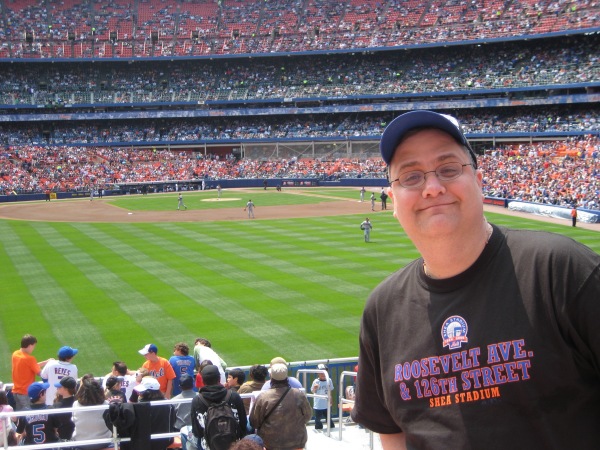
I think I’m a little too happy to have finally secured a spot in Shea’s sun-drenched picnic area, don’t you? But what a vista! As the t-shirt implies, it feels like the crossroads of the civilized world out there.
(Thanks to Emily for snapping what is now my all-time favorite picture of me and my ballpark.)
by Greg Prince on 28 April 2008 10:41 pm 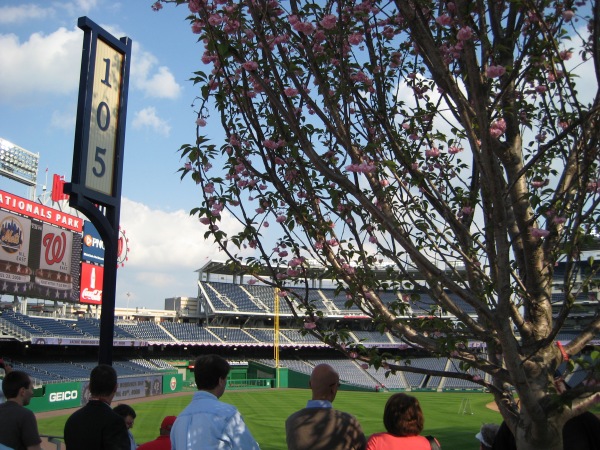
The newest ballpark in the Majors doesn’t break all that much ground, but I give it props for the cherry blossoms it planted along its main concourse. Very Washingtonian without being at all political. Nicely done!
by Greg Prince on 28 April 2008 10:38 pm 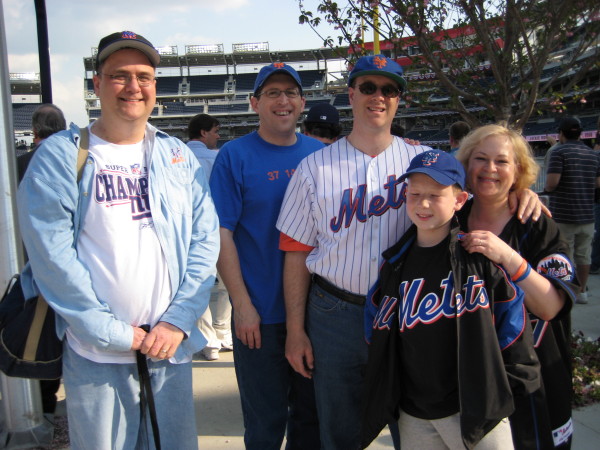
Mets fans were just happy to be anywhere after losing three in a row in Philadelphia and Chicago, but these Mets fans would be even happier hours later when their team would defeat the Nationals in Washington’s newest monument. From left to right, well, there’s me (wearing my Super Bowl Champion Giants shirt to subliminally annoy Redskins fans), my D.C. facilitator and well-numbered friend Jeff (formerly of Long Island, lately of Maryland) and the Chapmans Kevin, Ross and Sharon. We were by no means the only Mets fans at Nationals Park last Wednesday. People love it when New Yorkers descend on them en masse, however.
by Greg Prince on 28 April 2008 9:00 pm 12: Tuesday, September 9 vs Nationals
Often this year, ladies and gentlemen, as we have tackled our Countdown Like It Oughta Be, we have spoken to the extraordinary versatility of Shea Stadium and the kinds of events it has hosted. This grass and these walls have provided temporary grounds to icons spiritual, presidential and rock 'n' roll and to outdoor sports of all stripe.
But when you get right down to it, when you think of Shea and you think of something besides the Mets, you think of one other name. You think of the Jets.
Tonight we honor Shea Stadium's other long-time team-in-residence, the gang that called Flushing Meadows home for two solid decades. During their tenure here from 1964 through 1983, they made history, they wrought cheers and they made some very cold Sundays feel a little warmer.
Join us now in saluting an organization that started in the Polo Grounds, cultivated a new breed of fan and conjured a miracle of its own.
Join us now in welcoming home your New York Jets.
Football requires eleven men on the field at all times, thus we have gathered together eleven New York Jets greats who represent the team's most spectacular Shea Stadium achievements.
You can't have football without a kickoff, and no kicker was more identified with the tricky winds of Flushing Bay than he who battled them, ultimately successfully, for ten seasons before finding friendlier climes slightly to the west — Pat Leahy.
Playing special teams, one of the dangerous return men of his time, he led the entire National Football League in all-purpose yardage and three times in kick yardage; give it up for Bruce Harper.
On defense, four men who formed an unforgettable unit and heated up the Jets in their rise back to playoff contention in the early 1980s. Quarterbacks could never sit on their portfolios when the New York Sack Exchange was open for business. Give one more Shea Stadium welcome to these unstoppable defensive linemen: Abdul Salaam, Marty Lyons, Mark Gastineau and Joe Klecko.
From the offensive line, a player who spanned the two periods of Shea Stadium Jets glory, a member of the 1981 Jets team that played the final postseason football game ever at Shea Stadium and a rock for the '68 Super Bowl champs and '69 AFL Eastern Division winners as well, say hi to a guard for all seasons, Randy Rasmussen.
Staying on offense, we have three of the great weapons of the Super Bowl III champions, a trio of the most shimmering stars of the American Football League.
• He led the AFL in touchdowns scored in 1967, the year the Jets rose to respectability, and earned all-pro honors in 1968, Emerson Boozer.
• In the AFL championship game right here on December 29, 1968, he rushed 19 times for 71 yards and scored the first points of the Super Bowl two weeks later in Miami, Matt Snell.
• His six catches for 118 yards amid the bitter chill of Shea, including two for TDs, ensured the Jets would prevail over Oakland for the right to take on the Baltimore Colts and eventually secure supremacy of the football world. He is a pro football hall of famer and surely a Titan among Jets. At wide receiver, Don Maynard.
Finally, to lead his teammates down the Shea Stadium field one more time, there is no Jet more appropriate than he who will remove, yes, number 12, from the right field wall. Little more needs to be said than…ladies and gentlemen, from Broadway all the way back to Roosevelt Avenue, the greatest New York Jet of them all, Joe Namath.
Number 13 was revealed here.
by Jason Fry on 28 April 2008 3:00 pm One of the definitive events in recent Met years happened on April 6, 2006 — Carlos Beltran, after being treated shabbily by the Shea faithful for much of 2005 and booed during a slump in the early part of his next season, hit a home run, circled the bases and then plunked his behind on the bench, obviously angered by the fans' sudden about-face and demands for a curtain call. As the cheers continued, Julio Franco came over and spoke quietly but pointedly to him, after which Carlos popped out of the dugout for a wave. It was quick and it was grudgingly done, but it was the end of booing Beltran — he and we were off on a magical season.
Fast-forward to yesterday, with Carlos Delgado mired in what's either a horrible slump or the middle stages of the end. After his second home run of the day — an old-fashioned Delgado no-doubter off the scoreboard — the fans who have booed him mightily at Shea of late wanted their curtain call. But Delgado wasn't coming out — and there was no Julio Franco to suggest he rethink that decision.
The tabloid and radio debate over whether that was a bad move will go on for a bit, with what Delgado does tonight against Pittsburgh having potentially serious bearing. Delgado said yesterday that that kind of thing isn't his style, citing respect for the game — and the Associated Press backed him up with the tidbit that he's only taken curtain calls for a four-homer performance and his 400th round-tripper.
Logical enough, but awfully facile as explanations go. Delgado's a smart guy. He knows fans, and he knows New York. He knows perfectly well that what he was given yesterday was a peace offering, and he declined it. Which is his right, of course — he's been treated poorly by a fan base for whom “the natives are restless” would be a perilous understatement these days, and I don't blame him for refusing to bask in the warmth of their fair-weather affection. On the other hand, that rejection is an invitation for even-heartier abuse — and the comment about respect for the game, with the insinuation that the fans lack it, won't be missed by the boobirds.
I've found myself shifting a little where Delgado's concerned. While I haven't booed him, I haven't exactly been in his corner. By even the kindest measure his play has been atrocious this year both at bat and in the field. But what continues to burn me is the ever-flammable subject of 2007. For all Delgado was hailed as a clubhouse leader when he arrived, I remember him being in evidence off the field twice last year — once during the farcical week when Paul Lo Duca was supposedly a racist, and again when he was telling the New York Observer that the Mets got kind of bored out there. Neither particularly endeared him to me. (Though on Saturday CW11's cameras caught him consoling Aaron Heilman in the dugout after Heilman absorbed his own latest blistering of the fans — a welcome sight, but the kind of thing I thought we'd get from him routinely.)
But this column by the peerless Tim Marchman moved me to a bit of pity — Marchman offers a cold-eyed dissection of Delgado's woes, with little hope for a turnaround, but tempers that grim analysis with the observation that “one just hopes that the fans and even the writers keep in mind that baseball is hard. Don't get down on the man: Even if it isn't enough, he's doing what he can.” And there's no reason to doubt that. Delgado appears to have gotten old a couple of years earlier than we'd thought he would, but that's not a hanging crime. Gary Carter and Keith Hernandez and Edgardo Alfonzo, to name just three, all had the same thing happen to them. I'd like to think I never would have booed them, no matter what the circumstances.
Saturday, too, was a bit of an eye-opener where Delgado was concerned. Sitting in the bleachers with Greg and Emily and Joshua was fun for a lot of reasons, but it was an eye-opener about some baseball basics that I'd never appreciated because of years of seeing balls in play primarily from the camera behind home plate.
1. Losing a ball against the sky is easier than you'd think. Endy and Church both struggled with fly balls Saturday afternoon, and from the bleachers it was easy to see why. The best possible description of the sky was “baseball-colored” — once balls cleared the top of the stadium, it was touch and go just where they'd gone.
2. He really isn't going to throw that runner out. Runner on second, single to center, runner is heading home, the center fielder has the ball — and then you mutter when the center fielder just lobs it in. There wasn't a possible play on him? Really? Really. The view from the home-plate camera is foreshortened. When Francoeur rushed home in the sixth on Prado's single and Beltran flipped the ball in, I knew by the timing of events that it was exactly the kind of play that would have had me wondering if the run was assured of scoring. Watching it from behind Beltran's position, it was obvious he had no chance at a play. That camera lies about just how far it is to home plate.
3. Most fly balls have no chance. I'm rarely fooled into thinking flyouts are home runs or doubles anymore (heck, just look at the outfielders if you can't figure it out off the bat), but there's no doubt at all from behind the outfielders. The sound, velocity and trajectory of a well-struck ball are instantly and obviously different from a long but routine fly.
Delgado's drive in the fifth — the one Mark Kotsay caught on the warning track and thought was the third out — was different. It was hammered, and knocked down just enough by the wind to stay in the yard. And then he got booed for it, by a crowd that included lots of people yelling excitedly for balls the second baseman reeled in 30 feet into the outfield. I wouldn't feel charitable after too many days of that either.
But finally, there's this difference between the two Carloses and their curtain calls. Beltran was beginning the second year of a long stay in New York, one that had begun on a difficult note. Handed an olive branch, he had to take it — or run the very real risk of having to hear about that refusal from the fans and the beat writers forevermore. This is Delgado's last Flushing rodeo — barring a Lazarus-like turnaround, he's getting bought out before Citi Field opens and either moving to the American League or hanging them up for good. Beltran had to come out, for any number of reasons enumerated hastily by Julio Franco. Delgado did not, and didn't.
|
|






