The blog for Mets fans
who like to read
ABOUT US

Faith and Fear in Flushing made its debut on Feb. 16, 2005, the brainchild of two longtime friends and lifelong Met fans.
Greg Prince discovered the Mets when he was 6, during the magical summer of 1969. He is a Long Island-based writer, editor and communications consultant. Contact him here.
Jason Fry is a Brooklyn writer whose first memories include his mom leaping up and down cheering for Rusty Staub. Check out his other writing here.
Got something to say? Leave a comment, or email us at faithandfear@gmail.com. (Sorry, but we have no interest in ads, sponsored content or guest posts.)
Need our RSS feed? It's here.
Visit our Facebook page, or drop by the personal pages for Greg and Jason.
Or follow us on Twitter: Here's Greg, and here's Jason.
|
by Greg Prince on 2 June 2008 3:00 pm Bill Parcells (or maybe it's John Madden) likes to glorify football players who so come to play that you can toss the coin in the parking lot and they'll line up at midnight and knock the other guy on his ass. Wherever, whenever…they're ready.
I can dig that. I can dig the Mets winning wherever, whenever. As one who has meticulously inscribed the result of every single Mets game he has ever attended and as one who cherishes every single Mets win for which he has had the pleasure of inking a big ol' W, I'll take 'em where I can find 'em, wherever they put 'em, whenever I have to come and get 'em.
That said, even with the 201st win of my Log career easily secured and safely ensconced between 8:07 PM and 11:02 PM last night, even having benefited from whatever charge Johan Santana got out of an additional six hours and fifty-seven minutes' rest, I hereby introduce a measure to abolish Sunday Night Baseball.
Get it out of our lives. We don't like it, we don't need it, we don't want it.
We don't want to be on Sunday Night Baseball. We don't want to sit and stew for seven perfectly good hours on a beautiful Sunday afternoon. We don't derive any bonus from the exposure on Sunday Night Baseball. My apologies to any Mets fans outside the immediate New York area who are grateful for a few dozen innings a year they wouldn't otherwise see, but it's not helping the greater good at all.
Find me the Mets fan who is relieved that Gary Cohen won't be doing play-by-play, who is enriched by Jon Miller. Find me the Mets fan who is so sick of Keith Hernandez and Ron Darling that he welcomes the insights of Joe Morgan. Find me the Mets fan who enjoys eschewing familiarity with his team for obnoxious relatives who barge in three or four times a year to get your story completely wrong, the kind of people who make you swear you will never, ever invite these people over for Thanksgiving again. Are you out there, mythical Mets fan who actually appreciates SNY getting Sunday off in favor of ESPN interpreting your team as some kind of poor relation? As some kind of auxiliary club activity for bored Gothamites?
I used to think being on national television was some kind of reward or recognition for a team, that it meant you'd made it, that you had earned extra attention, that everybody getting a look at you confirmed your progress or your status. Instead, it's punishment for us, the hardcore fans. We get nothing from it, not a damn thing. We're not privy to fantastic announcing we'd otherwise miss. We're not receiving a brilliant perspective from fresh eyes that will help us understand the big picture. We get Jon Miller's tired blowhard act and Joe Morgan's pompous nonsense.
And we get 8 o'clock starts. On a Sunday. On a Sunday! Who on earth wants to wait around until 8 o'clock to watch a baseball game that could easily be played at 1 o'clock? And who on earth wants to wait around until 8 o'clock to attend a baseball game that not only could easily be played at 1 o'clock, but was supposed to be played at 1 o'clock, that was scheduled to be played at 1 o'clock?
Some weeks ago, my friend Joe asked if I wanted to go to one of the Dodgers games. Sure, I said, how about Sunday? Fine, he said, I'll get tickets. And he did. And very quietly, the damn thing was rescheduled. It's not a particular hardship for me as I keep pretty malleable hours. But Joe, like most adults, has to get up very early Monday morning. Joe would rather shred his scorebook than leave a game before it's over. Rubbing his eyes red, we stayed.
We were not in the majority. It's unfortunate enough when the Mets go in the tank as they have so often this season and the seats empty well ahead of the ninth. But on a pleasant night with a lovely win in progress, thousands and thousands headed to the exits ahead of the conclusion, especially families. By the ninth, it was mostly drunken 17-year-olds holding sway in the mezzanine.
Why the abandonment of ship by so many? It's not because they don't like baseball, it's not because they don't like the Mets winning, it's not because they choose to flaunt their prosperity by not watching all the game they paid for. It's because it's frigging late for people. It's a school night, for goodness sake. If you live in Flushing or Corona, it's convenient. If you live anywhere else, it's not.
Now if the ticket said “8:05 PM,” then caveat emptor and so forth. But it didn't. ESPN makes this call. ESPN could have made this call months ago. ESPN could have figured out media market 1 was playing media market 2, that by the first of June neither team's marquee value or competitive prospects would be spent, that its phoney-baloney Joe Torre story line would be in effect and it could have issued an edict unto the Mets that Uncle ESPN Wants You. Instead, tens of thousands of seats were sold to an afternoon game — a Sunday afternoon game whose conclusion generally averts bedtimes of all ages — and thousands of seats no doubt went wasted because, hey, people have lives, even baseball fans. Many of those who didn't waste their tickets had to issue themselves a curfew.
Seven hours later than planned for. An hour later than a normal night game. Font for confusion among uninformed ticketholders. Fodder for Phil Mushnick. Three excruciating hours of Miller and Morgan. An excuse to cancel the Mr. Met Dash.
I'm not asking ESPN to get out of the baseball business. They do several things well. They produce wonderful research. They have that handheld camera that records homers going official when the batter steps on the plate. They have on their side many able minds, even if none of them belong to Steve Phillips. They can do a doubleheader some other night of the week. I'll complain far less if they can start on Sunday nights at 7:00, which is prime time for the rest of television. If they wanted to show only West Coast games on Sunday nights, when at least those would be 4:00 local games there, that would seem mildly fair to somebody. Instead, it's the same thing year in, year out. They take our Sunday afternoons and rob them from us. They stick our team on Sunday night and they shove their atrocious announcers down our throats. They keep us out past midnight or they chase us from our seats by ten. They get me griping after a 6-1 win, for gosh sakes.
I like the Mets winning. I like Johan finding his groove. I like Carlos Beltran blasting a “390-foot home run” to the base of the scoreboard (somebody get Shea a tape measure). I like Ryan Church standing and remaining in one piece and hitting, too. I like going to a Mets game wherever they put it, whenever they put it. But Sunday Night Baseball's unique charms are completely lost on me.
by Jason Fry on 2 June 2008 4:16 am Hey, Mets! You've just put up a 5-2 homestand, playing the kind of baseball that makes even veteran fans and conspicuous doubters like us double-check that, yes, this was the same homestand that began with everyone wondering if Willie Randolph would emerge from his long-awaited meeting with the Wilpons and Omar still employed. So what's your reward? You get to fly all night and play in San Francisco tomorrow, of course! Thanks ESPN!
Willie Randolph, typically, said next to nothing after keeping his job. His actions were different, though: He played the rusty bench guys, sat down Carlos Delgado, gave His Boredness a rich southpaw compliment in cheering him for getting his uniform dirty, and saw Beltran and Wright and Reyes stop creaking and start humming. Suddenly the Mets look like the team they were before last Memorial Day — and as it always is in baseball, we've gone (or are rapidly going) from wondering if we'll ever win another game to being mildly surprised when we lose one.
Emily, Joshua and I overnighted in Philadelphia Saturday, exiting the car just after Easley made the second out of the seventh, which is to say we skipped out before the turning point of the game. Last night we were talking with friends of ours (Phillies fans but, I assure you, good people) about Willie, about what had happened to the Mets for a year and about how good they really are or aren't. The conversation came around to how what we do as baseball watchers can often be reduced to telling stories that fit the already-established facts, and how we forget that it doesn't take much to turn one story into a very different one. If Ray Knight had ended Game 6 with a drive caught at the wall by Dave Henderson, nobody would talk about the indomitable swagger of the '86 Mets — they'd be a bunch of irresponsible substance abusers who squandered their potential. If the '07 Mets had gotten something respectable from Tom Glavine in the final regular-seasong game and made a respectable showing in the playoffs, we might well have waxed rhapsodic about how they'd held off the valiant Phillies and everything they'd learned pulling themselves out of free-fall.
But what's the alternative? I'm not a stat guy, which has nothing to do with any distaste for sabermetrics. To the contrary, in fact: I love that stuff, but I struggle to internalize valuable metrics such as VORP and RCAA and BABIP to the point that I can assess their values the way I can dissect the traditional measures, limited though they are. And then there's the larger problem for me, which is that I can't fit a stats-minded understanding of a baseball season's ebb and flow into the narratives we naturally want to impose on it. If the Mets rebound and go to the playoffs, the truest explanation of what happened could be that key players like Reyes, Beltran and Heilman regressed to the mean. But that's not a satisfying narrative. No, if that scenario comes to pass, we'll say something along the lines of how singling out Delgado was the wake-up call for an underachieving clubhouse, shaking the players out of their lethargy and restoring the team's focus. Will that be true? Quite possibly not. But it'll feel true.
Anyway. The story of a season may be shaped in retrospect, but the story of tonight's game seems fairly clear. One day we'll stop feeling mildly disappointed that Johan Santana didn't pitch a complete game, strike out 15 and heal the sick in the field boxes and the front half of the loge with his aura. One day, we'll watch him coolly dig his way out of an early hole and hold a team at bay the way he did tonight and be very happy with that. Did you see that called third strike on poor Blake Dewitt to end the seventh? Mercy. Oh, and kudos to Johan for doing something pitchers rarely do these days — exiting to a warm hand from the crowd, he actually tipped his cap.
Johan's supporting cast? Jose Reyes's electricity/stupidity ratio has been good enough to make me tempted to discard that unhappy measure, David Wright's bat could melt lead right now, Carlos Beltran looks awake and alive, Luis Castillo is moving well around second, and how about Ryan Church? Though somebody tell Brian Schneider to lay off the congratulatory helmet slap. It's a long way to San Francisco, even if you don't feel nauseous.
With a week of West Coast games on tap, you're going to be sitting around at 7:10 fidgeting. Fill up some of that empty time by ordering the famous Faith and Fear Numbers shirt, available right here.
by Greg Prince on 1 June 2008 2:33 pm The cork shot out of the right field mezzanine in the early evening Saturday, burst out of every section of Shea Stadium, exploded from the souls of Mets fans wherever they were watching or listening. Our bottle had been plugged up tight, but Fernando Tatis pushed from its upper neck the last vestiges of the stubborn stoppage that had kept our sanity, our happiness, our self-esteem from flowing freely for far too long.
All Tatis did was single home Nick Evans. All Tatis did was put the Mets up by a run in the bottom of the eighth. All Tatis did was finalize a three-run rally to overcome a two-run deficit. Tatis didn't win the game right then and there, the Mets didn't win the game right then and there, the Mets didn't clinch anything right then and there.
Yet we popped our corks as if he had. It was high fives all around. My bloggingly brilliant companion, who grew up almost down the block; who came, by his calculation, to 51 games in one season of his adolescence; acted as if he had never seen the Mets score a run before. High Five! The loopy woman behind me, with vocal cords obviously fused together with the Queens DNA of Edith Bunker and Estelle Costanza (WILLLLIIIE! USE CAAAASSSTRO!), spoke to me the language of palms. High Five! Man to my right, alternating hopeful exhortation and groaning acceptance all afternoon, had just hit the jackpot. It paid off for both of us in a High Five!
High Fives…I was giving as good as I got.
It had been a while, a very long while, since I had exchanged high fives of any length, of any force, in any multiples to everybody in sight at Shea Stadium. A fiver here, a fiver there, but no velocity, no urgency, no sense that every hand within lunging reach in my row, in the row in front, in the row in back had to get slapped. Fivery had grown cold at Shea in 2008 — until the eighth. First Beltran's hang glider of a homer warmed us up, now Tatis' single brought us to a sizzle.
High Fives all around. High Fives for the Carlos homer. High Fives for the Fernando single. High Fives for the closer firing 15 pitches, 11 for strikes, 3 for swinging strike threes. High Fives for the successful reopening of Sanchez Bridge, the span that guarantees safe passage from the seventh to the ninth. High Fives for the put-upon starter who sucked up breaking bad and hung in like a mad man. A funny thing happened on the way to New Orleans for Mike Pelfrey: his trip was cancelled.
A High Five, too, for Endy Chavez. Endy Chavez battled the hell out of Chad Billingsley to close the seventh inning. Endy Chavez brought Mookie and Dunston to the plate. Endy Chavez, with catchers at the corners (everyone but CAAAASSSTRO!), took a ball, a strike and another strike. One-and-two, two down, two on, two out…and would have you bet a third of those wouldn't follow in a sec? That the Mets would waste this opportunity as they had wasted all others Saturday and for that matter Friday? That Billingsley would put away Endy and the Mets? That a second loss in a row, a second dismal loss in a row, was a sure thing? That the same old same old was in full effect as if Fernandomania had never broken out as recently as Wednesday?
But Endy Chavez battled the hell out of Chad Billingsley. Billingsley was supposed to be striding triumphantly to the dugout seconds after he went one-and-two on Chavez. But Endy fouled off the fourth pitch of the at-bat. And the fifth. He took a ball. Then fouled another pitch. And another. And another. And still another. Then he took a ball to make it three-and-two.
Then he fouled off another.
Endy Chavez wasn't giving up. Endy Chavez is on the Mets. Pythagorean Theorem demands we infer that the Mets weren't giving up, therefore how could we the Mets fans give up? Endy Squared + Mets Squared = LET'S GO METS! Squared. First and third, three-and-two, Endy up, Billingsley's pitch count crashing through triple-digits, the Mets still in this thing…
OK, so Endy popped to short. So the Mets didn't score. So it was still two-nothing Dodgers as it had been for what seemed like hours, seemed like days. But the Mets were somehow less dead than they had been since Thursday, less dead than we had grown used to them being during 2008, certainly less dead than they'd been at any juncture of any of my four previous trips to Shea (Opponents 27 Mets 12).
We could believe. We could sing along to “I'm A Believer” in the middle of the eighth. We're supposed to sing along to “I'm A Believer” every middle of the eighth but I've noticed that when the tenor of the times go awry, such as when the Mets are trailing 13-1 or 10-4 or 9-5 after seven-and-a-half, nobody is expected to believe anything but the worst, thus the singalong is shelved. Sing about believing when the Mets trail depressingly and probably insurmountably? What's the use in tryin'? All you get is pain. When we needed sunshine, we got…
Wait a sec. It didn't rain Saturday, not during the game. The forecast insisted there was an 80% chance of rain, floods, locusts, darkness, rivers turning to blood, all your popular plagues. There was a tornado warning in five New Jersey counties. Thunder was rocking Long Island as I prepared to take up Metstradamus on his sudden and gracious invitation to Cap Day. I was going to need more than a cap Saturday. I was going to need an ark.
Or so I thought. I stepped out of the house and there was not a drop of rain falling from the sky. I was outfitted in my trench coat and hauling a golf umbrella, but both were extraneous as the Mets' bats the nights before. It was warm and it was dry. And now, as late Saturday afternoon turned to early Saturday evening, it was bright as all get-out at Shea Stadium. I adjusted my cap to keep the sun from blinding me. Endy adjusted my mood to keep precedent from drowning me.
The Monkees did their thing. Duaner did his. David doubled. Carlos homered. The other one singled, too, setting off a chain of events that climaxed in the firelight, Fernando. There was something in the air this night, all right. Billy shut the Dodger door. Slammed it, actually. The fourth-place Mets had gotten back to .500 at the end of May. But nobody was combing for details after Wagner's final furious fastball. By then the cork was out, all hands were red and our crowd could not stifle itself. If ever tens of thousands of kindred spirits needed lifting, Saturday evening was then.
by Greg Prince on 1 June 2008 12:39 am 
Thanks to Mike Pelfrey’s gutty seven innings, Duaner Sanchez’s perfect eighth, Carlos Beltran’s unleashed power, Fernando Tatis’ clutch timing and Billy Wagner’s one-two-three ninth, I was able to record in The Log its 200th regular-season home win. After four consecutive losses, I was beginning to think it would never happen. But I always think that. I probably thought that prior to July 29, 2000, date of The Log’s 100th win.
Eerie if happy coincidences:
The Log’s first hundred wins came after 184 games.
The Log’s second hundred wins came after an additional 186 games.
The Log’s 100th win required an eighth-inning rally.
The Log’s 200th win required an eighth-inning rally.
The Log’s 100th win came on a Saturday afternoon.
The Log’s 200th win came on a Saturday afternoon.
I noticed Todd Zeile signing autographs almost to first pitch prior to The Log’s 100th win.
I sat next to a guy wearing a Todd Zeile jersey during The Log’s 200th win.
I would go to the Sunday game that followed The Log’s 100th win…with the guy with whom I co-author this blog.
I am going to the Sunday game that follows The Log’s 200th win…with the guy with whom I went to The Log’s 100th win — but I’m mentioning it in this blog.
Lincoln Logs were once popular.
Kennedy Airport less so.
by Greg Prince on 31 May 2008 1:38 pm The Mets hadn't risen so high this week that they were in danger of contracting vertigo, but I was feeling a little less than steady Friday among the upper boxes.
Never mind Row V (or my forthcoming Seven-Pack stay in Row Q). At least up there there's a railing to grab hold of as you make your way down the stairway from the stars, if not an oxygen tank as you make your way up its thousand steps. I was reminded last night that the most treacherous spot in Shea Stadium — besides behind Aaron Heilman — is the steep slope you have to negotiate if your ticket tells you you're in a UR Box B or A. Maybe you're nimble and you're fine, but I'm not and I wasn't.
In the best spirit of the Met offense, nothing really happened, but I didn't like the short trip to my seat. I really didn't like the guys in seats 3 and 4 rising every five minutes for another overpriced beer (or to rid their systems of the previous one). Nice guys, bad habits. I had the aisle, which I greatly appreciate for legroom, but all the getting up unsteadied me. With nothing to hold onto as I stepped onto the steps to let their thirsty asses out, I made myself a near-nuisance to those around me as I looked to grasp and clutch anything and anybody so I would feel more secure.
Sort of like looking to Nick Evans and Fernando Tatis for salvation.
When not being rousted, I was engaged in my usual nine-inning yapathon with Jim Haines, who invited me at about the last minute he could have for me to make it. I hadn't been to Shea on a Friday night all season (I've now seen them lose every day of the week but Sunday) and I hadn't been to Shea with Jim since the third date of the Collapse Tour, so it was worth the rush.
It's always worth the rush to join Jim. Actually, we've been joined at the proverbial hip since 2001 when we met and discovered we're basically the same person, at least in terms of topline interests and drill-down instincts. If you'd like to listen in on a four-inning critique of when and why M*A*S*H went downhill, two innings on what's irredeemable about six different radio formats and a three-inning version of Kiner's Korner in which Ralph unloads on everyone who ever did him wrong (Jim's arsenal of voices includes a spectacularly grumpy Walter Matthau, I discovered to my delight last night) — laced with intermittent takes on how certain publishers ruined certain magazines — then sit next to us. But don't keep getting up to buy a Bud and use the John. I hate that.
Only problem going to a Mets game with Jim, at least this game, is Jim doesn't yet approach the Zen state I actively seek where the 2008 Mets are concerned. I know they kind of suck and am learning to accept it. Jim knows they kind of suck yet it still bothers him. It leaves him questioning why he likes baseball, why he watches baseball, why he allows the Mets to disturb his biorhythms, why do they HAVE TO SUCK SO MUCH?
I cannot answer those questions for Jim. He must discover his own inner path and I hope the steps he takes are not perilously steep. But I do know with great certainty that M*A*S*H never recovered from the horribly indulgent two-part episode that sent Radar home in 1979.
by Jason Fry on 31 May 2008 3:01 am OK, admit it — you thought the bad dream of a year was over, that the swagger was back.
Well, perhaps it is. Even teams with swagger are going to lose 60 or so a year, some of them badly. But for fear of upsetting the new positivity, maybe we shouldn't look too closely at this one. The box score would seem to indicate the Mets showed plenty of fight, grit, guts and all those other Joe Morganesque intangibles (3-0 deficit erased, 4-3 shortfall made up), but we'd be grousing about an agonizing, punchless offense if not for the fact that the Dodgers' Blake DeWitt apparently considers throwing guys out at home unsportsmanlike. (And he doesn't know how to break up the double play. I bet Keith Hernandez is stomping around outside the visiting clubhouse waiting to heckle him.) After the scratching and clawing, well, the roof fell in, as Aaron Heilman's location was dreadful and hit after hit went between Delgado and Easley. Not so easy to extract something good from that wreck, particularly not with Chan Ho Park looking nothing like he did when Emily and I endured him in blue and orange last year. But I will say this: When the bad call came on Pierre and Heilman collapsed and even Schoeneweis got nicked up, I thought, “Ahh, every bullpen throws a rod every so often.” Which is a lot different than not being surprised because I'd been sitting there waiting to be punched in the stomach, which is how it felt until Willie started semi-platooning and calling out Delgado in the paper. (If you missed it, make sure you read my co-blogger's definitive analysis of Delgado.) The Mets lost, but that sky-has-fallen feeling wasn't there. Here's hoping it doesn't come back.
As with any baseball game, this one had its share of quirky little things. There was our first view of Clayton Kershaw, the L.A. hurler who's too young to drink and reminded me of some vaguely punk modernization of Orel Hershier, with a similar bladelike face and beady-eyed stare. There was the mystery of why poor Nick Evans is still around — Evans can work a count and understands the strike zone, which is good, but he's clearly overmatched, which only lots more at-bats will cure.
And there was the sight of Pedro Martinez in the dugout, obviously pleased as punch to be there. Gary, Ron, Keith and Kevin Burkhardt spent a fair amount of time discussing Pedro, leadership and the role he hopes to take on the team. According to them, Pedro seems determined to take some of the clubhouse weight on his shoulders — but only once he's healthy. Until then he'll keep to himself, apparently.
Ron and Keith seemed utterly unsurprised by that, but I found it baffling. This is one of those clubhouse rules I don't get — that if you're hurt and therefore not contributing, you keep your mouth shut even when everybody seems to think the team would be better off if you spoke up. Why is that? What would happen if this code were violated? Would Joe Smith or Carlos Muniz show Pedro the back of their youthful unlined hands if the old man spoke up in San Francisco next week? Hasn't Pedro done more than enough in a legendary career to open his mouth in the clubhouse whenever he feels like it?
Maybe solace will come from a spiffy new Mets garment — like the famous Faith and Fear Numbers shirt. You can get one (or more than one) right here.
by Greg Prince on 30 May 2008 7:54 pm Welcome to Flashback Friday: Tales From The Log, a final-season tribute to Shea Stadium as viewed primarily through the prism of what I have seen there for myself, namely 368 regular-season and 13 postseason games to date. The Log records the numbers. The Tales tell the stories.
6/25/78 Su Pittsburgh 0-1 Espinosa 1 3-4 L 4-0
Biggest regret I have from my hundreds, maybe thousands of hours I’ve spent at Shea Stadium? Aside from not witnessing more wins? Oh, that’s easy.
My biggest regret is I didn’t grab more stuff.
I grab stuff today, but that’s scavenging. Ever since Anheuser-Busch began producing aluminum beer bottles with Met logos, I swoop in and grab a couple of those every year. If I don’t feel like spending five bucks for ice and Diet Pepsi, I help myself to the leftover souvenir cup somebody else left behind. I could open a restaurant with all the Kahn’s and Carvel napkins I mindlessly stuff in my bag in the course of a season (if a restaurant could entice customers solely with the chance to repeatedly wipe their hands). And if a pocket schedule is worth taking once, it’s worth taking a million times.
Small-time. Small freaking time. This is the kind of crap that everybody can get their hands on, that many, for some strange reason (mental soundness, perhaps) don’t want. I regret that I didn’t get my hands on the real goods.
It was right freaking there for the taking and I passed it up.
There was this closet at Shea Stadium, see? It was there thirty years ago and I assume it still exists in some form. It has to. It’s where they kept everything.
Everything.
Every shirt, every cap, every jacket, every tchotchke with a Mets logo, everything bearing the insignia of visiting teams, everything that might be sold, everything that might be handed out or might have been handed out was stored in there. And, for precious minutes, I had access to it as if I’d won Supermarket Sweep.
You know what I did with that access? Nothing. Technically, next to nothing. I froze. I choked. I looked at called strike three with the bases loaded. I didn’t even last a third of an inning in there. Told I could have my pick of anything and everything on those shelves that went for miles and miles, I took…one thing.
A t-shirt. It said CINCINNATI 41. It didn’t fit all that well either.
For that missed opportunity, as for much where Metsiana has been concerned these past 30 years, I can thank my brother-in-law. He was not yet my brother-in-law on this occasion. He was my sister’s boyfriend of a few months, someone new enough on the scene that he was still trying to impress her with magnificent gestures — like taking her and her younger brother the Mets fan to a Mets game…and behind the scenes of the Mets game to where the real action is.
To the stuff.
Extraordinarily attentive readers of Flashback Friday may recall a meeting between a Shea Stadium vendor and myself from the summer of 1977. The reason the transaction — I paid for a batting helmet and began to walk away without my change until he reluctantly deigned to remind me — stuck was because five months later, that vendor was in my living room. That was my sister’s boyfriend. I recognized him. He recognized me. How bizarre. (Imagine Cow-Bell Man wandering through your kitchen.) His name was Mark and, having learned from Suzan what a big Mets fan I was, he instantly promised to take us to a his former place of employment.
As Mark does, he made good. The Sunday in June right after school ended was our big date. Suzan and I took a train to Woodside and Mark met us there to guide us the rest of the way. I wore a blank red t-shirt and, given my interest in the boiling-over American League East race of 1978, my new mesh Red Sox cap.
Regarding the shirt, I was told “you’re overdressed for Shea Stadium.”
Not only had Mark vended at Shea for five seasons (Mets and Jets), but his father was an usher when the place opened. Somebody knew somebody and he was able to secure field boxes on the third base side. It was the first time I had used somebody’s season tickets. The nameplate said NBC Sports. The rainchecks were not the usual kind with Mr. Met and an umbrella. These were yellow and paper-thin, torn from a coupon book. This is how season-ticketholders rolled.
But I doubt any of them rolled with a former vendor who was making his triumphant return to where he used to work, to swing by where the vendors readied their trays to say, in terms much nicer than he was thinking, “I’m out of here and you’re still stuck here.”
That’s Mark. He thinks a rough game, but he’s way more of a person than he lets on. He’s an unsentimental Linus Van Pelt: loves humanity, it’s many people he can’t stand.
Through whatever strings he still had active, Mark got us in the big closet. It was just the three of us, me and my sister and her boyfriend and all that stuff. I saw Astros stuff, not that I wanted it. I saw Padres stuff, not that I wanted it. Still, it was all there. This was in the days when you pretty much had to go to Shea if you wanted something from another team. I didn’t even know they’d manufactured CINCINNATI 41 t-shirts. That caught my eye, Tom Seaver of the Reds having pitched a no-hitter only a week earlier, Tom Seaver of the Reds never leaving the Mets as far as I was concerned.
“That’s IT?” Mark asked incredulously.
There was something else I wanted. It was two years out of date, but like everything else Shea had ever merchandised, it was there. The 1976 Bicentennial caps, worn to commemorate both the nation’s birthday and the National League’s hundredth anniversary. They were pillbox, 19th century-style lids, as if the Mets had been wearing them since 1876. They were pretty dopey, actually (the motif worked better for the Pirates), but every time I saw the Mets don them, which wasn’t often, I drooled after them. And there they were. I could take one if I wanted.
But I couldn’t bring myself to gorge on stuff. I was too overwhelmed by access, by circumstances, by generosity. Wasn’t it enough that Mark had brought us to the game and had brought us into the closet for a look-see?
“Yeah, the shirt is fine.”
I went back to our excellent seats. Mark and Suzan hung back in the closet, not particularly concerned with the action on the field. Suzan was no fan and Mark, well, he would have blown up Shea if he could have gotten away with it. When they did return, they came bearing a Mets totebag. Mark had filled up an old giveaway sack with as much Mets junk as a 15-year-old lifelong fan could value. There was a Mets t-shirt, a Mets beach towel, a Mets magnet, a Mets button, a Mets program…even a sharp Mets Superstripe cap. I was, with that Red Sox number, underdressed for Shea Stadium.
Mark grabbed anything he thought would capture my fancy. He didn’t read my mind on the Bicentennial cap, but as I would learn in the ensuing three decades of continual interaction with Mark, if you really want something, you need to speak up for it. Mark did that on my behalf in October 1999 when he ran headfirst into a familial buzzsaw and emerged with one ticket, for me, to the first National League Championship Series game, the first at Shea in eleven years, the first I’d ever go to. By then, Mark’s brother had become a season-ticketholder, which entitled him to purchase a bonus pair of tickets for each postseason game. Somebody among Suzan’s in-laws (not Mark’s brother) was looking forward to making a pretty penny on the extras. Mark wrestled it away, arguing long, hard and loud — as is the custom there — that “no one is more loyal to this stupid team than Greg, he deserves to go.”
It somehow worked. I thanked Mark profusely. He informed me he had sacrificed his next two birthday presents and I could pretty much forget about seeing anything for my birthday or Chanukah and I’m on my own if my stupid team should make the World Series.
That was his way of saying you’re welcome.
A bit of bark, occasionally. Very little bite. Really one of the most thoughtful people you’ll ever meet. No one, especially no one with no interest in baseball, has ever gone to the lengths Mark has gone to indulge or, as he puts it, “pander to” my interests. He does the same for everybody whatever their interests, even if he doesn’t hate those interests as he hates baseball.
Why does Mark hate baseball? Vending at Shea Stadium isn’t what it’s cracked up to be. Schlepping the beer, schlepping the less lucrative soda and official team publications (Mark’s the only person I’ve ever heard express disgust for Bob Murphy because Murph, upon seeing him carrying a stack of yearbooks, greeted him with “carrying a stack of yearbooks, huh?”) is hard, unprofitable labor and not terribly appealing when it is done among less than uniformly civil patrons (Mark’s also the only person I know who has ever cursed out Willie Mays Night). He didn’t like baseball to begin with. Five years at Shea (baseball and football, mind you; doesn’t care for the pigskin either) made it legendarily unappealing.
It didn’t help that he had a neighbor in his Flushing apartment building who knew he worked at Shea and would ask every single night, “how’d they do?” At the end of a particularly exhausting evening, probably extra innings, the question pushed Mark to the edge. He took out his building’s glass door and maybe some lobby furniture in the process of responding.
“THAT’S how they did!”
Mark’s not like that, not really. Just keep him away from baseball, I’ve learned.
Yet he sticks his hands in it for me. His own closet of unwanted cards and programs and authentic Mr. and Lady Met statues became my treasures. He bought me my first Starter jacket, which I’ll probably be clutching when I run out of extra innings. He arranged the infamous 30-pack of 1993 tickets for my 30th birthday. He saw to it that I got a brick for Citi Field. He didn’t actually handle the brick. If he had, he might have thrown it through somebody’s car window if he’d had to go back to Shea to secure it.
Today Suzan and Mark are married 26 years. My gift to them will be not taking them to a Mets game any time soon.
by Greg Prince on 30 May 2008 4:00 pm “It was out of my reach. What do you want me to do — dive for it?”
—Roger Dorn, Cleveland Indians, 1989
“I'm not going to dive just to dive. If I think I can reach it, I am going to dive. If I don't think I can catch it, I am not going to”
—Carlos Delgado, New York Mets, 2008
And in the sixth fourth inning of the third night of the rest of our lives, Carlos Delgado dove. He left his feet. He flew until he landed in dirt. And he caught something in his glove.
Could it be…? Was it really…?
Yes! A baseball! An official Major League baseball, autographed by Allen H. Selig, tattooed by Jeffrey F. Kent Andre E. Ethier, zipping toward the Right F. Corner.
It was stopped cold by Carlos J. Delgado.
The “J” stands for Jumpin' Jehosephat, He Gloved That!
Kent lined Ethier grounded to Delgado in the sense that Long Island Rail Road trains are declared to be operating on time as long as they're not six minutes late, the way that the Mets “draw” 45,000 on frigid Monday nights in early May for the Nationals. You could make a case that Kent lined Ethier grounded to the general vicinity of Delgado, but that would be akin to approximating paid attendance based on tickets sold (or printed). Let's say Kent's liner Ethier's bullet of a grounder was on the express track and Delgado seemed, as ever, to be loitering on the local platform, looking at his watch, fiddling with his PDA, calculating how much longer it would be until his time with the New York Mets is up, or perhaps checking his bank balance — which we assume is more liquid than his movement around first has been fluid.
But maybe we're thinking of the Carlos Delgado who used to play here, the one who started at first base no matter how little he did to rate it, the one who stubbornly stood his ground while the ground shifted under his tired feet, the one whose batting average has been tied firmly to the tracks by some Snidely Whiplash of a slump or, more likely, a perilous decline into physical dotage. He may as strong as a bull and as able as an ox where as compared to your run-of-the-mill 35-year-old, but he hasn't looked a damn thing like a baseball star for nearly two years now.
That Delgado was earning no curtain calls and no discernible percentage of the balloon payment the wicked Florida Marlins cleverly inserted into the final year of the contract they long ago pawned off on the New York Mets, long before they would ever have to pay the $16 million he's due through '08 (to say nothing of the $4 million in chump change the Mets will have to dispense unto him just to not hand him $12 mil on top of that in '09). That Delgado was the starting first baseman 'til Tuesday.
Tuesday he was no longer that guy. He got the night off, to “clear his head,” it was said. Cleared the batting order of its most obvious dead wood as well. The Mets got on without him on Tuesday, and it worked so well, they tried it again Wednesday. It's quite possible his head was cleared just fine Tuesday, so fine that it began to fill up with miff. Those pesky SNY cameras occasionally caught him appearing none too enthusiastic that the Mets were going toe-to-toe, lung-to-gill versus the first-place Marlins and that he wasn't a part of it all. When he got his opportunity, pinch-hitting in a tie game in the ninth, he worked out a walk. He was the winning run, in the event of a homer or a triple. Anything less, and he'd be six minutes late to the plate.
Willie Randolph didn't pinch-run for him, not until another walk pushed him to second. The manager didn't have a surfeit of bench players at that point; in fact, he had none. So he did what you do when you've decided the run on second is too important to waste and the runner on second is too slow to count on. You insert a pitcher to run.
At that development, Carlos Delgado did not evince amusement.
John Maine, whose speed remains the best-kept secret in Metsopotamia, trotted out to second. Delgado turned to trot to the dugout. I've seen pinch-runners trot to bases forever. I've never not seen the runners they're replacing not give them a courtesy slap of the hand. That's the spot when we're all in this together, we're all a team, we all want to win this thing right now — godspeed fleet o' feet substitute…and run! Run like the wind! Make us all winners!
There was none of that standard bonhomie from Carlos Delgado for John Maine. Delgado wore an expression of he's taking me out for a bleeping pitcher? You've GOT to be kidding me. I couldn't tell whether Maine offered his hand only to have it rejected, but I could see Delgado proffer a pat on the back. If a pat on the back could be characterized as condescending, this one could.
Nothing came of the switch. The inning ended on a flyout. Three innings later, the game ended on Fernando Tatis' double. Most of the Mets mobbed their freshly minted hero of a teammate. How could you wear a Mets uniform and not be thrilled at what Fernando Tatis had just done? How could you not be thrilled for Fernando Tatis? What else do you play baseball for, besides an enormous paycheck, if not for twelfth-inning, double-comeback, walkoff wins?
I'm told Carlos Delgado was not spotted in the dogpile. I have to admit I wasn't looking for him. At that moment, I was in the warmest Mets frame of mind I'd been all season. Maybe it was just coincidence that Carlos Delgado was nowhere in the picture.
Delgado used to make me happy, or at least the idea of him did. The 38 homers and 114 runs batted in with which he introduced himself helped not a little, but the concept of Carlos Delgado charmed me as much. He was what we lacked in one shiny-pated package: the big bat, the cool head, the burning desire, the thoughtful slugger, the leader for this new generation of Mets. His first April was prolific and promising: 9 HR, 20 RBI, one of the best team starts the Mets had ever experienced. Coincidence or Carlos? I was intoxicated by what Chris Smith wrote late in the spring of 2006 in New York Magazine:
Martinez is the most compelling personality and the Mets’ one indispensable player. But Delgado is the connective tissue. His arrival has relaxed his old pal Beltran and matured the endearingly spacey Reyes (Delgado has also choreographed an elbow-bumping post-homer dance routine with the 22-year-old shortstop). “There are some guys who carry the load, guys that lead the group,” Delgado says. “And most of the time, the media has it wrong. Because you don’t have to hit .300 to be that guy. I don’t get caught up with that bullshit, about what makes a great leader. Because if you have to ask, you just don't know.”
Wright is a human run-on sentence. Delgado is a meticulously edited series of bullet points. Yet the two men instantly gravitated toward one another, meeting for the first time as teammates during a midwinter Mets promotional appearance.
“The middle of January, guys are normally taking vacations,” Wright says. “But we’re in suits at a team dinner in New York and Carlos has about half the team huddled around him and he’s talking hitting, he’s talking different pitchers, he’s talking who he likes to face, who he doesn’t like to face. In the middle of January! I must have talked to him, from the beginning of spring training until now, like, hours, just what he thinks about. ’Cause he’s a run producer, he’s an RBI machine.”
Good god, Carlos Delgado could hit and he could talk and he scribbled notes in a notebook after sending baseballs far over fences and he was revered and the Mets were in first place from the third game on and the opposition twisted itself into shifts to stop him but Delgado didn't get caught up with that bullshift either. His average was down from prior years, but his power was present. He hit in spurts more than he did steadily, but the stats piled up handsomely and the wins followed. On the night the Mets clinched the division title, I spied some giddy rookie type dumping beer on the head of Reyes or Wright out on the field during an interview. Was that Anderson Hernandez? No, the culprit here had no hair. Was that Michael Tucker? No, Michael Tucker's head isn't as big as the one I saw.
Hey, that was Carlos Delgado! That was Carlos Delgado romping around like a September callup, caught up in the magic of a team celebration! When it came to going to postseason, Carlos Delgado really was a giddy rookie.
A few big hits notwithstanding since 2006, there's been little giddy or joyful about Carlos Delgado. Not his play, not watching it. His team became a leaderless, rudderless vessel. You might not have to hit .300 to be That Guy, but how would have Delgado known prior to 2006? The dude had hit over .300 three times, .301 in 2005. In 2007, it took him 'til the middle of July to crack .250. He never rose much above it. His pop went poof. And on the final, gruesome day of the season, a season when a wrist, a hip, a knee and an elbow all required some kind of attention, he took a Dontrelle Willis pitch off his left hand. The hand, like 2007, was fractured.
“I think at times we can get a little careless. We’ve got so much talent I think sometimes we get bored.”
Carlos Delgado could have said any number of things last September. He chose about the worst words he could have imagined to explain away a team sliding quickly into infamy. As inspirational diatribes go, “sometimes we get bored” fell well short of “we shall fight on the beaches, we shall fight on the landing grounds, we shall fight in the fields and in the streets.” The Mets didn't fight in the fields. The Mets surrendered. Carlos Delgado may have been flattened at the very end by an onrushing D-Train fastball, but he wasn't exactly leaving the impression that he and the Mets were to be mistaken for a herd of Dashing Dans.
The 2008 Mets had been running way more than six minutes late through Monday. Those were Carlos Delgado's Mets as much as anybody's. Carlos Delgado was morphing fast, from connective tissue to careless, bored, used Kleenex. His production had sunk to George Foster rhythms; he couldn't do much, but the occasional longball allowed you to rationalize he could still swing it now and then. Winning without him in the lineup and then seeing him trudge to the plate as a miscast pinch-hitter in the ninth made you squint at the specter of the last days of Dave Kingman, Kong rendered obsolete and ever grumpier by the acquisition of Keith Hernandez. Alas, there is no Mex in the hopper to take over first, Damion Easley's versatility and classy professionalism notwithstanding. Now you just hoped you weren't watching a heretofore quality human being and baseball player sulk himself into a 1999 model Bobby Bonilla lummox. In business, you can manage a brand in decline. You can stick the six-packs of Royal Crown Cola on the lowest shelf and give its space to an energy drink that sells better. RC won't stew on the bench, grumble in the clubhouse, suggest to Jon Heyman that they are on the cusp of an old-fashioned West Virginia ass-off. That's not a contest anybody wants to contemplate.
Two nights benched, save for a cameo snit. Two wins without him…the opposite of what Branch Rickey said to Ralph Kiner where last place was concerned. We could go to pieces with Carlos Delgado or we could begin to get it together without him.
Maybe Carlos Delgado, head cleared and inserted again at first, finally figured that out. Because Carlos Delgado, he dove for Jeff Kent's liner Andre Ethier's bullet of a grounder in the sixth fourth last night. Even with the bases empty, a tenuous 2-0 lead, built on Wright power and awaiting the benefit of opposing catcher's interference, needed all the help it could get to keep Claudio Vargas' goose from being prematurely cooked and to keep the newest era of Met good feeling from dying at the tender age of two days (as eventually we'd be positioned, per usual, to fall victim to the status Kuo).
But Carlos Delgado dove. And Carlos Delgado caught Kent's liner nabbed Ethier's grounder and hoofed it to first for the forceout. And Carlos Delgado got his uniform dirty in the effort. It grew only grimier as he attempted and just failed to beat Russell Martin to the bag for the double play on a liner off the bat of Jeff Kent — among the oldest and sharpest of Shea thorns, dating back to his appearance amidst the primordial ooze of 1992 — in the sixth. That he rolled through the muck to try as hard as he did felt like a moral victory, nearly as satisfying as the actual one that proceeded from there. SNY picked up Willie Randolph gesticulating like Bobby Valentine, as alive as I've seen him in his four years as manager of the New York Mets. “I like it when he gets dirty,” Delgado's manager said after the game. “His uniform has been pretty clean lately.”
Yeah, I'd noticed. Everybody noticed. Howie Rose remarked a week or two ago how he hadn't seen Carlos Delgado leave his feet all year. Pretty clean uniform he's got there, Wayne Hagin concurred. Delgado owns nine pages in the Mets media guide. None of them are devoted to exploits of fielding or running, but it's safe to assume you don't compile nine media guide pages and endure into your sixteenth big league season without at some point giving it your all, without caring like crazy, without getting your gosh darn uniform dirty once in a while.
We're aware that you were brought here for your bat if no longer so much for your intangibles. We're aware that one joint or another has given you trouble on and/or off for three seasons. We know that you'll be 36 in less than a month. We sympathize, to a point, that pride goeth before accepting a platoon. And we understand plenty that bending over gets more difficult with age, that diving for the sake of diving is often tantamount to show.
But Carlos, yes — sometimes we do want you to dive for it.
by Jason Fry on 29 May 2008 2:00 pm Around here we usually do a night-of recap and a next-day amplifier. But some games demand not just one but two recaps — particularly when you're getting Faith and Faith, with Fear skulking around somewhere in the dark waiting for its turn again. Last night's is one of those games — because who wouldn't want to relive this one an extra time or two?
In 2006, Fernando Tatis was dividing time between the Ottawa Lynx and the Baltimore Orioles. But tonight's bolt of heroism would fit perfectly if spliced into the Met highlight tape from that glorious year. Think of it as Baseball Like It Used to Be — and, of course, as we dream it could be again.
Oddly, I had a feeling early on that tonight would be different. I can't tell you if that's because you could truly feel something different at work at Shea, if I was just sick and tired of being sick and tired, or if an absent-only-physically cat was pawing up something special. But whatever the reason, clearly things were going to be slightly crazy — I have trouble recalling a game with so many balls hit like rockets for outs and outta-heres, from Cody Ross's Piazzaesque blow beyond the bullpen to the surface-to-air missile fired by Jacques Jones and caught from behind by Carlos Beltran, not to mention assorted smashes by Beltran and Luis Castillo and frozen ropes that have thawed out of memory.
Normally — by which I mean “in 2008” — I would have sunk into the couch as this game assumed a depressingly familiar shape: Oliver Perez shows some electric stuff but is erratic and gives up the lead, Mets go to sleep, Heilman scrubs the lipstick off the pig, people get booed, last Met in the clubhouse had to talk to the pesky media and turn off the lights. Yeah yeah, I've read that script. But for some reason I stayed upbeat — and for some reason the Mets rewarded that faith.
The much-maligned bullpen did its part by tearing up the depressing script before I could flip any further: Schoeneweis was good and Heilman was great, with a superb fastball and change, good location and a rather un-Heilmanlike stomp as he went about his business. And you know what? It's nice to not have that be the point of this recap — that OK, we lost but Heilman had a great outing and the fans got behind him, so maybe that's the start of something. Not that that wouldn't have been true, but it would have been awfully cold comfort for losing a series to these upstart Marlins. Endy — ENDY! — changed that with a low fastball golfed to right to tie the score, and then it looked like the Mets might reward Heilman with a win, a win that might have come with a slapstick coda as David Wright singled in pinch-runner John Maine and assorted large excited athletes tried to remember to celebrate without dogpiling a precious starting pitcher. (They're made of glass, donchaknow.)
That ending wasn't to be — it was Long March time, to an hour, an inning and a conclusion undiscovered. But hope was still along for the expedition. Billy Wagner came in (in a non-save situation) and looked superb. Duaner Sanchez, whose nice comeback story is shadowed by his ominously inconsistent velocity, pitched awfully well for five hitters but then got his head turned around by Alfredo Amazega, the Anti-Endy. Yet somehow hope still wasn't dead. There was magic in the night still to be tapped. No, with one out and runners on first and third Fernando Tatis wasn't going to roll one to Hanley Ramirez and slam his helmet to the ground after just getting doubled up as the young Fish congratulated Justin Miller for cheating the hangman. No, he wasn't going to hit an ankle-high screamer into Wes Helms's glove and watch in dismay as Wright was trapped halfway between third and a home plate he'd never reach. Not tonight. No, he was going to hit the game's final rocket down the left-field line, then still be digging for third (in case Beltran was nailed at the plate) when this one was put in the books.
When SNY replayed footage of the happy pile of Mets that briefly formed atop Tatis, I leaned closer: Who was the guy who'd wound up second from the bottom, giving Tatis some gleeful pounds? Oh, it's Sanchez. That's right, he looks completely different without his goggles. I didn't recognize him at first, just as I needed help getting reacquainted with the gritty, gutty pay of the last two nights. But I could get used to both sights.
by Greg Prince on 29 May 2008 3:46 am 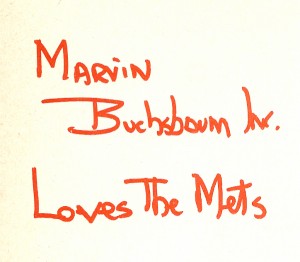
Dozens of advertisements urged on the Mets en route to their championship in the 1969 World Series program, but only one looked like a notice placed by a proud parent in the Playbill for a high school production of Bye Bye Birdie (which, come to think of it, was the unofficial theme of that Fall Classic). I was given the ’69 program a dozen or so years after the fact and have always been intrigued by the quarter-page ad Marvin took out. Was he real? Was he a superfan without portfolio but a little cash to burn? Was he a fictional character? Was Marvin Buchsbaum, Jr. really invented to sell Right Guard? I’ve never known. It’s never mattered. It’s just nice to see such unqualified support.
|
|







