The blog for Mets fans
who like to read
ABOUT US
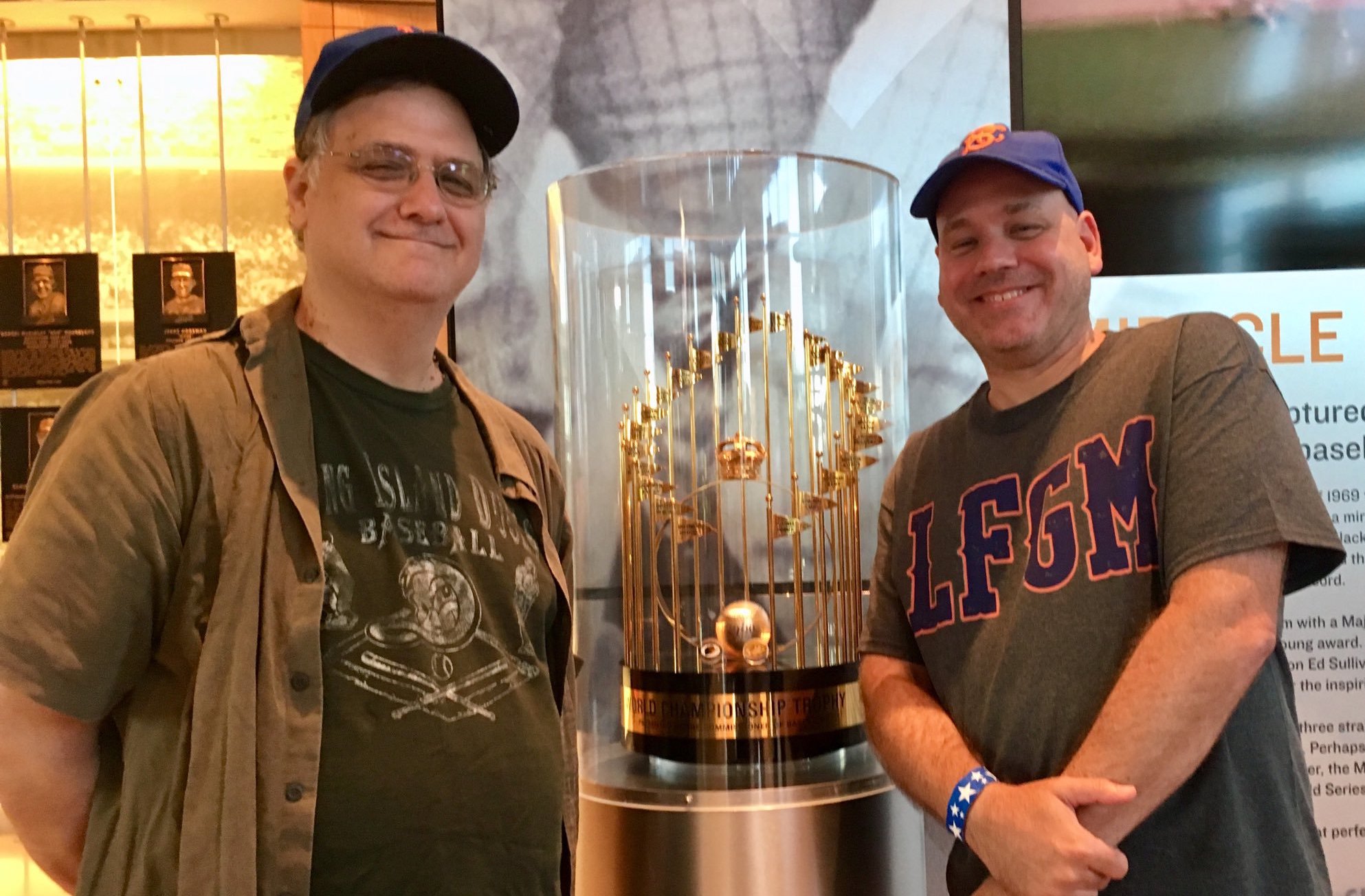
Faith and Fear in Flushing made its debut on Feb. 16, 2005, the brainchild of two longtime friends and lifelong Met fans.
Greg Prince discovered the Mets when he was 6, during the magical summer of 1969. He is a Long Island-based writer, editor and communications consultant. Contact him here.
Jason Fry is a Brooklyn writer whose first memories include his mom leaping up and down cheering for Rusty Staub. Check out his other writing here.
Got something to say? Leave a comment, or email us at faithandfear@gmail.com. (Sorry, but we have no interest in ads, sponsored content or guest posts.)
Need our RSS feed? It's here.
Visit our Facebook page, or drop by the personal pages for Greg and Jason.
Or follow us on Twitter: Here's Greg, and here's Jason.
|
by Greg Prince on 2 April 2008 12:44 pm Helen and Madeline attend his funeral, using veils to cover their horribly deteriorated forms. They continue to bicker endlessly as they did when younger, and react mockingly when the priest describes Ernest as having attained eternal life and youth through his good works. Leaving, they tumble down the stairs and shatter into pieces (although this seems merely to annoy them further).
—Conclusion to the Wikipedia plot synopsis for Death Becomes Her, a movie about those who refuse to accept aging and mortality as facts of life
The first name that crossed my mind was Ken Henderson. Ken Henderson was a Met for literally less than a week in 1978, but his fleeting presence made a lasting impression on me. There was a game very early that season in which he and Steve Henderson drove in three runs apiece and we beat the Cubs 6-0 and the Mets moved to 4-1 and led the N.L. East by a full game on April 10. Bob Murphy couldn’t stop raving about the batwork of “the Henderson men”. I’d had high hopes for Steve Henderson; he should have won the Rookie of the Year over Andre Dawson. I’d had high hopes for the 1978 Mets; I picked them for fourth no matter how they’d previously spiraled head-on into sixth. I’d lost track of Ken Henderson since he was a Giant in the early ’70s, but here he was, batting fifth and homering and adding veteran experience to a young team that was going to jump out of the grave of 1977 and into the thick of contention right away. 1978 was going to be different from 1977.
That was after five games. Ken Henderson came out in the sixth inning of the seventh game of 1978 — he crashed into Shea’s right field fence, twisted his left ankle and sprained his big toe for good measure — and never played for the Mets again. He was traded to Cincinnati in May for Dale Murray to whom, by 1979, I referred regularly as the Master of Disaster. The Mets finished last in ’78, like they did in ’77, as they would in ’79.
The next name that crossed my mind was Jose Reyes. He seemed to do something to his hamstring one night in May last year. It didn’t look good. We all held our breath. Losing Jose Reyes would pretty much end the season right then and there. We’d had proof from 2003 and 2004 (not that 2003 needed much help). Jose took off to recover for exactly one day, the five-run ninth day, and was in fine fettle, at least physically, the rest of 2007.
Of course Jose Reyes is about a century younger than Pedro Martinez. And Pedro is about a thousand times more important to the scheme of things than Ken Henderson ever was. But somewhere between their fates — the player who disappeared, taking with him the promise of entire season, and the player who gave us all a good scare that turned out to be nothing more — lies our man Martinez.
One gropes when speaking about Pedro and injury because one can’t bear to face the unfaceable. It was cruel irony that SNY was rerunning Tuesday afternoon’s Daily News Live late last night and a spirited debate ensued over how favorably the one-two combination of Johan Santana and Pedro Martinez compared with Seaver and Koosman, Gooden and Darling and so on.
Right now, it does not compare very well.
This is the time of year when we count our chickens, no matter how we attempt to resist the temptation. If you can’t be optimistic about your team before Passover, when can you? Think the ’78 Mets wouldn’t have finished out of the money had Ken Henderson been on call for all 162 games? You can think that in early April. You can think that Santana and Martinez are as money as a one-two gets in 2008, even if Martinez had started exacty eight of the Mets’ previous 207 outings. You can take succor from what you saw out of Pedro in his one month of sustained action last year and what you glimpsed in clips from the back fields of St. Lucie this March. You can reason that a fragile 36-year-old who has been handled with the most delicate of organizational kid gloves is a 17-game winner in waiting because of who he was before the kid gloves went on, who he is even as they were gingerly removed for his 21st professional season.
That’s early April thinking, and that’s OK as far as it goes, which sadly was the fourth inning in Miami last night. Early April sure got late quick.
Every time the Mets have a hamstring mishap, Keith Hernandez seems to be on hand to remind us, “That’s not good.” The effective portion of Keith Hernandez’s career all but ended with a hamstring injury in 1988. I can still see him crumpling between second and third in Busch Stadium. It happened on June 6. Joe McIlvaine kept calling it a day-to-day thing. Once the days became a week, he was DL’d. He was eligible to come off on June 22. He came back on June 23 and reaggravated the damn thing on the 24th. We next saw him on August 5. He hit a huge home run to beat the Pirates. It was inspirational, as Keith always was, but his decline was in full acceleration from that hamstring on.
Nobody’s more inspirational than Pedro Martinez. The way he pitches, the way he talks, the way he acts, the way he battles back from injury after injury. That’s a permanent part of his package now, sadly. Nobody rehabs quite like Pedro. Nobody works harder, has a better attitude, sets a better example for the kids at the complex, looms larger in your anticipation of his healing. Nobody gives a better interview describing his progress to Kevin Burkhardt. It’s all very admirable, but you’d sure like to have not learned so much of this side of Pedro Martinez’s resiliency. Orioles fans went a good 18 years before discovering how Cal Ripken handled a trip to the DL. That’s the way to do it if you possibly can.
Whatever silver lining they find after Pedro has his Martinez Resonance Image taken, I won’t believe them. I believed the return of Brian Bannister was just around the corner for more than three months of 2006, just down the block from Moises Alou in 2007. I believed Ken Henderson was “out of combat for a couple of days” as the Times‘ Joe Durso put it thirty years ago. I no longer believe anybody when it comes to appraising somebody else’s injuries. I’ll believe in Pedro as best I can before we see him again, though out of necessity I’m investing the balance of my faith in the likes of Perez, Maine, Pelfrey, Santana and Nelson Figueroa or whoever emerges from the cast of thousands that never seems to want for work around here. Among the pitchers who continue to pitch, we probably have the makings of a very fine one-two combo. I won’t be counting on Pedro Martinez as a component of that equation any time soon.
by Jason Fry on 2 April 2008 3:02 am Opening Day is wonderful. Your team plays, the fans cheer. If you lose, what the heck — it sure is nice to have baseball back. If you win, you feel like there’s no way you’ll ever see another loss. Look at that! Did you see what we did to those guys? 162-0, baby! This is the beginning of something beautiful!
The Day After Opening Day is often different. Lose that one, and suddenly you realize you’re in for the long haul. Huh. That stank. We’re a .500 club. This could be more difficult than I thought.
And when the Day After Opening Day sees a beloved icon go down with a hamstring problem, and then declare on his way to New York for an MRI that he heard a “pop” before limping off the field, you realize that long haul could be a lot more difficult than you thought.
Pedro had had such a good spring. I know. I also know, as we all do, that such a good spring means nothing. Just as such a terrible spring means nothing. But a pop in the hamstring of an aging starting pitcher means quite a bit. It means … well, we’ll start to know soon enough, but it probably means no Pedro J. until May. And it certainly means that all of our attempts to tell ourselves that the Mets’ problems with age and infirmity were overblown lasted exactly 12 1/3 innings. Less than that if you count Alou’s groin and El Duque’s foot and Castillo’s knees and Beltran’s knees and Wagner’s back and Delgado’s hip. Which we weren’t doing yesterday, because it was Opening Day and we won and we were glorious.
Did I mention it’s not Opening Day anymore?
Matt Wise may or may not throw more meatballs to indifferently skilled hitters. Ryan Church may or may not give away more at-bats by pressing against relievers who’d shown themselves constitutionally unable to start every hitter with anything other than a 3-0 count. We don’t know either way and have no particular portents to sort through in deciding. But aches and pains and creaks and pops and strains and pulls and the clawmarks of Father Time? We had plenty of warnings about those even before we got another.
by Greg Prince on 1 April 2008 1:00 pm Ya gotta hand it to the Mets. They invested wisely and now they’re taking one for the team, so to speak.
I don’t remember anymore how much they’re paying Johan Santana. It is so not important. Contracts and salaries are the stuff of winter, and winter, whatever stubborn grimness continues to transpire outside our windows, ended ages ago.
If Johan Santana’s Opening Day doesn’t light up your face, then you’re immune to spring fever. And if what the Mets are doing regarding their final game ever at Shea Stadium doesn’t make you see their management in a different light, then you’re as impenetrable as his changeup.
I’ve been reticent to mention it because nothing was official (of course I didn’t believe Johan was coming here, not really, until he threw strike one past Hanley Ramirez), but since it’s happening, I guess it’s all right to let you in on it. Hell, we’re 1-0 — everything’s all right.
First of all, I didn’t think the Mets were aware of us or any blogger save for Matt Cerrone. Turns out they are. They read a lot of these blogs, including this one. A note was dropped my way by somebody there regarding the Shea Stadium countdown and one conversation about Shea led to another and a proposal was made and negotiations ensued and this is what’s going to happen:
If you don’t have a ticket to the Shea finale, you still have a chance. That’s the good news. If you do have a ticket, you’re not necessarily in. That’s the bad news, I suppose…though you’re certainly not on the outs for good.
My three years of haranguing about Shea and how the Mets have neglected to pay it and its (and their) history proper homage finally got to somebody up the food chain, so they agreed with a plan that will ensure that the only people who get in on the final day are the people who deserve to be there. In other words, they’re refunding everybody’s money in the coming weeks.
Have they gone crazy? Crazy with altruism? Not exactly. They’ll still sell the tickets, but they are being very careful about who gets them and they won’t demand an arm and a leg for them, so kiss “platinum” goodbye come 9/28. My higher-up in the Mets’ front office (forgive the secrecy, but I promised not to reveal any names) said the idea that the secondary market for tickets was going to drive prices way up “bothered some people”. It was decided that with Santana on board, the Mets could afford to be confident, that they are going to sell close to 4 million tickets no matter what this year, that they could be choosy about who gets in on September 28.
That’s where I come in — among others. We’re the ones who get to be choosy.
See, there’ll be no advance ticket sales, which is why the refunds are going out. That applies to the seven-packs and the Sunday plans and even the season tickets. If you bought any on StubHub, those are also invalidated. Instead, admission will have to be earned.
Mets fans who want to attend the final Shea game will have to show one week before and submit to a seven-day battery of tests and interviews, conducted by me and Jason and a whole slew of bloggers. The Mets admitted that while they think they’re pretty good at running a baseball team and building a stadium, they have no clue about their fans. So they left it to the people who represent the fans and care about the fans and the team and all its history — the bloggers — to run the show for this one day.
For example, Dave Murray, who’s a uniform expert, is being flown in from Michigan to inspect wardrobes. If you want in, your closet better have plenty of Mets stuff. Mark at Mets Walkoffs is being enlisted for to administer a 410-question trivia quiz…walkoffs, comebacks, the whole gamut…and you better know why there are 410 questions or you’re immediately disqualified. Mike Steffanos of Mike’s Mets is working up a logic/mental agility examination to avoid the infiltration of total idiots. John of Metstradamus and Dan the Lonestar Met will lead a panel that gauges whether your behavior will be a boon or a burden to your row. Just about every blogger who’s also a longtime fan — Steve Keane at Eddie Kranepool Society, Coop at My Summer Family, Toasty Joe just to name three — is going to have a hand in determining admissions.
Faith and Fear’s role is multifold. Jason, having done such a splendid job of cultivating the youth of America vis-à-vis the allegiance of his son Joshua, is going to interview kids to decide if they’re really going to remember this day years down the road and if they’re going to blossom into full-bore Mets fans for the rest of their lives. He’ll also be going through baseball card collections. I’ll be assigning a series of essay questions, one per hour (10,000-word minimum), pertaining to love and passion for the Mets, though I’ll leave the grading of the papers to Dana Brand. Otherwise, I’ll be primarily assessing applicants’ hearts, minds and intentions, sort of like the airport marshals in Israel who look into passengers’ eyes to get a good read on them before they can board. I’m also going to need to see some ticket stubs from previous decades, prorated for age and income — but I will want proof that Shea has been a part of your life for a long time. Extensive anecdotes will be accepted in lieu of actual paper, though paper helps.
The details are still coming together, but we’ve got a great crew working on this. Loge 13 has agreed to chart seating assignments, Mets Geek will calculate a fair pricing structure, Ray of Metphistopheles is in charge of retrofitting Shea Stadium for the occasion (green fences, Gulden’s for the franks, lots of banners). And as a check against a bias toward fogeyism, Cerrone and Anthony from Hotfoot will do current event checks just to make sure you’re every bit the Mets fan now that you’ve ever been.
It will be a pretty Herculean effort and it doesn’t come with seats for any of us, our families or our friends. Actually, we’ll all be working out of the press box, providing the only sanctioned on-site coverage of the game as the Mets are pulling the credentials of every jaded, blasé reporter and columnist who has trashed Shea as unworthy of a proper farewell. Hence, if you’re looking for Wally Matthews that Sunday (and I don’t know why you would), don’t bother. MLB has already secured a restraining order that bars him from entering the borough of Queens until midnight.
Many of you who read Faith and Fear clearly deserve special consideration for admission to the final game at Shea, and Jason and I would love to offer it, but we can’t. That’s part of the deal I made with the Mets. No favors, just as nobody gets in because they have connections or the means to spend. For that matter, you don’t have to feel compelled to be extra nice to us, because it’s not going to matter. The whole thing I sold the Mets on is that on a day like September 28, 2008, all 56,438 seats should be filled by real Mets fans, 56,438 people to whom nothing could mean more than being in that ballpark on that occasion. Don’t worry, though. If you’re the kind of Mets fan I think you are, you’ll ace all the tests and land at least in the mezzanine. (Ducats will be distributed that Sunday morning; we’re honest brokers, not ticket brokers.)
It’s a big project, so I thought it would be a good idea to announce it today and give everybody a chance to prepare, bone up, whatever. Look at it this way: the Mets’ ace pitcher is Johan Santana, their record is perfect and no collapse is in evidence — plus it’s only April 1. On a day like today, it feels like anything is possible.
by Jason Fry on 1 April 2008 2:27 am It’s been an odd six weeks for this Met fan — derailed by tons of work, disenchanted with Port St. Lucie’s injuries and age, and disinclined to a level I hadn’t expected to forgive those caught up in the Mets’ September disaster. Relations between me and my favorite team had become somewhat chilly, and I was worried — for the first time in my adult life — that there might not be a thaw.
Last night I felt that maybe, just maybe, the ice was thinning. The Nationals’ park was indeed gorgeous, and left me thinking about our own date with the future, now just a year away. I found myself perking up at the sight of Lastings Milledge and Paul Lo Duca, and enjoyed mocking the Braves’ odd black-and-white looking road uniforms and early ineptitude. “Bobby Cox is in midseason form!” I crowed to Emily after the cameras caught him looking, post-error, like he’d just encountered a bad clam. (I was in midseason form, too: I fell asleep, lifted an eyelid to find Ryan Zimmerman striding to the plate with two outs in the ninth, and turned off the game. Oops.)
But even if you don’t miss the best part, the opening-night game usually winds up being unsatisfying. It’s partially that it’s not your team, and encountering your team solely through scheduling notes and announcer chatter and players’ resumes makes the last night of winter all the more lonely. It’s also the dearth of other baseball storylines, of hearing what touted rookies and relocated veterans and comeback kids are up to in front of various big, bundled-up crowds and walls draped in bunting. Opening night offers only one storyline, for better or worse, and either way it’s like wolfing down an appetizer and then not getting a meal.
But I really knew I was OK when I woke up later in the night and couldn’t sleep — because I was worried about Johan’s first impression and Big Pelf’s prospects and Castillo’s knees and Delgado’s reflexes and Jose’s head and everything else my mind could seize on. And then when I found myself with a certain bounce in my step, scant sleep notwithstanding, while walking Joshua to school. (Attired, of course, in his new, slightly oversized Reyes t-shirt.) And the kid was fired up, too: At five, he’s now old enough to be told that Opening Day is a secular holiday. No afterschool today, I told him — I’ll pick you up at 2:45, and yes, that’s plenty of time to see the game.
So we got hot dogs and ice cream and I put on my own finery — black Mets road uni, Faith and Fear shirt (get your own here), stars-and-stripes Met hat — and we watched Cubs-Brewers until they put the tarp on and Diamondbacks-Reds until it was time for pregame and we cheered the Mets as they were introduced by the Marlins’ public-address guy and then finally Jose Reyes tramped up to home plate with his odd side-to-side gait and 2008 had finally begun. And immediately I was locked in, grimacing at Jose striking out and exhorting Castillo to work the count and sparing only an offhand thought for why I’d ever been worried.
Ah, the game. Johan Santana is good — we knew that, but this was the day of really discovering it, of appraising his arsenal and how coolly he commanded it, rising above brief trouble like that was just the final thing to check off in his preparations for the long haul of 2008. As important was seeing the Mets poke at Mark Hendrickson the first time through the order, then fall on him like wolves the second time. (When Angel Pagan and Ryan Church announced themselves with a double and single, I scrawled “Angel + Church = Heaven!”, which isn’t particularly clever but made me happy because, hey, it’s Opening Day.) After that the only sour note was the random strike zone (random for both sides, at least) and the briefly worrisome sight of David Wright flopping like a gaffed fish around third base.
SNY did a nice job, starting with the addition of HD on the road. (For which I suppose I must grudgingly thank the Yankees.) I liked that they didn’t duck the wreckage of last year, beginning with a hide-your-eyes montage of everything that went wrong in the second half of September — painful, but far better than pretending the whole thing didn’t happen, or that time began with Johan signing a contract. (Though that Mohegan Sun ad repurposing “Super Freak” may have me burying an ice pick into my ears by the Kentucky Derby.) Keith, dependably, delivered his first moment to made the SNY suits cringe: After Gary welcomed Hartford to the SNY family, Ronnie gamely said that he loves Hartford, only to have an incredulous Keith ask, “You do?” Joshua and I sang “Take Me Out to the Ballgame” (and I wondered if I’d jinxed us by unthinkingly singing “the home team”) and I tried to explain all the things Hanley Ramirez had failed to do and then Heilman closed the door and Joshua declared “that’s a great beginning to the season!” Which it was.
And then the joy of finding out everything else that had happened, all the old names and new names and instant heroes. I mean, did you see Kosuke Fukudome hitting the first pitch he saw for a long double, then blasting a three-run homer to (briefly) save the Cubs’ bacon? Did you see Lastings Milledge getting to home plate one long stride ahead of Carlos Ruiz? (Break up the Nats!) Or the Indians and White Sox blasting away at each other like 18th-century warships? Or the Royals offering their fans at least one day of wild joy by shocking the Tigers? Or Carlos Gomez whacking the ball all around the Metrodome, giving Twins fans reason to embrace their new center fielder while honoring their old one? Or, to be less charitable, Tom Glavine going a lukewarm five innings and Yankee fans sitting in the rain for a while and going home? (Heh heh.)
Nothing revelatory there — just the pulse of life resuming its natural rhythms once again. Nothing extraordinary — except the routine miracles to be found in any day’s full slate of baseball games. Happy New Year!
by Greg Prince on 31 March 2008 8:43 am 1. Wish someone who will immediately get it a happy new year today.
2. Wish someone who has no idea what you're talking about a happy new year today.
3. Develop amnesia — what 2007?
4. If you still remember 2007, take a shower. Or a pill. Or a good, long look at Johan Santana.
5. Expect No. 1 starter quality from Santana, but don't count on a win every time.
6. Don't ever use a 4-for-4 by Minnesota Twin Carlos Gomez as a reason to bash Omar Minaya.
7. Allow Willie Randolph April before attacking him for past sins and detecting troubling patterns of misjudgment; he may be right and you may be wrong.
8. Applaud Carlos Delgado without qualification for a month.
9. Give Scott Schoeneweis the benefit of the doubt until mid-May. He can't possibly be any worse this year than last.
10. Take a deep breath before reacting to the first big hit or walk allowed by any Met reliever.
11. Present Ryan Church with a clean slate.
12. Jose Reyes gets 10 stolen base attempts to refigure it all out before being subject to reminders that he ran from second and two out with David Wright up against the Phillies last September 15 (if you haven't developed amnesia about all that).
13. Resist the temptation to take cheap shots at perennially lousy N.L. opponents. One of them is your defending champion.
14. Respect the Phillies and Braves. Do not fear them, not even the Mets-killers among them.
15. Don't let the predictable journalistic abominations that will slobber over the demise of the current Yankee Stadium (opened 1976) while dismissing the end of the one and only Shea Stadium (opened 1964) get to you. Seek refuge in blogs like ours and Loge 13 which present a more appropriate worldview of the Metropolitan area's current ballpark transition period.
16. Keep reading Mets blogs.
17. Tell at least one Mets fan you know who doesn't read Mets blogs to read one — ours or any other you enjoy. That Mets fan doesn't know what he or she is missing.
18. Don't wait for a walkoff win to read Mets Walkoffs and Other Minutiae, up and running after a winter's hibernation.
19. If you like deep, deep Mets minutiae of the Mets Walkoff variety, check out the equally detail-oriented Metaforian.
20. If you don't mind being reminded of the most gaping hole in Mets history, go to NoNoHitters.com and revel in the fact that Mets fans come up with stuff like this.
21. If the mood strike you, do what CharlieH did and start your own Metsian blog. No gatekeepers here.
22. Be outraged — send them a pointed e-mail, even — that MLB shortsightedly short-circuited the legendary and beloved jphilips41's YouTube page, the one with otherwise unseen clips from the '73 World Series pregame shows and the '77 and '79 Mets Old Timers Day ceremonies. Neil Best in Newsday broke the bad news, and it's bad news not just for Metsopotamians and for John Philips but for baseball which is lucky it can crawl, so often does it shoot itself in the free-publicity foot.
23. Should you ever meet John Philips, his next beer is on you.
24. Seeking a substitute for the treasure trove that was jphilips 41's collection won't be wholly satisfying, but you could do worse than the warts & all Shea Stadium slide show presented by Ballparks, Arenas and Stadiums. Other great ballpark, arena and stadium slide shows included.
25. Ignore the Carvel lines at Shea and go for Dippin' Dots instead. That's the ice cream of the future anyway…literally.
26. Somebody go to one of those “watch parties” bars hold when a season starts and tell me what the appeal is. I don't want to watch the Mets with a bunch of drunken strangers, except at Shea.
27. Be amazed by the gall of the ESPN Zone to hold a “watch party” at its Times Square location this Tuesday night for the Mets and Braves when reliable sources inform me that the very same ESPN Zone initially refused to change one of their myriad televisions on a recent Sunday to a Mets exhibition game even though a table full of Mets fans made the request, even though just about everything else being shown on every screen was spectacularly irrelevant to a New York audience.
28. If a nosy child asks you, as one did me last week, if you like the Mets because you're wearing a Mets sweatshirt and then volunteers, “I like the Yankees,” don't be shy about responding, “Good for you,” loudly in a room full of bored adults, such as a doctor's waiting room. It will make you and everyone in the room feel better.
29. If you are fortunate enough to find a good, old-fashioned stationery store that actually sells baseball cards by the pack and the store owner, moving and talking slowly after decades in the same location, asks you to confirm that “kids still like these, right?” be quick to reassure him that kids definitely still like these.
30. Don't feel compelled to tell him the kid in your focus group is 45.
31. If you turn on your car radio and hear David Coverdale crow, “Here I go again” moments after fulfilling your annual obligation to buy several packs of baseball cards before a new season starts, read into it anything you like.
32. If the first 2008 baseball card you find upon opening that first pack is an American Leaguer with whose work you are only vaguely familiar, it is appropriate to channel Whitesnake once more and think, “Here I go again,” because the first baseball card of any year is almost never a Met.
33. Should you gaze upon the midtown sky on the evening of April 8, pay attention to the colors of the tallest building in the vicinity. You will be pleasantly surprised (if you don't click here and ruin the surprise).
34. After Keith Hernandez revealed during a Spring Training game that one of his minor league roommates was Mike Vail and that Neil Allen, for whom he was traded, had the best curveball he ever faced, wonder who or what he doesn't know.
35. Give Wayne Hagin a chance. I cringed during his first Metscast when he said 1986 is a year that will “live in infamy” for Mets fans, but he's got pipes to die for and he's not Tom McCarthy.
36. Stop campaigning for the demotion of whoever's batting .182 after three weeks and insisting Fernando Martinez be promoted at once. Same applies in pitching terms to Jonathon Niese, even if he was born on October 27, 1986, a date that will live in non-infamy for Mets fans.
37. Cheer like hell for Carlos Beltran. Cheer him like he's David Wright.
38. Continue to cheer David Wright as previously cheered.
39. Continue to melt like Dippin' Dots on a hot day at the sight of Pedro Martinez.
40. React to all politicians invading a ballpark with absolute silence. Don't cheer. Don't boo. By your silence, maybe someone will get a clue that we want them concentrating on their government jobs.
41. Line every pocket with pocket schedules. What's the point of pockets otherwise?
42. Make an exception to your “watch party” skepticism when Jon Springer and Matt Silverman host one of their own on Sunday April 6 at Stout NYC, 33rd between Sixth and Seventh. It's to promote the brilliant Mets By The Numbers book that we've mentioned a few times already…and to watch the Mets beat the Braves, if possible.
43. If you haven't bought Mets By The Numbers, you can buy it at Stout.
44. Or buy it sooner. We really like this book around here.
45. We also recommend another selection in the bulging Matt Silverman oeuvre, 100 Things Mets Fans Should Know & Do Before They Die.
46. We recommend it so heartily that we're borrowing generously the book's premise for this post.
47. As we can barely come up with half as many Knows & Dos as Matt did, we truly admire the way he covers his Mets bases.
48. So secure yourself a copy…
49. And enjoy Opening Day…
50. And happy new year!
by Greg Prince on 30 March 2008 7:50 pm Just over a month ago I speculated on composition of the Opening Day roster of the New York Mets. I was 80% right.
Do I know my team or what?
Apparently not so much. Even allowing in advance for the possibility of injury, I actually penciled in for March 31 the names Moises Alou, Ramon Castro and Orlando Hernandez, a trio that has spent a combined 472 years, give or take, on the Disabled List since 2007, including right now. They are replaced, respectively, by youthful Angel Pagan, ancient Raul Casanova and possumy Mike Pelfrey.
Matt Wise made the team after all, but Duaner Sanchez did not. He is another ultimately unsurprising disablee, replaced at least for now by Joe Smith, who has shown a penchant for confusing batters in springtime. May it be a long spring for Joe Smith.
And the kid from 2007, Ruben Gotay, is unfortunately Atlanta-bound, replaced by THB Class of 2002 member Brady Clark. Clark's presence among us is a moderate upset given the reported surge in support for Fernando Tatis in the past week. Gotay's loss is a little distressing, especially since he wound up claimed by the Braves (the only thing we'd like them to claim is last place), but I won't pretend I was his biggest supporter. I liked half his bat — the right half — if little of his glove. But the kid was fast and had moxie, as evidenced by his contribution to the memorable five-run ninth the Mets pinned on the Cubs last May 17, and this team could always use more moxie, to say nothing of speed. Then again, Brady Clark wore 93 in St. Lucie (since reduced to 44) and made the team, so that's pretty moxieish if you're scoring at home.
We've been down Pagan's path a bit and it's thrilling to watch an original Cyclone swirl into Opening Day as the Mets' starting left fielder, though a healthy Alou, if such a commodity exists, would be preferable in that role. Whatever Wise chips in will be a welcome upgrade from the way Guillermo Mota crumbled under the pressure of serving up snacks to opposing hitters (without a side of HGH). Pelfrey feels like he's been trying to live up to his prospects since the days of Hank Webb (who played with Tug McGraw, who played with Julio Franco, who played with Mike Pelfrey), but maybe there's some baseball version of lousy dress, great performance at work with him and his tantalizing right arm. The most intriguing thing to me about Raul Casanova is that he was actually the player to be named later in the deal that sent Wally Whitehurst to the Padres.
Yeah, a lot later.
Your crew of 2008 Mets is set for now, and I do mean now. It changes and changes and changes again in the course of a season, so unless you're one of those people who must absolutely have a baseball card for every Met who's ever played, don't get too hung up on who's not here and too attached to who clings to the fringes…unless you are so inclined. It's baseball season almost. It's as good a time as any to develop irrational attachments. Even rational ones.
We are only 24 hours from Johan. I can't wait.
by Greg Prince on 30 March 2008 9:03 am 52: Tuesday, June 10 vs Diamondbacks
It is the dream, ladies and gentlemen, of every kid who has ever tossed a ball or swung a bat to put on a big-league uniform. Tonight we honor two boys who grew up to do just that…even if they never got to toss a ball or swing a bat in a big-league game.
They were Mets, in a sense. They were called up to the club, put on the roster and issued a number. They indeed, as the saying goes, came to play. But for whatever reason they made it into a game, either as a Met or for any other Major League team. As a result, their record in the bigs is nonexistent.
It's too late to do anything about that circumstance, but we can, at the very least, announce them as they might have been announced at Shea Stadium had they been penciled into a lineup or at least sent in to pinch-hit.
Your attention please, catcher for the New York Mets, number 22, called up in 1972 from Tidewater, Billy Cotton.
Your attention please, first baseman for the New York Mets, number 21, called up in 1992 from Tidewater, Terrel Hansen.
Billy and Terrel were here for such a brief time, they probably carried away nothing but a scant memory of Shea Stadium. Tonight, we want them to have more than that. Longtime equipment manager Charlie Samuels, who will be escorting our pair of almost-Mets down the right field line to remove number 52 from the wall, will first present each man with a uniform with his own originally issued number to commemorate the dreams of every kid who ever wanted to grow up to wear a Mets uniform.
51: Wednesday, June 11 vs Diamondbacks
Ladies and gentlemen, you have likely heard Shea Stadium referred to as a multipurpose facility. For the most part, that has meant the ability to host the Mets, the Jets and a few other high-profile get-togethers. While those are the calling cards of Shea, there have been a lot of sports played here. Tonight, we pay homage to a few events that deserve to be remembered as well.
The squared circle had its moment in the Shea lights in 1967 when the middleweight championship of the world was settled here. The last man to earn a boxing title at Shea was Emile Griffith, who won his belt by virtue of a 15-round decision over Nino Benvenuti. Please welcome back the champ, Emile Griffith.
From time to time, soccer has been just as prevalent at Shea as it is in the neighborhoods of Queens, as the ballpark has hosted several international matches and a few in the professional ranks of the North American Soccer League and the American Soccer League. New York's most famous soccer team played and won a big NASL playoff match of its own here 32 summers ago. From those 1976 New York Cosmos, the winning goalkeeper from that night, one of the great goalies in United States soccer history, say hello to Shep Messing.
And though it's been a long time since anybody's kicked an American football off at Shea, this used to be an occasional stopping-off point for college teams, particularly the legendary program run by Eddie Robinson. We speak of Grambling University, which prevailed over Norfolk State here in 1975. The Tiger quarterback that Saturday would go on to become the first African-American quarterback to lead his team to a Super Bowl victory. He said “it was honor to play at Shea” because his idol growing up was another Grambling alum, Tommie Agee. That's as good a reason as any for us to give a warm greeting to Doug Williams and ask him to lead our multipurpose all-stars up the right field line to remove number 51.
50: Thursday, June 12 vs Diamondbacks
To Mets management, ladies and gentlemen, every fan who passes through the Shea Stadium turnstiles is entitled to star treatment. One star who is a regular at Shea, however, has been content to be known simply as a rabid fan of the team he loves.
In the pilot to what would become his groundbreaking sitcom, the very special fan we recognize today picked up a ringing telephone and told whomever was on the other end of the line not to tell him the score of that night's Mets game because he taped it and hadn't yet watched it. That's what he said instead of “hello,” and we guess you could say he had us at hello. His series would be a showcase for references to Mets past and present and would include, hands down, the most memorable appearance by any Met on any television show this side of Kiner's Korner.
Ladies and gentlemen, to remove number 50 from the right field wall, please welcome a close, personal friend of SNY broadcaster Keith Hernandez — and the most famous Mets fan in the world — Massapequa's favorite son, Jerry Seinfeld.
49: Friday, June 13 vs Rangers
Ladies and gentlemen, congratulations on having endured as long as you have on this date, which happens to be Friday the 13th. Since baseball is filled with nonsensical rituals and superstitions, this seems a good night to carefully pay tribute to the occasional bit of bad luck that has haunted the New York Mets over the years. Quite simply, we think it's a matter of good karma.
We have two guests who are great sports. The first of them has to know his name has been invoked repeatedly at Shea Stadium every time Mets fans have gnashed their teeth at the latest one to get away. We refer, sadly, to the elusive Mets no-hitter. Our first guest also has to know his name isn't brought up with fondness. Nonetheless, it is impossible to watch great, almost perfect pitching at Shea and not, at some point in the course of a nearly spotless performance, think of the ninth-inning single that derailed what would have been the first perfect game in Mets history on July 9, 1969. Since the Mets won that night and that year, we feel we are safe from any black magic he brings us. Please give a warm welcome to the former Cub whose lifetime average at Shea was .429, Jimmy Qualls.
Our second guest, who will join Jimmy in taking down number 49, is known for a streak, but not for one he wanted any part of. Yet the streak happened and he handled all 27 consecutive losses, a Major League record, with grace and good humor. The thing is he didn't pitch too badly during that stretch of 1992 and 1993 when he was saddled with one L after another and the Shea crowd always offered him its heartfelt support. When he finally earned a win in relief on July 28, 1993, you would have thought he himself had pitched a perfect game. Please welcome back home to Shea the man they call AY, Anthony Young.
48: Saturday, June 14 vs Rangers
Ladies and gentlemen, night games in June usually mean daylight extends for several innings. But soon moonlight should be in evidence over Shea Stadium and that's perfect for our theme as we remove number 48 from the right field wall.
You are probably familiar with the classic film Field of Dreams and the mystic chords it strikes where baseball and life are concerned. If you are, you'll recognize the name Moonlight Graham, a young player — a real one — who shows up in the movie just long enough to appear in a single Major League game as a defensive replacement…not even an at-bat.
In the spirit of Moonlight Graham, we have assembled our own corps of Moonmen, if you will. They are Mets with admittedly limited Shea Stadium résumés but surely they are Mets in full. No serious aficionado of the team's history could overlook their presence on the all-time roster
Please greet for one more cup of coffee these Moonlight Mets:
• His Shea, Met and big-league debut consisted of catching the final half-inning of the final game of the 2004 season, the final game, as it happened, in the history of the Montreal Expos and, to date, the final game of his big-league career. Deciding he wasn't going to make it back to the Majors as a catcher, he has remained in the Mets farm system, working hard to convert himself to pitching. You may have seen him this past spring working in exhibition games as a reliever. Say hello again to Joe Hietpas.
• The Miracle Mets were on the verge of certifying themselves division champs when this lefty reliever made his only appearance of 1969 and, eventually, his big-league career, throwing two innings against the Pirates in a doubleheader at Shea on September 19. Give a nice hand to Jessie Hudson.
• His single game in the Majors consisted of the sixth through ninth innings of the first game of a doubleheader versus the Expos right here on September 14, 1971. Within three months, this catching prospect would be sent to the Angels in a trade that involved five players. He wouldn't make it back to the bigs with California but would go onto a lengthy career in the Mexican League and managed Mexico in the inaugural World Baseball Classic. Welcome back to Shea Francisco Estrada.
• The Mets, as they were prone to be for the first four decades of their existence, found themselves short of third basemen on June 15, 1997 when, in the bottom of the seventh, they inserted into their home Interleague game with the Boston Red Sox a pinch-hitter who stayed in to play third through the ninth. He never played at Shea or anywhere else in the big leagues again, but he did stick around, in a manner of speaking, helping coordinate minor league operations for the Mets since his retirement. Say hi to the 106th third basemen in New York Mets history, Kevin Morgan.
• In the last week of the 1993 season, this pitcher tossed a scoreless inning against the Cardinals to mark his Shea, Met and Major League debut. That inning was the 17th. The Mets broke a scoreless tie in the bottom of the frame, making this rookie a perfect 1-0 as a Met. Injuries would prevent his return in '94. and though he'd pitch in a few more games as a San Francisco Giant, he'd never earn another win, so it is that 17th inning at Shea that stands as the signature moment in the career of Kenny Greer, someone who did nothing wrong, only everything right in a Mets uniform. Give Kenny and all our Moonlighters a big round of applause.
47: Sunday, June 15 vs Rangers
Ladies and gentlemen, we want to wish all the dads joining us today a Happy Father's Day and even a happy birthday to all the fathers out there. It's impossible to think of Shea Stadium on Father's Day without thinking of the very first one in Shea's history, June 21, 1964. For one pitcher, it was a perfect day.
Twenty-seven Mets came to bat and twenty-seven Mets went back to the bench. The end result was the first perfect game in the National League in the 20th century. It is a feat that boggles the mind.
To remember that sun-splashed doubleheader opener, we have invited back the three principals from that game's final moment.
• The catcher from the Philadelphia Phillies, Gus Triandos.
• The batter, pinch-hitting for the New York Mets, Johnny Stephenson.
• And of course, the pitcher, who struck out John and nine other Mets that Sunday in 1964. He would eventually be elected to both the Baseball Hall of Fame and the United States Senate where he serves still. Please give a big Shea Stadium welcome to Jim Bunning.
Since the topic is hitless games and since the Mets have welcomed in the Texas Rangers for the first time in Interleague play, we thought it would be nice if Gus, Johnny and the senator had some company en route to removing number 47 from the right field wall. Thus, we asked the president of the Rangers, the author of seven no-hitters of his own and a valuable member of the 1969 world champion New York Mets to join them. Please welcome back to Shea Stadium, the hardest thrower this ballpark has ever known as its own, Hall of Famer Nolan Ryan.
Numbers 59-53 were revealed here.
by Greg Prince on 29 March 2008 10:47 am 
Don’t know how the last season of Shea Stadium will end, but it could do worse than to replicate what happened when Tug McGraw, Ron Swoboda and Tommie Agee got together for a little bubbly 39 years ago. Thanks to FAFIF reader Joey79 for sending along this shot. What do you suppose they’re going to do with these banners anyway? (Or, I suppose, how much do you think they’re going to sell them for?)
by Greg Prince on 29 March 2008 10:44 am 
Somewhere near this blog, I don’t know how many people are rooting for the Mets, but I think all of us could use a toast. To a past that gets more glorious as the years go by… To a future that will always be bright… To the present and its impending 162 games… To 2008, whatever it brings… Here’s to the Mets. Here’s to us, the Mets fans.
by Greg Prince on 29 March 2008 10:36 am 
I don’t know who this guy is, but I’ve seen him repeatedly since last September 30. This Reuters photo was used over and over last fall to illustrate the state of the Mets fan in the wake of the end of the 2007 season. At the risk of trivializing tragedy, he is our napalm girl, our Kent State. He represents where we were at one of the darkest times in our history, in our souls.
Oh, the humanity.
Dear Mets: Make this guy smile in 2008. Make us all smile. At the very least, don’t leave us like this again, OK?
|
|