The blog for Mets fans
who like to read
ABOUT US
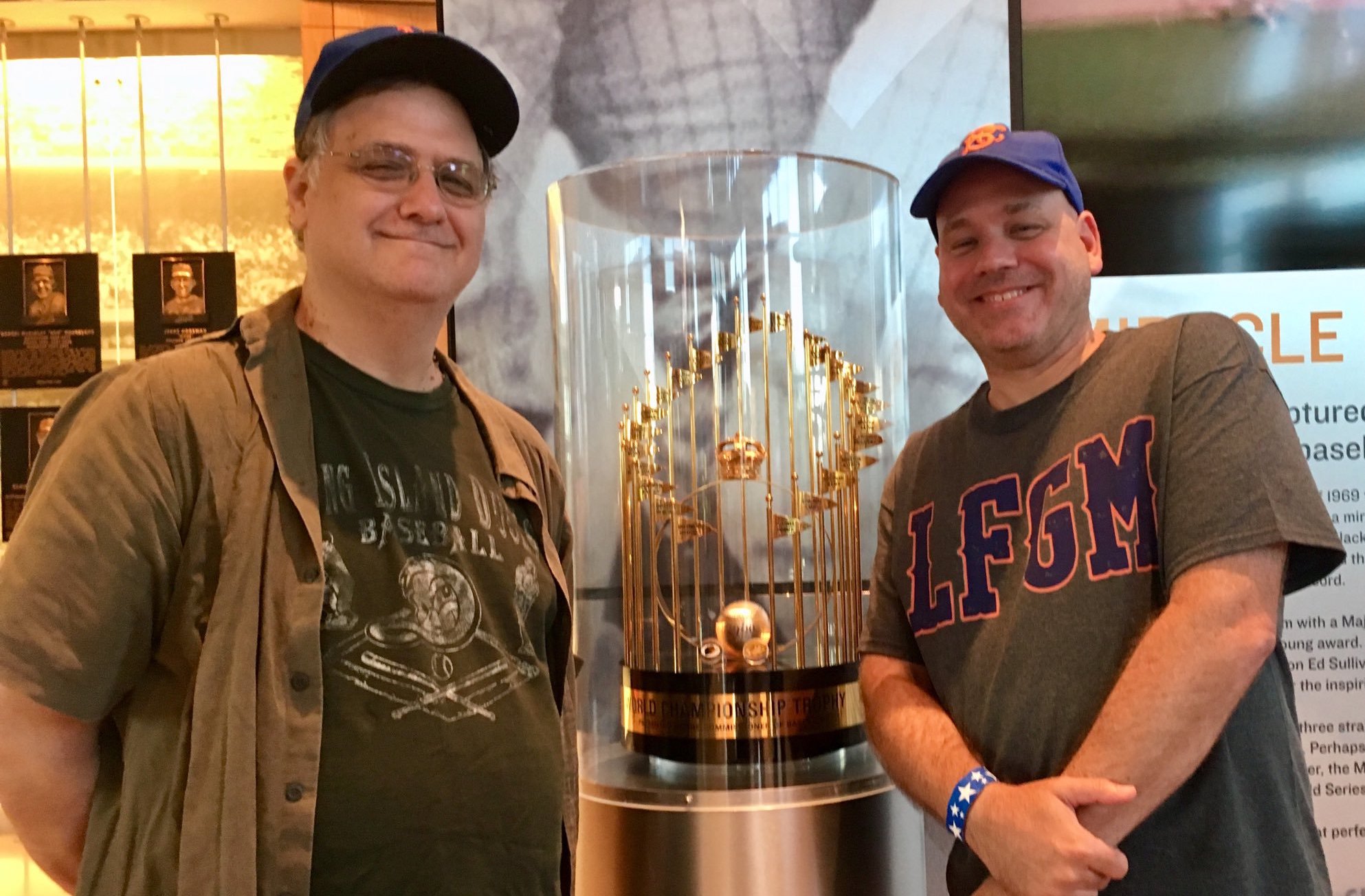
Faith and Fear in Flushing made its debut on Feb. 16, 2005, the brainchild of two longtime friends and lifelong Met fans.
Greg Prince discovered the Mets when he was 6, during the magical summer of 1969. He is a Long Island-based writer, editor and communications consultant. Contact him here.
Jason Fry is a Brooklyn writer whose first memories include his mom leaping up and down cheering for Rusty Staub. Check out his other writing here.
Got something to say? Leave a comment, or email us at faithandfear@gmail.com. (Sorry, but we have no interest in ads, sponsored content or guest posts.)
Need our RSS feed? It's here.
Visit our Facebook page, or drop by the personal pages for Greg and Jason.
Or follow us on Twitter: Here's Greg, and here's Jason.
|
by Greg Prince on 29 February 2008 2:50 pm …and read this. It is Mets By The Numbers' q&a (third part of a three-part series) with longtime beat writer Marty Noble, formerly of Newsday, now with mlb.com. It may be the best and most eclectic history of the New York Mets ever recorded.
Kudos to mbtn and its founder, Jon Springer, on beginning a tenth year of tracking Met numerology with such understanding, insight and wry humor. He and fellow obsessive Matt Silverman (who's got a fun new blog of his own, Metsilverman, worth checking out) have released a book based on Mets By The Numbers and it will be reviewed here early next week. Until then, ya gotta read the Noble piece. You'll never think of half the Mets you think you know the same way again.
by Greg Prince on 28 February 2008 4:05 pm 
Now that Shawn Green has let it be known he won’t be playing baseball for a living any longer, I can let it be known I rooted just a little extra harder for Shawn Green.
Not to the point that it clouded my judgment on his decreased offensive output, his limited mobility, his disappearance from the runs batted in column for nearly two months. I believe I viewed Shawn Green as just another Met where all that was concerned.
But I rooted just a little extra harder for Shawn Green. It made me happy he played for my team. I would have been happier had he played for my team five years sooner, but you can’t have everything.
He had his moments. He had an eleventh inning to remember at the end of June. He, like the Mets, enjoyed a very nice first two months of last season. He did his best fielding in the second inning of the first game of the 2006 NLDS, when Green to Valentin to Lo Duca produced the two most electrifying tags you’ll ever see at once.
Shawn Green also had this: According to the 2007 GourMets Cookbook, matzoh ball soup “is Shawn’s clubhouse favorite”. It makes me smile to think Shawn headed straight for a shissel of chicken broth and knaidlach right after walloping that walkoff homer off the Cards (and accepting his teammates’ heartiest congratulations), even if, as my friend Sharon (who passed this culinary tidbit along to me) noted, “From this I glean that a) Green is the only one who the authors realize is Jewish; b) you’re less likely to be embarrassed if your wife submits an actual recipe; and/or c) the clubhouse caterers put out a WEIRD postgame spread.”
None of it was a reason to keep Shawn Green on the Mets. None of it was a reason to look past the gathering horde of late-career deficiencies that turned him into a fourth outfielder/second first baseman before September. But Shawn being, as the back of the baseball card above (created by these folks) pointed out, “the premier Jewish ballplayer and Jewishly identified ballplayer of this generation” and a Met…well, I rooted just a little extra harder for him.
Soup for you, Shawn. You earned it.
(FYI, that’s Scott Schoeneweis on the other half of that card. His combination of Jewishness and Metsishness gives me no naches whatsoever.)
by Greg Prince on 28 February 2008 8:55 am Your 2008 New York Mets' potential/likely Opening Day roster:
CATCHERS (2)
Brian Schneider, Ramon Castro.
• Givens.
INFIELDERS (5)
Carlos Delgado, Luis Castillo, Jose Reyes, David Wright, Ruben Gotay.
• Gotay's switch-hitting and youth give him a leg up on Jose Valentin for utility infield purposes.
OUTFIELDERS (6)
Moises Alou, Carlos Beltran, Ryan Church, Endy Chavez, Marlon Anderson, Damion Easley.
• Anderson and Easley are versatile enough to play first and second. Because they can do that and pinch-hit, Brooklyn's Own Angel Pagan probably starts the season in New Orleans or goes elsewhere.
STARTING PITCHERS (5)
Johan Santana, Pedro Martinez, John Maine, Oliver Perez, Orlando Hernandez.
• If El Duque is healthy, it's unlikely Mike Pelfrey gets a foot in the door before El Duque is certifiably unhealthy.
RELIEF PITCHERS (7)
Billy Wagner, Aaron Heilman, Duaner Sanchez, Pedro Feliciano, Scott Schoeneweis, Jorge Sosa, Matt Wise.
• Wise has a partially guaranteed contract that gives him $750,000 whether he makes it or not. If he doesn't, the other options are Steven Register, Brian Stokes, Ruddy Lugo and maybe Joe Smith. Under better circumstances, Ambiorix Burgos might be, too, but his bejeweled right arm isn't ready.
So, if I've got this straight…
…putting aside stretching and golf…
…barring injuries…
…taking into account rehabilitation from injuries…
…making a schedule-oriented strategic decision that foregoes the fifth starter until the middle of April…
…and understanding the dangers implicit in solemnly trusting the best-laid plans of Minaya and men…
…we're basically holding Spring Training as a precaution against Matt Wise pitching himself off the team.
Just checking — and by no means complaining. Having witnessed enough camps whose overriding purpose was inventing roles for Mike Bruhert and Mardie “The Chief” Cornejo, I'm not about to underrate the general appeal of roster stability. Still, suspense does seem on the verge of taking a spring break if all we're waiting for is to discover whether the back end of our relief corps is Wise or unWise. Then again, the Mets have a way of making their own drama just when you're settling in for the utterly prosaic.
by Greg Prince on 27 February 2008 12:30 am If you've seen Mathematically Alive, the wonderful documentary on the condition known as Mets fandom, you will remember a cat in a hat straight out of Dr. Seuss. That cat, Matt Hoey, is the fellow who made it his business to camp out at Shea days in advance of the first tickets going on sale every February so he could get them before anyone else. (Could there be a loftier ambition in winter?) I was always amused to see his name and/or his picture printed in the papers without fanfare or backstory every single year. “Hey,” I thought of this fellow, “it's the same guy! How come they never mention that?” Eventually they did. The Dr. Seuss lid (blue and orange, natch) struck me as a bit ostentatious, but the film gave me a valuable insight into him: He's a Mets fan like you, like me, like all of us. Sometimes that's all we need to know about a person.
Kathy Foronjy and Joe Coburn, directors of Mathematically Alive, send word that Matt has been in a serious accident and was hurt pretty badly. They ask that Mets fans everywhere send our best wishes for a speedy and full recovery to one of our own via getwellmatt@mathematicallyalive.com. Kathy and Joe will pass your messages of love and support to Matt's wife Tracey, who will let him know that Mets fans everywhere are thinking of him. If you take a minute, it will mean a lot.
by Greg Prince on 26 February 2008 11:55 pm 
| The year is 2018. There is no crime and there are no more wars. Corporations are now the leaders of the world, as well as the controllers of the people. A violent futuristic game known as Rollerball is now the recreational sport of the world, with teams representing various areas competing for the title of champion.
That’s from the IMDb plot summary for 1975’s Rollerball. I have no idea why I thought to look it up ten seconds after taking in the updated Citi Field slide show on mets.com, revised to reflect the ballpark logo that was introduced yesterday. No idea at all. |
|
|
by Jason Fry on 26 February 2008 5:40 am “It’s like walking across the desert step by step and today he finally got to the oasis.”
That's Rick Peterson on Duaner Sanchez getting to pitch today in an intrasquad game, and with all due respect to the Jacket and bridge-potentially-too-far similes, both of which I approve of highly, throwing 25 pitches to teammates wearing hideous spring-training motley is nothing like an oasis after an arid hike. Spring training being spring training, it's more like a mirage, to be followed by five weeks' worth of further mirages.
Don't get me wrong: All hail Duaner Sanchez and his return to fighting shape and can-do spirit. Goodness knows we need him: Through the pitiless 20/20 of hindsight, Sanchez showing up in Port St. Lucie last spring heavy of flesh and light of commitment was the first sign that something might be wrong with the 2007 Mets, and when you finish one game out of playing extra baseball, you can point to any factor as the straw that might have left you with a quadriplegic dromedary. (Hey, we've got a desert theme goin' here, so help out.)
I've long since chalked up Duaner's fateful Aug. 1, 2006 Miami food run to the hand of fickle Fate, who doesn't usually hand back gifts like Oliver Perez in such situations. (Though perhaps Dame F. did steer Omar to the noxious Guillermo Mota.) But '07 was different: A combination of unforeseen physical complications and unwelcome attitude problems, and a cascade of at-first-minor trouble in the bullpen. You can recite the litany just as I can: The absence of Duaner begat the inconsistency of Aaron, which begat the overwork of Billy, while some burning bush told Willie to use Pedro F. and Schoeneweis oddly. (Desert theme again. I know I'm pushing it.) All the reports on Duaner are strongly enthusiastic so far, and that's an unreservedly Good Thing. (I'd say that of course all February reports are strongly enthusiastic — witness this, by the same Ben Shpigel whose testament is above — but I'm sure as I type that El Duque's waking up in a rented condo and discovering his leg has turned gangrenous, but he'll take it slow and be ready to answer the bell or something. For God's sake, put Pelfrey in the fifth slot!)
Anyway, Peterson of Arabia's report made me realize I'd reached a not-particularly-welcome mileage marker on my own spring journey: the first time that I catch myself grumbling that spring training is way too fricking long. It's that mirage thing again: About five days after hearing about pitchers jogging failed to cheer me up, we get Mets swinging bats and hurling balls in earnest. Ahh, cool water! Oh, wait — intrasquad game. If you can get enthusiastic about Team Sandy Alomar's 7-5 win over Team Jerry Manuel, my hat's off to you.
But wait! Over there! It's the real oasis of baseball … oops, no, it's the Mets playing the University of Michigan tomorrow. Mirage.
OK, so that one was more shimmer than sand — but look! Mets/Tigers on Thursday! Eh. I'll look at the box score, register my first worry at whatever known quantity got whacked around (it'll either be too early or he'll be too strong or he was working on stuff or his last couple of batters were better than the first few) and go back into my coma.
But what's that! Spring-training telecast Friday, with Johan on the hill!
(Mir … oh, heck, even I can't be cynical about that one.)
But post-Johan, there'll be a solid month to go. A month for silly quotes and dead-arm periods and someone to get in trouble in a mall parking lot and the rookies getting sent out and the NRI guys heading home or elsewhere and the Guy on the Bubble With the Inspiring Story getting cut and overheated chatter about the final one or two roster spots and the late-March dog-for-cat trade that scrambles all those projected rosters. And then, finally, it'll be time to pack away the blue and orange and white and black and hope for the world's least-effectual bit of revenge against the Marlins. (Of which I'll of course happily lap up whatever scrap I'm given.) And then April, and to work.
Spring training is wonderful — in abstract. Spring training is wonderful — compared to the depths of winter. When it's 20 degrees and you've lost whatever desperate interest you feigned in the Super Bowl, spring training absolutely is an oasis. But when you get there, the leafy palms and tranquil pools have moved just a bit farther ahead. Attaboy, Duaner. Now, could somebody wake me on March 31?
by Greg Prince on 25 February 2008 7:05 am The Academy would like to pause for a moment to remember those Mets who have left us in the past year…
Chan Ho Park, 2007
…Park was unlucky in the third, but that wasn’t bad luck in the fourth. That was nearly 900 feet of bad pitches redirected so quickly and violently by Amezaga and Ramirez that everyone in our part of the mezzanine knew where they were headed before they cleared the infield.
—May 1, 2007
Jon Adkins, 2007
…[T]he removal of Jon Adkins from the roster to accommodate an emergency catcher seemed to throw the entire bullpen into turmoil.
—August 1, 2007
Lino Urdaneta, 2007
We hung around just to see Lino Urdaneta reduce his ERA to finity, even though that looked perilous for a moment as a hop ate up David Wright and his doofy-looking zebra shoes — and during the inning I thought Urdaneta might be hyperventilating to the point of having a heart attack, which would have been a terrible way of proving that yes, he could have a worse outing that that long-ago day against the Kansas City Royals.
—May 7, 2007
Jeff Conine, 2007
With a large lead, Willie pulled him and the camera caught Ollie sitting down, collecting his thoughts when Jeff Conine walked over and shook his hand. Jeff Conine? Jeff Conine who’d been a Met for about a month? Jeff Conine who contributed virtually nothing to this pennant drive? Jeff Conine who was about to retire no matter what the Mets did during his abbreviated tenure here? Yeah, Jeff Conine. I wondered if Oliver Perez and Jeff Conine had done more than nod at each other since Conine joined the Mets. But there he was, being very much a veteran toward a younger player. I liked that. I really liked that. I suppose I liked Conine, too, though I never got much of a look at him as a Met. Nobody did.
—October 18, 2007
Sandy Alomar, Jr., 2007
Sandy Alomar, Jr. lined out hard to second. Didn’t realize until the scoreboard mentioned it that this was Alomar’s Shea debut. As a Met? No, ever. I just looked it up…and I see that in a Major League career that stretches back to 1988, he had played against the Mets only once, in three Interleague games in 2002 at Jacobs Field.
—August 24, 2007
David Newhan, 2007
When David Newhan placed a ball just beyond the firm grasp of Aaron Rowand last night, it was stunning to see him wind up on second because nobody runs like that anymore…
—June 6, 2007
Ricky Ledee, 2006-2007
…Ricky Ledee…was designated for assignment even after his clutch leftfield defense in the seventeenth inning made Saturday night his best game as a Met. All of Ricky Ledee’s other games as a Met are tied for second.
—July 8, 2007
Chip Ambres, 2007
Should these Mets use this 4-3 road trip, this 7-4 stretch since the break, as a launching pad for further momentum, to build a more impenetrable divisional margin, to ride to another Eastern title, to ascend Mount Olympus as planned but pre-empted a year ago, then this game was totally magic — the Chip Ambres Game, we’ll call it; he walks in and suddenly he’s a hero.
—July 23, 2007
Brian Lawrence, 2007
Brian Lawrence: 29 innings, 43 hits, 6.83 ERA. Good night, funny man.
—September 18, 2007
Dave Williams, 2006-2007
…Dave Williams came up from Norfolk, donned No. 32 and effectively channeled Rick Anderson…
—August 20, 2006
Mike DiFelice, 2005-2007
…Scott Olsen coaxed a third strike past DiFelice. “GODDAMNIT DIFELICE!” I bellowed. Oh well. Kind of hard to break habits formed over 149 games.
—September 20, 2006
Aaron Sele, 2007
Entering Sunday, Aaron Sele had made 32 appearances as a Met and the Mets were 9-23 when he pitched. So you don’t think it was all a coincidence, Aaron Sele held a 5.29 ERA for 2007 from the beginning of the season to September 17 — six games earlier, which was the last time Randolph saw fit to use him. It’s been a year plainly worthy of Kenny “Squeak” Scolari, BASEketball‘s resident luckless nebbish. Except that after running through six relievers in five innings, Willie was down to his whaddayagonnado? corps, and Sele was the best of that lot. For the first time, in the 155th game of the season, Aaron Sele did what he had to do.
—September 23, 2007
Guillermo Mota, 2006-2007
Yes, there are Mets on this year’s roster I have no use for…master run-allower Guillermo Mota come(s) to mind.
—August 15, 2007
Philip Humber, 2006-2007
If he comes through and helps us gather in the monster pot that’s been lingering on the National League East table a little too long, then we will have reason to believe we have a keeper on our hands. If he doesn’t, Philip Humber’s long-term future will be pretty low on my worry list.
—September 26, 2007
Carlos Gomez, 2007
Could it be? Holy cow, it is — it’s Carlos Gomez! That’s when I began to feel lucky — Gomez is one of those prospects whose debut I would have dropped everything that could be reasonably dropped to see, and I hadn’t had to drop a thing.
—May 14, 2007
Julio Franco, 2006-2007
Even the intangibles, the stuff you can feel is going to backfire, never came back to haunt. You know those voices you hear in your head? The ones that recap the game with lines like “…in the loss, Julio Franco became the oldest man to…”? That voice was silenced. Julio Franco became the oldest man to homer, oldest man to homer into a pool, oldest man to homer and steal in the same game, oldest man to homer off the oldest pitcher to give up a homer to the oldest man ever to homer…and the Mets won.
—May 5, 2007
Shawn Green, 2006-2007
…[O]n the way out, after Wagner buried (for a night) the ghost of Taguchi, after Heilman found St. Louisians he could steamroll and after Mr. Green put a decisive dent both the score and the scoreboard, there was an extra edge to the walkoff happiness around me.
—June 26, 2007
Lastings Milledge, 2006-2007
I’m reading a pretty good book called A Great Day in Cooperstown about how the Hall of Fame came to be and the festive occasion its opening was. All the immortals who were still alive in 1939 — Walter Johnson, Cy Young, Tris Speaker, a recently retired Babe Ruth — came to Upstate New York and caused quite the commotion. I wondered what it must have been like to have witnessed modern baseball in its formative years, to have seen these players create the game as we know it, to possibly bump into one of them on Main Street when they showed up to get enshrined. It must have been tremendous, I decided, but it’s all right that I wasn’t there then because if I had been, I wouldn’t be around now. And if I weren’t around now, I wouldn’t be seeing Lastings Milledge in his formative years recreating the game we will know in the 21st century. That’s how far gone I am over this kid who’s been a Met for a week and change.
—June 8, 2006
Paul Lo Duca, 2006-2007
I would not want to be on the same baseball field as Paul Lo Duca when he loses his temper, but from a safe distance in the stands it’s immensely entertaining — he literally looks like a cartoon character, with his eyes bulging and his eyebrows reduced to perfect downward slashes that wouldn’t look out of place on an emoticon. Tossing his gear wasn’t enough, of course — the shin guards had to follow, along with the chest protector, which I’m surprised he didn’t rip apart with his teeth or light on fire after it got hung up on the dugout railing. What actually happened with Marvin Hudson? I dunno, but it is not a contradiction to say that I love Lo Duca and also bet it was his fault.
—June 24, 2007
T#m Gl@v!ne, 2003-2007
He did win those two playoff games, did make those two All-Star teams, did not unleash firecrackers in the Dodger Stadium parking lot. There are worse villains in Met Hell. That’s who the Sixth, Seventh, Eighth and Ninth Circles are reserved for. T#m Gl@v!ne will now and forever be ensconced in the One-Third Circle of Met Hell. We might have assigned him a few circles lower, but he proved on September 30 that one-third is as deep as he goes when it really counts.
—November 23, 2007
Don’t forget to send us your ideas for the Shea Stadium Final Season Countdown. Details here.
by Greg Prince on 22 February 2008 8:49 am Welcome to Flashback Friday: Tales From The Log, a final-season tribute to Shea Stadium as viewed primarily through the prism of what I have seen there for myself, namely 358 regular-season and 13 postseason games to date. The Log records the numbers. The Tales tell the stories.
7/24/84 Tu St. Louis 2-2 Berenyi 1 10-21 W 9-8 (10)
I’d been waiting a long time for this game.
I’d been waiting through an eleven-game road trip.
I’d been waiting through a mandatory summer semester.
I’d been waiting through the end of the spring term.
I’d been waiting the better part of my life.
I’d been waiting the better part of my life to go to Shea Stadium and root for the first-place Mets, to stand and cheer and exult and not merely hope and hang my head on the way in and after the last out. I’d been waiting since 1973 to have something as remarkable as first-place Mets to root for. That was the year the Mets came from last to finish first. That was the year I first came to Shea. When I came, they were last. Whatever they were between July 11, 1973 and July 24, 1984, I knew what they weren’t.
First.
When they were finally that, I knew how they got there.
Without me.
If all I could contribute was distant good vibes, so be it. I’m not selfish. If you need to earn your newfound status in my absence, I could never ask you to wait on my account. Go. Go catapult yourselves over those roving bands of Cubs and Phillies. Go shake off the dust from seven years of lean. Go slake the thirsts of everybody else up there in New York. I’ll sip on the standings in a far-away newspaper, content myself with agate type, jump up and down midway through the 11 o’clock news, especially if your score came with a highlight. I can get by on the first-place Mets becoming the first-place Mets without me.
But listen you guys: don’t forget who’d been taking you home and in whose arms you’d always been. So Darling — and the rest of youse, for that matter — save some first place for me.
***
These days I know Mets guys in Michigan, in Texas, from hard by the Canadian border. They get by nicely. They get instant access to their Mets. The geography isn’t nearly as daunting as it used to be.
1984 qualifies as used to be. In 1984, geography was daunting. If you were away from your first-place baseball season, it was a potentially cruel, cruel summer. Well, not that cruel. Sixth place was sadistic. First place was still first place, no matter where you were taking it in from, no matter how little of it you could instantaneously absorb, no matter that none of it was in your personal space. Nena said it best in ’84: this is what we’ve waited for, this is it, boys — this is the Mets floating toward the top of the NL East like 25 blue and orange balloons.
You took what you could get in Tampa, where I was winding down my junior year, the only one to extend into mid-July instead of late April because of some arcane State University System requirement that nine (9) hours of undergraduate classes applied to a Bachelor of Arts degree be completed during one or more summer semesters. It was now or never for those nine (9) hours. It was now. So I took what I could get.
The Mets had been granted the honor of the season-opener in Cincinnati on April 2. That was something I could take, Tampa being Spring Training home to the Reds and a low-power Tampa radio station carrying weekday afternoon Reds games ever since I arrived in town. I put two and April 2 together. I would get to listen to the Mets open the season! At least a few innings before classes kicked in.
But you know what AM-1050 aired on Monday afternoon, April 2, 1984? Not the Mets at Reds. Somebody at WHBO (it stood for Hillsborough) forgot to flip a switch. My Opening Day detour was blocked. Never mind that the Mets would lose their first lidlifter in a decade, never mind that Mike Torrez would get lit up, never mind that Darryl Strawberry’s first homer of the first year he pledged to be a team leader went to immediate waste, never mind that the Mets were 0-1 and were the only club in all of baseball to earn their way into the GB column. I wanted to hear them be humiliated! Just like I did in ’83 and ’82 and all the way back to ’77 when I got used to the depths of the division.
Except, even with radio nowhere, the Mets remembered to flip their switch. They won their next six games. That made them, if I remember my college math, 6-1. That put them, and I remember this college math, in first place. It was only April 11, but, I’ll be damned…somebody was alive out there.
This brand new 1984 Mets juggernaut was a little on the unfamiliar side to me, given that I was in Tampa and they were everywhere but. The manager, Davey Johnson, was new. The emerging ace, Dwight Gooden, was new. His second, Ron Darling, was new. The catcher they threw to, Mike Fitzgerald, was new. I was a junior, but I was falling for a bunch of freshmen.
The Mets’ early hold on first place was tenuous and sporadic. They’d slip out. They’d slip back in. They’d slip again. As late as June 1, they slipped to ordinary: 22-22, fourth place, four out. Not the first division, but it sure as hell beat 1977 through 1983. And before it had a chance to become any one of those faminetastic years, 1984 revealed itself once and for all as a whole other era of Mets baseball.
Hell, I could see that from Tampa even if I couldn’t see the Mets at all. Bless those box scores. Bless that Hubie Brooks and his team-record hitting streak. Bless Lee Mazzilli — no, no longer a Met, but a Pirate who left third base too soon one night in an attempt to tag up and score what didn’t become the winning run in Pittsburgh, permitting the Mets to prevail in thirteen. Bless the mysteriously resurrected Kelvin Chapman, plucked off the 1979 scrap heap five years after his failed second base trial and now platooning successfully with Wally Backman. Bless Wally Backman. And bless Keith Hernandez who didn’t want to be a Met the year before but now was clearly Mr. Met. Bless these Mets. They made me feel so full of…what’s the opposite of shame?
***
Met pride showed itself when NBC insisted the Mets switch from a Saturday night to a Saturday afternoon so everybody, even those of us marooned in Tampa, could see them (see them lose, but see them nonetheless). Met pride showed itself when I lingered in a Meineke muffler shop waiting room so I could soak up every word of a glowing Sports Illustrated profile of the unbelievably great young Doctor K, who in his last electrifying start struck out eleven Expos (describing him losing on an Andre Dawson homer, but describing him nonetheless). Met pride really showed itself as an all-nighter extended into a third dizzying day, which happened to be the first day of summer, which happened to be the day the Mets took first place the latest they had in any summer since 1973, when, come to think of it, they didn’t get around taking first place until roughly the first day of fall.
I would stay up all night if it meant the Mets could be in first place come morning, but this was ridiculous.
The requirement was for nine (9) hours of academic credit. So why was I up for fifty-four (54) of fifty-seven (57) consecutive hours on June 19, June 20 and June 21? Blame it on a near-lethal cocktail of chronic dishevelment, youthful hubris and Winesburg, Ohio, the book for which I owed a term paper of the big-ass variety but hadn’t, as of June 18, actually gone to the library to research. I also had to read The Great Gatsby, cover to cover, before I could sleep. There seemed to be a final that demanded it. I also had to tend to my job at the college daily, where I could have written the headline on my own obit.
As junior expires from exhaustion,
Straw clocks Carlton for 3-run HR
It’s how I would have wanted to have gone out.
At 21, I wasn’t as young as I used to be (the previous November, I pulled off 68 hours awake in a 75-hour span, but I was only 20 back then), so I needed a little somethin’-somethin’ to stay up. My performance-enhancement of choice was NoDoz, something I was using only once — I swear! — not to gain an edge, but to recover from sleepiness. Even that little foray into perfectly legal over-the-counter drug use made me feel like a dirtbag. I skulked into a 24-hour Eckerd Drug in the middle of the night Tuesday — or was it Wednesday? — to buy my first box. I had to ask a kindly old pharmacist out of central casting where he kept it. I felt like such a lowlife purchasing it. Swallowed however many I needed to properly analyze Sherwood Anderson. NoDoz turned my insides into a giant piece of cardboard, the kind you might get with your shirts if your dry-cleaner boxes them. So much for NoDoz being habit-forming. I couldn’t stand it. Nevertheless, I remained awake…widely so.
Longish story short, I got the book read, got the research done, got the paper written and got to the Arts & Letters building for the final. Even managed to stagger into the elevator and out onto the third floor. Just before the test, I stopped into the ladies room.
That’s not a typo. I had to go to the bathroom, so I went into the first one I saw, the one closest to the elevator. At the very moment I wondered who let the urinals out, a woman in the hall barked at me: “Hey! You can’t go in there!” Hey, I just figured that out. My brain snapped out of its seven-second delay and back into real time. I did a U-turn, put my head down, found the right facility and, feeling relieved, went to class. Apparently I passed the final. I’m pretty sure I avoided that third floor my entire senior year lest I see that barking lady again.
You’d think after being up for almost 2-1/2 straight days that all I’d want to do was drop into bed. And that’s all I did want to do. Except that on this Thursday afternoon, at whatever time it was, I had one piece of business remaining.
I had to find out how the Mets were doing.
They were at Shea, without me, trying to attain first place. I may have been delirious from lack of sleep, but I was clearheaded enough to lunge not for my bed, but for my phone. For Sportsphone. (516) 976-1313. The Mets had entered the day a half-game behind Philadelphia. It was too dreamlike to imagine where they’d be if they won.
Sportsphone sent my head into the clouds. Within 60 seconds, the voice on the other end was telling me it had been 7-7 in the seventh when Rusty Staub, our beloved Rusty Staub who was the Met rightfielder the night the Mets went into first for the first time in 1973, lashed a pinch-single to plate Hubie Brooks and George Foster. 9-7 Mets. One inning later, Ron Hodges — the hero of that very same first first-place night in ’73 when he clutched the ball that had struck the top of the wall in the top of the thirteenth and drove another ball into the outfield for the win in the bottom of the thirteenth — walked with the bases loaded. 10-7 Mets. Three reliable Doug Sisk outs later, the score was a final. Like Sportsphone, the Mets were fast and first. First-place Mets.
FIRST-PLACE METS!
FIRST-PLACE METS!
FIRST-PLACE METS!
On the afternoon of June 21, the last day of American Lit and the first day of summer, the New York Mets, last-place team last year and five of the last seven years, moved into first place.
The Mets were in first place! The Mets were in first place! The Mets were in first place! It was really happening. It wasn’t just a rumor. I wasn’t just rooting for a lousy team for the rest of my life. I didn’t need NoDoz to stay up a few more hours into the evening to enjoy the sensation. My roommate, also named Greg, also from Long Island and, yes, also a Mets fan (whoever made the housing assignments must have thought it would cut down on confusion to put us together) came back from wherever he’d been and I told him. Joyousness swept the room from the window to the door.
And then I — if you’ll excuse the colloquialism — collapsed.
Refreshed on Friday morning, I went to Home Town News and bought the thin but essential national edition of the Daily News. There was a back page headline blaring METS MOVE INTO 1ST. This was no first-place 1-0 after Opening Day gag where the papers would run a ha-ha METS IN FIRST headline either. This was 36-27, the real thing. I clipped the headline and taped it to my dorm room wall (just as I used to clip and save those early April versions that mocked me but were better than nothing). I ran back to Home Town News on Saturday for Friday’s Post, two pre-Internet days after the fact, so I could read Dick Young write about how the Mets, Cubs and Phillies were “playing footsie with first place”. Percentage points might be needed to clarify the standings, but for the balance of the next week, our toes rested on top of theirs.
It was true. We were in a pennant race. The genuine article. On the first day of summer, the whole world knew our name.
I just had to get out of Tampa and back to Shea Stadium. I just had to.
***
Right before the All-Star Break, my last weekend before heading home, the Mets passed their midterms with flying colors, sweeping the Reds a five-game series at Shea, giddily tossing their caps into the stands after the fifth win and ensuring a half-game foot over the Cubs’ throat in time for the midsummer classic. I watched that Met-heavy affair (Strawberry, Hernandez, Orosco, Gooden) at the Greenery Pub down the block from my dorm, where I pointed out to my non-fan friends which was on the mound at Candlestick was Doctor K. There he is! Striking out Lance Parrish, Chet Lemon and Alvin Davis in succession! They didn’t care. I was elated.
Three days after that, lucky Friday the Thirteenth, I packed up my Corolla and took off north toward I-95 where Bob Murphy and Steve LaMar on WHN could be received at night as far south as South Carolina. The flagship station transmitted to me that the Mets were beating the Braves. They stayed in first place while I stayed in Wilson (North Carolina, not Mookie). I drove straight through the next day, stopping for gas in Delaware, where I put on my Mets cap before getting out to pump. I was one cocky traveler on the fringe of Phillies country. A couple of hours later, I was back in Long Beach in time for dinner, the first-place Mets’ eighth consecutive victory and the beginning of the truncated yet decidedly uncruel portion of summer 1984 where I could watch or listen to my first-place team kick ass every night or day.
Talk about a sweet season on my mind.
***
My own road trip was over, but the Mets insisted on fulfilling their contractual obligation to play four in Atlanta, three in Houston and four more in Cincinnati. I couldn’t wait for them to come home to meet me but I would have to, until July 24 versus St. Louis. That would be the night I would step right up and personally greet the first-place Mets for the first time in my life.
It was everything I hoped it would be. First off, there was a crowd. An honest-to-goodness crowd. Joel and Larry and I actually had to stand in line to buy tickets for this Tuesday night game. Imagine that! The last Mets game I’d been to, in July of ’83, was on a Friday night and drew fewer than 13,000 — and that was with Nolan Ryan pitching (though to be fair, not for the Mets). This was clearly not last July. This was surely no longer last year.
We bought three upper deck seats because those were all that were available. The view was great. We saw a first-place team bat last. As it was my first game of the year, I looked to buy a yearbook and a program because that’s what I always did. But I added a third goodie to my haul: a foam hand featuring a raised foam index finger. It was orange, it indicated WE ARE #1 and it advised all who stared at it to CATCH THE RISING STARS. Those would be the #1 Mets. I had seen foam fingers on television, in other cities, for other teams. Those had come into vogue sometime after 1973. I’d had finger envy ever since. Now I was cured.
It never occurred to me the first-place Mets might lose that night. The odds were against it. First-place teams were generally favored to win. We scored three in the third, one of them driven in by Keith Hernandez. Bruce Berenyi, considered the last piece of the puzzle for the Rising Star rotation of Gooden, Darling, Terrell and Lynch, gave it, plus one, back in the fourth, but no worries, not in 1984. The Mets scored four in the fourth, one of them driven in by Keith Hernandez.
Things got really giddy from there. I began chanting M! V! P! for Keith. I read Cubs fans were doing the same for Ryne Sandberg. As with the foam finger, I didn’t want to be left out of what fans of winning teams did. I had also read the wave had reached Shea before the All-Star break, that it had become quite the sensation. Y’know what? On the first night I ever got to see the first-place Mets at Shea Stadium, I joined in. The wave wanted to wash over the upper deck? Who was I to be a killjoy? I stood up for no reason, I raised my arms in the air and I waved hello. I may have even been wearing my foam finger.
I never did it again. Chalk it up, like my flirtation with NoDoz, to youthful indiscretion.
Like I said, no chance the Mets would lose, even when Berenyi was knocked out in the seventh by an Andy Van Slyke RBI-triple, even when Sisk lost all control and walked three straight, even when Tom Gorman allowed a two-run homer to Tito Landrum after an Art Howe single. By the middle of the eighth, it was Cardinals 8 Mets 7.
But it was 1984 and these were my first-place Mets. They had M! V! P! candidate Keith Hernandez. He singled home the tying run in the bottom of the eighth. Neither team scored in the ninth, so as consolation for having to wait until July 24 to see the Mets this year, I got an extra inning: a scoreless top and an awesome bottom. With Neil Allen pitching and two outs spotted, Mookie singled and stole second. After a walk to Wally (pinch-hitting for Kelvin), Keith Hernandez came up. He singled off Allen. Mookie scored. We won 9-8 in 10 and exchanged high-fives at once.
The Neil Allen connection I got immediately. We all got it. As soon as Keith was in the on-deck circle, every Mets fan among the nearly 37,000 in attendance uttered some variation on “they were traded for each other.” It was more obvious than the difference between a men’s room and a ladies room. What I didn’t get until I read it later was four times that night Keith Hernandez stepped up with a runner on second — facing four different Cardinal pitchers — and four times he drove in the runner from second. When Keith Hernandez stepped up, he really stepped up.
Funny how I remember reading that fact and retain it 24 years later. It’s funny because I couldn’t have told you one damn thing about Winesburg, Ohio 24 hours after I slept it off.
***
I also remember one other damn thing about the first-place Mets winning that night in 1984, one other very nice damn thing. It was the walk down the ramps and the chants on the ramps — two of them.
1) “WE’RE NUMBER ONE! WE’RE NUMBER ONE!” over and over again, no foam finger required. This was the same chant I recalled from the larval stage of my fanhood in 1969. Then it was just on TV. Now it was me in person being a part of it, being as loud as anybody, feeling that sensation about the Mets that was the opposite of shame.
2) “STEINBRENNER SUCKS! STEINBRENNER SUCKS!” Notice that it was personal. It wasn’t about the Yankees, who had never, ever come up in chantversation at Shea Stadium to my recollection. George Steinbrenner embodied the evil on the ramp that night as the dark era that had gripped us since ’77 dissolved for good. Steinbrenner was the one who bought up all the good players at the dawn of free agentry, took over the back pages and consigned our stories to the legal notices at the edge of the sports section. Now we had Hernandez and Strawberry and Gooden. We had all the good players and all the good stories. We had the first-place Mets, 3-1/2 in front of the Cubs at that moment. George Steinbrenner had a sub-.500 club 22-1/2 in back of the Tigers. If nobody had thought to chant about him, I would have completely forgotten about them.
Boy did it feel good to win a game of chants.
The Mets were in first place, if I haven’t mentioned it. It was so unreal to me. They’d been in first without interruption since July 7, and on a baseball level, I understood it. But on a Mets fan level, because they’d been out of first place without interruption since 1973, I couldn’t believe they were leading their division right before my eyes. At last they were in first place with me. On the drive home from Shea, I posed a riddle to Joel: “Who’s in first place in the National League East?” It was a pretty lame riddle, but I really loved the answer.
Don’t forget to send us your ideas for the Shea Stadium Final Season Countdown. Details here.
by Greg Prince on 22 February 2008 8:44 am 
Foam sweet foam…I knew the Mets had arrived as a force in the National League East when I could purchase merchandise that told the technical truth of the matter as spelled out in the standings and in the stands on July 24, 1984.
Incidentally, I scanned this last September when we were doing a pictorial countdown of some kind that, like Winesburg, Ohio, I can no longer remember.
by Greg Prince on 20 February 2008 5:27 pm Shea Stadium is as different from the average ball park as a jet plane is from the contraption the Wright brothers flew at Kitty Hawk, North Carolina, in 1903.
So reported a very early Mets yearbook, which also said Shea would be opening in the summer of '63 and that it would be “the greatest ball park ever built”. Well, we know Shea was different, we know it didn't open until April of '64 and, as far it being the greatest ball park ever built, did we mention…
• That the 21 runs of escalators will mean “no jamming before or after ball games”?
• That you can “forget your parking problems,” thanks to the 45 acres of parking spaces and $110,000,000 expressway program?
• That the subway station's pedestrian overpass measures “the width of a highway”?
• That taxis “go right to entrances” (provided you pretend to work there)?
• That eventually “the stadium will be domed in so that it will be an all weather stadium and rain checks will be a thing of the past”?
• That “for once you won't have to crane your neck or imitate a giraffe to follow all the action” because you will find “a perfect view from every seat”?
I'm sold. Shea Stadium was and is indeed a jet among prop planes, the greatest ball park ever built as long as you don't forget to consider the joy you've experienced there, the thrills you've received there, the memories you've made there. Take that into account and, yes, Shea has been indisputably the greatest.
Let us, then, bring in the greatest to honor it. And to do that, we are asking your help.
Perhaps you've noticed that when some other ballparks have had their final seasons, the resident ballclub has indulged in a delightful daily ceremony in which for every game remaining, a number has been removed from the outfield fence, 81 through 1. What makes it so enjoyable is seeing from game to game whom a team calls on to remove a given number — what individual or group gets to be announced to that crowd one more time, walk on that field one more time, soak in applause for an accomplishment or association with that ballpark one more time. It's a living history played out in 81 chapters.
We haven't heard if the Mets are doing anything like this in 2008 to mark the final season of Shea Stadium. We kind of assume they are, but only to the extent that we kind of assume the Mets will do anything we think they should do but don't (like retire uniforms…or induct Hall of Fame members…or hold Old Timers Days…or heat their pretzels). We don't know if the Mets will do a countdown or, if they do, count down to our satisfaction.
Hence, we are going to do it for them. All of us here.
During the course of March, Jason and I plan to unveil the Shea Stadium Final Season Countdown, offering up the Faith and Fear slate of number-removers a few at a time. We want to have our countdown done before Opening Day. We want it to be the Shea countdown like it oughta be. And for it to live up to that lofty goal, we want your input.
What we are asking of you, FAFIF reader, is to compile your own list of who you would like to see take down a number from Shea Stadium's outfield wall in 2008. You can send us one name. You can send us more than one. You can send us as many as you care to. You can suggest pairings or groupings. You can match individuals to specific numbers if you like. You can give us your reasons if you think an explanation is in order. We will take your suggestions under advisement, toss them into the horseshoe-shaped pot with our own ideas and begin our countdown during the first week of March. The only parameter we insist on is an undeniable connection to Shea Stadium, the greatest ball park ever built.
Give it some thought and e-mail us your ideas at faithandfear@gmail.com by Thursday, February 28. There are no wrong answers except to let the occasion of Shea's final season go by without conducting a proper farewell.
Thanks as usual to Joe Dubin for scanning and sending along those enthusiastic pages from the 1962 and 1963 Mets yearbooks, one of which is headlined, “You name it…SHEA STADIUM has it.”
|
|