The blog for Mets fans
who like to read
ABOUT US

Faith and Fear in Flushing made its debut on Feb. 16, 2005, the brainchild of two longtime friends and lifelong Met fans.
Greg Prince discovered the Mets when he was 6, during the magical summer of 1969. He is a Long Island-based writer, editor and communications consultant. Contact him here.
Jason Fry is a Brooklyn writer whose first memories include his mom leaping up and down cheering for Rusty Staub. Check out his other writing here.
Got something to say? Leave a comment, or email us at faithandfear@gmail.com. (Sorry, but we have no interest in ads, sponsored content or guest posts.)
Need our RSS feed? It's here.
Visit our Facebook page, or drop by the personal pages for Greg and Jason.
Or follow us on Twitter: Here's Greg, and here's Jason.
|
by Greg Prince on 25 August 2007 4:00 pm Eighteen home games remain in the 2007 season. Eighty-one home games can be assumed (barring weather, wildcat strikes, goodness only knows what) for 2008. And then that's it for regularly scheduled baseball at Shea Stadium.
There are 99 games left in the life of the ballpark that was born in 1964 and is slated to die before it can turn 45.
Holy Phil Mankowski! Y'know?
Like the Delta Shuttle roaring in for a landing just over the visitors' bullpen, time is just flying by. Those eighteen remaining games will be over soon enough, giving way — knock concrete — to some irregularly scheduled baseball in October. Those are extra innings, nothing you can pencil in yet, not easy to get your mitts on. Then we count down to next year and next year we count down from 81. When we get to zero, maybe there'll be some more extra innings. We hope so. But then those will end, too, and that will be that.
It's really happening. We're in double-digits. There are fewer than 100 regular-season games left at Shea Stadium. Ever.
I must be inoculating myself against the bitter end (I mean promising beginning) because without really meaning to, I've been at Shea a lot this year. A real lot. Friday night marked my third consecutive game and my 25th of the season, a crowded dance card even by my personal hardcore standards.
Twenty-five home games is more than I have made myself present for in any Mets season but two. In fact, last night's Los Mets fiesta at the expense of Los Dodgers tied pennant-winning 2000 for third place in The Log's regular-season pages (which don't reflect the five delightful dates tacked on that October). I believe I'm done for this weekend, but I'll be back out there when the Astros come to town, and have no reason to think I won't show up at least once for each remaining opponent. If I get to an even 30, then this here 2007, for all its faults and foibles into which we have so deeply delved, will have passed my beloved 1999 (29 games) for second place all-time. I suppose I could go nuts, purchase a Pennant Race Pack and give all-time champ 2001 (38 games) a Dynamet Dash for its money, but that's a fairly prohibitive exercise in terms of time and resources. Going to more games this year than in my favorite year will be a significant enough fan achievement.
In case you're wondering — and I can't imagine you are — the Mets are 16-9 with me in attendance in '07, behind only my '01, '99 and '00 regular-season Shea win totals. I am apparently the antidote to the home record blues (the Mets are 18-20 without me…so why don't they “take care” of me?). And just when I begin to get nervous that I'm anathema to victory, such as I was Thursday night after back-to-back L's, it was W time again Friday.
At the risk of being unnecessarily sappy about it, especially when I've stoked my share of “what's wrong with my first-place team?” discontent, every game at Shea Stadium feels a bit like a win to me in 2007. It's not just that I'm trying to enjoy what little time Ol' Leaky and I have left together; it's that I no longer even have to think about how much I want to be there. I'm just drawn to Shea, like a Paul Lo Duca to a flame. If you're not getting paid to do so, you don't voluntarily show up 25 separate times in less than five months to a place that is not particularly convenient to you. It must be more fun than I let on.
Plus there's always something new. Yes, new, despite the age of the facility and the nominal repetition of the exercise. I've made Shea debuts with a fistful of people (including the two I joined Friday night) who've entered my life this year and my fandom and I have been enhanced by their companionship. I suppose I'll be doing that sort of thing at Citi Field, going to games for the first time with somebody I've only recently met. When I do, I'll tell you if it's exactly the same, if it's way better or if it doesn't really measure up to the experiences I've had forging relationships where I've been doing it for so long. For now, I've got Shea and it's still showing me new and good times.
For Los Mets night, I sat in the left field loge…and I mean the left field loge. We were in a box to the fair side of the foul pole, a 90-degree drop from Tommie Agee territory. This was my 348th regular-season game at Shea Stadium yet my first sitting in just that loge spot, taking in just that view and perspective of the ballpark that won't be there the year after next. It made for a magnificent vista. Deep fly balls in our direction were best left to the imagination, but otherwise, you saw everything. Unlike in fair territory in right, you saw the scoreboard. You saw the DiamondVision. You saw Lastings Milledge tumbling and snaring. You saw Carlos Beltran covering acres of ground. You saw Moises Alou and wished he wouldn't get in Beltran's way. You had to squint, but you saw the Los in Los Mets.
I wouldn't go so far as to say this was Bizarro Shea, but I met my companions outside Gate A, which is literally completely opposite of where I do most of my meeting, at Gate E. It wasn't the first time I'd gone in at Gate A, not even the first time in 2007 I'd gone in at Gate A, but I definitely felt like Kramer when he found himself in a panic downtown far away from his familiar Upper West Side. I don't even know if Gate A is in 718.
The security's a lot tighter at Gate A, apparently. Uniformed TSA types didn't simply and indifferently paw at my bag — they aggressively searched it. I mean they opened my glasses case, examined my radio, asked me “what's this for?” when handling my innocent iPod splitter (which I didn't even know was still in the bag). I actually don't think this was a Gate A thing, more a Fiesta Latina Night thing, sadly. I'm willing to give those who make these decisions the benefit of the doubt as to why there were suddenly crisp white-shirted securitarians (no Mets or Shea logos on their uniforms) by the escalator at the entrance to loge checking tickets. I don't think it was because loge is undergoing some kind of field level gentrification, but rather somebody figured out that when the Mets host postgame concerts, they often get patrons who don't know their way around Shea and thus wouldn't know loge from mezzanine any more than I know salsa from merengue. Actually, it's not a bad idea. They do that in Broadway theaters, you know. (Come 2009, we'll all be strangers in a strange seating chart land and we'll need all the help we can get.)
But the superdiligent searches of bags? Gee I wonder why they chose this particular promotional night to be all Checkpoint Charlie and not, say, DHL Drawstring Bag Night, which was Thursday. Threat Level Los Mets? I wonder if any families who came to Shea specifically for Fiesta Latina Night but decided the baseball was good enough to merit a return on a future evening will wonder why there's not that kind of security when there's no Fiesta in sight (and I'm not the only one wondering). Something tells me marketing and operations did not dance on the same page in advance of Friday.
I have no idea why there are people who get up in arms over the Mets' acknowledgement that Latinos y Latinas play and/or watch baseball. It's New York, there are lots of people who speak Spanish, there happen to be lots of players who do the same. If it's good for business and it's good for the standings, I'm all for it. All anybody wants is a good ballclub. In our little slice of loge, there were fans of every international strain, it seemed, and you know who they cheered most wildly for? Whoever on the Mets did something good. Those are my kind of fans. As I've said via my actions 25 separate times this season, we Metropolitan-Americans gotta stick with our own kind.
Fox is doing something brilliant for once: Watch today in the third inning for a reunion of longtime totally awesome broadcast team Tim McCarver and Ralph Kiner. Oh baby I love it!
by Jason Fry on 25 August 2007 4:49 am A funny thing has happened since I admitted that I don't particularly like the 2007 Mets — they've started growing on me.
No, the just-concluded three-game set with the Padres wasn't good for the W-L record or the heart. But the Mets beat Trevor Hoffman once, then came leaping out of the coffin twice more. There is the small matter that they didn't win either of those games, but for me, the larger matter is that they didn't do what the '07 Mets were doing far too often earlier this season. They didn't listlessly take a beating, but went out biting and snarling. Much better.
The other thing was that, well, I missed them. With Joshua at DisneyWorld this week with his grandparents, Emily and I sacrificed the last two Padres games for the social ramble. I caught the last two innings of the middle game in a bar, tuning in just after Guillermo Mota finished sucking. As for the finale, I heard the first two innings, then tuned in after dinner, heard the score was 6-1 San Diego and shut the radio off with an I-don't-need-this-shit snap. Slapstick followed when we got home and I had to process that a) we'd lost 9-8 and b) we'd somehow led that game on the way to 9-8. That's great! Wait! That's horrible!
So by tonight it had been too long. I shook my head over the little LOS on the uniforms (it's not like the regular ones say THE), but didn't particularly mind. And I was eager to beat B(r)ad Penny, whom I've despised ever since his Marlin days for his Clemenseque troubles with impulse control as well as on general principles — somehow the combination of his being a messy, sweaty hulk and that fussy pageboy 'do annoys me beyond measure. Watching Penny wilt in the heat and on the scoreboard was satisfying. As was watching Oliver Perez gather himself (the opening of every Oliver start just has to be a cliffhanger, doesn't it?) and then regain his worrisomely absent velocity and cruise.
Reyes continues to run wild, David Wright packed a month's worth of highlights into a single game, and somehow Mike DiFelice got three hits. And we even got to see Endy in the dugout and Lo Duca via remote, not so far away wearing Cyclones motley. Incredibly, come Monday the 2007 2.0 lineup (with Castillo for Valentin and Milledge for Green) might actually all be on the field at the same time.
Was everything perfect? No. Delgado is lost in his own personal dark forest again and Wright's comment that Billy Wagner “looked good” proves that David knows when it's more important to play teammate than scout. Because Billy was certainly not good — first he was sloppy, and then he threw Jeff Kent a slider with a big fat target on it, one that Kent just missed driving over the fence. (Which I don't want to even think about right now. Because I'd be in the fetal position under my desk, and it's filthy under there. I'd be trying to smother myself with dust bunnies. I might even succeed.)
Anyway, all was well enough when the credits rolled. One more tick off the late-August clock, one more night to watch the Braves and the Phillies and the standings and wonder if now is the time to think about the end of the season and what may lie beyond. Not yet — it's still too early. But it's not too far off now. Keep rolling like this and we'll be discussing it soon enough.
by Greg Prince on 24 August 2007 5:28 pm If you still haven’t quite gotten all the bubble gum dust off your fingers, then it’s Flashback Friday at Faith and Fear in Flushing.
I stopped collecting baseball cards a long time ago. But I never stopped accumulating them.
That’s what I have, an accumulation. They have gathered. They have piled up. They have snaked their way hither and yon, to and fro. If I walk six feet in any direction from where I sit, I should be within arm’s reach of desire. Or at least a 1974 Tito Fuentes, the one on which he’s wearing a headband around his cap, which never made a lick of sense to me.
When it comes to my baseball cards, I have a decent idea of where to begin, but no idea where to end. That’s because my baseball card collection is a swarm. It just kind of started when I wasn’t looking and it kept coming. It hasn’t stopped yet. And if it hasn’t by now, it’s safe to bet it never will.
Then again, it’s not a collection at all. Collecting implies an active process. While I will cop to being one who piles up card after card, pack after pack, year after year, I can’t say I’m a hobbyist or a connoisseur. I just like my cards.
They are, when viewed from any discernible angle, less a collection than an accumulation. I have accumulated I don’t know how many baseball cards. Thousands? Tens of thousands? I don’t know. Who counts grains of sand?
Who wants grains of sand? Who wants anything else when you can have baseball cards?
This may be my inner child talking — and holding out for more change to take to the Cozy Nook or Belle’s Luncheonette or Kreitzman’s Bicycle & Toy for one more pack — but at this point, the outer adult is willing to admit he’s never quite outgrown his love of those cards. Every spring, I reach into my wallet (bills are required now) and buy four fresh packs wherever I can find them.
Why four?
Why not?
It seems right.
Three? Not enough.
Five? Childish.
I am all grown up, chronologically speaking.
Four it is.
Here are some things I learned one spring not long ago by maintaining the Topps tradition.
• Most players don’t wait until 34 to have their “career year,” but Scott will take it.
• It all came together for Ben in 2004.
• Athletics came fairly easy for Marcus.
• On back-to-back April days, Bill won games with walk-off RBI — in vastly different ways.
• Matt, a small-town boy who grew up the son of a textile mill worker, is good-natured and fun-loving — and not even his manager is safe from his pranks.
When I was a kid, there was an aim to all of this accumulation of card fronts and card backs. Get a Met. Complete a set. Collect an entire series. I don’t have that kind of aim anymore. I just like buying ’em and opening ’em and having ’em. About forty years in, baseball cards are too much a part of baseball for me to ever give them up. They’re not the obsession they were before my thirteenth birthday, but they’re still here and I have no intention of having them removed from my system.
Accumulating baseball cards is a lifelong affliction. It goes into remission but there’s no known cure.
I’ve been to baseball card shows and baseball card shops. At the age of 12, I traded with other kids, and at the age of 40, I bought some off of eBay. I still have the cards I flipped for in sixth grade. I’ve acquired specially cased Mets cards at Shea Stadium several times since the early ’90s. If that option were available when I was in my collecting prime, I probably would’ve been launched into a tizzy. Baseball and baseball cards in the same place? I wanna go there NOW!
I’ve been lucky enough to inherit some key cards — starting with my sister’s 1967s and 1968s which got me going — and have been gifted with some others. A day camp counselor named Irwin who felt bad for the way I got smacked in the face with the rudder of a sailboat attempted to ease my pain with the cream of his collection: a Mays, a Mantle, a rookie Koosman-Ryan combo to name three. (My pain was eased.) I opened up boxes of Sugar Frosted Flakes in order to scoop out 3-D versions of Reggie Jackson, Mickey Lolich, Lou Brock and Sonny Siebert. I ate one too many Hostess Suzy Q’s just so I could have the Seattle Mariner named Dan Meyer who was serving as snack cake placemat.
It’s been a rich, full life of obtaining and owning baseball cards however they’ve fallen into my possession. But there’s one sensation that beats all:
Opening a pack of cards and finding my favorite player while being nine years old.
It’s the only reason I can think of for having been a kid in the first place.
Third grade was a good year for baseball cards. Topps put out 787 of them, a record. My earliest transactions that year yielded two immediate classics: a Cleon Jones and a Willie Mays. I called my best friend John with the news. “I got Cleon Jones! I got Willie Mays!” And then I probably hung up because there was nothing more to say.
It was 1972, 35 years ago, the year of the In Action cards. There was one of Roberto Clemente In Action smirking at the plate, probably holding his tongue over a called strike. (That’s action? Maybe In Action meant “inaction”.)
There were cards stenciled TRADED. Jim Fregosi had one of those. Jim Fregosi was a star, so he rated being photographed in his new team’s uniform. The guy he was traded for wasn’t a star. His cap was merely airbrushed to reflect his updated status. Nolan Ryan wore a phony-as-all-get-out Angels cap. But Jim Fregosi was a full-fledged Met.
(Sigh.)
In 1972, I got cards.
I got Boyhood Photos of the Stars cards.
I got League Leaders cards.
I got a card with a picture of the Commissioner’s Award, whatever that was.
I got a Chicago Cubs team card in which everybody’s head floated around a Cubs logo.
I got Rookie Stars cards of guys who have may have been rookies but never became stars.
I got manager cards that I never quite knew what to do with.
I got checklist cards, though I never checked them off.
I got loads of guys looking out from the under the bottoms of the bills of their caps because they had obviously been sent to new teams since their pictures were taken but didn’t rate TRADED treatment or airbrushed aesthetics.
I got Joe Lahoud in some sort of Brewers witness protection program, pretending he had never been a Red Sock.
I got red-capped Rich (yes, “Rich”) Allen masquerading as a White Sock when he was clearly a profile in Phillie.
I got about a million Texas Rangers who didn’t want the world to know they had all been Washington Senators just months earlier.
I got Milt Pappas with a red glove and no cap whatsoever.
I got Don Gullett looking very nervous, Clay Kirby seeming unusually suspicious and Joe Hoerner standing as far back from the camera as possible.
I got Gates Brown and Ike Brown.
I got Milt May and Jerry May but not Rudy May or Lee May.
I got Gerry Moses giving himself one thumb up.
I got Marty Pattin as if I were constitutionally obligated to do so on a biennial basis.
I got a Boots Day and a Rich Hand and a Phil Roof and a Mel Queen.
I got a Bob Barton and a Dick Drago and a Scipio Spinks — several Scipio Spinks, in fact.
I got a Tom Bradley and a Tom Egan and a Tom Haller and a Tom Burgmeier and a Tom Timmerman.
But I didn’t get a Tom Seaver.
If you were me when I was nine, you and me had one favorite player: Tom Seaver. Thus, if you were me when I was nine, you and me had one goal: get a Tom Seaver.
Tom Seaver was pervasive in 1972. He was everywhere. He had been as long as I could remember, and it was the best part of being a Mets fan. The Mets had settled into comfortable mediocrity in the early ’70s, good enough to let you think they might win, not quite good enough to actually do so (unless everybody else in the division was in the same boat, but we wouldn’t test that theory until 1973). These were the 83-win years: 83-79, 83-79, a strike-shortened 83-73 that started out promisingly but reverted, via oodles of injuries and characteristic offensive inertia, to 83-win business as usual.
Tom Seaver was more or less the same old same old in 1972, or so I thought. The same old Seaver in the summer of ’72 was good news. Great news. Even if he wasn’t exactly the best Seaver he had ever been, he was still Tom Seaver, understood as one of the very best in any year. Yet I can still hear Bill Mazer on WHN telling a caller after a Mets game that September, “well, he’s won 20 games, but it hasn’t really been a typical Tom Seaver year.”
Imagine that! Imagine posting a 20-win season (21-12, actually) for a team that didn’t have a single batter record 100 hits across the 156-game schedule and imagine it being considered not quite up to snuff. Seaver’s ERA in 1972 was 2.92. That was the highest it had ever been since he came up in ’67. Imagine a 2.92 ERA being vaguely disappointing. Imagine 21 wins not providing quite enough solace to compensate for a career-low-to-date 13 complete games, a stat one biographer referred to as “both embarrassing and puzzling” in its time. After 1971 (ERA: 1.76), anything would have been a bit of a comedown, but talk about some high standards. Come to think of it, I believe Bill Mazer was responding to a “what’s wrong with Seaver?” query.
Nothing was wrong with Tom Seaver to me when I was nine. Tom Seaver was my favorite player, playing on my favorite team, winning 116 games in his first six seasons as if that’s what every ace did for every nine-year-old’s favorite team.
The only problem I had with Tom Seaver was his pervasiveness stopped as soon as I opened my packs of Topps.
The cards came out in April. No Seaver.
They flowed like a cardboard river through May. No Seaver.
Third grade ended in June. No Seaver.
My pack-buying tailed off as summer ensued. Whatever packs I bought in July had one disturbing element in common: No Seaver.
Marty Pattin…the Commissioner’s Award…Scipio Spinks…nope, no Seaver. Maybe it was just never going to happen.
My family took off on a trip to California in August. We drove the coast from San Diego to San Francisco, where my parents lived when my dad was in the army after they first married. The third-best part of the journey was it meant I would not spend the latter half of my summer as the pee wee league Clown who infamously “botched it up” in centerfield (going on family vacation with the Rec Center season still in progress was the nine-year-old’s version of going undercover like Joe Lahoud). The second-best part of the journey was discovering the latest issue of Sport magazine in the gift shop of the Jack Tar Hotel in San Fran. Guess who was on the cover…yes, that’s right, Tom Seaver. Tom Seaver was on the cover of national magazines and you didn’t blink because he was, Steve Carlton’s freakish 1972 notwithstanding, the best pitcher in all of baseball every year, even when he wasn’t having a “typical” Tom Seaver year.
The best part? In the middle of the state, we stopped for a night or two in a town my parents knew and loved called San Luis Obispo. My sister and I went into a Woolworth’s for some reason the morning after we arrived. Summer was nearly over, but they were still selling cards. I had never bought baseball cards away from home before, so for novelty’s sake, I counted out change for one final pack for the year. And in it, I got — pictured tossing lightly in a blue warmup jacket during Spring Training, making total eye contact and catalogued No. 445 — a Seaver. A 1972 Tom Seaver.
Still got it, too.
Next Friday: The right time to roll to the No. 3 Song of All-Time.
by Greg Prince on 24 August 2007 5:26 pm 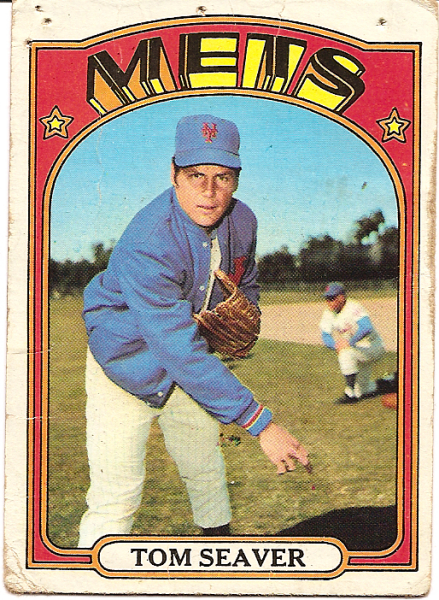
It took ’til the end of summer, but I got a Seaver in 1972. I was so proud that I apparently tacked it to my bulletin board with at least five different pushpins.
by Greg Prince on 24 August 2007 7:05 am The bottom of the sixth Thursday night, which lifted the Mets from a desultory 6-1 deficit to a thrilling 7-6 lead, was one of the most precious half-innings you'll ever witness as a Mets fan. If it had been a ninth inning or an October inning, we'd be talking about it into eternity. If it had unfolded as part and parcel of a victory, it would be The Bottom Of The Sixth, assigned to a lower shelf among the family heirlooms, to be sure, but snug in the Upper-Case cabinet nonetheless.
I was at Shea for Buckner!
Well, I saw The Grand Slam Single!
Gosh, I didn't get to go to those, but I was at The Bottom Of The Sixth!
You were? Cool!
Within a couple of weeks, sadly, the bottom of the sixth — all lower-cased — will be mostly forgotten and it will require a detailed explanation as to what was so great about one half-inning in an aggravating extra-inning loss. To avoid the memory hole rush, clip and save the following:
The Mets were down 6-1 and it wasn't even that close.
Luis Castillo singled. Luis Castillo singled three different times. If he had singled four different times, specifically in the tenth with two on and two out and one behind, “Brother Louie” would replace “Lazy Mary” every night in the seventh, but let's not get ahead of ourselves. Luis Castillo has been zipping the ball at bat and stopping the ball in the field. Without endorsing a three-year $22 million contract as a reward, he's proving the perfect addition for the final two months of a pennant drive.
David Wright reached via a lousy play by the Padre third baseman, which was appropriate because David Wright was playing goalie in an archery match at third all night.
Carlos Beltran walked. Earlier Carlos Beltran doubled in a run. The Padres wised up and fed him a ball, a strike, then three balls.
Carlos Delgado…sigh. If Carlos Delgado had been just a touch more his old self, even his old self from before he went out with the bum knee in Pittsburgh, this would have been a sweep of San Diego. Carlos Delgado didn't get a hit the entire series and we lost two of three. Still, it doesn't excuse a single boo from the heavily represented Moron Corps at Shea. In fact, there were so many morons who booed Mets that they could have been welcomed on the scoreboard. I hope they all got stuck on an escalator and nobody came to rescue them.
Moises Alou walked — with the bases loaded to make it 6-2. Could anybody have done that? From the mezzanine, I couldn't say, but I was firing aptly named throw pillows around the living room at the commencement of the season when Moises was swinging at first pitches as is apparently his wont. I thought he showed great control with the bases loaded (better control than Glavine had).
Shawn Green, spelling Milledge now that the kid has taken the vet's job, hung in there. Mock the cliché if you like, but he took good swings in his first two fruitless at-bats. This time, one great swing on the first pitch and he singled hard into right field, scoring Wright and Beltran, making it 6-4 suddenly. You could feel the momentum rising from nil to nitro the way you did if you were in this old ballpark on June 30, 2000 when the score was building from 8-1 Braves to 11-8 Mets. You could also feel so much naches for Shawn, lost in a bumpy, slumpy forest for almost three months, derided and dismissed by the Metsnoscenti and dislodged from his job for every good reason in the world. Shawn Green has taken his demotion like a pro, not even a hint of “I need ABs if I'm going to help the team” griping that many veterans would willingly let slip. Shawn knows he has sucked since June. Shawn knows he is not this team's future. Maybe Shawn knows he's no lock for this team's postseason roster if the compilation of one is required. If you have a heart, you felt just un pitsel bit good for a good guy when he singled in those two runs in the sixth.
Sandy Alomar, Jr. lined out hard to second. Didn't realize until the scoreboard mentioned it that this was Alomar's Shea debut. As a Met? No, ever. I just looked it up (in fact, I realized I almost forgot he batted in the sixth) and I see that in a Major League career that stretches back to 1988, he had played against the Mets only once, in three Interleague games in 2002 at Jacobs Field. I've got to give him and DiFelice all the credit in the world for playing the most interactive of positions on the field and handling it so well since Lo Duca and Castro went down. You've hardly caught or even faced the pitchers on what's now your staff, yet there you are, thrown into the fire. I don't know what the dynamic is (and maybe Glavine would have had a more characteristic night with a more familiar catcher), but it sure seems admirable. Though he didn't get a hit in the sixth, Sandy's foot-block of the plate in the third to deny Milton Bradley what appeared to be a sure run was one of the quieter outstanding defensive plays of the year.
Marlon Anderson pinch-hit a three-run homer. Wow…Wow…WOW! What a freaking GIFT this guy has been to the Mets since the Dodgers eschewed his services. He didn't hit home runs, at least the out-of-the-park kind, the first time he was here. He may not hit many or any more, but in this jewel of a sixth, he was the inning's platinum sheen.
Mets led 7-6. There was so much joy at Shea at that moment. After high-fiving my main man Mike, I just turned around at looked at everybody in my immediate vicinity. They were happy in ways you can forget being at a great game, or at least a great half-inning, can make you. I locked eyes with a woman behind me, off my left shoulder. I smiled widely. She smiled widely. I didn't need another high-five. Our smiles slapped palms.
What a goddamn shame we still had to get nine outs. A far bigger shame that we neglected to.
by Greg Prince on 23 August 2007 9:05 am Rare is the out-of-town scoreboard update that doesn't involve ATL or PHI (or, because we are the way we are, NYY) that gets our collective attention, but geez, nobody at Shea or anywhere had ever seen anything like what TEX was doing to BAL.
“Wow. The Rangers are winning 14 to 3.”
“Now it's 16 to 3. Birds must have gotten Mussina back.”
“Ohmigod, it's 20 to 3. Baltimore has to be using a position player to pitch.”
“21-3! Maybe the Orioles want to rethink that extension they gave Trembley.”
“Look! It's 24 to 3! That's the Cowboys and the Dolphins in Super Bowl VI.”
“26-3! Texas must have gone for the two-point conversion.”
“27-3! I think the record's 29.”
“They did it! 30 runs! And they have to play another game!”
Yes they did. The Texas Rangers scored 30 runs — 30 unanswered runs — against the Baltimore Orioles in the first half of a twinight doubleheader at Camden Yards. They broke the modern record for most runs scored by one team in one game, which was indeed 29, first accomplished by the 1950 Red Sox and later equaled by the 1955 White Sox; the last major league baseball (yes, baseball) team to score more was called, quite fittingly, the Colts, though they scored their 36 some 79 years before Peyton Manning was born, when the rules said pitchers had to take a swig of hard cider after every strike. The O's, up 3-0 after three, used only pitchers to pitch, killjoys that they obviously are. Somebody on the Rangers actually notched a save for continuing to breathe during the seventh, eighth and ninth innings while his teammates tacked on 16 insurance runs.
Again, your final from Camden Yards in the first game of a doubleheader, the Texas Rangers 30, the Baltimore Orioles 3.
Makes Padres 7, Mets 5 look practically inoffensive.
Or was that Jake Peavy's doing?
I have to admit that except for fits and spurts, it was far more interesting for me and my online-turned-actual buddy Ben, enjoying our first mezzanine rendezvous, to imagine what Texas was doing to Baltimore than it was to watch with full attention the Mets flail helplessly at the starting pitcher for the National League All-Star team. Jake Peavy was the Jarrod Saltalamacchia of throwing Wednesday night, striking out eleven in six innings, including setting down Carlos Delgado fifteen separate times with runners on base.
OK, math's off there, but that's what it looked like when we deigned to pay attention, so effective was Peavy and so deep was our conversation about the Rangers, the Orioles and everything except what we paid to see (funny how that goes). Peavy had no-hit stuff, thus the no-hitter he carried into the fifth. He walked five, but as long as he didn't walk them consecutively, he was in reasonable shape. It was only by the royal graces of his highness Count Pitch that Peavy came out after six innings.
Before we could derive the benefit of going Jakeless, we would be pretty much screwed. Butterfingers all around betrayed Brian Lawrence through five, yet the heat 'n' serve bat of Carlos Beltran and the record-shattering wheels of Jose Reyes (serenaded for his 67th steal of the year while Beltran prepared to drive him home…clearly a moment too sublime for a game so crappy) kept Peavy just honest enough to make it close, 4-2 heading to the sixth. Lawrence was removed for Guillermo Mota, which seemed like not such a bad thing when he mowed down the Padres in uncharacteristic order. After Peavy retired Alou, Milledge and DiFelice with no fuss in the bottom of the sixth (which is exactly what he did in the bottom of the second and the bottom of the fourth) and departed — one hundred pitches being one hundred pitches — we had almost escaped with our competitiveness in tact.
Then Mota came out to pitch the seventh.
Jason calls Guillermo Mota the master run-allower for a reason. Mota finds a way to eventually turn zeroes into heartbreak. You don't think he can do it, but that's because you're not the master run-allower. He is. One perfect inning blemishing his line? C'mon skip. Leave me in there. I know I can create trouble for us. It was a tough task. In spite of himself, Mota started the seventh by inducing a flyout from Geoff Blum and striking out Milton Bradley. Guillermo Mota had a streak on the line. Four straight outings with at least one run…usually more…always earned…allowed.
Yes, he is a master of the genre.
With the Rangers by now doing nothing more to distract us than having their hitting shoes refitted for the nightcap (which they cruelly won 9-7), we were forced to take a good look at Guillermo Mota.
Adrian Gonzalez singled off Guillermo Mota.
Mike Cameron drew a walk from Guillermo Mota.
Adrian Gonzalez and Mike Cameron advanced on a wild pitch from Guillermo Mota.
Sensing a trend here?
The master at work, continued:
Khalil Greene singles to left off…Guillermo Mota! Two Padres score on runs allowed by…Guillermo Mota!
Khalil Greene steals second off…Guillermo Mota!
Kevin Kouzmanoff doubles off…Guillermo Mota! One more Padre, thus, scores on a third run allowed by…Guillermo Mota!
The master's craftsmanship was impeccable.
The Padres led 7-2. Sure, the Mets cut it to 7-5 on a spry ninth-inning rally, aided by the Padres' defensive indifference and a couple of legit base hits, including one from Mr. Metlin Jeff Conine. Sure, the potential tying run technically came to bat, but since the technical potential tying run was wearing a uniform that said DELGADO, the potential was technically limited. Trevor Hoffman tried to blow it the way Trevor Hoffman has been known to blow it between recording oodles of saves, but he's no Guillermo Mota. Hoffman's just a dilettante run-allower.
Ben had lots of penetrating questions for me as the night progressed, though it was his last one that was the best one. Does a loss like this feel worse because it went from being hopeless to close to undeniably certain at the end or does the sudden surge of hope make it somehow more tolerable? I demurred on answering as we exited Shea, a loss being a loss, but I'm now willing to commit that it is better to sniff the possibility of a second consecutive comeback and be foiled than to go gently onto that good 7 Express.
A loss was still a loss, you betcha, but for a moment there it felt like it wouldn't be. You were struck out eleven times in six innings by one of the best pitchers in the circuit and you faced the most statistically successful closer in the history of baseball and you still had a Delgado's chance in hell to win. Not a horrible coda to an otherwise tepid eight innings.
Some other reasons the Mets had a way better night than the Orioles:
• ATL lost.
• PHI lost.
• Mota, one would like to believe, exposed his lack of guts and unnatural enhancement so that maybe, just maybe, somebody will stop using him in official ballgames. Call this a first-and-a-half guess because I was formulating the guess between the strikeout of Bradley and the single by Gonzalez, but couldn't have Willie just removed him and his sorry ass with two out in the seventh for no reason other than the certainty that he was going to cease recording outs any second now? Shoot, Schoeneweis is finally getting out lefties and one happened to be up next. Anybody's who's witnessed Mota's masterful run-allowing of late knows asking Guillermo to put up two straight scoreless innings is like asking Britney Spears to remember to put on two separate undergarments two days in a row. I mean what are the odds it will actually happen?
• Beltran recovered nicely from his called strike three in the third to drive home Jose and David in the fifth and David (on base five times without really trying) again in the ninth. Three RBI Wednesday on top of five Tuesday on top of four Sunday. Twelve ribbies in three games: purely backwash on the Rangers, but most valuable play from anyone else.
• Reyes, it should not be glossed over, is the Mets' all-time single-season stolen base champ, having swiped three with relative ease. The crowd's jolly sing-song reaction, prompted by no more than scoreboard confirmation that No. 67 had been achieved — most of us knew it already — was a little slice of Amazin' heaven. For all the “Jose!”s he's received, I can't think of any that have risen up organically for something as deceptively simple as a steal of third. Here's to 68 and beyond. (And here's to you, Roger Cedeño…66 bags wasn't so bad either.)
• Ben, who spotted the Orwellian deletion of Rick Down's incidental image from the “Sweet Caroline” video about three seconds after Down was dismissed from the premises, astutely observed the kid who is awarded the video game on DiamondVision is no longer handed a box with Derek Jeter's picture on the cover. We think Albert Pujols is the new prize, which is a little nauseating, but in this case, a little is better than a lot.
• Did I mention we didn't give up 30 runs? Then again, we only left Mota in for two innings. Maybe the Rangers will take him on their barnstorming tour this offseason — you know, give the folks away from the big cities who haven't had the privilege a once-in-a-lifetime chance to see real, live big league mashers tee off against recently released big league pitchers.
One can only hope.
by Greg Prince on 22 August 2007 7:35 am That old feeling. It was there Tuesday.
No, I don't mean thrilling come-from-behind wins against Hall of Fame (c)losers in which everybody has a hand in triumph, after which you look up and realize your team is in pretty darn good shape.
OK — that, too. But something almost better because it's been missing more than I realized.
With Carlos Beltran locked in more securely than anybody east of Garret Anderson, Howie Rose noted how when Beltran's hot, he's unstoppable, but when he's cold, he essentially gets himself out. So true, I thought.
Well, Carlos is locked in and he is unstoppable and it is a big help, to say the least. When he came to bat in the eighth with the Mets down by one and runners at the corners, I thought this first:
“Oh boy! We have exactly who we want up right now!”
I thought this second:
“If what Howie said earlier is accurate, that means at some point Carlos will cool off and a situation like this that comes down to his hitting with runners on won't be desirable. That will be very sad.”
I thought this third:
“Shut up, stupid.”
And this matters…how? I'm not sure. I just know that most of this season I've worried about thinking the wrong optimistic thought and having it karmically backfire. Last night I instinctively went the other way, looking ahead to when something on some date to be determined will go wrong, as if whatever's going on at this moment is going undoubtedly right.
It was, in my occasionally overwrought way of rooting, the most reassuring sign that 2007 might turn out well after all. The five-game lead and such is a decent enough indicator, I suppose, but sometimes you can just feel something turn to the good and familiar. I remember after Piazza hit the homer that capped off the magical ten-run inning in 2000 that Rob Emproto mentioned to me the camera angle on one of the replays: Mike would swing and everybody on the first base side would turn en masse to watch his ball wave bon voyage. Rob said he grew used to that angle in 1999 when that sequence and reaction were regular occurrences, but to that point in the next season he hadn't seen it at all. Seeing it again was a relief to him.
That's how I felt worrying that the Beltran we got Tuesday night wouldn't always be that very Beltran, the one who tore up the league last week and is threatening to do the same this week. It felt good to think in those “this is so pleasant I don't want the sensation to end” terms that were a dependable part of my thought process in 2006.
Oh, right…Beltran's at-bat. He singled in the tying run. You probably knew that, but it seemed worth mentioning.
The Mets fell behind again, but when Lastings Milledge returned the favor by singling off Trevor Hoffman to start the ninth, you just kind of knew, didn't you? We didn't fall to Hoffman. We didn't fall to Heath Bell who was probably salivating at the chance to make us regret his departure. We gave back leads but we kept the game. It was a very first-place thing to do.
Bell was hardly the goat and Luis Castillo — game-winning hitter after Milledge, Mike DiFelice, Marlon Anderson and Jose Reyes did their ninth-inning parts — wasn't the only clutch performer, but I found their roles in this passion play of a baseball game instructive. These are two guys who seem to represent something to a good-sized segment of Mets fans.
• Heath Bell was the Overlooked Reliever who never got a chance from management who didn't understand what they had.
• Luis Castillo is the dreaded veteran who gets too much of the benefit of the doubt when in fact there is little in his current portfolio to merit it.
Nonsense I say to both dogmatic characterizations.
Castillo has vindicated my relative faith in him, though I imagine there will be nights when he pops up four times and I ask what the hell Omar saw in him. Likewise, Bell may very well come in the next two nights and yield nothing to Beltran and make me wonder why we wasted him and Royce Ring on Jon Adkins and Ben Johnson.
But those are the actual ballplayers Heath Bell and Luis Castillo. They'll have their ups and downs. There will be nights when I'll be proven dead right about both — I didn't ever want to look at Heath Bell in a Mets uniform ever again after his multiple callups between 2004 and 2006 yielded little in the way of substantial performance and I was reasonably happy to have obtained Luis Castillo because I'm not at all convinced of the specialness that many have assigned to Ruben Gotay — and there will be nights when I will be proven dead wrong. That's baseball and that's fine.
What I don't get is the need by some fans (and I'm not necessarily referring to anybody in particular, just a lot of what I've read online in my 2-1/2 years of blogging) to slot guys such as Bell or Castillo into their preconceived notions of player value judgments, for lack of a better phrase.
“The failure to give an unsung pitcher like Heath Bell a longer look is symptomatic of…”
“The reliance on aging infielders like Luis Castillo shows…”
Statements that begin with clauses like those are some of the most unfun sentiments in this great game of ours. They're right down there with “This week's Power Rankings say…” and “Hi, this is Jon Miller with Joe Morgan…” Unless you're vying for a general manager's job somewhere, I'm not sure what the big kick is in aching to be right rather than happy.
My blogging partner came up with a great line ten years ago, one he's probably forgotten. He had predicted the Mets would lose a hundred games in 1997. They were doing nothing of the sort that summer, as I like to point out once a month. In baseball, Jason said, sometimes there's nothing as satisfying as being proven wrong.
I sense there are Mets fans who would rather see Luis Castillo (or other vets who don't meet with their seal of approval) fail so it validates some abstract theory on player procurement. I hope whoever they are have been watching him field his position and handle his bat these last few weeks because he's been doing exactly what Omar Minaya acquired him to do and the Mets and, by extension, we are the beneficiaries. Rooting isn't a Henry Clay proposition. It's way more fun to be wrong and happy than it is to be right and miserable.
As for Bell, my feeling that he wasn't going to make it as a Met (based on 81 mostly ineffectual appearances across three seasons) doesn't look terribly valid because he's sure done well as a Padre. Maybe we could have gotten that out of him here. Or maybe he needed that ever popular change of scenery and a different pitching coach. I do know that if he were still a Met and was succeeding as he has for San Diego, I'd happily post three times a week, “My goodness, I was SO wrong about this guy and ain't I glad?”
Esoteric topic to chew over in the face of a rousing walkoff victory? I suppose. But the mind tends to wander when the Mets are winning. That, too, is a very good sign.
by Greg Prince on 21 August 2007 10:00 pm 
If everything goes right for the next two months and change, Jeff Conine will have the opportunity to take part in a New York City event that he took so much pride in helping put the kibosh on four Octobers ago.
Tell me boy, now wouldn’t that be sweet?
Ya gotta love this guy! Look how happy he is holding that wretched yet ultimately hilarious sign! If you can’t read it clearly, it says the Yankees will be honored in a parade on the Tuesday after the 2003 World Series. In case you’ve forgotten, Conine’s Marlins won the 2003 World Series in six thrilling games, rendering all mass transit routes to the parade moot since even our marvelous downtown trains don’t extend all the way to South Florida.
(Delicious image courtesy of the back cover of Miracle Over Miami by Dan Schlossberg with Kevin Baxter…and preface by Mr. Marlin himself.)
by Greg Prince on 21 August 2007 9:43 pm In Albert Brooks' Defending Your Life, Judgment City serves as a celestial yet brilliantly pedestrian way station for the recently departed. If the individuals who arrive fresh from death are not judged up to snuff, they are sent back to Earth for another lifetime reincarnated as somebody else until they get it right. If they pass judgment, they “move on” to the next magnificent level of universal existence.
I'd like to think we represent that next level for Florida Marlins. We've done it before and we can do it again.
Perhaps there is no greater test case than that of converting Mr. Marlin to Metdom. Jeff Conine, as every schoolchild knows by now, was part of both the '97 and '03 champions, albeit never one of the more flamboyant pieces of the Fish pie. I'm actually quite surprised that he is overwhelmingly considered the ultimate Marlin since I have to admit virtually his entire career has occurred with my being only dimly aware of it despite how much we play them. I remember him losing first base time to Darren Daulton in '97. I remember his return to Tru Playa Pimp Park Stadium in '03 being a South Floridian cause célèbre, lighting up faces along I-95 South from Hollywood to Hallandale (which isn't very many exits, but there aren't very many Marlins fans). I don't remember much else.
Did you know Jeff Conine was the 1995 All-Star Game MVP? I might have the night he won it since I actually watch All-Star Games, but I'd forgotten all about it. Everything else about Jeff Conine's achievements as a player have escaped me, too, if I ever knew about them in the first place. I don't mean to be disrespectful to Mr. Marlin, but he's just made zero impression on me as a player. I don't doubt he's beaten us a game or two over time, but with all the Kotsay and Dunwoodie bogeymen with whom Florida has tortured us across the years, who can keep track of the more likely suspects?
But I welcome Jeff Conine to the fold for several reasons.
1) Righthanded bat, et al.
2) Marlin Mania has always served us well. Their first wave of franchise demolition gave us our Leiter, our Cook, our Piazza somehow. The next wave gave us our Lo Duca and our Delgado. Those Marlins helped give us our last three playoff teams. Viva la fire sale!
3) Though the 1997 Marlins were an affront to our higher aspirations for my beloved 1997 Mets, the presence of Moises Alou on their World Series roster likely negates his later Cubbiness, which as any decent superstitious weirdo can tell you is essential to negate if you have certain goals for your team.
4) We don't appreciate the 2003 Marlins nearly enough, both for their simply amazing run from nowhere to the top and for who they ran through in the home stretch of their sprint to glory. If the 2001 Diamondbacks killed a most unappetizing dynasty and the 2002 Angels buried it, the 2003 Marlins of Jeff Conine and Luis Castillo and assorted non-Mets/not-yet-Mets drove a stake through its heart. (I shudder, from a strictly clinical standpoint, to think what the 2004 Red Sox did to it, charging it as they did full-force from behind.)
I don't exactly remember what Jeff Conine did in support of The Greater Good in the 2003 World Series, but he did do this afterwards: He posed on the back cover of a book called Miracle Over Miami: How the 2003 Marlins Shocked the World holding a genuine and genuinely presumptuous New York City Subway poster. It was a notice about additional service, decorated with an oversized vertical swastika, urging one and all to
Celebrate our Yankees' World Series victory at a New York ticker-tape parade!
The parade date is listed as Tuesday, October 28, 2003…three days after Josh Beckett and a school of friendly Fish made sure no such celebration would ever take place. I suppose any World Champion Marlin could have posed with that poster, but Jeff Conine was the one who did. And he looks pretty pleased about it.
Mr. Marlin was Señor Schadenfreude, too? Mr. Marlin rubbed the collective pinstriped nose in their inability to attend their own parade? Mr. Marlin practically stuck out his tongue at aura and mystique?
Mr. Marlin is my kinda guy.
by Jason Fry on 21 August 2007 12:37 am Sometime in the not-so-distant future Jeff Conine will become the 819th Met, welcomed by me with great enthusiasm. My natural sympathies lie with youth and potential over age and a diminishing track record (Milledge over Green, Gotay over Castillo), but they're put aside when it comes to constructing a bench. There, you want evidence of a good eye, the ability to deliver results in part-time play, a proven track record, and intangibles. Conine, all 41 years of him, would seem to have all of those things, and be an excellent replacement for the felled, mourned Damion Easley as the right-handed bat off the bench.
Comments on the then-rumored trade over at MetsBlog got me curious: Just how many ex-Marlins do we currently employ, anyway?
(Warning: Jace Math ahead. Adjust your expectations accordingly.)
Taking our likely roster should we play ball in October — which I figure will be Pedro, Glavine, El Duque, Maine, Perez, Sosa, Heilman, Schoeneweis, Mota, Feliciano, Smith, Wagner, Lo Duca, Delgado, Castillo, Reyes, Wright, Alou, Beltran, Milledge, Castro, Conine, Anderson, Chavez, Green — here's a look at what teams have served as homes for that collection of Mets:
FLA — 7 (Mota, Lo Duca, Delgado, Castillo, Alou, Conine, Castro)
HOMEGROWN — 6 (Heilman, Feliciano, Smith, Reyes, Wright, Milledge. Hush up about Feliciano's stopoff in Japan.)
LAD — 5 (Pedro, Mota, Lo Duca, Anderson, Green)
WSH/MON — 5 (Pedro, Mota, Alou, Anderson, Endy)
PHI — 4 (Wagner, Conine, Anderson, Endy)
HOU — 3 (Wagner, Alou, Beltran)
TOR — 3 (Schoeneweis, Delgado, Green)
KC — 3 (Beltran, Conine, Endy)
ATL — 2 (Glavine, Sosa)
STL — 2 (Sosa, Anderson)
PIT — 2 (Perez, Alou)
CIN — 2 (Schoeneweis, Conine)
ARZ — 2 (Duque, Green)
BAL — 2 (Maine, Conine)
TB — 2 (Sosa, Anderson)
CHW — 2 (Duque, Schoeneweis)
CHC — 1 (Alou)
SD — 1 (Perez)
SF — 1 (Alou)
BOS — 1 (Pedro)
NYY — 1 (Duque)
CLE — 1 (Mota)
MIN — 1 (Castillo)
ANA — 1 (Schoeneweis)
MIL, COL, DET, SEA, OAK, TEX — 0
(If you want to consider other possibilities: Gotay was a Royal; Sele's suited up for Boston, Texas, Seattle, Anaheim and Los Angeles; Newhan's been a Padre, Phillie and Oriole; DiFelice's world tour has included stops in St. Louis, Tampa Bay, Arizona, Kansas City, Detroit and Chicago (NL); Alomar's played for San Diego, Cleveland, Chicago (AL), Colorado, Texas and Los Angeles; Burgos was a Royal; Lawrence was a Padre; Vargas was a Marlin; and Pelfrey's homegrown. Oh, and Easley was an Angel, Tiger, Devil Ray, Marlin and Diamondback.)
Raiding the Marlins is nothing new for this team, and the Natspos factor undoubtedly reflects Omar's resume. The Dodger connection surprised me a bit, but at least we're doing well on the Cub factor. And I trust we've forgiven El Duque his time in the service of the Vertical Swastika — refugees can't be choosers, right?
Sticking with roster minutiae on a rainy off-night, I've always been borderline obsessed with roster oddities, whether it's the Lost Mets who never got baseball cards, Mets whose cups of coffee came in the midst of lengthy stints in the minors, or guys who earned their orange and blue in life if not on the diamond. Then there are the Almost Mets, the guys who suited up but never got into a Met game, a short list whose dean is Terrell Hansen. Hansen was brought up in '92, assigned No. 21, waited around for a couple of days, got sent back down, played for another decade or so — and never made the Show. There are more-compelling reasons to hate Jeff Torborg, but make room for that one — as I once wrote, Terrell Hansen would give his eyeteeth to be Moonlight Graham.
I had always fixed the roster of the Almost Mets at five: Jerry Moses ('75), Terrell Hansen ('92), Mac Suzuki ('99), Justin Speier ('01) and Anderson Garcia ('06), with only Hansen not finding his way into the Baseball Encyclopedia at some other time with some other team. So imagine my surprise when I was goofing around on the sublime Mets By the Numbers and discovered three other Almost Mets — and another Met tragedy.
According to MBTN, the first Almost Met was Jim Bibby, who was called up but not put to work in 1969 and again in 1971. Then came Randy Bobb, in 1970. (Bobb shares a '71 Mets Rookie Stars card with Tim Foli, which makes him part of another list, but lets try and keep our obsessions separate here.) And finally there was a name I'd never heard before — Billy Cotton, recipient of a DNP for 1972.
Bibby made his debut in '72 as a Cardinal, and went on to win 111 games in a perfectly serviceable 12-year career. Bobb's big-league career was over by the time he got to Shea, but had collected 10 at-bats (and one hit) in two short tours of duty with the Cubs. But Billy Cotton never played in the big leagues. In '73 he played for Tidewater, Toledo and Memphis, in '74 he collected five RBIs for Iowa, and that was the end of his professional career. Google him, and you'll be left with the merest scraps of info — he was a No. 1 pick, a Sun Devil, and wore 22 for the Mets in September 1972. And that's it — there's no record of what Yogi Berra didn't see in him, or why he didn't at least give him a moment, as Art Howe did to get Joe Hietpas into the book. Billy Cotton was Terrell Hansen before there was a Terrell Hansen.
For me, the discovery of another phantom Met doesn't make Hansen's story any less poignant. To the contrary — I knew Hansen because I saw him on TV and he got a baseball card. Cotton gave baseball at least a decade of his life, played it at a level 99.99% of human beings couldn't imagine, and yet his near-miss came as a complete surprise to one of the most-rabid fans of the baseball team that so briefly employed him.
If I ever get a time machine, I'll of course do some of the things I've always figured I'd do, like kill Hitler and gawk at dinosaurs and invest in Standard Oil and say certain things to certain girls and not say certain other things to certain other girls and give Jose Reyes's drive in the 9th inning of Game 7 a little boost beyond Jim Edmonds' reach. But if the machine's still working after that, I'm going to go visit Yogi and Torborg and see if things can't be put right.
|
|






