The blog for Mets fans
who like to read
ABOUT US

Faith and Fear in Flushing made its debut on Feb. 16, 2005, the brainchild of two longtime friends and lifelong Met fans.
Greg Prince discovered the Mets when he was 6, during the magical summer of 1969. He is a Long Island-based writer, editor and communications consultant. Contact him here.
Jason Fry is a Brooklyn writer whose first memories include his mom leaping up and down cheering for Rusty Staub. Check out his other writing here.
Got something to say? Leave a comment, or email us at faithandfear@gmail.com. (Sorry, but we have no interest in ads, sponsored content or guest posts.)
Need our RSS feed? It's here.
Visit our Facebook page, or drop by the personal pages for Greg and Jason.
Or follow us on Twitter: Here's Greg, and here's Jason.
|
by Greg Prince on 7 August 2007 8:29 am Why can't pitchers hit even a little better? Who knows more about pitching?
Why don't catchers facing a pitcher they used to catch hit .750 against that pitcher? Who knows more about that pitcher's thinking?
Why are so many pitchers so nuts about not allowing anyone to talk to them on the days they start? Will they forget it's one for fastball, two for a curve?
Why are ballplayers always shown departing for a road trip in a jacket and tie? In what other business are you required to dress one way for your travel and another for your actual job?
Why is there a lingering obsession about how players wear their pants, their socks and their stirrups? “They're too high!” “They're too low!” “They're old school!” They're just pants, socks and stirrups.
Why are older-style uniforms considered traditional and somehow unimpeachable? Maybe the genuine tradition is just starting now and everything before now was all wrong.
Why do retired or veteran ballplayers perpetuate this myth that it's just not like it used to be when I came up, we'd stay and talk baseball with the older guys, now everybody rushes out of the clubhouse? I've heard at least two generations of ballplayers who have been assailed by their elders for not caring nearly as much about the game insist they, in fact, were the last of that dying breed that cared about the game. Can we assume just about everybody who plays the game cares about the game in his own way?
Why does almost every batter stand and watch his deepest fly balls sail toward the fence? Don't they know what a home run looks like? Have they been clued in that not every ball hit well leaves the park? That it's better to run so you can be on third instead of second or second instead of first should the ball not be gone or not be caught? Is it common knowledge among the players that all the games are televised and usually recorded by the clubs themselves?
Why do pitchers who discover magical arm angles that save their careers forget to employ that arm angle eventually?
Why doesn't Willie Randolph “challenge” every player the way he “challenged” Cliff Floyd two years ago? Remember that? Floyd had been injured and a little lethargic in '03 and '04 and then has that Monsta year in '05 and the line all season from Willie was “I challenged Cliff and he responded.” Great work. Do it again.
Why does a pitching coach wear a uniform while a trainer wears slacks and a golf shirt? Each man sits in the dugout most of the time and only runs onto the field in an emergency. They may as well wear the same getups.
Why do stadium A/V squads play songs like Billy Joel's “Pressure” to taunt the visiting team's young, often Latino relief pitchers who probably have no idea about the message being conveyed and that they're supposed to become unnerved by such a clever jukebox selection?
Why after all the bad publicity attached to chewing tobacco about a decade ago have I noticed what seems like a plethora of Skoal cans in players' back pockets this year?
Why does Shawn Green lean against his bat in the on-deck circle like a man waiting for a bus?
Why does Shea sell blue cotton candy? When did cotton candy start coming in a color that isn't pink? If they're gonna sell cotton candy in blue, why not sell half of it in orange?
Why do I look at the out-of-town scoreboard at least six times per half-inning even when I know damn well no other game besides the one in front of me has begun?
Why does almost every announcer tell us the potential tying run will be coming to the plate “in the person of” Johnny Estrada? What are the odds Johnny Estrada will come to bat reincarnated as a dining room table?
Why, if nobody likes it, is the volume turned up so loud on every bit of pregame and between-innings business? I've yet to hear anybody tell me “it's great the way they've got the decibels goin' tonight!” In fact, I've yet to hear anybody tell me anything without me begging pardon and asking it be repeated.
Why don't the Mets hand out more bobbleheads and hand them to adult fans who pay the freight and seriously collect that kind of stuff?
Why are we told who is sponsoring this call to the bullpen but often have to wait until after the commercial to be told who the call was for?
Why do people who know you're going to a game say they'll look for you on TV? They won't, and even if they do, the chances are remote they'll find you unless you're Christine Glavine or some gesticulating idiot with primo seats behind the plate?
Why doesn't somebody clean up all those mysterious puddles that materialize every few sections in every concourse? It's a wonder more fans don't slip and more lawsuits aren't filed.
Why do regular people get days off while baseball teams get off days?
by Greg Prince on 6 August 2007 10:14 pm 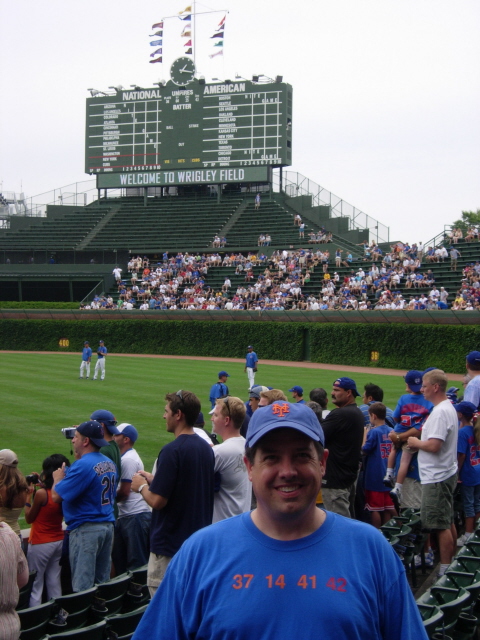
| Ernie Banks became famous at Wrigley Field for, among 512 other things, suggesting, “Let’s Play Two!” Dave Murray doubled up on Mr. Cub by heading to the North Side of Chicago on Saturday and wearing four…the four retired Mets numbers featured on the now classic Faith and Fear in Flushing t-shirt.
As Dave recounts at the ever-entertaining Mets Guy in Michigan, he encountered a reasonably savvy souvenir shop owner in Wrigleyville who observed:
“OK, I know what the shirt means, but who is No. 14?”
Dave clued him in that it was none other than the manager who bested Leo “No, these were the real Mets” Durocher in 1969, Gil Hodges.
Also wearing 14 that summer and for many summers in Chicago, Ernie Banks. |
|
|
by Jason Fry on 6 August 2007 10:00 pm We hold these truths to be self-evident: There can never be enough interesting/entertaining writing about baseball in general and the Mets in particular. Sure, the Mets play nearly every night and are covered by some 10 local papers and a fleet of blogs. But even then, eventually you've read everything the knights of the keyboard have written, and you're still wanting more. Because damn it, it's six hours (or 20, or two or 0.25) until there's a game on, and you're worried about Pedro's rehab, the state of the farm system, Mark Teixeira and what statistical simulations suggest will happen for the rest of the season, to name the first four things that pop into your head.
Over there on the left we've got a lot of links. But on this off-day, I wanted to spotlight two writers I find particularly entertaining and interesting.
The first is Marty Noble, the veteran reporter turned MLB.com scribe. I've got enormous respect for Noble's years of hard work, baseball knowledge and the unfussily straightforward way he offers insider analysis. But what I really love are his mailbags. (Truth be told, I don't read game stories anymore, no matter who writes them.) Noble seems to save up the dumbest questions Met fans can imagine for some day when he just can't stand it anymore. Then it's time for a mailbag — in which Marty lines up the witless and whacks away at them until he's got his equilibrium back.
Take this one. Things start off OK, as Noble uses a reader's disbelief about Rickey Henderson's leadoff homers vs. the Mets' to illustrate how great players can seem to distort statistics. But from there … well, buckle up.
Jordan R. supposes that Duaner Sanchez will be a free agent when he comes off the DL, at which point the Mets should sign him to a two- or three-year contract because “he is so valuable to their bullpen when he's healthy.” Noble's fairly restrained here, calmly correcting the record about Sanchez's contract status before getting a bit testy: “Now, why would the Mets want to offer him anything more than one-season contract, even if they were competing for his services?”
Alex X. wants to move Fernando Martinez to second base for no particular reason I could detect. “I've never quite understood the public's fascination with changing players' positions,” huffs Marty, then dispenses with a similar question suggesting Ramon Castro man first.
Next comes the overly sentimental Marty C., who wants Mike Piazza back as a backup catcher and World Series DH. “So you want the Mets to acquire a player who might serve as a DH for a maximum of four games in October and carry him for 2 1/2 months as a backup catcher with tarnished defensive skills?” asks Noble, and you can easily picture his eyebrows arching higher and higher until they're levitating and have to be retrieved with a stepladder.
My favorite Marty Noble mailbag, though, came in April. This one starts off calmly enough, with straightforward analysis of Pelfrey, Humber, Vargas and the rest of the waiting-in-the-wings pitchers. Marty's pretty even-keeled, except at the end, when his advice is “lest you all be labeled junior Steinbrenners, be a tad more patient.”
But then, oh, that next question. It still makes me laugh half a season later. The luckless Dan R. wants to know why the Mets keep using Aaron Heilman “when all he does is throw the same pitch over and over again and get destroyed by hitters.” Marty coolly acknowledges Heilman's recent woes and explains what Willie's thinking about the bullpen is. But then he can't keep it in any more: “He has been an invaluable asset for two seasons. You want to do what with him now? The rotation? The Minors? Exile? Prison?”
My other new favorite is the New York Sun's Tim Marchman, who's consistently very smart, bitingly acerbic and really funny. He first caught my eye with this terrific scouting report of the '07 Mets, including his pitiless, laugh-out-loud summation of Moises Alou: “a horrible defensive outfielder, with the range of a box turtle.”
But then whenever Marchman writes, I know I'll laugh out loud at least once, shake my head at a particularly pungent line, and come away thinking about something differently. Take this analysis of how Omar Minaya simultaneously finds diamonds in the rough like John Maine and Oliver Perez and wastes roster sports on Jose Lima and Chan Ho Park — “pitchers so bad no one was aware they were still playing professional baseball.” (The answer: Minaya likes reclamation projects, but only if they're flyball pitchers with decent peripherals and at least some recent success.) Or read this smart take, from June, on our vanishing outfielders and what we should and shouldn't worry about. (And now Beltran and Gomez are gone. What a bizarre year we're having.)
There's this, from our July near-death experience: “There is bad baseball, and there is pitiful baseball, and there is painful, embarrassing baseball, and there is the kind of baseball the Mets have played this month, which is none of these things, but is instead just depressing. Watching the Mets these days is like nursing yourself through a hangover, or looking at happy photos of yourself with someone who threw you over for your best friend.” There's this piece, that did a beautiful job explaining how ballplayers age and why Carlos Delgado should be fine. Or this reassuring take on our failures in the clutch, with a bit of priceless psychology: “When they miss every opportunity without fail, the team is glum and fans become pessimists, and big hits like Chip Ambres's game-winning single in the 10th inning yesterday can even irritate by their contrast with the usual shoddiness.”
Some weeks Marchman writes five times a week, and his consistency is awe-inspiring: When he's good he's the best sports columnist in New York by a wide margin, and when he's just OK he's the best by a small margin. Kind of like the 2007 Mets, I suppose. Read him.
by Greg Prince on 6 August 2007 3:00 pm It was neat.
That's the word my vocabulary sent up to describe the sensation of watching Billy Wagner retire Mike Fontenot and secure Tom Glavine's 300th career (and 58th New York Mets) win Sunday night. Some round numbers are more spherical than others and this one is a perfect circle. Perfectly neat.
The guy's career began 20 years ago this month. He goes out approximately every fifth day, skipping the Disabled List altogether, and posts an average of 15 wins annually. Perfectly consistent, too. I remember when one of the pitchers who was on the verge of 300 wins in the early '80s neared this mark, Warner Wolf said to put it in perspective, imagine a pitcher winning 14 games a year for 20 years: he would still need 20 more to make it to 300.
You don't need to go to the videotape to know baseball has been populated by awesome pitchers who did not manage this perfectly neat number. Nobody's pulling the plaques of Bob Feller or Sandy Koufax or Bob Gibson or Juan Marichal or Jim Palmer or Catfish Hunter or Ferguson Jenkins for not getting there; nor should anybody think any less of Tommy John or Jim Kaat or Bert Blyleven for finishing a bit short (or Randy Johnson if he hangs 'em up 16 shy as back problems may dictate).
But getting to 300 certainly merits extra credit. Every starting pitcher would love to win a 300th but only 23 have achieved it even though we're talking about the most single-minded creatures on the diamond in any game they play. They help their teams when they win but they help themselves first. They revel in getting the W. They express gratitude for being taken off the hook. They can barely force a smile if their good work is not personally rewarded.
Quick, what's Jose Reyes' won-lost record and how does it rank among shortstops? How many wins did Cleon Jones accumulate in his career? Was Ray Knight ever no-decisioned?
It doesn't work that way. The whole “pitchers aren't players” line Keith Hernandez doles out every night isn't simply the raving of a mad Mex. It is different for starting pitchers. Their schedules are different. Their metrics are different. Their responsibilities are different (though let us forever note that the first run of Tom Glavine's 300th win was driven in by Tom Glavine). With few exceptions, you — a family member, a teammate, a fourth-estatesman — can't talk to one of them on the day he pitches. Imagine David Wright or Carlos Delgado telling a reporter, “Sorry, I don't do interviews when I'm starting.”
Their near-term goals are different, too. When Barry Bonds and Alex Rodriguez went dry in their quest to get off of home runs 754 and 499, respectively, it made perfect sense. Their job has never been to go up and swing for the fences. It's to hit the ball somewhere fair. They have the talent and ability to hit it far and sometimes the damn thing travels out of everybody's reach. When Bonds and Rodriguez started to think about it, they had to have adjusted their thought processes from “see the ball, hit the ball” to “must…hit…next…home…run.” With that attitude, it's not surprising each of them was going to hit nothing more than a figurative wall for a week.
Starting pitchers, unless they're aiming for a strikeout record, one supposes, don't have that problem. Their job is to get an out, any kind of out, to get at least 15 outs with their team ahead or as many outs as it will take to rate a win. As we've discussed a bit of late, it's kind of a silly statistic. A starter can throw nine brilliant innings and be pinned with a loss. A reliever can enter an inning with two outs, pick off a runner and exit for a pinch-hitter and eventually be credited with a victory because his teammates score a passel of runs on “his” behalf. Thus, on a case-by-case basis, whoever gets one win is sort of irrelevant.
Whoever gets 300 of them, however, must be doing something very well for very long. That sounds a lot like Tom Glavine.
by Greg Prince on 6 August 2007 9:09 am 
Things I already admired about Tom Glavine the Met (really).
A one-hit shutout of the Rockies that sounded as close to the real thing as I’ve ever heard.
Two legitimate All-Star berths.
Eight innings, two hits and no walks to win one for Ralph Kiner.
Domination of the Dodgers and the Cardinals when it counted most.
At least 15 decisions he deserved to have go his way even if they didn’t.
Pitching past missing teeth and finger numbness.
The professional bunting and the emergency pinch-hitting.
And now No. 300 in a Mets uniform.
Congratulations Tom.
Really.
by Jason Fry on 6 August 2007 4:32 am Since we began this blog, Tom Glavine has been something of an odd figure in its pages. For a while, we called him The Manchurian Brave, as some combination of Questec and his own stubbornness seemed to have turned him into a mediocre pitcher, one whose struggles just reminded us of his dominance wearing that other uniform. (Not entirely his fault, but that's fandom.) Then Glavine finally listened to Rick Peterson and to what his own stats were telling him: He had to change. He did so, reinventing himself in mid-2005, at a stage in his career where refusal to do so might have won him grudging plaudits for staying a very successful course even if it had needed a late course correction that didn't come — he did it his way and all that. That adaptation won us over, and we started referring to him as The Eventual Met.
But it's true that neither Greg nor I could ever quite get into his corner, leading to the rather odd scenario of a New York Met — an honest-to-goodness New York Met — chasing his 300th career win while two of the biggest Met fans on the planet tried to rally themselves to be truly excited about it. Greg chronicled his feelings last week; by the time I got to a set for Glavine's first attempt, the main attraction had yielded the field to the relief corps.
Today was going to be a baseball doubleheader. Joshua and a number of his classmates descended on Keyspan Park with all the energy a gang of sugared-up, excited four-year-olds can bring. I'm glad to say Keyspan is still standing. I'm happier to say that Sandy the Seagull visited, mugged for pictures and was generally charming, which mollified Emily enough to put aside her two-year-old grudge. Joshua, meanwhile, took a bizarre liking to the Aberdeen Ironbirds' centerfielder that Emily and I refused to share or even countenance. (Matt Angle, if you somehow get stuck with the nickname Li'l Boopy, I apologize. It doesn't make sense to me either.) Fortunately, there were numerous Cyclones runs to celebrate — a Cyclone and an Ironbird hit balls over the right-field fence, something I'd never seen even once at Keyspan due to the stiff wind usually blowing in from the ocean. After the game, Joshua ran the bases, without dad's accompaniment. “I'll meet you at home plate — you remember where that is, right?” I told him as he got ready to run from first. If a four-year-old could have scoffed, he would have. Perhaps he might have mentioned that he knows Carlos Gomez is actually faster than Reyes, so shut up about home plate, old man. Or perhaps he might have pointed out, more practically, that he'd have to be pretty obtuse not just to run where the other kids were running. On the way out, Joshua and his friend Nicholas saw one of those inflatable batting-cage things where you can see how hard you can throw and decided they wanted to do it. The other people in line and assorted bystanders weren't particularly thrilled by this, but they cheered after Joshua reared back and tossed the first one right through the hole in the center of the catcher's mitt. Kind of a mini-eephus pitch (the gun recorded it at 12 MPH), but still.
I have no idea where these genes come from.
So we got into the Zipcar for the bottom of the first of the main event, and followed Glavine's quest through car radio and handheld radio and upstairs and downstairs TVs. I shook my head to realize that Glavine had been sent to the showers by a double from Angel Pagan, once upon a time a Brooklyn Cyclones heartthrob cheered by us from the Keyspan stands. Whether you're talking baseball history or just your own personal subset of the same, the only surprise should be when such connections don't appear. Baseball provides them for anyone paying the least attention.
Despite my own lukewarm feelings about The Eventual Met, I found myself sitting bolt upright in bed for the last several frames of Glavine's pursuit of 300, exhorting Mota and Feliciano and Heilman and Sosa and finally Wagner along. Part of it was for Glavine, of course — and not just the laundry he wears, I'm pleased to say. (Not thrilled, but pleased. Hey, I'm trying.) One of the reasons Glavine's never connected with many Met fans, I think, is that he's so bloodless about how he does things. It's a detachment that can be taken for aloofness. But he wasn't bloodless in the ninth — he was nervous and smiling and fidgety and a host of things we've rarely seen him be. Christine Glavine's anxious vigil helped, too — if you didn't respond to her mostly suppressed tears as the margin turned to a few outs and then a few strikes, you've truly got a heart of stone.
But there were other things that had me sitting bolt upright. Like not wanting to endure another round of questions and bullpen mea culpas and assorted distractions for five more days, when we've got other goals to pursue. Like wanting to beat the Cubs at Wrigley, of course, because who doesn't ever want to do that? And like knowing that the Phillies and Braves had won, so there was business to be taken care of.
All of these considerations were right and proper — a Met's milestone, a father and husband and son's quest, a team's need to keep the eyes on the prize, the numerical reality of the standings. Whatever proportions we each felt them in, as Met fans and baseball fans they were there for all of us.
by Greg Prince on 5 August 2007 6:33 am This from the AP recap of Saturday's game regarding the turning point in the third inning:
With two outs and runners on second and third, Theriot hit a grounder to shortstop Jose Reyes. Reyes fielded the ball on the infield grass, but first base umpire Marty Foster ruled Reyes' throw was late to first, allowing Jason Kendall to score. Replays showed Reyes' throw just beat Theriot, but Mets manager Willie Randolph didn't contest the call.
“Why?” said Randolph. “It doesn't make [any difference]. Would he change it? It's pretty obvious so I have nothing to say. I would have gotten thrown out of the game. What does that accomplish?”
Oh. Of course. No reason to let an umpire know he's not getting them right. They don't revoke their mistakes.
Except maybe they'll understand they might have blown one and they'll be more vigilant next time it happens to your team. Maybe you get a makeup call, baseball's two wrongs sometimes equaling a right. Maybe an umpire or an umpiring crew will be a little less likely to take advantage of your apparent disinterest in the outcome of an individual call.
Does an umpire actually think, “Randolph's not gonna give me guff, but Piniella will, so if I want to save myself some hassle, I'll give the close calls to the Cubs”? Doesn't sound likely, but who the hell knows? But if you see a wrong committed in your field (we're not talking about saving the world here, just saving a run), why wouldn't you say something?
Willie's correct in that “safe” probably to almost certainly would not have become “out”. There is such a thing as false hustle, even among managers. But squeaky wheels, sadly, get greased more often than the silent kind. Willie Randolph runs out and tells Marty Foster, “I think you blew it, ask for help,” and at worst he gets tossed. At least he's made a statement. Willie doesn't have nearly the portfolio as a manager to play the calm-and-sturdy card as much as he does.
I don't need Lou Piniella out there tearing up bases and rearranging dirt. I don't need Bobby Cox setting records for obnoxious behavior. I don't need Joe Torre acting priggishly offended that a decision would ever tilt away from his entitled charges. But I could use a little more of a proactive nature from Willie Randolph. It's silly for any of us to judge his demeanor unhelpful when we're not on the bench or in the clubhouse, but watching a call that was, yes, fairly close, but even to the naked eye close enough to obviously wrong elicit zero reaction from our manager…it's very discouraging.
Get in somebody's face, Willie. We deserve your engagement.
P.S.: Barry Bonds is giving the most gracious press conference you could imagine in the wake of him hitting No. 755 in San Diego, sending warm wishes to Alex Rodriguez, our own Tom Glavine, the Padres fans and Henry Aaron. So in that spirit (even if the charm is a bit disingenuous), congratulations to him on tying a helluva historic record. Cap tip to Rodriguez, too. Let's get another milestone taken care of tonight, shall we?
by Greg Prince on 5 August 2007 12:39 am After watching what happened with two out in the bottom of the third Saturday and the score nothing-nothing, we can definitively say John Maine knows how to throw the ground ball that will get him out of trouble.
He always seems to have that uncomfortable stretch early, though. Saturday it was in the third. Second and third after Lilly's bunt and it's not looking good. But he gets Soriano, the big out, and we held our breath on Theriot's weird grounder off the mound. But Reyes makes a sweet grab and a strong throw and nips the runner at first to escape with no damage. Ball beat the runner and the first baseman is on the bag and the ball is caught. That's it. Very close play, but credit Marty Foster for staying with it the whole way and not being swayed just because Theriot called himself safe crossing the bag. Credit Delgado, too, for making the stretch and holding on to the the damn thing. He's not the greatest fielder in the world, but he got the job done.
The third was the turning point. After that, the Cubs didn't score and Moises Alou's two solo homers carried the day. Thanks to Reyes' glovework — the replay showed just how nip and tuck it was, but the guy was clearly out — Maine could settle down. Lilly only gave up those shots to Alou, but it's not like the Cubs were putting anything on the board after the second.
What a nice 2-0 win for the Mets under this scenario. I'd hate to think what might have happened had that call at first in the third gone the other way.
by Greg Prince on 4 August 2007 10:19 am I don't have any of the quotes at hand because I haven't saved what I've read or transcribed what I've heard. But I'm pretty sure at various times this season, I've read or heard or both from experts and would-be experts that the Red Sox or the Tigers or the Angels are the class of baseball, never mind the American League. And that the Dodgers or Padres or Brewers or Braves are mortal locks of some sort in the N.L.
The Mets? They've been hyped up and hyped down and hyped out. I sense another hype cycle beginning. We can handle the Mets on our own without listening to outsiders.
Have you checked the standings lately for everybody else's performances? All those lock teams are pretty ordinary lately. The Red Sox are the only club that has held its own (we're all probably pretty happy about that, at least in a second-hand way) and they haven't been particularly torrid. The Tigers with all the young pitching and explosive offense? They just dipped into second behind the Indians who were recently teetering on the brink. The Angels? They're barely holding off the Mariners of whom you've barely a word since John Olerud was making Steve Phillips look dim (not that Steve needed much help). The Padres were fading until they stopped. The big bad Dodgers wouldn't be in the playoffs if the playoffs started today, the scheduling of which would be a shame since we'd have nothing to do by October.
The Brewers last night took back the lead they gave away to the Cubs. The Cubs were dead earlier. They're plenty alive now. The Diamondbacks weren't going to be that much of a factor. They're in first place. The Rockies were no factor at all. Now they're closer to first in their division than the almighty Braves are in ours. They're also a tick closer to the Wild Card — remember that? — than Atlanta, which is also behind Philadelphia, another team that wasn't going anywhere but hasn't gone down in flames as of yet.
I'm not here to offer any reliable forecast for the next two months. I wouldn't write off the Yankees, for example, because that seems like a pretty good formula for disappointment. The Cardinals don't seem likely to make much noise, but they're still within hollering distance where they sit. Do the Twins ever recede quietly? Don't take your eye off them. By next week everybody I've mentioned could all be in the thick of it or barely clinging to the thin of it, hot as coals or cold as ice. It will mean something because wins and losses add up like crazy over the big One-Six-Two, but it will also mean little when prognosticators and pontificators try to tell you this one here's the obvious favorite while that one there's doubtlessly done.
Somebody's bound to be right once the stopped-clock equation is invoked, but I won't believe a word of it until I see an “x” or “y” or whatever you choose to use to denote a clinch next to somebody's name. There is little to be gained by coronating or dismissing anyone right now, including us and our five-game lead. I'd rather have it than not, but by next week our margin could shorten, could lengthen, could stay inert.
Who knows? Nobody, that's who.
Why don't more writers and broadcasters get that? There is no great honor in circling a particular name in early August and bleating “AH HA!” just as there is no shame in not knowing until late September the outcome of an extremely long campaign. I signed up to watch all 162. I can wait 'til the end to find out what happens.
by Jason Fry on 4 August 2007 12:00 am One of the biggest sins of realignment is that it separated us from the Cubs, for years one of our best rivals. One of the biggest virtues of baseball is that every summer brings a game like today's — a tense, back-and-forth Wrigley Field affair under blazing skies before a packed house. Sometimes they end badly, whether it's Sammy Sosa beating John Franco or a Paul Wilson gem turning into a cubic zirconia or Derrek Lee victimizing Heath Bell. (Not all summer affairs played in sunny weather, but you get the idea.) But sometimes they don't. Sometimes you get a hugely entertaining, walk-on-air win that leaves you with absolutely no doubt about why Ernie Banks wanted to play two.
I'm not sure a lot of us expected to get a win out of this game, particularly not the way Carlos Zambrano was throwing. But El Duque was just as good — the eephus pitch he dropped on old friend Cliff Floyd was a treasure, and I enjoyed his long-legged origami exit over the dugout railing after one inning. (Duque! You're like 52 years old! Use the stairs!) After Ramon's stand-up-and-shout bolt into the left-field seats (Is Lo Duca hearing thunderous footsteps yet?), somehow I knew we were going to win. The boys looked like they'd dialed up the intensity for Zambrano, and they kept it up after his departure, working counts and finding the pitches they needed. (Incidentally, I don't mind Zambrano's histrionics, as long as he saves his roars and fist pumps for the close of innings.)
I loved the shot of Billy Wagner's cooler-than-cool reaction to Delgado's double scything down the line past him; I loved the shot of Wright scoring and pumping his fist more. Though the ensuing two-out peppering of Ryan Dempster was nice, too, interspersed with shots of Lou Piniella telekinetically setting things on fire in the Cub dugout. And then the fatal double play hit into by Jacque Jones — is there anything crueller in baseball than watching the enemy shortstop slicing across the second-base bag, ball in hand, and knowing your chance has gone? Cruel when it's your team's hopes being snuffed out, of course — when you're on the shortstop's side, well … let's play two!
P.S. From the Schadenfreude Department, it was hard to beat this sentence from yesterday: Clemens was booed off the mound after he allowed eight runs and nine hits in 1 2-3 innings. I mean, read that again and see if you don't start to drift off to a happy place. I'm only surprised the sound didn't transform him into a cloud of sulphurous steam that then dissipated wanly, Sauron-style, over the rooftops of the Bronx.
Oh, and this Dugout is the best summation of Yankee fans I've ever read. My goodness I love baseball.
|
|






