The blog for Mets fans
who like to read
ABOUT US

Faith and Fear in Flushing made its debut on Feb. 16, 2005, the brainchild of two longtime friends and lifelong Met fans.
Greg Prince discovered the Mets when he was 6, during the magical summer of 1969. He is a Long Island-based writer, editor and communications consultant. Contact him here.
Jason Fry is a Brooklyn writer whose first memories include his mom leaping up and down cheering for Rusty Staub. Check out his other writing here.
Got something to say? Leave a comment, or email us at faithandfear@gmail.com. (Sorry, but we have no interest in ads, sponsored content or guest posts.)
Need our RSS feed? It's here.
Visit our Facebook page, or drop by the personal pages for Greg and Jason.
Or follow us on Twitter: Here's Greg, and here's Jason.
|
by Greg Prince on 3 August 2007 7:35 pm 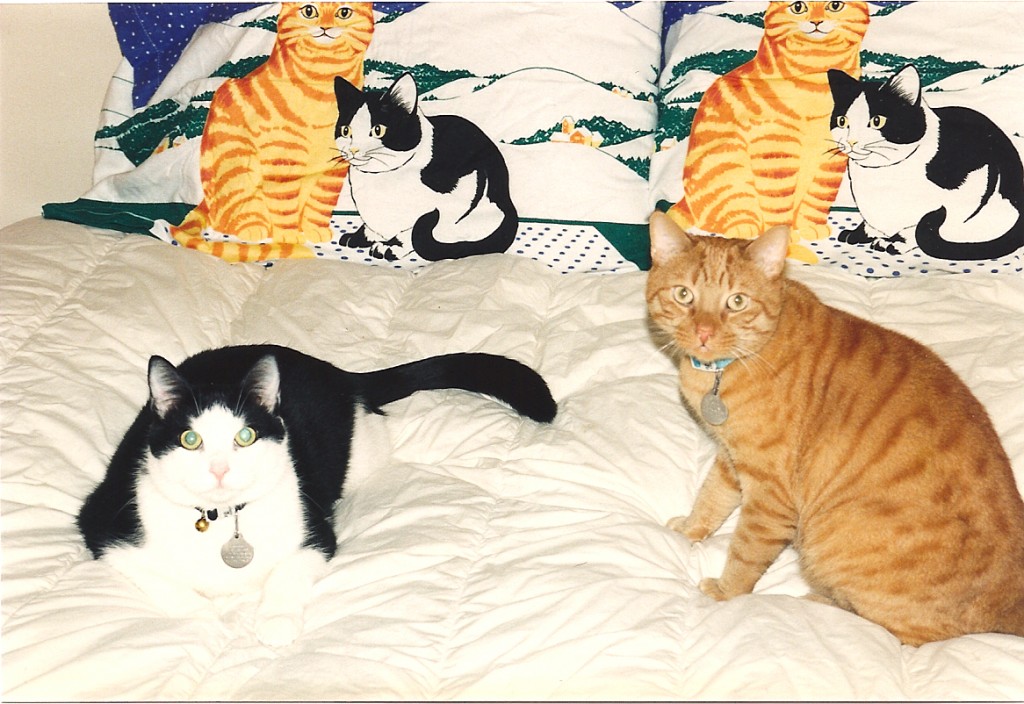
Bernie and Casey posed here in tribute to their favorite 1997 Mets, Edgardo Alfonzo at third and Rey Ordoñez at short, replicating the Great Wall of Flushing that made the left side of our infield so impenetrable that year. Likewise, very little got by these cat-like, uh…cats. In the background you’ll see the pillow cases our kitties licensed when America was gripped by Bernie and Casey Fever in the 1990s. They had a whole line of merchandise.Well, they should have.
by Greg Prince on 3 August 2007 3:27 am It's an unqualified good day when your tenth starting pitcher of the season acquits himself satisfactorily for a win while your ace in exile kicks ass in an ad hoc intramural scrimmage.
Brian Lawrence had a good day. Pedro Martinez made sure we had a great one.
Lawrence was solid for five innings. Chris Capuano was harassed for six. Damion Easley ran like the wind — or at least a stiff breeze — in becoming the third current Met, alongside Marlon '05 and Jose '06, to have homered for the Mets while not wasting a baseball in the process (doesn't it always surprise you that an inside-the-park home run counts the same as a Prince Fielder moonshot?). Everybody but Luis Castillo got on base and everybody but Luis Castillo hit with everybody but Luis Castillo on base.
The Mets pounded the squabbling Brewers, yet that was only the co-best news of the day. In Port St. Lucie, Pedro threw 67 simulated-game pitches, the vast majority of them strikes. He left feeling good, which should leave us feeling very good as it contributes, at the statistical two-thirds mark of the year, to a tentative up-arrow on our team's Conventional Wisdom watch.
It oughta be indisputably up. We head into Chicago to face the first-place Cubs as the first-place Mets (first time those two statuses have coincided as far as I know). Regardless of what happens at Wrigley, we'll be the first-place Mets when the Terrible Teixeiras tote their annoyningness to Shea on Tuesday. We've been in first place every single day since May 16. The idea is to be there on September 30, but it helps to maintain it early and often.
Yet our worldview as Mets fans seems mostly informed by the 47 losses, not the 61 wins thus far found in the '07 collection. We're spooked by that horrend-o stretch when we dropped 13 of 16 in June. We remember losing three in Colorado and two more in Houston. We can't let loose of the shame attached to splitting four with the Nationals.
We took two of three from the Brewers? What you mean is we lost a chance to sweep.
I think I understand why we look at our first-place Mets as such a severe disappointment. I'm spooked by the losing, too. Hence, I'll take it upon myself to be our spooksperson and try to figure out why we think the way we do, though ultimately I suppose I can only spook for myself.
This is me, 2007, the long view on my team:
How can you be so pessimistic about these Mets? They're in first place. They've got two still-rising stars on the left side of their infield who are beginning to regain their consistency. They've got one of the best all-around players in the game, when healthy, in center. They've got a closer pitching up to his notices in a way no Mets closer has in ages. They've got solid starting plus a surefire Hall of Famer who's supposed to be back by September. They've got a lineup capable of getting hot all at once — in fact, they're due for a hot streak and maybe they're on it already. They've got an ownership that's far more willing to pay for a winner than most teams. They're good. They really are.
This is me, 2007, in the moment with my team:
AAAUUUGGGHHH!!! SHUT UP WITH YOUR OPTIMISM! YOU'RE GOING TO RUIN EVERYTHING! AAAUUUGGGHHH!!!
That's my eternal internal conflict. I Gotta Believe. We all do. But I can't believe anybody can expect anything specific that's going on in real time to go well. I can't believe anybody would even suggest the next pitch or the next swing will result in a positive development. I can't believe anybody would pencil in wins against lesser opponents or count on a couple of runs in the bottom of an inning. I can't believe everybody doesn't believe what I believe when it comes to rooting very, very carefully.
Maybe it's devout adherence to the “don't offend the baseball gods” rule, as if a celestial committee comprised of Nino Espinosa, Clem Labine and Hot Rod Kanehl — chaired by Uncle Bill Robinson — is Upstairs deciding our fate based on how deep I dare to assume Carlos Delgado will belt the next delivery from Tim Hudson. (Greg's thinking a little cocky tonight. That settles it. Delgado's grounding out.)
Maybe the entrance — call it the Exit 6986 off-ramp — to the nook of my brain where I've stashed away all the thousands of instances in which things went well is hopelessly blocked by heavy traffic at the intersecting cranny (Exit 777879…) of my brain where all the things that ever went wrong always seem to be speeding straight into a spinout.
Or maybe I'm just a muffinhead and don't know how to be overwhelmingly happy or reasonably rational between first pitch and final out.
I'm not sure what it is. I just know that I have, to date, ingested 108 Metropolitan cocktails this year.
How do you make a Metropolitan cocktail?
Easy. You mix one part long-term calm assurance with one part constant nagging anxiety and you shake like the upper deck during an NLDS.
Two-thirds of the 2007 season complete, I'm drinking Metropolitans as if I'm from another era. I resemble those ad guys in Mad Men, except I don't smoke cigarettes, wear suits or chase skirts. But I do insist on having my cocktail. Sipping a well-mixed Metropolitan is the only way I can unwind and get through the stress of this year's Mets.
It's different from drinking the Kool-Aid, but not wholly.
In years not nearly as good as this one, when there is only remote promise of progress, I can still picture success. Even in the sad campaigns, I see some improvement materializing somewhere down the road. That's the Gotta Believe part. That's living The Principle, as Bill Henrickson might say if he were one of us. You can't be a Mets fan if you don't think you're eventually going to receive your heavenly reward. But I contend you can't be a Mets fan — or a baseball fan — if you're sure it's due you right away.
It's a tangled web I've weaved, but it truly works for me. I'd like it to work for everybody.
Tuesday night, when Glavine was going for 300, I whiled away possible history in an IGT — an in-game thread for you non-board types. Geographically dispersed Mets fans watch or listen or monitor the game online and weigh in with an observation here or there. I've rarely made more than a token appearance in an IGT, but on Tuesday I just kind of got hooked. The back-and-forth typing pretty accurately reflected any group of Mets fans of which I've ever been part, whether at Shea, at play or at my computer. In broad strokes, I detected three kinds of people in this thread:
• Those who stuck strictly to describing the action (“Milledge caught it!”), posting a reaction (“WOW!”) or unleashing entertaining tangents (“Does anybody really name their dog Fido?”).
• Those who projected that what could go wrong would go wrong.
• Those who were offended by what one IGTer called the prevailing “'woe is us' vibe”.
I was in more or less in that middle group even though I saw the point of the third. For example, I didn't really believe the sight of Scott Schoeneweis warming up elevated the Brewers to new levels of overconfidence even if I said so. And I didn't really think Moises Alou had forgotten how “I got it!” works when he snatched a catch away from Lastings even if I said so. I wasn't even willing to write off the entire season because Geoff Jenkins walked off all over Aaron Sele even if I felt as beaten as our bullpen.
One of the other IGTers, meanwhile, threw his hands in the air and dismissed the result with “that was predictable,” a blurt that led to a literal response about how it wasn't predictable which, in turn, led to one of those ugly “no, you're a horse's patoot!” spats that killed whatever buzz might have lingered after 13 innings of baseball camaraderie (the moderator stepped in and all lived virtually ever after). No epithets needed to be hurled, but I was on the side of whoever berated whoever thought a Mets loss was fait accompli. In my code of ethics, it's OK to tell yourself the Mets are going to lose, yet it's completely out of line to act as if you were expecting it.
Does that make sense? If you're a Mets fan, it should.
I wouldn't hold what is said or typed in the heat of battle against anybody; emotions run as high as a Luis Castillo pop fly during Mets games. There are no casual Mets fans. You either care like hell or you don't care at all. And if you really care, you will keep your head up conceptually and tamp your enthusiasm down anecdotally.
What else are you going to do? Walk around with that dratted “woe is me” vibe? No, don't do that. It's repellent, especially when your team is the first-place Mets. We're not long-suffering fans — we bleed buckets' worth and wail in legitimately searing pain, but we're not long-suffering fans. The fans of the first-place team we play this weekend…they're long-suffering fans. Royals fans and Reds fans and, assuming such a species exists, Devil Rays fans are long-suffering.
We're short-suffering fans. We're not doomed. We're never doomed. We should never look at life (life = Mets) as we're always going to lose/we're always going to blow it/we're always going to feel humiliated. We're not, not always. We could lose. We could blow it. We could feel humiliation. But it's not a done deal. What we have isn't chronic. It's acute. It hurts like Hebner when it flares up, but it usually subsides.
If we were as long-suffering as we thought we were as recently as 2004, we wouldn't have been in the playoffs in 2006 and be as likely as anyone in our league to be there again in two months.
Yet don't go whistling past the ballyard either. It doesn't help matters to be a supreme situational optimist, a cock of the walk as it were. Has it ever worked? Have you ever known it to work? How many times have you decided “it's in the bag” only to find the bag has broken and the cling peaches have rolled into the gutter? How many times has the otherwise lordly Gary Cohen told you something encouraging like “the one thing unlikely to happen here is Jose Reyes bouncing into a double play with Carlos Gomez on first” only to watch Jose Reyes bounce into a double play with Carlos Gomez on first? Heck, I've twice in the last week listened to Diamondbacks announcers puff up the invincibility of Jose Valverde just before the Arizona closer gave up a game-tying run in the ninth.
It's not just announcers either. A fine fellow I know recently calculated for me what the Mets' July record projected to based on the “good chance” of winning three of four from the Nationals and the first game in Milwaukee. Only because I really like the guy did I not explicitly tell him:
AAAUUUGGGHHH!!! SHUT UP WITH YOUR OPTIMISM! YOU'RE GOING TO RUIN EVERYTHING! AAAUUUGGGHHH!!!
The Mets did not win three of four from the Nationals, nor the first game in Milwaukee.
It didn't have to be predictable.
But it was.
One third of this season remains. It looks good, except when it's going on. Then it's a disaster in the making. Until it's not. Y'know?
Y'don't?
Well, I guess what I'm saying is I've figured out nothing and probably communicated to you even less. But I will take that cocktail now.
by Jason Fry on 2 August 2007 4:41 am Sometimes the social ramble claims a game from the schedule. Hey, it happens. It's a long season.
But sometimes the social ramble claims two in a row.
And sometimes those games include a pitcher you've never particularly warmed up to either making his bid to possibly become the last 300-game winner (though I think there will be others, as surely as I think 256 640 KB won't, in fact, be enough for anybody) and your first chance to view Luis Castillo. I had two can't-miss events the last two days, both of which I thoroughly enjoyed, but by the time I walked out of Varsity Letters tonight (and tell me this lineup isn't the sportswriting equivalent of Murderers' Row) I was feeling a tad guilty about my team, off in the wilds of Central Time battling another division leader without me looking in on them. They needed me. Well, no, they didn't need me. But I'd missed them.
On Tuesday I'd begged the occasional update from a pal with a decent cellphone and watched the final couple of queasy innings in an Upper East Side bar at a fairly ungodly hour. Tonight I had my faithful radio, the cheap plastic one whose lettering has long since worn off, so that every April I wind up staring at its buttons in consternation and have to relearn their functions through trial and error. Top of the ninth, Mets up 8-5, two men on and Castillo at the plate. An excellent time to get acquainted via the word picture with our newest Met, except Luis Castillo promptly rammed into what sounded like a fairly unlikely double play. Great, I thought as Delgado lined out and I crossed the Bowery, I'm a jinx.
But I was a jinx who needed his Mets fix, so I decided to skip the subway and walk home over the Brooklyn Bridge, a trek that seemed about right to cover the rest of the game (barring unforeseen and unwelcome reversals) and the out-of-town scoreboard and highlights. There aren't many better ways to get caught up on your team's doings than a late night in the city and the game in your ear; as I passed through Chinatown I found myself thinking that Billy Wagner and Howie Rose deserve more credit than they get. Wagner has had an astonishing season — I wasn't worried as he tiptoed through tonight's moderate jam, whereas last year I would have been up a lamppost by the time J. J. Hardy stepped into the box. Being a closer means he doesn't get the credit he deserves — closers are generally in the news only when they're flubbing their lines and not following the script. As for Howie, he did a masterful job describing the scene in Miller Park, zooming in and out between the outfielders' readiness and Wagner coming set and runners being checked and batters stepping out and looks ahead. Sometimes I feel Howie doesn't get the credit he's earned because we mourn the fact that the dream team of Rose and Cohen only got two seasons, despite now being well deployed with new partners. And as with closers, it can be tough to notice a terrific inning of play-by-play — the masters of it take you so smoothly and thoroughly into the game that you barely register the role they're playing, even though that role is, well, everything.
Wagner and Delgado ensured Howie could yell “Put it in the books!” around the time I started across the bridge; a bit after Marlon Anderson's interview I encountered a crew shooting a commercial that involved a mob of unkempt-looking people, a spotlight-wielding helicopter and the usual army of harried, vaguely occupied film-crew people and attendant bored cops. I had to wait with the other pedestrians and cyclists caught in the live-set dragnet, but that didn't seem like a big deal — there were Braves and Phillies and Yankees and Red Sox to check on.
After 10 minutes or so we were released by a production assistant, who noted gratefully to another assistant that compared to the last group, we were pretty nice. I suppose we were. But you know what? Speaking for myself, when the city's been kind to you and the radio guys are on top of their game and your team's won, it's easy to be nice.
by Greg Prince on 1 August 2007 8:46 am I feel awful about Tom Glavine not winning his 300th game. Now we're going to have to hear about it for at least five more days.
My dismay is less a matter of personal Glavbivalence than storyline fatigue. Seventeen Mets played Tuesday night in Milwaukee. Sixteen of them lost. But it was only Tom Glavine who was denied a win.
Now the Tom Glavine Chowder & Marching Society will follow him around the Midwest for five long days asking if they can charge those minibar M&Ms to his credit card. For five days, Glavine's relatives and Glavine's friends and Glavine's hangers-on will clog the hotel lobbies of Milwaukee and Chicago. Kevin Burkhardt will have to stick close and become known as the 31st Glavine, lest Mrs. Glavine slip away from SNY's curious cameras for as long as a second.
Mike Glavine might even get another start at first.
Willie Randolph removed Tom Glavine in the seventh after his total pitches climbed to 95, the last of them smacked to center by Damien Miller. With the manager's decision, the pitcher reluctantly turned toward the dugout. With the pitcher's march off stage (and the Miller Park crowd's classy ovation — I wouldn't have done it for Jeff Suppan in a million years), Gary Cohen announced “Glavine can go ice his arm.”
He could also go soak his head, one was tempted to add. Glavine tried to win himself No. 300 and us, incidentally, No. 60. He didn't pitch badly, but, you know, enough with the Glavine already.
By the 13th inning, I had kind of forgotten the original plot of July 31 was Tom Glavine versus history. We were treated to a whale of a game anyway, something you could imagine would be talked about for years if it took place in the postseason. There was indeed a playoff atmosphere, right down to the Mets' inability to get a big hit and Guillermo Mota's failure to record a crucial out.
Tom Glavine didn't nail down No. 300. He left in the top of the seventh with a 2-1 lead. Once he did, the whole thing was out of his hands. The Mets, thus, lost as a team. They also didn't win as a team. If we're going to be asked to stand five-day vigils for our erstwhile Manchurian Brave — Tom Glavine is the kindest, bravest, warmest, most wonderful human being I've ever known in my life — then it should have been incumbent upon him not to walk five, not to run up his pitch count near one hundred with none out in the seventh, not to be in a position where he would be ordered to abandon his post with nine outs unaccounted for. Once Tom Glavine exited, the odds increased that Tom Glavine wouldn't win his 300th game.
So what?
So the Brewers unfortunately prevailed in this war of attrition.
So Luis Castillo didn't hit like Ruben Gotay; at least he didn't field like Ruben Kincaid.
So centerfield was Milledge Park even if Lastings at the bat was Milledge Lite.
So Reyes and Wright actually went to the trouble of playing like Reyes and Wright in a losing cause.
So Heilman and Feliciano and Mota and Sele and their surprisingly sturdy defense couldn't plug their fingers into the big, bad Brewer dike forever.
So the removal of Jon Adkins from the roster to accommodate an emergency catcher seemed to throw the entire bullpen into turmoil. (By the ninth inning you're using your fifth starter?)
So Delgado didn't look too swift trying to score from first on Green's double in the sixth when they showed the slow-motion replay.
So the replay was shown at regular speed. It was Delgado who ran in slow motion.
So Green is stuck on 29 RBI, or not quite twice as many as Alou has despite Alou missing half of May, all of June and most of July.
So Bernie Brewer didn't have the decency to tumble hundreds of feet to a beery fate when Geoff Jenkins got us all blasted.
So a game I began watching in July and ended watching in August didn't seem to bode particularly well for our October prospects.
So Tom Glavine didn't get his 300th win.
So what?
Moises Alou went practically 300 minutes without an injury. Now that's a milestone worth celebrating.
by Greg Prince on 31 July 2007 1:01 pm I don't know how many fans have been fortunate enough to witness a pitcher win his 299th game. I've done it twice. I was at Fenway Park to watch Tom Seaver of the White Sox pick up No. 299 in 1985 and I was at Shea Stadium last week to watch Tom Glavine do the same.
It was a way bigger thrill the first time.
Never mind that this was my first trip to Fenway, my first trip to any big-league ballpark other than Shea. This was Tom Seaver, my childhood and all-time baseball idol, age 40, bulling his way through a professional rebirth. When he wound up on the White Sox by way of something called the free agent compensation pool, Seaver had come off his only two losing seasons, an injury-riddled 5-13 with the dreadful 1982 Reds and 9-14 with the rebuilding (to put it kindly) 1983 Mets. 9-14 actually wasn't so bad on a 68-94 club (ERA: 3.55), but Tom was not going out as he had come in.
His shift to the junior circuit gave him new life. After adjusting to the hitters' league, Seaver emerged as the White Sox' ace in '84, going 15-11, with 10 complete games and 4 shutouts in 34 starts. At 39 years old, he was putting up numbers a 24-year-old would die for in any era, especially the present one (see anybody throwing 10 complete games, even with benefit of a DH, anymore?). 1984's rebound left Tom a dozen wins shy of 300.
Determination to experience a different stadium and then sheer luck of the draw put Joel Lugo, his buddy the future golf wiz Rich Neugebauer and myself at Fenway on July 30, 1985 when Seaver was aiming for eleventh win of the season, the 299th of his career. Tom did not disappoint. Facing a lineup topped by Dwight Evans, Wade Boggs, Jim Rice and Bill Buckner (and opposing Oil Can Boyd), Seaver gutted out nine strong innings, leaving matters tied 4-4. The White Sox, to the cheers of a couple of thousand New England Mets fans, scored three runs for him in the tenth. Juan Agosto held the fort and Seaver left Boston with a 7-5 win, career victory No. 299.
It was a very special night.
Tom Glavine's 299th? It was all right, I suppose. This Tom faced a lousy Pirates club, whose biggest threat to him was mounted in the first: three one-out walks. A nicely turned double play, Reyes to Easley to Delgado, quelled that uprising. Three Mets scored in the bottom of the first, three more in the bottom of the third. Glavine didn't look terribly sharp the rest of the way (Freddy Sanchez and Jason Bay smoked him for a double and a homer, respectively, in the fifth) but he hung on for 112 pitches and six innings. The Mets never scored the additional runs that seemed available to them, causing Mike Steffanos and I unnecessary anxiety, but Heilman and Wagner were perfect and the Mets won 6-3.
As did Glavine. Good for him.
When Tom Seaver won his 300th, it was a milestone of milestones. Yankee Stadium was jammed with Mets fans. Phil Rizzuto Day took a back seat. Doc Gooden, going for and breaking Tom's Mets' consecutive win streak record in Chicago the same afternoon, took a back seat. Rod Carew attaining his 3,000th hit on the West Coast took a back seat. The Players Association's planned job action for later in the week took a back seat. If there was a visit from Mars, it went unnoticed. Tom Seaver took the mound on August 4, 1985 and didn't let go of it until he had converted No. 300. He came at Don Baylor with two out in the ninth and Baylor flied out to Reid Nichols in left. With that, Carlton Fisk and every other White Sock embraced Seaver almost exactly where he deserved to be embraced: on a pitcher's mound in New York. It was the most useful deployment of Yankee Stadium until Dave Mlicki gave it a much-needed shot of vitality in 1997.
If Tom Glavine matches the feat of Tom Seaver and 21 others tonight in Milwaukee, it almost assuredly will not end where it should. Tom Glavine will be in the clubhouse or perhaps the dugout when the ninth rolls around. Almost nobody pitches nine innings anymore, certainly not at age 41. The last two guys to get to 300, Clemens and Maddux, watched others secure their milestones. Sign of the times. Sign of age. Whichever. The likelihood is that Tom Glavine will not be on the field when he “earns” his 300th win, that he will not have been on the field for maybe an hour, that it will be in the hands of men named Feliciano, Mota, Heilman and Wagner to get it for him if he's in a position to get it at all.
Seaver needed Juan Agosto to preserve his 299th. That was one inning of relief that followed a regulation nine, nine frames that gave his White Sox every chance to succeed. Seaver alone secured his 300th. Glavine, if recent precedent holds, will have been removed from the lineup by the sixth or seventh at latest. On any other night, it wouldn't be worth remarking on. A pitcher's W is a footnote. A team's W is the goal. But it will take a little of the edge off a historic achievement to watch Tom Glavine, in a warmup jacket, his glove put away, come out to congratulate somebody else for nailing down his milestone.
Not that he isn't worthy of a 300th win. Not that we aren't reasonably delighted for him, Brave roots and all. But we can count. We know it's Glavine the Enemy (or, at best, Glavine the Stranger) with 242 wins, Glavine the Met with 57 going on 58. He's a Met now and every Tom Glavine triumph is an asset for us, regardless of what he was doing and who he was doing it for from 1987 through 2002. But there's familiarity and then there's family.
Even though he's sporting the right laundry on the brink of his momentous occasion, Glavine going for 300 as a Met doesn't begin to match the big deal it was for me (and I'm guessing many of you) when Tom Seaver reached the same milestone in sartorially challenged horizontal stripes. Tom Seaver was with the Chicago White Sox, but on July 30 and August 4, 1985, that was a technicality. Since March 31, 2003, Tom Glavine has been with the New York Mets. This is his fifth season here. It took me two-and-a-half of those seasons to stop secretly rooting for the ex-Brave to lose, maybe half-a-season more to figure out his winning equaled our winning, the next season to finally appreciate we were privileged to be on board a future Hall of Famer's ride toward history, wherever his journey started. In my mind, Tom Glavine's Met-by-technicality status didn't fade until 2005. That's more my problem than his, I readily admit.
I'm fine with Tom Glavine on the Mets. I'm more than fine when he's on his game. I was way more than fine when he shut down the Dodgers in Game Two last fall and did the same to the Cardinals in Game One of the next series. He's a pro's pro and then some. Watching even twilight Glavine reveals a generous glimpse of the skills and the talent that made him one of the best of his time. His ability to transform from Mr. Outside to Mr. Inside when quesTec called his strike zone bluff was probably the greatest late-career adjustment I'd seen since Seaver morphed from power pitcher to crafty righthander. Though I still believe management's starry-eyed pursuit of him in 2002 was misguided for a team on the downslide, and that he would have U-turned for Atlanta in a sec last winter had the opportunity and money been right, it hasn't been a bad deal having Tom Glavine in a Mets uniform. His 300th win, hopefully this evening, deserves our respect and our applause.
It feels OK. It just doesn't feel a whole lot more than that.
by Greg Prince on 30 July 2007 8:51 pm The National League East refurbishes as the trade deadline (4 PM Tuesday) approaches.
The Braves are about to get Mark Teixeira from Texas for Jerrod Jarrod Saltalamacchia and prospects.
The Phillies have picked up Kyle Lohse from Cincinnati.
And your New York Mets will reportedly acquire 2B Luis Castillo from the Twins for non-prospects Drew Butera and Dustin Martin.
The Braves should be improved.
The Phillies might be helped.
The Mets? Castillo's in that realm of players I've always been convinced bats .490 against us, particularly as a visitor. His Shea average is .293, actually. Close enough. Three Gold Gloves are in his cabinet, from the relatively recent past.
Did I mention he's a proven second baseman? He's not dream-date Brandon Phillips, but he's not bad as available alternatives go.
Unless he morphs into Robbie Alomar, he couldn't hurt.
Now if only we could find the 2006 versions of Beltran, Reyes, Wright, Delgado and Lo Duca, we'd be pulling away from the rest of the division in no time at all.
by Jason Fry on 30 July 2007 5:21 am My moment of clarity — or what passes for such for the likes of me — came during the fourth inning of yesterday's rain-shortened Met victory, alongside Greg and Stephanie and Emily and Joshua.
Mets up 2-0. Rain coming down steadily and worse rumored to be on the way. Three Nats outs required for an official game. Three Met outs required to begin working on those three Nats outs. So swing those bats, boys! Runs are always a good thing, but time has joined the Nationals on the enemies list.
Easley singles on a 2-2 count, the seventh pitch of his at-bat.
Castro works the count to 2-1 and drives a ball to left-center.
The fans stand up. The apple goes up. I scoop Joshua up so he can see. Home run!
All right boys! 4-0. Now. The rain. The rain is coming down in sheets. Up in the Cliche Factory, buckets are being put on the Descriptions of Weather conveyor. Cats and dogs are being assembled for possible deployment. Let's get in the dugout and get Maine back out there.
Gotay swings at the first pitch…
Attaboy!
… and singles!
It's sacrilege to say it, but this may be too much of a good thing. There is no one out. We need outs, even those of our own making. I lean over Professor Joshua to mention something along these lines to Greg. He gives me the gimlet eye he reserves for when I'm mucking around with baseball's karmic third rail and tells me we don't assume things. He is right, of course. I am still worried.
Maine sacrifices Gotay to second on the first pitch.
An out! And an efficient out at that!
Reyes works a 2-1 count and grounds out.
Two out!
Milledge works out a walk after a seven-pitch at-bat that takes about a week — a very wet week. Billy Traber is done for the day.
And during the pitching change, it hits me: The Mets are playing like the complete opposite of the flat, lead-assed team I've just buried in a volcano of postgame angst. They're working counts, getting good pitches, pouncing on wounded pitchers, and doing all the things that we associate with 2006, not 2007. Except they're doing it at the worst possible time. Where's Moises Alou hitting the first pitch into a double play when it might actually be useful?
Sitting under the overhang of the mezzanine listening to Joshua declaim about baseball and watching the rain fall as Chris Schroder warms up, I know what's going to happen: The Mets are going to have a big inning, doing all the things I've recently accused them of no longer doing, only they're going to take so long doing it that the umps will finally signal for the tarp. Conditions won't improve, the game won't be official, and none of it will matter. Their own rally will be the killer.
I'm distracted from the abyss opening beneath our feet by the fact that loungey jazz piano is playing over the Shea PA. That takes me a minute before I realize that the pitcher's named Schroder. Ha, that's actually kind of funny. As my wife puts it, “the trained rats made a joke!” (It's long been Emily's contention that the music choices, out-of-town highlights and scoreboard factoids are chosen by trained rats pushing levers — makes perfect sense to me.)
The game finally resumes in increasingly underwater conditions. The folks in the right-field Dream Seats have a canopy to keep them dry. The canopy for the left-field Dream Seats is broken or nonexistent; those fans are struggling to cover themselves with some sort of tarp. Guess those are the Bad Dream Seats. Back to my own unfolding bad dream, where Wright continues the Mets' ill-timed display of patience by coaxing a 3-2 count out of Schroeder. (I now have “Linus and Lucy” stuck in my head, possibly for the next week.)
Gotay and Milledge break and Wright singles on a 3-2 pitch. Gotay scores, Milledge to third.
5-0! But arrgggh! This is now a 30-pitch inning.
Delgado flies out to right on the second pitch. Whew!
You know the rest. Maine set the Nats down in order to make things official (though a long opening at-bat from Tony Batista had me on edge) and my bad dream vanished like the morning mugginess did in the rain. The only sad thing about the day was that Joshua didn't get a chance to run the bases, a reversal he accepted philosophically in large part because Emily and I had begun lowering expectations at breakfast time. But that's OK. The kid'll get another chance to run the bases. And despite my doubts following Saturday's doubleheader, the Mets ran them just fine.
Postscript: It was great fun listening to my four-year-old instruct Greg about this thing called baseball. Greg did his part kindly and admirably, listening respectfully and peppering Joshua with questions, which he was thrilled to answer. My proudest moment was when Greg asked Joshua who the fastest Met was and he passed up the crowd-pleasing easy answer to reply, “Carlos Gomez is the fastest Met — but he's hurt right now.” (Heck, this might be my proudest moment as a father.) The funniest moment? I interrupted their colloquy to warn Joshua about the possibility that the game might be called before it was official, and started explaining what needed to happen for an official game. I knew I'd got something wrong when Greg suddenly went rigid and looked miserable. A quick backtrack with the help of my blog brother (home team doesn't need to complete the fifth if ahead … duh, Jace) and Joshua's baseball education continued along the right path. As did the day and, perhaps, this confounding season.
by Greg Prince on 29 July 2007 11:10 pm Moises Alou has been around for hundreds of years.
A 1-1 count with 1 out is neutral-neutral-neutral.
Carlos Gomez is the best or perhaps just fastest Met.
Ramon Castro hit a triple-decker…no…double-decker home run because it was good for two runs.
The “Jose!” song helps Jose Reyes.
Every baserunner aims to steal the next base in front of him.
We're supposed to yell “CHARGE!” a lot.
Some things I didn't know and a few that I could always use refreshing on all came at me with blinding speed and accuracy today from one Joshua Fry, my seatmate for much of Sunday afternoon's abbreviated win over the Nationals. Joshua, 4 going on 5 (which describes how many innings we needed to beat the rain and Washington), truly knows his stuff.
He knows what a hitter's count is.
He knows what a pitcher's count is.
He knows what fouling off a ball with two strikes means.
He knows we root for three outs only when the other team is up.
He knows that those guys who run onto the basepaths after the third inning are responsible for cleaning the field.
And he really did call David Wright's stolen base in the third. It was uncanny.
A bit of the nomenclature and calculation needs ironing out (in the case of Alou, hundreds and hundreds of years might actually be correct — I mean how much do we really know about the guy?), but otherwise, Joshua already understands baseball and the Mets better than a lot of people who go to Shea Stadium and demonstrate only their cluelessness when they open their mouths. Joshua, on the other hand, knows what he's talking about. And he explains it in detail and with patience and not a little charm. I couldn't possibly imagine where he gets all this from, but he obviously gets it good.
“I'll see you at the next baseball game,” he told Stephanie and me when we parted ways.
Good deal for us.
by Greg Prince on 29 July 2007 2:00 pm There's never a wrong day to consider Tom Seaver's career, but every Hall of Fame induction day in particular, I like to think about our only authenticated Mets Hall of Famer. Seeing as how his pitching speaks so well for itself, I thought it would be appropriate to choose five lines from five starts from around this time of year during his prime and, well, marvel at their consistency and almost uniform dominance.
July 27, 1970
Mets 5 Giants 3 @ Shea
Tom Seaver, age 25, pitches 9 innings.
Gives up 3 earned runs.
Allows 6 hits.
Walks 3.
Strikes out 6.
Seaver walks and scores what proves to be the winning run in the 5th on a Ken Singleton base hit.
Gaylord Perry takes the loss.
July 27, 1971
Mets 3 Cardinals 2 @ Shea
Tom Seaver, age 26, pitches 8 innings.
Gives up 2 earned runs.
Allows 6 hits.
Walks 1.
Strikes out 7.
Leaves for a pinch-hitter in the 8th, trailing 2-1.
Mets score 2 in the 9th to win.
Danny Frisella gets the decision.
July 28, 1972
Pirates 3 Mets 1 @ Three Rivers
Tom Seaver, age 27, pitches 7 innings.
Gives up 2 earned runs.
Allows 4 hits.
Walks 4.
Strikes out 8.
Dock Ellis pitches a complete game.
Time of Game: 2 hours 5 minutes.
July 27, 1973
Mets 2 Cardinals 1 @ Busch
Tom Seaver, age 28, pitches 9 innings.
Gives up 1 earned run.
Allows 9 hits.
Walks 2.
Strikes out 8.
Only Cardinal run scores in the 1st on a double play.
Seaver lowers ERA to 1.96.
July 26, 1974
Mets 3 Cardinals 0 @ Busch
Tom Seaver, age 29, pitches 9 innings.
Pitches a shutout.
Allows 4 hits.
Walks 1.
Strikes out 5.
Losing pitcher Lynn McGlothlen allows 12 hits but pitches 8 innings.
1974 is by far the worst of Tom Seaver's 10 full pre-Massacre seasons as a Met and he still throws 5 shutouts, completes 12 games and strikes out 201 batters.
In these five essentially random starts, the Mets scored 14 runs for their ace. Seaver's ERA was 1.71 across 42 innings facing the likes of Bobby Bonds, Willie Mays, Willie McCovey, Lou Brock, Joe Torre, Ted Simmons, Willie Stargell and Manny Sanguillen. He went 3-1 with one no decision.
None of these starts was a record-breaker. I don't particularly remember any of them and I've never read anything noteworthy about them. But in this era when we practically genuflect if a pitcher goes at least six innings and gives up no more than three earned runs (and faint if he goes beyond seven), it's worth remembering that Tom Seaver exceeded such parameters as a matter of course. For a decade. For us.
I sometimes can't believe we ever call any other Met pitcher great.
With due respect to any pitchers currently on the cusp of milestones, I know we should never call any other Tom terrific.
by Jason Fry on 29 July 2007 4:24 am If it wasn't Willie Randolph burning his entire bench in the seventh (whywhywhywhywhy), leading to the sight of Tom Glavine pinch-hitting in the ninth, it was Lastings Milledge air-mailing everybody south of the loge on a throw home, or Mike Pelfrey crawling out of the wreckage of his usual one bad inning, or Pedro Feliciano pitching like he was tired, or Aaron Heilman doing the same, or Jose Reyes popping up pitches. Yes, I know Pelfrey looked good the rest of the time and Milledge made a terrific play to offset that one and Carlos Delgado looks like he's coming around, but in the end none of that mattered, so I can't really muster the enthusiasm for finding an umblemished oat or two in this bunch of horseshit.
One of the unwelcome themes of this year has been the Mets somehow staying in first place despite themselves, reflecting a malaise we've all pondered and tried to define without quite getting it — we've treed the sucker, but the dogs can't get him down. Is it the routine blowouts? The lack of hitting with RISP? The career years turned into average years? The transmutation of Carlos Beltran back into porcelain?
In the darker hours of the night, we sometimes have a worse thought: Is this what the early stages of Yankeeization feel like? (OK, I've wondered it in the dark hours of the night.) Last year we dominated. Now we're not dominating. I want to dominate. You're in first place, shut up. Yeah, but we look flat. You're in first place, shut up.
Yeah, but we look flat. So shut up yourself.
I don't think it's that our expectations have been raised by last year, so that merely being in first place now isn't enough. I think there's some of that at work here, but it's a pretty small part of what's going on. Rather, it's that this team's default condition seems to be flat — a certain distracted torpor that's hard to endure, and sure doesn't make for a very compelling storyline. Can a talented team playing uninspired baseball hold off two fundamentally flawed teams trying to close the distance? I think it can, and then it's anybody's ballgame, as the 2006 Cardinals will be reminding fans of mediocre teams for a generation to come. But what a half-assed plan for taking care of business. Bad baseball, players lingering in the netherworld of the semi-DL for who knows how long, dumb managerial decisions — it's tough to watch a summer of this stuff and tell yourself that it'll be OK once some magic wand is waved, that Pedro will make everything better, or that Moises Alou will restore order. (He sure restored order for the Nats tonight.)
I'm a Met fan. I watched Bruce Boisclair and Jeff McKnight and Chris Jones and Jorge Velandia and Jason Phillips and Vance Wilson and Jeff D'Amico. It's pathetically obvious, after all these years, that I'll watch anything that shows up wearing blue and orange. But for a first-place team, this year's Mets squad is remarkably hard to watch. Too often they look they'd rather be doing something else, and inevitably that makes you think that maybe you ought to take that under advisement yourself.
Last night I comforted myself by taking solace in the fact that there would be two games today. It struck me as a beautiful thing. What I forgot was that a crappy enough game can make you forget all about a victory won six-odd hours earlier.
Joshua runs the bases tomorrow, weather permitting. The Mets run the bases tomorrow, Nationals pitching and their own inclination permitting.
|
|






