The blog for Mets fans
who like to read
ABOUT US
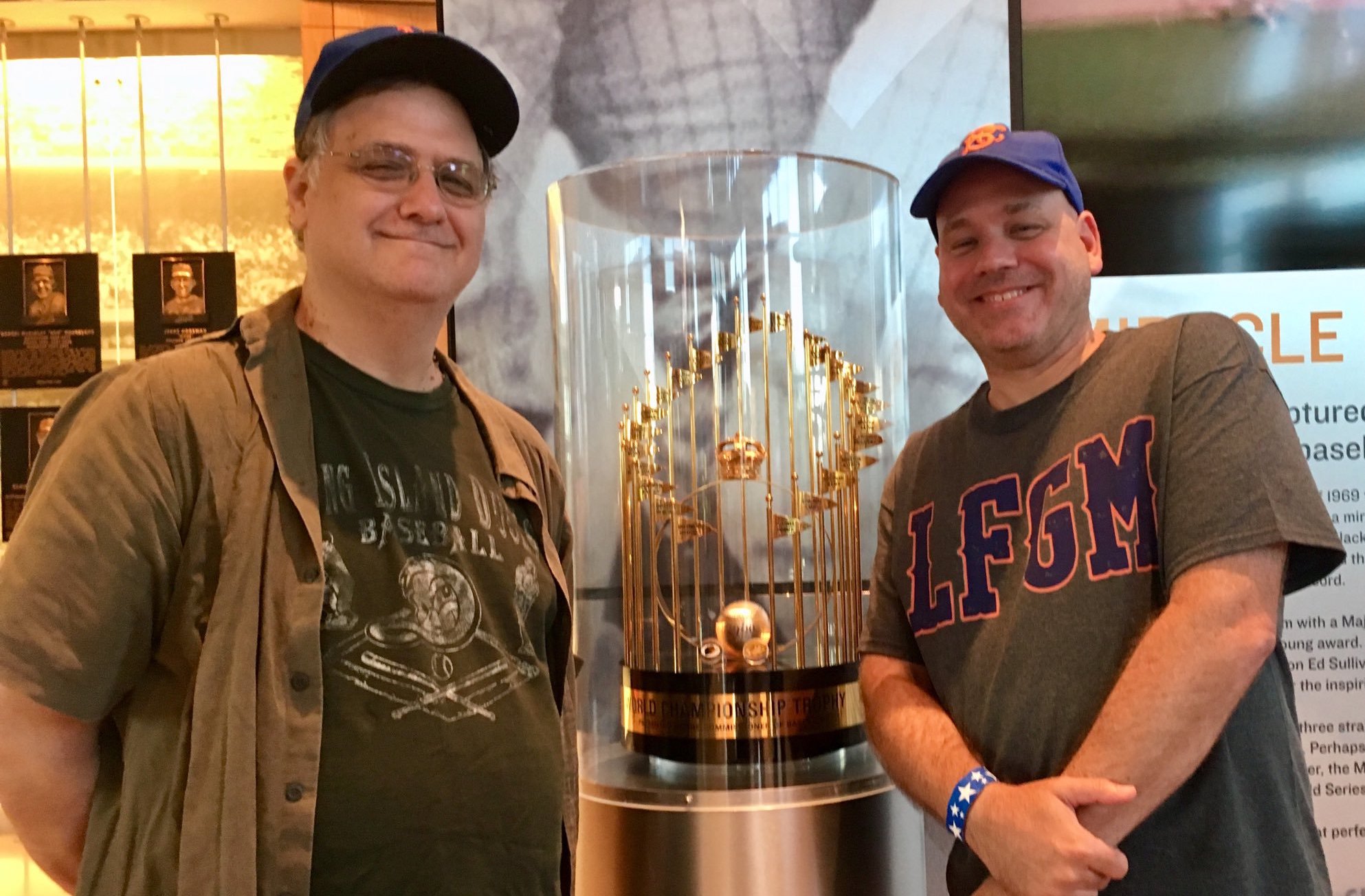
Faith and Fear in Flushing made its debut on Feb. 16, 2005, the brainchild of two longtime friends and lifelong Met fans.
Greg Prince discovered the Mets when he was 6, during the magical summer of 1969. He is a Long Island-based writer, editor and communications consultant. Contact him here.
Jason Fry is a Brooklyn writer whose first memories include his mom leaping up and down cheering for Rusty Staub. Check out his other writing here.
Got something to say? Leave a comment, or email us at faithandfear@gmail.com. (Sorry, but we have no interest in ads, sponsored content or guest posts.)
Need our RSS feed? It's here.
Visit our Facebook page, or drop by the personal pages for Greg and Jason.
Or follow us on Twitter: Here's Greg, and here's Jason.
|
by Greg Prince on 9 August 2007 8:36 pm Turnabout is foul play.
Bleah, bleah, bleah…ptui! I spit out this horrible ending to what could have been a beautiful game.
Willie Harris pulling an Endy out of his grabhole — leaving ample room for the shoving up of any bats we haven’t already wished plunged high, far and deep up Chipper/Teixeira way — and robbing Carlos Delgado of a game-tying, Shea-boggling homer was the defensive equivalent of Brian Jordan ruining our 2001 season twice. It was also a rude response to our gorgeous ninth-inning dousing of their flickering hopes, a brilliant event not even 24 hours old, now consigned to back of the fridge with the expired half-brick of cream cheese you don’t even remember buying.
How can people stay mad at Barry Bonds when it’s clearly Willie Harris who has ruined baseball?
We make a hard stand Wednesday night and break their black little hearts. Then we stir up a next-afternoon comeback for the ages, like something out of May 17. No right or reason to expect it, but it’s getting delivered. We sent six batters to the plate in the ninth and they all reached base…or almost made it. Gotay, Reyes and Wright did their jobs. Castillo’s high chopper required only a bit of Tartan Turf to have injected him into the rally for real. Even Alou, having been lubricated with a generous dose of 3-In-One, nearly beat out a ground ball to short. Delgado you know about. Delgado you know probably had a homer taken away by this bedbug Willie Harris. Maybe it was just a long double, but it was probably four bases and a tie score. Instead, we registered three runs and three outs when four and two were the respective minimum and maximum permissible in today’s ninth.
Imagine the Braves blowing a 7-3 lead like that. Imagine a 7-7 tie and all the momentum shifting our way. Imagine actually taking a series from these bastards.
You’d better not. You’ll become violent.
Don’t imagine anything. Instead, realize the reality of the situation. Three-and-a-half-game lead and all, the key numbers are these: six games left against Atlanta and 42 against everybody else. The Mets are advised to kick the ever-lovin’ spit out of everybody else in those other 42 in order to secure their second consecutive Eastern Division title and another shot at the belt because I have no confidence, none, that they’ll handle the Braves in the other six. Not after four series comprised of one win and two losses every time. I thought we buried this bullshit last year. Apparently we have not.
by Greg Prince on 9 August 2007 2:00 pm Mike Bacsik, a New York Met in 2002 and 2003, gave Barry Bonds the pitch that became his 756th home run. Barry Bonds gave Mike Bacsik a bat in appreciation, inscribing it:
“To Mike, God Bless. Barry Bonds”
Barry Bonds can ask for a whole mess of Mets pitchers to be blessed for getting him to 756. Bacsik became the 75th hurler who has been a Met to surrender a homer to Bonds. Obviously Bacsik was a National when the record-breaker was served up. But we're not being picky here. To be in this special wing of the Barry Bonds Home Run Society, you had to have been a Met (a Major League Met, not a farmhand) at some point in your career. And you had to have given up a home run to the man either before you became a Met, while you were a Met or, like Bacsik, after you were a Met.
If Bonds never hits another home run, the list could still grow. If Omar Minaya got a hankering to have Clay Hensley on the Mets, for example, then Hensley would be added to the list, having been tagged with the 755th home run of Bonds' career. Likewise, if Craig McMurtry, now 47, were to come out of retirement to shore up the rotation (he hasn't pitched since 1995, but he's still younger than Julio Franco), then we'd have to add him for he gave up the first homer ever to Barry Bonds.
But we don't have Hensley and we don't have McMurtry. We have had 75 pitchers who have thrown 155 gopher balls to Barry Bonds. That's just over 20 percent of the kaboom king's total. He hit only 38 of these against pitchers when they wore Mets uniforms, but that's another story.
Who were these once Mets, then Mets, now Mets or eventual Mets? I could tell you, but then I'd have to…no, I wouldn't have to kill you, but if I tell you, I wouldn't be able to ask you. And I wanna ask you.
So let's have a quiz! No prizes, just productivity-killing fun. (Try to curb your Internet instincts from looking up the answers directly. I'll give 'em later, along with the inevitable clarifications for whichever questions I muddy in my quest for cleverness.) Remember: the home runs didn't necessarily have to be hit against the Mets, just a pitcher who at some point pitched for the Mets.
Please help these pitchers identify themselves.
1) I'm remembered as the second pitcher in some pretty good rotations, so it's fitting, I suppose, that I gave up Barry Bonds' second home run ever.
2) I gave up Bonds' 26th homer. And I wouldn't be on this list as a Met if the Mets weren't so hot to give away the guy who gave up Bonds' second home run ever.
3) I had a no-hitter going in the seventh until Bonds hit his 201st home run off me. The shock for Mets fans was I had a no-hitter going in the seventh…and that it wasn't the Mets who were being no-hit, given how that particular year was going.
4) If Bacsik's the 75th member of this club, then I guess I'm the 74th, even if the last of the three homers I gave up to Bonds only put his career total to 667.
5) I once had something of a numerical nature the guy who's the answer to the previous question has now. But I gave up just one homer to Bonds: his 171st.
6) Bonds got me for the 56th home run of his career. Once he went and hit another 554 off other people, I could have dropped to my knees and flung my glove in the air in celebration. But I would have exulted too soon, for I also gave up Bonds' 611th homer.
7) Mets fans were far more annoyed that I gave up home runs to the likes of Alfredo Amezaga and Hanley Ramirez than they are that Bonds touched me for eight homers (even if eight is the most anybody in this particular club has on his ledger).
8) I had a perfect ERA of 0.00 in three appearances for Willie Randolph, but I wasn't so lucky when I gave up Bonds' 622nd homer when I was pitching for Bob Boone.
9) I'm one of those myriad lefty specialists who hung around to face lefty sluggers like Bonds. When I was a Met, I wasn't all that special. In fact, I was a starter and gave up Bonds' 244th homer. I'd give up three more to him in my later incarnation in relief. The last two (Nos. 511 and 516), I'll bet, made Mets fans particularly happy given who I was pitching for by then.
10) I was involved in a trade with five other pitchers altogether, but I was the only one of the six who ever gave up a homer to Bonds. I gave up five of 'em, starting with No. 288 and ending with No. 434.
11) My name comes up tangentially in connection to Barry Bonds for some reason. I gave up his 657th homer, but that can't be why people have invoked my name when his comes up. I wonder why we're connected. I wish I had a shot at answering this.
12) Some of the most notable closers in Mets history escaped the wrath of Bonds. I didn't. I gave up the 711th home run of the guy's career, but big deal. We won the game.
13) I took care of Barry Bonds and everybody on his team when it mattered most. But I did give up his 286th and 524th homers, though I doubt Mets fans remember either of those blasts, so associated am I with the aforementioned great effort against Bonds' team.
14) I gave up Barry Bonds' 465th homer, but I prefer to bask in the afterglow of having been the only one in this club to have won a game the night before Barry got to 756.
15) I'm the person who gave up Barry Bonds' 438th home run. That's all you need to know.
16) If all Mets fan knew about me was I gave up Bonds' 46th and 55th career homers, I'd feel a lot better about my career. I think a whole Nation would feel the same.
17) Boy did I suck as a Met. Wait, let me narrow it down for you. Exactly ten years before Barry Bonds became baseball's all-time home run king was the last time Mets fans didn't particularly care how much I sucked. As an aside, I gave up the 110th home run of Bonds' career. But mostly I sucked as a Met.
18) Yeah, I sucked as a Met, too. It was almost as if there were a rule that I had to suck as a Met for like an entire year. I would give up Bonds' 173rd career home run…as a teammate of the guy who gave up the 110th.
19) I was way better than my brother when it came to not giving up home runs to Barry Bonds. Sure, the guy got me for No. 180, but my brother gave up many more to him than I did. So I've got that going for me.
20) Greg thinks I'm the most obscure Met in this entire club, at least in terms of having been a Met. That's a purely subjective metric, but I'm so obscure Greg actually did a double-take when he saw my name. He was all “ohmigod, I totally forgot this guy was ever on the Mets.” It's like I was so obscure that any season I helped build as a Met couldn't have been worth finishing. I'm so obscure that once a season that wasn't worth finishing wasn't finished, I was finished, too…y'know? I'm too obscure to be on any list. I think I'm too obscure to have given up two home runs to Barry Bonds, No. 8 and No. 253. But I did. You know…I must have been around a while to have been tagged by Bonds 245 homers apart. That might help you figure out who I was. Honestly, I don't know what more there is to say about me. If Greg's forgotten me, you have every reason to have also.
21) I doubt I'm all that well remembered by Mets fans either. Greg barely recalls my Met tenure. but I was a part of history. In the runup to Bonds' single-season home run record, I gave up three dingers to the big man in a week, Nos. 559, 560 and 562 in his career. Steve Phillips must have been impressed by me because he went out and got me the very next summer. I wouldn't say he traded the world for me, but he was willing to toss in a very valuable body of water.
22) What the guy before me said? You know, about Nos. 559, 560 and 562? Guess who gave up No. 561? Me! I only gave up that one homer to Bonds, but in my only two Mets appearances, I gave up three homers, including two to a genuine World Series hero. (I really, really, really sucked as a Met.)
23) Barry Bonds hasn't been that much of a problem for the Mets in terms of being a frequent threat since he became a Giant. But when he was a Pirate, he was a potential problem 18 games a year. Remember Barry as a Pirate? I do. I gave up his final Pirate homer, the 176th of his career and the first of three he hit off me in my fairly distinguished career.
24) My kids weren't going to be as uneducated as I was. I saw to that. I guess I didn't seem too bright the five times I gave up homers to Barry Bonds. Five, incidentally, is the total of two plus three…and three is the number I gave up to Bonds after I decided my kids' education was my biggest concern. The last of 'em, so far, was No. 607. Home runs to Bonds, that is. I don't have that many kids as far as I can count.
25) In my time, I also gave up five homers to Bonds, starting with No. 342 and winding up with No. 679. In my time with the Mets, I gave up the first grand slam to another player of some note. My Mets time was rather brief.
26) I gave up four homers to Bonds, the first of them No. 190. But honestly, I've got my own big number that people have been talking about lately, so screw my being in this crappy club for jerks.
27) That's almost exactly what I said about the Mets not long ago, even though I haven't put any big numbers that people are talking about. But I did give up Bonds' 519th and 551st home runs.
28) Just as I sure gave up the second-most home runs to Barry Bonds that any pitcher who has pitched for the Mets has, the Mets sure gave up on me at a pretty young age. I sure made them look bad by going out and being the second-best pitcher in the National League shortly thereafter, at least according to Cy Young voters. The first home run I gave up to Bonds was his 175th. The last was his 394th.
29) My career has been about as gaudy as Bonds'. I'm only in this club because I gave up Barry's 287th homer. I'm only pitching for the club I'm pitching for this week because I've been hurt.
30) Barry got to me for Nos. 40 and 60 when I was one of the best pitchers in baseball and No. 156 when I was in noticeable decline. He never saw me at my absolute best even though he's actually a little older than I am.
31) As of Tuesday night, Mike Bacsik and I had our names next to Barry Bonds' record-setting home runs. The next homer Bonds hit, on Wednesday, Bacsik's name was replaced by Tim Redding's because No. 757 became the new lifetime record. But unless a slugger really bulks up the way Bonds did the year Barry hit the 567th of his career off me, then I'll be a trivia question well into perpetuity. Let's just say it's unlikely I'll ever knuckle under to another pitcher in this regard.
Tip of the trivial cap to Mark at Mets Walkoffs for inspiring this exercise in, well, triviality.
by Jason Fry on 9 August 2007 3:47 am Something tells me this enigmatic, frustrating, confounding 2007 season finally began in earnest Tuesday night. Three with the Braves, those familiar objects in rearview mirror that indeed may be closer than they appear. At the end of the month four with the Phils, whom we may yet be forced to take seriously. That's a lead-in for three more with Atlanta. Then, a week later, Atlanta and Philadelphia back to back. (Following that, we close things out with 13 against the supposed soft underbelly of the National League East. Those games may frighten me the most — somewhere Chris Nabholz is laughing.)
Better competition, injuries and inconsistency brought us to this point — a pennant race that just truly shifted into gear. Mets, Braves, Phillies. Gentlemen, start your engines.
After a disquieting evening of watching Brave killer Oliver Perez get tormented, it was on to the premier matchup — John Smoltz vs. Pedro Martinez. Ah, memories of getting off the '05 schneid with that marvelous … what's that you say? Oh. Right. Pedro was pitching tonight, but for Port St. Lucie. As update after update came in showing Pedro being tattooed by Lakeland Tigers, I suddenly remembered Joan Payson's request while on a cruise: Just telegraph me when the Mets win. Still, filling in more than capably as understudy was El Duque, whom the Diamondbacks' front office must see in their nightmares. We got this guy for Jorge Julio?
With Emily actually at the game with her father, Joshua and I settled in front of the TV, cranked to Brobdingnagian volume to be heard over the protestations of the air conditioner. I decided this was the time to teach the kid about the countdown — how I yelp “24 to go!” after a hitless first inning, then decrease it by three, in hopes that one day the countdown will actually reach zero. My lesson looked prophetic for a while, what with El Duque launching evil breaking stuff at every conceivable angle and speed. So of course the moment I got truly excited about the magic at work — thiswasthenightiexplainedthecountdowntothekidandemilyandherdadwereattheparkwowwowwowwow! — was the moment it fizzled. And the moment I got beyond that and started appreciating El Duque's effort for what it was inspired the Braves to explode out of the casket, with their usual mix of damage from Braves you've never heard of (Willie Harris), Braves you've stopped calling Braves you've never heard of in vain hope that that will make them stop torturing us (Kelly Johnson) and shrewd new Schuerholz acquisitions (Mark Teixeira). And, of course, Chipper. Larry Jones, that stock villain from a billion baseball penny-dreadfuls, with his killer's eyes and his smile that practically forms two right angles when he's really pleased with himself, like the dead grin sported by the Joker. You just knew Chipper had to be lurking somewhere — under the bed or in the closet or wherever he takes himself when he senses there are Met fans to jump out. Was it a surprise when Chipper wound up with a double thanks to his own hitting and a little outfield connivance from us, or when Kelly Johnson showed admirable hustle scoring all the way from the first on a ball that didn't get to the warning track. Staring glumly at the ruins of El Duque's masterpiece, I wondered how I'd fooled myself into thinking it might have been different.
But then it was different. That bottom of the seventh was pure passion play, what with Reyes showing his age by being too eager and Luis Castillo getting the kind of roll-your-eyes hit he always seemed to get against us while wearing teal, followed by the delightful sight of Bobby Cox trundling out of the dugout to get Ron Mahay, looking like a troll tramping out from under his bridge to harass travelers.
And then, an inning later, after decent work from Heilman and a lightning-bolt throw from Lo Duca, Moises Alou making up for recent double plays and general creakiness with one of those gone-from-the-moment-he-hit-it home runs. A fitting ending, 1-2-3 from Billy Wagner, everybody go home happy and hope your subway's running by now.
No, that would be too easy. Billy had to load the bases with nobody out, leading to angst and slapstick in the Fry house. Somehow I'd wound up at the dining-room table, looking across the entire room at the screen, but had to stay there because that's where I'd alighted with Alou connected. So, Francoeur hits his terrifying high bouncer that Wright turns into a fielder's choice, but here comes Andruw — with the kid Escobar on deck as apprentice executioner, if needed. Wagner gets his sign, looks back at Woodward and …
TiVo switches over to “Top Chef.”
(TiVo and HD are on different video and audio feeds, so you can't see or hear TiVo asking to change the channel, because … oh, just trust me on this one.)
AUUUGGHHHH!!!!! I nearly overturn a dining-room chair as I vault to the sideboard and seize the TiVo remote. But wait — Emily really likes “Top Chef.” PUT ON THE RADIO, STUPID! OK. Yes. Radio! I grab the receiver remote and start clicking TUNER, only nothing's happening. TUNER TUNER TUNER TUNER. Ack! This is the OLD remote! Where's the NEW remote? Is this it? Yes! Jesus H., this thing is like the command module of a starship. Just go to the actual receiver and … tuner? Tuner? Where the hell is the tuner? HERE IT IS!
“…PUT IT IN THE BOOKS!”
Wha? Really? How on earth did we cheat the hangman?
You know what? Never mind how. I'll find out in a bit. It's enough that we did.
by Greg Prince on 8 August 2007 9:14 am 
| Mets fans liven up every gathering, so much so that the dullest of affairs (a nondescript Washington Nationals victory, for example, for example) can become a mob scene when one of us is spotted. That’s how it went for Matt Murphy of Queens, a Mets fan who presumably couldn’t get a ticket for the big Mets-Braves series at Shea, so he decided to slum at the Phone Booth in San Francisco Tuesday night. Bay Area locals, knowing they have been in unethical possession of a team they refer to as the “Giants” since 1958, were beside themselves with joy to have a real New Yorker and real New York baseball fan in their midst, so much so that they just had to reach out and touch him. Matt needed police protection to save him from his adoring public. It’s true folks — we Mets fans are so magnetic that we just attract well-wishers wherever we go.
Having brightened the evening of aimless Californians, Matt next flew to Australia to break bread with Craig Shipley.
(Photo of a Mets fan causing a frenzy by Brant Ward of the San Francisco Chronicle.) |
|
|
by Greg Prince on 8 August 2007 4:30 am Barry Bonds just became baseball's all-time home run king. He hit his 756th against a slightly familiar lefty on the Washington Nationals.
Some slightly familiar company he keeps:
Jack Fisher gave up the home run that tied Babe Ruth's single-season home run record.
Tracy Stallard gave up the home run that broke Babe Ruth's single-season home run record.
Steve Trachsel gave up the home run that broke Roger Maris' single-season home run record.
Chan Ho Park gave up the home run that broke Mark McGwire's single-season home run record.
Mike Bacsik gave up the home run that broke Hank Aaron's career home run record.
And the fan who caught Barry Bonds' record-breaking home run? Our old pal Dave O'Brien just reported with a touch of astonishment that he's wearing a Mets jersey.
Who says we're not a part of home run history?
In other news from Tuesday night, the team Hank Aaron used to play for and still works for beat the team Mike Bacsik used to pitch for…beat them rather handily. With a 756th career home run being hit across the continent, I consider the matter trivial. As Hank Aaron recorded a graceful, gracious, great message of congratulations to somebody he probably wanted nothing to do with, for one Tuesday night, I'm willing to let this Atlanta victory over the Mets go uncommented upon.
If Hank can extend a hand, so can I: Congratulations to the greatest hitter I've ever seen. However you did it, whatever happens to you as a result of however you did it, whyever you act the way you do, you could play some ball, with or without.
I wish you had done it without.
by Greg Prince on 7 August 2007 8:29 am Why can't pitchers hit even a little better? Who knows more about pitching?
Why don't catchers facing a pitcher they used to catch hit .750 against that pitcher? Who knows more about that pitcher's thinking?
Why are so many pitchers so nuts about not allowing anyone to talk to them on the days they start? Will they forget it's one for fastball, two for a curve?
Why are ballplayers always shown departing for a road trip in a jacket and tie? In what other business are you required to dress one way for your travel and another for your actual job?
Why is there a lingering obsession about how players wear their pants, their socks and their stirrups? “They're too high!” “They're too low!” “They're old school!” They're just pants, socks and stirrups.
Why are older-style uniforms considered traditional and somehow unimpeachable? Maybe the genuine tradition is just starting now and everything before now was all wrong.
Why do retired or veteran ballplayers perpetuate this myth that it's just not like it used to be when I came up, we'd stay and talk baseball with the older guys, now everybody rushes out of the clubhouse? I've heard at least two generations of ballplayers who have been assailed by their elders for not caring nearly as much about the game insist they, in fact, were the last of that dying breed that cared about the game. Can we assume just about everybody who plays the game cares about the game in his own way?
Why does almost every batter stand and watch his deepest fly balls sail toward the fence? Don't they know what a home run looks like? Have they been clued in that not every ball hit well leaves the park? That it's better to run so you can be on third instead of second or second instead of first should the ball not be gone or not be caught? Is it common knowledge among the players that all the games are televised and usually recorded by the clubs themselves?
Why do pitchers who discover magical arm angles that save their careers forget to employ that arm angle eventually?
Why doesn't Willie Randolph “challenge” every player the way he “challenged” Cliff Floyd two years ago? Remember that? Floyd had been injured and a little lethargic in '03 and '04 and then has that Monsta year in '05 and the line all season from Willie was “I challenged Cliff and he responded.” Great work. Do it again.
Why does a pitching coach wear a uniform while a trainer wears slacks and a golf shirt? Each man sits in the dugout most of the time and only runs onto the field in an emergency. They may as well wear the same getups.
Why do stadium A/V squads play songs like Billy Joel's “Pressure” to taunt the visiting team's young, often Latino relief pitchers who probably have no idea about the message being conveyed and that they're supposed to become unnerved by such a clever jukebox selection?
Why after all the bad publicity attached to chewing tobacco about a decade ago have I noticed what seems like a plethora of Skoal cans in players' back pockets this year?
Why does Shawn Green lean against his bat in the on-deck circle like a man waiting for a bus?
Why does Shea sell blue cotton candy? When did cotton candy start coming in a color that isn't pink? If they're gonna sell cotton candy in blue, why not sell half of it in orange?
Why do I look at the out-of-town scoreboard at least six times per half-inning even when I know damn well no other game besides the one in front of me has begun?
Why does almost every announcer tell us the potential tying run will be coming to the plate “in the person of” Johnny Estrada? What are the odds Johnny Estrada will come to bat reincarnated as a dining room table?
Why, if nobody likes it, is the volume turned up so loud on every bit of pregame and between-innings business? I've yet to hear anybody tell me “it's great the way they've got the decibels goin' tonight!” In fact, I've yet to hear anybody tell me anything without me begging pardon and asking it be repeated.
Why don't the Mets hand out more bobbleheads and hand them to adult fans who pay the freight and seriously collect that kind of stuff?
Why are we told who is sponsoring this call to the bullpen but often have to wait until after the commercial to be told who the call was for?
Why do people who know you're going to a game say they'll look for you on TV? They won't, and even if they do, the chances are remote they'll find you unless you're Christine Glavine or some gesticulating idiot with primo seats behind the plate?
Why doesn't somebody clean up all those mysterious puddles that materialize every few sections in every concourse? It's a wonder more fans don't slip and more lawsuits aren't filed.
Why do regular people get days off while baseball teams get off days?
by Greg Prince on 6 August 2007 10:14 pm 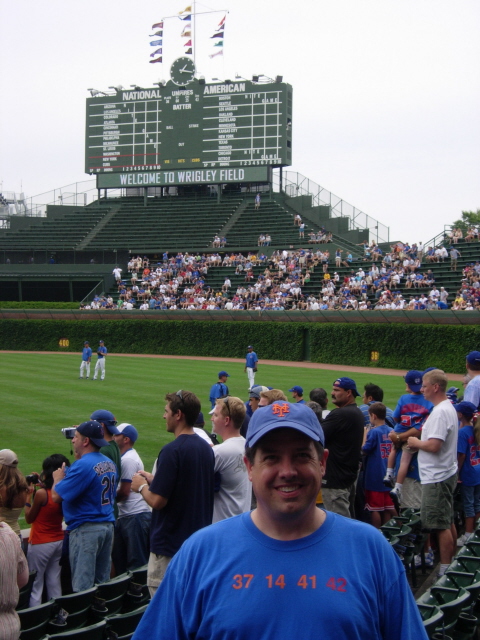
| Ernie Banks became famous at Wrigley Field for, among 512 other things, suggesting, “Let’s Play Two!” Dave Murray doubled up on Mr. Cub by heading to the North Side of Chicago on Saturday and wearing four…the four retired Mets numbers featured on the now classic Faith and Fear in Flushing t-shirt.
As Dave recounts at the ever-entertaining Mets Guy in Michigan, he encountered a reasonably savvy souvenir shop owner in Wrigleyville who observed:
“OK, I know what the shirt means, but who is No. 14?”
Dave clued him in that it was none other than the manager who bested Leo “No, these were the real Mets” Durocher in 1969, Gil Hodges.
Also wearing 14 that summer and for many summers in Chicago, Ernie Banks. |
|
|
by Jason Fry on 6 August 2007 10:00 pm We hold these truths to be self-evident: There can never be enough interesting/entertaining writing about baseball in general and the Mets in particular. Sure, the Mets play nearly every night and are covered by some 10 local papers and a fleet of blogs. But even then, eventually you've read everything the knights of the keyboard have written, and you're still wanting more. Because damn it, it's six hours (or 20, or two or 0.25) until there's a game on, and you're worried about Pedro's rehab, the state of the farm system, Mark Teixeira and what statistical simulations suggest will happen for the rest of the season, to name the first four things that pop into your head.
Over there on the left we've got a lot of links. But on this off-day, I wanted to spotlight two writers I find particularly entertaining and interesting.
The first is Marty Noble, the veteran reporter turned MLB.com scribe. I've got enormous respect for Noble's years of hard work, baseball knowledge and the unfussily straightforward way he offers insider analysis. But what I really love are his mailbags. (Truth be told, I don't read game stories anymore, no matter who writes them.) Noble seems to save up the dumbest questions Met fans can imagine for some day when he just can't stand it anymore. Then it's time for a mailbag — in which Marty lines up the witless and whacks away at them until he's got his equilibrium back.
Take this one. Things start off OK, as Noble uses a reader's disbelief about Rickey Henderson's leadoff homers vs. the Mets' to illustrate how great players can seem to distort statistics. But from there … well, buckle up.
Jordan R. supposes that Duaner Sanchez will be a free agent when he comes off the DL, at which point the Mets should sign him to a two- or three-year contract because “he is so valuable to their bullpen when he's healthy.” Noble's fairly restrained here, calmly correcting the record about Sanchez's contract status before getting a bit testy: “Now, why would the Mets want to offer him anything more than one-season contract, even if they were competing for his services?”
Alex X. wants to move Fernando Martinez to second base for no particular reason I could detect. “I've never quite understood the public's fascination with changing players' positions,” huffs Marty, then dispenses with a similar question suggesting Ramon Castro man first.
Next comes the overly sentimental Marty C., who wants Mike Piazza back as a backup catcher and World Series DH. “So you want the Mets to acquire a player who might serve as a DH for a maximum of four games in October and carry him for 2 1/2 months as a backup catcher with tarnished defensive skills?” asks Noble, and you can easily picture his eyebrows arching higher and higher until they're levitating and have to be retrieved with a stepladder.
My favorite Marty Noble mailbag, though, came in April. This one starts off calmly enough, with straightforward analysis of Pelfrey, Humber, Vargas and the rest of the waiting-in-the-wings pitchers. Marty's pretty even-keeled, except at the end, when his advice is “lest you all be labeled junior Steinbrenners, be a tad more patient.”
But then, oh, that next question. It still makes me laugh half a season later. The luckless Dan R. wants to know why the Mets keep using Aaron Heilman “when all he does is throw the same pitch over and over again and get destroyed by hitters.” Marty coolly acknowledges Heilman's recent woes and explains what Willie's thinking about the bullpen is. But then he can't keep it in any more: “He has been an invaluable asset for two seasons. You want to do what with him now? The rotation? The Minors? Exile? Prison?”
My other new favorite is the New York Sun's Tim Marchman, who's consistently very smart, bitingly acerbic and really funny. He first caught my eye with this terrific scouting report of the '07 Mets, including his pitiless, laugh-out-loud summation of Moises Alou: “a horrible defensive outfielder, with the range of a box turtle.”
But then whenever Marchman writes, I know I'll laugh out loud at least once, shake my head at a particularly pungent line, and come away thinking about something differently. Take this analysis of how Omar Minaya simultaneously finds diamonds in the rough like John Maine and Oliver Perez and wastes roster sports on Jose Lima and Chan Ho Park — “pitchers so bad no one was aware they were still playing professional baseball.” (The answer: Minaya likes reclamation projects, but only if they're flyball pitchers with decent peripherals and at least some recent success.) Or read this smart take, from June, on our vanishing outfielders and what we should and shouldn't worry about. (And now Beltran and Gomez are gone. What a bizarre year we're having.)
There's this, from our July near-death experience: “There is bad baseball, and there is pitiful baseball, and there is painful, embarrassing baseball, and there is the kind of baseball the Mets have played this month, which is none of these things, but is instead just depressing. Watching the Mets these days is like nursing yourself through a hangover, or looking at happy photos of yourself with someone who threw you over for your best friend.” There's this piece, that did a beautiful job explaining how ballplayers age and why Carlos Delgado should be fine. Or this reassuring take on our failures in the clutch, with a bit of priceless psychology: “When they miss every opportunity without fail, the team is glum and fans become pessimists, and big hits like Chip Ambres's game-winning single in the 10th inning yesterday can even irritate by their contrast with the usual shoddiness.”
Some weeks Marchman writes five times a week, and his consistency is awe-inspiring: When he's good he's the best sports columnist in New York by a wide margin, and when he's just OK he's the best by a small margin. Kind of like the 2007 Mets, I suppose. Read him.
by Greg Prince on 6 August 2007 3:00 pm It was neat.
That's the word my vocabulary sent up to describe the sensation of watching Billy Wagner retire Mike Fontenot and secure Tom Glavine's 300th career (and 58th New York Mets) win Sunday night. Some round numbers are more spherical than others and this one is a perfect circle. Perfectly neat.
The guy's career began 20 years ago this month. He goes out approximately every fifth day, skipping the Disabled List altogether, and posts an average of 15 wins annually. Perfectly consistent, too. I remember when one of the pitchers who was on the verge of 300 wins in the early '80s neared this mark, Warner Wolf said to put it in perspective, imagine a pitcher winning 14 games a year for 20 years: he would still need 20 more to make it to 300.
You don't need to go to the videotape to know baseball has been populated by awesome pitchers who did not manage this perfectly neat number. Nobody's pulling the plaques of Bob Feller or Sandy Koufax or Bob Gibson or Juan Marichal or Jim Palmer or Catfish Hunter or Ferguson Jenkins for not getting there; nor should anybody think any less of Tommy John or Jim Kaat or Bert Blyleven for finishing a bit short (or Randy Johnson if he hangs 'em up 16 shy as back problems may dictate).
But getting to 300 certainly merits extra credit. Every starting pitcher would love to win a 300th but only 23 have achieved it even though we're talking about the most single-minded creatures on the diamond in any game they play. They help their teams when they win but they help themselves first. They revel in getting the W. They express gratitude for being taken off the hook. They can barely force a smile if their good work is not personally rewarded.
Quick, what's Jose Reyes' won-lost record and how does it rank among shortstops? How many wins did Cleon Jones accumulate in his career? Was Ray Knight ever no-decisioned?
It doesn't work that way. The whole “pitchers aren't players” line Keith Hernandez doles out every night isn't simply the raving of a mad Mex. It is different for starting pitchers. Their schedules are different. Their metrics are different. Their responsibilities are different (though let us forever note that the first run of Tom Glavine's 300th win was driven in by Tom Glavine). With few exceptions, you — a family member, a teammate, a fourth-estatesman — can't talk to one of them on the day he pitches. Imagine David Wright or Carlos Delgado telling a reporter, “Sorry, I don't do interviews when I'm starting.”
Their near-term goals are different, too. When Barry Bonds and Alex Rodriguez went dry in their quest to get off of home runs 754 and 499, respectively, it made perfect sense. Their job has never been to go up and swing for the fences. It's to hit the ball somewhere fair. They have the talent and ability to hit it far and sometimes the damn thing travels out of everybody's reach. When Bonds and Rodriguez started to think about it, they had to have adjusted their thought processes from “see the ball, hit the ball” to “must…hit…next…home…run.” With that attitude, it's not surprising each of them was going to hit nothing more than a figurative wall for a week.
Starting pitchers, unless they're aiming for a strikeout record, one supposes, don't have that problem. Their job is to get an out, any kind of out, to get at least 15 outs with their team ahead or as many outs as it will take to rate a win. As we've discussed a bit of late, it's kind of a silly statistic. A starter can throw nine brilliant innings and be pinned with a loss. A reliever can enter an inning with two outs, pick off a runner and exit for a pinch-hitter and eventually be credited with a victory because his teammates score a passel of runs on “his” behalf. Thus, on a case-by-case basis, whoever gets one win is sort of irrelevant.
Whoever gets 300 of them, however, must be doing something very well for very long. That sounds a lot like Tom Glavine.
by Greg Prince on 6 August 2007 9:09 am 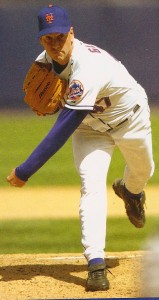
Things I already admired about Tom Glavine the Met (really).
A one-hit shutout of the Rockies that sounded as close to the real thing as I’ve ever heard.
Two legitimate All-Star berths.
Eight innings, two hits and no walks to win one for Ralph Kiner.
Domination of the Dodgers and the Cardinals when it counted most.
At least 15 decisions he deserved to have go his way even if they didn’t.
Pitching past missing teeth and finger numbness.
The professional bunting and the emergency pinch-hitting.
And now No. 300 in a Mets uniform.
Congratulations Tom.
Really.
|
|