The blog for Mets fans
who like to read
ABOUT US

Faith and Fear in Flushing made its debut on Feb. 16, 2005, the brainchild of two longtime friends and lifelong Met fans.
Greg Prince discovered the Mets when he was 6, during the magical summer of 1969. He is a Long Island-based writer, editor and communications consultant. Contact him here.
Jason Fry is a Brooklyn writer whose first memories include his mom leaping up and down cheering for Rusty Staub. Check out his other writing here.
Got something to say? Leave a comment, or email us at faithandfear@gmail.com. (Sorry, but we have no interest in ads, sponsored content or guest posts.)
Need our RSS feed? It's here.
Visit our Facebook page, or drop by the personal pages for Greg and Jason.
Or follow us on Twitter: Here's Greg, and here's Jason.
|
by Jason Fry on 6 July 2007 5:04 am Does the hamate bone exist for any reason except to sideline baseball players? Holy Benny Agbayani — how many outfielders can one playoff contender lose and still stay upright? With Carlos Gomez lost until September, I had to remind myself not to look askance at Ricky Ledee. Because if not him, who? The Mets were obviously thinking the same thing, hastily bringing back David Newhan and dispatching Lastings Milledge to play anywhere — Binghamton, Cooperstown, a rap studio, an argyle-sweater factory — where he could get some quick at-bats. With Moises Alou still trapped in the Quad Zone, perhaps Lastings will get the extended audition fate denied him repeatedly after all. If the Mets' line of outfield succession was like that of the presidency, Lastings would be the Secretary of Labor. But looks like he'll make the Oval Office — I mean, left field — anyway.
This week I keep missing the beginning of games, which means I've been missing the only part one would want to see. It's strange to see your team is up 2-0 and mutter obscenities. Fortunately, neither Reyes nor Delgado nor Castro nor Beltran nor the reluctantly accepted Ledee were done. Neither was John Maine, who pitched like he was hurling a gauntlet down before Roy Oswalt. I can strike people out too, All-Star. I've got 10 wins, All-Star. What are you going to do, All-Star? (By the way, with Smoltz 86'ed the Braves somehow have just one All-Star.)
Oliver on the shelf. Sosa on the shelf. Alou still on the shelf. Gomez on the shelf. Lastings trying to get off the shelf. The reconstructed, glued-back-together Pedro not yet ready for picking up from the shelf. Yes sirree, we live in interesting times.
by Greg Prince on 5 July 2007 8:56 am If you can remember all the way back to May 17 (as in 17 runs surrendered), the Mets scored five runs in the ninth inning against the Cubs to secure a most unlikely 6-5 victory at Shea. I was at that game, endured eight mediocre innings and almost left. Almost. Instead, I changed seats and was treated to what stands as the in-person comeback of a lifetime. I came home and divined one lesson of many from that afternoon was “play the full nine, stay the full nine.”
I haven’t been particularly reliable about taking in first pitches lately, but I’m almost always around for the end, whether at Shea or on the couch. This week’s three-night Festival of Humidor Destruction has adhered to that pattern. I seemed to miss the competitive portions, a.k.a. the first innings, Monday, Tuesday and Wednesday, but once it became apparent that these games had become follies, I hung in there to watch them become history.
The Fourth of July followed the examples set on the Second and Third. We were deep into our 17th (as in 17 runs surrendered, it bears repeating) annual viewing of 1776 (as in 17 runs surrendered, it bears repeating yet again) when the Mets and Rockies began to get it on at Coors. As is tradition, I forego baseball and everything else for this movie. Thus, the Mets had to start without me — not a bad deal for them as they jumped to a 3-0 lead in my absence. David Wright belted a home run, inspired no doubt by John Adams’ words when he recruited Thomas Jefferson to serve on the Declaration of Independence committee:
This business needs a Virginian.
The same could be said for our tattered rotation and John Maine’s upcoming turn in it, but as ever, I digress. We paused the disc once or twice to monitor doings in Denver, unfazed by an early 3-3 score. We weren’t winning, but at least we weren’t losing. It’s effing Colorado, after all; 3-3 in the third is no more definitive than 3-3 in the NBA. Once our DVD was over (spoiler alert: we’re not British), Stephanie called me upstairs to peer out the bathroom window, our best southern exposure. We had a panoramic look at no fewer than nine different fireworks displays, sanctioned or otherwise. No Aaron Copland accompaniment, but no crowds either. Nice show.
Twenty minutes of peering complete, I head back downstairs. It’s the bottom of the fifth. We’re losing 7-4, a runner’s on first. Discouraging, but not devastating. It’s still Colorado unless they’ve moved it. Plus, there were two outs. Mota’s pitching. He gives up a foul grounder. Oh wait, it’s called fair for some strange reason. First and second. Then Matsui pokes one between Delgado and Valentin. Thought one of ’em could get it. 8-4. Damn. Ball in the hole to Reyes. He can get the runner. No, Holliday beats it out.
And that appeared to be the best part of the game I would see. In a matter of seconds it would be 12-4 and a few minutes later it would be 15-5 and they told two friends and they scored two runs and so on and so on and so on.
Anyway, through eight the Mets were losing 17 to 6, giving me some morbid consolation that it was an appropriate score on a day when we commemorate 1776. But then the ninth rolled around and reminded me why I like baseball so much.
Three things:
1) Paul Lo Duca led off and saw 14 pitches before grounding out to third. Down eleven runs, he worked the count to 3-2 and then fouled off eight consecutive Matt Herges deliveries. Talk about never giving up. Lo Duca doesn’t think “let’s get this over with, let’s get showered, let’s get on the bus, let’s get to Houston.” He’s just “next pitch…” I’m sure there’s a graph somewhere that would illustrate the Mets’ likelihood of storming back from eleven behind in the ninth was nil (a little Best of Thomas Paine would also do the trick). But watching a baseball player hang in there in impossible circumstances…well that’s why you sit around all winter and stare out your southern exposure. You wait for baseball. You wait for 6-5 rallies in the ninth, of course, but you wait just as much, in a way, for Paul Lo Duca to not care that it’s 17-6 in the ninth and foul off pitch after pitch after pitch after pitch.
2) As noted, Lo Duca battles for 14 pitches and reaps nothing more than an atom ball and an atta boy. Next batter, Carlos Beltran, hits the first pitch he sees far, fair and for a double. That, too, is baseball. It evens out in the oddest ways. Beltran comes around on a single and a sac fly to make it 17-7, thus ruining my 1776/17-to-6 symmetry, but that’s OK. Nice to see the Mets taking ninth innings seriously even if their pitchers mostly laughed off this entire series.
3) I laughed a great deal during the latter portions of Lo Duca’s epic at-bat when Keith Hernandez compared Paul to Bruce Willis. What, you mean like Die Hard? asked Gary Cohen — who admitted during some desperate blowout chatter that he doesn’t go to the movies during the season. Between pitches, the announcers tried to remember the name of the latest Willis action thriller, one whose exploding title (Live Free or Die Hard) chewed up much screen space during ads on Mets telecasts not two weeks ago. Gary’s guess was Die Hard and Like It.
I can’t say why for sure, but that cracked me up. Die Hard and Like It. Captures Hollywood’s sequel ethic perfectly. Describes what this road trip has become, too. Anything one finds funny as a 17-7 decision and a four-game losing streak go final must be worth staying tuned for.
by Greg Prince on 4 July 2007 6:55 am I'm beginning to think we're the worst good team in baseball. Maybe we're the best bad team, but no, we're still in first by a breathable margin (thanks Astros, thanks Dodgers). However it's framed, someone's Juneing all over our July.
As on Monday, Tuesday night I learned I've gotta keep at least one eye on these bastards. I ran an 8 o'clock errand which caused me to miss the Mets' two-run first. But OK, they scored without me, I guess it's safe to pick up a bit of other business away from the TV for just a little while. Uh-uh. Literally the next game-thing I knew, it was 6-2 Rockies. Just like it was 6-0 Rockies the night before when I dared to blink. I thought this was the Fourth of July, not the Second of February.
In case you were wondering, Aaron Sele lives, Kaz Matsui is Paul Molitor and Joe Smith remains very, very young.
Aw hell, if we can be nice to Julio Franco, we can think good thoughts in broader terms. Happy Independence Day to the greatest country on earth, no matter how “excessive” some of its foibles can be. Happy Endypendence Day, too, while we're at it. Gads, I miss him.
by Jason Fry on 3 July 2007 11:28 pm It's time.
Time to kick some Rockie ass? Time for young hurlers to prove something while other young hurlers heal? Time for SNY to bring the HD cameras on the road?
Yes to all of the above. But I'm not talking about those things. I'm talking about a more painful subject.
It's time for Julio Franco to step aside. Definitely for a couple of weeks, possibly for good.
Julio Franco is hitting .188. Slugging .250. Getting on base at a .322 clip. His OPS is .572. As a pinch-hitter, he's doing better but not much better — .250. On defense, he has very little value — if we had a depth chart for first base, he'd be third on it. And now his knee is hurt, so he can't run — witness the final out of our non-sweep in Philadelphia. I have a lot of respect for Julio Franco, and I'm sure if he could have run hard, he would have. But he couldn't.
As written before, as a baseball fan you have to resist falling prey to Not Player X syndrome. Seeing players and their shortcomings up close, it's easy to become irrationally certain that everything will be fine if Player X is excised from the starting lineup, the usual routine, or the roster. Who do I want playing right in late innings? Not Shawn Green. Who do I want coming into this tie game with the bases loaded? Not Scott Schoeneweis. And so on. The absence of an actual player to fill the role instead isn't the point, because that would be rational. No, in our worst moments we just want Player X to be somewhere else, to be replaced by … Schmendrick, as my co-blogger once dubbed the all-purpose replacement.
As sins of fandom go, “Not Player X” is even dopier than sentimental faith in the long-departed (I've heard rumblings of a Draft Edgardo Alfonzo movement among Mets fans, which tugs at my heart but not at my head) or crazy trade proposals. (WFAN voice: “Duh Mets shud send Heilman and Shoanwice to duh Reds for Griffey and that kid Bailey, wit duh Reds pickin' up Junior's salary.” Uh-huh. Take your meds.) But such suggestions are at least proposing alternatives, however fanciful. Not Player X is “we gotta get rid of this guy” and nothing else, as if 24 players would be an improvement.
Julio Franco doesn't deserve that. Because we don't truly want him gone. He earned his contract last April, when he saw Carlos Beltran's career path heading into the dreary subdivision along Robbie Alomar Lane, marked by such gloomy cul-de-sacs such as Booing Fans Court, Sniping Media Path and One Met Said Way. You remember: Beltran was refusing to acknowledge a curtain call, but Franco sent him to the top step, to a peace treaty with Mets fans and an MVP-worthy season. And that, one suspects, was a public example of innumerable conversations held privately in dugouts and clubhouses and hotels. We were never privy to any of them. We should be grateful for all of them.
Julio Franco is a marvelous baseball story. He's a marvelous story, period — a life with lots of chapters written in many lands, revolving around baseball but also quiet exemples of the value of living right, eating right, and drawing strength from within, whether it's from spirituality, self-confidence or both. (The Church of Faith and Fear is nondenominational.) He's given an enormous amount to baseball, and he's pretty far from done with it. You get the feeling he's one of those guys you'll never not hear about — he'll be a roving instructor, or a scout, or a bench coach, or a manager. He'll be having us doing double-takes and looking up his stats and the astonishing roster of his decades' worth of teammates for years to come.
Julio Franco is almost 49. That's not in itself reason to pack him off to the baseball hereafter. But neither should it be a guarantee of employment. That should come down to whether the Mets are better off with Franco as their primary right-handed pinch-hitter and a backup first baseman, or with someone else who could do the job and give them greater roster flexibility. Say, Ben Johnson or Ramon Castro. (A third catcher wouldn't be too different from a backup first baseman.) I have trouble believing the Mets wouldn't be better constructed with one of those guys filling Franco's role. These days the names of Lenny Harris and Rusty Staub are often invoked when discussing Franco. It's meant as a compliment, but when I hear it, my first thought is “two more guys who stayed too long at the fair.”
Sentiment is for fans, and it's a wonderful thing. But general managers (and fans trying to think like them) have to be ruthless. I'm not calling for Franco to be released — ruthless isn't the same as disrespectful. But doesn't it make sense for Franco to go on the DL until his knee is fully healed, with his role filled by Johnson — or Castro with a third catcher added? (As the always-interesting Tim Marchman writes in the New York Sun, “injuries are never good, but they can create unexpected opportunities and lead to surprising things.”) If that doesn't work and Franco heals, activate him — that's only fair. But if it does work, it's time to have a conversation.
One of baseball players' greatest strengths is their immense belief in themselves — a quality that in the best of them is every bit as superhuman as the astonishing things they can do physically. But eventually that strength becomes a weakness — to succeed at this level you need a will strong enough to deny reality, but reality always gets the final word. And it's the player who is always and inevitably the last to hear it.
The Braves are coming to Shea on August 7th. Maybe Julio Franco will be healed that day, and ready to contribute when the game is close and late. Or maybe we'll have seen that we're better off with Johnson or Castro or someone else in that role, with Franco continuing to contribute on our bench — but without leaving it. In which case it could be a perfect day for Franco to doff his hat for the cheers he's more than earned, from both dugouts and from the stands, as he begins the next chapter of a long baseball life.
by Greg Prince on 3 July 2007 8:25 am They tried to make me watch the Rockies, I said no, no, no.
Yes they wear black but we didn't come back, I know, know, know.
With apologies to Amy Winehouse (and my choice for single of the decade) and to you, gentle reader, I have little of substance to add to this fine wire-service account of Monday night's Colorado fiasco during which we lost Ollie and often. Perhaps I'm just hung over from all those contests against all those 2006 playoff teams and 2007 playoff contenders to have noticed much. I'll leave it to my partner to embellish my scanty observations if he so chooses. This, by the way, was our in-game exchange:
J: Tonite sux.
G: Hope [a future game] doesn't suck as much as this one does.
As you can see, we really save our best material for each other.
Tom Glavine's one bad apple of a third took place while I was on the horn with a helpful Cablevision customer service representative asking why my MLB package disappears on one TV but not the other, hoping all the while that it would be understood I wanted it to appear on both, not vanish altogether. It was 3-0 when I was instructed to unplug the cable box. It was 6-0 when it, like the Mets' ass, was rebooted.
There's still something glitchy with the package. I eventually got the Dodgers beating the Braves, which I guess counteracts the Rockies beating the Mets and augments the Astros beating the Phillies. I didn't get to see the other West Coast games, which is most of the fun of Extra Innings. I also didn't see the Mets do a damn thing even once I was off the phone with Cablevision.
by Greg Prince on 2 July 2007 9:08 pm I'm glad Paul Lo Duca never declared his candidacy for anything other than National League All-Star Catcher. I'd hate to see his quotes taken out of context, particularly this quote fragment from Friday:
“I'm a gambler, a racist and I like 18-year-old girls.”
Can't you just hear the rest? I'm Russell Martin and I approved this message — because handling a pitching staff is too important to be left to deviants.
Of course Lo Duca wasn't making his case for the Ty Cobb Sharpened Spike Award, given each year to the player who best exemplifies the worst in humanity. The rest of what he said was:
“That's the perception in New York. Is any of it true? Not an ounce of it, and nobody knows that.”
I'll leave the gambling and 18-year-old girls out of it since that's last year's tawdry news. The other thing? In this hemisphere's most multinational dugout? I don't think that's Lo Duca. I don't know the man and I don't know what goes on behind closed clubhouse doors, but the contretemps that his defensive quote was based on didn't strike me as racist whatsoever.
It struck me as a good journalism lesson.
This is the peep from Paulie that got his latest ball of confusion rolling, as recorded first by Peter Botte and rereported (in the wake of the paper's sudden interest in the Mets) by Adam Rubin of the Daily News:
I'll do this [interview], but you need to start talking to other players. It's the same three or four people every day. Nobody else wants to talk. Some of these guys have to start talking. They speak English, believe me.
It was assumed or inferred that “some of these guys” didn't refer to Aaron Sele or Damion Easley or whichever non-Latino Met whose brain isn't picked to death before and after games. So let's go along with that premise, that Lo Duca meant you should go get quotes from somebody who isn't him or Wright or Glavine or Wagner or Green.
He's right. How can you not notice, if you're an aficionado of game stories and audio actualities, that it is essentially the same five guys who are gone to on a team that at any given moment is at least half Latino? That it's almost never one of the fellows from Puerto Rico or the Dominican or Venezuela?
Is it because Carlos Delgado is hiding in the trainers' room? Because Carlos Beltran seems about as dull off the field as he is usually exciting on it? Or is it because the Mets' beat writers are white guys who, without malice, tend to gravitate to guys with whom they can communicate most easily with the fewest obvious barriers?
Probably a little of each. The players who are dying to talk to the media are legendarily the vast minority in any accent. If you give them an out, they'll take it. The language differences certainly don't contribute to the desire to chat. It's hard enough to say something interesting in English. Imagine trying to be engaging in your second language.
Nevertheless, they're all paid enough to talk. Delgado shouldn't hide if indeed that's what he's doing (as has been implied). As for the other guys who aren't from the U.S., I haven't had a hard time understanding them when a microphone's been thrust to their lips. Beltran is gracious. Reyes explains the game very well, certainly as well as the omnipresent Wright. Gomez, 21, talked his way through the bunt that knocked out Clemens a few weeks ago (making me think Omar Minaya's policy that Met minor leaguers, wherever they're from, speak English and Spanish is one of the best ideas a GM's ever implemented). Franco has obviously seen it all. And if Delgado isn't steamed at his own performance, he's totally the man when it comes to speaking baseball. Perez, Feliciano, Valentin…I've heard them talk if not as often as their Anglo teammates. Their words are as good as anybody else's. Seek them out like you would Paulie's or David's.
I won't pretend to know the dynamic of the Met clubhouse, but everything we've been able to divine says, the occasional entertaining Lo Duca blowup notwithstanding, that everybody gets along reasonably famously. Whether it matters or not, that's reassuring. And as long as we expect to hear from ballplayers before and after games, we may as well hear from as many of them as possible. I don't think Lo Duca's a racist. But I also don't think those whose job it is to interview Mets have been mining every corner of the roster in pursuit of perspective. If there's a scandal in any of this, that's what it is.
by Greg Prince on 2 July 2007 12:54 am So the Phillies managed not to be swept a four-game series by the Mets. So the Phillies can continue to entertain the possibility that they are in a three-way race for the Eastern Division lead. So the Phillies, for one more day, can avoid their date with destiny.
The Phillies are the Chinese food of the National League. A half-hour after hating them, I've forgotten I ever saw them. Mets fans seem to invest a great deal more antipathy and anxiety in them than merited. They're dangerous, just not lethal.
If I sound a little more mellow and less vindictive than an annoying loss merits, so be it. Part of it is the way the June Gloom (4-14) 180'd into the June Boom (8-1). The rest we'll call goin' fatigue (as in “I got fatigued goin'”). Philadelphia is close enough to Long Island so that goin' on two consecutive railroad daytrips is not wholly inconvenient, but it ain't a mere hop on the 7 from Woodside either. I'm glad I went and glad I went again to the first and third games of this series. Of course I am. I was riding a four-game losing streak in Philadelphia before this weekend, one that dated back to August of '86 when Fred was just intrigued enough by the notion of a ROAD TRIP! to join me for the hell of it. The Mets lost that night. They lost 10 years later when I convinced Stephanie that the fourth-place Mets, the fifth-place Phils and the sixth-rate Vet were worth three hours of our attention. They lost three years after that to cap off a frighteningly memorable week of losing that nearly killed off a wonderfully memorable year. And they lost three years ago when Steph and I were determined to add spankin'-new Citizens Bank Park to our ledger.
Leaving Pennsylvania twice with wins, no longer Oh-and-Philly after 21 years, was a most welcome feeling. Being surrounded by Mets fans in another state was most welcome, too. These weren't home games but they weren't away games. They were Fourthmeal. If the gift shops weren't lousy with Phillies merchandise and the public-address guy hadn't overdone the introduction of “J.C. RoMMMMEEEERRRRoh!” you would have thought it was a neutral site. My Saturday section from top to bottom was about 3:1 Mets fans. The men's room line afterwards was so orange and blue that I felt compelled to feign amazement when I saw a Phillies cap within the friendly confines. I was honestly surprised when “Takin' Care of Business” wasn't cranked after the last out.
The only obnoxiously vocal Phillies fan I encountered Saturday sat behind me (natch) and his expression of frustration boiled down to this: “Mets…BOO!” Lame? You bet, especially when repeated about fifty times for two innings until somebody countered him with “Phillie fan…BOO!” Beer consumption also distracted him.
Though I came home Friday night giddy from my fling with the Cit and the day-night sweep it encompassed, by Saturday I was able to take in their ballpark/our second home with a little more reserve and perspective. As was the case in 2004 when I first encountered it, I came away thinking this is The New Normal, meaning Citizens Bank is the bare minimum of what a modern retro ballpark should be. It functions very highly. It offers all the stuff you would need or want (at costs slightly less than you would think and they give you noticeably more of whatever you're buying). It is run beautifully. It certainly kicks the ass of what it replaced, more important to the local fans than to the daytripping dilettantes like me.
But it's not special. PNC is special. Camden is special. Phone Company of San Francisco is special. I go to those places and want to pitch a tent and camp out on their grass until they nudge me gently awake the next morning for batting practice and pierogi races. Citizens Bank is, in a perfect ballpark world, adequate to the task at hand.
Come 2009, let's do what we did three times this weekend and beat the Phillies. Let's be more than adequate in our next ballpark. And if you can pile as much soft ice cream into a batting helmet as they do, that would be much appreciated.
Sitting in the outfield for two games was instructive to our future since Citi Field will put a lot of seats out there and there won't be nearly enough seats to begin with. I sat high in Harry the K's territory yesterday, the height-equivalent of the mezzanine, probably, and it wasn't too bad a view (unless you're a stickler for what happens in deep left). What they say about the bandbox nature of CBP resonates in person. Every popup looks like a home run. Every fly ball is a home run unless we hit and one of their leaping demons lunges and grabs it. Every home run looks like it's headed for the stars. Ryan Howard not only would have hit his Saturday shot out of Shea, I think he it to Shea.
I did cherish the ability to get up and walk around and still keep an eye on the action. Two years ago, just as my blogging had begun to bring me into contact with new and wonderful people whom I would be meeting for the first time at Shea, I had arranged to hook up with a friend in the middle of a game. He and his wife had tickets in one place, I had them in another. “I'll see you in the top of the fifth behind Section X,” I said. And we did that and it was lovely but we were each craning our necks at the one nearby monitor to peek at what we were missing. That part wasn't lovely.
On Friday, I went with one of my oldest friends in the world, Dr. Fred Bunz, whose only character flaw is not being a Mets fan (but his willingness to humor and indulge me forgives that quickly enough). We watched a couple of innings from our seats and then got up to find some food and then found there were dozens of little spots where we could land-graze-amble-chat-repeat, yet stay on top of what was going on (I groaned when I heard the crowd roar, until I realized it was our crowd roaring at the Mets' three-run fourth). Since I don't get to see Fred very often now that he's ensconced in Baltimore, I was more interested in talking with him than I was in watching every pitch, thus the Cit's situation struck me as ideal. We didn't get back to our seats until the sixth and I didn't feel I had missed all that much.
Quick aside on Fred's non-Metsdom and how it can be mistaken by association with me. I had arranged, thanks to all this blogging, to hook up with a reader and online pal who was also making the trip from Maryland (the guy with impeccable taste in t-shirts). I introduced these two to each other as “you're both from the same state.” My new Maryland buddy immediately asked my old Maryland buddy, “do you see the Mets in Washington a lot?” I could tell Fred hadn't heard him clearly because he said, “not that much, it's kind of far away.” I told Fred later that I didn't think he quite caught the question. Fred didn't. He thought he was asked if he took the Metro to Washington a lot. Fred told me he was glad he didn't accidentally blow his cover. I'm somehow relieved that I can still maintain a few relationships that have almost nothing to do with the Mets…and that they are with people who will gladly accompany me to Mets games.
Saturday I did my walking around and face-stuffing early then hung with my new favorite family of Mets fans, the Chapmans of Central Jersey. Mom Sharon, whom you've also seen in the world's greatest tee, invited me to join them and a slew of disparate types in Section 242 where she had secured a big block of tickets. When I mentioned I'd be coming by train, I was immediately invited to get off at the NJ Transit stop near them and spend some time at their house, which was a trip unto itself. They built a patio that looks a baseball diamond (Dad Kevin pointed out that it's 69 feet to their backyard/centerfield fence, as the sign on the fence helpfully indicates). Their living room is a Mets shrine (three Bill Goff prints commemorate the three ballparks where each of their children saw his or her first game). Their youngest, Ross, is a bona fide genius of the game (for example, he won't ever buy a Ford, he informed us, because of Derek Jeter's incessant shilling for the car). And all of them couldn't have been nicer or more thoughtful hosts. As with Fred and bmfc1 Friday, seeing the Chapmans Saturday made this detour into the belly of the East a very homey adventure.
Now the Mets wing west, four up on the Braves, five up on the…who was that we just played again? Congrats to Jose, David, Carlos and Billy on their All-Star berths. A hang-in-there-and-channel-it-for-good to John Maine who was denied a selection but deserved it far more than Cole Hamels, the punky LP from Friday night (nice control, schmuck). Our All-Stars and their occasionally stellar teammates have played almost a full half — 80 games. I have been to more than a fifth of it — 17 games. Me and the Mets, we're having a pretty good season together.
by Jason Fry on 1 July 2007 3:24 am …there was a team that had a starting rotation many — including some of us — thought was better than ours. Whose lineup seemed to stack up pretty well with ours. A team that talked big that this was their year, for the first time since 1980 and the second time since … well, since never.
What happened to the Philadelphia Phillies? They're on the DL — Freddy Garcia and Jon Lieber and Tom Gordon and Brett Myers are sidelined, Pat Burrell's disappearing act continues, and Jimmy Rollins and Chase Utley and Ryan Howard can't do it all themselves. I mean, Dobbs and Ruiz and Happ? Who are these guys? (Though Michael Bourn is positively Endyesque as a figure of fear if you're a batter who's just sent one into the gap and sees him closing ground out there.)
The Phillies have had a run of horrific luck. But bad luck's part of the game, and so far we've done what we're supposed to do when confronted with a wounded, unlucky opponent — step on his throat, since you know he'd step on yours. Like the Phillies did in the beginning of the month, as a sputter against the Diamondbacks turned into a disaster against them, kicking off that lovely 4-14 stretch in which we won once a week. Ugly, but we then finished the month 8-1, however, making June 2007 about the most encouraging damn 12-15 month I can remember.
In the beginning of the year it was our rotation that looked old and suspect. Now the Phillies barely have a rotation, and we find ourselves indignant at the idea that John Maine might not make the All-Star team, and largely shrugging off a hamstring strain for a guy with a 7-3 record. Jorge Sosa had one more start before the All-Star break; we'll hand that one over to Mike Pelfrey and see if New Orleans has sharpened his sinker and dulled his anxieties, and assume Sosa will be back in two weeks. Up next for the Phils? Someone named Kyle Kendrick, who began the year in Reading. If Kyle Kendrick pulls a Darrin Winston on us, the Phils salvage one of four. If we prevail, the Phils are a .500 team.
A bit of amnesia's a good thing in baseball — it lets you revel in 8-1 to the exclusion of 4-14. It might be good for Phillie fans too, considering the ill portents abounding. In the seventh, Aaron Rowand went racing toward the center-field fence, then went three-quarters over it, with Carlos Beltran's second home run of the day actually glancing off his glove before finding its right and proper home beyond the fence. As the play unfolded, it sure looked like a replay of the circus catch Rowand made last year, robbing Xavier Nady in a game that the rain ended before we could get to Gavin Floyd. Except this year Rowand didn't catch the ball. (Though he did keep his nose intact.) This week, rain-shortened wins have been on our side of the ledger — sorry, Anthony Reyes. Even when we don't play we win: witness the suspiciously spiked Mets-Cards finale, which just happened to come on a night when it would have been really good for the Mets to get on a bus early for a double header against a division rival. The fact that the skies cleared by around 9 that night and stayed that way? Purest coincidence.
All this is a roundabout way of saying I'm not putting my money on Kyle Kendrick tomorrow.
by Greg Prince on 30 June 2007 12:00 pm “Greg? Is that you?”
“Um, yeah. Hi Shea.”
“Where have you been all Friday? You missed the day-night doubleheader on TV. The Mets swept!”
“I heard. Great for us.”
“You must’ve heard. You have an extra-big smile on your face.”
“Sure. I’m always happy when the Mets take two.”
“From the Phillies, no less.”
“Yeah, I guess that’s who they played.”
“You guess! Silly boy. You know it was a potential battle for first place and that by sweeping the Mets ensured they’ll at the very least leave town no worse than where they came in.”
“You don’t say.”
“Well, you missed an exciting day of baseball. I’m going to get a crusty usher to wipe down your cramped seat with a grimy wet rag so I can tell you all about it. Fish a single out of your wallet.”
“No, that’s OK. I’ll just stand here.”
“Well at least let me find you a stale pretzel and a Diet Pepsi with no cap. It’ll only be $8.50.”
“Um, no. I’m good. I had something.”
“Are you all right, Greg? Usually you’re starved for what I can give you.”
“No. I mean yeah. Fine. I’m fine. What’s with the third degree?”
“How about a nice five-dollar-and-twenty-five-cent slice of Sbarro pizza?”
“No.”
“Maybe I should get you some help. There’s a number for the Dallas police department somewhere above a urinal in my upper deck…”
“I said I’m fine!”
“Greg, something about you is different. You don’t want to sit with me. You don’t want anything I’m offering you. You’re suddenly immune to my charms. And you weren’t around to watch the doubleheader against the Phillies…wait! You weren’t…YOU WERE!”
“What?”
“You were at Citizens Bank Park today!”
“Huh? What would make you say such a crazy thing?”
“Don’t deny it! A stadium knows when one of its fans has been somewhere else. And what’s that plastic red batting helmet in your bag? That’s a…PHILLIES ICE CREAM HELMET! You were!”
“Now, Shea, don’t get all hysterical on me.”
“HYSTERICAL? You’re cheating on me!”
“What cheating? I went to see the Mets! I’ve gone to see the Mets in other ballparks before. I’ve shown you the pictures. I went to RFK two years ago and you didn’t mind.”
“Yes, but this is different.”
“Why?”
“Because it’s Philadelphia. Because it’s so close. Because you think that tarted-up, red-brick whore of a new ballpark of theirs is prettier than me!”
“Shea, don’t be like that.”
“I’ll be any way I wanna be!”
“Yeah. That’s the problem.”
“WHAT DID YOU SAY?”
“Huh?”
“I said WHAT DID YOU SAY?”
“Oh, I’m sorry. I couldn’t hear you over your decrepit, ancient sound system.”
“I NEVER!”
“That’s right you never. You never sound good. You’re never comfortable to be in. Your food tastes terrible. Your bathrooms are a horror show. You make it impossible for me to get around you. You treat me as if I have nowhere else to go.”
“How could you say all that after we’ve been together for 35 years? After all the great times we’ve had together this year?”
“Oh Shea. It’s not about that.”
“What do you mean it’s not about that? You, Mr. Sentimental Blogger, you, it’s always about that with you. That practical ‘why shouldn’t we be modern and comfortable’ jazz is Jason’s bit. With you, it’s always ‘Shea Stadium is home, Shea Stadium is special, Shea Stadium is ours.’ I guess I’m not that special anymore, huh?”
“No.”
“WHAT?”
“Well, not with that crappy attitude.”
“WHAT?”
“No, I’ve NEVER liked your attitude! I love YOU, but your attitude SUCKS! You act as if I’m doing you a favor by being with you as often as I am. I was with you last Friday, last Saturday, last Monday, last Tuesday, and you squeeze me for every dime, you paw through my stuff, you eye me suspiciously, you give me no room to breathe, you act like I’m some sort of moron, you don’t even speak clearly to me.”
“And I suppose Citizens Bank Park speaks clearly to you.”
“Yes, as a matter of fact, Citizens Bank Park has the greatest sound system I’ve ever heard at a baseball game.”
“When did that become so important to you?”
“It isn’t. I don’t care about a sound system, but…”
“But what?”
“But it’s nice to be somewhere where things work the way they you figure they’re supposed to in the 21st century.”
“Oh, don’t worry. You’ll have a place like that soon enough.”
“Don’t start with that Citi Field stuff again. I’ve barely given Citi Field a second look.”
“What are you talking about? I’ve read your mash notes!”
“That? I was just trying to be fair.”
“Fair? Are you fair to me? You’re running down to PHILADELPHIA to sit in that floozy tramp of a stadium?”
“It’s not a stadium. It’s a ballpark.”
“Excuse me. I forgot multipurpose stadiums aren’t adequate for Mr. Ballpark anymore. Mr. ‘PNC Park is so precious, let’s move it to Flushing.'”
“Not this again.”
“Don’t think I’ve forgotten all those googly-eyes you were making at Pittsburgh five years ago.”
“It was just a vacation.”
“So now you need a vacation from me?”
“Stop putting words in my mouth. How about putting some decent food in my mouth?”
“WHAT DID YOU SAY?”
“Shea, you make me sick with the garbage you sell me. Why do you think I keep bringing sandwiches with me from 7-Eleven?”
“You said it was your delicate digestive condition.”
“Who do you think gave me the indigestion in the first place?”
“Oh, that’s it. You’re not seeing any more games in me for two weeks.”
“Like I don’t know the schedule.”
“Anything else? Anything else your pretty ditzhead of a ‘ballpark’ do for you yesterday?”
“Well, everybody who worked there couldn’t have been nicer.”
“So why don’t you go to Disneyland if you want nice?”
“Do you have to take everything I say the wrong way?”
“Well, what do you want from me? I forced all the ticket scanners to spit out a ‘Welcome to Shea Stadium’ after you go through security. And you get some of your change back correctly if there’s change at all. Isn’t that enough?”
“Maybe not.”
“You don’t come to me for the Mets? Didn’t you always say that that’s what you and me are all about?”
“Again with the words in my mouth. Yes, Shea, I love you and the Mets and you know it. But god it was refreshing to be in a place where everybody treats you like a valued guest, not a shakedown object. Where everybody smiles and not just because they begrudgingly went through some half-assed customer-training session. And a place where I can hear the PA, yet not be overwhelmed by it and where I can see everything from everywhere and where they serve some of the best barbecue I’ve ever had. Where I can go to the men’s room and come out dry!”
“So I’m not good enough for you anymore?”
“Hmm.”
“What? What did you say? Was that a ‘yes’? I’m not good enough for you anymore?”
“I didn’t say that.”
“One doubleheader and you’re through with me?”
“I wasn’t there for the doubleheader.”
“Don’t lie to me.”
“I’m not lying. I was there just for the day game.”
“You were?”
“Yeah. I met my friend Fred from Baltimore at 30th Street Station because Philadelphia was a mutually convenient spot in the middle and there were tickets for the game available since it was a makeup of a rainout. I didn’t stay for the nightcap. I listened to it on the train coming back.”
“So you don’t love that…that place enough to have stayed the whole day?”
“I guess not.”
“Oh Greg! You do love me more than any ballpark!”
“I didn’t say I didn’t.”
“Oh come here and let me charge you an arm and a leg for subpar concessions and surliness. Tell you what, let’s forget everything I said and we’ll watch today’s game on Fox together. You can tell me all the things you love about me all over again.”
“I can’t.”
“Why not? I’m not mad at you anymore.”
“I’m going back.”
“What?”
“I’m going back later today. Taking another train and meeting some other people. Going to another Mets game in Philadelphia.”
“Oh. I see. Well. I hope you’re very happy together, you and your SIGHTLINE SLUT! GO! GO HAVE ANOTHER BULL’S BARBECUE SANDWICH! GO HAVE SOME MORE TURKEY HILL ICE CREAM! GO USE A CLEAN BATHROOM! GO BE TREATED LIKE A HUMAN BEING!”
“Um, OK. See you tonight. Bye.”
by Greg Prince on 30 June 2007 2:48 am 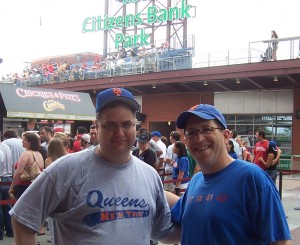
Our shirt of many numbers made its Pennsylvania photographic debut during the first game of Friday’s day-night doubleheader thanks to a commenter you know as bmfc1 and I know as a 1-man Bob Murphy Fan Club. It was my extreme pleasure to meet him early in the Mets’ 8-1/2-hour sweep of the Phillies. As for my shirt, a recent gift from my wife who sees me those 10 minutes a week I’m not at one Northeastern ballpark or another, some frustrated local who is not familiar with or perhaps disrespectful of the Borough of Reyes had something ignorant to imply about it outside Citizens Bank Park after the 6-5 visitor victory.
Queeeens, this sillydelphian chuckled. Ha-ha! Queeeens!
Who won? I asked. And who’s in first? Ha-HA!
Inviolable rule of mindless taunts: They’re more effective if you have a proverbial leg to stand on.
|
|






