The blog for Mets fans
who like to read
ABOUT US

Faith and Fear in Flushing made its debut on Feb. 16, 2005, the brainchild of two longtime friends and lifelong Met fans.
Greg Prince discovered the Mets when he was 6, during the magical summer of 1969. He is a Long Island-based writer, editor and communications consultant. Contact him here.
Jason Fry is a Brooklyn writer whose first memories include his mom leaping up and down cheering for Rusty Staub. Check out his other writing here.
Got something to say? Leave a comment, or email us at faithandfear@gmail.com. (Sorry, but we have no interest in ads, sponsored content or guest posts.)
Need our RSS feed? It's here.
Visit our Facebook page, or drop by the personal pages for Greg and Jason.
Or follow us on Twitter: Here's Greg, and here's Jason.
|
by Jason Fry on 10 August 2007 9:48 pm Emily saw the note a couple of weeks ago: Sesame Street characters at Shea, a 12:10 start, finale of a three-game set against the Braves. Noting that I had more vacation days than I likely would be able to use, she suggested what should have been obvious to me: Take Joshua.
Well, of course. A father-son trip to Shea. What could be finer?
My own parents have given me innumerable things to be grateful for, not least among them raising me a Met fan and thus protecting me from falling into the darkness of the Bronx. But while my parents have many admirable qualities, they weren’t much for baseball games at Shea.
I grew up in Setauket, where we watched New York City newscasts and the paper had New York City theater information and the radio stations were New York City radio stations, but the city itself was like a foreign land to us. A dangerous foreign land to be regarded with fear and suspicion. Once or twice a year, we’d drive in for some mission or other, and you’d have thought we were entering the Iditarod the way we arranged and prepared and fussed beforehand. Shea Stadium wasn’t really going into the city, at least not the way I thought of it then (and think of it now, proving that Brooklyn chauvinism and Suffolk County provincialism can lead you to the same destination), but I doubt there were five family outings to Shea between 1976, when I discovered baseball, and 1984, when we moved to Florida. And that’s probably why I started fires as a teenager and now steal OxyContin from pharmacies.
No, not really. It’s fine — that was the way it was, and I neither lamented that it wasn’t otherwise nor was damaged by it. (And in fairness, I paid little attention to the Mets in 1982 and 1983, so those years shouldn’t count.) Though my childhood remove from New York City did yield an amusing story: More than a decade ago Emily was living in New York and I was living in D.C., and while visiting I got the rather harebrained idea that we should burn a precious Saturday driving out to Setauket so Emily could, like, see where I went to junior high and stuff. So the day of our drive to Suffolk County, I’m up at around 6 a.m. getting ready and wondering why Emily isn’t doing the same.
“What in God’s name are you doing?” she mutters unhappily.
“Come on, we’ve gotta get up — it’s a long drive!” I chirp.
When I refused to be dissuaded, Emily rolled her eyes and got up. We got in the car and arrived in Setauket at around 6:45 in the morning. The town, of course, was utterly deserted, leaving Emily shaking her head as she watched my face contort with the realization that no, I hadn’t grown up very far from New York City after all.
Joshua has it comparatively easy — hop on the 2/3, switch to the 7, no LIE to be braved or LIRR to be navigated. So off we went to Shea at 10:45 or so — he’s dreaming of treats and Muppets, I’m dreaming of taking two out of three, we’re both fantasizing about Jose Reyes heroics.
A good start, but my dreams of some father-son idyll wouldn’t last.
Through various misadventures (a colloquy about hats, bad train luck, forgetting to go to the ATM), we didn’t get to our seats until there were two out in the top of the first. If the Sesame Street characters had done any cavorting, I’m afraid we missed it. Four-year-old attention spans being what they are, I’d sprung for mezzanine boxes to ensure Joshua would be able to see. But those seats were under a broiling sun, and after a couple of innings I realized the shallow arc the sun was traversing across the sky wouldn’t put us into shade until it no longer mattered.
Joshua, like many children, is apparently made of asbestos — despite the temperature threatening to soften lead, he decided the best vantage point for watching the game was my lap, and once there he could amuse himself by wriggling, grabbing my face and scraping the hair off my legs with the bottom of his sandals. My kid is a precocious baseball fan, but this wasn’t one of his high-focus days — among other things, doves, airplanes and cranes moving around at Citi Field offered much more interest than whatever the Mets and Braves were doing down there. By the middle innings we were both drenched with sweat, sticky with overflow ketchup and chocolate ice cream, and fractious, sniping about the timing of mandatory bathroom trips and debating the proper relationship between not listening to fathers and the likelihood of getting further treats. And the Mets weren’t helping, not with John Maine pulling his usual act of getting unnerved by a bit of bad luck, only this time he gave up a shockingly long homer to Chipper (whom I tried to teach my unnervingly fair-minded son to boo) and then a less-flamboyant one to Teixeira.
Not very Ozzie and Harriet, but we did rally once we were able to move up and grab some seats in the shade. And the Mets rallied too — in the ninth Joshua found his misplaced focus and began energetically cheering on Reyes and Gotay, loudly and confidently informing our neighbors of scenarios in which we’d turn a 7-3 deficit into a chance to play more baseball. He was aghast that his bringdown of a father could only muster muted cheers for Wright’s home run.
“But it’s only 7-6,” I said, thinking darkly of the tack-on runs we’d allowed. “We’re still a run behind.”
“Daddy,” Joshua said gravely. “If we lose 7-6 that’s still better, because they really tried.”
“A loss is still a loss,” I retorted, and immediately tried to snatch the words back, because Joshua wasn’t necessarily right in a baseball sense, but he was undeniably right in the ways that matter to four-year-olds. (Fortunately, he was trying to scavenge a beer-soaked Matt Yallof card from beneath the next seat and didn’t hear me.)
And damned if we didn’t almost do it. Only the need to keep a steadying hand on my kid (by then half-unhinged by sun and sugar) kept me from leaping out of my seat for Delgado’s drive — so obviously gone, so obviously … in Willie Harris’s glove. Joshua argued that the rules said you weren’t allowed to jump over the fence, and kept insisting on the point until he abruptly contorted himself into a ball on a seat in a fantastically crowded 7 car and passed out, a condition he stayed in through the hike through 42nd Street, the 2/3, the walk home and about an hour of couch time.
Father-son baseball trips, like rubber games, don’t always go exactly the way you would have scripted them. But for all that, they’re among our better inventions. That night we heard Joshua singing himself to sleep with “Take Me Out to the Ballgame,” and I watched footage of Delgado’s liner and thought, with a smile, that hey, they really tried.
by Greg Prince on 10 August 2007 12:31 pm If you can’t find you or anyone like you portrayed in an overblown, cartoonishly acted eight-part series about a time you remember living through, too, relax — it’s Flashback Friday at Faith and Fear in Flushing.
Except for one month as a telemarketer my junior year in college (we sold memberships to the Hillsborough County Police Benevolent Association; if our prospects assumed I was a cop and it motivated them to buy a window sticker, I didn’t go out of my way to correct them) and a three-day stint the winter after college with a Japanese-owned market research firm where we all had to gather in a circle and tell something about ourselves (which was just before I quit), I haven’t had a job since I was 14 that didn’t somehow involve writing.
That makes me think I haven’t had a real job since I was 14.
I don’t always get to write what I want to make a living, but I get to do what I’d be doing no matter what, whether somebody’s paying me or not. I’ve always liked to say if I could do something useful like fix cars, I’d do that. But I can’t. All I can do that’s marginally viable as an occupation is write. Hard to believe writing can compose a job, let alone a career. Somehow just enough people read to make it so.
I began writing for publication when I was 15 and previewed the impending high school soccer season for the Long Island Journal (coach said the team would be good), which means I’ve been at this in some form or fashion for 29 years. Even if soccer was involved, I instantly decided I preferred writing to what I consider my last real job, which I haven’t held, like I said, since I was 14, thirty years ago this summer. I wasn’t bad at what I did, but I didn’t stick with it. I doubt it had much of a long-term future.
And what was the vocation I turned my back on in the heat of 1977?
Meet your local newsboy.
***
That’s the phrase we on the street used. “Carrier” was a management term. When I had to make collections on Thursday nights, I’d identify myself to my wary customers peeking through their screen windows and Venetian blinds as “newsboy!” Maybe “Newsday!,” the paper I delivered faithfully for 15 weeks in the spring and summer of ’77. Never “paperboy”. Newsboy sounded bad enough.
The irony — somebody who would go on to become a writer leaving the world of honest work behind after delivering what other people wrote — struck me even then (assuming that’s ironic…I know surprisingly little about English for someone who’s written for most of the last 29 years). But it wasn’t a foot-in-the-door situation. I didn’t think I’d be discovered on my front stoop inserting Part 2 into the main news section by an itinerant editor who needed someone to go cover that big city council meeting. It was just a rite of passage. You grew up where I grew up, you eventually delivered Newsday on your block. Nobody told you to do it, you just did it. Really, it was less vocation than calling.
I liked it at first. Then I liked it in theory. Then I liked it less and less. Then I gave it up, never to return to the trade as far as I know. A comeback isn’t necessarily out of the question, but I doubt Newsday has newsboys per se anymore. I had a shopping cart some thoughtless dolt left in our driveway which had been sitting in the basement for several years. I put it to work. Every day after school in May and June and then in the early afternoons of July and August, I got my 30 copies of the paper and I rolled my cart up and down East Beech Street between Roosevelt and Neptune boulevards and then the width of Roosevelt Boulevard between East Walnut and East Penn streets.
Not too many shopping carts full of Newsdays these days. Or kids on bikes (I had enough trouble riding one to attempt tossing projectiles from one). Newsday is no longer an afternoon paper. Where I live, I’ve never seen them delivered. They just show up around dawn, presumably dropped off by a guy with a van.
We had a guy with a van. A yellow van. He was our manager, Mr. Thiessen. Every cliché about vans in the ’70s materialized with this man, right down to mellow beach scene artwork that decorated the back windshield. Goodness only knows what the van was used for at night when he wasn’t doling out Sunday supplements. Seemed like an all right sort, though I learned instantly that supervisory personnel don’t much care for cleverness in the ranks. For example, there was a night I had some burning newsboy question that couldn’t wait for the weekly Long Beach Boulevard rendezvous Mr. Thiessen demanded every Monday. So I looked up his phone number in the white pages and called him. He wasn’t pleased at my garden-variety industriousness.
“Don’t ever call me at home,” he admonished me. No, of course not. You don’t call someone as important as Newsday route manager Mr. Thiessen at home. I’m surprised his number was even listed.
I didn’t care for that sort of attitude. I didn’t care for it from the guy at the telemarketers in college nor the guy who ran the Japanese market research firm nor, for that matter, almost every editor and publisher I’ve had to answer to. I now technically work for myself. I can’t say I necessarily care for me either.
***
On my watch, the Newsday readers of E. Beech between Roosevelt and Neptune and Roosevelt Blvd. between Walnut and Penn were taken care of. They wanted their paper between the doors? They got it between the doors. They wanted it in the mailbox? It was probably the province of Emile the mailman by law, but they got it in the mailbox. They wanted it under the WELCOME mat? Actually, nobody wanted it there even if that’s where Mr. Thiessen said it was supposed to go. It got wet there, so I learned to leave it elsewhere.
The route was strange for me, particularly on East Beech where I’d lived since a few days after I was born but had taken myself, unlike Newsday, out of circulation. I had no friends to speak of on the block since first grade and here I was finishing eighth. I had to reacquaint myself with neighbors I (and my parents) mostly avoided. Some of them were pieces of work.
East Beech was a weird mix. It was, on the face of it, a quiet suburban street but it managed to play home to some ramshackle houses filled (illegally) with multiple ramshackle families. I’m not passing judgment on the income levels, mind you, just the class aspect. East Beech’s residents, whatever their financial situation, had a prevailing lack of it. The kids were monsters, the mothers and fathers were cranks — occasionally anti-Semitic cranks at that. But the worst neighbors were, improbably, the best tippers. Maybe they appreciated a workingman more than a quiet, studious adolescent. I don’t know. I delivered their paper where they wanted it and when they wanted it (though Sunday mornings were always a struggle) and they were good for a “keep the change” when their tab was $1.55 and they handed me two bills.
A forty-five cent tip was hot stuff in the summer of 1977. I had one friendly, upscale older lady who couldn’t have been nicer, loved to chat, offered me the occasional glass of water…but never went for more than a dime. It was like a code with her I think. The best tip I ever got was from some couple that rented the upstairs apartment at the house on the corner of Neptune. They probably had a yellow van, too, and were too mellow to be bothered counting out the 35 cents for their Sunday-only subscription, which they were like four weeks late in paying. When I finally got ahold of him, Dude emptied an ashtray of change into my hand and told me to keep it all. The tip amounted to $1.85. I could swear there was an Eisenhower dollar in there somewhere.
***
That Newsday route was mine for exactly 105 days. On 104 of them, I did my job. I did it on the 36th day, same day I took my first Regents exam, in algebra (and somehow got an 88). I did it on the 60th day, the day after the great blackout of 1977 (with the city papers in understandably short supply, a man asked to buy one of mine, but I had to decline, the relationship among me, my cart and my customers a sacred bond). I did it on the 98th day, a Sunday when I was anxious to get it out of the way so I could watch Tom Seaver pitch against Jerry Koosman in a matchup previously unimaginable, at least until the 31st day — June 15.
On only one of the days I was a newsboy for Newsday, the 87th, I sublet it. It was Wednesday, August 10, that I entrusted the afternoon paper habits of my clientele to my friend Noel. Overpaid him for the privilege, too. Think I gave him five bucks. But I needed that Wednesday off. I was taking a portion of my singles, my quarters, my dimes and my nickels and I was going, for the very first time, on my own to Shea Stadium.
Yes! Day game! I’m 14! I’m responsible, or a reasonably close facsimile thereof! A new era is at hand! If there’s a Mets game, I can go to it! There are trains that will take you there! I learned that going with my sister the last few years. Now I’m going to pull it off without any adult supervision. Just me and two friends and my wits.
Good lord that was exciting. My entire existence, then as more or less now, revolved around wanting to go to a Mets game. These days, I go to many. That year I went to one, just one. That one. Me. I had to ask permission but I didn’t have to ask anybody to take me or ask anybody to pay my way in.
On the 87th day I held it — and the only day I didn’t personally operate it — that Newsday route paid real dividends.
***
Even if seeing the Mets in the summer of 1977 meant seeing the 1977 Mets, it was a thrill. The ’77 Mets minus Seaver and Kingman were sorry sacks of sugar. I handled enough newspapers that season to know that wasn’t news. If I’d handled a few more, maybe I’d have gotten to see more Mets games.
When you delivered Newsday, you were encouraged to sign up new subscribers. The more subs you secured, the more points you were awarded for putting toward valuable prizes. Frisbees. Beach towels that declared Long Island was Newsday Country. The only prize that ever caught my eye was two tickets to a Mets game. Having signed up no new subscribers other than my reluctant parents, I wasn’t eligible, but I can still remember the piece of paper included with delivery stack alerting us to the possibility that we humble Newsday carriers could use our points toward seeing the Mets on such-and-such night, the Mets featuring “stars Kranepool and Henderson”.
Ohmigod, I thought. Our stars used to be Tom Seaver and Dave Kingman. Now they’re Ed Kranepool, who doesn’t even start, and Steve Henderson, who just got here.
It makes me wonder what second prize was that week.
***
With Seaver and Kingman gone, I had a whole new slew of Mets to embrace and it never occurred to me not to. Wasn’t Henderson’s fault that he was going to be thrust into being our version of George Foster (or Dan Norman’s that he’d have to be Ken Griffey once he came up) to compensate for the trade that made him a Met. Steve actually made a good first impression. I don’t know if he rated “star” status so soon, but by the end of ’77, we were making straight-faced arguments for Hendu, not Andre Dawson, as N.L. Rookie of the Year. If you prorated Steve’s performance for a full season, it wasn’t so crazy, even if being a Mets fan in 1977 was.
The four guys who came from Cincinnati are always the pawns discussed in the after-the-fire aftermath of the Midnight Massacre. But let’s not overlook who came for Kingman from San Diego. There was a pitcher, Paul Siebert. Siebert was on the Padres? I thought he was with Houston. And a utilityman, Bobby Valentine. He hasn’t been with the Angels all this time? Though I knew both men from their baseball cards, I hadn’t kept up with them prior to their Met incarnations.
I can’t say I remember a blessed thing about Paul Siebert other than he wore No. 43. But Bobby Valentine…there was a name to remember, huh? I vaguely recalled him as a promising Dodger and a severely injured Angel. Had no idea he was ever in San Diego. But now he was a New York Met and in certain minds he never stopped being one. Bobby V, as we would come to know him, was a Mets player in the 1970s, a Mets coach in the 1980s and the Mets manager in the late 1990s and the early 2000s. A pennant-winning manager of starting players like Benny Agbayani, Jay Payton and Timo Perez, all of whom you could imagine, in your darker moments, being quite at home as 1977 Mets.
Other than Bud Harrelson turning this trick from the ’60s to the ’90s, I can think of no other person who wore a Mets uniform across four consecutive decades besides Valentine. Though his playing tenure was undistinguished in less than two seasons at Shea, it didn’t seem at all odd to me when he reappeared as a coach in the mid-’80s, just as his detours to Texas and Japan seemed like marking time before he inevitably became our skipper in 1996.
Without the overshadowed portion of the Massacre, the Kingman-related violence, Bobby Valentine probably doesn’t become part of the Met legacy. He has his detractors, I know, but it’s a very different team history if Bobby V doesn’t take things over and shake things up when he does. It may not have been worth trading Tom Seaver, but for long-term purposes, I’m willing to give up Dave Kingman for Bobby Valentine.
***
Let’s be real, though. It wasn’t the trade of Kingman (or Mike Phillips for Joel Youngblood, a gem of a steal) that hung over Shea like a cloud from June 1977 until new ownership delivered CPR to this brain-dead endeavor. It was Seaver for Henderson, Norman, Doug Flynn and Pat Zachry. Flynn was sold to us as a great gloveman. He was, first taking over from Harrelson at short and then, when Felix Millan’s career ended with an Ed Ott-induced thud in Pittsburgh, second base. Dougie won a Gold Glove for us. I really, really liked Doug Flynn. I borderline loved Steve Henderson. I waited a long time for Dan Norman to pan out.
But Pat Zachry. Geez. You don’t want to be the righthanded pitcher who replaces Tom Seaver in the Mets rotation in 1977. You could be the righthanded pitcher who replaces Tom Seaver in the Mets rotation in 1984, because then you’d be Dwight Gooden. That was fine. But Zachry? Even with his Rookie of the Year award not yet a year old (they made him share it with Butch Metzger, a prototype of Blas Minor as if you would need two cracks to create one of him), he was doomed. His legitimate All-Star selection in 1978 notwithstanding — he made the same team as Tom Seaver — Pat had no chance in New York. I never realized just how bad he had it until this past June when Bill Madden unearthed this anecdote in the Daily News:
“One of my fondest memories of New York was when I tried to use Getty Gas certificates I’d gotten for being on ‘Kiner’s Korner’ at a Getty station on Roosevelt Avenue near Shea. The attendant had no idea what they were and he came after me with a ball peen hammer.”
You can keep your images of extraneous boroughs burning and mass murderers on the loose and Lenny Randle stranded in the dark at home plate on the night of July 13 when he was sure The End was nigh — “God, I’m gone. I thought for sure He was calling me. I thought it was my last at-bat.” There is, in retrospect, no sadder metaphor for the decline and turmoil of New York in the summer of 1977 than this poor bastard Pat Zachry who was traded for somebody they called The Franchise trying to redeem petroleum vouchers personally bestowed upon him by a Hall of Famer and being not only denied proper credit but threatened with a tool.
To be a Met in New York in 1977 was not to be a prince of the city.
***
If I’d had the Newsday carrier points, maybe I would have gone to the Newsday carrier game. Instead, I chose August 10, the Mets and Cardinals. I chose to go with Stephen, a lapsed Mets fan with whom I hung out almost daily that summer (even though I would have been hard-pressed even then to tell you why), and Todd, my oldest friend in the world, dating clear back to fourth grade. Todd was a Yankees fan before there was any reason to be. Stephen had switched local teams that spring. Todd was honorable if misguided. Stephen was a bit of a creep when it came to baseball. But I apparently couldn’t find any Mets fans that week.
It didn’t really matter who I went with. It mattered where I was going. First, to the LIRR station in Long Beach, to the ticket window. “Round trip, Shea Stadium, please.” It was explained to me that I’d have to hold onto this ticket because after changing at Jamaica, I’d have to change again at Woodside for the train to Shea. I tried to keep that straight in my head, for me and for Stephen and Todd. This was my adventure. I couldn’t lose them even if I wanted to.
The beauty part about presenting a ticket marked Shea Stadium to an LIRR conductor is there’s no doubt as to your destination. “Going to the Mets game?” he asked as he punched. Yup, I said. “Who’s pitching?” he asked. I was ready with the answer having bought a competitor’s paper at the station: Craig Swan. I loved knowing the answer.
I wish that once a day somebody would ask me who’s pitching.
All connections were made and we arrived safely at Shea. I led our party to the ticket windows on the third base side. I wanted to sit in the field boxes and be able to stare into the Mets dugout. I was a pretty big shot with all that newsboy change rattling around in my pocket. With a field box going for $4.50 a pop and attendance going pretty much in the toilet, this was an achievable goal. We got our tickets and we sat fairly close to the field. Close enough to see Lenny Randle had survived the blackout intact.
Of course I had to pick up a yearbook and a program. I did that every year even if “every year” only covered every year since 1973. I got the revised edition of the yearbook, the one that expunged all evidence of Seaver and Kingman. Joe Torre was on the cover, sitting in the manager’s office, making out a lineup and maybe dining out on that “if Felix hadn’t gotten four hits…” story again. He looked reasonably happy. Even though I’m sure I was trying to act as cool and casual about all this as a 14-year-old could — as if I went to a Mets game every Wednesday — I’ll bet I looked reasonably happy. I was at a Mets game on my own recognizance, on my own nickel, on my own, on my day off from Newsday. It was Craig Swan and the Mets versus Tom Underwood and the Cardinals in the middle of the afternoon. Why shouldn’t everybody look happy?
***
I found the least happy person at Shea Stadium. Before first pitch, after buying the yearbook and the program, I remembered that I wanted to replace my souvenir batting helmet, the one I requested my father buy me at Nathan’s of Oceanside in 1971 because Lindsey, Ralph and Bob made it clear it could be purchased there. It had been damaged in the course of eighth grade when Stephen would come over after school and we’d indulge in a contest of what could best be described as “break things in Greg’s room.” The helmet, adjustable, plastic and (as the announcers reminded us) not intended for actual game use, was an easy target.
There was a concession stand behind our third base seats. I asked the man behind the counter for a helmet. He grumbled something, looking all the while like a baseball stadium, even beautiful Shea Stadium, was the last place he wanted to be today. He handed me the helmet and told me that it would be three dollars. I handed him a ten and thanked him. Wow, I thought, I got a new batting helmet right here at Shea!
“Hey!” the voice croaked out. “You forgot your change.”
Indeed I had. So much for my 14-year-old cool. I was a little embarrassed by my error in the transaction. Score it E-Fan. I thanked the vendor again. He went back to grumbling.
I’ve engaged in probably thousands of exchanges with hundreds of Shea vendors since August 10, 1977, thirty years ago today, but this one stands out. The vendor, I’d learn over the winter, was an NYU student. He came to my house, not to give me the rest of my change (for all I know, I asked him to break a twenty) but because he had by then become my sister’s boyfriend. Eventually, he would become her husband, my brother-in-law. Because Suzan said the guy she was dating had been a vendor at Shea Stadium, I recognized his face as soon as I saw him. He actually recalled me, too, so few were ticketholders in 1977.
Mark said he must have liked something about me because usually he wouldn’t tell 14-year-olds they forgot their change.
***
Of course the Mets didn’t win. The best they could hope for was to be blacked out like Lenny Randle was in the bottom of the sixth on July 13 (the Mets were losing to the Cubs when Con Ed was hit and lost officially once they resumed play in September…natch). The Mets won only 64 times that year. Think they were going to waste one of those precious commodities on us? Swan pitched what would become known in the ’80s as a quality start: 3 earned runs over 8 innings. Actually, that doesn’t sound too bad for any season. He held Lou Brock and Garry Templeton in check, but Roger Freed — replaced for defense late by young Keith Hernandez — reached Swannie for a two-run homer in the second. The Mets were down 2-0. Imagine the Mets of 2007 losing 20-0 in the second inning. That’s what the Mets losing 2-0 in a second inning in 1977 was like.
Despite Lenny Randle driving in Doug Flynn and keeping his average well above .300 (he was probably glad to be playing in daylight) and Bobby Valentine going 1-for-3 as starting first baseman (Valentine, not Kranepool) and Steve Henderson collecting yet another Rookie of the Year credential with a base hit, Tom Underwood silenced Mets bats pretty handily — him and not-yet-Met Butch Metzger, who collected the save.
Ted Simmons batted cleanup for the Cardinals. Mike Vail batted cleanup for the Mets. Yet we only lost 3-1. There should have been a column in the standings for moral victories. But there wasn’t.
***
Todd, Stephen and I reversed the commutation process back through Woodside and Jamaica all the way to Long Beach. Todd lived way on the other side of town from me and Stephen and was in a bit of a panic mode about getting home. I think I decided that since I had gotten us back to our starting point, I wasn’t responsible for him any longer and sought out the eastbound bus with my remaining change before I could grow gnawingly concerned over his fate. (Don’t worry; he made it to ninth grade with the rest of us.) By the time I got home, I think I was down to a few coins in my pocket and the five-dollar bill my mother insisted I stick in my shoe. Plus my yearbook, my program, my batting helmet, my ticket stub from my first Mets game I went to on my own and my recollection of the first day I ever took off from the first — and, by my writerly reckoning, last — real job I ever had.
***
The next day, Thursday, I was back on the Newsday beat. Newspapers had become a big deal overnight. The Post would sell a million copies on August 11. Not because of a surge of interest in the Mets game. It was Son of Sam. He was arrested a few hours after I came home from Shea. He was front page news. Noel, however, was the lead story for my customers. I got five separate complaints that my substitute didn’t place Newsday right where they wanted it. So much for relying on a caddy. To this day, I almost never trust anyone to pick up the slack for me. I wonder if it’s all Noel’s fault.
Though I did effective enough damage control, I wasn’t long for the route. I’d gotten tired of delivering Newsday, of playing possum with the local miscreants, of leaping back from German shepherds who went nuts at the sound of a doorbell, of waiting for well-meaning dowagers to ceremoniously fish dime tips from their purses. I didn’t want to be a quitter, but I did want to quit. I’d made up some cover story about not wanting my paper route to interfere with my schoolwork and my parents bought it. I couldn’t get them to buy a full week’s subscription to Newsday (they wouldn’t take the Sunday edition since they thought Newsday was a waste of paper — which I half resented and half respected), but that I could sell. I bothered to tell my best customers, for some reason, that I would no longer be their newsboy now that I was starting my final year of junior high. One of them was thoughtful enough to tell me to “wait here” and get me a dollar bill. It was like “put this toward your education, son.” I may sound snarky about it now, but notice that I remember it distinctly.
Having made my decision, I turned my little green account book over to Mr. Thiessen who would find another newsboy or newsgirl to take my place. I guess I left him in a temporary lurch, but there was always another kid to deliver Newsday. I had nothing in particular against my manager, really, but I carried this disturbing image all summer that if I’d stuck with my route through the fall and winter, Mr. Thiessen would point to his yellow van with the mellow beach scene artwork and tell me if I continued to work hard, someday this would all be mine.
I decided I’d rather write about soccer. Or anything at all. Believe me, I have.
***
Of course I stuck with the Mets, no matter the attendant indignities. After the Seaver/Kingman car wreck, the Mets stopped being in the papers very much unless they paid for the privilege. I can still see the ad with the slogan everybody seems to remember from that summer. I was in our basement on a Saturday night, readying the Sunday edition’s guts when I came upon a picture of a bunch of Mets and a bunch of children forming a bad dream of a team picture. Mixed in among “Lee, 22” and “Steve, 24” and a peeved “John, 26” were various Roberts and Karens and other representatives of the cream of Metropolitan youth identified by their dependable 1960s baby names and last birthdays. They were 10, 12, maybe even my age, 14 (though having traveled to and from a Mets game on my own, I was clearly no longer as young as I used to be). The team’s front office was determined to make chicken salad out of the Seaverless, Kingmanless, hopeless 1977 New York Mets by inviting Long Island’s parents to…
BRING YOUR KIDS TO SEE OUR KIDS
Ohmigod, I thought yet again.
When you were coming of age alongside the Mets in the late ’70s, you thought that a lot.
Next Friday: Twenty years of knowing better but listening nonetheless.
by Greg Prince on 9 August 2007 8:36 pm Turnabout is foul play.
Bleah, bleah, bleah…ptui! I spit out this horrible ending to what could have been a beautiful game.
Willie Harris pulling an Endy out of his grabhole — leaving ample room for the shoving up of any bats we haven’t already wished plunged high, far and deep up Chipper/Teixeira way — and robbing Carlos Delgado of a game-tying, Shea-boggling homer was the defensive equivalent of Brian Jordan ruining our 2001 season twice. It was also a rude response to our gorgeous ninth-inning dousing of their flickering hopes, a brilliant event not even 24 hours old, now consigned to back of the fridge with the expired half-brick of cream cheese you don’t even remember buying.
How can people stay mad at Barry Bonds when it’s clearly Willie Harris who has ruined baseball?
We make a hard stand Wednesday night and break their black little hearts. Then we stir up a next-afternoon comeback for the ages, like something out of May 17. No right or reason to expect it, but it’s getting delivered. We sent six batters to the plate in the ninth and they all reached base…or almost made it. Gotay, Reyes and Wright did their jobs. Castillo’s high chopper required only a bit of Tartan Turf to have injected him into the rally for real. Even Alou, having been lubricated with a generous dose of 3-In-One, nearly beat out a ground ball to short. Delgado you know about. Delgado you know probably had a homer taken away by this bedbug Willie Harris. Maybe it was just a long double, but it was probably four bases and a tie score. Instead, we registered three runs and three outs when four and two were the respective minimum and maximum permissible in today’s ninth.
Imagine the Braves blowing a 7-3 lead like that. Imagine a 7-7 tie and all the momentum shifting our way. Imagine actually taking a series from these bastards.
You’d better not. You’ll become violent.
Don’t imagine anything. Instead, realize the reality of the situation. Three-and-a-half-game lead and all, the key numbers are these: six games left against Atlanta and 42 against everybody else. The Mets are advised to kick the ever-lovin’ spit out of everybody else in those other 42 in order to secure their second consecutive Eastern Division title and another shot at the belt because I have no confidence, none, that they’ll handle the Braves in the other six. Not after four series comprised of one win and two losses every time. I thought we buried this bullshit last year. Apparently we have not.
by Greg Prince on 9 August 2007 2:00 pm Mike Bacsik, a New York Met in 2002 and 2003, gave Barry Bonds the pitch that became his 756th home run. Barry Bonds gave Mike Bacsik a bat in appreciation, inscribing it:
“To Mike, God Bless. Barry Bonds”
Barry Bonds can ask for a whole mess of Mets pitchers to be blessed for getting him to 756. Bacsik became the 75th hurler who has been a Met to surrender a homer to Bonds. Obviously Bacsik was a National when the record-breaker was served up. But we're not being picky here. To be in this special wing of the Barry Bonds Home Run Society, you had to have been a Met (a Major League Met, not a farmhand) at some point in your career. And you had to have given up a home run to the man either before you became a Met, while you were a Met or, like Bacsik, after you were a Met.
If Bonds never hits another home run, the list could still grow. If Omar Minaya got a hankering to have Clay Hensley on the Mets, for example, then Hensley would be added to the list, having been tagged with the 755th home run of Bonds' career. Likewise, if Craig McMurtry, now 47, were to come out of retirement to shore up the rotation (he hasn't pitched since 1995, but he's still younger than Julio Franco), then we'd have to add him for he gave up the first homer ever to Barry Bonds.
But we don't have Hensley and we don't have McMurtry. We have had 75 pitchers who have thrown 155 gopher balls to Barry Bonds. That's just over 20 percent of the kaboom king's total. He hit only 38 of these against pitchers when they wore Mets uniforms, but that's another story.
Who were these once Mets, then Mets, now Mets or eventual Mets? I could tell you, but then I'd have to…no, I wouldn't have to kill you, but if I tell you, I wouldn't be able to ask you. And I wanna ask you.
So let's have a quiz! No prizes, just productivity-killing fun. (Try to curb your Internet instincts from looking up the answers directly. I'll give 'em later, along with the inevitable clarifications for whichever questions I muddy in my quest for cleverness.) Remember: the home runs didn't necessarily have to be hit against the Mets, just a pitcher who at some point pitched for the Mets.
Please help these pitchers identify themselves.
1) I'm remembered as the second pitcher in some pretty good rotations, so it's fitting, I suppose, that I gave up Barry Bonds' second home run ever.
2) I gave up Bonds' 26th homer. And I wouldn't be on this list as a Met if the Mets weren't so hot to give away the guy who gave up Bonds' second home run ever.
3) I had a no-hitter going in the seventh until Bonds hit his 201st home run off me. The shock for Mets fans was I had a no-hitter going in the seventh…and that it wasn't the Mets who were being no-hit, given how that particular year was going.
4) If Bacsik's the 75th member of this club, then I guess I'm the 74th, even if the last of the three homers I gave up to Bonds only put his career total to 667.
5) I once had something of a numerical nature the guy who's the answer to the previous question has now. But I gave up just one homer to Bonds: his 171st.
6) Bonds got me for the 56th home run of his career. Once he went and hit another 554 off other people, I could have dropped to my knees and flung my glove in the air in celebration. But I would have exulted too soon, for I also gave up Bonds' 611th homer.
7) Mets fans were far more annoyed that I gave up home runs to the likes of Alfredo Amezaga and Hanley Ramirez than they are that Bonds touched me for eight homers (even if eight is the most anybody in this particular club has on his ledger).
8) I had a perfect ERA of 0.00 in three appearances for Willie Randolph, but I wasn't so lucky when I gave up Bonds' 622nd homer when I was pitching for Bob Boone.
9) I'm one of those myriad lefty specialists who hung around to face lefty sluggers like Bonds. When I was a Met, I wasn't all that special. In fact, I was a starter and gave up Bonds' 244th homer. I'd give up three more to him in my later incarnation in relief. The last two (Nos. 511 and 516), I'll bet, made Mets fans particularly happy given who I was pitching for by then.
10) I was involved in a trade with five other pitchers altogether, but I was the only one of the six who ever gave up a homer to Bonds. I gave up five of 'em, starting with No. 288 and ending with No. 434.
11) My name comes up tangentially in connection to Barry Bonds for some reason. I gave up his 657th homer, but that can't be why people have invoked my name when his comes up. I wonder why we're connected. I wish I had a shot at answering this.
12) Some of the most notable closers in Mets history escaped the wrath of Bonds. I didn't. I gave up the 711th home run of the guy's career, but big deal. We won the game.
13) I took care of Barry Bonds and everybody on his team when it mattered most. But I did give up his 286th and 524th homers, though I doubt Mets fans remember either of those blasts, so associated am I with the aforementioned great effort against Bonds' team.
14) I gave up Barry Bonds' 465th homer, but I prefer to bask in the afterglow of having been the only one in this club to have won a game the night before Barry got to 756.
15) I'm the person who gave up Barry Bonds' 438th home run. That's all you need to know.
16) If all Mets fan knew about me was I gave up Bonds' 46th and 55th career homers, I'd feel a lot better about my career. I think a whole Nation would feel the same.
17) Boy did I suck as a Met. Wait, let me narrow it down for you. Exactly ten years before Barry Bonds became baseball's all-time home run king was the last time Mets fans didn't particularly care how much I sucked. As an aside, I gave up the 110th home run of Bonds' career. But mostly I sucked as a Met.
18) Yeah, I sucked as a Met, too. It was almost as if there were a rule that I had to suck as a Met for like an entire year. I would give up Bonds' 173rd career home run…as a teammate of the guy who gave up the 110th.
19) I was way better than my brother when it came to not giving up home runs to Barry Bonds. Sure, the guy got me for No. 180, but my brother gave up many more to him than I did. So I've got that going for me.
20) Greg thinks I'm the most obscure Met in this entire club, at least in terms of having been a Met. That's a purely subjective metric, but I'm so obscure Greg actually did a double-take when he saw my name. He was all “ohmigod, I totally forgot this guy was ever on the Mets.” It's like I was so obscure that any season I helped build as a Met couldn't have been worth finishing. I'm so obscure that once a season that wasn't worth finishing wasn't finished, I was finished, too…y'know? I'm too obscure to be on any list. I think I'm too obscure to have given up two home runs to Barry Bonds, No. 8 and No. 253. But I did. You know…I must have been around a while to have been tagged by Bonds 245 homers apart. That might help you figure out who I was. Honestly, I don't know what more there is to say about me. If Greg's forgotten me, you have every reason to have also.
21) I doubt I'm all that well remembered by Mets fans either. Greg barely recalls my Met tenure. but I was a part of history. In the runup to Bonds' single-season home run record, I gave up three dingers to the big man in a week, Nos. 559, 560 and 562 in his career. Steve Phillips must have been impressed by me because he went out and got me the very next summer. I wouldn't say he traded the world for me, but he was willing to toss in a very valuable body of water.
22) What the guy before me said? You know, about Nos. 559, 560 and 562? Guess who gave up No. 561? Me! I only gave up that one homer to Bonds, but in my only two Mets appearances, I gave up three homers, including two to a genuine World Series hero. (I really, really, really sucked as a Met.)
23) Barry Bonds hasn't been that much of a problem for the Mets in terms of being a frequent threat since he became a Giant. But when he was a Pirate, he was a potential problem 18 games a year. Remember Barry as a Pirate? I do. I gave up his final Pirate homer, the 176th of his career and the first of three he hit off me in my fairly distinguished career.
24) My kids weren't going to be as uneducated as I was. I saw to that. I guess I didn't seem too bright the five times I gave up homers to Barry Bonds. Five, incidentally, is the total of two plus three…and three is the number I gave up to Bonds after I decided my kids' education was my biggest concern. The last of 'em, so far, was No. 607. Home runs to Bonds, that is. I don't have that many kids as far as I can count.
25) In my time, I also gave up five homers to Bonds, starting with No. 342 and winding up with No. 679. In my time with the Mets, I gave up the first grand slam to another player of some note. My Mets time was rather brief.
26) I gave up four homers to Bonds, the first of them No. 190. But honestly, I've got my own big number that people have been talking about lately, so screw my being in this crappy club for jerks.
27) That's almost exactly what I said about the Mets not long ago, even though I haven't put any big numbers that people are talking about. But I did give up Bonds' 519th and 551st home runs.
28) Just as I sure gave up the second-most home runs to Barry Bonds that any pitcher who has pitched for the Mets has, the Mets sure gave up on me at a pretty young age. I sure made them look bad by going out and being the second-best pitcher in the National League shortly thereafter, at least according to Cy Young voters. The first home run I gave up to Bonds was his 175th. The last was his 394th.
29) My career has been about as gaudy as Bonds'. I'm only in this club because I gave up Barry's 287th homer. I'm only pitching for the club I'm pitching for this week because I've been hurt.
30) Barry got to me for Nos. 40 and 60 when I was one of the best pitchers in baseball and No. 156 when I was in noticeable decline. He never saw me at my absolute best even though he's actually a little older than I am.
31) As of Tuesday night, Mike Bacsik and I had our names next to Barry Bonds' record-setting home runs. The next homer Bonds hit, on Wednesday, Bacsik's name was replaced by Tim Redding's because No. 757 became the new lifetime record. But unless a slugger really bulks up the way Bonds did the year Barry hit the 567th of his career off me, then I'll be a trivia question well into perpetuity. Let's just say it's unlikely I'll ever knuckle under to another pitcher in this regard.
Tip of the trivial cap to Mark at Mets Walkoffs for inspiring this exercise in, well, triviality.
by Jason Fry on 9 August 2007 3:47 am Something tells me this enigmatic, frustrating, confounding 2007 season finally began in earnest Tuesday night. Three with the Braves, those familiar objects in rearview mirror that indeed may be closer than they appear. At the end of the month four with the Phils, whom we may yet be forced to take seriously. That's a lead-in for three more with Atlanta. Then, a week later, Atlanta and Philadelphia back to back. (Following that, we close things out with 13 against the supposed soft underbelly of the National League East. Those games may frighten me the most — somewhere Chris Nabholz is laughing.)
Better competition, injuries and inconsistency brought us to this point — a pennant race that just truly shifted into gear. Mets, Braves, Phillies. Gentlemen, start your engines.
After a disquieting evening of watching Brave killer Oliver Perez get tormented, it was on to the premier matchup — John Smoltz vs. Pedro Martinez. Ah, memories of getting off the '05 schneid with that marvelous … what's that you say? Oh. Right. Pedro was pitching tonight, but for Port St. Lucie. As update after update came in showing Pedro being tattooed by Lakeland Tigers, I suddenly remembered Joan Payson's request while on a cruise: Just telegraph me when the Mets win. Still, filling in more than capably as understudy was El Duque, whom the Diamondbacks' front office must see in their nightmares. We got this guy for Jorge Julio?
With Emily actually at the game with her father, Joshua and I settled in front of the TV, cranked to Brobdingnagian volume to be heard over the protestations of the air conditioner. I decided this was the time to teach the kid about the countdown — how I yelp “24 to go!” after a hitless first inning, then decrease it by three, in hopes that one day the countdown will actually reach zero. My lesson looked prophetic for a while, what with El Duque launching evil breaking stuff at every conceivable angle and speed. So of course the moment I got truly excited about the magic at work — thiswasthenightiexplainedthecountdowntothekidandemilyandherdadwereattheparkwowwowwowwow! — was the moment it fizzled. And the moment I got beyond that and started appreciating El Duque's effort for what it was inspired the Braves to explode out of the casket, with their usual mix of damage from Braves you've never heard of (Willie Harris), Braves you've stopped calling Braves you've never heard of in vain hope that that will make them stop torturing us (Kelly Johnson) and shrewd new Schuerholz acquisitions (Mark Teixeira). And, of course, Chipper. Larry Jones, that stock villain from a billion baseball penny-dreadfuls, with his killer's eyes and his smile that practically forms two right angles when he's really pleased with himself, like the dead grin sported by the Joker. You just knew Chipper had to be lurking somewhere — under the bed or in the closet or wherever he takes himself when he senses there are Met fans to jump out. Was it a surprise when Chipper wound up with a double thanks to his own hitting and a little outfield connivance from us, or when Kelly Johnson showed admirable hustle scoring all the way from the first on a ball that didn't get to the warning track. Staring glumly at the ruins of El Duque's masterpiece, I wondered how I'd fooled myself into thinking it might have been different.
But then it was different. That bottom of the seventh was pure passion play, what with Reyes showing his age by being too eager and Luis Castillo getting the kind of roll-your-eyes hit he always seemed to get against us while wearing teal, followed by the delightful sight of Bobby Cox trundling out of the dugout to get Ron Mahay, looking like a troll tramping out from under his bridge to harass travelers.
And then, an inning later, after decent work from Heilman and a lightning-bolt throw from Lo Duca, Moises Alou making up for recent double plays and general creakiness with one of those gone-from-the-moment-he-hit-it home runs. A fitting ending, 1-2-3 from Billy Wagner, everybody go home happy and hope your subway's running by now.
No, that would be too easy. Billy had to load the bases with nobody out, leading to angst and slapstick in the Fry house. Somehow I'd wound up at the dining-room table, looking across the entire room at the screen, but had to stay there because that's where I'd alighted with Alou connected. So, Francoeur hits his terrifying high bouncer that Wright turns into a fielder's choice, but here comes Andruw — with the kid Escobar on deck as apprentice executioner, if needed. Wagner gets his sign, looks back at Woodward and …
TiVo switches over to “Top Chef.”
(TiVo and HD are on different video and audio feeds, so you can't see or hear TiVo asking to change the channel, because … oh, just trust me on this one.)
AUUUGGHHHH!!!!! I nearly overturn a dining-room chair as I vault to the sideboard and seize the TiVo remote. But wait — Emily really likes “Top Chef.” PUT ON THE RADIO, STUPID! OK. Yes. Radio! I grab the receiver remote and start clicking TUNER, only nothing's happening. TUNER TUNER TUNER TUNER. Ack! This is the OLD remote! Where's the NEW remote? Is this it? Yes! Jesus H., this thing is like the command module of a starship. Just go to the actual receiver and … tuner? Tuner? Where the hell is the tuner? HERE IT IS!
“…PUT IT IN THE BOOKS!”
Wha? Really? How on earth did we cheat the hangman?
You know what? Never mind how. I'll find out in a bit. It's enough that we did.
by Greg Prince on 8 August 2007 9:14 am 
| Mets fans liven up every gathering, so much so that the dullest of affairs (a nondescript Washington Nationals victory, for example, for example) can become a mob scene when one of us is spotted. That’s how it went for Matt Murphy of Queens, a Mets fan who presumably couldn’t get a ticket for the big Mets-Braves series at Shea, so he decided to slum at the Phone Booth in San Francisco Tuesday night. Bay Area locals, knowing they have been in unethical possession of a team they refer to as the “Giants” since 1958, were beside themselves with joy to have a real New Yorker and real New York baseball fan in their midst, so much so that they just had to reach out and touch him. Matt needed police protection to save him from his adoring public. It’s true folks — we Mets fans are so magnetic that we just attract well-wishers wherever we go.
Having brightened the evening of aimless Californians, Matt next flew to Australia to break bread with Craig Shipley.
(Photo of a Mets fan causing a frenzy by Brant Ward of the San Francisco Chronicle.) |
|
|
by Greg Prince on 8 August 2007 4:30 am Barry Bonds just became baseball's all-time home run king. He hit his 756th against a slightly familiar lefty on the Washington Nationals.
Some slightly familiar company he keeps:
Jack Fisher gave up the home run that tied Babe Ruth's single-season home run record.
Tracy Stallard gave up the home run that broke Babe Ruth's single-season home run record.
Steve Trachsel gave up the home run that broke Roger Maris' single-season home run record.
Chan Ho Park gave up the home run that broke Mark McGwire's single-season home run record.
Mike Bacsik gave up the home run that broke Hank Aaron's career home run record.
And the fan who caught Barry Bonds' record-breaking home run? Our old pal Dave O'Brien just reported with a touch of astonishment that he's wearing a Mets jersey.
Who says we're not a part of home run history?
In other news from Tuesday night, the team Hank Aaron used to play for and still works for beat the team Mike Bacsik used to pitch for…beat them rather handily. With a 756th career home run being hit across the continent, I consider the matter trivial. As Hank Aaron recorded a graceful, gracious, great message of congratulations to somebody he probably wanted nothing to do with, for one Tuesday night, I'm willing to let this Atlanta victory over the Mets go uncommented upon.
If Hank can extend a hand, so can I: Congratulations to the greatest hitter I've ever seen. However you did it, whatever happens to you as a result of however you did it, whyever you act the way you do, you could play some ball, with or without.
I wish you had done it without.
by Greg Prince on 7 August 2007 8:29 am Why can't pitchers hit even a little better? Who knows more about pitching?
Why don't catchers facing a pitcher they used to catch hit .750 against that pitcher? Who knows more about that pitcher's thinking?
Why are so many pitchers so nuts about not allowing anyone to talk to them on the days they start? Will they forget it's one for fastball, two for a curve?
Why are ballplayers always shown departing for a road trip in a jacket and tie? In what other business are you required to dress one way for your travel and another for your actual job?
Why is there a lingering obsession about how players wear their pants, their socks and their stirrups? “They're too high!” “They're too low!” “They're old school!” They're just pants, socks and stirrups.
Why are older-style uniforms considered traditional and somehow unimpeachable? Maybe the genuine tradition is just starting now and everything before now was all wrong.
Why do retired or veteran ballplayers perpetuate this myth that it's just not like it used to be when I came up, we'd stay and talk baseball with the older guys, now everybody rushes out of the clubhouse? I've heard at least two generations of ballplayers who have been assailed by their elders for not caring nearly as much about the game insist they, in fact, were the last of that dying breed that cared about the game. Can we assume just about everybody who plays the game cares about the game in his own way?
Why does almost every batter stand and watch his deepest fly balls sail toward the fence? Don't they know what a home run looks like? Have they been clued in that not every ball hit well leaves the park? That it's better to run so you can be on third instead of second or second instead of first should the ball not be gone or not be caught? Is it common knowledge among the players that all the games are televised and usually recorded by the clubs themselves?
Why do pitchers who discover magical arm angles that save their careers forget to employ that arm angle eventually?
Why doesn't Willie Randolph “challenge” every player the way he “challenged” Cliff Floyd two years ago? Remember that? Floyd had been injured and a little lethargic in '03 and '04 and then has that Monsta year in '05 and the line all season from Willie was “I challenged Cliff and he responded.” Great work. Do it again.
Why does a pitching coach wear a uniform while a trainer wears slacks and a golf shirt? Each man sits in the dugout most of the time and only runs onto the field in an emergency. They may as well wear the same getups.
Why do stadium A/V squads play songs like Billy Joel's “Pressure” to taunt the visiting team's young, often Latino relief pitchers who probably have no idea about the message being conveyed and that they're supposed to become unnerved by such a clever jukebox selection?
Why after all the bad publicity attached to chewing tobacco about a decade ago have I noticed what seems like a plethora of Skoal cans in players' back pockets this year?
Why does Shawn Green lean against his bat in the on-deck circle like a man waiting for a bus?
Why does Shea sell blue cotton candy? When did cotton candy start coming in a color that isn't pink? If they're gonna sell cotton candy in blue, why not sell half of it in orange?
Why do I look at the out-of-town scoreboard at least six times per half-inning even when I know damn well no other game besides the one in front of me has begun?
Why does almost every announcer tell us the potential tying run will be coming to the plate “in the person of” Johnny Estrada? What are the odds Johnny Estrada will come to bat reincarnated as a dining room table?
Why, if nobody likes it, is the volume turned up so loud on every bit of pregame and between-innings business? I've yet to hear anybody tell me “it's great the way they've got the decibels goin' tonight!” In fact, I've yet to hear anybody tell me anything without me begging pardon and asking it be repeated.
Why don't the Mets hand out more bobbleheads and hand them to adult fans who pay the freight and seriously collect that kind of stuff?
Why are we told who is sponsoring this call to the bullpen but often have to wait until after the commercial to be told who the call was for?
Why do people who know you're going to a game say they'll look for you on TV? They won't, and even if they do, the chances are remote they'll find you unless you're Christine Glavine or some gesticulating idiot with primo seats behind the plate?
Why doesn't somebody clean up all those mysterious puddles that materialize every few sections in every concourse? It's a wonder more fans don't slip and more lawsuits aren't filed.
Why do regular people get days off while baseball teams get off days?
by Greg Prince on 6 August 2007 10:14 pm 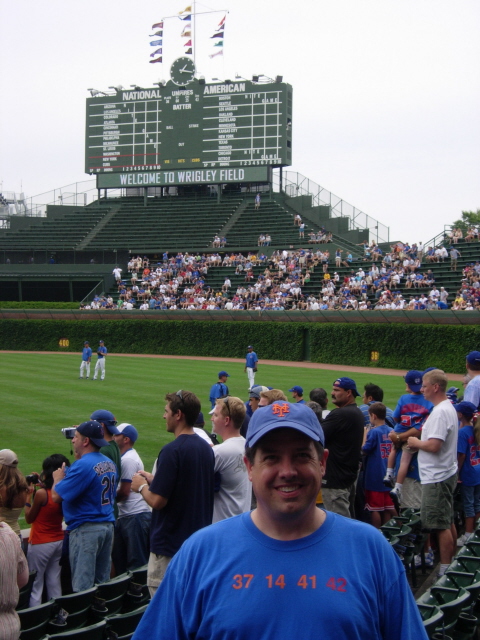
| Ernie Banks became famous at Wrigley Field for, among 512 other things, suggesting, “Let’s Play Two!” Dave Murray doubled up on Mr. Cub by heading to the North Side of Chicago on Saturday and wearing four…the four retired Mets numbers featured on the now classic Faith and Fear in Flushing t-shirt.
As Dave recounts at the ever-entertaining Mets Guy in Michigan, he encountered a reasonably savvy souvenir shop owner in Wrigleyville who observed:
“OK, I know what the shirt means, but who is No. 14?”
Dave clued him in that it was none other than the manager who bested Leo “No, these were the real Mets” Durocher in 1969, Gil Hodges.
Also wearing 14 that summer and for many summers in Chicago, Ernie Banks. |
|
|
by Jason Fry on 6 August 2007 10:00 pm We hold these truths to be self-evident: There can never be enough interesting/entertaining writing about baseball in general and the Mets in particular. Sure, the Mets play nearly every night and are covered by some 10 local papers and a fleet of blogs. But even then, eventually you've read everything the knights of the keyboard have written, and you're still wanting more. Because damn it, it's six hours (or 20, or two or 0.25) until there's a game on, and you're worried about Pedro's rehab, the state of the farm system, Mark Teixeira and what statistical simulations suggest will happen for the rest of the season, to name the first four things that pop into your head.
Over there on the left we've got a lot of links. But on this off-day, I wanted to spotlight two writers I find particularly entertaining and interesting.
The first is Marty Noble, the veteran reporter turned MLB.com scribe. I've got enormous respect for Noble's years of hard work, baseball knowledge and the unfussily straightforward way he offers insider analysis. But what I really love are his mailbags. (Truth be told, I don't read game stories anymore, no matter who writes them.) Noble seems to save up the dumbest questions Met fans can imagine for some day when he just can't stand it anymore. Then it's time for a mailbag — in which Marty lines up the witless and whacks away at them until he's got his equilibrium back.
Take this one. Things start off OK, as Noble uses a reader's disbelief about Rickey Henderson's leadoff homers vs. the Mets' to illustrate how great players can seem to distort statistics. But from there … well, buckle up.
Jordan R. supposes that Duaner Sanchez will be a free agent when he comes off the DL, at which point the Mets should sign him to a two- or three-year contract because “he is so valuable to their bullpen when he's healthy.” Noble's fairly restrained here, calmly correcting the record about Sanchez's contract status before getting a bit testy: “Now, why would the Mets want to offer him anything more than one-season contract, even if they were competing for his services?”
Alex X. wants to move Fernando Martinez to second base for no particular reason I could detect. “I've never quite understood the public's fascination with changing players' positions,” huffs Marty, then dispenses with a similar question suggesting Ramon Castro man first.
Next comes the overly sentimental Marty C., who wants Mike Piazza back as a backup catcher and World Series DH. “So you want the Mets to acquire a player who might serve as a DH for a maximum of four games in October and carry him for 2 1/2 months as a backup catcher with tarnished defensive skills?” asks Noble, and you can easily picture his eyebrows arching higher and higher until they're levitating and have to be retrieved with a stepladder.
My favorite Marty Noble mailbag, though, came in April. This one starts off calmly enough, with straightforward analysis of Pelfrey, Humber, Vargas and the rest of the waiting-in-the-wings pitchers. Marty's pretty even-keeled, except at the end, when his advice is “lest you all be labeled junior Steinbrenners, be a tad more patient.”
But then, oh, that next question. It still makes me laugh half a season later. The luckless Dan R. wants to know why the Mets keep using Aaron Heilman “when all he does is throw the same pitch over and over again and get destroyed by hitters.” Marty coolly acknowledges Heilman's recent woes and explains what Willie's thinking about the bullpen is. But then he can't keep it in any more: “He has been an invaluable asset for two seasons. You want to do what with him now? The rotation? The Minors? Exile? Prison?”
My other new favorite is the New York Sun's Tim Marchman, who's consistently very smart, bitingly acerbic and really funny. He first caught my eye with this terrific scouting report of the '07 Mets, including his pitiless, laugh-out-loud summation of Moises Alou: “a horrible defensive outfielder, with the range of a box turtle.”
But then whenever Marchman writes, I know I'll laugh out loud at least once, shake my head at a particularly pungent line, and come away thinking about something differently. Take this analysis of how Omar Minaya simultaneously finds diamonds in the rough like John Maine and Oliver Perez and wastes roster sports on Jose Lima and Chan Ho Park — “pitchers so bad no one was aware they were still playing professional baseball.” (The answer: Minaya likes reclamation projects, but only if they're flyball pitchers with decent peripherals and at least some recent success.) Or read this smart take, from June, on our vanishing outfielders and what we should and shouldn't worry about. (And now Beltran and Gomez are gone. What a bizarre year we're having.)
There's this, from our July near-death experience: “There is bad baseball, and there is pitiful baseball, and there is painful, embarrassing baseball, and there is the kind of baseball the Mets have played this month, which is none of these things, but is instead just depressing. Watching the Mets these days is like nursing yourself through a hangover, or looking at happy photos of yourself with someone who threw you over for your best friend.” There's this piece, that did a beautiful job explaining how ballplayers age and why Carlos Delgado should be fine. Or this reassuring take on our failures in the clutch, with a bit of priceless psychology: “When they miss every opportunity without fail, the team is glum and fans become pessimists, and big hits like Chip Ambres's game-winning single in the 10th inning yesterday can even irritate by their contrast with the usual shoddiness.”
Some weeks Marchman writes five times a week, and his consistency is awe-inspiring: When he's good he's the best sports columnist in New York by a wide margin, and when he's just OK he's the best by a small margin. Kind of like the 2007 Mets, I suppose. Read him.
|
|







