The blog for Mets fans
who like to read
ABOUT US
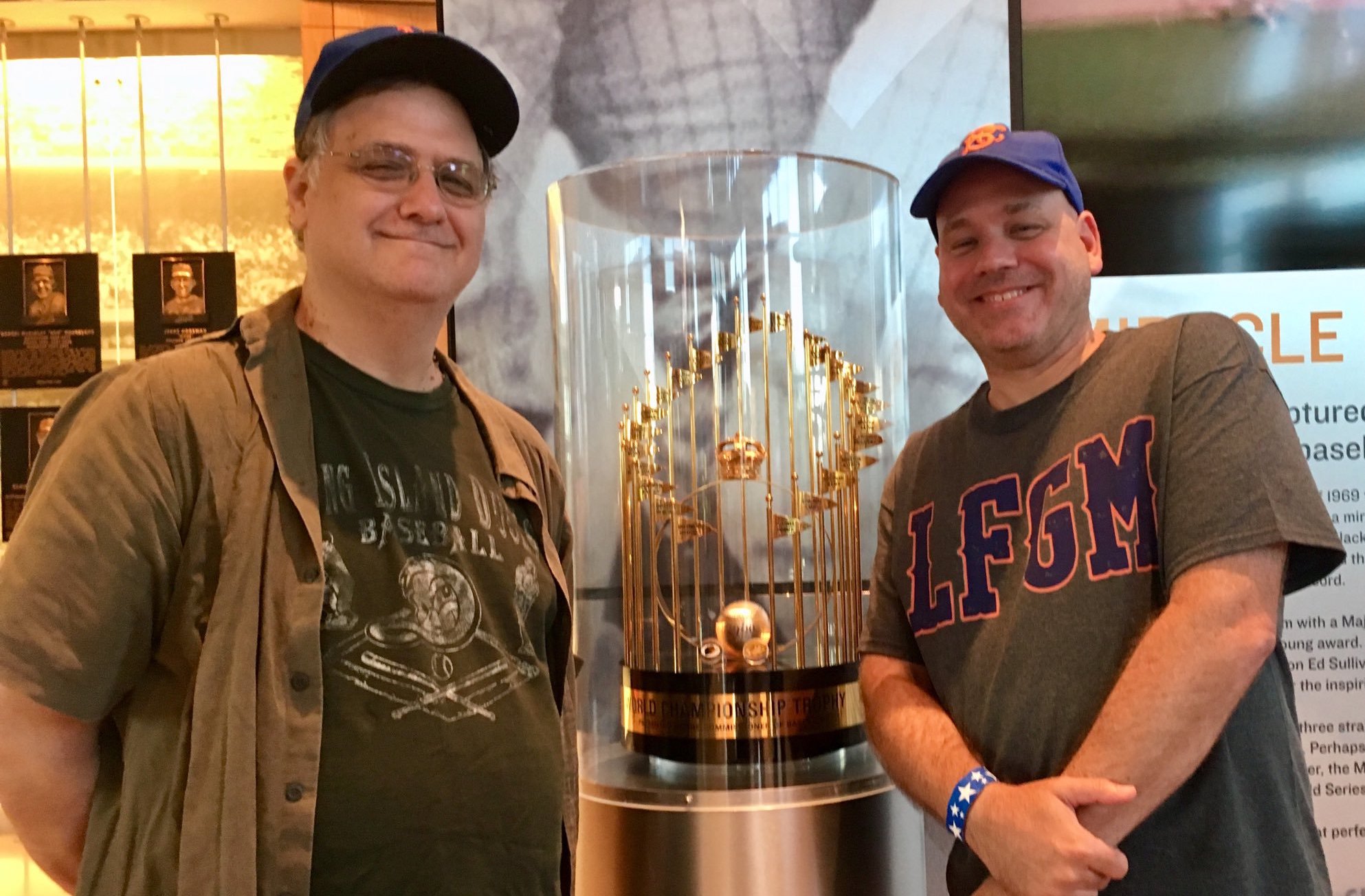
Faith and Fear in Flushing made its debut on Feb. 16, 2005, the brainchild of two longtime friends and lifelong Met fans.
Greg Prince discovered the Mets when he was 6, during the magical summer of 1969. He is a Long Island-based writer, editor and communications consultant. Contact him here.
Jason Fry is a Brooklyn writer whose first memories include his mom leaping up and down cheering for Rusty Staub. Check out his other writing here.
Got something to say? Leave a comment, or email us at faithandfear@gmail.com. (Sorry, but we have no interest in ads, sponsored content or guest posts.)
Need our RSS feed? It's here.
Visit our Facebook page, or drop by the personal pages for Greg and Jason.
Or follow us on Twitter: Here's Greg, and here's Jason.
|
by Greg Prince on 20 April 2007 7:01 pm If you can trace your roots without paying a genealogist, then it must be Flashback Friday at Faith and Fear in Flushing.
On April 18, 1957, New York’s National League franchise opened its home schedule just as it had done every year since 1883, just as it would never do again.
Fifty years and two days ago, the Giants defeated the Phillies 6-2 at the Polo Grounds. Within six months, there would be no more New York Giants.
What’s that like? What’s it like to watch your baseball team leave town? What’s it like to root for a team that defined baseball for millions, that practically invented modern professional sports, and see it slip away? What’s it like to be told that 75 years of unmatched history don’t matter?
What’s it like to lose your team? How does one so ancient and storied and recently successful just up and cross the country?
I don’t know firsthand. Born too late for that, of course. Instead I’m the beneficiary of the makegood, the Mets. I’ve been very happy with that. Still, I wonder.
What was it like to be a Giants fan in 1957? Those Giants finished sixth in an eight-team league, going 69-85 before going west. Chances are if you were a Giants fan in 1957 you latched on in some previous, happier campaign. My understanding of Giants fans was you didn’t simply become one. You always were one.
I can read about the New York Giants and I do. I can talk to those who lived with the New York Giants and I do. But I can never really know the New York Giants. I wish I could.
As this is the 50th anniversary of the last season of the New York Giants, it is also the 35th anniversary of the beginning of a lifelong infatuation of mine with the idea of the New York Giants. In the spring of 1972, they started becoming my team from before my team existed. I was already a far-gone Mets fan, schooled in the basics, that we were formed in 1962, that others’ removal from the local stage made room for us. 1962 was the year the Mets and I were born. I knew there had to be something here before us.
There was.
The Giants.
My Giants.
Baseball Digest began my retroactive conversion process. In its June 1972 issue appeared an article promising to fill me in on “the battle for New York” through the ages. There was, apparently, more to it than arguing the relative merits of Jerry Grote vs. Thurman Munson, Cleon Jones vs. Roy White, Tom Seaver vs. Mel Stottlemyre. This thing went back a ways. This predated the Mets and the Yankees. The roots of the battle for New York, the magazine said, extended to the Giants.
The Giants? The team Willie Mays played on before just being traded to the Mets? The team Willie Mays played on in New York which is why Joan Payson was so anxious to “bring him home” as all the papers explained? The Giants who, pictures of young Willie Mays revealed, wore the same orange NY on their caps as the Mets did?
Wow. I could sense a real connection.
Baseball Digest filled me in on the salient details. The Giants began playing in Upper Manhattan in the 19th century but really took off around the turn of the 20th when a win-at-all-costs manager named John McGraw grabbed the helm. With a magnificent pitcher named Christy Mathewson on his side, McGraw drove his Giants to dominate early baseball. They captured the National League pennant in 1904 and spit on the idea of playing the champion of the upstart, perhaps illegitimate American League for any of the marbles. The only marbles worth pocketing were won in the National League. Forced to partake in a World Series the following year, they trampled Connie Mack’s Philadelphia white elephants with Matty pitching three shutouts. Though royally screwed out of the 1908 pennant amid Fred Merkle’s alleged Boner (Cubs got away with that one…and nothing since), four more pennants would follow for the Giants of the Polo Grounds of the 1910s.
As Larry Doyle put it so memorably, it was great to be young and a Giant.
Until the fucking Highlanders got going.
You know who the Highlanders were and who they became. They were American League nonentities who paid McGraw rent on the Polo Grounds so they’d have somewhere decent to play. They were nobodies. Baseball in New York meant the Giants. It had since 1883. The Giants were the team immigrants followed to learn the intricacies of their adopted homeland’s game. McGraw was a perfect assimilation tutor. He preached and practiced inside baseball. Bunting. Hitting and running. The beauty of the game. The Giants were sporting heroes. Mathewson was a phenomenon. They were the first big-city team, the darlings of brokers and actors and people who stayed loyal. The New York Giants were the most famous team in the land.
Until the fucking Highlanders got going.
Did I mention them already?
In Digest form, Highlanders became Yankees. Yankees got Ruth. Ruth’s Yankees began outdrawing McGraw’s Giants. Giants beat the Yankees in the 1921 and 1922 World Series proving forever the superiority of inside baseball over lummox fence-swinging. Disgusted, McGraw threw the Yankees out of the glorious Polo Grounds. Defeated and disgraced, they scattered to parts unknown never to be heard from again.
No. They built their own stadium in another borough and…I can’t get into it. It’s too offensive to my National League sensibilities.
McGraw’s Giants ran out of steam as the 1920s wound down. Muggsy himself retired in 1932, having given way to a new generation of Giant legends he himself had mentored: Bill Terry, Carl Hubbell, and the largely forgotten — except for a stamp — Mel Ott. All-time greats. The Giants had a few moments (a world championship in ’33, pennants in ’36 and ’37), but nothing like the early 1900s. It took the uncharacteristic hiring of fiery Leo Durocher in 1948 to relight the spark in Upper Manhattan and make the Giants something more than the team that used to be the team in town. The Giants of Durocher won a pennant in 1951 and a World Series in 1954.
Three years later, they were gone from New York.
Before I read this article, I didn’t like the Yankees. Now I hated them and would hate them forever. Nice job, assholes.
There was something else printed in 1972 that would have a profound effect on the way New York baseball history would be viewed going forward. It was called The Boys of Summer by Roger Kahn. It is brilliant, it is touching, it is — if you are me — despicable.
The Boys of Summer made the Brooklyn Dodgers immortal. The Dodgers may have lost that 1951 pennant to their archenemies the Giants, but they won the aftermath. The Boys of Summer ensured the Dodgers would become synonymous with the last golden age of New York baseball, the last to include three Major League teams. Over time, the shorthand for the 1950s became The Boys of Summer and their crazy fans in their demented tiny ballpark with their loony Sym-Phony versus the General Motors Yankees nearly every October. That was the rivalry, you know.
No it wasn’t. The Dodgers and Yankees weren’t baseball’s greatest rivalry. The Red Sox and Yankees aren’t baseball’s greatest rivalry. Nothing will ever touch the Giants and Dodgers. The New York Giants and the Brooklyn Dodgers. Same league, same city, same blocks, same houses sometimes. People got killed arguing the Giants and the Dodgers. The Giants were half of that. Sometimes, pre-World War II to be sure, they were more than half of that. Actually before Larry MacPhail came along to run the show, the Dodgers were daffy without being any good. The New York Giants took the lifetime series from the Brooklyn Dodgers 650-606. Yet the last dozen years of the Dodgers’ existence is what has been memorialized to the exclusion of almost everything else when pre-1962 New York National League baseball is discussed.
The Giants? The Giants of the Polo Grounds? The flagship of professional baseball in the world’s greatest city? Oh yeah, there was a third team, wasn’t there?
So here I am, 50 years after they’re gone, getting riled up on their behalf, carrying a torch for a club that hit the road before I was the proverbial twinkle in anyone’s eye. What am I doing it for? For an article I read in third grade? For an orange NY on a black background? For the idea that a team so massive — gigantic, if you will — once existed and then didn’t? For a ballpark that I never saw, except as a plaque affixed to the outside of a tower of a housing project? For Bobby Thomson and Master Melvin and Big Six and the flawed McGraw and Willie Mays before he was 42 and falling down in centerfield? For New York National League baseball a handful of years before I came into existence?
Yes. That’s it exactly. I wouldn’t trade the New York Mets for anything a time machine could offer me, but there is a New York Giants fan rooting inside my soul. There has to be. We are, as I never tire of repeating, the sums of all the seasons that came before the one we’re in. When you root for a team only months older than yourself, your sum has to come from somewhere.
It’s 1981, nine years after the Baseball Digest article. The Mets are the Mets, which is to say not good and not popular. But there I am, a high school senior on the cusp of another season of standing tall for my horrible home team when my father, not at all engaged by baseball then, makes an observation. I remind him of some guy he knew in junior high or high school, in Jackson Heights, in the ’40s. Everybody was either a Dodgers fan or a Yankees fan. Except for that one guy. He just stuck with the Giants the way I stick with the Mets. He was kind of an oddball, added my dad.
That sealed it. Me and the Giants were one. I guess I get riled up for that guy, too.
Natch when your defunct team hasn’t been funct for 50 years, your options are limited. I can’t stress enough that none of this makes me look kindly upon the San Francisco Giants. They are just another Met opponent to me. Though I saw a few markers commemorating their franchise heritage when I visited Pac Bell in 2001, I also understood that it was all stolen goods. Screw the San Francisco Giants. I hold them in eternal contempt with the Highlanders and the Cubs.
So I read books. Every book about the New York Giants and the Polo Grounds that comes along I buy. I go to museums. I join listservs. And I watch carefully for every film clip. I can’t see Bobby Thomson hit that shot off Ralph Branca enough. I can’t see Willie run back, back, back and set a standard for Endy Chavez enough either. I wish I could see more. Though other images occasionally flicker by in black and white, those two moments of triumph are what 75 years of Giants baseball usually boil down to. (Could be worse. Could be the Expos — out of business since 2004 and still waiting for their first moment of triumph.)
My only living, breathing connection to the New York Giants and the Polo Grounds and everything I didn’t witness firsthand is the Giants Fan Club. Those are “the guys,” as their leader calls them. A few times a year they…we get together at a Chinese restaurant in Riverdale to talk baseball, mostly Giant baseball. The last meeting was last week, the night Glavine faced Moyer (a couple of whippersnappers compared to the company I was keeping). The guys comprise a very welcoming bunch to camp followers like myself, happy to recall which usher looked the other way and left a gate open, who was pitching for the Reds some week in 1940, why they couldn’t stand Frankie Frisch as an announcer. I treasure their memories probably almost as much as they do.
How did it happen that this all there is to the Giants? How did the New York National League franchise fail to maintain its foothold? Negligent management? Changing times? Withering demographics? It’s not like everybody dispossessed by the O’Malley-Stoneham cabal of municipal treason lined up to become Yankees fans. Their attendance dipped by nearly 70,000 during the revolting 1958 baseball monopoly they undeservingly inherited.
Why do you think New York needed the Mets so badly? National League baseball, baby. It was something different. It was better. It was what the people wanted. (Yankee attendance dropped 250,000 from 1961 to 1962, not incidentally.) The distinctions between the leagues have blurred but it’s still better here. John McGraw was right all along about the Junior Circuit. Ignore them and dispatch them to distant precincts.
And hit and run. Always hit and run.
I guess I’ll have a sustained opportunity to get a taste of New York Giants baseball starting in 2009. They’re gonna build a new ballpark for the Mets, you may have heard. It is going to play off the heritage of the city’s National League tradition. It’s going to look like Ebbets Field. And be sort of shaped like Ebbets Field. And it’s going to have a rotunda like Ebbets Field. And it will honor maybe the greatest Dodger to have played at Ebbets Field. And there will be an Ebbets Club behind home plate.
But if you scroll down for a couple of minutes on the Mets’ site to find all the minutiae that will make Citi Field the spectacular showplace for which each and every one of us has been actively crying out, you will find it:
Various areas of Citi Field will reinforce the setting of the venue and the Mets connection to the City of New York and baseball history, including […] Coogan’s Landing beyond the left field fence…
Coogan’s Landing refers to Coogan’s Bluff, the quirky piece of real estate on which the Polo Grounds stood when the Giants called one version or another of it home from 1889 to 1957 (and, by the way, when the Citibound Mets did the same in 1962 and 1963). It’s not much. But it’s something. And, for the benefit of those who would skew history to suit their own vision of nostalgia, the Giants still won the pennant, the Giants still won the pennant, the Giants still won the pennant.
Ah, I can’t leave this topic all riled up. It means too much to me. So here’s something better than anything I have to say, coming courtesy of a thoughtful gent in a Polo Grounds e-mail group to which I belong. He recently sent me this excerpt from an article by the greatest baseball writer ever, Roger Angell. It describes the scene in Upper Manhattan on September 29, 1957 — the final game the New York Giants played that year, the final game the New York Giants played at all, the final baseball game the Polo Grounds ever figured to host.
***
I went to the last New York Giants game of them all in the Polo Grounds — September 29, 1957 — taking my nine-year-old daughter with me. It was her first major-league game. It was a fine, cool day, the flags were flying, and we sat in the upper deck. There were some dull, touching ceremonies before the game, when a lot of the old-timers who had turned up to say good-by were introduced. George Burns was there and Larry Doyle and Rube Marquard and Carl Hubbell. Bill Rigney presented a bouquet of roses to Mrs. McGraw, and Bobby Thomson pointed to the left-field seats for the photographers. “When is it going to start?” my daughter asked.
It finally did start, but it wasn’t much of a game. Willie made a fine catch and throw in the first inning, but that was about all there was. The Pirates ran up the score, and the Giants looked terrible. The stands were half-empty and the crowd was the quietest I have ever heard at any game. Between each inning, a mournful-looking gentleman in the next section to us stood up and displayed a hand-lettered sign that said, “Giant fan 55 years.” In the eighth inning, I heard a spectator behind me murmur, “Well, at least the Dodgers lost too.” The Pirates won, 9-1.
There was a little excitement right after the game when some history-minded fans dug up home plate and several chunks of the outfield turf for souvenirs. A small crowd gathered outside the clubhouse steps to shout their farewells, but we didn’t join them. On our way out of the park, my daughter looked at me rather anxiously and said, “I had a good time. That was fun. I’m sorry they lost.”
I didn’t feel anything — nothing at all. I guess I just couldn’t believe it. But it’s true, all right. The flags are down, the lights in the temple are out, and the Harlem River flows lonely to the sea.
***
Next Friday: Take heed of the No. 7 song of all-time.
by Greg Prince on 20 April 2007 6:50 am I have a strong suspicion that the Mets we have seen through 14 games represent the new normal. These are the 2007 Mets. Our team. Our time.
Totally this time.
Granted, it's a small sample, a mere 8.64% of the season accounted for, but have you seen anything from these Mets that worries you to any great extent? I don't mean the ding to Lo Duca or the nursing of Heilman or the continuing education of Ambiorix Burgos or that every time the camera picks up Damion Easley, he seems to be wishing he took that repairman's job with Maytag. Of course there are going to be physical limitations and mental blocks and moss that gathers on those rarely called on to roll. That's normal stuff to worry about. You're crazy if you don't dwell on something.
But the big picture…it's pretty reassuring, isn't it? We're 14 games through '07 and save maybe for a couple of uncomfortable innings by a starting pitcher here and there, one or two vapor locks in the field and a few too many LOBs a week or so ago, have the Mets done anything wrong?
Not really. They've looked great without actually looking their best. I'm willing to bet they can play better than they have even if it will be tough to improve on 10 wins in 14 games, which happens to be the best mark in all of baseball right now.
Tim McCarver liked to say and Rob Emproto likes to remind me that you're never as good or as bad as you look. But sometimes, I gotta believe, you are what you appear to be. The Mets appear to be awesome, even more so than they appeared at this time one year ago.
Our record in 2006, when first place was freshly painted, was the same, 10-4. Given the newness of our occupation and the floundering of the former N.L. East penthouse tenant, the vibe was heady and novel. After 14 games a year ago, we winged our way west to San Diego and San Francisco and back this way for a changing of planes in Atlanta. It was one of those death-knell trips we'd been programmed to expect, except the bell never tolled. I was pretty sure we were for real before that trip and the 6-4 run through those erstwhile killing fields confirmed it. I wouldn't necessarily say the rest of last season was a victory lap, but we knew we were good by the end of that very first month.
Now? I have a sense we're more than that. There has been no letdown by these guys after not scooping it all up in '06, the key words here being these guys. In this era of piping hot personnel turnover, the '07 Mets have remained relatively stable. Most nights seven of the eight position players are Met vets. The rotation is composed of familiar faces. Only Alou, a couple of guys at the end of the bench and a jumble of middle relievers are new in town.
There's significance in that, I think, on several counts.
1) After two seasons of mixing and matching and dutifully filling the recycling bin to the rim with Tides and pink slips every Monday morning, Omar has got the team he wants out there, at least as close as he can get to it for now. His eye for talent along with Willie's talent for drawing out performance are on display daily. It's nearly impossible to fathom anybody filled their roles directly before them because I can't envision anybody filling their shoes.
2) I really get the sense the players themselves are on a mission. It's a very fan-projecting way to think, I admit, but do you imagine that any of the vast core of this team is satisfied with the way '06 ended? They didn't care what flags and rings were being distributed in St. Louis. They didn't give a damn what Jimmy Rollins said about anything. They're still the loosey-goosey, mile-smile fun bunch we fell in love with last year, but there's just that little extra edge to them now. They're good and they know it and they're intent on letting everybody they come up against understand it.
3) For us, the base, there is a comfort level I haven't felt in years. The getting-acquainted maneuvers this spring were minimal. We know our guys now. We trust them. They did it before and, heck, they can do it again. As much as I loved acquiring the big names we now call Mets, I cringed just a tiny bit the previous couple of winters over the mercenary factor. The Beltrans, Wagners and Delgados no longer have that rented-stranger feel to them. They're Mets. They're us. They're still here a year later. And they're kicking ass up and down the East Coast.
They continued to do so Thursday night in a dozen pleasing ways large and small. John Maine needed extra rest? OK, he got it and he cruised. El Duque needed to go in regular rotation? OK, he did and he cruised. One troubling inning and everything else fell into place. It was as if his last shaky start never happened.
When I found out we were facing a pitcher of whom most of the western world had never heard, I shuddered. The Mets can't handle obscure rookies. Even the 2006 Mets could be blindsided by unknown quantities, and this one seemed to have an excellent curveball. But these are the 2007 Mets and the 2007 Mets just know what they're doing. They sized up Rick Vanden Hurk and they battered him as if he were Chris Carpenter.
Lo Duca out? Willie moved some pieces around. Beltran bats in the two-hole and pretends it's the three-hole: 4 for 6, homer, two ribs. Castro takes Paulie's position and he homers and knocks in three. Delgado still not quite there? Maybe not, but he sure has a knack for big doubles. Wright got a hit 'cause he always does. Alou got two 'cause it's April. Reyes was Reyes and all that implies. Jose Valentin is ungodly hot (and incredibly competent afield) and even the often stiff and awkward Shawn Green is swinging with ease and yielding contributory results.
I think that's everybody. Everybody chipped in and the Mets stepped all over the Marlins. What was the final score again? 11-3. What was it the night before? 9-2. Night before that? 8-1 over somebody else. It's almost as if it doesn't matter who they play or when they play them. Earlier this season — and this season couldn't be much earlier than it already is — the Mets won 10-0, 11-1 and 11-5.
This is Met baseball. They pound people and they don't give them much of a chance to respond. And they're not even playing perfectly. The cold spell up north sapped them of power. The pitchers couldn't get their feel and threw too many balls. Wright and Delgado haven't truly broken out by any means.
Yet we're 10 and 4, ahead of the world. We may not be as good as we look. We may be better.
I don't want to hear that we've played some fallow siblings. Were the world champion Cardinals an easy assignment? The revamped Phillies? The Nats I'll give you but the Marlins? They're not terrible and even if they were, since when has that ever mattered during crunch time between the sacks of Soilmaster?
As for the Braves, yes, we're 1-2 against our closest competition, having blown them off the map once and lost tight ones to them twice. Now that the Phillies have retreated to an undisclosed location for group therapy, it appears it will be us and the Atlantans for a while. Even that, though, is different from the version to which we became accustomed circa 1998. We're not looking up at any Braves this time around. They want to compete in this division? They have to go through Shea. Whatever they accomplish this weekend, if in fact they accomplish anything, they'll have to keep it up at a pace commensurate to the one we set. We are quite capable of setting a demanding pace.
I respect the Braves, if not for their pre-2006 accomplishments then for the excellent start they themselves have enjoyed in 2007. I respect every team, every square on the schedule, every possible exigency, every fateful detail that can swat a year awry. I respect the baseball season and thus take none of its potential whims lightly.
But as a Mets fan in 2007, I fear nothing and nobody.
by Greg Prince on 19 April 2007 4:14 am Congratulations go out to David Wright for extending his two-season hitting streak to 25 games and Met opponents for extending their 46-season hitting streak to 7,163 games
Both are Mets records.
There are, however, figurative asterisks attached to both marks. Wright, who has hit safely in the first 13 games of 2007, has 12 games to go to break the more widely acknowledged single-season Met hitting streak record, which still belongs jointly to Hubie Brooks and Mike Piazza. The opponents' streak, meanwhile, is even longer if its definition is stretched to encompass 74 postseason contests along with eight regular-season affairs that ended in ties.
That's 7,245 official games in which the Mets have competed and somebody has gotten a hit against them. Somebody. Anybody.
For the Marlins Wednesday night, that was Miguel Cabrera, whose leadoff single in the seventh inning — after a check-swing on a one-and-two pitch that was ruled a ball by first base umpire Laz “Angel” Diaz — kept the streak alive for another game.
Or another week of games.
Or month of games.
Or lifetime of games.
Oh for fuck's sake, I give up. We're never getting a goddamn no-hitter, are we?
9-2 romp over Dontrelle Willis and the Miami chapter of the Phillies is a heckuva consolation prize. Wright's single in the first was mostly a footnote by the time it was over, but so were Jose's four hits, Other Jose's three hits and the first Carlos's three ribbies. The lead was secure enough to get greedy, if indeed one can be greedy to have one, just one, of those shiny objects in the window, the one we can never, ever, ever fucking have.
Can we?
I was willing to settle for a big ol' win and feel pretty, pretty good about John Maine on eight cold nights' rest. He walked some guys, but he had the high heat cooking and the Fish flailing and even with two hits surrendered in the seventh, a performance that bodes well for the back end of the rotation (if, in fact, he's not already at the front end).
But then Mark Buehrle no-hits the Rangers. It was the White Sox' 16th no-hitter.
Some teams have 16 no-hitters. The Mets have none.
What do I have to do to get one of these? Not want one? I tried that! That was my on-the-fly strategy. By the fourth inning when it appeared history was within the grasp of a few dozen fastballs, I drowned out the voices in my head with one prevailing thought.
C'mon Marlins. Get a hit.
What the hell? Hoping the other way hadn't worked. So let's try this. Stephanie happened to enter the living room as the bottom of the seventh was commencing. She heard the word “no-hitter” and asked if she should go back on the computer which, after all, is where she was for the first six innings. I appreciated her assessment of the situation, but no, I told her. Don't worry about it. I don't want a no-hitter anyway.
Maybe, just maybe, if I could convince myself and the gods that what I wanted was a blemish under the H, then maybe, just maybe, they'd work against me in this matter as they always do. I thought articulating that desire would help the cause.
My mind is more useless than I suspected.
I've heard a Mets fan or two claim — without a game in front of them that would test their stance — that they sort of don't want a no-hitter. They seem to be serious. With a no-hitter, they argue, we're like everybody else (save for the Padres, the Rockies and the Devil Rays). Right now we're special. We get to ride a small bus and everything.
I'm not buying it, but I see it. Just this afternoon, I found myself responding to an e-mail from a guy I haven't known a week. He had written me about Leron Lee. Leron Lee is code for Mets fans, just like Jimmy Qualls and Joe Wallis and everybody from Antonio Perez on back.
Not long after Miguel Cabrera had his club membership stamped, I thought about that exchange. Me and Rich met last Thursday and in no time we're speaking the language. Other people say hi and ask how do you do? Mets fans say Leron Lee and ask one out in the ninth off Seaver in '72?
This is how we communicate. This is our native tongue. We are fluent in no no-hitters. Such is the language of yuck.
Being 9-4, winning 9-2…what a crappy night.
by Jason Fry on 19 April 2007 2:46 am Surprise!
Greetings from Florida, where I am living proof that the Mets' no-no-hit streak can resist absolutely anything, even the self-pity and self-absorption of bloggers.
My hotel is about a half-mile down the waterfront from a house I lived in as a teenager, and haven't particularly missed — if you've never been to St. Petersburg, it looks vaguely like L.A., except it's more humid and there's less to do. I'd just settled in at a beach bar (sounds great, but it was raining) and noted that the Mets were up 8-0 in the sixth when I suddenly realized I had a long-ago connection to this hotel. Twenty years ago I'd hop off my windsurfer to catch my breath on their beach, only to get shooed away lest I bother the vacationers. Huh. The things you forget.
Anyway, I called Emily and found her oddly guarded.
“If the Mets game is on, you ought to watch it,” she said.
Huh? Ohhhh. 8-0. In the sixth. I get it.
“I understand,” I said, thinking (and not for the first time), my wife is so much cooler than I deserve.
I asked the girl at the bar if they could get the Marlins game (I know, it's the Mets game, but think vaguely local) and she scowled. The beach bar didn't have a dish — it got the same channels as the hotel rooms. They couldn't even watch the Tampa Bay Lightning.
And that's when I knew the Mets would pitch their first no-hitter. Because really, from my perspective it was perfect: I was sitting in the rain in a vaguely moldy beach bar half a mile from a house where my only good Mets memory was Anthony Young somehow not losing a game, watching the Yankees pound the Indians because that was the only baseball I could see. Obviously the night would end with Lo Duca (bone bruise and all) hoisting John Maine high. Did Maine even know the Mets had a no-hit jinx? Probably not. He'd be vaguely amazed and bemused when told, but the knowledge of all those years and all those pitchers would roll right off of him, because — marvelously, finally — it wouldn't matter anymore.
Maybe I could take my burger back to my room, get the complimentary wireless access fired up, and get an MLB Gameday subscription in time. But that would surely jinx things. I'd get connected just in time to see Dan Uggla bloop one in. I sat back down. No, it was fate — I'd watch the Yankees and hope ESPN would break in with an in-game update. Emily would TiVo the ninth — hmm, no she wouldn't, she knows way better than that. SNY would show it 50 times before the week was out. I was fine, in the sense of “not actually fine, but not totally left out.” Greg and our ace commentors would make me feel like I was there, I'd watch the brand-new UltiMets Classic Sunday night, and it would all be fine. I shouldn't be disappointed, even if my role on our long-awaited date with history was to witness A-Rod and Giambi going back to back.
Of course the 7th lasted too long on the crawl and when ESPN cut in and Miguel Cabrera was standing at the plate I had a feeling they weren't spotlighting a particularly nifty strikeout. Then it was 8-2 and just another night of the world's longest streak.
Oh well. I'll leave the details to my better blogging half. In the meantime, to paraphrase Tom Terrific, whatcha crying for? We won the game, 9-2.
Update: And Mark Buehrle did what Maine couldn't? The 16th no-hitter in Chisox history? I swear, this game….
by Greg Prince on 18 April 2007 5:51 pm David Wright has now hit in 24 consecutive regular-season games, tying the franchise record set by Hubie Brooks in 1984 and equaled by Mike Piazza in 1999. Wright has done it across two seasons which makes it a different animal from its predecessors, so even if he hits in a 25th straight tonight in Florida — which would be excellent — Hubie's notch on the Mets' statistical bedpost appears safe…for at least a couple of weeks (I heartily endorse gang-breakage of every Met offensive record in 2007, save maybe for Joe McEwing's).
Mike Piazza is an era of Mets history incarnate. His 24-game hitting streak was appreciated mightily between May 25 and June 22, 1999, but is it one of the first things you think of when you think of Mike Piazza the Met? First 24 things?
Hubie Brooks? That's a different story. He's not to be wholly defined by what he did between May 1 and June 1, 1984. Though it would land awfully high on theoretical Hall of Fame plaque, it would be a tad unfair to boil two honorable Met hitches encompassing six Met seasons to one month of a fine player's career.
Given that The David has vaulted the topic of Met hitting streaks to top of mind, I thought it appropriate to revisit the Met career of The Hubie, primarily as recounted in 2005's One Hundred Greatest Mets of the First Forty Years, in which our Mr. Brooks ranked No. 60.
***
It is, sadly, the human condition to lock in one's perception of a situation even when faced with evidence to the contrary. For example, the New York Mets have never been able to do anything with that nettlesome (or Nettlesless) third-base position.
We all know that throughout their entire history it's been one disaster after another, from Cliff Cook to Joe Moock to, god help us, Joe Foy. It's a charming enough storyline to have inspired the ditty about the Seventy-Nine Mets Who Played Third on An Amazin' Era, the team's 25th anniversary video. Yessir, playing third for the New York Mets is like drumming for Spinal Tap: Sooner or later, you're bound to blow up, and not in the way the kids mean.
Except that by 1986, the third-base curse was, for all practical purposes, reversed and buried by Hubie Brooks. The organization did its best to perpetuate the tepid image of the hot corner even when confronted with a competent practitioner. Called up in September 1980, Hubie was handed No. 62, as if to say, third base will eat you alive, kid, don't even bother.
After acquitting himself reasonably in his trial (and working his way down from 62 to 39 to 7), Hubie showed up to spring training 1981 to find Joe Torre handing the job to outfielder Joel Youngblood, who didn't want it, and then catcher John Stearns, who stepped on a ball and couldn't play it. Left with only a third baseman to play third base, Torre had no choice but to pencil in Hubie Brooks at the 5-slot, and Hubie Brooks stayed there for the better part of the next four seasons.
He didn't move off of third until, team man that he was, he shifted to short to make room for Ray Knight in the late summer of '84. Hubie was shortly thereafter packaged for Gary Carter, a trade nobody could rationally dispute.
He left two legacies in his wake:
1) Brooks was followed at third by, roughly, Knight, HoJo, Magadan, Bonilla, Kent, Alfonzo, Ventura, Alfonzo again, Wigginton and Wright. Sure there were some gaps and yeah, the total's grown from 79 when that song was recorded to 134 (including exactly one inning of one game played by Kevin Morgan in 1997, the only inning of the only game he ever played in the Majors), but the position's been held down by reasonably able men for decent stretches of time.
2) When Mike Piazza hit safely in 24 straight games in 1999, it was Hubie Brooks' 15-year-old mark that he matched with an eighth-inning homer off Vic Darensbourg. Gary Cohen announced it with something like “Move Over Hubie!”
It's not so bad to root for a team on which Hubie Brooks could endure so long as an aspirational figure, even for the greatest-hitting catcher of all time.
by Jason Fry on 18 April 2007 4:53 am In a lot of ways, this was the perfect baseball game: Tight and tense early, with some intriguing twists and turns, and then a leisurely gallop away from the field. During Glavine's third-inning duel with Ryan Howard (bases loaded, two out, forces of good clinging to a 2-0 lead) I turned to Emily and declared, “Baseball is so cool!” Because whatever the outcome, how can you not love crafty Tom Glavine willing his frozen hand to wing change-up after change-up (inside, outside, up, down, a little faster, a little slower) at a monstrous young power hitter who can not only hit the ball to New Jersey but also think with the situational acumen of a 10-year veteran?
By mid-summer I'll be hard-pressed to remember Glavine's six pitches to Howard — a non-decisive at-bat in an early-season game that turned into a blowout victory. But this is the absence that leaves us mopey and downtrodden in the winter: a little confrontation that leaves you staring at the TV and trying to think along with pitcher and hitter and nodding and clapping and frowning and holding your breath and saying silly things. Even the least-interesting baseball game is usually good for a moment or two like that. If winter's good for anything, it's eluded me.
And for the record, Howard walked, forcing in a run and making the score Mets 2, Phillies 1. Which was far from the worst thing in the world, as Glavine promptly carved up the once-terrifying, now vaguely pathetic Pat Burrell to end the inning. When the pounding was over, Charlie Manuel apparently had to be restrained from punching a talk-radio host. I think it's safe to say the vultures are gathering around poor Charlie. The Phillies being the Phillies, the odds are at least even that they'll do something equal parts panicky, PR-minded and just plain dumb. (Just as long as they don't do something that might actually work, like naming Jimmy Rollins player-manager.)
While 8-1 blowouts are always welcome, it was nice just to get to see some baseball. And nicer to send the boys down to Florida, where they and we shouldn't have to worry about aging hamstrings, slippery baseballs or whether a foul ball in liquid-nitrogen conditions might shatter poor Paul Lo Duca's finger. Catchers are tough hombres: Lo Duca has a bone bruise, which means he hopes he'll play tomorrow. If my intense life of typing and riding the subway ever left me with a bone bruise, I'd probably wrap my injured hand in a quilt and shriek at anyone who got within five feet to keep their distance. Lo Duca will most likely be squatting behind the dish in Miami with his hand in the line of fire, knowing at least one foul ball is likely to hit him in the exact same place. Great quote from Lo Duca, via John Delcos's awesome LoHud Mets blog: “I wanted to go in the corner and cry.”
Speaking of Florida, I'm heading that way myself, to offer the blogger perspective at a conference on sportswriting. (Talking about blogging will likely prevent me from blogging. I believe that qualifies as ironic.) Will be on the wrong side of the state to see Soilmaster Stadium up close, but as it happens I do have tickets to Devil Rays-Indians at the Trop. Mr. Prince will do the honors until I can return with a full report on catwalks, retiring Wade Boggs's number and whether there actually are such things as Devil Rays fans.
by Greg Prince on 17 April 2007 1:30 pm Loge 13, a blog dedicated to “the last days of Shea” — thus a blog after my own heart as any I’ve ever read — reminds us that today is the 43rd birthday of the place we call home for the next 18 months. The impulse is to stick the requisite number of candles in a four-tiered cake, light only some of them (because a third probably came without wicks), have the frosting from one level drip onto the level beneath it and, after being careful to step around the puddles of icing that have inevitably formed, blow the whole thing out as best we can…then go wait 15 minutes to use the bathroom.
Two trips to Shea in the first week of its second-to-last season remind me as always that the gauzy notions I tote in my sentimental schlep bag never quite match the stark real-time reality of the place. It doesn’t work, it’s rarely worked, it won’t suddenly start working from a form or function standpoint. Most public buildings probably need at least one of those two to be considered a success.
To which I say so what?
It’s too late for the birthday boy to start making resolutions. Besides, it’s a ballpark. Our ballpark. There is no type of structure in the world whose architectural and logistical sins can be held it against it less. When our minds wander back over all the days and nights we’ve indulged our passion and our passion has indulged us, “what were the widths of those concourses again?” probably won’t be the first thought that springs to mind.
Maybe a new ballpark can momentarily attract the curious and entertainment-starved with glossy come-ons relating to “multiple sit-down, climate-controlled restaurants”; “numerous permanent attractions”; and some strange commodity called “enhanced comfort” — and I won’t necessarily sneeze at that stuff when it comes to be — but that’s of primary concern to daytrippers and dilettantes.
We’re Mets fans. We want the memories, the ones we’ve got, the one we’ll get. All of ours since April 17, 1964 and through the early fall of 2008 stand courtesy of Shea Stadium. That’s nothing to sneeze at either.
I was at Shea on its 30th birthday, a win against the Astros. DiamondVision commemorated the milestone with a video montage of momentous occasions set to one of the most beautiful songs our house band the Beatles ever recorded. As John Lennon, who capably filled in for Ron Hunt right around second base, put it:
And these memories lose their meaning
When I think of love as something new
My next game is Saturday.
by Jason Fry on 16 April 2007 4:07 am Recently Emily decided to change the pictures around in Joshua's room, a project that began with replacing the scattering of old framed snapshots competing for space on the bookshelves with relatively current pictures of people important in his life, and continued with removing wedding pictures and oddball landscapes from the walls in favor of art with a Brooklyn or baseball theme. (Or, in the case of his poster celebrating the first-ever Cyclones game, both.)
After some mild debate, we opted to involve the kid in the important parts of the planning, which is the kind of apparently straightforward parenting decision that would turn a Park Slope blog into cyber-Fallujah inside of two days. On the one hand, it's his room, so duh. On the other hand, at four and a half Joshua is naturally still inclined to a certain amount of magical thinking — plus he has his father's death-before-dishonor mulishness and can argue like a trial lawyer on trucker speed. So we broached the subject with exquisite caution, only to find our son in World's Most Agreeable Boy mode, and even demonstrating a mildly precocious eye for composition.
And then, as we were surveying this little family miracle, Joshua calmly announced that he wanted a picture of Jose Reyes in his room. And a picture of David Wright. Reyes should be fielding, he said, and Wright should be hitting a home run. And the two pictures should be in the same frame.
We can do that, Emily and I agreed after about a tenth of a second.
Joshua's request didn't quite come out of nowhere, as you might suspect from current environs. He has no shortage of Met gear for whatever occasion might arise, is the proud owner of a Met bobblehead with his picture for a face, and likes having the origin of his baseball signed by Wright, Pedro and Beltran repeated for him. (His cousin is a Delta flight attendant who occasionally draws a Met charter. Wright, by the way, signed the ball “Joshua, see you in the Big Leagues!” David Wright rocks.) And Joshua usually sees the first inning or two of each weeknight game, with another inning or so on the radio in his room while getting ready for bed, and knows the weekend brings those wonderful things known as day games, current Build-an-Ark weather excepted.
Still, you never know what will take, so we were pretty much the proudest parents in Brooklyn after receiving our marching orders. Now the only question is how big a truck Joshua will drive through this loophole in the parental rules governing presents and requests. A picture of Reyes and Wright, with Reyes fielding and Wright hitting a home run and they're in the same frame? Coming right up, son. Commission a copy of that Madame Tussaud's wax figure? We'll look into it. Build lifesize statues of Reyes and Wright out of platinum and sapphires? Hey, that's why they invented the second mortgage.
The photos arrived last week — Reyes is airborne on the pivot, having vaulted a prone Ryan Howard, while Wright is hitting a single in Game 3 of the NLDS. (I know, he wanted a home run. Hush.) The pictures were pretty cheap. The dry-mounting, double matte and framing? Um … the pictures were pretty cheap. Did I bat an eye at the price tag? Not really. The value of helping the kid grow up true to the orange and blue? I don't need a MasterCard commercial to tell me that.
by Greg Prince on 15 April 2007 9:43 pm With women’s basketball having recently bounced waywardly through the news and rain pounding down on our quadrant of the country, seems as good a time as any to mention that my last Girl of Summer has left the building.
So to speak.
The New York Liberty the week before last traded Becky Hammon to the San Antonio Silver Stars. They’ve received some very tall, reportedly talented young woman in exchange. I’m deeply sorry they did.
Perhaps you’ve heard of the Liberty and maybe even Hammon. They’re in the WNBA, the ten-year-old women’s basketball league I used to follow mostly a little, occasionally a lot. I used to follow any number of teams and sports that I don’t much keep up on anymore, but this one was kind of special. From 1997 to 2002, there was an unspoken simpatico between the Liberty and the Mets. The Liberty didn’t know about it. The Mets didn’t know about it. The only ones who knew about it were Stephanie and me.
On a lark, we went to one of their games at the Garden. It was like at first sight. What was there not to like? Liberty games were bright and vibrant, lots of good-natured folks, often with families, who couldn’t afford tickets to Knicks games or didn’t buy tickets to Mets games and probably didn’t feel comfortable coming out to most games.
We liked the prices. We liked the timeout shtick when they’d bring girls and boys onto the court to play musical chairs. We liked the t-shirts with shades of blue and orange. We liked Maddie (short for Madison) the overgrown, overstuffed doggie mascot. We liked the accessibility of it all: Don our Liberty gear (I topped mine with a Mets cap), hop on a train, watch a competitive basketball game played below the rim, cheer for a team called New York with a blank slate. The Liberty brought back for me the best of what I liked about basketball as a kid, evoking my lost passions for the Reed-Frazier Knicks (going to the Garden for and caring about a sport I once loved on a par with baseball) and the Dr. J Nets (the multitoned ball of the ABA and the sensation of being in on a thing that most people weren’t).
If we didn’t become Liberty diehards, we followed the team moderately to closely. We got to know the identities of the players. I squinted mentally and saw parallel Mets where I could. The face of the franchise was Teresa Weatherspoon, always smiling, always chatting, always finding the camera. She was Al Leiter. The other Spoon — Serving Spoon to Teresa’s T-Spoon — was Sophia Witherspoon. Sophie. Sophie wore No. 13. Overshadowed by Teresa (who was, at first, overshadowed by Rebecca Lobo whose 50 adorned the souvenir jerseys of hundreds of little suburban girls who didn’t care that she was almost always injured), Sophie became our favorite. My Fonzie. A picture exists of Stephanie and me in “dueling” 13s, lovetapping one another with the long teal foam spoons they gave out one night. SPOONS STIR UP THE GARDEN, I think they said.
Sue Wicks was the calm veteran presence…Robin Ventura for sure. Vickie Johnson moved beautifully and didn’t get much press. Had to be John Olerud. Kym Hampton was strong in the middle, not a perfect Piazza allegory, but close enough. Crystal Robinson nailed three-pointers like Rey Ordoñez stopped ground balls. Tamika Whitmore, a young, bruising, powerful player who had much to learn — I could have sworn Butch Huskey had left town.
The Liberty of the late ’90s and early ’00s could have used another slugger in the middle of their lineup. Or perhaps one more good arm. Sound familiar? The Liberty were Metlike and the Mets were Libertylike in their shared habit of coming so close that we could taste it and falling just short enough to leave us emotionally drained.
The Mets had their Braves and Yankees to overcome. The Liberty had one rolled into both, the Houston Comets. There was a time when I hated the Houston Comets. The Comets were the enemy. They had that one player who you had to respect (Cynthia Cooper = Greg Maddux), that one player you couldn’t stand to look at (Sheryl Swoopes = Chipper Jones), that one thing you couldn’t do anything about (beating the Comets = going to Turner Field). The Comets won the WNBA championship every year when the league started. They always seemed to do it at the expense of the Liberty.
It was hell. It was extra hell for those of us who had all the hell we could handle from being the Mets who failed to beat the Braves and Yankees when it most severely counted. Because we got to know the Liberty as our Girls of Summer, we couldn’t just come for the foam spoons and go home. We felt for them. We wanted them to win.
In late August 1999, it looked like it might happen. Stephanie and I excitedly attended our first playoff game (my first since the Knicks and Lakers in ’73). It was against the Charlotte Sting. I could hate the Sting for a couple of nights. Sports fans can do that. The hate translated to elation. The Liberty beat Charlotte on a Sunday night. Won the series on a Monday night. We were going to the championship!
Stephanie secured tickets for Game One at MSG. Of course it was against the Comets, best of three. First here, then two in Houston. Houston was favored. Houston was always favored. Wow did I hate them. I’ll bet Swoopes’ real name was Larry.
We saw the Liberty lose for the first time in our three years of rooting for them in person. We went home unhappy. We were down 0-1 and the teams were traveling to Texas. If we couldn’t beat our bitter rivals on our own turf, what were the chances we could do anything against them in their den of horrors? (Fucking Braves…I mean Comets.)
Saturday afternoon. September 4, 1999. Four o’clock start. And we’re getting slaughtered. We were down a lot at the half. The Comets were cruising to a series sweep. I bolted to catch a train to Shea, a Saturday night game with Joe versus the Rockies. Didn’t like deserting the sinking ship and leaving Stephanie to fend for herself, but the Liberty were going to be over soon enough.
Liberty games were broadcast on WWRL then but for some reason that station hadn’t picked up the finals. There was no radio. Not much to hear, I imagined. Still, I needed closure. When Joe and I arrived at Shea, I sought out a pay phone (this was my last Sprintless summer) and called Stephanie for the bad news.
“How did the Liberty do?”
“They won!”
Poor, delusional wife of mine, I thought. She really hasn’t grasped how sports works.
“What do you mean they won?”
“They came back.”
“What? What happened?”
What happened was a furious New York rally that left the Liberty down by two with the clock rushing down to zero. Houston’s arena management, never having read how Dewey defeated Truman, released championship confetti from the rafters. It fell all over Teresa Weatherspoon as she heaved a desperation shot from beyond mid-court. A prayer, they call it in basketball.
It went in. Teresa Weatherspoon drilled a three-pointer from what had to be 60+ feet away and the Liberty won. They extended the series.
A miracle. Amazing. And it happened at Shea, home office of miracles and amazing.
No, technically, it didn’t happen at Shea, but that’s where I learned of it, that’s where Stephanie and I shared the most delirious, most delightful, most delicious sports moment we’d gone through together since the Giants won Super Bowl XXV and we cashed in big on an office pool, even if this was over the phone and after the fact. The Liberty’s eventual series loss was neither surprising nor diminishing. We had Norwood wide right. Now we had Teresa and the shot. With any luck, as 1999 pushed ahead, we’d have some Mets moments to match them.
I returned to my seat, where Joe was dutifully filling out the lineups in his scorebook. I told him the Liberty won. It didn’t pierce his consciousness. Not that much does when Joe is focused on his scorebook, but in this case, I was the one with his head somewhere else. Nobody at Shea that night probably gave much thought to the New York Liberty, but I did. That Al Leiter pitched us to a win on the strength of a Fonzie homer made it all the better — a cross-gender, pan-ball doubleheader sweep. We stayed on the Braves’ heels and we evened our series with the Comets.
That’s right, they were both we. In my mind, T-Spoon hit a home run.
Becky Hammon? She was a rookie in ’99. She’d start playing more in 2000 and eventually, as the Libs we knew retired or were traded (something that seemed untoward, but the WNBA is a professional sports league), she became the face of the franchise. I didn’t really have a parallel Met for Becky Hammon back in the day, but I guess with the teeth she flashed and the squeals she elicited she was soon enough more or less David Wright. Except the Liberty went from good to bad on Becky’s watch and we stopped paying attention because with Vickie and Sue and Kym and Rebecca and Tamika and Crystal and Sophie and T-Spoon no longer in residence at the Garden, it just wasn’t the same.
Still, as long as Becky was handling the ball and making the plays and showing up on the next generation of Liberty fans’ backs, we had a connection to those New York Liberty we, it is not farfetched to say, loved. And as long we could connect to those Liberty, we still had an active thread that connected us to the Bobby V, Mike and Al, Robin and Rey-O, Reeder and Fonzie and Oly and Benny and so on Mets who we also loved. We had one 1999 Liberty/Met still in our midst.
Now we don’t.
by Greg Prince on 15 April 2007 1:16 am It's quite appropriate that Saturday afternoon's game was the 325th regular-season affair I've attended at Shea Stadium. Any game whose chronological standing ends in a multiple of 25 finishes off a sheet in The Log, my trusty steno notebook in which I've jotted down the essentials of every game to which I've ever been. I reach the bottom, I turn the page.
Just as the Mets must after losing to the cellar-dwelling Nationals.
Turn the page, fellas. Turn the page from this:
4/14/07 Sa Washington 2-5 Hernandez 5 177-148 L 6-2
I'll read my code one spare day and perhaps recall all the futility of this specific Saturday loss. Or perhaps the green won't echo after all. Fine. I'll be better off forgetting the clutchless hitting (everybody), the boneheaded fielding (Wright), the inane baserunning (Beltran), the indifferent starting pitching (El Duque) and the relentlessly criminal umpiring (Mike “Angel” Winters for both his whack-a-mole strike zone and spastic thumb) that contributed to today's 6-2 L.
Just about every element of what could go wrong in a baseball game went wrong for the Mets, which could get and keep me very down right into the teeth of tomorrow's nor'easter (can't imagine anybody will be wearing 42 around here Sunday afternoon). Remedy? Turn that damn page, figuratively and literally.
But before I do, here's some of what is not included in The Log, but some of what its chicken-scratchings may someday jog:
• The flag atop the Citi construction site blows one way while the Shea centerfield flag flies another. And neither of them have anything to do with the flags that ring the existing stadium. What's up with that? By the way, a construction site is a perfect backdrop to Shea's essentially unfinished motif. They could just leave it undone, stay at Shea and after a few years we'd probably come to view the girders and pits as remnants of Nickelodeon Extreme Baseball that we'd simply never noticed before.
• Beachballs bopped around with glee, dropped out of sight to jeers and reappeared magically the next inning. Who brings beachballs to games in April?
• Bag searchers and ticket scanners now say “Welcome to Shea,” with no discernible sign of an exclamation point. You can just feel the mandatory fan-friendly training in action. I say it fades by next homestand and is utterly gone by May.
• There's a men's room almost directly behind home plate on the highest level of the ballpark. It has maybe six urinals. The line for it after the game is longer than it would be if it had more. Why a bathroom in the middle of its largest level has the fewest plumbing fixtures possible is one of the great unsolvable mysteries of this doomed edifice. (The ladies room next to it also queued for miles, so we assume it is also inadequate to its assigned task.)
• This is actually left over from the Home Opener, but as long as we're indulging in tile talk, I was surprised to find a paper towel dispenser actually dispensing paper towels on Monday after the game. Having availed myself of its contents, I wiped my hands dry on a towel and looked to toss it into the washroom's trash can. Except the trash can had been removed and, in its place, stood a veritable Everest of used paper towels. This means somebody decided the logical thing to do with his used towel was toss it in a corner where there should have been a waste basket. The next fellow decided the same thing and, by tacit communal agreement, Mount Paper Towel burgeoned from the porcelain earth. (I couldn't pass by this erstwhile molehill without topping it off.)
• “Sweet Caroline” takes a little longer to get the crowd revved without a playoff or Home Opener atmosphere or a Met lead. But the people come around with the oh-ohs and the so-good-so-goods eventually and the point of “SC” is to engage the customers. Still a great singalong anywhere, anytime (yes, yes, Fenway, I know, I know) but it feels just a bit old suddenly, and not because it hit the charts in 1969. Mr. Mojo never rose again after '99. Armando claiming “Who Let The Dogs Out?” as his mound music post-2000 never sat quite right. There's a fine line between crafting traditions and leaving the past in favor of the present.
• Gosh 2006 was nice.
• I saw a 37 14 41 42 shirt, our FAFIF exclusive, at Shea on somebody I'd never seen before. But it wasn't a surprise because I knew CharlieH, one of our Golden Circle commenters, was going to be debuting in his and Del Unser-knowin' dad's Saturday seats — Mrs. CharlieH's Xmas present to her man. Swell guys both. I thought Charlie was crazy to have removed his jacket to show off his good taste in tees, but in the sunlight of the upper deck, temperatures were surprisingly tolerable. Likewise, the postgame transit picture was clearer than on Monday. (Maybe that was the problem today — we need Traffic and Weather to work against us if we want an optimal sports report.)
• One of my longest-running (sometimes trudging, ultimately loyal) Mets relationships picked up almost exactly where it left off in September. The last time I saw my buddy Joe, a Mets companion of seventeen, now eighteen seasons (and quirks all his own) was for a weekend loss to the Nationals. Some things never change. Joe and I are on a six-game losing streak together, causing genuine concern between the two of us that we may never witness another win side-by-side at Shea. We're back at it in a week, but the world always comes to an end when we take in a loss.
• This was the day the world didn't come to an end when we lost. Oh, I didn't enjoy the result nor how it came to pass, but I allow the Mets two losses a year. They're permitted to post a first loss of the season (that's the “get it over with already” loss that keeps me from imagining how awful it will feel to miss out on 162-0) and a first loss of my Shea season. By definition that comes early on, so I'm still in that “baseball's here!” mood, the one that permits me to shake off horrendous defeats at the hands of irritating opponents and patently crooked officials.
Watching baseball…seeing friends…sitting outside…fuckin' A.
Page turned.
|
|