The blog for Mets fans
who like to read
ABOUT US
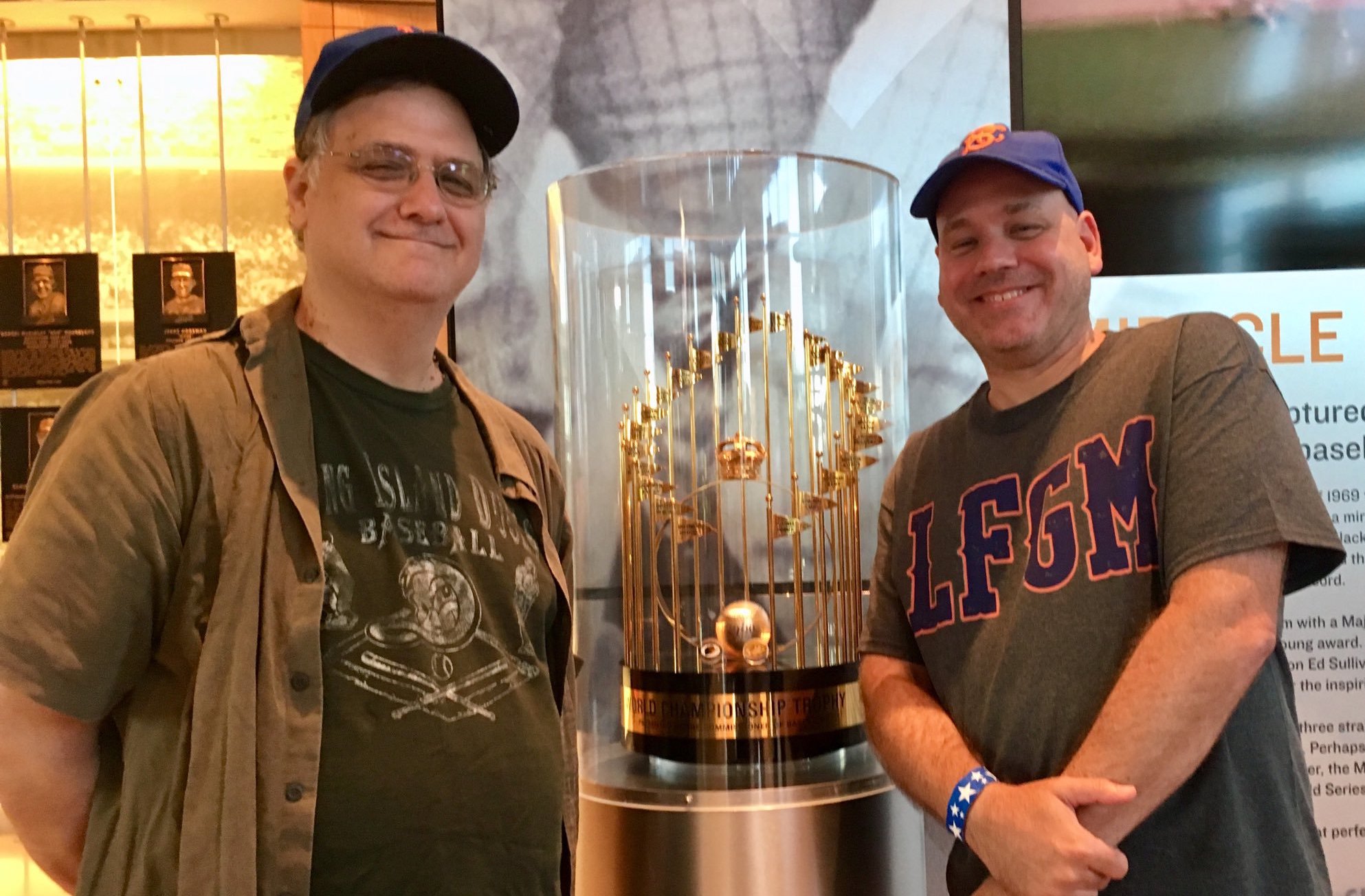
Faith and Fear in Flushing made its debut on Feb. 16, 2005, the brainchild of two longtime friends and lifelong Met fans.
Greg Prince discovered the Mets when he was 6, during the magical summer of 1969. He is a Long Island-based writer, editor and communications consultant. Contact him here.
Jason Fry is a Brooklyn writer whose first memories include his mom leaping up and down cheering for Rusty Staub. Check out his other writing here.
Got something to say? Leave a comment, or email us at faithandfear@gmail.com. (Sorry, but we have no interest in ads, sponsored content or guest posts.)
Need our RSS feed? It's here.
Visit our Facebook page, or drop by the personal pages for Greg and Jason.
Or follow us on Twitter: Here's Greg, and here's Jason.
|
by Greg Prince on 8 February 2007 12:01 am In one of the scoops of the winter, Ben Shpigel noted in the Times last week that the Mets want to sell a lot of tickets in 2007. I also hear they’d like to win as many games as possible.
To be fair (even if it’s not as much fun), Shpigel’s angle was the Mets’ push to set new and ridiculous attendance records this year. If you didn’t notice, we wound up contributing to 3,379,535 tickets sold in 2006, by far the best gate in Mets history. On average, we sat 43,327 strong at Shea per every date — 78 of them, thanks to three doubleheaders — of the regular season. Or at least we intended to.
It’s a little misleading to compare attendance figures from before and after 1993, and not just because 1993 marked a presumable increase in Mets fan suicide attempts. That was the year the National League adopted the American League policy of reporting paid attendance based more on the paid — how many seats were sold for the game — than the attendance — how many were filled.
There can be a dramatic difference between the two. In 1984, the Cal Griffith Twins were making googly eyes toward Tampa-St. Pete, hoping to desert one depressing dome for another that was on the drawing board. Minnesota had an escape clause based on paid attendance. If it fell below a certain figure, they could adios the Twin Cities and head for the theoretically more receptive climes of the Bay Area. To preserve the dormant pride of Minneapolis-St. Paul, the Metrodome suddenly began selling out, though it wasn’t a surge among the common folk that turned the trick. Business interests, led by that Pohlad fellow who eventually bought the team, snapped up all extant tickets one day to make a statement of support. I can still see the wire-service photo of a nearly empty Metrodome whose announced attendance that afternoon neared 52,000.
We haven’t experienced quite that vivid a dichotomy between ducats and the fannies that account for them, yet there’s almost always some disparity at play. I’ve gotten pretty good at estimating the Shea house over the years and I’ve learned to pad my guess upwards a few thousand over appearances because I know looks are officially deceiving. On the quiet Monday night we set the current record, the paid attendance was 34,027…yeah, only if each Fandini distributed was counted as a person. Still, having sat through some dismal seasons amid some sparse crowds, it’s nice knowing you’re pretty much guaranteed substantial company at Mets games these days. It’s indicative of the overall success of the franchise and the mass response to it. You’ll take a 2006 over a 1993 any day in 81.
How much company does one really need, though? Shpigel’s article said the Mets are targeting 3.5 million in 2007, with the author suggesting 4 million isn’t completely out of the question. It would take 49,383 tickets sold for 81 home dates (no rainouts, no twofers) to reach this previously unreachable star.
Keep your feet on the ground, I say. I don’t want to be part of 4 million. 3,379,535’s good company. Four million is a crowd.
Attendance is going to be a tricky issue for the next few seasons. The Mets will draw in 2007 because of their momentum from 2006. They’ll draw in 2008 because it will be the last year of Shea. They’ll draw in 2009 because it will be the first year of Citi Field and, assuming the place isn’t an artistic disaster and they themselves don’t completely go in the tank, they’ll draw very nicely into the early 2010s.
Without so much as a Post-It to warn us, the days of walk right in, sit right down and put your feet right up are over. Showing up at Shea is no longer synonymous with spreading out and kicking back. The nights when you could lean any which way you chose and chat with your neighbor and have your run of the concessions to say nothing of your choice of Leon Hess Memorial Urinal probably ended in 2005. Unless you’re going to rough it on one of those Arctic April nights when the paid attendance is more a ghost story than a trustworthy statistic, you’re going to be sardining away your remaining days at Shea.
Better to be uncomfortable for a contender than at ease amid ineptitude. We’ve each and every one of us spent far too many years of our lives as the oddball Mets fan in any given situation to not welcome the critical mass we’ve gathered and figure to maintain for a few years. Yet as the Shea calendar prepares its inevitable tearaway from 162 to 0, I’ve been looking forward to at least a few more nights as I remember them. Not 1979/1993 remember them, but just, I dunno, normal. Gimme a humming crowd of 25,000, 30,000 on a weeknight, maybe 40,000 on a Sunday. Gimme people on each level but don’t necessarily cram us in until we figuratively can’t breathe. Gimme a playoff atmosphere fairly often (gimme playoffs for sure) but gimme a mellow afternoon and a slow 7:10 once in a while. And for those who (or whose corporations) buy the good tickets but don’t use ’em, gimme your tickets.
It’s a quality-of-life issue, albeit a nuanced one. I don’t want the Mets to slide back so far on the field that empty orange acres dominate the SNY tableau. Mets games seemed filled last year with Mets fans mostly, not cultists for out-of-town one-trick ponies or area victims of front-runneritis. If the Mets are going to continue to be as good as they were in 2006 and make Mets fans happy, then oh yeah, I want us all to share in the good times.
But I’m going to miss the manageable evening out, the row that isn’t filled butt to gut, the late decision to meet and buy something decent in the mezzanine. Regular ol’ single-game tickets have yet to go on sale and the Mets are already implementing postseason-like registration for their platinum affairs, Opening Day and the Subway Series. Register for a chance to buy a ticket. Not a ticket, but a chance.
And this is Shea. Citi Field will be a whole other dealio. Current capacity is more or less 56,000 (seems to narrow and widen at will if you check the agate at the bottom of the boxscores). The future — here sooner than we can imagine — will give us a far smaller playpen in which to fight it out for seats. Mets.com lists Citi’s projected capacity at about 45,000 including standing room.
Standing room? Welcome to the new new New York Mets, indeed. Three years ago, in the largest market in the National League with what was by then the biggest ballpark in the National League, the Mets ranked 11th out of 16 franchises in attendance. Now we’re going to be sold the privilege to stand and deliver. That’s progress.
Of course those gym spots will look pretty good when seated attendance tops out in the 42,000s.
Small is beautiful when it comes to ballparks. That’s been the retro rule since Camden Yards. Nobody liked 65,000-seat monstrosities like the Vet. Almost everybody loves Fenway and Wrigley.
Has anybody bothered to ask, though, why retro parks are called that? They’re throwbacks to the early part of the 20th century when the stadiums were smaller because the crowds were smaller. Attendance records get set these days because more people show up, especially when a club is at the top of its game. In last-place 2003, 42,000 seats available for a Mets game would have meant plenty of good seats were generally still available when the first pitch was thrown. Per-game attendance was 26,757 for a terrible team. Despite every logical instinct to the contrary, that was about the average attendance in 1969 for a great team. (In those days, however, you had “total attendance” and “paid attendance” announced, which would explain everybody’s insistence that there were more than 59,000 on hand for Tom Seaver’s imperfect game yet a shade under 51,000 in the fine print; you also didn’t have the tickets sold factored in, though who the hell would have a ticket for the 1969 Mets and not use it?)
Used to be a million a year was splendid, two million astounding. But now? A million a year gets you practically contracted. Expectations everywhere have ratcheted skyward, especially here. 41,723 X 81 at Shea last year when pennant race suspense was minimal. 43,210 X 81 this year for the 3.5 million projection to be hit (with the Mets squeezing every bit of ticket-package revenue out of their fans before putting the bulk of singles on sale, it will probably be exceeded). We will likely have more than an entire Citi Field’s worth inside Shea every date in ’08 given the goodbye impulse.
Then we shrink. Citi Field will be a veritable boutique at the very moment the Mets have shed their boutique brand equity. It may be ideal aesthetically, especially after one too many Mount McKinley climbs up Shea’s highest deck, but it will be de facto exclusionary. The only way tickets will be readily available is if the Mets are readily terrible. And none of us wants that. We want it to be so crowded that everybody goes there yet not so crowded that we can’t.
One can easily contradict himself in terms of what one wants out of all this. A good team. A jumping joint. A big crowd. But not too big. And don’t jump too much. But don’t suck. And give me a nice ballpark. But give me a place in it. And don’t take away one of the things I took for granted about the old ballpark, its size and general accessibility in terms of admission. Except I always thought it was too big. And all those empty seats were a rather glum sight. But reassuring in their way, for come the day we contend, they’ll be filled. We’ll have a good team. A jumping joint. A big crowd.
And plenty of parking.
Need to warm up on a cold night? If you haven’t seen Wednesday’s Daily News, go to their site and read Christian Red’s dynamite reporting from the Dominican Republic on Pedro Martinez’s rotator cuff rehab. It’s a great and encouraging story on the most charismatic personality this team has ever seen. Shea, Citi, a patch of dirt on a highway median…I’d buy a ticket to watch Pedro pitch anywhere right now, temperature be damned.
by Greg Prince on 5 February 2007 12:02 pm Major professional sports championships won in full or part at what is presently known as Dolphin Stadium:
San Francisco 49ers: 2
Denver Broncos: 1
Indianapolis Colts: 1
Florida Marlins: 2
Miami Dolphins: 0
HA! The Dolphins haven’t won a thing since moving into the building where they dominate everything but the bottom line of the competitive ledger, have they? Their badly run baseball tenant is positively bathed in glory compared to the emptiness in Don Shula’s trophy case since the joint opened in 1987. Since January 1974, actually. That doesn’t stop Shula’s jaw from jutting in front of cameras long past its day in the sun, but it should.
The Marlins? They’re an odd fish in the Dolphin tank. The next time we glance inside the Super Bowl facility we have, for own nefarious purposes, referred to as The Sack, Soilmaster Stadium, Tru Playa Park, Your Name Here Stadium and even, surprisingly respectfully, Joe Robbie Stadium, will be in third week of April, a Wednesday night. There will almost assuredly be approximately 500 people for every point the Bears scored yesterday. Unless it’s drizzling. Then there will be fewer.
Thanks to the unbalanced schedule, we know about the Marlins. We see them 19 times a year every year whether we want to or not. Though the home/away ratio is always 10:9 or 9:10, it seems like we play just about every game against them in Florida. You can’t think of the Marlins without thinking of their distressing home situation and you can’t think of that and not want it and them to go away.
While we’ve been wintering and wondering if there’s possibly a pitcher out there for the pinching, our gilled counterparts — however many of them there are — have been tossed a life preserver of sorts. Talk about constructing and funding a new Miami ballpark has gotten reasonably serious. The Marlins may actually escape the shadow of the Dolphins, the 6 o’clock showers, the sweltering indifference of their exit off the Florida Turnpike and a setup that leaves their groundskeeping supplies in full public view.
I hope they do. I don’t like the Marlins. I don’t like any National League team that isn’t us. But they’re here, they’re teal, I’ve gotten used to them. Besides, we gotta play somebody somewhere. It might as well be them in an upgraded setting. It’s absurd to believe that South Florida can’t properly support an MLB franchise if the MLB franchise were to be run and housed like a fairly normal business. The Marlins have never had anything going for them in the way of human ownership and yet there they are, the only N.L. team in the past 24 seasons to own two Commissioner’s Trophies.
That’s gotta be worth something. All those folks crammed into those three counties that make up the Marlins’ ADI (even accounting for the legendary snowbirds) have gotta be worth something. A generation of children of expatriates of baseball-savvy metropolitan areas growing up with a potentially decent place to take in a game has gotta be worth something. A retractable roof playing velvet rope to the objectionable elements that have been killing attendance at JRS since 1993 has gotta be worth something. Whatever intelligence exists in Marlin scouting and development that allowed them to be competitive under insane circumstances in 2006 has gotta be worth a ton.
Maybe if the Marlins had been brutally unsuccessful in their 14 seasons in the bigs I wouldn’t be rooting for their rescue. But the way they managed to win two World Series, even if the first one involved Bobby Bonilla in a featured role, is a part of baseball history, and not the Bonds-McGwire-Sosa kind. Huizenga is Roy Boe on steroids for ripping apart a champion before the ticker tape was picked up, but then another personally detestable owner came in and they won (versus the Yankees at Soilmaster North, technically). There must be something going on down there that’s worth preserving.
What if the Marlins don’t get their ballpark? You figure they move to some inconvenient non-EDT outpost that will play havoc with the Mets’ travel. Bet they keep them in the division anyway. Who needs another weird road trip? Maybe the relocated Marlins move out of our jurisdiction and we get Pittsburgh back. I’m second to no fan in my admiration for PNC Park, but I don’t wanna play there any more than we have to. We occasionally win games at The Sack. Nothing good ever comes out of PNC except the view.
Fantasize all you want about making an opponent disappear. You’re still required to play somebody to fill up those 162 boxes on the schedule. We learned that when the Expos morphed into the Nationals.
I continue to carry the tiniest of torches for the departed Montreal Expos. Finished a book not long ago in which I learned they were known as Nos Amors in Quebec. Our loves. That’s sad. So was Olympic Stadium and the deterioration of everything Expo, making Washington a logical landing spot. But it’s still sad that it didn’t work out. The Expos were interesting. They were different. In this corner, they remain missed.
The Marlins don’t quite rile up my emotions that way. They’re mostly annoying. But as one who has gotten used to them, one who claimed a Broward address back in the day, one who got a surprisingly big kick out of their 2003 title run, one who rooted for them in October of 1997 against his better judgment and one who will always link the best night of the 2006 regular season to their presence at Shea Stadium, I would like to see them stay afloat in Florida as long as they can.
If for no other reason than they make the Dolphins’ 33-season title drought look laughable by comparison.
by Greg Prince on 4 February 2007 11:52 am Let me see if I’ve got this straight. If Rex Grossman sees his shadow, we get eight more weeks of winter. If Peyton Manning earns a trip to a theme park, we get eight more weeks of winter.
Yeah, that’s about the size of it. One football team will beat another tonight and 56 nights hence the Mets play the Cardinals in St. Louis. Now that will be a super Sunday and a super matchup, one surely worthy of carrying on in the name of double-alum Super Joe McEwing. May the victor walk a mile in his shoes.
Until then, let the other national pastime do its thing. Why not? I like chips. I don’t mind hype. I love NFL Films. I get a kick of counting to XLI. Not to be uncool about this, but I dig the drop everything & gather ’round nature of the Super Bowl, even one featuring two teams whose respective fortunes concern me not a whit.
They know what they’re doing in rigidly timed football. One big Tarantino adrenaline shot to the chest, we all burst out of our winter comas for a potentially thrilling moment and then it’s back to normal. One and done. It works for the Super Bowl.
It wouldn’t work for baseball. We like math. Best of five. Best of seven. The World Series is a microcosm of that long march of a season of ours. Oh, the games start too late unless you live in California (which I hear nobody does) and Fox debases it year in and year out (I really wish C-Span would telecast baseball in October) and it’s unwatchable if the Mets lose the seventh game of the NLCS, but otherwise baseball’s championship is perfect for baseball.
You don’t invite people over to watch it with you. You don’t fill in boxes to make it more interesting. You don’t wait for the third out so you can see the next Bud Light commercial. It’s best taken as a solemn vigil. It was exactly that when you were sneaking your transistor into school and it is exactly that when you’re prying your eyelids open to the 14th inning at Minute Maid Park at two in the blessed A.M. when you don’t know when or if or how it’s gonna end. If the Colts win tonight, we’ll get Peyton Manning out the wazoo. When the Giants and Mets and White Sox won, we got pleasantly surprising dabs of Dusty Rhodes and Al Weis and Geoff Blum. I bet they’d make pretty decent company at Disneyland.
Nevertheless, I’m willing to let football carry the ball today. It will be interesting to see what Marlins Stadium looks like with people.
The forecast in Miami calls for rain. Prepare the Soilmaster.
Elsewhere amid all things super:
• Super kudos to XM Radio for again replaying Game Four of a certain 1999 National League Division Series in the just-completed wee, small hours of Saturday night. Murph and Cohen still sound immortal and Todd Pratt still should have kept running.
• The super, one of a kind talent of tenor Billy Henderson has left us, another one of the Spinners gone too soon. Thankfully the music he left behind means that whenever we need to hear from him, he’ll be around.
• The most super superlative of all this morning is for the FAFIF readers and Mets fans everywhere who helped the Baby Miranda tribute at the Starlight Starbrite Childrens Foundation surpass and shatter its fundraising goal. Our deepest thanks for pitching in and brightening some otherwise dark days. PS: It’s not too late to lend a hand to the kids and families who can truly use your help.
by Greg Prince on 3 February 2007 1:06 am 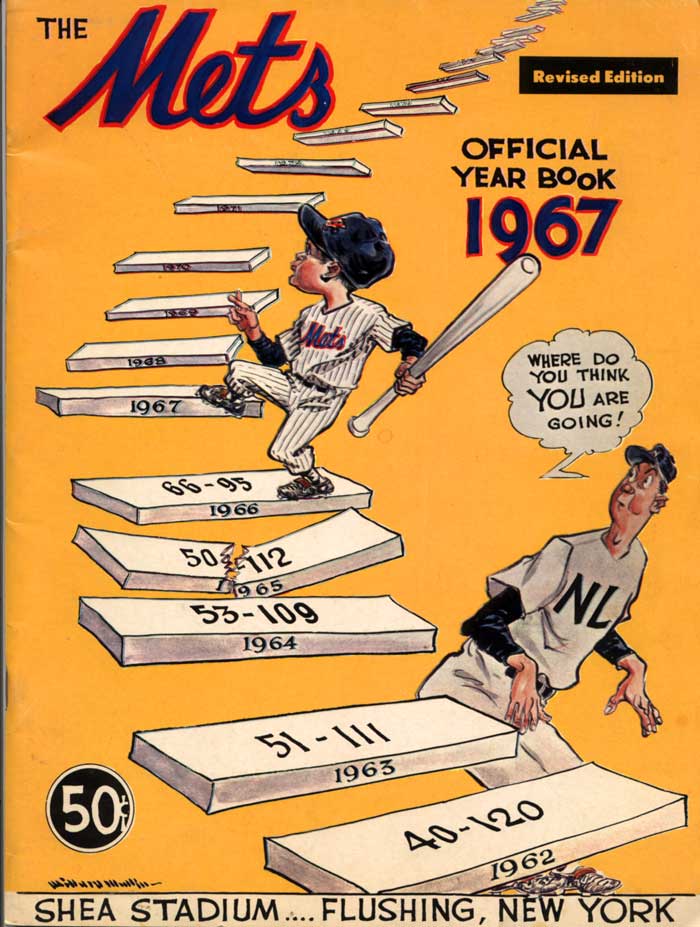
In 1967, the Mets were determined to rise from the depths of their tenth- and ninth-place beginnings. They didn’t just yet, but Willard Mullin’s illustration of the effort is just one reason the ’67 yearbook stands as a gem from another time.
by Greg Prince on 3 February 2007 12:54 am If the clock is running inexorably counterclockwise, then it must be Flashback Friday at Faith and Fear in Flushing.
To borrow from the late, great Molly Ivins, the 1967 Mets yearbook is more fun than a church-singin’-with-supper-on-the-grounds.
Yearbooks get more expensive every year and are progressively less fun. The 2006 version was ten bucks, 244 pages long and distressingly short on zazz. There was a nice takeout by the esteemed Dennis D’Agostino on the twentieth anniversary of ’86 but everything else about it fairly whispers annual report. Proxy statements are more whimsical.
The cover, various Mets in various boxes, is as exciting as a ticket brochure. The player facts are minimal (Yusaku Iriki enjoys playing golf in his spare time). The recap of the previous year is Orwellian in its deletion of those who had since moved on (Marlon Anderson never pinch-hit that inside-the-park homer and Mike Piazza never waved goodbye). There’s an ad for a perfume with a big picture of Paris Hilton; kids shouldn’t have to see that. The modern-day yearbook is heavy on heft, long on price, light on charm.
Ah, but the 1967 Mets yearbook…the Mets yearbook was something then. You should have seen the Atlantic Ocean in those days.
I didn’t see the 1967 yearbook in those days. I was 4 and a couple yearbooks away from entry into Metsdom. I probably couldn’t have rounded up the 50 cents necessary to buy one at Shea to say nothing of getting a ride to and from. I have a copy thanks to my co-blogger’s relentless pursuit of all things Schmelz. He had it on a tip a couple of slow winters ago that the elusive Al, who was seemingly never properly photographed as a Met (the Schmelzes believe a photograph steals something precious from the soul — or am I thinking of I Dream of Jeannie?), showed up in a team picture. Sadly, this SECOND Revised Edition of the OFFICIAL Year Book (were there bootlegs?) came a cropper and Dr. Fryenstein’s mad experimentation would have to wait another day.
I, on the other hand, made out like a bandit when Jace tossed the thing my way. What a treasure. Start with the cover, drawn by Willard Mullin of New York World Telegram & Sun fame, the premier sports cartoonist ever. The only sports cartoonist we modern folk have with which to compare him is Bill Gallo which is no comparison at all. Maybe you’ve seen some of Mullin’s most classic work, the moony Jint and the perpetually scruffed-up Bum who personified New York National League baseball in the ’50s. Their successor was the kid Met who by 1967 was taking toddler steps up the stairs of heretofore awful records. Note the detail, specifically the cracked step of 1965 when the kid Mets stumbled and managed a worse record than 1964’s extraordinarily poor result.
But that’s ancient history in 1967. Mullin’s boy, our boy, is in ascendance. He’s leaving behind those hundred-loss seasons — imagine acknowledging all your miserable failures of the past half-decade on the cover of your primary propaganda tool — and, having launched himself to the heady stratosphere of 66 wins, he’s on the climb. Watch out National League!
Gosh, what optimism. Unfounded in the short term, of course. The next step would be cracked, too, as the ’67 team stumbled to five fewer victories than in ’66. But we know that Mullin’s golden staircase reaches its apogee way ahead of schedule, just two years after, so no complaints on the prognostication front.
They don’t draw covers like that anymore. And they don’t print yearbooks like this either. Turn the page and the first picture you countenance is a solemn “changing of the guard,” two men in suits who may as well be shaking hands in the Kremlin. It’s grip ‘n’ grim time for a stoic George Weiss “turning over presidency of the Mets” to a wary Bing Devine in November of ’66. Khrushchev and Brezhnev couldn’t have looked any less comfortable. And who, come to think of it, were the marketing wizards who decided the first image to hit fans with was two men in suits?
That’s the beauty of baseball back then, I’ve Bing-divined. It wasn’t marketed, not really. There was something clubby about the whole thing. Oh, it was insidious. It needed Marvin Miller and the NFL and society to shake it up. It needed to move into the second half of the twentieth century by 1967. But the quaintness I found when I leafed through the 1967 yearbook is from another time.
Which is what surprises me. The Mets are supposed to be thoroughly modern. They’re the expansion team born amid the hopes of the New Frontier. They’re the embodiment of the Swinging Sixties.
More relevant to my self-centered view of things, they’ve taken place almost entirely in my lifetime.To have experienced the Mets and nothing but the Mets as your forever baseball team, to have not even a wisp of experience of living without them or before them, arithmetic says you can’t be much over 50. It would take a man or woman born no later than the mid-1950s having a child by the mid-1970s and that child having a child by the mid-1990s to assume there’s a family with three generations of pure, lifelong, well-versed Mets fans — not your grandpa who converted from the Dodgers or Giants or apathy or worse and raised your pop/you right, mind you, but someone whose childhood team was the Mets. Demographically speaking, that third generation is only approaching the staircase as we speak.
Tradition in the sepia sense has always been for the Tigers and the Cubs and the Red Sox and other franchises with roots dating back a century or more. They’re the ones that have grandfather clauses. They’re the ones caked in must and dust. They’re the ones with the antiquated team publications that read so anachronistic in relation to the now. The Mets’ 1967 yearbook, from suddenly 40 years ago, proves to me that we might be, too.
Enough sociological, anthropological noodling. Let’s turn more pages.
There’s Vaughan Devine, President. Oh wait, that’s the same guy from the page before where he was Bing. The Mets took their “Officials” headshots very seriously (and, by their looks, took them before World War II). No Mr. Devine, you can’t use your nickname here. This is our page of record.
There’s Vaughan again. Naturally. Baseball fans love executives. President Bing is a little looser in this two-page spread (whereas Weiss, “Man of Dynasty and Destiny,” gets a double-truck of his own later and couldn’t be a whole lot tighter). We have shots of Devine playing basketball with Solly Hemus in 1954, donating his vital fluids to a blood drive in Rochester and being delighted by “gag gifts” at a 50th-birthday surprise party in St. Pete. Bing, who passed away last month, seems reasonably delighted by the all-stag affair.
Baseball was a very manly business in 1967. A group photo of the Met beat writers (you don’t see those anymore) features 13 men, including a few (Vic Ziegel, Steve Jacobson, Maury Allen) who are still active and one (Dick Young) who most of us believe hung on too long. Not pictured: a single woman.
Pictured: a married woman. That would be Josephine Westrum. She’s pouring coffee for her husband the manager, Wes Westrum. According to the caption, by doing so she “proves worth as a manager at the breakfast table.” I’m assuming that was considered complimentary by the editors in 1967, fellows, one senses, whose values system was set in stone by 1937. The first yearbook I ever had as a kid was the ’72 and while there were arcane references to Met player wives as “better halves,” I don’t remember nearly as much patronizing prose. A lot could change in five years. A lot did.
But in 1967, “Mets are Model Wives.” Look out Twiggy, here comes Mrs. Jack Fisher sporting the latest from Carnaby Street or wherever ’60s fashions were sold. Yes, it’s Austin Powers come to life on pages 54 and 55, a fashion shoot to benefit the Doctors’ Wives Auxiliary of Flushing Hospital when “Shea Stadium served as the ‘salon’.” Some salon — they used a ramp between loge and mezzanine. That’s where we find the “purty Mrs. Dennis Ribant” (let’s keep her first name out of the public eye) pretending to sell copies of the Daily News. How this helped Flushing Hospital I couldn’t tell you, but there’s no denying it: Mrs. Dennis Ribant sure was purty.
Somebody worked overtime on assigning nicknames to the major Met players themselves. Newly acquired Tommy Davis was THE TOMMY GUN: Mr. Two-Time Batting King. He’s captured in candid conversation with Mickey Mantle, presumably reminding him “they call me MISTER Two-Time Batting King”. Titular ace Jack Fisher is simply HI-JACK, perhaps in honor of his absconding with 24 losses two years earlier. Ken Boyer is 7-TIME ALL-STAR (not much of a nickname, but truthful advertising), Bob Shaw is THE CITY SLICKER: Mound Magician of Mets (coming off a 12-14, 4.30 campaign — some magician) and 21-year-old William Francis Denehy is “Literally Billy the Kid,” presumably in deference to his callowness and not because the Mets planned to use him in a trade to rob the Washington Senators blind of manager Gil Hodges.
Having been on the Mets scene myself since ’69, I’ve seen most everybody who’s played for us. But I never saw the guys mentioned above, certainly not in their New York phase. Mets who were Mets in 1967 but not later may as well be Cleveland Spiders from 1899. I know they were there. I’ve read about them plenty. Yet it feels somehow impossible there were Mets without me, even more unlikely that these historical figures cavorted with many of the same gents — THE JONES BOY (Cleon), THE PONY EXPRESS (Buddy), “THE DEAN” AT AGE 22 (Kranepool already a legend), Seaver The Saver: Picked out of a hat (Tom not yet Terrific nor worth upper-casing) — who introduced me to baseball. It was only two years from ’67 to ’69 but from the time I was 4 to the time I was 6, it was an eternity.
What links the eras as I read through this, what connects what I perceive to be the time before time began and the time when time started, is a bit of the advertising. The Mets may have presented themselves through out-of-date thinking (unless reincarnating Ron Swoboda as THE PEEPUL’S CHERCE was “with it”) but a couple of their sponsors were clearly endeavoring to be a part of the late ’60s as they happened. Opposite the Flushing Gothic of Weiss and Devine is a perky, today kind of couple selling cherry-red Plymouth Furys. On the back we have a Rheingold ad that’s almost cutting-edge in its meta-commentary on the medium: an Archie Bunker type (before we knew that’s what he was called) clutching a beer, smoking a cigarette and demonstrating “In N.Y., the city of tough customers, only Rheingold’s made it to the top.” It’s an ad that’s sort of about the ad…if you look at it hard enough. Or tough enough.
It’s 2007. The Fury is off the lot. Rheingold shuttered its brewery. Don Bosch never developed into MIDDLE MAN: Center of Attention. Vaughan Devine beat it out of town after a year. Judging by his own downcast demeanor before his September dismissal, Wes Westrum never asked the dutiful Josephine for that second cup. The 1967 Mets lost 101 games. But this 1967 yearbook? It’s a winner in any baseball library.
Next Friday: It seemed like such a good idea.
by Jason Fry on 31 January 2007 11:11 pm So the other day ESPN.com invited readers to rank the major-league teams from #1 to #30, using one of their whizzy mechanisms where you drag numbers onto pictures. (Which is very cool until you work from worst to first, get to about #6 and realize you forgot the Reds.)
So here’s how I ranked them, with voters’ consensus rank in parentheses. (Caveats: I did this quickly, and I don’t know jack about most of the American League. Because, honestly, who gives a shit.)
30. Royals (26)
29. Orioles (27)
28. Devil Rays (29)
27. Pirates (28)
26. Nationals (30)
25. Rockies (25)
24. Reds (23)
23. Rangers (19)
22. Diamondbacks (22)
21. Mariners (24)
20. Astros (16)
19. Giants (18)
18. Marlins (20)
17. Brewers (21)
16. Cubs (9)
15. Braves (17)
14. Padres (15)
13. Blue Jays (13)
12. Indians (14)
11. Cardinals (5)
10. Dodgers (7)
9. Phillies (10)
8. Mets (4)
7. Angels (11)
6. Red Sox (2)
5. Yankees (1)
4. White Sox (6)
3. A’s (12)
2. Twins (8)
1. Tigers (3)
So.
I don’t apologize for thinking the Yankees and Cubs won’t be that good. (The Cubs won a division on paper, so what — ask Steve Phillips, Mo Vaughn and Roberto Alomar how that turns out. Besides, they’re the Cubs.) I don’t think the Cardinals deserve an asterisk or anything, but 5th best in baseball? C’mon. I admit I’m probably too high on the A’s because of a lingering Moneyball crush and it’s just too hard to keep track of a team that uses a DH 3,000 miles away.
But what you’re really wondering is this: Eighth? Really, Jace? The average ESPN voter has more faith in our team than you do?
Um, I guess so.
Look, I still rated us the best team in the National League. But I admit to being nervous, and it’s not just a longtime Met fans’ innate pessimism.
It’s the pitching.
Tom Glavine and Orlando Hernandez are capable, but they’re awfully old. Mike Pelfrey and Philip Humber could become stars, but they’re awfully young. John Maine and Oliver Perez could take a step forward, or a step back. (Given Perez’s career, by now he’s got enough steps for a whole dance routine.) Dave Williams and Jason Vargas and Aaron Sele are the pitching equivalent of spaghetti hurled at a wall. And Pedro? His projected date of return ranges from August to never.
I’m not sure what percentage of that glass is full and what percentage is empty, but it makes me anxious. I wouldn’t be shocked if Glavine got to 300 wins and a few more for lagniappe, El Duque was serviceable, either Pelfrey or Humber had a breakout, star-making year, either Maine or Perez or both took steps forward, the spaghetti starters weren’t needed beyond spot starts, and Pedro arrived like a conquering hero come summer. In that case, print my playoff tickets and hold my October calls, please.
But I also wouldn’t be astonished if Glavine was merely serviceable, El Duque spent a long time on the shelf, Pelfrey and Humber scuffled while learning their craft in New Orleans, Maine and Perez took steps backwards, the spaghetti starters channeled Lima and Gonzalez, and Pedro never arrived at all. In that case, we could lose a lot of 7-6 affairs, and October might be spent listening to Tommy Lasorda tell us to get out of the tree.
Maybe the sight of pitchers running along the warning track and reading the 35th story about Moises Alou just fitting in will make me perk up a little. Maybe. For now, though, it’s freezing and I look at our pitching staff and I think, We could be second or third and we could be 15th, so yep, that averages out to around eighth.
Change my mind, please.
by Greg Prince on 29 January 2007 10:06 pm The swings Darryl Strawberry and David Palmer took at each other last night during a bench-clearing brawl in the first inning were sissy swipes compared to the real punch Gary Carter displayed.
Sissy swipes? Did somebody actually use the phrase “sissy swipes” in a baseball game story at some point in the past quarter-century? Without irony?
Yup. That’s how Jack Lang of the Daily News led his report on the Mets-Braves game of July 11, 1986, one in which Palmer “plunked Strawberry in the butt” after surrendering a three-run homer to Carter. Though “Darryl dropped his bat, threw his helmet and started for the mound,” Lang reassured his readers that “no one got hurt and it was all over in a matter of minutes.”
Kind of describes the game story as we knew it when newspapers were our primary conduit to baseball information.
Jack Lang, you’ve probably heard, passed away last week at 85. If I hadn’t been paying attention, I would have thought Lang was still writing for the News. Or the Long Island Press even.
Without looking it up, I couldn’t remember any particular piece Jack Lang wrote in his more than 25 years on the Mets beat. That’s not a knock on Jack. He had a job to do: sum up the game and, if deadline permitted, gather a few quotes. Rereading his story on the 11-0 drubbing the Mets put on the Braves in their championship season, there are no quotes (Friday night game, late start for NBC, Saturday paper) but I got the flavor of what happened all over again.
By 1986 the reader almost certainly knew the score by the next morning. Lang could sum up the feel of the game in the first paragraph and then get to the meat of the matter in the second and third:
Carter hit a three-run homer and a grand slam his first two trips as the Mets treated Sid Fernandez to a fun festival in walloping the Braves, 11-0.
Carter drove in the Mets’ first seven runs and that was much more than El Sid needed as he rolled to his 12th win — the most by any NL pitcher this season. Fernandez had three hits, two doubles and a single, and Len Dykstra had another three-hit game.
There. The game in a nutshell. Colorful and concise. We know about the fight, we know about the offense, we know about the pitching. Just lay a bed of we’ve got the teamwork/to make the dream work underneath it and it’s 1986 again.
Not having others’ game stories from the July 12 papers with which to compare it, I couldn’t tell you if the reporters from Newsday, the Post or the Times covered it better or worse or if they, unlike Lang, plumbed the depths of David Palmer’s psyche. I don’t recall knowing until I read The Bad Guys Won! that Palmer was nursing a grudge against Carter that dated to their Expo battery days. Wrote Jeff Pearlman many years after the fact:
With bodies piling on top of them, Hernandez turned to Palmer and in a calm tone asked a simple question: “Dave, why would you do that?”
Palmer yelled back: “Carter and all that bullshit! I hate that guy!”
Amid the mayhem Hernandez was unmoved. “Look, if you hate Gary, why hit Darryl?” he said, bodies flying left and right. “It’s not right.”
Palmer had to admit, the man had a point.
The point about Jack Lang is he was a constant for us as Mets fans. Lang started covering the game when television was a novelty and stayed at it until sports talk radio was proliferating, easing up for good a bit shy of the Internet age. He was there when “sissy swipe” was considered neither patently offensive nor wholly outdated and he remained until you could print “butt” in a family paper. He bridged more than a couple of eras and by late in his career could still tell you what you needed to know about last night’s game particularly if you didn’t see it or hear it.
It’s different now. Results seem to get buried in all but wire service game stories, not without cause. Does anybody still wait for the News to get a score? For any paper? If you missed the game you can get the score without really trying. You can get an instant AP writeup on any number of sites minutes after the game is over. You get the likes of us picking it apart and putting it back together. Lang’s paper and its competitors are online like everybody else.
It’s not just sportswriting that assumes you know what you actually need to know and figures it’s role is to tell you something you didn’t know. Political coverage, especially when there’s no election in sight, chooses to dwell on mood and attitude before informing you what the guy or gal running for office actually said. In Sunday’s Times there was an interesting interview with Garry Shandling in which the most newsworthy tidbit — that a collection of The Larry Sanders Show DVDs will be released in April — wasn’t to be found until the reader got well down into the jump page.
No, it’s not just sports that’s written with more latitude than it used to be. But it is sports that we care about here. I wonder if we are truly better served in today’s marketplace than we were when Jack Lang was on duty.
On the face of it we are. The speed and accessibility and range of voices is not to be underestimated. 1986 wasn’t exactly prehistoric times but back then there was no discussion of the game to take you through the night on the radio. There was no ticker flashing scores and details on your cable television. There was no computer connecting you to anything that would help you fill in the blanks on those three hits by Lenny Dykstra. You could catch the score on WINS or WCBS, you could get a few highlights on one of the 10 o’clock or 11 o’clock newscasts or you could call Sportsphone if you were really desperate. WFAN and ESPNews and every dot com we count on did not exist.
We are better off for that. More is very much better in terms of delivery. More is often better in terms of insight and perspective. More is sometimes better in that all these vehicles that weren’t around when Lang was on the beat mean we get baseball news and opinion all year round.
Then again, it can also be inane as all get out.
Wally Matthews in Newsday last Wednesday:
Perhaps if Willie Randolph were still a player, and not the manager who led them to within a victory of the World Series, the Mets would show him a little more respect and a lot more money.
The rest of his column (a column, not a news story it should be noted) excoriated the Mets for cheaping out on their manager, for not getting a deal done during the winter, for blaming him for the Mets losing to the Cardinals in the NLCS.
There can be no other explanation for why this is not getting done.
Ken Davidoff in Newsday last Thursday:
A winter of discomfort will not carry over into the Mets’ spring. Willie Randolph will not be a lame-duck manager this season.
Randolph and the Mets agreed in principle yesterday to a three-year, $5.65-million extension, three people familiar with the situation confirmed. The extension will kick in immediately — Randolph’s $700,000 contract for 2007 was torn up — and run through 2009, with a team option for 2010.
Oh.
Without knowing who was whispering into whose ear in the course of November, December and January, I couldn’t say how serious any “discomfort” became between Randolph and ownership. They apparently entered into something called a negotiation. The negotiation ensued and a resolution, Willie’s contract, was agreed upon.
Willie Randolph got his millions. The Mets got their manager. Wally Matthews got his word quota filled even if it read very shakily before the Randolph deal was announced and as a total waste of space afterwards.
Seriously, read it. There’s nothing in there that any blogger or commenter or poster on any Mets board couldn’t have dreamt up if he or she were so inclined. There is nothing professional about Matthews’ accusations and assessments (“there can be no other explanation…”). There is nothing from sources, even unnamed sources, to suggest the organization and its skipper were heading for the meltdown the columnist implies. It was all just insipid speculation whose shelf life was mercifully short even by the standards of today’s reduced newscycles.
Columns that grasp at any passing breeze weren’t invented with the connection of the first T1 line.
Across the breadth of Lang’s long day on the beat there was bad sportswriting as well as good sportswriting. Yet it’s discouraging to realize that in an era when we the fans are superserved — regularly serving ourselves — we are often badly served by the credentialed media in whom we’re supposed to invest our trust. In Matthews’ case, it wasn’t just an opinion that you could take or leave. He was presenting as fact an impending crisis based exclusively on his innuendo about the Mets’ supposedly unreasonable stance toward Randolph. And if you read or listen enough to the pros, Matthews’ methodology is hardly isolated.
Somehow, especially since I like to believe we become more enlightened the more we progress as a society, I find this more offensive than the most vicious Dick Young broadside against the integrity of a player we loved but he didn’t particularly like. Dick Young died in 1987. Everybody in his profession should know better by now.
by Greg Prince on 29 January 2007 10:06 pm The swings Darryl Strawberry and David Palmer took at each other last night during a bench-clearing brawl in the first inning were sissy swipes compared to the real punch Gary Carter displayed.
Sissy swipes? Did somebody actually use the phrase “sissy swipes” in a baseball game story at some point in the past quarter-century? Without irony?
Yup. That's how Jack Lang of the Daily News led his report on the Mets-Braves game of July 11, 1986, one in which Palmer “plunked Strawberry in the butt” after surrendering a three-run homer to Carter. Though “Darryl dropped his bat, threw his helmet and started for the mound,” Lang reassured his readers that “no one got hurt and it was all over in a matter of minutes.”
Kind of describes the game story as we knew it when newspapers were our primary conduit to baseball information.
Jack Lang, you've probably heard, passed away last week at 85. If I hadn't been paying attention, I would have thought Lang was still writing for the News. Or the Long Island Press even.
Without looking it up, I couldn't remember any particular piece Jack Lang wrote in his more than 25 years on the Mets beat. That's not a knock on Jack. He had a job to do: sum up the game and, if deadline permitted, gather a few quotes. Rereading his story on the 11-0 drubbing the Mets put on the Braves in their championship season, there are no quotes (Friday night game, late start for NBC, Saturday paper) but I got the flavor of what happened all over again.
By 1986 the reader almost certainly knew the score by the next morning. Lang could sum up the feel of the game in the first paragraph and then get to the meat of the matter in the second and third:
Carter hit a three-run homer and a grand slam his first two trips as the Mets treated Sid Fernandez to a fun festival in walloping the Braves, 11-0.
Carter drove in the Mets' first seven runs and that was much more than El Sid needed as he rolled to his 12th win — the most by any NL pitcher this season. Fernandez had three hits, two doubles and a single, and Len Dykstra had another three-hit game.
There. The game in a nutshell. Colorful and concise. We know about the fight, we know about the offense, we know about the pitching. Just lay a bed of we've got the teamwork/to make the dream work underneath it and it's 1986 again.
Not having others' game stories from the July 12 papers with which to compare it, I couldn't tell you if the reporters from Newsday, the Post or the Times covered it better or worse or if they, unlike Lang, plumbed the depths of David Palmer's psyche. I don't recall knowing until I read The Bad Guys Won! that Palmer was nursing a grudge against Carter that dated to their Expo battery days. Wrote Jeff Pearlman many years after the fact:
With bodies piling on top of them, Hernandez turned to Palmer and in a calm tone asked a simple question: “Dave, why would you do that?”
Palmer yelled back: “Carter and all that bullshit! I hate that guy!”
Amid the mayhem Hernandez was unmoved. “Look, if you hate Gary, why hit Darryl?” he said, bodies flying left and right. “It's not right.”
Palmer had to admit, the man had a point.
The point about Jack Lang is he was a constant for us as Mets fans. Lang started covering the game when television was a novelty and stayed at it until sports talk radio was proliferating, easing up for good a bit shy of the Internet age. He was there when “sissy swipe” was considered neither patently offensive nor wholly outdated and he remained until you could print “butt” in a family paper. He bridged more than a couple of eras and by late in his career could still tell you what you needed to know about last night's game particularly if you didn't see it or hear it.
It's different now. Results seem to get buried in all but wire service game stories, not without cause. Does anybody still wait for the News to get a score? For any paper? If you missed the game you can get the score without really trying. You can get an instant AP writeup on any number of sites minutes after the game is over. You get the likes of us picking it apart and putting it back together. Lang's paper and its competitors are online like everybody else.
It's not just sportswriting that assumes you know what you actually need to know and figures it's role is to tell you something you didn't know. Political coverage, especially when there's no election in sight, chooses to dwell on mood and attitude before informing you what the guy or gal running for office actually said. In Sunday's Times there was an interesting interview with Garry Shandling in which the most newsworthy tidbit — that a collection of The Larry Sanders Show DVDs will be released in April — wasn't to be found until the reader got well down into the jump page.
No, it's not just sports that's written with more latitude than it used to be. But it is sports that we care about here. I wonder if we are truly better served in today's marketplace than we were when Jack Lang was on duty.
On the face of it we are. The speed and accessibility and range of voices is not to be underestimated. 1986 wasn't exactly prehistoric times but back then there was no discussion of the game to take you through the night on the radio. There was no ticker flashing scores and details on your cable television. There was no computer connecting you to anything that would help you fill in the blanks on those three hits by Lenny Dykstra. You could catch the score on WINS or WCBS, you could get a few highlights on one of the 10 o'clock or 11 o'clock newscasts or you could call Sportsphone if you were really desperate. WFAN and ESPNews and every dot com we count on did not exist.
We are better off for that. More is very much better in terms of delivery. More is often better in terms of insight and perspective. More is sometimes better in that all these vehicles that weren't around when Lang was on the beat mean we get baseball news and opinion all year round.
Then again, it can also be inane as all get out.
Wally Matthews in Newsday last Wednesday:
Perhaps if Willie Randolph were still a player, and not the manager who led them to within a victory of the World Series, the Mets would show him a little more respect and a lot more money.
The rest of his column (a column, not a news story it should be noted) excoriated the Mets for cheaping out on their manager, for not getting a deal done during the winter, for blaming him for the Mets losing to the Cardinals in the NLCS.
There can be no other explanation for why this is not getting done.
Ken Davidoff in Newsday last Thursday:
A winter of discomfort will not carry over into the Mets' spring. Willie Randolph will not be a lame-duck manager this season.
Randolph and the Mets agreed in principle yesterday to a three-year, $5.65-million extension, three people familiar with the situation confirmed. The extension will kick in immediately — Randolph's $700,000 contract for 2007 was torn up — and run through 2009, with a team option for 2010.
Oh.
Without knowing who was whispering into whose ear in the course of November, December and January, I couldn't say how serious any “discomfort” became between Randolph and ownership. They apparently entered into something called a negotiation. The negotiation ensued and a resolution, Willie's contract, was agreed upon.
Willie Randolph got his millions. The Mets got their manager. Wally Matthews got his word quota filled even if it read very shakily before the Randolph deal was announced and as a total waste of space afterwards.
Seriously, read it. There's nothing in there that any blogger or commenter or poster on any Mets board couldn't have dreamt up if he or she were so inclined. There is nothing professional about Matthews' accusations and assessments (“there can be no other explanation…”). There is nothing from sources, even unnamed sources, to suggest the organization and its skipper were heading for the meltdown the columnist implies. It was all just insipid speculation whose shelf life was mercifully short even by the standards of today's reduced newscycles.
Columns that grasp at any passing breeze weren't invented with the connection of the first T1 line. Across the breadth of Lang's long day on the beat there was bad sportswriting as well as good sportswriting. Yet it's discouraging to realize that in an era when we the fans are superserved — regularly serving ourselves — we are often badly served by the credentialed media in whom we're supposed to invest our trust. In Matthews' case, it wasn't just an opinion that you could take or leave. He was presenting as fact an impending crisis based exclusively on his innuendo about the Mets' supposedly unreasonable stance toward Randolph. And if you read or listen enough to the pros, Matthews' methodology is hardly isolated.
Somehow, especially since I like to believe we become more enlightened the more we progress as a society, I find this more offensive than the most vicious Dick Young broadside against the integrity of a player we loved but he didn't particularly like. Dick Young died in 1987. Everybody in his profession should know better by now.
by Greg Prince on 27 January 2007 12:57 pm Before Opening Day, before Spring Training, before Pitchers & Catchers, there has been revealed the first physical evidence that we will indeed be granted another baseball season.
There is light in the late afternoon.
It’s a surprise every winter. Light takes an extended holiday in December and half of January, long enough so that you think it will be in short supply forever. But maybe a week ago, the darkness began to noticeably yield. Come 4 o’clock every day, the sky suddenly showed signs of generosity. Come 4:30 there was still something to see. Come five, streetlights and headlights were cooling their heels until we absolutely needed them. Keep an eye out the window: it’s going to stay a little lighter a littler longer every day for a while now. And where there is light, surely there will be our game.
Light is the gift we receive from above. It is our signal that everything will eventually turn out fine. If you could do anything to spread the light, I’m guessing you would.
A loyal Faith and Fear reader has alerted us to a fundraising drive going on for the Starlight Starbright Children’s Foundation, an organization devoted to improving the lives of seriously ill children and their parents as they persevere together through unimaginably tough times. The impetus for this particular initiative was the devastating loss suffered by a Mets fan family of good standing in the online community. Their daughter Miranda was born fighting. She gave it her all for 36 hours. The fight ended far too quickly.
Our loyal reader and other terrific Mets fans in the acquaintance of this family are determined there be light spread in the wake of this terrible darkness. They have established the Baby Miranda Memorial with the Starlight Starbright Children’s Foundation. It’s a way of remembering one child while trying to make things better for another.
You can read more about Starlight Starbright here. You can find out about the Mets’ involvement with the foundation here. And if you choose to, you are invited to join in the tribute to Baby Miranda here.
Your contribution, however slight, will do one of the best things possible. Where there would otherwise be darkness, you will help spread the light.
by Greg Prince on 27 January 2007 12:57 pm Before Opening Day, before Spring Training, before Pitchers & Catchers, there has been revealed the first physical evidence that we will indeed be granted another baseball season.
There is light in the late afternoon.
It's a surprise every winter. Light takes an extended holiday in December and half of January, long enough so that you think it will be in short supply forever. But maybe a week ago, the darkness began to noticeably yield. Come 4 o'clock every day, the sky suddenly showed signs of generosity. Come 4:30 there was still something to see. Come five, streetlights and headlights were cooling their heels until we absolutely needed them. Keep an eye out the window: it's going to stay a little lighter a littler longer every day for a while now. And where there is light, surely there will be our game.
Light is the gift we receive from above. It is our signal that everything will eventually turn out fine. If you could do anything to spread the light, I'm guessing you would.
A loyal Faith and Fear reader has alerted us to a fundraising drive going on for the Starlight Starbright Children's Foundation, an organization devoted to improving the lives of seriously ill children and their parents as they persevere together through unimaginably tough times. The impetus for this particular initiative was the devastating loss suffered by a Mets fan family of good standing in the online community. Their daughter Miranda was born fighting. She gave it her all for 36 hours. The fight ended far too quickly.
Our loyal reader and other terrific Mets fans in the acquaintance of this family are determined there be light spread in the wake of this terrible darkness. They have established the Baby Miranda Memorial with the Starlight Starbright Children's Foundation. It's a way of remembering one child while trying to make things better for another.
You can read more about Starlight Starbright here. You can find out about the Mets' involvement with the foundation here. And if you choose to, you are invited to join in the tribute to Baby Miranda here. Your contribution, however slight, will do one of the best things possible. Where there would otherwise be darkness, you will help spread the light.
|
|