The blog for Mets fans
who like to read
ABOUT US

Faith and Fear in Flushing made its debut on Feb. 16, 2005, the brainchild of two longtime friends and lifelong Met fans.
Greg Prince discovered the Mets when he was 6, during the magical summer of 1969. He is a Long Island-based writer, editor and communications consultant. Contact him here.
Jason Fry is a Brooklyn writer whose first memories include his mom leaping up and down cheering for Rusty Staub. Check out his other writing here.
Got something to say? Leave a comment, or email us at faithandfear@gmail.com. (Sorry, but we have no interest in ads, sponsored content or guest posts.)
Need our RSS feed? It's here.
Visit our Facebook page, or drop by the personal pages for Greg and Jason.
Or follow us on Twitter: Here's Greg, and here's Jason.
|
by Greg Prince on 19 December 2006 8:09 pm 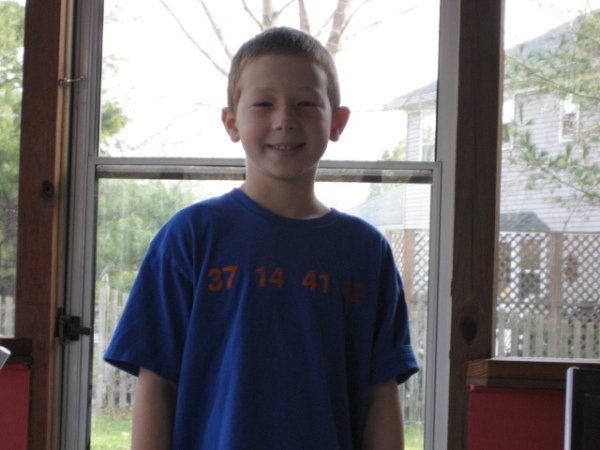
Ross Chapman can skip arithmetic class with our blessing. He knows all the important numbers, as evidenced by his sharp FAFIF t-shirt. Ross attends elementary school in Central Jersey, where his mom reports he shows off his 37 14 41 and 42 every chance he gets.
Way to go, Ross. Keep it up and maybe they’ll make it the school uniform.
by Jason Fry on 18 December 2006 5:14 am Truly veteran readers of this blog may recall last year's incarnation of this post, and so know that THB stands for “The Holy Books.” In which case your geek-proximity alarms just went off and you're backing slowly away.
Everybody else, here's a quick refresher: I have a pair of binders, dubbed The Holy Books by Greg, that contain a baseball card for every Met on the all-time roster. They're ordered by year, with a card for each player who made his Met debut that year: Tom Seaver is Class of '67, Mike Piazza is Class of '98, Jose Reyes is Class of '03, etc. There are extra pages for the rosters of the two World Series winners, including managers, and for the 1961 Expansion Draft, with the latter including the only man to appear in THB who neither played for nor managed the Mets. (Answer at the bottom.)
When a player has a Topps card as a Met, I use that unless it's truly horrible — Topps has been around a decade longer than the Mets, so they get to be the card of record. No Met Topps card? Then I look for a Tides card, a non-Topps Met card (Upper Deck gets too excited about rookies, which is good for THB), a Topps non-Met card, or anything.
Topps had a baseball-card monopoly until 1981, and minor-league cards only really began in the mid-1970s, so cup-of-coffee guys from before '75 or so are a problem. Companies like TCMA and Renata Galasso made odd sets with players from the 1960s — come on down, Jim Bethke, Bob Moorhead and Dave Eilers! A card dealer named Larry Fritsch put out sets of “One Year Winners” spotlighting players with mayfly careers: Welcome to the books, Ray Daviault, Ted Schreiber and Dennis Musgraves!
But even those efforts don't cover everybody. Brian Ostrosser got a 1975 minor-league card as an Oklahoma City 89er that looks like the intern made it with a photocopier. Leon Brown got one of those (1975 Phoenix Giants) and an Omaha Royals card issued by the police department (yes really) that was equally bad and printed in a nonstandard size to boot. But they're lucky compared with seven Mets — Al Schmelz, Francisco Estrada, Lute Barnes, Tommy Moore, Bob Rauch, Greg Harts and Rich Puig — who have no cards whatsoever. (Greg thinks Tommy Moore's 1990 Senior League card with the Bradenton Explorers should count, and maybe it should.) In fact Al Schmelz — whose name is apparently German shorthand for “aluminum smelter” — never even had a decent color photograph taken while wearing his Met uniform. Believe me, I've looked — I even wrote to him to ask. (He ignored me. I'd have ignored me too.) Those seven plus Ostrosser and Brown are the legendary Lost Nine. Who aren't really lost, but whose existence in THB depends on scrounged photos and my touch-and-go Photoshop skills.
Today's Schmelzes and Puigs don't fall through the gaps: Between the various big-league sets and innumerable minor-league team sets, most any player who signs a pro contract has a card somewhere. As THB keeper, during the season I scrutinize new card sets in hopes of finding a) better cards of established Mets; b) cards to stockpile for prospects who might make the Show; and most importantly c) a card for each new big-league Met. At season's end, the new guys get added to the binders, to be studied now and then until February. When it's time to pull old Topps cards of the spring-training invitees and start the cycle again.
For anyone who didn't have the crap scared out of them by that admission, here's the Class of 2006, THB-style, in order of matriculation….
Paul Lo Duca — Today Lo Duca is beloved by us for his grit, smarts, blunt interviews and general pissiness. A year ago, he was the guy looking possessed at the Christmas party/Anna Benson Farewell whom few of us thought had the skills to be a No. 2 hitter. But he did have a 2006 Met card. For decades Topps has used graphics trickery to put guys in new uniforms, but the trickery didn't used to be so tricky. In the 1960s traded players were recognizable because their cards were head shots without caps, and in the 1970s they were notable because they looked like people sticking their heads through backdrops at state fairs — if those backdrops had been painted by prisoners with only a nodding acquaintance with baseball-team logos and their proper place on caps. Today things are better: Lo Duca's Topps '06 card shows him in Marlins road gear, mask on, standing and ready to throw. Tweak colors in Photoshop and stick the slightest hint of a K under the chest protector and he looks like a Met all right. Unfortunately, this passable Lo Duca card meant he didn't get a new one in the Updates set. With any luck, next year he'll no longer be an anonymous catcher in a Marlin uniform.
Carlos Delgado — More Topps Photoshop trickery gave Delgado a fairly convincing Met card last winter, the illusion betrayed only by the impossibility of a photo existing of Delgado batting in our pinstripes, particularly with a background of Marlins in their home unis. Incidentally, when a new Met hits the roster, I also pull all their Topps cards and stash them in a box. (Why yes, there is more geekiness.) I've got every regular-issue Topps card since '91, so this is normally no big deal. But there are prospect cards that can have two, three or even four players — and over time it's inevitable that multiple prospects from a single card become Mets, forcing me to go buy another copy of that card. I mention this because Carlos Delgado shares his 1993 TOP PROSPECTS: CATCHERS rookie card with Mike Piazza, momentary Met Brook Fordyce and a '92 Yankee draft pick named Donnie Leshnock. Having acquired this card for a third time in '06, I'd like to ask Omar Minaya to just go ahead, sign Donnie Leshnock and let him catch an inning.
Xavier Nady — Alas, poor X. He was never quite as good as we thought he could be, but his exile to Pittsburgh seemed cruel when the rest of the Met pen stepped up and made adding another reliever (at the time an utterly defensible move) look unnecessary. X got a nice card from Upper Deck showing him slapping hands after a victory. He didn't get to do that much as a Pirate.
Jose Valentin — Think Move X by General Manager Y is ridiculous? Before you call sports radio, think of Stache's 2006 campaign. Nobody on God's green earth liked bringing Valentin aboard in February, March or April. If any of us had been GM for a day then, we'd have pink-slipped Stache before you could say “Gerald Williams.” So this winter Omar of course went for double or nothing. Back when I was still calling him John, Jose got a Topps rarity for '06: a Met wrapper around a photo of him in Dodgers garb. Yecch. I went with an Upper Deck card showing him in the proper uniform — unfortunately, it's a horizontal card. Yecch. To be put right in '07, one hopes.
Julio Franco — Having every Topps card back to '91 means even adding veterans to the Box o' Mets is no big deal. Except Julio Franco's first Topps card came in 1984, when I was 15 years old and just three years removed from collecting cards as an actual child. Julio's '06 Topps Series 2 card shows him in those strikingly awful St. Lucie black/blue/orange togs — a common fate for players in their first year with new teams. He looks competent and old. In other words, he looks like Julio Franco.
Billy Wagner — Wags also came with a well-faked '06 Topps Met card, in full Mets pinstripes hurling a pitch. Show-offy of Topps.
Brian Bannister — In the minor leagues he looked like a gutty control artist. In the majors he issued an ungodly number of walks but somehow Houdini'ed his way out of mess after mess, only to be felled by his own baserunning. It would have been interesting to see what 2007 would have revealed: Rick Reed or Rick Baldwin. Now it's up to the Royals to find out. Bannister goes into the THB (probably for keeps) with a decent, no-frills portrait from Topps' '06 Rookie Debut insert set.
Duaner Sanchez — Middle relievers are the bane of THB. Nobody says a LOOGY or a seventh-inning specialist is their favorite player, so they stay stuck in card limbo with backup catchers and pinch hitters. Duaner's flamboyant ways and great numbers earned him a card in Topps' second series, which made me happy — until the card appeared and it was a shot of Sanchez without his goggles. Or at least I assume that's who it was, because I couldn't pick a goggleless Duaner Sanchez out of a police lineup. Upper Deck came to the rescue with a goggles-and-all card.
Jorge Julio — Looked so much like Armando Benitez that he got booed when introduced on Opening Day, never having thrown a regular-season pitch as a Met. Those of you who loathe Met fans' predilection for abuse, that will serve as a trump card for at least three or four years. Went into THB with an Upper Deck card in a Met uniform.
Chad Bradford — Sad he's gone, but the Orioles are insane to give any setup guy a three-year deal. Upper Deck's card captures his submarine, knuckle-scraping delivery perfectly. Just looking at the position Bradford's in will give you back pain.
Endy Chavez — Got a Met card in Topps Updates. And a highlights card of that play where he…well, you know. Really, The Catch should just be his baseball card for the rest of his career.
Darren Oliver — Another exhibit in the Trust Omar Hall of Fame. Good, solid Upper Deck card in a Met uni.
John Maine — For a while it looked like he'd get stuck with half of an old Orioles prospect card. But then he survived a finger injury, his own anonymity, Met indifference and gopher balls to push his way into the rotation and record the last Met W of 2006. Topps honored him with a card in the Updates set, showing him pitching in spring-training garb. Which I guess proves he really did pitch in spring training.
Jose Lima — A Tides card. What is this doing here? Jose Lima never pitched for the Mets. What's that? No, he didn't. No, I won't look it up. He didn't. I'm not listening to you.
Jeremi Gonzalez — 2004 Topps card in the uniform of the Tampa Bay Devil Rays. There's a joke in there somewhere. Unfortunately, it was on us.
Alay Soler — Sent collectors into paroxysms when Topps slipped a last-minute card of him into Series 2 with the odd number RC1, no place on the checklist, and mysterious rumors that less than 1,000 had been printed. I got in early and paid only a moderately absurd amount of money for mine. THB uses an Upper Deck card in which he's wearing spring-training colors and looks like he doesn't want to throw this next pitch. Sad to say, that's probably the right card for him.
Orlando Hernandez — Jorge Julio got a Topps Updates card as a Diamondback, but El Duque didn't get one as a Met. Bizarre. For now he's a 2006 Topps Diamondback. In some parallel universe's Faith and Fear in Flushing, I'm explaining how I broke my own rule and used his 2006 World Series Game 1 Highlights card as his regular card, because when a guy comes back after a leg injury like that, shuts out the Tigers and sets the tone for our third title, you have to honor it.
(I'm going to go off and stare at the wall for a while.)
Lastings Milledge — Got a whole string of cards from Topps, which loves hometown rookies. I chose his oddball Mets team-set card, which shows him digging for third with ambitions about the plate. As opposed to, say, a card of him falling down at Fenway or looking at the latest sign some veteran has hung in his locker. Patience, folks. He's still a baby and very talented. I will now flip back to my THB card for Alex Escobar and scream “NO JINX! NO JINX!” (By the way, Alex Escobar looks like the next Albert Pujols on his 2001 Topps Mets card. NO JINX!)
Eli Marrero — 2005 Topps, Kansas City Royals. Hey, they had to make some Royals.
Henry Owens — Former catcher, late bloomer, studying to be a doctor, Lo Duca carried his bags in during spring training. Divine numbers in AA. Rather back-to-earth numbers in the Show. The Marlins agreed he was an interesting story. Bowman 2006 card, looks like a spring-training shot.
Mike Pelfrey — 2006 Bowman Draft Picks card, shows him at an actual start at Shea, looking determined and very tall. Calls him Michael Pelfrey. In a few years this could look oddly formal and force me to recall that Mike Pelfrey was just a raw kid then, not a household name. Or I might find it bitterly amusing that I ever thought anyone would care what first name appeared on one of the few Mike Pelfrey baseball cards.
Ricky Ledee — 2005 Topps, a Dodger card. I don't like other teams' uniforms in THB, but sometimes I wind up hoping things don't change: Because for there to be a 2007 Met card of Ricky Ledee, Ricky Ledee would have to be a 2007 Met. See also: Offerman, Jose.
Michael Tucker — Tides card. The box seats behind Tucker are nearly empty. No wait, there's a man applauding wildly. He's wearing an I LOVE MICHAEL t-shirt and a Braves cap. Hey, it's Angel Hernandez! Christ do I hate Michael Tucker.
Dave Williams — Tides card, possibly to be rectified in 2007.
Guillermo Mota — A Met card from Topps Updates, rather improbably. From the grip, looks like he's throwing a change-up. Obviously this is not the fucking pitch he fucking threw to Scott Fucking Spiezio.
Shawn Green — A legit Met card from Topps Updates. Man does his swing look long. Trust Omar. Trust Omar. Trust Omar. Trust Omar….
Oliver Perez — No matter what he does, I'll have a soft spot in my heart for him for being about as good as any Met fan could possibly hope in Game 7. 2006 Topps Updates card.
Philip Humber — A surprise as the final Met of 2006 (and the 799th all-time) and a surprise as a baseball card. Turns out he was featured on some random insert card stuck into a 2005 Topps factory set, photo taken before the injury that made us wonder if we'd ever see him again. Here's hoping we do, in cardboard and as part of the starting rotation.
* Oh yeah, the answer. Lee Walls was drafted by the Mets on October 10, 1961 and traded (with $100,000) to the Dodgers on Dec. 15 for Charlie Neal and a player to be named later, who turned out to be Willard Hunter. You could look it up.
by Jason Fry on 18 December 2006 5:14 am Truly veteran readers of this blog may recall last year’s incarnation of this post, and so know that THB stands for “The Holy Books.” In which case your geek-proximity alarms just went off and you’re backing slowly away.
Everybody else, here’s a quick refresher: I have a pair of binders, dubbed The Holy Books by Greg, that contain a baseball card for every Met on the all-time roster. They’re ordered by year, with a card for each player who made his Met debut that year: Tom Seaver is Class of ’67, Mike Piazza is Class of ’98, Jose Reyes is Class of ’03, etc. There are extra pages for the rosters of the two World Series winners, including managers, and for the 1961 Expansion Draft, with the latter including the only man to appear in THB who neither played for nor managed the Mets. (Answer at the bottom.)
When a player has a Topps card as a Met, I use that unless it’s truly horrible — Topps has been around a decade longer than the Mets, so they get to be the card of record. No Met Topps card? Then I look for a Tides card, a non-Topps Met card (Upper Deck gets too excited about rookies, which is good for THB), a Topps non-Met card, or anything.
Topps had a baseball-card monopoly until 1981, and minor-league cards only really began in the mid-1970s, so cup-of-coffee guys from before ’75 or so are a problem. Companies like TCMA and Renata Galasso made odd sets with players from the 1960s — come on down, Jim Bethke, Bob Moorhead and Dave Eilers! A card dealer named Larry Fritsch put out sets of “One Year Winners” spotlighting players with mayfly careers: Welcome to the books, Ray Daviault, Ted Schreiber and Dennis Musgraves!
But even those efforts don’t cover everybody. Brian Ostrosser got a 1975 minor-league card as an Oklahoma City 89er that looks like the intern made it with a photocopier. Leon Brown got one of those (1975 Phoenix Giants) and an Omaha Royals card issued by the police department (yes really) that was equally bad and printed in a nonstandard size to boot. But they’re lucky compared with seven Mets — Al Schmelz, Francisco Estrada, Lute Barnes, Tommy Moore, Bob Rauch, Greg Harts and Rich Puig — who have no cards whatsoever. (Greg thinks Tommy Moore’s 1990 Senior League card with the Bradenton Explorers should count, and maybe it should.) In fact Al Schmelz — whose name is apparently German shorthand for “aluminum smelter” — never even had a decent color photograph taken while wearing his Met uniform. Believe me, I’ve looked — I even wrote to him to ask. (He ignored me. I’d have ignored me too.) Those seven plus Ostrosser and Brown are the legendary Lost Nine. Who aren’t really lost, but whose existence in THB depends on scrounged photos and my touch-and-go Photoshop skills.
Today’s Schmelzes and Puigs don’t fall through the gaps: Between the various big-league sets and innumerable minor-league team sets, most any player who signs a pro contract has a card somewhere. As THB keeper, during the season I scrutinize new card sets in hopes of finding a) better cards of established Mets; b) cards to stockpile for prospects who might make the Show; and most importantly c) a card for each new big-league Met. At season’s end, the new guys get added to the binders, to be studied now and then until February. When it’s time to pull old Topps cards of the spring-training invitees and start the cycle again.
For anyone who didn’t have the crap scared out of them by that admission, here’s the Class of 2006, THB-style, in order of matriculation….
Paul Lo Duca — Today Lo Duca is beloved by us for his grit, smarts, blunt interviews and general pissiness. A year ago, he was the guy looking possessed at the Christmas party/Anna Benson Farewell whom few of us thought had the skills to be a No. 2 hitter. But he did have a 2006 Met card. For decades Topps has used graphics trickery to put guys in new uniforms, but the trickery didn’t used to be so tricky. In the 1960s traded players were recognizable because their cards were head shots without caps, and in the 1970s they were notable because they looked like people sticking their heads through backdrops at state fairs — if those backdrops had been painted by prisoners with only a nodding acquaintance with baseball-team logos and their proper place on caps. Today things are better: Lo Duca’s Topps ’06 card shows him in Marlins road gear, mask on, standing and ready to throw. Tweak colors in Photoshop and stick the slightest hint of a K under the chest protector and he looks like a Met all right. Unfortunately, this passable Lo Duca card meant he didn’t get a new one in the Updates set. With any luck, next year he’ll no longer be an anonymous catcher in a Marlin uniform.
Carlos Delgado — More Topps Photoshop trickery gave Delgado a fairly convincing Met card last winter, the illusion betrayed only by the impossibility of a photo existing of Delgado batting in our pinstripes, particularly with a background of Marlins in their home unis. Incidentally, when a new Met hits the roster, I also pull all their Topps cards and stash them in a box. (Why yes, there is more geekiness.) I’ve got every regular-issue Topps card since ’91, so this is normally no big deal. But there are prospect cards that can have two, three or even four players — and over time it’s inevitable that multiple prospects from a single card become Mets, forcing me to go buy another copy of that card. I mention this because Carlos Delgado shares his 1993 TOP PROSPECTS: CATCHERS rookie card with Mike Piazza, momentary Met Brook Fordyce and a ’92 Yankee draft pick named Donnie Leshnock. Having acquired this card for a third time in ’06, I’d like to ask Omar Minaya to just go ahead, sign Donnie Leshnock and let him catch an inning.
Xavier Nady — Alas, poor X. He was never quite as good as we thought he could be, but his exile to Pittsburgh seemed cruel when the rest of the Met pen stepped up and made adding another reliever (at the time an utterly defensible move) look unnecessary. X got a nice card from Upper Deck showing him slapping hands after a victory. He didn’t get to do that much as a Pirate.
Jose Valentin — Think Move X by General Manager Y is ridiculous? Before you call sports radio, think of Stache’s 2006 campaign. Nobody on God’s green earth liked bringing Valentin aboard in February, March or April. If any of us had been GM for a day then, we’d have pink-slipped Stache before you could say “Gerald Williams.” So this winter Omar of course went for double or nothing. Back when I was still calling him John, Jose got a Topps rarity for ’06: a Met wrapper around a photo of him in Dodgers garb. Yecch. I went with an Upper Deck card showing him in the proper uniform — unfortunately, it’s a horizontal card. Yecch. To be put right in ’07, one hopes.
Julio Franco — Having every Topps card back to ’91 means even adding veterans to the Box o’ Mets is no big deal. Except Julio Franco’s first Topps card came in 1984, when I was 15 years old and just three years removed from collecting cards as an actual child. Julio’s ’06 Topps Series 2 card shows him in those strikingly awful St. Lucie black/blue/orange togs — a common fate for players in their first year with new teams. He looks competent and old. In other words, he looks like Julio Franco.
Billy Wagner — Wags also came with a well-faked ’06 Topps Met card, in full Mets pinstripes hurling a pitch. Show-offy of Topps.
Brian Bannister — In the minor leagues he looked like a gutty control artist. In the majors he issued an ungodly number of walks but somehow Houdini’ed his way out of mess after mess, only to be felled by his own baserunning. It would have been interesting to see what 2007 would have revealed: Rick Reed or Rick Baldwin. Now it’s up to the Royals to find out. Bannister goes into the THB (probably for keeps) with a decent, no-frills portrait from Topps’ ’06 Rookie Debut insert set.
Duaner Sanchez — Middle relievers are the bane of THB. Nobody says a LOOGY or a seventh-inning specialist is their favorite player, so they stay stuck in card limbo with backup catchers and pinch hitters. Duaner’s flamboyant ways and great numbers earned him a card in Topps’ second series, which made me happy — until the card appeared and it was a shot of Sanchez without his goggles. Or at least I assume that’s who it was, because I couldn’t pick a goggleless Duaner Sanchez out of a police lineup. Upper Deck came to the rescue with a goggles-and-all card.
Jorge Julio — Looked so much like Armando Benitez that he got booed when introduced on Opening Day, never having thrown a regular-season pitch as a Met. Those of you who loathe Met fans’ predilection for abuse, that will serve as a trump card for at least three or four years. Went into THB with an Upper Deck card in a Met uniform.
Chad Bradford — Sad he’s gone, but the Orioles are insane to give any setup guy a three-year deal. Upper Deck’s card captures his submarine, knuckle-scraping delivery perfectly. Just looking at the position Bradford’s in will give you back pain.
Endy Chavez — Got a Met card in Topps Updates. And a highlights card of that play where he…well, you know. Really, The Catch should just be his baseball card for the rest of his career.
Darren Oliver — Another exhibit in the Trust Omar Hall of Fame. Good, solid Upper Deck card in a Met uni.
John Maine — For a while it looked like he’d get stuck with half of an old Orioles prospect card. But then he survived a finger injury, his own anonymity, Met indifference and gopher balls to push his way into the rotation and record the last Met W of 2006. Topps honored him with a card in the Updates set, showing him pitching in spring-training garb. Which I guess proves he really did pitch in spring training.
Jose Lima — A Tides card. What is this doing here? Jose Lima never pitched for the Mets. What’s that? No, he didn’t. No, I won’t look it up. He didn’t. I’m not listening to you.
Jeremi Gonzalez — 2004 Topps card in the uniform of the Tampa Bay Devil Rays. There’s a joke in there somewhere. Unfortunately, it was on us.
Alay Soler — Sent collectors into paroxysms when Topps slipped a last-minute card of him into Series 2 with the odd number RC1, no place on the checklist, and mysterious rumors that less than 1,000 had been printed. I got in early and paid only a moderately absurd amount of money for mine. THB uses an Upper Deck card in which he’s wearing spring-training colors and looks like he doesn’t want to throw this next pitch. Sad to say, that’s probably the right card for him.
Orlando Hernandez — Jorge Julio got a Topps Updates card as a Diamondback, but El Duque didn’t get one as a Met. Bizarre. For now he’s a 2006 Topps Diamondback. In some parallel universe’s Faith and Fear in Flushing, I’m explaining how I broke my own rule and used his 2006 World Series Game 1 Highlights card as his regular card, because when a guy comes back after a leg injury like that, shuts out the Tigers and sets the tone for our third title, you have to honor it.
(I’m going to go off and stare at the wall for a while.)
Lastings Milledge — Got a whole string of cards from Topps, which loves hometown rookies. I chose his oddball Mets team-set card, which shows him digging for third with ambitions about the plate. As opposed to, say, a card of him falling down at Fenway or looking at the latest sign some veteran has hung in his locker. Patience, folks. He’s still a baby and very talented. I will now flip back to my THB card for Alex Escobar and scream “NO JINX! NO JINX!” (By the way, Alex Escobar looks like the next Albert Pujols on his 2001 Topps Mets card. NO JINX!)
Eli Marrero — 2005 Topps, Kansas City Royals. Hey, they had to make some Royals.
Henry Owens — Former catcher, late bloomer, studying to be a doctor, Lo Duca carried his bags in during spring training. Divine numbers in AA. Rather back-to-earth numbers in the Show. The Marlins agreed he was an interesting story. Bowman 2006 card, looks like a spring-training shot.
Mike Pelfrey — 2006 Bowman Draft Picks card, shows him at an actual start at Shea, looking determined and very tall. Calls him Michael Pelfrey. In a few years this could look oddly formal and force me to recall that Mike Pelfrey was just a raw kid then, not a household name. Or I might find it bitterly amusing that I ever thought anyone would care what first name appeared on one of the few Mike Pelfrey baseball cards.
Ricky Ledee — 2005 Topps, a Dodger card. I don’t like other teams’ uniforms in THB, but sometimes I wind up hoping things don’t change: Because for there to be a 2007 Met card of Ricky Ledee, Ricky Ledee would have to be a 2007 Met. See also: Offerman, Jose.
Michael Tucker — Tides card. The box seats behind Tucker are nearly empty. No wait, there’s a man applauding wildly. He’s wearing an I LOVE MICHAEL t-shirt and a Braves cap. Hey, it’s Angel Hernandez! Christ do I hate Michael Tucker.
Dave Williams — Tides card, possibly to be rectified in 2007.
Guillermo Mota — A Met card from Topps Updates, rather improbably. From the grip, looks like he’s throwing a change-up. Obviously this is not the fucking pitch he fucking threw to Scott Fucking Spiezio.
Shawn Green — A legit Met card from Topps Updates. Man does his swing look long. Trust Omar. Trust Omar. Trust Omar. Trust Omar….
Oliver Perez — No matter what he does, I’ll have a soft spot in my heart for him for being about as good as any Met fan could possibly hope in Game 7. 2006 Topps Updates card.
Philip Humber — A surprise as the final Met of 2006 (and the 799th all-time) and a surprise as a baseball card. Turns out he was featured on some random insert card stuck into a 2005 Topps factory set, photo taken before the injury that made us wonder if we’d ever see him again. Here’s hoping we do, in cardboard and as part of the starting rotation.
* Oh yeah, the answer. Lee Walls was drafted by the Mets on October 10, 1961 and traded (with $100,000) to the Dodgers on Dec. 15 for Charlie Neal and a player to be named later, who turned out to be Willard Hunter. You could look it up.
by Greg Prince on 15 December 2006 9:28 pm 1976: Rocky is released. The Italian Stallion, as written and portrayed by virtual unknown Sylvester Stallone, enters the lexicon. “Yo” is popularized as a greeting, often followed by “Adrian”. A glass of uncooked eggs is the new breakfast of challengers. Running up the steps of the Philadelphia Museum of Art and lifting one’s arms in the air in triumph becomes accepted behavior. The movie is an unexpected smash. An Academy Award is earned. Even in a field that includesNetwork and All The President’s Men, it is not an insane choice, for Rocky is awesome.
Also, Lee Mazzilli makes his Major League debut with the New York Mets. Bats .195 in 24 games.
1979: Rocky II is released. Rocky Balboa can’t find anything to do with himself after getting his shot at the title, so despite telling Adrian otherwise, he accepts a rematch with champ Apollo Creed, a.k.a. The Master of Disaster. Mickey trains him like something out of the 1930s. It works. Rocky takes the title in a double knockout. The sequel is OK. Hope they don’t make a ton of these.
Also, Lee Mazzilli makes the National League All-Star team, hits a home run off of Ron Guidry and drives in the winning run with a walk. Bats .303 for the year. Is referred to in the tabloids as the Italian Stallion. The Mets finish last. Dale Murray pitches like the Master of Disaster.
1982: Rocky III is released. On the night it opens, several young men who have seen it shout to those waiting on line for the next show in Lynbrook that “Rocky wins and the old man dies!” Beyond the spoiler alert, Rocky is smacked around by Clubber Lang and requires the Eye of the Tiger to get back what he lost. Brother-in-law Paulie more annoying than ever. Frank Stallone and his band see screen time. Nevertheless, one critic calls it his favorite Rocky. That would be me.
Also, Lee Mazzilli is traded from the Mets to the Rangers for Ron Darling and Walt Terrell, then from the Rangers to the Yankees for Bucky Dent, then from the Yankees to the Pirates for Tim Burke.
1985: Rocky IV is released. Rocky serves as stand-in for America’s Reaganesque resiliency in the Cold War, as the champ with a Burning Heart flies to the Soviet Union to avenge the death of friend Creed at the hands of Ivan Drago in what was supposed to be an all-in-good-fun exhibition match. The Soviets, however, are not about good fun, not at all. Further details elude me as I’ve never been able to sit start-to-finish through this, hands down, the worst of the Rockymovies. The video for James Brown’s Living In America suffices plenty.
Also, Lee Mazzilli languishes as a last-place Pirate.
1990: Rocky V is released. While not much better than Rocky IV, it is mildly watchable. Rocky Balboa’s career is over and he’s managing young Tommy Gunn until his protégé turns resentful rival. Rocky teaches the punk and his Don King-like advisor a lesson while winning the love of his son after losing all his assets and rediscovering what really counts. Or something like that. Thus ends the saga of cinema’s longest-running heavyweight two sequels too late.
Also, Lee Mazzilli spends his first year as a retired Major Leaguer having enjoyed a late surge of success on three postseason teams, the ’89 Blue Jays, the ’88 Mets and the 1986 World Champion New York Mets. Mazz’s pinch-hits in Games Six and Seven are key to his original team — which reacquired him that August — winning their first World Series since Mazzilli was a 14-year-old fan in Sheepshead Bay.
Postscript: Sylvester Stallone spends the 1990s opening Planet Hollywood and movies like Judge Dredd. Neither is nearly as well-loved as the Rocky series. In the new century, he is absent from the local multiplex.
Also, Lee Mazzilli drifts from actor to restaurateur to minor league manager to coach for one his former teams, the New York Yankees where his biggest contribution is jobbing a fill-in umpire in an Interleague game versus the Mets, conning overmatched Robb Cook into calling Todd Zeile out at first base after an apparent double. His affiliation with the success of his employer gets him a job as Baltimore Orioles skipper in 2004. It’s over by 2005. A year later he lands back with the Yanks. He’s tossed out after the club is beaten by Detroit in the playoffs.
2006: Rocky Balboa opens December 22. He’s going to fight one more time. He’s 60. It’s not a comedy. He tellsNewsweek, “everyone makes mistakes. I look around at people my age, and I can see it in their eyes — a kind of bittersweet reflection: ‘I didn’t live the life that I wanted, and now I’ve got all this stuff I want to say, but nobody wants to hear it.’ I was feeling that, and if you don’t get it out, it can become a beast that tears you apart.”
Also, Lee Mazzilli is hired to be in-studio analyst for Mets telecasts on SNY two months after an extended on-air audition by Zeile does not produce a regular gig for 2007. Lee’s presence frees up Darling to announce more games. Mazzilli is excited about joining the SNY team. “This is a great opportunity for me,” he says in a press release. “The Mets are a huge part of my life. I grew up with this organization.”
Yo.
by Greg Prince on 15 December 2006 9:28 pm 1976: Rocky is released. The Italian Stallion, as written and portrayed by virtual unknown Sylvester Stallone, enters the lexicon. “Yo” is popularized as a greeting, often followed by “Adrian”. A glass of uncooked eggs is the new breakfast of challengers. Running up the steps of the Philadelphia Museum of Art and lifting one’s arms in the air in triumph becomes accepted behavior. The movie is an unexpected smash. An Academy Award is earned. Even in a field that includes Network and All The President’s Men, it is not an insane choice, for Rocky is awesome.
Also, Lee Mazzilli makes his Major League debut with the New York Mets. Bats .195 in 24 games.
1979: Rocky II is released. Rocky Balboa can’t find anything to do with himself after getting his shot at the title, so despite telling Adrian otherwise, he accepts a rematch with champ Apollo Creed, a.k.a. The Master of Disaster. Mickey trains him like something out of the 1930s. It works. Rocky takes the title in a double knockout. The sequel is OK. Hope they don’t make a ton of these.
Also, Lee Mazzilli makes the National League All-Star team, hits a home run off of Ron Guidry and drives in the winning run with a walk. Bats .303 for the year. Is referred to in the tabloids as the Italian Stallion. The Mets finish last. Dale Murray pitches like the Master of Disaster.
1982: Rocky III is released. On the night it opens, several young men who have seen it shout to those waiting on line for the next show in Lynbrook that “Rocky wins and the old man dies!” Beyond the spoiler alert, Rocky is smacked around by Clubber Lang and requires the Eye of the Tiger to get back what he lost. Brother-in-law Paulie more annoying than ever. Frank Stallone and his band see screen time. Nevertheless, one critic calls it his favorite Rocky. That would be me.
Also, Lee Mazzilli is traded from the Mets to the Rangers for Ron Darling and Walt Terrell, then from the Rangers to the Yankees for Bucky Dent, then from the Yankees to the Pirates for Tim Burke.
1985: Rocky IV is released. Rocky serves as stand-in for America’s Reaganesque resiliency in the Cold War, as the champ with a Burning Heart flies to the Soviet Union to avenge the death of friend Creed at the hands of Ivan Drago in what was supposed to be an all-in-good-fun exhibition match. The Soviets, however, are not about good fun, not at all. Further details elude me as I’ve never been able to sit start-to-finish through this, hands down, the worst of the Rocky movies. The video for James Brown’s Living In America suffices plenty.
Also, Lee Mazzilli languishes as a last-place Pirate.
1990: Rocky V is released. While not much better than Rocky IV, it is mildly watchable. Rocky Balboa’s career is over and he’s managing young Tommy Gunn until his protégé turns resentful rival. Rocky teaches the punk and his Don King-like advisor a lesson while winning the love of his son after losing all his assets and rediscovering what really counts. Or something like that. Thus ends the saga of cinema’s longest-running heavyweight two sequels too late.
Also, Lee Mazzilli spends his first year as a retired Major Leaguer having enjoyed a late surge of success on three postseason teams, the ’89 Blue Jays, the ’88 Mets and the 1986 World Champion New York Mets. Mazz’s pinch-hits in Games Six and Seven are key to his original team — which reacquired him that August — winning their first World Series since Mazzilli was a 14-year-old fan in Sheepshead Bay.
Postscript: Sylvester Stallone spends the 1990s opening Planet Hollywood and movies like Judge Dredd. Neither is nearly as well-loved as the Rocky series. In the new century, he is absent from the local multiplex.
Also, Lee Mazzilli drifts from actor to restaurateur to minor league manager to coach for one his former teams, the New York Yankees where his biggest contribution is jobbing a fill-in umpire in an Interleague game versus the Mets, conning overmatched Robb Cook into calling Todd Zeile out at first base after an apparent double. His affiliation with the success of his employer gets him a job as Baltimore Orioles skipper in 2004. It’s over by 2005. A year later he lands back with the Yanks. He’s tossed out after the club is beaten by Detroit in the playoffs.
2006: Rocky Balboa opens December 22. He’s going to fight one more time. He’s 60. It’s not a comedy. He tells Newsweek, “everyone makes mistakes. I look around at people my age, and I can see it in their eyes — a kind of bittersweet reflection: ‘I didn’t live the life that I wanted, and now I’ve got all this stuff I want to say, but nobody wants to hear it.’ I was feeling that, and if you don’t get it out, it can become a beast that tears you apart.”
Also, Lee Mazzilli is hired to be in-studio analyst for Mets telecasts on SNY two months after an extended on-air audition by Zeile does not produce a regular gig for 2007. Lee’s presence frees up Darling to announce more games. Mazzilli is excited about joining the SNY team. “This is a great opportunity for me,” he says in a press release. “The Mets are a huge part of my life. I grew up with this organization.”
Yo.
by Greg Prince on 13 December 2006 12:22 am You’ve thought it. I’ve thought it. We’ve all thought it if we’ve gone to our share of games at Shea Stadium between 2001 and 2006:
Trachsel’s pitching? I always see Trachsel!
It was rarely thought with enthusiasm.
Now that going to Mets games will presumably no longer carry any threat of Trachselization, at least not in the sense we came to understand it, I felt compelled to explore whether there was any truth to the perception that Steve Trachsel started every time I showed up at Shea.
To be fair I knew the answer was no. I know who has started for the Mets in every single game I’ve ever been to. I write it down. It’s the only player-specific notation I make in The Log, the steno pad I’ve had since high school. In it is page after page detailing the bare-bones essentials of each trip I’ve made to Shea since my first one in 1973: Date, Opponent, Starting Pitcher and Result (W or L and score) in ink; day of week, all-time record vs. opponent, number of starts per pitcher, all-time regular-season record at Shea in lead.
There are other pages devoted to games “elsewhere” and even a page that has managed to fill up with “postseason” info, but they, like the heart of The Log, contain no data pertaining to who might have hit three homers, stolen three bases or racked up his 151st career pinch-hit. That’s for memory and the Internet. But the starting pitcher is inscribed for history’s sake.
Knowing who started a dispiriting Friday night loss to the Padres in 1979 and who started a dispiriting Friday night loss to the Padres in 1996 is certainly one way of distinguishing one dispiriting loss to the Padres from another. (Falcone and Isringhausen, if you were wondering.) Plus, the starting pitcher is the only thing we’re told days in advance. We may assume Jose Reyes will be leading off and playing short when we’re making plans to buy tickets for Wednesday, but nobody lists the probable shortstops. The identity of the centerfielder is never fodder for surefire small talk either. Who’s going tomorrow? Beltran? Cool. But it sticks with me going on three decades that the first time I ever attended a Mets game without adult supervision, the LIRR conductor asked “who’s starting?” and I told him, “Craig Swan,” and I felt very on top of things (even if Swannie wasn’t, losing 3-1 to the Cards).
The only entities that win or lose are the team and a pitcher. Sometimes it’s a reliever, but his identity doesn’t emerge until after the fact and it’s almost never considered flattering. If you’re Billy Wagner, you’re not supposed to lose and you’re rarely permitted to win. If you did, you probably did something wrong. Come to think of it, I have absolutely no idea what Billy Wagner’s won-lost record was last year.
I can tell you with a flip of The Log who I’ve seen start for the Mets more often than anybody else in my 323 regular-season home games. I can tell you who I saw start once and only once. I can give you all the in-betweens as well.
But I wanted to learn a little more than I already knew I had at my fingertips. I wanted to figure out whether my starting-pitching experience has been utterly random or quirkily aberrational or perfectly normal. So in conjunction with The Log, I did a little research and discovered a few fascinating (for the middle of December) facts.
First of all, thanks to Ultimate Mets Database, I now know 217 different pitchers have started Mets games since 1962. I have attended games started by 83 of them, or 38.2% of all Mets starters. Conversely, I didn’t see 134 Mets pitchers throw a game’s first pitch. As my first Mets game came in the franchise’s twelfth season, obviously I missed a lot of pitchers.
The men who started the 13th, 14th and 16th most games in Mets history — Al Jackson, Jack Fisher and Gary Gentry — were all gone by July 11, 1973, my first appearance. Couldn’t do anything about them. This led me to wonder who I didn’t see start, particularly who didn’t start for me when, by all rights, he should have. Was there somebody who was always on his throw day when I had a ticket?
Yes. The Met who started the most games since I’ve been going to games but never started in my presence was somebody I would have preferred had never become a Met, at least via the route he traveled to get here. That would be Pat Zachry. He is No. 17 on the all-time Mets starts list with 113, a somewhat meaningless stat for my purposes since we’re talking only about starts at Shea. Zachry’s key data is the 55 times he started for the Mets at home between 1977 and 1982. In the years he was in the rotation, I went to 20 Mets games. So how is it possible that he and I missed each other every single time?
Zachry was hurt more than I remembered. The most starts he had in any one season as a Met was 26 in 1980, but that was my year to collect my one-and-done markers from Roy Lee Jackson and Mark Bomback. Two years later, I went to games on August 12 and 14, Swan and Mike Scott sandwiching Zachry. Just luck of the draw that I missed him. I did watch him record a win in 1982, but that was in long relief of my sole Charlie Puleo sighting. Only now am I realizing that a pitcher traded to the Mets for Tom Seaver picked up for a pitcher traded from the Mets for Tom Seaver.
No wonder I hold no ill will for Puleo and a ton of it for Pat Zachry.
Whatever the factors, what are the odds I wouldn’t get a single Pat Zachry Mets start? Between 1977 and 1982, I saw Puleo start. I saw Bomback start. I saw Ray Burris start. I saw a prehistoric Terry Leach start. I saw a posteffective Randy Jones start. I saw Dave Roberts and Wayne Twitchell, for crissake. Not that I was really angling for a piece of Pat, but still. I mean, how much luck of the draw is there?
Probability is measured as total number of occurrences of an event divided by total number of trials. Zachry’s Met tenure covered a period when the Mets played 430 home games (accounting for his midseason 1977 arrival — for Seaver — and a 1979 fog-enshrouded tie with Pittsburgh). Given his 55 starts, there was a 12.79% probability that if you went to Shea Stadium between the Seaver trade and the end of ’82, you’d see Zachry start. Hence, I should have seen him start 2.558 of the 20 games I attended.
But I didn’t. Go figure.
Who else escaped The Log? Frank Viola’s shorter if more successful Met term, which included a 20-win season in 1990, ran its course without my bearing witness. He started 41 of the 193 home games the Mets played while he was a Met, or just over 21% (Sweet Music was also durable). I only made it to Shea 8 times between August 1989 and September 1991, the whole of the Viola era. I should have seen him make 1.7 starts. Instead, I got Sid Fernandez thrice, David Cone twice and Bobby Ojeda, Ron Darling and Doc Gooden once each. I’m not complaining.
Likewise, Jason Jacome, Kevin Kobel and Wally Whitehurst slipped through my cracks, even if I had nothing against alliterative initials. I never went out of my way to avoid them but I never made an extra effort to see them. That could describe just about any starting assignment. Sometimes there’s a bit of extra juice in choosing a date — hey, Bill Pulsipher is being called up this Saturday! — but mostly it’s the game first, rotation spinning where it may. When I wasn’t going to that many games in a given year and a pitcher was here only a couple of years, it would figure the occasional Walt Terrell would come and go without me cheering him on in person.
My attendance was quite scattered until the past decade when it picked up dramatically. Since 1997, I’ve been good for an average of 22 games a season, which makes my missing any starters since the late ’90s a little suspicious…especially since there has been such a plethora of starters in the last ten years. I inked most of them in The Log, but not all. Tyler Yates, for example, made four home starts in April and May 2004, months when I was preoccupied enough by non-Mets matters to keep me from Shea (it happens). I went to 29 regular-season home games in 1999, but none of them was the pair that Allen Watson started. To Jeremy Griffiths: It was nothing personal, I swear, that I managed to have other engagements on August 3 and September 1, 2003.
In 2006, as every schoolchild knows, 13 different Met pitchers were entrusted to get things going. Interestingly, nobody was a classic emergency starter — every one of them got at least three shots at starting, with at least two home starts included. The Log tells me I nailed 11 of the 13, with only Jeremi Gonzalez and Brian Bannister eluding my grasp. Barring trades or disasters (or in the case of Gonzalez, a disastrous trade), out of my grasp they shall stay.
That’s mostly who I didn’t see. But who did I see? Like I said, 83 Mets starters. None more than Al Leiter. The Senator leads the list by far with 37 starts between 1998 and 2004 (not counting two starts in the ’99 playoffs, because it’s the playoffs, and his return with the Marlins in 2005, because he was the enemy). Al Leiter and I got to know each other very well. We should have. I was on hand for 36.5% of his Shea starts, nearly two of every five. Since he was in a five-man rotation and missed some starts due to injury here and there, it’s phenomenal how twinned we were.
How phenomenal? The probability of seeing Al Leiter start at Shea from ’98 through ’04 was a tad over 18%. I shouldn’t have seen him start more than 29.37 times. Perhaps he grabbed Watson’s, Griffiths’ and Yates’ turns when I wasn’t paying attention.
Following Leiter are six double-digit stalwarts.
Rick Reed 24
Steve Trachsel 20
Bobby Jones 19
Dwight Gooden 11 (6 in 1993 when the K Korner was kwiet)
Tom Glavine 10
Masato Yoshii 10 (fits right in, eh?)
As alluded to at the top, into every Log a little Trachsel must fall. I don’t think I was inhaling more than my fair share until 2006 when my life became a veritable Trachselpalooza. I saw Steve Trachsel start 6 times in my 22 dates at Shea. Seeing as how 10 other pitchers divided 16 other starts, I don’t understand what that was all about.
In terms of anomalies, Trachsel and 2006 is hardly the sore thumb of The Log. Six starts for one pitcher isn’t even a record, though it is excessive. The most I ever saw one pitcher start in one year was one-year wonder Kevin Appier. Got 9 helpings of Appier in 2001, the only season any was available. I attended a never-to-be-approached-again 38 contests at Shea in ’01, so if somebody was going to pitch, I was going to see him. That included the brief yet ubiquitous tenure of one Bruce Chen. Chen came in late July for Turk Wendell and Dennis Cook. He made 6 starts at Shea. I was there for 5 of them. Apparently, we both signed up for the Tuesday/Friday plan.
Being an integral part of Kevin Appier’s and Bruce Chen’s Mets careers (on hand for 56.3 and 83.3 percent of their respective Shea starts, all in 2001) is, uh, nice, but I’m happier to know I caught 1.5% of Tom Seaver’s lifetime Mets home starts, 0.6% of Jerry Koosman’s (my first game) and 2.2% of Jon Matlack’s (including my first win). I don’t know what to think of making only one of Anthony Young’s 18 Shea starts and that one being the one in which he set the record for consecutive losses by a pitcher starting and/or relieving.
My real badge of honor comes from being a hundred-percenter a half-dozen times. Of the 83 starters in The Log, there are 6 whose every single home start as a Met I observed in the flesh. One of them, Juan Acevedo, made two Mets starts, both at Shea, both in 1997, both with me looking in. Don’t tell Juan the first time I was there was mostly to see the other team’s starter, rarely a motivating factor, but in this case the visitors were the Blue Jays and their pitcher had last pitched against the Mets in 1986 and…oh, all right, it was Roger Clemens. Jeering the Rocket, cheering the Avocado, it was all good; we won.
Of the other five for whom I was 100% behind, three — Twitchell in ’79, Jason Roach in ’03 and the late Cory Lidle in ’97 — made two Mets starts total, but just one each at home. The remaining two hurlers received one lone Mets start apiece. One was recurringly ridiculed 1986 lefty specialist Randy Niemann, pressed into duty by a backlog of August doubleheaders. Niemann made other starts for other teams, so while he was a novelty in ’86, his unusual appearance (he started and won) was not quite akin to that which I was party seven years later.
There was only one New York Mets pitcher who made only one start in his entire Major League career who made it at Shea Stadium in front of me. Talk about probability.
Since 1962, the Mets have played 3,572 regular-season home games. But in only one of them (.0002799%) did this fellow start. Since 1962, the Mets have announced paid regular-season home attendance of 88,836,858. But only 27,904 (.0003141%) can say they held a ticket for the Saturday afternoon makeup doubleheader of August 7, 1993 and, take it from me, only a fraction of them can say they a) showed up and b) stuck around for the nightcap. Those of us who did can say they witnessed the only start by one Michael Anthony Draper.
Yes, I saw normally neglected Rule V middleman Mike Draper’s only Major League start. Filling in for a bleached-out, bum-kneed Bret Saberhagen, Draper lasted three innings, gave up three runs, all earned, on five hits and three walks. Down 3-0 with one out in the bottom of the third, Dallas Green sent up Tim Bogar to pinch-hit for him. The Mets would take him off the hook with three that inning and eventually win the game 10-8, another Michael (Maddux) grabbing his first Met win and another Anthony (Young) notching his last Met save. It was Draper’s final Major League appearance. He was DL’d August 13 with a bad elbow and elbowed out of the organization at the end of September, unconditionally released and likely forgotten by everybody but me and Boogie.
Boogie?
Almost exactly a year after his one and only Major League start, Stephanie and I were in a faux Fifties diner, Boogie’s, in Chicago (it couldn’t be real Fifties — it was 1994). On the wall above the cash register, there were maybe a dozen plates signed by local and national celebrities. Many were sports stars or at least participants. One toward the end of the row required a double-, triple-, quadruple-take to confirm it didn’t say Mike Ditka. It didn’t. It was autographed by 1993 Met Mike Draper. It probably said best of luck.
Which was quite generous of Mike, given that his luck of the draw had yielded him just the one start.
by Greg Prince on 13 December 2006 12:22 am You’ve thought it. I’ve thought it. We’ve all thought it if we’ve gone to our share of games at Shea Stadium between 2001 and 2006:
Trachsel’s pitching? I always see Trachsel!
It was rarely thought with enthusiasm.
Now that going to Mets games will presumably no longer carry any threat of Trachselization, at least not in the sense we came to understand it, I felt compelled to explore whether there was any truth to the perception that Steve Trachsel started every time I showed up at Shea.
To be fair I knew the answer was no. I know who has started for the Mets in every single game I’ve ever been to. I write it down. It’s the only player-specific notation I make in The Log, the steno pad I’ve had since high school. In it is page after page detailing the bare-bones essentials of each trip I’ve made to Shea since my first one in 1973: Date, Opponent, Starting Pitcher and Result (W or L and score) in ink; day of week, all-time record vs. opponent, number of starts per pitcher, all-time regular-season record at Shea in lead.
There are other pages devoted to games “elsewhere” and even a page that has managed to fill up with “postseason” info, but they, like the heart of The Log, contain no data pertaining to who might have hit three homers, stolen three bases or racked up his 151st career pinch-hit. That’s for memory and the Internet. But the starting pitcher is inscribed for history’s sake.
Knowing who started a dispiriting Friday night loss to the Padres in 1979 and who started a dispiriting Friday night loss to the Padres in 1996 is certainly one way of distinguishing one dispiriting loss to the Padres from another. (Falcone and Isringhausen, if you were wondering.) Plus, the starting pitcher is the only thing we’re told days in advance. We may assume Jose Reyes will be leading off and playing short when we’re making plans to buy tickets for Wednesday, but nobody lists the probable shortstops. The identity of the centerfielder is never fodder for surefire small talk either. Who’s going tomorrow? Beltran? Cool. But it sticks with me going on three decades that the first time I ever attended a Mets game without adult supervision, the LIRR conductor asked “who’s starting?” and I told him, “Craig Swan,” and I felt very on top of things (even if Swannie wasn’t, losing 3-1 to the Cards).
The only entities that win or lose are the team and a pitcher. Sometimes it’s a reliever, but his identity doesn’t emerge until after the fact and it’s almost never considered flattering. If you’re Billy Wagner, you’re not supposed to lose and you’re rarely permitted to win. If you did, you probably did something wrong. Come to think of it, I have absolutely no idea what Billy Wagner’s won-lost record was last year.
I can tell you with a flip of The Log who I’ve seen start for the Mets more often than anybody else in my 323 regular-season home games. I can tell you who I saw start once and only once. I can give you all the in-betweens as well.
But I wanted to learn a little more than I already knew I had at my fingertips. I wanted to figure out whether my starting-pitching experience has been utterly random or quirkily aberrational or perfectly normal. So in conjunction with The Log, I did a little research and discovered a few fascinating (for the middle of December) facts.
First of all, thanks to Ultimate Mets Database, I now know 217 different pitchers have started Mets games since 1962. I have attended games started by 83 of them, or 38.2% of all Mets starters. Conversely, I didn’t see 134 Mets pitchers throw a game’s first pitch. As my first Mets game came in the franchise’s twelfth season, obviously I missed a lot of pitchers.
The men who started the 13th, 14th and 16th most games in Mets history — Al Jackson, Jack Fisher and Gary Gentry — were all gone by July 11, 1973, my first appearance. Couldn’t do anything about them. This led me to wonder who I didn’t see start, particularly who didn’t start for me when, by all rights, he should have. Was there somebody who was always on his throw day when I had a ticket?
Yes. The Met who started the most games since I’ve been going to games but never started in my presence was somebody I would have preferred had never become a Met, at least via the route he traveled to get here. That would be Pat Zachry. He is No. 17 on the all-time Mets starts list with 113, a somewhat meaningless stat for my purposes since we’re talking only about starts at Shea. Zachry’s key data is the 55 times he started for the Mets at home between 1977 and 1982. In the years he was in the rotation, I went to 20 Mets games. So how is it possible that he and I missed each other every single time?
Zachry was hurt more than I remembered. The most starts he had in any one season as a Met was 26 in 1980, but that was my year to collect my one-and-done markers from Roy Lee Jackson and Mark Bomback. Two years later, I went to games on August 12 and 14, Swan and Mike Scott sandwiching Zachry. Just luck of the draw that I missed him. I did watch him record a win in 1982, but that was in long relief of my sole Charlie Puleo sighting. Only now am I realizing that a pitcher traded to the Mets for Tom Seaver picked up for a pitcher traded from the Mets for Tom Seaver.
No wonder I hold no ill will for Puleo and a ton of it for Pat Zachry.
Whatever the factors, what are the odds I wouldn’t get a single Pat Zachry Mets start? Between 1977 and 1982, I saw Puleo start. I saw Bomback start. I saw Ray Burris start. I saw a prehistoric Terry Leach start. I saw a posteffective Randy Jones start. I saw Dave Roberts and Wayne Twitchell, for crissake. Not that I was really angling for a piece of Pat, but still. I mean, how much luck of the draw is there?
Probability is measured as total number of occurrences of an event divided by total number of trials. Zachry’s Met tenure covered a period when the Mets played 430 home games (accounting for his midseason 1977 arrival — for Seaver — and a 1979 fog-enshrouded tie with Pittsburgh). Given his 55 starts, there was a 12.79% probability that if you went to Shea Stadium between the Seaver trade and the end of ’82, you’d see Zachry start. Hence, I should have seen him start 2.558 of the 20 games I attended.
But I didn’t. Go figure.
Who else escaped The Log? Frank Viola’s shorter if more successful Met term, which included a 20-win season in 1990, ran its course without my bearing witness. He started 41 of the 193 home games the Mets played while he was a Met, or just over 21% (Sweet Music was also durable). I only made it to Shea 8 times between August 1989 and September 1991, the whole of the Viola era. I should have seen him make 1.7 starts. Instead, I got Sid Fernandez thrice, David Cone twice and Bobby Ojeda, Ron Darling and Doc Gooden once each. I’m not complaining.
Likewise, Jason Jacome, Kevin Kobel and Wally Whitehurst slipped through my cracks, even if I had nothing against alliterative initials. I never went out of my way to avoid them but I never made an extra effort to see them. That could describe just about any starting assignment. Sometimes there’s a bit of extra juice in choosing a date — hey, Bill Pulsipher is being called up this Saturday! — but mostly it’s the game first, rotation spinning where it may. When I wasn’t going to that many games in a given year and a pitcher was here only a couple of years, it would figure the occasional Walt Terrell would come and go without me cheering him on in person.
My attendance was quite scattered until the past decade when it picked up dramatically. Since 1997, I’ve been good for an average of 22 games a season, which makes my missing any starters since the late ’90s a little suspicious…especially since there has been such a plethora of starters in the last ten years. I inked most of them in The Log, but not all. Tyler Yates, for example, made four home starts in April and May 2004, months when I was preoccupied enough by non-Mets matters to keep me from Shea (it happens). I went to 29 regular-season home games in 1999, but none of them was the pair that Allen Watson started. To Jeremy Griffiths: It was nothing personal, I swear, that I managed to have other engagements on August 3 and September 1, 2003.
In 2006, as every schoolchild knows, 13 different Met pitchers were entrusted to get things going. Interestingly, nobody was a classic emergency starter — every one of them got at least three shots at starting, with at least two home starts included. The Log tells me I nailed 11 of the 13, with only Jeremi Gonzalez and Brian Bannister eluding my grasp. Barring trades or disasters (or in the case of Gonzalez, a disastrous trade), out of my grasp they shall stay.
That’s mostly who I didn’t see. But who did I see? Like I said, 83 Mets starters. None more than Al Leiter. The Senator leads the list by far with 37 starts between 1998 and 2004 (not counting two starts in the ’99 playoffs, because it’s the playoffs, and his return with the Marlins in 2005, because he was the enemy). Al Leiter and I got to know each other very well. We should have. I was on hand for 36.5% of his Shea starts, nearly two of every five. Since he was in a five-man rotation and missed some starts due to injury here and there, it’s phenomenal how twinned we were.
How phenomenal? The probability of seeing Al Leiter start at Shea from ’98 through ’04 was a tad over 18%. I shouldn’t have seen him start more than 29.37 times. Perhaps he grabbed Watson’s, Griffiths’ and Yates’ turns when I wasn’t paying attention.
Following Leiter are six double-digit stalwarts.
Rick Reed 24
Steve Trachsel 20
Bobby Jones 19
Dwight Gooden 11 (6 in 1993 when the K Korner was kwiet)
Tom Glavine 10
Masato Yoshii 10 (fits right in, eh?)
As alluded to at the top, into every Log a little Trachsel must fall. I don’t think I was inhaling more than my fair share until 2006 when my life became a veritable Trachselpalooza. I saw Steve Trachsel start 6 times in my 22 dates at Shea. Seeing as how 10 other pitchers divided 16 other starts, I don’t understand what that was all about.
In terms of anomalies, Trachsel and 2006 is hardly the sore thumb of The Log. Six starts for one pitcher isn’t even a record, though it is excessive. The most I ever saw one pitcher start in one year was one-year wonder Kevin Appier. Got 9 helpings of Appier in 2001, the only season any was available. I attended a never-to-be-approached-again 38 contests at Shea in ’01, so if somebody was going to pitch, I was going to see him. That included the brief yet ubiquitous tenure of one Bruce Chen. Chen came in late July for Turk Wendell and Dennis Cook. He made 6 starts at Shea. I was there for 5 of them. Apparently, we both signed up for the Tuesday/Friday plan.
Being an integral part of Kevin Appier’s and Bruce Chen’s Mets careers (on hand for 56.3 and 83.3 percent of their respective Shea starts, all in 2001) is, uh, nice, but I’m happier to know I caught 1.5% of Tom Seaver’s lifetime Mets home starts, 0.6% of Jerry Koosman’s (my first game) and 2.2% of Jon Matlack’s (including my first win). I don’t know what to think of making only one of Anthony Young’s 18 Shea starts and that one being the one in which he set the record for consecutive losses by a pitcher starting and/or relieving.
My real badge of honor comes from being a hundred-percenter a half-dozen times. Of the 83 starters in The Log, there are 6 whose every single home start as a Met I observed in the flesh. One of them, Juan Acevedo, made two Mets starts, both at Shea, both in 1997, both with me looking in. Don’t tell Juan the first time I was there was mostly to see the other team’s starter, rarely a motivating factor, but in this case the visitors were the Blue Jays and their pitcher had last pitched against the Mets in 1986 and…oh, all right, it was Roger Clemens. Jeering the Rocket, cheering the Avocado, it was all good; we won.
Of the other five for whom I was 100% behind, three — Twitchell in ’79, Jason Roach in ’03 and the late Cory Lidle in ’97 — made two Mets starts total, but just one each at home. The remaining two hurlers received one lone Mets start apiece. One was recurringly ridiculed 1986 lefty specialist Randy Niemann, pressed into duty by a backlog of August doubleheaders. Niemann made other starts for other teams, so while he was a novelty in ’86, his unusual appearance (he started and won) was not quite akin to that which I was party seven years later.
There was only one New York Mets pitcher who made only one start in his entire Major League career who made it at Shea Stadium in front of me. Talk about probability.
Since 1962, the Mets have played 3,572 regular-season home games. But in only one of them (.0002799%) did this fellow start. Since 1962, the Mets have announced paid regular-season home attendance of 88,836,858. But only 27,904 (.0003141%) can say they held a ticket for the Saturday afternoon makeup doubleheader of August 7, 1993 and, take it from me, only a fraction of them can say they a) showed up and b) stuck around for the nightcap. Those of us who did can say they witnessed the only start by one Michael Anthony Draper.
Yes, I saw normally neglected Rule V middleman Mike Draper’s only Major League start. Filling in for a bleached-out, bum-kneed Bret Saberhagen, Draper lasted three innings, gave up three runs, all earned, on five hits and three walks. Down 3-0 with one out in the bottom of the third, Dallas Green sent up Tim Bogar to pinch-hit for him. The Mets would take him off the hook with three that inning and eventually win the game 10-8, another Michael (Maddux) grabbing his first Met win and another Anthony (Young) notching his last Met save. It was Draper’s final Major League appearance. He was DL’d August 13 with a bad elbow and elbowed out of the organization at the end of September, unconditionally released and likely forgotten by everybody but me and Boogie.
Boogie?
Almost exactly a year after his one and only Major League start, Stephanie and I were in a faux Fifties diner, Boogie’s, in Chicago (it couldn’t be real Fifties — it was 1994). On the wall above the cash register, there were maybe a dozen plates signed by local and national celebrities. Many were sports stars or at least participants. One toward the end of the row required a double-, triple-, quadruple-take to confirm it didn’t say Mike Ditka. It didn’t. It was autographed by 1993 Met Mike Draper. It probably said best of luck.
Which was quite generous of Mike, given that his luck of the draw had yielded him just the one start.
by Greg Prince on 9 December 2006 7:41 pm On October 1, 2005, the Mets beat the Rockies 3-1 and raised their record to 83-78.
On October 1, 2006, the Cardinals lost to the Brewers 5-3 and lowered their record to 83-78.
The Mets clinched a tie for third place.
The Cardinals clinched a division title.
The next day, the Mets would complete their season with a loss.
The next day, the Cardinals would prepare for the playoffs.
The Mets won 12 more games in 2005 than they won the year before.
The Cardinals won 17 fewer games in 2006 than they won the year before.
The Mets finished 2005 tied for third with the Marlins.
The Cardinals finished 2006 as World Champions.
83-78.
83-78.
by Greg Prince on 9 December 2006 7:41 pm On October 1, 2005, the Mets beat the Rockies 3-1 and raised their record to 83-78.
On October 1, 2006, the Cardinals lost to the Brewers 5-3 and lowered their record to 83-78.
The Mets clinched a tie for third place.
The Cardinals clinched a division title.
The next day, the Mets would complete their season with a loss.
The next day, the Cardinals would prepare for the playoffs.
The Mets won 12 more games in 2005 than they won the year before.
The Cardinals won 17 fewer games in 2006 than they won the year before.
The Mets finished 2005 tied for third with the Marlins.
The Cardinals finished 2006 as World Champions.
83-78.
83-78.
by Greg Prince on 7 December 2006 3:47 pm Got my Sports Illustrated 2006 Sportsman of the Year issue yesterday. The winner is Dwayne Wade, a basketball player, judging by the uniform he’s wearing. I hear he’s good.
Of more interest than this year’s choice was the cover gallery SI printed of all its Sportsmen, Sportswomen and Sportsgroups. Of the 53 annual accolades it has bestowed, 12 (fully or partially) have gone to baseball players.
1955: Johnny Podres
1957: Stan Musial
1965: Sandy Koufax
1967: Carl Yastrzemski
1969: Tom Seaver
1975: Pete Rose
1979: Willie Stargell
1988: Orel Hershiser
1995: Cal Ripken
1998: Mark McGwire & Sammy Sosa
2001: Curt Schilling & Randy Johnson
2004: Boston Red Sox
Sportsmen? Some, sure. Probably. Others? Uh…
Rose bet on baseball.
McGwire’s not here to talk about the past.
Sosa no habla, quite suddenly.
Johnson? Outta my [bleeping] way, grump, grump.
How did they miss Barry Bonds?
In their day, I’m sure all these choices looked sane. But with the same issue of the magazine running a piece in which Tom Verducci dismisses McGwire from Hall of Fame consideration based on his squirmy non-defense at the steroid hearings of 2005 and all it and the arc of his build implies, it just goes to show ya how fleeting sportsmanship can be.
The current Hall of Fame ballot has three candidates who were all mortal locks for January 2007 when they hung ’em up in October 2001: Ripken, Tony Gwynn and McGwire. (And of course Paul O’Neill would enter via the intangibles wing.) Gwynn’s many batting titles and Ripken’s perfect-attendance record still stand. McGwire’s 583 home runs and his world-turning 1998 no longer exist.
I don’t know about that. I saw it. You saw it. We all saw it. McGwire overwhelmed baseball for a half-decade and excelled at it for the better part of 15 years. We were naming him Sportsman and All-Century and an Interstate highway. I understand the impulse to erase the unpleasantness we now feel after putting two and two together. That, though, is more our problem than his. He played. He produced. He was celebrated. By us. In his time, there was nobody like McGwire, just like there would be nobody like Bonds in McGwire’s wake.
They did what they chose to do. We didn’t discourage them. Baseball didn’t stop them. Mark McGwire rocked the sport. Money was made off him at every turn. The Verduccis and their ilk, the professional tut-tutters who now know better, covered him up close. If there was an attempt to expose him, it didn’t get very far. McGwire was good business, good copy, extraordinary video. He was handed a bat and did untold damage with it. That was his job. If he hurt himself along the way, well, a Hall of Fame plaque isn’t going to unlearn him of whatever lesson we think we’ll teach him by denying his career the affirmation it earned. He’s still the one who has to live with his insides.
Kids get the wrong message from that? Things can be done.
Parents and coaches: Drive home the fact that we didn’t know then what we seem to know now and “you pick up a syringe, I’ll break your hand.”
And to the baseball establishment, including institutions like the Hall of Fame and Sports Illustrated: Ease up on the equating of athletic success with humanitarian achievement. Pete Rose had a great 1975. O.J. Simpson rushed for more than 2,000 yards. And Randy Johnson marched in from the bullpen on no days’ rest to shut down the Skanks like they were Channel 2 cameramen. On the field, they were greats. Off the field, assume nothing. You want to recognize them for the hitting and the running and the throwing? Do so. But get over the “integrity,” “sportsmanship” and “character” folderol that are codified into the HOF voting criteria. It ain’t the Hall of Saints.
|
|






