The blog for Mets fans
who like to read
ABOUT US
Faith and Fear in Flushing made its debut on Feb. 16, 2005, the brainchild of two longtime friends and lifelong Met fans.
Greg Prince discovered the Mets when he was 6, during the magical summer of 1969. He is a Long Island-based writer, editor and communications consultant. Contact him here.
Jason Fry is a Brooklyn writer whose first memories include his mom leaping up and down cheering for Rusty Staub. Check out his other writing here.
Got something to say? Leave a comment, or email us at faithandfear@gmail.com. (Sorry, but we have no interest in ads, sponsored content or guest posts.)
Need our RSS feed? It's here.
Visit our Facebook page, or drop by the personal pages for Greg and Jason.
Or follow us on Twitter: Here's Greg, and here's Jason.
|
by Greg Prince on 7 October 2006 11:48 pm
The greatest lineup in baseball history is lining up at the Northwest ticket counter at Detroit Metro.
They couldn't do much in the ALDS, but they sure know how to take a cab.
How about those ragtag Tigers? With their measly 95 wins, they have just taken three straight from the mighty Yankees and their intimidating 97 wins.
What an upset.
The dynasty is dead!
Oh wait…the dynasty's been dead since 2001. This is five straight Octobers, plus one handy November, in which we celebrate Elimination Day, a true national day of thanksgiving.
Celebrate good times…come on!
Doo-doo-doo-doo.
Doo-doo-doo-doo.
And on this, our potentially Holy Saturday, let us pray.
Oh great Baseball gods. You have delivered unto us the Amazin' gift of New York in October in which our team marches on to compete for Your greater glory while the other team whom Satan blighted upon our land in Nineteen Aught Three, comprised completely of overpriced demons, revolting whiners and ferret-faced sneering weasels, has been humiliated despite all expectations from the unknowing masses in distant precincts of our land. Oh great Baseball gods, we pledge to do our best to keep our eyes on Your most sacred Prize, which of course is the next game to be played, in a little while, for it is we who have a next game and it is they who do not. Oh great Baseball gods, we will do our best to not let You nor Your children down. We as Mets fans will turn our considerable energies away from rooting against that which is wicked and toward such that is good. We thank you, oh great Baseball gods, for the opportunity to represent New York with requisite humility for the remainder of this, Your greatest month, in a manner that is holy, sacred and utterly Amazin'.
Amen.
by Greg Prince on 7 October 2006 11:48 pm
The greatest lineup in baseball history is lining up at the Northwest ticket counter at Detroit Metro.
They couldn’t do much in the ALDS, but they sure know how to take a cab.
How about those ragtag Tigers? With their measly 95 wins, they have just taken three straight from the mighty Yankees and their intimidating 97 wins.
What an upset.
The dynasty is dead!
Oh wait…the dynasty’s been dead since 2001. This is five straight Octobers, plus one handy November, in which we celebrate Elimination Day, a true national day of thanksgiving.
Celebrate good times…come on!
Doo-doo-doo-doo.
Doo-doo-doo-doo.
And on this, our potentially Holy Saturday, let us pray.
Oh great Baseball gods. You have delivered unto us the Amazin’ gift of New York in October in which our team marches on to compete for Your greater glory while the other team whom Satan blighted upon our land in Nineteen Aught Three, comprised completely of overpriced demons, revolting whiners and ferret-faced sneering weasels, has been humiliated despite all expectations from the unknowing masses in distant precincts of our land. Oh great Baseball gods, we pledge to do our best to keep our eyes on Your most sacred Prize, which of course is the next game to be played, in a little while, for it is we who have a next game and it is they who do not. Oh great Baseball gods, we will do our best to not let You nor Your children down. We as Mets fans will turn our considerable energies away from rooting against that which is wicked and toward such that is good. We thank you, oh great Baseball gods, for the opportunity to represent New York with requisite humility for the remainder of this, Your greatest month, in a manner that is holy, sacred and utterly Amazin’.
Amen.
by Greg Prince on 7 October 2006 3:13 am
Welcome to Flashback Friday, a weekly feature devoted to the 20th anniversary of the 1986 World Champion New York Mets.
Twenty years. Forty-three Fridays. This is one of them.
You know who wanted the Astros to beat the Mets in 1986? George Bush.
Both of them.
The elder Bush was the vice president at the time. His home away from Washington was a Houston hotel room. He was throwing out the first pitch at the Astrodome before Game One. As he was leaving, a Channel 4 reporter, Mike Taibbi, had a clear shot at him, so to speak. “Mr. Vice President!” he called out. “Who's going to win the series?”
Bush, who looked almost as annoyed as he would when chatting with Dan Rather two Februarys hence, answered curtly. “The Astros.”
I had no plans to vote for Vice President Bush come 1988, but that sealed it.
As for the younger George Bush, my introduction to him came in 1992 via Richard Ben Cramer's masterwork, What It Takes: The Way to the White House. No mere Making of the President, Cramer's book sought to discern how a man — each of six men who ran in '88 — could possibly think he was qualified to lead the free world. It's a half-dozen psychobiographies in one, with a particular amount of attention paid to George Herbert Walker Bush. Unlike the Astros in 1986, he would go on to win.
Cramer kicks off his book at the Astrodome, with the veep prepping to fling the ol' ceremonial horsehide.
This is about as good as it gets, as close as American politics offers to a mortal lock. On this night, October 8, 1986, the Vice President is coming to the Astrodome, to Game One of the National League Championship Series, and the nation will be watching from its La-Z-Boys as George Bush stands front and center, glistening with America's holy water: play-off juice. Oh, and here's the beauty part: he doesn't have to say a thing! He's just got to throw out the first ball.
The author goes on to explain that in executing something so simple, there are a thousand details and a million egos to hurdle. Nobody was more of a problem than the vice president's son, George Walker Bush. See, a box, the box of Astro owner John McMullen, was arranged for family and staff and somebody had the temerity to include “Junior” out. He wouldn't have bad seats, he just wouldn't be sitting with his dad in camera range. Cramer portrayed the offspring's anger before Game One. It had nothing to do with Mike Scott or Dwight Gooden. It had everything to do with that staff man.
Maybe he doesn't know Junior's here — the hell he doesn't, he oughta — or that he might want to sit with his parents, have a few laughs with the family…or that he likes to be seen in Texas, might want to run in Texas someday. What would that asshole know about running?
Typical Junior, according to the author.
They were screwing around with the wrong guy. Junior was the Roman candle of the family, bright, hot, a sparkler — and likeliest to burn the fingers. He had all the old man's high spirits, but none of his taste for accommodation. In fact, he was more like Bar, the way he called a spade a spade. But it wasn't so easy for him to do it in the background, the way she'd done it all these years.”
(“Bar,” of course, was then-second lady Barbara Bush. She'd come into some infamy in the very same Astrodome 19 years later when she suggested that for the evacuees of Hurricane Katrina, living in this arena was probably an upgrade over whatever the floods had washed away in New Orleans.)
Worse for the staffer was that the seats George W. Bush wanted for himself and his wife Laura were to be occupied by that particular staff man and his aide. With his new nemesis in full earshot, Junior, indeed throwing off sparks, expressed his dismay to another family retainer, Lee Atwater.
SEATS AIN'T WORTH A SHIT. I GUESS THE BOX GOT A LITTLE CROWDED. PEOPLE WHO THINK THEY GOTTA BE HERE…
Eventually, George W. Bush calmed down or got distracted and took off with his entourage for an Astrodome skybox. His father the vice president threw the first pitch. It bounced in front of the plate. Embarrassed, he buried his head in his hands. So much for that holy water play-off juice.
George W. Bush was a footnote to a constitutional appendage in 1986. We didn't know who he was. We didn't know he was 40 and that years later we would be told that when he turned 40 he decided to forsake alcohol for the Almighty and that, as Cramer noted then, “these days, control, discipline — some of that old Bush medicine — was what he was always teaching himself.”
What that would imply for this nation's future in how it was run and where it would head…totally unknowable and unimaginable then. On October 8, 1986, George W. Bush was simply an unpleasant character in some way associated with the Houston Astros.
He had plenty of company.
This isn't about politics. It's about pitching. The Astros had it but good. But boy was it unlikable.
Nolan Ryan? He was ours, damn it. Was. The previous Met regime, the one Grant's fingerprints were all over, traded Nolie in his youth and he would never forgive us. Old Timers Days — occasions he wouldn't be ready for until he was 47 — would come and go but Nolan would never come, not even when the only team with whom he ever won a World Series, the 1969 Mets, were the guests of honor. He may have been great, and projecting cool may have contributed to his greatness, but he was too cold for my taste. Oh, and he dusted Lenny Dykstra in Game Two of the NLCS. Lenny retaliated by singling and sparking the Mets' first rally of the playoffs. He also slightly outpitched Doc Gooden in Game Five. As it happens, we won both games.
Bob Knepper? Something about him rubbed me the wrong way. Probably the four wins the Astros gained in the four games he pitched against us in '86. One of them was a relief appearance decided on a bum 15th inning call. Knepper was the original impossible-to-hit lefty. He also said his religion forced him to speak out against women striving to be umpires (or fill any position of authority) and, after the National Organization for Women criticized him, he publicly characterized NOW as “a bunch of lesbians”. Saw his efforts in Game Three evaporate via a combination of Darryl Strawberry, Lenny Dykstra and Dave Smith. Only two of them played for the Mets. We won that game.
Charlie Kerfeld? One hot year as a setup man revealed him as a massive clown. He did the Rocker thing on a smaller scale. Of New York he said, “I'm ready to get away from this zoo. I'm ready to get back to where some real people are and get away from these animals.” Having induced a crucial bounceback to the mound from slumping future Hall of Famer Gary Carter, Kerfeld displayed his Homo sapiens qualities by grabbing the ball and practically waving it at the Kid before throwing it to first in Game Three. Carter got even two games later, delivering a twelfth-inning hit, laying waste to Ryan's nine big innings and putting the Mets one game from the pennant. (Later, when I noticed that a sponsor of our games on WHN was Astro Nissan, I wondered if either the advertiser or the station was paying the least little bit of attention.)
Mike Scott? Ryan was immortal but the Mets won the games he started. Knepper was close to impenetrable but the Mets got past him in his first start. Kerfeld had finally seen his act boomerang on him. But Mike Scott was Mike Scott. Middling ex-Met turned unremarkable Astro turned filthy cheat turned untouchable cheat. Scuffed the ball — no serious person denied it — to unprecedented success. Owned the Mets in Game One and Game Four. Mike Scott clinched Houston's division championship by no-hitting the Giants. He hadn't done the same to the Mets…yet. He was, famously, the guy the Mets didn't want to see in Game Seven, the game after Game Six.
All that and two George Bushes. No wonder the 1986 National League Championship Series was the most polarizing event under the Astrodome until Pat Buchanan's declaration of a culture war at the 1992 GOP convention.
I entered Game One confidently rooting for the Mets and left Game Six sweaty, exhausted and rooting for the Mets. In between, I discovered a team called the Houston Astros in ways you don't want to discover somebody. They weren't all pitching. Glenn Davis was a legit MVP candidate. Kevin Bass should have been. Everybody else was either terribly savvy or slightly underrated. But it was the pitching, particularly the pitching of Scott, that made them a nightmare.
It's true. I had a bad dream before the playoffs. I dreamt the Red Sox were playing the Astros in the World Series while I was wandering through the Green Acres mall parking lot toward the freestanding Alexander's department store. This was at odds with what I prognosticated in my journal on October 4.
ALCS: Angels in 7
NLCS: Mets in 5
WS: Mets in 4
On the afternoon of Game Six, our Game Six, the Red Sox and Angels were knotted at three. They were playing that night. I didn't care, not anymore. I cared about us. We were up but there was That Man again. Out damned Scott!
But first Knepper. And he was a pain in the ass, too. There must have been something in his religion that permitted the torture of Mets hitters. Over eight innings, he had allowed two hits and no runs. Less successful was Bobby Ojeda, hailed on New York back pages as THE EQUALIZER (a new show on CBS that fall) for tying the series at one. Houston got to our Bob for three runs in the first. Atypical. It was only a squeeze play gone awry that rescued him. And us.
Bobby O settled down. He pitched four shutout innings after the first, but left for a pinch-hitter down 3-0. Rick Aguilera picked him up for three more, but it was still 3-0. If Knepper was untouchable this Wednesday afternoon, what would Scott be Thursday night?
Between the eighth and ninth, just after 5 o'clock — the thing started at 3:00 and was going to be over in a blink — I flipped from Channel 7 to Channel 4 to see if Live at Five had anything to say. There was Mike Taibbi, still covering the series as news, outside the Astrodome. He explained to anybody who wasn't actually watching the game that we could look forward to a seventh and deciding game, Scott and Darling, tomorrow night.
I flipped back. Dykstra pinch-hit for Aguilera. He tripled.
At that very moment, I shit you not, I knew the Mets were coming back. Mike Scott no longer mattered. It was 1986. It wasn't the year of the Astros, not even the year of Scott, no matter how hard the sandpaper industry was rooting for its next spokesman. It was the year of the Mets. If lefthander Lenny Dykstra was going to triple off lefthander Bob Knepper and over Billy Hatcher's head in center, the year wasn't going to end today/tomorrow.
For the record, I wasn't 'fraid of no Scott. I wasn't. We got nothing off him in the first game. We scratched out a run in the fourth game. We were bound to break through.
But who the hell wanted to find out? So it was of utmost importance that once Dykstra imbued me with confidence
• that Mookie drive him in (he did) and
• that Mex bring home Mookie (he did) and
• that once Smith replaced Knepper we tie it right away (we did, on two walks and a Ray Knight sac fly) and
• that pinch-hitter Danny Heep take advantage of Smith's uncontrollable wild streak and accept the BB the battered closer was dying to deliver for the go-ahead run.
He didn't. I'm still peeved about it, but 3-3 in the middle of nine was better than 0-3 after eight.
Roger McDowell came on in the bottom of the ninth and never stopped. He pitched innings 9 through 13. He alternated closing and setting up with Jesse Orosco all year, yet with the flag hanging seductively behind the door marked W and a killer hiding sandpaper in his back pocket behind the door marked L, this was no time for pitch counts. Roger McDowell was considered a good-natured flake. For five innings, he was serious as death.
The Astros scored nothing off him for five. The Mets scored nothing off Smith and Larry Andersen for four. It was 3-3 in the middle of the ninth and it was 3-3 in the bottom of the thirteenth.
Did I mention the pennant and two kinds of survival — psychic for the Mets, actual for the Astros — was on the line? The impact of this game was reverberating everywhere. I don't know how the Six O'Clock Newses were covering it. I never flipped away again. I know stories came out later and still circulate about how commuters stopped in and on their tracks to follow this game. I wouldn't know. I was a freelance writer then. I worked from home. I do know that my phone rang a lot in extra innings. Larry, the well-meaning non-baseball pal since high school who didn't exactly know what was going on but knew something significant was happening in my world; Jeannine, engaged or engaged to be engaged to my college buddy Tony in Florida, neither of them fans of the Mets but both of them sympathetic to me; Chuck, my best friend who rooted for the Mets “for my sake”…they all called multiple times. The words varied, but their theme was consistent:
“What a game!”
The fourteenth was and is a blur. I'm not sure I remembered it by the fifteenth. The Mets scored a run in the top of the fourteenth. What a game! Jesse replaced Roger in the bottom of the inning. He gave up a homer to Billy Hatcher. What a game? It hit the leftfield fair pole, but it wasn't fair. It wasn't fair at all. Hadn't we fought back from the dead in the ninth? Didn't we just take the lead? Isn't that all we needed?
No fair.
So Jesse Orosco would have to give us his best without giving up a thing. He did. He got out of the fourteenth. He got out of the fifteenth after Aurelio Lopez — scored on in the fourteenth — did the same. Lopez would be followed by Jeff Calhoun in the top of the sixteenth, which begged a question.
Where was Jim Deshaies? Deshaies was the Astros' fourth starter, a lefty no less. He was 12-5 in the regular season. Where was Danny Darwin? He was a vet, 5-2 after coming over from Milwaukee. Two perfectly good pitchers and Houston manager Hal Lanier ignored them for the length of the series. Come to think of it, Kerfeld, maddeningly brilliant until the day before, wasn't called on either. I don't know if Bush the younger was on hand after Game One, but talk about witnessing first-hand the folly of stubbornly staying the course.
The Mets, on the other hand, were cutting — swinging and connecting for three hits — and running…toward home. Straw doubled and Knight singled him in. A flurry of walks and wild pitches preceded a Dykstra single. Suddenly, after fifteen long and grueling and long and intense and long and long and longer innings, the Mets were up by three runs, 7-4, and in need of only three outs to become league champions.
That's all.
Jesse was still pitching. He had gone three innings twice in 1986. He was being asked to do it a third time without surrendering three runs in the process. But after all the momentum the Mets had, how could he?
He could try.
Cut Jesse some slack here, a commodity Mets fans didn't provide him much of in 1986.
He was tired.
He was 29.
He started pitching professionally in 1978.
He had come in to hold the fort in the first, third and fifth games of this series.
He was 2-0 by dint of his own good work and two walkoff hits.
He was making his 61st appearance of the year.
He was embarking on his 89th inning since early April, almost all of them were pressurized, especially the seven since Saturday. This would be his eighth of this postseason.
Jesse was very tired.
Another blur ensued. Astro batters became Astro baserunners. The phone rang. The talk was profane. Outs were needed. They weren't arriving. My insides were pretzels, my outside was producing enough perspiration with which to salt them generously.
Kevin Bass stepped up with two on, two out and two in. It was 7-6 Mets. You've probably heard there was a conference at the mound among the pitcher, his catcher and his first baseman. You've no doubt read accounts that explain how Mr. Hernandez urged Mr. Carter not to encourage Mr. Orosco to throw a fastball on the off chance that Gary would or Jesse could.
Here's a version you might not have read or heard. It's from Philip Roth's Patrimony, a memoir about the end of his father's life. In the fall of 1986, Herman Roth, born in 1901, battled a brain tumor but kept his son, then in London, informed via phone of the Mets' doings. London was five hours ahead but where baseball was concerned, a world away. There was no technology to transcend the time difference or the ocean. Phillip Roth and Herman Roth would have to communicate by telephone the morning after the sixth game of the National League Championship series.
The subtitle on its cover says Patrimony, like the NLCS that sneaks in on page 146, is a true story.
Why wouldn't it be?
“Phil?
“Yes.”
“It's Dad. You've never seen anything like it. Mets won in the sixteenth.”
“Great. I was going to phone you a little later.”
“I only just got up. I knew you'd be wondering. They were down three in the ninth. Did I tell you this last night, about the ninth?”
“Don't worry. Tell me everything.”
“Get this. They get three runs in the ninth. They go ahead four three. That pitcher is in there.”
“Kerfeld, for Houston?”
“No. For the Mets. I can never think of his name.”
“McDowell.”
“No. The other guy.”
“Orosco.”
“Yeah, Morosco. The Mets go ahead four three. Then Houston gets a home run, ties it up four four. In the sixteenth inning the Mets get three runs. They go ahead seven four. Houston gets up. Guy gets on base and the next guy gets a home run. Seven six. And then Kevin Bass strikes out and they won the series.”
“So They won the series.”
“They won the series.”
“How'd the Mets get the three runs?”
“Dykstra. I'm telling you! After Morosco gave up the runs in the sixteenth, Hernandez came out to the mound — I just read this in the paper — and you know what he said to him? 'If you throw another fastball, I'll kill you.'”
“I wonder if he would have.”
“I would have,” my father said, laughing, and sounding as though whatever had floored him in the spring was a fluke and he was going to live a thousand years.”
The Roths were ecstatic. The Bushes couldn't have been too thrilled. The Princes? After the last out, Bass' 3-2 strikeout on Orosco's slider — “heartstopping baseball,” Bob Murphy called it — I found myself doing what I did after the Mets clinched against the Cubs. I ran over to my mother and hugged her. It was the second maternal hug and I had sought as an adult. Just before doing so, I tossed my cap toward the ceiling of my parents' bedroom and screamed, “THAT'S IT!” Funny, I thought shortly thereafter, in September I used first-person plural as in “we did it!” This time after sixteen innings, four hours and forty-two minutes, I couldn't claim “we” had done anything. October 15, 1986 was all them, the players and the manager and the coaches leaving their guts on the Astrodome turf.
The game went so long and ran so close to the ALCS affair that ABC had to cancel its network newscast. The Mets and Astros became the Red Sox and Angels almost without pause. I still didn't care who won there. Whoever it was, they'd be meeting the Mets, as Murph saw fit to note, “in the World Series, Saturday night at Shea.”
Mike Scott's next start would be April 6, 1987.
by Greg Prince on 7 October 2006 3:13 am
Welcome to Flashback Friday, a weekly feature devoted to the 20th anniversary of the 1986 World Champion New York Mets.
Twenty years. Forty-three Fridays. This is one of them.
You know who wanted the Astros to beat the Mets in 1986? George Bush.
Both of them.
The elder Bush was the vice president at the time. His home away from Washington was a Houston hotel room. He was throwing out the first pitch at the Astrodome before Game One. As he was leaving, a Channel 4 reporter, Mike Taibbi, had a clear shot at him, so to speak. “Mr. Vice President!” he called out. “Who’s going to win the series?”
Bush, who looked almost as annoyed as he would when chatting with Dan Rather two Februarys hence, answered curtly. “The Astros.”
I had no plans to vote for Vice President Bush come 1988, but that sealed it.
As for the younger George Bush, my introduction to him came in 1992 via Richard Ben Cramer’s masterwork, What It Takes: The Way to the White House. No mere Making of the President, Cramer’s book sought to discern how a man — each of six men who ran in ’88 — could possibly think he was qualified to lead the free world. It’s a half-dozen psychobiographies in one, with a particular amount of attention paid to George Herbert Walker Bush. Unlike the Astros in 1986, he would go on to win.
Cramer kicks off his book at the Astrodome, with the veep prepping to fling the ol’ ceremonial horsehide.
This is about as good as it gets, as close as American politics offers to a mortal lock. On this night, October 8, 1986, the Vice President is coming to the Astrodome, to Game One of the National League Championship Series, and the nation will be watching from its La-Z-Boys as George Bush stands front and center, glistening with America’s holy water: play-off juice. Oh, and here’s the beauty part: he doesn’t have to say a thing! He’s just got to throw out the first ball.
The author goes on to explain that in executing something so simple, there are a thousand details and a million egos to hurdle. Nobody was more of a problem than the vice president’s son, George Walker Bush. See, a box, the box of Astro owner John McMullen, was arranged for family and staff and somebody had the temerity to include “Junior” out. He wouldn’t have bad seats, he just wouldn’t be sitting with his dad in camera range. Cramer portrayed the offspring’s anger before Game One. It had nothing to do with Mike Scott or Dwight Gooden. It had everything to do with that staff man.
Maybe he doesn’t know Junior’s here — the hell he doesn’t, he oughta — or that he might want to sit with his parents, have a few laughs with the family…or that he likes to be seen in Texas, might want to run in Texas someday. What would that asshole know about running?
Typical Junior, according to the author.
They were screwing around with the wrong guy. Junior was the Roman candle of the family, bright, hot, a sparkler — and likeliest to burn the fingers. He had all the old man’s high spirits, but none of his taste for accommodation. In fact, he was more like Bar, the way he called a spade a spade. But it wasn’t so easy for him to do it in the background, the way she’d done it all these years.”
(“Bar,” of course, was then-second lady Barbara Bush. She’d come into some infamy in the very same Astrodome 19 years later when she suggested that for the evacuees of Hurricane Katrina, living in this arena was probably an upgrade over whatever the floods had washed away in New Orleans.)
Worse for the staffer was that the seats George W. Bush wanted for himself and his wife Laura were to be occupied by that particular staff man and his aide. With his new nemesis in full earshot, Junior, indeed throwing off sparks, expressed his dismay to another family retainer, Lee Atwater.
SEATS AIN’T WORTH A SHIT. I GUESS THE BOX GOT A LITTLE CROWDED. PEOPLE WHO THINK THEY GOTTA BE HERE…
Eventually, George W. Bush calmed down or got distracted and took off with his entourage for an Astrodome skybox. His father the vice president threw the first pitch. It bounced in front of the plate. Embarrassed, he buried his head in his hands. So much for that holy water play-off juice.
George W. Bush was a footnote to a constitutional appendage in 1986. We didn’t know who he was. We didn’t know he was 40 and that years later we would be told that when he turned 40 he decided to forsake alcohol for the Almighty and that, as Cramer noted then, “these days, control, discipline — some of that old Bush medicine — was what he was always teaching himself.”
What that would imply for this nation’s future in how it was run and where it would head…totally unknowable and unimaginable then. On October 8, 1986, George W. Bush was simply an unpleasant character in some way associated with the Houston Astros.
He had plenty of company.
This isn’t about politics. It’s about pitching. The Astros had it but good. But boy was it unlikable.
Nolan Ryan? He was ours, damn it. Was. The previous Met regime, the one Grant’s fingerprints were all over, traded Nolie in his youth and he would never forgive us. Old Timers Days — occasions he wouldn’t be ready for until he was 47 — would come and go but Nolan would never come, not even when the only team with whom he ever won a World Series, the 1969 Mets, were the guests of honor. He may have been great, and projecting cool may have contributed to his greatness, but he was too cold for my taste. Oh, and he dusted Lenny Dykstra in Game Two of the NLCS. Lenny retaliated by singling and sparking the Mets’ first rally of the playoffs. He also slightly outpitched Doc Gooden in Game Five. As it happens, we won both games.
Bob Knepper? Something about him rubbed me the wrong way. Probably the four wins the Astros gained in the four games he pitched against us in ’86. One of them was a relief appearance decided on a bum 15th inning call. Knepper was the original impossible-to-hit lefty. He also said his religion forced him to speak out against women striving to be umpires (or fill any position of authority) and, after the National Organization for Women criticized him, he publicly characterized NOW as “a bunch of lesbians”. Saw his efforts in Game Three evaporate via a combination of Darryl Strawberry, Lenny Dykstra and Dave Smith. Only two of them played for the Mets. We won that game.
Charlie Kerfeld? One hot year as a setup man revealed him as a massive clown. He did the Rocker thing on a smaller scale. Of New York he said, “I’m ready to get away from this zoo. I’m ready to get back to where some real people are and get away from these animals.” Having induced a crucial bounceback to the mound from slumping future Hall of Famer Gary Carter, Kerfeld displayed his Homo sapiens qualities by grabbing the ball and practically waving it at the Kid before throwing it to first in Game Three. Carter got even two games later, delivering a twelfth-inning hit, laying waste to Ryan’s nine big innings and putting the Mets one game from the pennant. (Later, when I noticed that a sponsor of our games on WHN was Astro Nissan, I wondered if either the advertiser or the station was paying the least little bit of attention.)
Mike Scott? Ryan was immortal but the Mets won the games he started. Knepper was close to impenetrable but the Mets got past him in his first start. Kerfeld had finally seen his act boomerang on him. But Mike Scott was Mike Scott. Middling ex-Met turned unremarkable Astro turned filthy cheat turned untouchable cheat. Scuffed the ball — no serious person denied it — to unprecedented success. Owned the Mets in Game One and Game Four. Mike Scott clinched Houston’s division championship by no-hitting the Giants. He hadn’t done the same to the Mets…yet. He was, famously, the guy the Mets didn’t want to see in Game Seven, the game after Game Six.
All that and two George Bushes. No wonder the 1986 National League Championship Series was the most polarizing event under the Astrodome until Pat Buchanan’s declaration of a culture war at the 1992 GOP convention.
I entered Game One confidently rooting for the Mets and left Game Six sweaty, exhausted and rooting for the Mets. In between, I discovered a team called the Houston Astros in ways you don’t want to discover somebody. They weren’t all pitching. Glenn Davis was a legit MVP candidate. Kevin Bass should have been. Everybody else was either terribly savvy or slightly underrated. But it was the pitching, particularly the pitching of Scott, that made them a nightmare.
It’s true. I had a bad dream before the playoffs. I dreamt the Red Sox were playing the Astros in the World Series while I was wandering through the Green Acres mall parking lot toward the freestanding Alexander’s department store. This was at odds with what I prognosticated in my journal on October 4.
ALCS: Angels in 7
NLCS: Mets in 5
WS: Mets in 4
On the afternoon of Game Six, our Game Six, the Red Sox and Angels were knotted at three. They were playing that night. I didn’t care, not anymore. I cared about us. We were up but there was That Man again. Out damned Scott!
But first Knepper. And he was a pain in the ass, too. There must have been something in his religion that permitted the torture of Mets hitters. Over eight innings, he had allowed two hits and no runs. Less successful was Bobby Ojeda, hailed on New York back pages as THE EQUALIZER (a new show on CBS that fall) for tying the series at one. Houston got to our Bob for three runs in the first. Atypical. It was only a squeeze play gone awry that rescued him. And us.
Bobby O settled down. He pitched four shutout innings after the first, but left for a pinch-hitter down 3-0. Rick Aguilera picked him up for three more, but it was still 3-0. If Knepper was untouchable this Wednesday afternoon, what would Scott be Thursday night?
Between the eighth and ninth, just after 5 o’clock — the thing started at 3:00 and was going to be over in a blink — I flipped from Channel 7 to Channel 4 to see if Live at Five had anything to say. There was Mike Taibbi, still covering the series as news, outside the Astrodome. He explained to anybody who wasn’t actually watching the game that we could look forward to a seventh and deciding game, Scott and Darling, tomorrow night.
I flipped back. Dykstra pinch-hit for Aguilera. He tripled.
At that very moment, I shit you not, I knew the Mets were coming back. Mike Scott no longer mattered. It was 1986. It wasn’t the year of the Astros, not even the year of Scott, no matter how hard the sandpaper industry was rooting for its next spokesman. It was the year of the Mets. If lefthander Lenny Dykstra was going to triple off lefthander Bob Knepper and over Billy Hatcher’s head in center, the year wasn’t going to end today/tomorrow.
For the record, I wasn’t ‘fraid of no Scott. I wasn’t. We got nothing off him in the first game. We scratched out a run in the fourth game. We were bound to break through.
But who the hell wanted to find out? So it was of utmost importance that once Dykstra imbued me with confidence
• that Mookie drive him in (he did) and
• that Mex bring home Mookie (he did) and
• that once Smith replaced Knepper we tie it right away (we did, on two walks and a Ray Knight sac fly) and
• that pinch-hitter Danny Heep take advantage of Smith’s uncontrollable wild streak and accept the BB the battered closer was dying to deliver for the go-ahead run.
He didn’t. I’m still peeved about it, but 3-3 in the middle of nine was better than 0-3 after eight.
Roger McDowell came on in the bottom of the ninth and never stopped. He pitched innings 9 through 13. He alternated closing and setting up with Jesse Orosco all year, yet with the flag hanging seductively behind the door marked W and a killer hiding sandpaper in his back pocket behind the door marked L, this was no time for pitch counts. Roger McDowell was considered a good-natured flake. For five innings, he was serious as death.
The Astros scored nothing off him for five. The Mets scored nothing off Smith and Larry Andersen for four. It was 3-3 in the middle of the ninth and it was 3-3 in the bottom of the thirteenth.
Did I mention the pennant and two kinds of survival — psychic for the Mets, actual for the Astros — was on the line? The impact of this game was reverberating everywhere. I don’t know how the Six O’Clock Newses were covering it. I never flipped away again. I know stories came out later and still circulate about how commuters stopped in and on their tracks to follow this game. I wouldn’t know. I was a freelance writer then. I worked from home. I do know that my phone rang a lot in extra innings. Larry, the well-meaning non-baseball pal since high school who didn’t exactly know what was going on but knew something significant was happening in my world; Jeannine, engaged or engaged to be engaged to my college buddy Tony in Florida, neither of them fans of the Mets but both of them sympathetic to me; Chuck, my best friend who rooted for the Mets “for my sake”…they all called multiple times. The words varied, but their theme was consistent:
“What a game!”
The fourteenth was and is a blur. I’m not sure I remembered it by the fifteenth. The Mets scored a run in the top of the fourteenth. What a game! Jesse replaced Roger in the bottom of the inning. He gave up a homer to Billy Hatcher. What a game? It hit the leftfield fair pole, but it wasn’t fair. It wasn’t fair at all. Hadn’t we fought back from the dead in the ninth? Didn’t we just take the lead? Isn’t that all we needed?
No fair.
So Jesse Orosco would have to give us his best without giving up a thing. He did. He got out of the fourteenth. He got out of the fifteenth after Aurelio Lopez — scored on in the fourteenth — did the same. Lopez would be followed by Jeff Calhoun in the top of the sixteenth, which begged a question.
Where was Jim Deshaies? Deshaies was the Astros’ fourth starter, a lefty no less. He was 12-5 in the regular season. Where was Danny Darwin? He was a vet, 5-2 after coming over from Milwaukee. Two perfectly good pitchers and Houston manager Hal Lanier ignored them for the length of the series. Come to think of it, Kerfeld, maddeningly brilliant until the day before, wasn’t called on either. I don’t know if Bush the younger was on hand after Game One, but talk about witnessing first-hand the folly of stubbornly staying the course.
The Mets, on the other hand, were cutting — swinging and connecting for three hits — and running…toward home. Straw doubled and Knight singled him in. A flurry of walks and wild pitches preceded a Dykstra single. Suddenly, after fifteen long and grueling and long and intense and long and long and longer innings, the Mets were up by three runs, 7-4, and in need of only three outs to become league champions.
That’s all.
Jesse was still pitching. He had gone three innings twice in 1986. He was being asked to do it a third time without surrendering three runs in the process. But after all the momentum the Mets had, how could he?
He could try.
Cut Jesse some slack here, a commodity Mets fans didn’t provide him much of in 1986.
He was tired.
He was 29.
He started pitching professionally in 1978.
He had come in to hold the fort in the first, third and fifth games of this series.
He was 2-0 by dint of his own good work and two walkoff hits.
He was making his 61st appearance of the year.
He was embarking on his 89th inning since early April, almost all of them were pressurized, especially the seven since Saturday. This would be his eighth of this postseason.
Jesse was very tired.
Another blur ensued. Astro batters became Astro baserunners. The phone rang. The talk was profane. Outs were needed. They weren’t arriving. My insides were pretzels, my outside was producing enough perspiration with which to salt them generously.
Kevin Bass stepped up with two on, two out and two in. It was 7-6 Mets. You’ve probably heard there was a conference at the mound among the pitcher, his catcher and his first baseman. You’ve no doubt read accounts that explain how Mr. Hernandez urged Mr. Carter not to encourage Mr. Orosco to throw a fastball on the off chance that Gary would or Jesse could.
Here’s a version you might not have read or heard. It’s from Philip Roth’s Patrimony, a memoir about the end of his father’s life. In the fall of 1986, Herman Roth, born in 1901, battled a brain tumor but kept his son, then in London, informed via phone of the Mets’ doings. London was five hours ahead but where baseball was concerned, a world away. There was no technology to transcend the time difference or the ocean. Phillip Roth and Herman Roth would have to communicate by telephone the morning after the sixth game of the National League Championship series.
The subtitle on its cover says Patrimony, like the NLCS that sneaks in on page 146, is a true story.
Why wouldn’t it be?
“Phil?”
“Yes.”
“It’s Dad. You’ve never seen anything like it. Mets won in the sixteenth.”
“Great. I was going to phone you a little later.”
“I only just got up. I knew you’d be wondering. They were down three in the ninth. Did I tell you this last night, about the ninth?”
“Don’t worry. Tell me everything.”
“Get this. They get three runs in the ninth. They go ahead four three. That pitcher is in there.”
“Kerfeld, for Houston?”
“No. For the Mets. I can never think of his name.”
“McDowell.”
“No. The other guy.”
“Orosco.”
“Yeah, Morosco. The Mets go ahead four three. Then Houston gets a home run, ties it up four four. In the sixteenth inning the Mets get three runs. They go ahead seven four. Houston gets up. Guy gets on base and the next guy gets a home run. Seven six. And then Kevin Bass strikes out and they won the series.”
“So They won the series.”
“They won the series.”
“How’d the Mets get the three runs?”
“Dykstra. I’m telling you! After Morosco gave up the runs in the sixteenth, Hernandez came out to the mound — I just read this in the paper — and you know what he said to him? ‘If you throw another fastball, I’ll kill you.'”
“I wonder if he would have.”
“I would have,” my father said, laughing, and sounding as though whatever had floored him in the spring was a fluke and he was going to live a thousand years.
The Roths were ecstatic. The Bushes couldn’t have been too thrilled. The Princes? After the last out, Bass’ 3-2 strikeout on Orosco’s slider — “heartstopping baseball,” Bob Murphy called it — I found myself doing what I did after the Mets clinched against the Cubs. I ran over to my mother and hugged her. It was the second maternal hug and I had sought as an adult. Just before doing so, I tossed my cap toward the ceiling of my parents’ bedroom and screamed, “THAT’S IT!” Funny, I thought shortly thereafter, in September I used first-person plural as in “we did it!” This time after sixteen innings, four hours and forty-two minutes, I couldn’t claim “we” had done anything. October 15, 1986 was all them, the players and the manager and the coaches leaving their guts on the Astrodome turf.
The game went so long and ran so close to the ALCS affair that ABC had to cancel its network newscast. The Mets and Astros became the Red Sox and Angels almost without pause. I still didn’t care who won there. Whoever it was, they’d be meeting the Mets, as Murph saw fit to note, “in the World Series, Saturday night at Shea.”
Mike Scott’s next start would be April 6, 1987.
by Jason Fry on 6 October 2006 6:29 am
Nothing like victory to turn Shea indignities into amusements.
Your co-bloggers and their wives, famous in these precincts for their remarkable patience, took up residence in the upper deck within high-fiving distance of planes leaving La Guardia, and immediately had to marvel at our neighbors to the immediate rear. These guys should have been the subjects of some kind of medical experiment: They combined the manic energy of puppies with the alcohol capacity of Viking war chiefs. They were plenty obnoxious (though at least they didn't seem to have a mean bone in their bodies), and in an 11-1 loss would no doubt have become unbearable companions early. But as accompaniments to a distant 4-1 win that never seemed particularly in doubt? What the heck. They were tolerable and even fitfully amusing. Or at least ignorable.
Similarly, getting from the top of the upper deck to the 7 train was not an odyssey for the timid. It took half an hour, much of that spent in the human equivalent of stop-and-go traffic on the south side of Roosevelt Avenue, watching one particularly wasted youth climb over the fence (topped with really nasty, sharp metal twists that you wouldn't want anywhere near your crotch or your palms) between the street and the parking lot four times, falling twice. He kept going back and forth, and I don't have the faintest idea why. Maybe he just liked falling off fences. (In perhaps the least-surprising development in the history of Shea Stadium, he turned out not to have a Metrocard.) As before, in an 11-1 loss this confinement and nearby dipshittery would have been torture. After taking a commanding 2-0 lead in the NLDS? It was surreal and kind of fun — Would we ever reach the 7? Would Asshat Boy fall off the fence again? Would he respond to the crowd's increasingly inventive taunts?
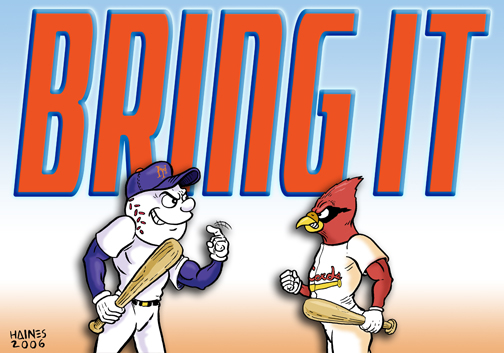
Then there was our 7 car — wow. A trio of Shea vendors who'd changed back into their Yankee gear and were rehearsing really lame gangsta raps. Some braying doofus complaining that the top team in each league should just go right to the World Series and suggesting that an NLCS win against the Cardinals “would exorcise the ghosts of Jack Clark and John Tudor.” (Huh?) And, interspersed with drunk staggering Met fans, the handful of outer-borough locals who'd gotten on the empty 7 at Main Street in Flushing and looked up in uncomprehending terror when 56,000 people stormed their car a stop later.
(Oh, and once the 7 finally crawled its way to Times Square, the 2 was running local. OK, that wasn't so amusing.)
Speaking of taunts, one of our upper-deck neighbors deserved a seat upgrade for high-quality tormenting of Kenny Lofton after his demand that a bus be moved from behind the outfield fence and out of the batter's eye. (He wasn't wrong — what idiot thought that was a fine place for a bus? — but let's ignore that.) After Lofton struck out, the heckler fired off a string of gems, beginning with “TURN OFF THE SCOREBOARD! I CAN'T SEE THE BALL!” and progressing to “TIME OUT — THERE'S PAINT ON THE FIELD!” Good stuff — but, alas, completely inaudible to the players a quarter-mile below. That guy should have been escorted to a spot behind the Dodger dugout at once.
And finally, the elevator at Clark Street, which was filled with Met fans and one young woman in a Yankee shirt, accompanied by her Met-affiliated boyfriend. That was fine. It was even fine when she sighed that “I'm surrounded.” But it was not fine when she began woofing that it didn't matter, because the Yankees were going to go all the way, that they'd win the Subway Series again.
Normally I let this kind of thing ride; after an 11-1 loss I certainly would have. But after pushing the Dodgers to the brink — and on the same day the Tigers had beaten That Other Team? Nuh-uh.
“Yankees, huh — whose name do you have on the back?” I asked. (Confession: I already knew.)
“Um…A-Rod,” she said.
“Ohh,” I said. “The clutch hitter.”
The car began to snicker.
“I didn't even buy this shirt,” she stammered. “Someone gave it to me.”
“He was great today,” I said. “And he's like a .500 hitter — if you're up 10 or down 10.”
Open laughter now. The Yankee girl hid her face in her boyfriend's shoulder. And as we walked out of the station, I heard her mutter “it's true — I hate like half my team.”
Ah, winning. It really does change everything.
by Jason Fry on 6 October 2006 6:29 am
Nothing like victory to turn Shea indignities into amusements.
Your co-bloggers and their wives, famous in these precincts for their remarkable patience, took up residence in the upper deck within high-fiving distance of planes leaving La Guardia, and immediately had to marvel at our neighbors to the immediate rear. These guys should have been the subjects of some kind of medical experiment: They combined the manic energy of puppies with the alcohol capacity of Viking war chiefs. They were plenty obnoxious (though at least they didn’t seem to have a mean bone in their bodies), and in an 11-1 loss would no doubt have become unbearable companions early. But as accompaniments to a distant 4-1 win that never seemed particularly in doubt? What the heck. They were tolerable and even fitfully amusing. Or at least ignorable.
Similarly, getting from the top of the upper deck to the 7 train was not an odyssey for the timid. It took half an hour, much of that spent in the human equivalent of stop-and-go traffic on the south side of Roosevelt Avenue, watching one particularly wasted youth climb over the fence (topped with really nasty, sharp metal twists that you wouldn’t want anywhere near your crotch or your palms) between the street and the parking lot four times, falling twice. He kept going back and forth, and I don’t have the faintest idea why. Maybe he just liked falling off fences. (In perhaps the least-surprising development in the history of Shea Stadium, he turned out not to have a Metrocard.) As before, in an 11-1 loss this confinement and nearby dipshittery would have been torture. After taking a commanding 2-0 lead in the NLDS? It was surreal and kind of fun — Would we ever reach the 7? Would Asshat Boy fall off the fence again? Would he respond to the crowd’s increasingly inventive taunts?
Then there was our 7 car — wow. A trio of Shea vendors who’d changed back into their Yankee gear and were rehearsing really lame gangsta raps. Some braying doofus complaining that the top team in each league should just go right to the World Series and suggesting that an NLCS win against the Cardinals “would exorcise the ghosts of Jack Clark and John Tudor.” (Huh?) And, interspersed with drunk staggering Met fans, the handful of outer-borough locals who’d gotten on the empty 7 at Main Street in Flushing and looked up in uncomprehending terror when 56,000 people stormed their car a stop later.
(Oh, and once the 7 finally crawled its way to Times Square, the 2 was running local. OK, that wasn’t so amusing.)
Speaking of taunts, one of our upper-deck neighbors deserved a seat upgrade for high-quality tormenting of Kenny Lofton after his demand that a bus be moved from behind the outfield fence and out of the batter’s eye. (He wasn’t wrong — what idiot thought that was a fine place for a bus? — but let’s ignore that.) After Lofton struck out, the heckler fired off a string of gems, beginning with “TURN OFF THE SCOREBOARD! I CAN’T SEE THE BALL!” and progressing to “TIME OUT — THERE’S PAINT ON THE FIELD!” Good stuff — but, alas, completely inaudible to the players a quarter-mile below. That guy should have been escorted to a spot behind the Dodger dugout at once.
And finally, the elevator at Clark Street, which was filled with Met fans and one young woman in a Yankee shirt, accompanied by her Met-affiliated boyfriend. That was fine. It was even fine when she sighed that “I’m surrounded.” But it was not fine when she began woofing that it didn’t matter, because the Yankees were going to go all the way, that they’d win the Subway Series again.
Normally I let this kind of thing ride; after an 11-1 loss I certainly would have. But after pushing the Dodgers to the brink — and on the same day the Tigers had beaten That Other Team? Nuh-uh.
“Yankees, huh — whose name do you have on the back?” I asked. (Confession: I already knew.)
“Um…A-Rod,” she said.
“Ohh,” I said. “The clutch hitter.”
The car began to snicker.
“I didn’t even buy this shirt,” she stammered. “Someone gave it to me.”
“He was great today,” I said. “And he’s like a .500 hitter — if you’re up 10 or down 10.”
Open laughter now. The Yankee girl hid her face in her boyfriend’s shoulder. And as we walked out of the station, I heard her mutter “it’s true — I hate like half my team.”
Ah, winning. It really does change everything.
by Greg Prince on 5 October 2006 7:03 pm
OK, Glavine…Tom. It's on you tonight.
I don't want to contradict myself from yesterday when I said the starting pitcher issue is overemphasized in the postseason, but based on the variables that revealed themselves in Game One — namely the use of all five prime Met relievers — it would be helpful to have Tom Glavine give us those six innings that were requested of John Maine. In fact, if he wants to give us those plus maybe the inning and change Maine left on the table at Willie's behest, I wouldn't complain.
Is Tom Glavine a “big-game pitcher”? Who the hell knows? I don't care about his Brave postseason record. That was a million baseball years ago. As a Met, there haven't been a ton of big games for him to pitch. 2003 and 2004 were the years Glavine woke up every morning and looked in the mirror and wondered what the hell was I thinking? for signing here. Last year the pitcher and the team seemed to land on the same page as going concerns. And this year Tom was as big a reason as anybody for the Mets clinching the division from the get-go.
So is he a big-game pitcher? Well, it's a baseball game and he's a big pitcher and he had a real nice game against the Dodgers in September and not such a great one in June. He's better of late than he was in the middle of the season. He took his St. Joseph's for Children and he's healthy as far as we know. And, though it won't show up in the boxscore, he's a Met. Never thought I'd say it with conviction, but he's one of Ours. During the pregame intros Wednesday, he received an audibly louder cheer than most of his non-starting teammates (including one from this torch 'n' grudge bearer in Row R). His Shea greeting owes, I figure, to his career stature, his franchise longevity and the amount we've got riding on his head/left arm.
On a club whose rotation probably didn't turn to plan more than three times consecutively all year (as the plan changed from moment to moment), he's our rock. I'd say him and Trachsel, but Trachsel hasn't pitched since September 23 and, as the saying goes, he's Trachsel. Tonight's starter is Glavine. He's Glavine.
He'd better be.
by Greg Prince on 5 October 2006 7:03 pm
OK, Glavine…Tom. It’s on you tonight.
I don’t want to contradict myself from yesterday when I said the starting pitcher issue is overemphasized in the postseason, but based on the variables that revealed themselves in Game One — namely the use of all five prime Met relievers — it would be helpful to have Tom Glavine give us those six innings that were requested of John Maine. In fact, if he wants to give us those plus maybe the inning and change Maine left on the table at Willie’s behest, I wouldn’t complain.
Is Tom Glavine a “big-game pitcher”? Who the hell knows? I don’t care about his Brave postseason record. That was a million baseball years ago. As a Met, there haven’t been a ton of big games for him to pitch. 2003 and 2004 were the years Glavine woke up every morning and looked in the mirror and wondered what the hell was I thinking? for signing here. Last year the pitcher and the team seemed to land on the same page as going concerns. And this year Tom was as big a reason as anybody for the Mets clinching the division from the get-go.
So is he a big-game pitcher? Well, it’s a baseball game and he’s a big pitcher and he had a real nice game against the Dodgers in September and not such a great one in June. He’s better of late than he was in the middle of the season. He took his St. Joseph’s for Children and he’s healthy as far as we know. And, though it won’t show up in the boxscore, he’s a Met. Never thought I’d say it with conviction, but he’s one of Ours. During the pregame intros Wednesday, he received an audibly louder cheer than most of his non-starting teammates (including one from this torch ‘n’ grudge bearer in Row R). His Shea greeting owes, I figure, to his career stature, his franchise longevity and the amount we’ve got riding on his head/left arm.
On a club whose rotation probably didn’t turn to plan more than three times consecutively all year (as the plan changed from moment to moment), he’s our rock. I’d say him and Trachsel, but Trachsel hasn’t pitched since September 23 and, as the saying goes, he’s Trachsel. Tonight’s starter is Glavine. He’s Glavine.
He’d better be.
by Greg Prince on 5 October 2006 7:52 am
Here's one vote for starting more games at 4 o'clock. It's an outstanding time of day to witness postseason baseball in person.
Golden sunlight bathes Shea in early October between 3 and 4. Or so I just learned. As I sat in gorgeous weather waiting for the festivities to unfold, I marveled at how gol'dang good Queens looked, how the construction in what used to be the parking lot (there's space for maybe eight cars now) is spreading, how this must have been what it felt like in 1969 while Tommie Agee and Ron Swoboda sprinkled their gloves with pixie dust.
Of course we were the 4 o'clock start, us and the Dodgers — media markets 1 and 2 — because our teams and all teams are the scum of the earth, except for the Yankees who make the world go round. We were instructed by ESPN to scurry in unison to our ratholes after sundown so Captain Fantastic could Lead By Example in prime time. Funny, though: Fox has been so buoyed by Yankee ratings October after October that next year not a single Division Series game will be appear on over-the-air network television. Memo to soulless corporations with no feel for what you're broadcasting…did it ever occur to you that maybe shoving the ex-dynasty down everybody's throats for a decade soured America on its erstwhile National Pastime?
Meanwhile, first pitch 4:09 PM, despite the pleasing aesthetic aspects, was an admitted inconvenience for a lot of people with steadier jobs than mine. The three people who made my entrance possible by inviting me to be their fourth all showed up long after the action commenced. I heard tales from other quarters of folks with valuable playoff tickets that seemed to be going wanting as Dodger hour approached; responsibility's an ugly burden. I half-expected Shea to look like The Ted. It didn't, not at all. Mets fans will fight their way past deadlines and punchclocks and commutation hassles to see three, five, nine or fifteen innings of heartstopping baseball. I saw no pockets of unoccupied orange, blue, green or — where we were — red.
And was it not poetic media justice that the game the elitists just had to have in that all-important 8:20 slot got RAINED OUT? Steve Somers took one irate call after another from Yankee fen complaining about being forced to endure a delay until 10 PM and then be told to get their 26-ringed asses back to the Bronx by 1 PM the next day. Since we're all sports consumers, I tried to feel some simpatico for those put out by forces beyond their control.
I didn't.
Now those magnetic Yankees and the oodles of precious eyeballs they're alleged to attract will be apart as their ALDS with the Tigers continues in the early afternoon. And we will be in the spotlight dance after 8 o'clock. It will be chillier than it was Wednesday and it will be darker and it will be inconvenient for its own set of reasons. If there's rain (there's not supposed to be), well, that will suck, too. But we're Mets fans. We only complain when we don't have a game at all.
by Greg Prince on 5 October 2006 7:52 am
Here’s one vote for starting more games at 4 o’clock. It’s an outstanding time of day to witness postseason baseball in person.
Golden sunlight bathes Shea in early October between 3 and 4. Or so I just learned. As I sat in gorgeous weather waiting for the festivities to unfold, I marveled at how gol’dang good Queens looked, how the construction in what used to be the parking lot (there’s space for maybe eight cars now) is spreading, how this must have been what it felt like in 1969 while Tommie Agee and Ron Swoboda sprinkled their gloves with pixie dust.
Of course we were the 4 o’clock start, us and the Dodgers — media markets 1 and 2 — because our teams and all teams are the scum of the earth, except for the Yankees who make the world go round. We were instructed by ESPN to scurry in unison to our ratholes after sundown so Captain Fantastic could Lead By Example in prime time. Funny, though: Fox has been so buoyed by Yankee ratings October after October that next year not a single Division Series game will be appear on over-the-air network television. Memo to soulless corporations with no feel for what you’re broadcasting…did it ever occur to you that maybe shoving the ex-dynasty down everybody’s throats for a decade soured America on its erstwhile National Pastime?
Meanwhile, first pitch 4:09 PM, despite the pleasing aesthetic aspects, was an admitted inconvenience for a lot of people with steadier jobs than mine. The three people who made my entrance possible by inviting me to be their fourth all showed up long after the action commenced. I heard tales from other quarters of folks with valuable playoff tickets that seemed to be going wanting as Dodger hour approached; responsibility’s an ugly burden. I half-expected Shea to look like The Ted. It didn’t, not at all. Mets fans will fight their way past deadlines and punchclocks and commutation hassles to see three, five, nine or fifteen innings of heartstopping baseball. I saw no pockets of unoccupied orange, blue, green or — where we were — red.
And was it not poetic media justice that the game the elitists just had to have in that all-important 8:20 slot got RAINED OUT? Steve Somers took one irate call after another from Yankee fen complaining about being forced to endure a delay until 10 PM and then be told to get their 26-ringed asses back to the Bronx by 1 PM the next day. Since we’re all sports consumers, I tried to feel some simpatico for those put out by forces beyond their control.
I didn’t.
Now those magnetic Yankees and the oodles of precious eyeballs they’re alleged to attract will be apart as their ALDS with the Tigers continues in the early afternoon. And we will be in the spotlight dance after 8 o’clock. It will be chillier than it was Wednesday and it will be darker and it will be inconvenient for its own set of reasons. If there’s rain (there’s not supposed to be), well, that will suck, too. But we’re Mets fans. We only complain when we don’t have a game at all.
|
|