The blog for Mets fans
who like to read
ABOUT US
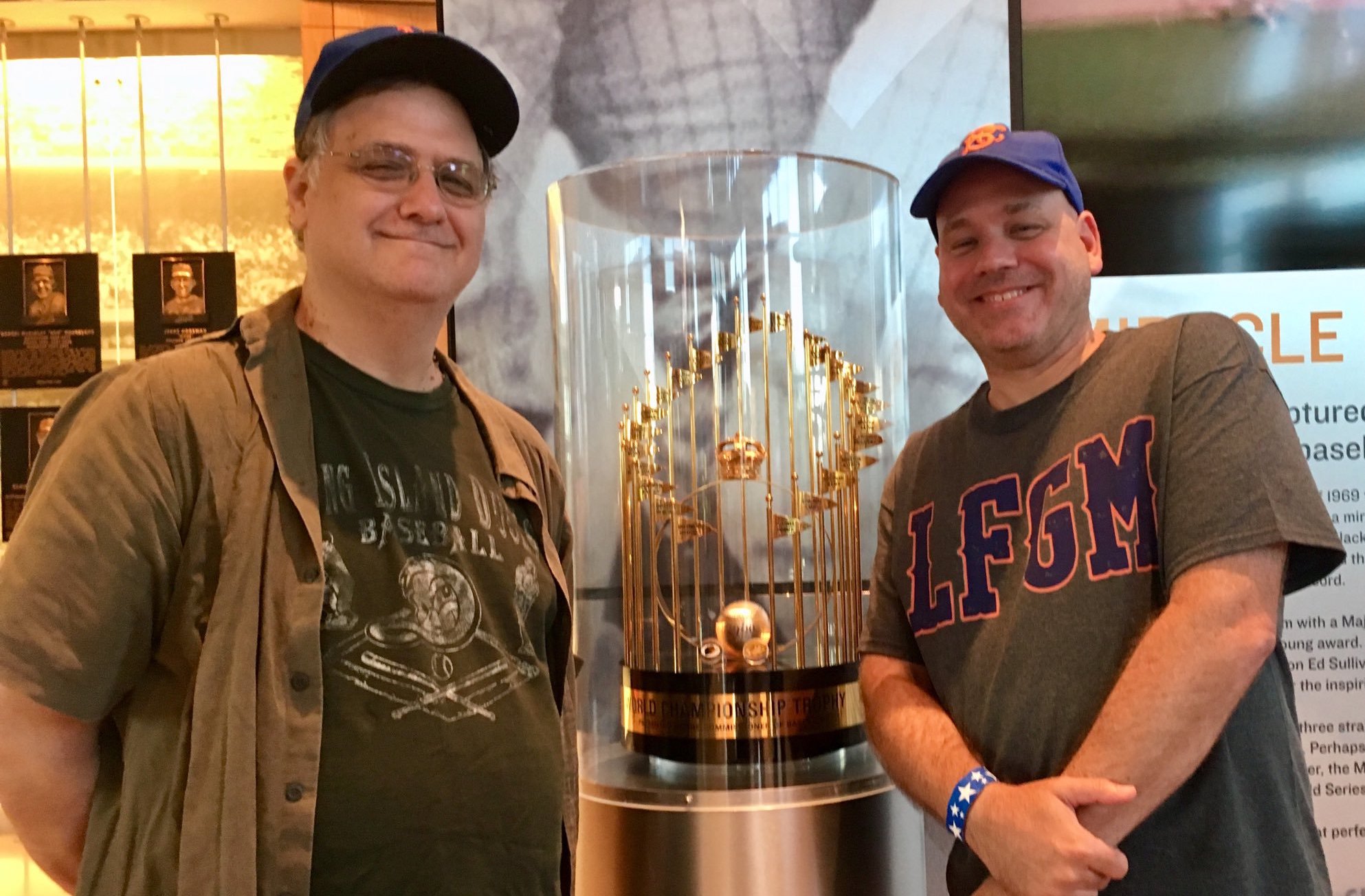
Faith and Fear in Flushing made its debut on Feb. 16, 2005, the brainchild of two longtime friends and lifelong Met fans.
Greg Prince discovered the Mets when he was 6, during the magical summer of 1969. He is a Long Island-based writer, editor and communications consultant. Contact him here.
Jason Fry is a Brooklyn writer whose first memories include his mom leaping up and down cheering for Rusty Staub. Check out his other writing here.
Got something to say? Leave a comment, or email us at faithandfear@gmail.com. (Sorry, but we have no interest in ads, sponsored content or guest posts.)
Need our RSS feed? It's here.
Visit our Facebook page, or drop by the personal pages for Greg and Jason.
Or follow us on Twitter: Here's Greg, and here's Jason.
|
by Greg Prince on 2 June 2006 7:13 am Welcome to Flashback Friday, a weekly feature devoted to the 20th anniversary of the 1986 World Champion New York Mets.
Twenty years, 43 Fridays. This is one of them.
Lest you think the 2006 Mets can’t possibly catch up to the achievements of their 1986 big brothers, we’re already 100 games ahead of one particular ’86 pace.
In 2006, the Mets used their tenth starting pitcher in their 49th game.
In 1986, the Mets used their ninth starting pitcher in their 149th game. They never even got to a tenth.
What a bunch of pikers!
We know all too well our habit of offering repeated opportunities to lukewarm arms from far and wide of late. And we won’t be shocked if our starters used total shoots into the high teens before the year is up. The real surprise may be that the pitching-rich New York Mets of 1986 actually had to use nine starting pitchers themselves.
Without looking, who do you think they were?
Gooden? Easy.
Darling? He’s on TV.
Ojeda? What a steal!
Fernandez? No start was as good as his final relief appearance against Boston, but he did make the All-Stars based on his starting.
Those are the Big Four. Depending how you take your bigness, you could make a case for an Extra Large Five. The symmetry of Ojeda 18 wins; Gooden 17; Fernandez 16; Darling 15 could continue with Roger McDowell’s 14, ‘cept for the pesky detail that the Rajah was a reliever. On the studliest staff in the league, it’s almost heresy to imagine there was a vulture feeding off the good works of the virtuosos who comprised the Queens Quartet. From a distance, it’s a puzzler how Roger McDowell accumulated 14 wins from the pen. While it was in progress, it seemed perfectly normal. That our two closers, McDowell and Orosco, combined for 22 victories and 43 saves, speaks to a lot of late-inning lightning. Nobody was complaining too loudly.
But if we’re looking for that fifth Beatle, it wasn’t McDowell. It was reluctantly Rick Aguilera. He was the afterthought of the 1986 rotation, the deep-sea fishing rights clause Adams, Franklin and Jefferson didn’t argue too strenuously in favor of keeping in that Declaration of theirs. Gooden…Ojeda…Darling…Fernandez…fine, fine, just make with the John Hancock.
One got the sense that Davey never felt all that secure about Aggie as his fifth starter. It was Rick’s second year in the bigs, which probably gave him no cred with Johnson. In 1985, the skipper sent down Sid even though he was presumed to have a spot sewn up before spring. Aguilera made the team out of St. Pete in ’86, but when he didn’t make the most of his first three starts (ERA: 8.22), he was replaced in the rotation.
Not easily replaced, but not particularly missed in the short-term. With the Mets having locked down first place early and often, Davey could try to squeeze some use out of Bruce Berenyi. Battling injuries and obsolescence, the ex-Red was inserted into the spin cycle in early May and held a spot into late June. I have to confess that I barely remember Bruce Berenyi contributing to the eventual world champions. With an ERA that topped out at 6.35 after his very last Major League appearance, it’s no wonder. On the ’86 Mets, you could pencil in Bruce Boisclair for seven starts and you wouldn’t feel it in the pocket.
By July, Rick Aguilera reclaimed his spot and was actually quite effective when there was little pressure beyond appearances’ sake. He finished with 10 wins and an earned run average below 4, a quietly impressive renaissance. Still, he got no love when it counted. Mets need a starter for an inexplicable exhibition against the Red Sox in early September? Use Aguilera. Mets have a pointless doubleheader on the second-to-last day of the regular season? Use Aguilera. Mets lining up their rotation for the post-season? Forget Aguilera.
Rick’s respectable three shutout innings in Houston Game Six were overshadowed by Roger’s remarkable five zeroes. And the W affixed to his record from the single biggest win in franchise history, Boston Game Six? Hard to say that was hard-earned. It was Aguilera’s surrender of two runs in the top of the tenth that allowed him to be pitcher of record on the winning side when the bottom of the tenth yielded three for the good guys. The Mets have 12 World Series wins in their history. Rick Aguilera has as many as Tom Seaver and one more than Doc Gooden and Al Leiter combined. Go figure.
So, it’s the Big Four or Five plus the anonymous Berenyi. That’s six. We said there were nine. We’ll cut the suspense already yet. A backlog of twinbills threw lefty specialist Randy Niemann (his specialty was an inability to retire big league hitters) onto the mound to start a game against the Cardinals in August. He won, the son of a gun. And the general malaise permitted a team that has it clinched with two weeks to go allowed young John Mitchell a shot against the Phillies after the fact in September. Mitchell was the John Maine of his day except he didn’t get hurt but he did lose.
The ninth starter the Mets used in 1986 — chronologically the seventh — was the feelgood story of the summer. Well, one summery night anyway. With Aggie in the doghouse and Berenyi’s ankle barking, the Metsies reached down to Tidewater and brought up an aged neophyte to start June 9 at Shea against Philadelphia.
Rick Anderson was 29. Old for a freshman, not particularly young in baseball thinking then and not that tender now. He had been in professional baseball (or at least the Mets system) since 1978. Eight years later, he was getting his first taste of white balls for batting practice and never handling your luggage. He was in The Show.
Everybody loved Rick Anderson. Everybody. He was, unbeknownst to self-styled diehards like myself, Uncle Andy to his younger mates who remembered him from the bushes. Everybody wanted to do right by Uncle Andy. “This is a sentimental choice,” Davey admitted. “He has been a minor league workhorse and he’s deserved a shot in the past.” Entering play at 37-15, nine up on Montreal, the manager could afford to be sentimental.
His teammates and manager were into it. The crowd was, too. The Jim Morris of his time was granted the same two-strike clapping that accompanied Doc and the others. Anderson held up his end of the bargain. One lousy unearned run in the fourth put him behind, but the Mets rallied for two in the sixth. Uncle Andy was pinch-hit for in the bottom of the seventh with a 2-1 lead. He gave up only four hits and two walks.
About the only thing that went kind of wrong in 1986 was Rick Anderson was denied a victory on his very special night. With Kevin Gross working his usual mysterious spell over Met bats, they functioned no more. Meanwhile, Orosco coughed up one in the eighth and Sisk did his thing in the tenth and the Mets lost 3-2. Uncle Andy was dispatched to Tidewater with an 0.00 ERA and 0-0 record.
It didn’t make much of a dent in the standings, but it was disappointing for 24 hours. What a shame, this guy who worked so hard all those years. Stupid Phillies. Stupid Sisk.
The postscript was a little anticlimactic. Anderson came back after the break and pitched some long relief, getting four more starts: three in doubleheaders, one the afternoon after the division was put away. His first win came at Wrigley but wasn’t much of a story considering George Foster was busy accusing the Mets of racism. Final Mets numbers for Rick Anderson were 2-1, 2.79. About a hit an inning, but hardly any walks. He didn’t make the postseason roster and he didn’t see 1987 with the Mets. Instead, Rick Anderson became one of the first links in what severe nutcases like myself refer to as the Ed Hearn chain. It’s also Uncle Andy’s. Even Goose Gozzo’s, for god’s sake.
Anderson, Hearn and Gozzo for Chris Jelic and David Cone.
Cone for Jeff Kent and Ryan Thompson.
Thompson and Reid Cornelius for Mark Clark.
Clark, Lance Johnson and Manny Alexander for Turk Wendell, Mel Rojas and Brian McRae.
McRae and Rigo Beltran for Darryl Hamilton and Chuck McElroy.
McElroy for Jesse Orosco.
Orosco for Joe McEwing.
Super Joe released — the chain goes snap!
Rick Anderson, now the Twins’ pitching coach under ex-Tide teammate Ron Gardenhire, signed with the Mets in June 1978. He was traded for a guy who was traded for a guy who was traded for a guy who was traded for a guy who was traded for a guy who was traded for a guy who was traded for a guy who was still here as late as March 2005. What could be more Amazin’?
I mean besides Julio Franco signing his first pro contract with the Phillies in June 1978, the same month Rick Anderson signed his first pro contract with the Mets, and Franco being traded for Von Hayes in December 1982, and Hayes driving in the tying run off Orosco that denied Anderson his first big league win on June 9, 1986, twenty years before Franco became the überelder statesman of the 2006 Mets…who have already used one more starting pitcher in 52 games than the 1986 Mets did in 162, yet are in first place on the Second of June by five lengths over Atlanta and 5-1/2 over Philly?
Besides that, not much.
by Greg Prince on 1 June 2006 4:37 pm By walking off the field freshly triumphant after 13 innings, the Mets continue to provide free advertising for the most relevant blog of them all, and everything is fairly wonderful, but I'm surprisingly bugged that in his six May starts, including last night's sublime pitchers' duel, Pedro Martinez's won-lost record was 0-1.
That's not Pedro Martinez. That's maybe Pedro Feliciano. Or Teddy Martinez in mop-up duty. Pedro should have been Maydro. According to Metsblog, he posted a 2.14 ERA in the merry, merry month. How on earth is that 0-1 material? At worst, it should be 0-0-6 because I continue to be in Pedro's (or K-Dro's) Corner (or Korner) from last Friday night. He said then he didn't lose. He's right. He doesn't lose. At least he hasn't in 2006 from this vantage point.
I don't usually get caught up in pitchers' records because they're subject to so many variables. The only number that ever mattered was 20 and twenty-game winners are an extinct species in these parts; Frank Viola was our last. If starters, almost by design, almost never finish, decisions are bound to be community property with the bullpen. So why dwell on an ND when you can revel in an Endy? Besides, Pedro needn't win another game to gain induction into Cooperstown five years from the minute he retires. But he's entitled to those he's earned on our behalf.
There aren't enough words or awards to shower on this man. What he has done for this franchise is positively Keithish (the fierce first baseman, not the lovably loopy analyst). Yesterday, Lee Jenkins wasted a lot of space in the New York Times picking over the carcass of the Scott Kazmir trade as if we're all donning sea-green armbands every time he starts in St. Petersburg. I'm with the informed dissenters who are convinced that if Kazmir stayed, Pedro never would have come, that the overhaul of this team would have never taken place the way it has. When you consider where we were pre-Pedro, 2005 and 2006 to date have marked a remarkable renaissance for what was, twenty short months ago, a floundering franchise.
That's not to excuse a transaction that even I, who didn't hate it, can't defend any longer. It's just to say I like very much what's happened to the Mets since the end of 2004 and if we had to, in essence, give up a budding stud to get a transcendent one (along with a first-place future to be named not that much later), then I chalk Scott Kazmir up to the cost of doing business.
On the First of June 2006, I'm not worried about departed Devil Rays or decrepit palace intrigue. I'm not even overly overwrought about Pedro officially being 5-1 instead of the 11-or-so-0 he deserves to have next to his name…though his teammates not hitting Brandon Webb a lick is no shame. Like our ace, he was as crisp as a bag of Baked Lays. But Brandon Webb's not my cause.
Mets got the win, right?
Milledge threw out Counsell at third on a speeding bullet, right?
Jose Valentin owned second base on both sides of the ball, right?
Endy Chavez took drama lessons from David Wright, right?
Duaner Sanchez promises to take good care of Pedro's W, right?
Then all is right with the world.
by Jason Fry on 1 June 2006 5:30 am Not bad for a night's work: a pitchers' duel from a bygone era, some pretty defense, clutch relief, a whale of a throw and a(nother) Met walkoff. And 13 innings in roughly the time to play one moderately long game of regular duration.
Brandon Webb was first sighted in this park three years ago, beating us in his first-ever start. Of course, that put him in a class numbering somewhere in the thousands, so it was a shock to realize how good this matchup promised to be. Brandon Webb? He's 8-0? Unscored upon since seemingly forever? Really? Strange things happen out in the desert when you stop paying attention.
The Webb hyperventilating sure wasn't some heat-induced delirium, though: With that sinker of his, it's a wonder he ever loses. Considering he doesn't walk anybody, waiting for the sinker or two per start that won't sink is a pretty tenuous game plan. Luckily, enter Pedro J. Martinez, who's rarely seen an occasion he can't rise to. (By the way, a pox on these interviews with players during the game. Is nothing sacred?)
Other random semi-insights and asides before we head into an off-day:
• I'd pay for a DVD of “Paul Lo Duca's Greatest Tantrums.” When Lo Duca loses it, he gets his money's worth — I'd put him in the Pissed-Off Pantheon with the likes of Dallas Green and Dennis Cook. After Carlos Beltran finished his third minute of writhing around on the ground (eeek), SNY cut over to Lo Duca and found him still trying to make Paul Emmel's hair catch fire by glaring at him. (No way was that a swing, by the way.)
• Oh what a throw from Lastings Milledge! That seed was the defensive equivalent of a no-doubter home run — the moment the ball left Milledge's hand, I let out a little yelp of happy anticipation, much the same sound you make when you see a ball leave the bat at that certain angle and velocity. Seeing Wright's glove pop backwards when the ball arrived on the fly was quite something, too. If Milo can do things like that on even a semi-regular basis, I'll forgive him whatever mustard he wants to anoint his game with.
• What was up with the back of Brandon Medders' head? Does he sleep on the rosin bag? Did the bullpen catcher peg him with it?
• I still don't know why Jose Valentin can't bat without his helmet flap folding the top of one ear over, but he can do everything else. That move to third on the ball hit to his right, after he saw the ball was hit slowly enough that baseball conventional wisdom didn't apply, was the epitome of cagey veteran. The only downside? If he keeps this up, we'll be too patient with apparently washed-up pinch hitters for years, remembering how wrong we all were about Valentin. (Seems like a fair deal right now, too.)
• It's official: Johnny Estrada is the worst bunter in major-league history. And he's a catcher! How many bunts has he seen from two feet away that he can't manage one himself? I'm glad he didn't get it down, but for Chrissakes….
• When Ramon Castro came up, Emily asked what would happen if somebody got hurt, seeing how the Round Mound of Pound was our final position player. I ventured that they'd move whomever could fill in best to the position vacated by the injured player, then stick a pitcher in the outfield and move him between left and right depending on who was up, shades of Orosco and McDowell in the Ray Knight/Eric Davis game. (Morning-after add: A move Davey swiped from Whitey Herzog, who'd sometimes do it just to conserve pinch-hitters.) And, I offered, it would be kinda fun to see. In theory, of course.
by Greg Prince on 31 May 2006 8:32 pm It went unremarked upon as far as I could tell that when David Wright had to sit out a game in Florida, Jose Valentin filled in at third and became the Mets' 132nd third baseman. With The David firmly ensconced there, it seems likely (barring everything) that the hot corner will be warm and snuggly for a good, long while.
But second base is a mess. Second base is usually a mess. Nobody counts all the second basemen we've gone through (it's 113). Nobody's written a song, as far as I know, to acknowledge that second base can't be satisfactory filled. One was written about the then-79 third basemen in Mets history. It showed up on An Amazin' Era, the 25th anniversary videocassette celebration. Third base was a lingering Mets joke then. Mr. Wright has at last made it the feelgood finale to an overlong romantic comedy.
But second base gets no love when it comes to earning angst. Second base has almost always been a problem child among Met positions. Well, a problem child whose misbehavior is more “maybe we should get him some help” rather than “YOU GO TO YOUR ROOM NOW!” After all, we won two world championships with four second basemen. Boswell and Weis platooned. Backman and Teufel platooned. Gregg Jefferies manhandled the position for a little while. Jeff Kent stood there for a time. Both would hit a ton, but not for us. We imported some very credentialed talent to play second. Roberto Alomar couldn't be bothered. Carlos Baerga was going through a phase. Second base has never been easily tamed.
There were a few individual success stories. Fonzie, of course, though only after he was yanked off third for Ventura. Ron Hunt early. Doug Flynn primarily with the glove. Felix the Cat could spray hits around and turn the pivot. But while second base hasn't exactly been the sack of shame, it hasn't been the sack of honor either.
Now it's a sack of…
The Mets are proving 50 games into the season that you can build and maintain a first-place lead without a regular second baseman. Conclusion: It's just not that important a position.
My logic professor warned against such inductive reasoning. But honestly, who's on second? And does it really matter?
2006 in brief has brought us this:
• Anderson Hernandez wins the job by default. Everybody's thrilled because he sure can field. Everybody gets a little less thrilled when it becomes apparent he sure can't hit. Then he gets hurt. Everybody takes a deep breath because…
• Kaz Matsui wins the job by default. Everybody's thrilled because he sure did hit an inside-the-park homer his first at-bat (that first AB bit proving most charming once again) and he gets to balls and hangs in on double plays like he never did before, like Willie was working with him behind Petco Park as soon as he returned. He got a few timely hits and the folks got off his back but then he stopped getting timely hits and the equation that worked pretty well for Hernandez — good glove, little bat — began to work against Matsui in popular and practical terms. He's benched and nobody minds because…
• Jose Valentin wins the job by default. He's part of a mix & match, actually, but we haven't seen Kaz anywhere near second and Chris Woodward continues to anchor the bench. Jose Valentin, it will be recalled, was perhaps the most reviled Met since Gerald Williams. But that was all the way back in April. The 99.9% of Mets fans who assumed he was utterly worthless (I'll count myself among the vocal majority) were delightfully surprised by his offensive surge in his outfield cameos and decided they couldn't get enough of him. What's that? He can play second, TOO? Who knew? Put him in! Put him in! He doesn't look particularly comfortable out there and we're bound to pay for it, but he is hitting, so no complaints.
Until the ball that goes under his glove leads to the run that dooms Pedro when Brandonmania kicks into high gear, if in fact Valentin is starting tonight, and I'll assume he is. Pedro deserves every hot Met bat he can get.
None of these fellows is the 2006 answer. Randolph has already ruled out the return of Anderson Hernandez any time soon (though rules are made to be broken). Kaz seems lost. He's seemed lost before only to surge to the brink of being found, so maybe there's a tiny bit of hope there. Jose Valentin has proved himself the moral equivalent of Chase Utley for May; we'll see about June. I think Chris Woodward's still on the team.
Yes, it's a stew. But so were Backman and Teufel. So were Boswell and Weis. Those stews weren't as ingredient-heavy as these, but maybe we can get by. Maybe Jeff Keppinger will eventually be judged to have paid his debt to society and be released from a Virginia prison. Maybe, as suggested somewhere downblog, Mark Grudzielanek, a name-brand second baseman and the assumed December answer to our second base spelling test, will finally get his geography straight and head to New York. Maybe Edgardo Alfonzo, released by the Angels, will come home and…damn, he's already signed with Toronto. And he's batting .089.
Maybe Keith Miller's not busy.
I don't have a solution. I don't have a strong preference, other than for routine competence on both sides of the ball. It's second base on the Mets — I don't think I can expect much more.
by Greg Prince on 31 May 2006 7:34 am If you're looking for highs in the course of a season, you start with wins. But next to those, I can't think of anything more uplifting than the big-time position prospect who makes an unexpected middle-of-the-schedule debut. It's little wonder that we all got fairly excited when Lastings Milledge became the 789th Met Wednesday. He didn't look scared in doing so and he didn't sound scared talking about it afterward. The scary part is wondering what's next.
For a hotshot to get a shot between Opening Day and September 1, it usually means something has gone wrong, often terribly wrong. Appendicitis striking your starting rightfielder would qualify.
David Wright was that rare phenom who got the mid-season call when things were going reasonably well for the big club. The Mets hadn't yet fallen out of the 2004 playoff picture and Ty Wigginton was representing professionally at third. Wright was a case of we can't keep 'em down on the farm anymore. Jose Reyes' promotion a year earlier reflected his readiness but also the dreck that the 2003 Mets had shown themselves to be. Or was anybody particularly satisfied that Rey Sanchez was our starting shortstop?
Neither Wright nor Reyes, for all their advance pub, was the classic franchise-saver, the five-tool power bat we'd been promised since the day we signed on as Mets fans. Wright was going to be a real good hitter, it was said, but I don't remember being guaranteed a classic slugger. He hit more homers last year as a Major Leaguer than he did in any one season in the minors (though his combined bushes/bigs total in '04 was a nifty 32). Reyes was about defense, then speed and then hitting, certainly not power-hitting. Even today, he is patronized after home runs with “you sure hate to see him do that.” Yes, I can't stand the way he drives in runs and matures at the same time.
As you indicated, there was no one whose recall was more hyped than Darryl Strawberry. What had gone terribly wrong to precipitate his arrival was the Mets as a whole. 1983: Seaver starts his emotional homecoming and the Mets win on Opening Day. Craig Swan starts the second game and the Mets win again. Then it was toilet time in Flushing. We were 6-15 when the clarion call to Tidewater went out. Up came Darryl and Tucker Ashford. Tucker Ashford? Yeah, the Mets called up two players to make their debut on May 6, 1983. Ashford was the pack of gum you buy at the CVS so the cashier doesn't think you're some kind of weirdo for buying whatever the other, far more obvious thing is.
Tucker Ashford very briefly took over for Hubie Brooks at third. Darryl Strawberry replaced a vacuum in the heart of the Mets' batting order, one that had been sucking the life out of rallies since 1962. There was almost always a hole there, but in 1983 it was astoundingly noticeable. You could drive the National League East through it. Darryl Strawberry becoming a Met had been a dream since that Sports Illustrated article introduced him to the world. Hey, we have the No. 1 pick in the draft… We had waited almost three full years for Strawberry specifically, let alone all of our lives for anyone remotely like him.
Of course it was a jolt to have him here in the flesh, but the occasion of his promotion was also tinged with sadness. From May 6, 1983 on, there would be no more looking forward to the day Darryl Strawberry arrived. This was it. If he failed, there'd be no “well, at least we still have Darryl Strawberry on his way…D'OH!” I felt a little of that with Milledge Wednesday just as I've felt it with every gonna-be-great Met since Straw. It's a perverse endorsement of the “Me & Bobby McGee” school of scouting: I'd trade all of their tomorrows for one single yesterday of imagining what huge stars they were going to be.
Darryl? Can't say he wasn't a huge star. Can't say he was Ted Williams in any shade either. It's not a wash. He did become the No. 4 Greatest Met of the First Forty Years. He also became at least the second-greatest disappointment among human beings in Mets uniforms whose youths were so promising. I'd rather not go on about this, because Lastings Milledge isn't Darryl Strawberry.
There are some others I sure hope he's not.
I hope Lastings Milledge is not Jeromy Burnitz. Burnitz, like Milledge, like Straw, was a No. 1 draft pick. He wasn't quite as ballyhooed but he did serve as a glimmer of hope amid a present of mud, his future arriving in June of 1993, the world's worst season. Jeromy was a raw rookie, the way I've always read Ron Swoboda was. Very strong. Very unpolished. Like Rocky, you just kind of knew it was never all going to come together for Jeromy. Let's not sell Burnitz altogether short, however. He's had a productive, power-hitting career in distant precincts. His Mets tenures were honorable if ultimately lame. Rumor has it he's still plying his trade in the National League Central.
I hope Lastings Milledge is not Alex Ochoa. Ochoa brought “five-tool player” into our vernacular, almost exclusively as a laugh line. Too bad. Technically, he was a September ('95) callup, but he was tearing up AAA the following summer when he was resummoned for real. As with Straw's '83 and Burny's '93 milieus, 1996 was a Met disaster area. Perfect for a phenom. And Alex was phenomenal. Hit for the cycle in Philadelphia in the eleventh game of his second stay. Was hitting .390 after that. New York profiled him as The Cuban Missile. But the Missile missed most of its targets. Sold to us as the key to the Bobby Bonilla deal (as if Damon Buford and getting rid of Bobby Bonilla weren't plenty enough), Ochoa simply came up short. He didn't work any of his tools all that consistently or superbly; great arm, though. He was sent away for Rich Becker — pretty close to the ultimate insult — and persevered as a helpful spare part on other clubs, eventually earning a ring as a reserve outfielder on the 2002 World Champion Angels. Hasn't played since.
I hope Lastings Milledge is not Alex Escobar. Goodness gracious, I hope Lastings Milledge isn't Alex Escobar. This Alex got his call to glory in May of 2001 for Nadylike reasons. Shorts in the outfield necessitated two shots of Escobar before his time. Neither Jay Payton nor Tsuyoshi Shinjo played Wally Pipp to Escobar's Iron Horse. Alex seized no opportunities. When he returned very late in 2001, he displayed a little pop, just enough to supplement those glowing organizational reports that said Alex Escobar was three matching jackpots on a dollar scratcher. Next thing we knew, he was swapped to Cleveland for Robbie Alomar. It was a trade that helped nobody. Escobar recently resurfaced in Washington. As a National, not a lobbyist.
You can name your own examples of guys we waited and waited for only to be kept waiting. Some, like Payton, had numerous false starts, succeeded for a time and then went away unmourned. Others, like Preston Wilson, never finished their cup of Shea Stadium coffee before moving on (with our slightly reluctant blessing) to tealer pastures. And the Ken Singletons and the Dan Normans and the Gregg Jefferieses and…ah, you know.
But we're not always wrong. We as a people were all over a bonus baby first baseman who debuted to great fanfare on September 22, 1962. Ed Kranepool would come to bat six times in the Mets' first season and get one hit. He was 17 years old. Noted Leonard Koppett amid the luxury of post-Miracle hindsight, “The funny part was, there were Met fans who said, 'This may be our first championship player.'”
Incidentally, Ed Kranepool is 13 years and 9+ months older than Julio Franco. Julio Franco is 26 years and 7+ months older than Lastings Milledge. Ed Kranepool, at 17, was no more than 22 years younger than any 1962 Met (Gene Woodling, whose career ended the same week Eddie's started). The spread between Franco and Milledge is unprecedented on any Mets roster. Warren Spahn, born in April 1921, and Krane, hatched November 1944, set the record, if it can be called a record, in 1965. Julio Franco (August '58) and Jose Reyes (June '83) broke that record* on Opening Day. Franco and Milledge (April '85) set it anew last night.
So what else is old? The last player born before Franco to make a Mets debut was Pat Tabler in 1990. The last Met born before Franco still playing as a Met? Tim Teufel in 1991.
It's 2006.
On the other side of the age coin, Milledge is the most recently born of all 789 Mets, bumping Reyes back one notch. They are two of thirteen Mets to have been born in the 1980s. In chronological order of first Met appearance:
2002: Pat Strange
2003: Reyes, Danny Garcia
2004: Wright, Craig Brazell, Jeff Keppinger, Victor Diaz
2005: Royce Ring, Mike Jacobs, Anderson Hernandez
2006: Brian Bannister, John Maine, Milledge
Three of those guys are on the roster right this very minute. Three have lately seen the DL. Three others are rattling around Norfolk. The other four have scattered to the wind.
It's 2006.
With Reyes and Wright, the team that spawned the Youth of America is nicely making up in quality what it clearly lacks in fresh-faced quantity. Lastings Milledge isn't supposed to stick around all that long for right now, but maybe he'll be our next championship player.
Him and Franco and the 23 other kids who first saw light somewhere between 1958 and 1985.
*I consulted a very helpful spreadsheet shared by Ultimate Mets Database on the Crane Pool Forum to check dates and make assumptions. If I failed to cite an age spread that topped Spahn-Krane before Julio Franco-Reyes did, it's my fault for not being more diligent in looking.
by Jason Fry on 31 May 2006 4:26 am So Lastings Milledge made his Mets debut tonight, accompanied by an enormous wooden cross, enough hype to launch several score circuses and approximately 50,000 mentions of Barry Zito and/or Dontrelle Willis. Collected his first big-league hit, too — a well-struck double off Miguel Batista to lead off the seventh.
Now that we've taken care of the historical record, let's admit that Milledge's debut is the only thing anyone will remember about this game, a listless tropical affair in which Alay Soler ran out of gas after a 10-pitch at-bat and most of the Met lineup looked like it had never filled up the tank in the first place. OK, people who brought dogs to the park will remember it, I suppose. Nothing against man's best friend, but the thought of being seated next to a panting dog on a night in which the stadium already felt like the bottom of an aquarium…ugh. After Milledge got his hit, the cheers vanished so quickly that you'd have thought someone unplugged something. Kid got his hit, it's 7-1 and hot as hell, Willie already threw in the towel by not pinch-hitting for Oliver, we're surrounded by dogs…let's go.
Can't say I blame 'em: I did think of going, but heat, tiredness, parenthood and rumor that Milledge might not make it to Shea in time kept me home. Sorry, Milo — I'll do better by you going forward.
The last big debut I remember swearing I'd attend was David Wright's, and that time I honored my pledge — I grabbed a friend from work and headed out to Shea on July 21, 2004 to see the phenom go 0 for 4 in a 5-4 win for the good guys against the soon-to-be-extinct Montreal Expos, a game about which I remember absolutely nothing except the cheers for Wright. The next day, without me looking down at him (but, if memory serves, with Greg in attendance), Wright would go 2-for-4 and the rest would be recent history.
Had I gone tonight, I would have missed an interesting stat from Elias, passed along by Gary Cohen: When Darryl Strawberry made his big-league debut, he was 21 years and 55 days old. When he took the field tonight, Lastings Milledge was 21 years and 55 days old. Too good to check, as they say in the less-reputable parts of the newspaper biz.
Not that any of us want to be in the business of comparing Milledge to Strawberry. Darryl arrived as “the black Ted Williams” and the savior of a downtrodden franchise, neither of them labels that did him any good. Milledge is, at least officially, just getting a taste until Xavier Nady returns from his appendectomy, and this team doesn't need saviors. (Though another back-of-the-rotation starter would not be turned away.) Straw came advertised as a prodigious home-run hitter; Milledge is still growing into himself, but is more of a contact-and-speed guy. Darryl won a World Series ring for us, but we all thought he'd wind up with more. Milo? Check back in a few months. And then there were worse things for Darryl, none of which we hope to see on Milledge's resume. Oh yeah, and Darryl wound up as a Yankee. Let's not even think about that.
Straw's debut? It was the night of May 6, 1983, at home against the Reds before 15,916 — and unlike tonight, it was a memorable game for reasons beyond personnel. Unlike Milo, Straw would have to wait for that first knock — he got it on May 8, which just happened to be my 14th birthday. On May 6, however, he struck out in the first, popped to third in the fourth, struck out in the seventh and ninth, walked in the 11th, and..well, I'm getting ahead of myself.
Tom Seaver started and went eight, leaving down 3-1. But the Mets tied it on a two-run homer by Dave Kingman with two outs in the bottom of the ninth. The Reds grabbed the lead back in the 10th; the Mets tied it on a solo shot by Hubie Brooks with two outs in the bottom of the 10th. Then, in the 13th, Darryl drew a two-out walk and stole second. Mike Jorgensen walked, and Frank Pastore gave up a walkoff three-run homer to George Foster. The winning run? A technicality, but it was scored by Darryl Strawberry.
Whew! Take a look for yourself — we would have blogged this one to within an inch of its life.
by Greg Prince on 30 May 2006 5:45 pm Nady out an indefinite period for an emergency appendectomy. Coming up from Norfolk, according to WFAN, is Lastings Milledge.
Yes, that Lastings Milledge. The guy we haven't traded so this moment could materialize. Not like this (recover quickly Hawk, we need ya), but here he comes. First Xavier, now the Savior. Except we don't need saving, so we'll see how young Milledge, born in 1985 (!), copes.
(Say, whatever became of Victor Diaz?)
It's dizzying to be a Mets fan these days, isn't it? The Tigers are a great deal of fun thus far and the White Sox are gamely defending their championship when Ozzie Guillen commands them to and the Cardinals are in first place with a new ballpark and the entire N.L. West is finding itself, but are any fans having a wilder and, on all counts, more successful season than us?
Comeback after comeback. Walkoff after walkoff. Character heaped upon Character (that's Upper-Case Character). First place and Lastings, too.
If you have a minute, grab the current New York magazine for an insightful profile of the best team in town (that's not the angle, but it's fun to say). Chris Smith, who does one “the Mets are a strange and wonderful thing” Mets piece per year, traces our surge to superness to the trade for Delgado. He is The Man in and out of the clubhouse, according to the article. Carlos D. may be in a slump, but who would argue the greater point?
It's the June 5 issue of the magazine, the one whose cover story puzzles out what the city might look in the next ten years. My guess is it will have a lot of Mets in it.
by Jason Fry on 30 May 2006 5:13 am The holiday weekend was also my 15th college reunion, so tonight was my first chance in a couple of days to really focus on orange-and-blue dramas. Sure, I did my share of one-earing it over the weekend, which isn't coincidental: As a high-school senior I wound up picking between New Haven and Boston, and opted for New Haven because I thought I'd be able to sometimes see and usually hear the Mets there. (In 1987 the Mets were way up the dial on some low-powered station; as it turned out, even in New Haven listening was hit and miss at night after some Toronto station jacked its signal strength. Boston? No chance.)
Anyway, while keeping an occasional ear on Met doings I did manage to curse Tom Glavine: I tuned in Saturday afternoon to hear a certain excitement in Howie's voice; it was obvious just from the way The Eventual Met's pitches were being described that Something of Import was happening. As I suspected, no Marlin had reached base; no sooner had I started fretting that I'd anger all my friends by spending the next 90 minutes huddled in the fetal position while Glavine pitched the first no-hitter in Mets history than Reggie Abercrombie put an end to that. Oops. Sorry, Glav.
By the time I tuned in Sunday El Duque had departed; tonight I was determined that it was me and the Mets. Well, me, the Mets and endurance: Two rain delays and Trachsel was cruel, and the way Trachsel pitched was crueler. That aside, this one had little pieces to remember even before the extremely satisfying denouement: Lo Duca's ballet for hand, second base and Orlando Hudson's glove was entertaining, as was his double down the third-base line that hit…the bag? (No.) A rock? (No.) The lip of the grass? (Yes!)
As we fought back and coughed the lead up and fought back again, I found myself thinking about baseball teams and the long season. It's an unhappy fact of baseball life that lots of times what gets you to the postseason (or X distance into it) ahead of the other guy is everything breaking right: Major guys don't get hurt, platooners and bench guys and middle relievers have career years, balls land on chalk instead of just beyond it, and so on. With that in mind, if you want some more hopeful spin I sure saw some stuff rotating tonight: Once again we were behind late and I wasn't in the least bit scared — I had a feeling things would line up somehow.
Carlos Delgado is ice-cold? Cliff Floyd is heating up.
Kaz Matsui has finally run out of Met lives? Jose Valentin has found himself.
Xavier Nady can't hit in the clutch? Endy Chavez does nothing but.
Baseball teams sometimes get referred to as machines, but if so they're rarely drive-me-off-the-dealer-lot Ferraris. Instead, they're kit cars whose hoods are always up, with the daily drive a mad scramble for new parts and old parts and slightly reconditioned parts and parts banged into place while cursing and parts extracted and left for some other sucker to make use of. Sometimes the car winds up on the side of the road by June and it's a long walk to next February. Sometimes you get into September babying it and hoping, only to see the dash turn into a sea of red lights. And sometimes….
Shit, I ain't jinxing it. Let's just say that sometimes you get to the end of May and listen approvingly to the engine and flip the dial and hit the fourth great song in a row that's just beginning and you think, Baby, let's floor it.
by Greg Prince on 29 May 2006 6:05 pm Beyond the noble significance in its title, Memorial Day is also considered the beginning of summer. I never quite got that as a kid when I was in school because school went on for another three or four weeks, depending on how the calendar turned. After high school, calling it the beginning of summer no longer seemed like an adult conspiracy to tease me. After college, it didn’t really seem to matter because as an adult, summer is just a hot version of the rest of the year (they never tell ya these things in advance, do they?).
Twenty-five years ago was the last time the International Adult Conspiracy got the better of me. That was my senior year in high school. I was 27 days from graduation, 27 days from no longer being tied to the year as defined by the Long Beach Board of Education. Memorial Day was merely the day before Tuesday and however many classes remained before I was officially Outta There. Summer waited for late June.
That Memorial Day was a good one for the Mets. We entered that Monday on a roll, having just taken three of our last four. 3-1. A .750 winning percentage.
Before that? Uh, we were 8-24. But that was clearly behind us.
If 1980 was the year The Magic [Was] Back, 1981 (“The Magic Is Real, Catch It Here”) was the year of the magical hangover. It was such a disappointing crash back to earth that I was too dizzy to notice it was going on. Lose 24 of 32 to start the year? It was just a detail. The 8-24 coming on the heels of an 11-38 finish to 1980? Listen, I knew what I saw. The Mets who went 47-39 in the middle of ’80, those were the real Mets. Between the end of 1980 (whose final third wasn’t a fair reflection of who we were because of injuries) and the beginning of 1981, we had improved immeasurably.
We had brought back Rusty Staub. We had brought back Dave Kingman. We attempted to sign Dave Winfield and Don Sutton but when they chose to go elsewhere, we managed to sign Bob Bailor and Mike Cubbage and Randy Jones and Dave Roberts. We were free agent players! Young guns Mookie Wilson and Hubie Brooks were here to stay. All our Magic cogs — Stearns, Mazzilli, Henderson, Flynn, Taveras, Treviño, Youngblood, Swannie, Zachry, Allen — were another year older and wiser and presumably better. If that didn’t spell contention, I don’t know what did.
I’m glad logic wasn’t a high school class because I would not have passed the Regents. The terrible start to 1981, including a seven-game losing streak and a nine-game losing streak, wasn’t an accurate gauge of the Mets’ quality. How could it be? There had been a spate of off days and rainouts early. It played havoc with the pitching. Rube Walker had been joined by Bob Gibson (attitude coach, it was said), but even they couldn’t work miracles with an unforgiving schedule. Of course there was going to be some erraticism.
I explained away the seven-game losing streak to the pockmarked schedule. The rest? I’m fairly certain bad luck was involved. For example, there was a 9-7 loss to the Giants at Shea on Tuesday, May 5, in which the Giants built a 9-0 lead after five innings and the Mets charged back with seven in the ninth. Kingman confounded a shift and poked a single between first and second to make it 9-7. Two outs, first and third, Cubbage up as the winning run. It was going to be the greatest comeback in human history! Cubbage flied out but I wasn’t discouraged. The Mets, I convinced myself, had learned something valuable that night. They learned not to give up. From here on out, I said, they’d start scoring earlier and winning more.
The lesson took. They stuck much closer the next night (losing 6-4), won the night after that (3-2 behind Ed Lynch) and on Friday night, May 8, they were the center of the baseball universe. Fernandomania came to Shea, as did I. Fernando Valenzuela was the sensation of the game then. I don’t know if anybody has captured everybody’s imagination on an extended basis the way he did those first couple of months of 1981.
In his first six starts, he was 6-0 with an ERA of 0.33. Five complete games (the sixth went extras and he left after nine). Four shutouts. Fifty strikeouts in 45 innings. Fernando Valenzuela of Navojoa, Sonora, Mexico did this at the reported age of 20, without speaking English, without any physical resemblance at all to Sandy Koufax except for very similar left arms.
Now he’d be facing the Mets. A big deal. A very big deal. How big? In the previous three games against the Giants, the Mets drew 16,803 fans…total. For Fernandomania, the paid attendance at Shea was 39,848. That’s the 1981 equivalent of about 70,000 now. There was a guy in a sombrero going nuts. Or nachos, shall we say. Instead of giving away fifty bags of peanuts to an entire randomly selected section as had become custom during the seventh-inning stretch (“This Magic Moment,” the promotion was called), the Mets let them eat Doritos. From deep in the right field mezzanine, I was practically moved to tears. So, this is what Shea looks like with people in it.
We countered Fernando Valenzuela with Mike Scott. Mike Scott pitched the game of his life (to date). He was nicked for a run via a Bob Bailor error, a balk of his own and a Dusty Baker single in the first. And that was all he gave up. Seven innings, four hits, six strikeouts.
Fernando Valenzuela overmatched him. Another complete game shutout: seven hits and five walks but eleven strikeouts. His ERA dipped to 0.29. We lost 1-0 but it felt almost like a win. Thus inspired, the Mets took the field the next afternoon and took it to Rick Sutcliffe. We won 7-4. We were looking good.
Then we lost nine in a row. It started the next day, Mother’s Day. Randy Jones, perhaps still paying for stealing Jerry Koosman‘s Cy Young Award five years prior, dropped to 0-5. In the fourth, three consecutive Dodgers reached on three consecutive errors by Hubie Brooks. Had to be an aberration. Hubie was batting .338…how could he be such a bad fielder?
Anyway, the 1981 Mets almost fell out of sight. I say almost because the Cubs were, somehow, worse. When we descended to 8-24, they were below us at 5-26. Johnny Carson made fun of the Cubs. I was almost jealous. You mean we suck this bad yet we don’t even get credit for it? I also say almost because there was a great turnaround in the offing. I just knew there was. Finally, it began to unfold.
The Mets went to the West Coast and lost three apiece to the Padres and the Dodgers, then two more to the Giants. The getaway game at Candlestick was a win. Then we went to St. Louis for a weekend series and fashioned a two-game winning streak on Friday. Lost Saturday, but Sunday was scintillating. I’m sure that’s how Steve Albert put it on Channel 9, but in this unusual circumstance, he was right. We clung to a 1-0 lead, Scott again pitching brilliantly. Mazzilli had homered off Bob Shirley to lead off the fifth and Scott made it stand up clear to the ninth. Alas, Keith Hernandez homered to start the home ninth and it was 1-1. Neil Allen curbed any more damage and we went to extras.
The Mets of previous years — OK, the previous week — would have given up, rolled over, phoned it in. But not these reviving 1981 Mets, at last, I sensed, the rightful heirs to the 1980 Mets (the good part of 1980). Facing none other than Bruce Sutter, the reliever who Ralph Kiner reiterated over and over ended games after seven innings. But not today, not in the top of the tenth when Mazz tripled, Stearns doubled and Brooks singled. Mets 3 Cardinals 1. The Cards got two on in the bottom of the inning, but a double play (Jorgensen-Taveras-Jorgensen) erased the runners and the Mets won. In what I considered a showdown between the National League’s two best firemen, Neil Allen bested Bruce Sutter.
No wonder that the next afternoon, Memorial Day, found me in such a good mood. The Mets had won three of four, taking a series from the first-place Redbirds in the process. Now into Shea came the other powerhouse in our division, the Philadelphia Phillies. The same Phillies who won the World Series last October. The same Phillies who derailed our pennant hopes by sweeping five games from us in the middle of August. The same Phillies who dropped us from 47-39 to 11-38 to 8-24 by my reckoning.
Not this time, you bastards. We were primed. PRIMED! Starting for us was Greg Allen Harris. It was his second Major League start. Hardly any Mets were named Greg to my mind, so I was predisposed to root extra hard for him. I don’t think any pitcher was ambidextrous, but Greg Harris allegedly was. Who wouldn’t root for that?
Greg Harris faced a lineup featuring Pete Rose, Mike Schmidt and Gary Matthews. But guess what: Dick Rutheven was facing a lineup featuring Joel Youngblood, Lee Mazzilli and Hubie Brooks and they collected three hits apiece. In the first inning, Dave Kingman laid down a sacrifice bunt and the Mets scored four. In the second inning, Dave Kingman blasted a grand slam and the Mets scored four more. Goodbye Dick Rutheven. ‘Blood, Mookie and Hubie each contributed two ribbies. Greg A. Harris, pitching righty, earned his first Major League W. Final score: Mets 13 Phillies 3.
What a great Memorial Day! And what a great run the Mets were off on. By week’s end, the Mets would take this series and the next one from the clearly more pathetic Cubs. Friday night the Mets announced a trade with the Expos: Jeff Reardon and Dan Norman for Ellis Valentine. Reardon was good, but we had Neil Allen, so were set for closers. Ellis Valentine…WOW! He was one of the most talented players in the league.
One week after Memorial Day, we had risen from the ashes of 8-24 to the rarefied air of 15-27. We were in fifth, 5-1/2 ahead of Chicago in sixth and only 6 behind Pittsburgh for fourth. From there, well, who knew? Miraculous comebacks were our heritage. Summer would be here soon enough. Four months remained in the season. What was going to stop us?
Any number of things, it would turn out, but twenty-five Memorial Days ago, I didn’t know that. And I was fine not knowing.
by Greg Prince on 28 May 2006 10:33 pm So just to set up for the week ahead, we've got Trachsel Monday night against the Diamondbacks (last year, no game on Memorial Day, this year a night game; we're getting there), Soler on Tuesday followed by Pedro on normal rest. After an off day, it will be Glavine Friday, Hernandez Saturday and back to Trachsel on Sunday.
Do you know what that means? It means barring the unforeseen — and there's been lots of that — we have an actual rotation spinning on its own axis every five games. It includes a rookie with just one start and an ancient who's put in only five innings (four lovely, one icky) as a Met, but it shapes up as…let's just say it shapes up. Since the dehammyfication of Bannister and the zapping of Zambrano, we haven't been able to say that much. It's shown.
Yet here we are, still in first place by a reasonable margin despite a month or so when 40% of our starts have been taken by the lame and the halting and 20% more thrown by somebody who isn't Pedro Martinez or Tom Glavine.
Glavine's clearly the MVP of this club to date. He hasn't tossed a single bad game yet. Probably not a bad inning. It would be co-MVPs except Pedro and wins have been strangers on a train lately. He was right, though, the other night when he told the assembled reporters at his locker that he didn't lose to Florida just because he got tagged with an L. I haven't seen him lose since he's become a Met. Sometimes the other team wins is all. Hell, I'd say there haven't been any no-decisions where he's concerned. The decision to sign him was brilliant, the decision to space out his starts has been genius, the decision to not score on his behalf…well, there we could use a little less indecisiveness and a few more runs.
Not a problem for Orlando Hernandez who was spotted four in the first and took care of Marlin business thereafter. The second inning was a little slimy (as Fish, even the baby ones, tend to be), but he righted himself and the Mets were smart enough to score a few more on his behalf. They generally score for everybody but Pedro. I haven't kept track, but it seems Beltran's doing the inverse of last year. He'll homer for you and you and you and you, but not you, Pedro. You already got yours.
Let's assume the “neggies” (the downcast stats and trends sunshine-minded PR departments don't care to disseminate; the beat men on the '62 Mets popularized their calculation) will even themselves out and that the pozzies will keep pumping as they have. Let's assume that because it's no fun to go the other way.
• Let's assume Glavine is the living embodiment of what Leo Mazzone said about him a generation ago: “Payback is a bitch with Tommy Glavine. Just look into his eyes sometime.” I don't know whom he's paying back, but I like this effectively vengeful side of him.
• Let's assume the offense will sign a Louisville Slugger of apology and present it to Pedro.
• Let's assume Alay Soler won't become Julio Valera (he wasn't bad his first start either).
• Let's assume Trachsel is, you know, Trachsel.
• And let's assume Orlando E.D. Hernandez is capable of four splendid innings for every occasional clinker, a ratio beyond the grasp of John Maine, Jose Lima and Jeremi Gonzalez. Unless we're primed to recall Jim Palmer, Jack Morris or Juan Marichal, let's stay away from J-boys, OK?
Assume all that and you're spinning pretty good for yourself.
|
|