The blog for Mets fans
who like to read
ABOUT US

Faith and Fear in Flushing made its debut on Feb. 16, 2005, the brainchild of two longtime friends and lifelong Met fans.
Greg Prince discovered the Mets when he was 6, during the magical summer of 1969. He is a Long Island-based writer, editor and communications consultant. Contact him here.
Jason Fry is a Brooklyn writer whose first memories include his mom leaping up and down cheering for Rusty Staub. Check out his other writing here.
Got something to say? Leave a comment, or email us at faithandfear@gmail.com. (Sorry, but we have no interest in ads, sponsored content or guest posts.)
Need our RSS feed? It's here.
Visit our Facebook page, or drop by the personal pages for Greg and Jason.
Or follow us on Twitter: Here's Greg, and here's Jason.
|
by Greg Prince on 28 March 2006 9:35 pm Holy crap! The baseball season starts in less than a week!
I’ve been holed up with my Snigh for the last few days and realize that everything I’m seeing (except for the sailing show, the poker show and the Dean Martin Roasts infomercial) translates to potential implications for the first days of the rest of our life.
Seeing this afternoon’s slightly meaningful exhibition, for example, implied strongly that Mr. Lima and Mr. Iriki, each conch-shelled by Marlin hitting, will not be joining us for Opening Day. And by implication of his non-appearance at the game’s beginning, Aaron Heilman will be joining the bullpen, ceding his slot in the rotation to Brian Bannister, a positive dual development.
Heilman to the pen? Never fully understood why he was being airlifted out of it. He was a tremendous reliever last year and relief counts in this man’s game. If he doesn’t think you can get rich pitching often and briefly, he should chat with his wealthy teammate Billy Wagner. A lights-out setup man can become a lights-out closer elsewhere. I’m not endorsing the transactioning of Aaron anywhere but to the seventh or eighth inning, but he shouldn’t be wearing that hangdog (I mean the really hangdog) look of his at this development. He can help the team now and eventually help himself on the open market (or as Billy Wags’ successor if he’s extremely patient).
As for Bannister, he could storm out of the gates and into the rotation like Bill Latham in 1985 or Tyler Yates in 2004 but I’m thinking otherwise. The kid looks good — sorry, that’s as deep as my analysis goes on limited exposure — and it demonstrates the kind of starting depth for which the New York Mets weren’t supposed to be known in 2006. It’s also a little gratifying to see the farm system produce an arm that’s ready to produce in kind. I’m generally and literally with the guy in this discussion who said developing your own prospects is akin to having good posture…
People admire it, but if you can slouch your way across the street just as quickly, who really cares?
…but it’s nice to rediscover that the land of Seaver and Gooden isn’t a total slouch when it comes to creating pitchers.
With Heilman in the pen, I don’t know what that means for Heath Bell’s immediate future. I have to be honest and say I’ve never really worried about Heath Bell’s immediate future, which puts me in the minority in the Metsosphere, where Heath has been a hurl célèbre for as long as I’ve been here. I’ve not been interested in freeing Heath Bell from Norfolk purgatory because I haven’t been all that impressed with his pitching (lifetime ERA 4.88) to this point in his young career.
But a) he has been pitching well this spring and b) on his son’s bedroom wall, as captured by the cameras of Mets Weekly, is a faux road sign that says TO SHEA STADIUM. When I saw that, I felt a kinship for the Bells, father and son. What if Heath’s released or traded, I wondered. Does the kid take down the sign and replace it with, hypothetically, TIGER FAN PARKING ONLY?
More concrete questions have been arising this week as well. Trachsel gets lit up this late in spring and I ask, is Trachsel going to be OK? That’s normal. But Zambrano is sharp and I worry, is Zambrano just teasing us to get us overconfident so we throw around misguided phrases like pitching depth? That’s normal for me in the course of a season, never taking very much good news very well for very long. It’s another sign that Upper-Case Spring is ending and lower-case spring is really here.
Second base is really decided as well. Was it ever a contest? We knew Bret Boone would disappear, we knew Kaz Matsui would implode and we knew Jeff Keppinger would need Anderson Hernandez to step on a grenade to get a legitimate shot at the job. Hernandez didn’t and now Hernandez is the second baseman.
Unless Hernandez has a kid with a TO SHEA STADIUM sign on his bedroom wall, I’m not ebullient over this development. I don’t trust too many second basemen since Fonzie was truly Fonzie. The recent track record (Alomar, Sanchez, Garcia, Gutierrez…Kaz looks pretty good by comparison) is littered with disappointment and Disabled List visits. Hernandez is the rawest rookie to start the season at second since Kelvin Chapman in 1979, not counting Gregg Jefferies in 1989, but Jefferies was mostly raw in the head.
The rationale for A-Hearn over J-Kepp (somebody slap A-Rod for starting this dopey T-Rend) is defense, which sounds awfully familiar…
• “Robbie Alomar brings a Gold Glove to Shea.”
• “Don’t worry about second. Ricky Gutierrez will be a surehanded glove until Reyes gets back.”
• “Having Randolph as his manager will help Matsui adjust to second, as will having Mientkiewicz at first.”
What’s that? Ancient history? Maybe. And defense becomes a primary concern with Delgado lumbering around first? Perhaps. But will it be enough to make up for whatever we don’t get out of the eight-spot in the order if Anderson Hernandez is as feeble in April as he was last September? If he’s been tearing it up in camp, it’s been when I haven’t been watching. Hernandez and the pitcher equaling two outs is a lot to overcome even if one through seven are as nifty as advertised.
If.
You know which second baseman could hit for us at least some of the time? Jeff Kent. You know who’s the longest-ago Met still active? Jeff Kent. Not sure why this occurred to me the other night, but I’ve poked around and concluded that no player who played for the Mets as long ago as Kent — August 28, 1992 — remains a big league player. He quietly replaced John Franco in this heretofore unheralded role last summer upon Franco’s designation for retirement.
Following Kent as LAMSA:
• Jeromy Burnitz, 6/21/1993
• Jose Vizcaino, 4/4/1994
• Kelly Stinnett, 4/5/1994
Fernando Viña, who Met-debuted somewhere between Vizcaino and Stinnett in Chicago a dozen years ago, was just cut by the Mariners. The shelf lives of 1994 Mets are dwindling as we speak.
Preceding Kent as LAMSA:
• Felix Mantilla, 4/11/1962; reigned until 10/2/1966
• Al Jackson, 4/14/1962; reigned until 9/26/1969
• Chris Cannizzaro, 4/14/1962 (C for Jackson at the Polo Grounds, so he technically saw action after his pitcher); reigned until 9/28/1974
• Ed Kranepool, 9/22/1962; reigned until 9/30/1979
• Tug McGraw, 4/18/1965; reigned until 9/25/1984
• Nolan Ryan, 9/11/1966; reigned until 9/22/1993
• Jesse Orosco, 4/5/1979; reigned until 9/27/2003
• John Franco, 4/11/1990; reigned until 7/1/2005
Six days to go…
I’m not a big believer in preseason predictions, but you can count on these at Gotham Baseball coming true.
by Greg Prince on 25 March 2006 1:00 am Welcome to Flashback Friday, a weekly feature devoted to the 20th anniversary of the 1986 World Champion New York Mets.
Twenty years, 43 Fridays. This is one of them.
It rained in Jupiter Thursday night. It rained on the Mets and the Marlins. It rained out a baseball game.
How often can you offer praise for rain?
SportsNet New York came to Cablevision Thursday night. It called for an impromptu evening of thanksgiving. Yes, I’m a tool of corporations on either end of a lucrative business proposition. The Mets and the Time Warners and the Comcasts and, unfortunately, the Dolans will be taking their taste out of my hide in cable bills to come. But on the night when a new network featuring Mets baseball arrives on my clicker, honestly, who cares?
No, it’s not wall-to-wall Mets, but I’ll take one wall for now and hope for more later. Indeed, should I ever be elevated to the Vice Presidency of the United States, this is the channel to which I will demand every TV in my hotel suite be tuned in advance of my downtime.
When one of SNY’s many pregame shows reported it was raining at the spring training home of the Marlins, I didn’t sweat it. I guessed that a delay/postponement/cancellation of a Meaningless Spring Training Exhibition Game would give this channel a chance to preview its portfolio for those of us who were previously uninitiated. If it didn’t result in Fran Healy interviewing Bob Cousy, I knew we’d instantly be ahead in the win column.
SNY did not disappoint. We got a look at Mets Weekly — including three quick glances of yours truly sitting and typing in a preview of the world-awaited Bloggers Roundtable (there should be more of us a week from Saturday, so begin averting your eyes now); Kids Clubhouse, a show doing the Lord’s work of brainwashing children to our side of the street; and…yes!…a Mets Classic.
What did SNY pick to fill the rainy void? Why, the division-clincher of September 17, 1986. Good choice! A popular choice, actually. When the Classic Sports Network, precursor to ESPN Classic, broadcast over-the-air on Channel 31 in New York nearly a decade ago, this game was actually something of a staple. Watching it then for the first time in 10 or so years drove me to a steady drizzle of tears. This must have been early 1997, so the Mets had not yet begun to rise under Bobby Valentine, meaning the sight of Mex and Kid and Doc in their prime of primes, as well as that babyfaced Magadan kid coming out of nowhere, really got to me.
Didn’t have the same effect last night, but it was a most, most welcome sight and sign where Uncle Snigh and Mother Nature were concerned. Our new network will indeed cater to us on some level, and as far as the Florida weather is concerned, I could think of worse things than missing an MSTEG in favor of an MC.
Some Friday up the road, we’ll revisit 9/17/86, the days leading up to it and the hangover seeping out of it. But after last night, I’d rather talk about the rain.
Rain is almost never welcome in our baseball landscape. There was that cute scene from Bull Durham in which Crash Davis created his own rainout which led to a 50-game winning streak or something improbable (the greatest baseball movie ever made didn’t always make sense) and we’ve heard about Spahn and Sain and how all opponents preferred precipitation. Groundskeepers like Pete Flynn (still probably cursing the onrushing crowds from that clincher) know a hose can’t do everything.
But honestly, rain? In baseball, who needs it?
Last night, we in Cablevision country needed to be reassured that we were right for hailing SNY’s entry onto our family package tier. Likewise, in 1986 rain served a purpose as well.
During that championship season, the Mets were rained out eight times in the regular year and twice more in post. That’s ten times I winced, grimaced or outright frowned. I don’t have the pictures to prove it, but what else would any of us have done? Especially in 1986, who would pray for rain? If anything, we’d ask that the heavens above make this particular season go on and on and on and not stop the beat ’til the break of dawn.
But there were some good things to come in out of the rain in 1986. For one, there was No Surrender, the best Mets highlight film (therefore, the best highlight film) ever. Whenever there was a rain delay on SportsChannel, SportsChannel broke out No Surrender, the official video paean to 1985. And while 1986 cruised along to bigger and better things, I couldn’t relive 1985 enough.
The greatest thing about No Surrender…well, there were several. First of all, it was on videotape, not film, a first for Mets highlight packages. Nowadays that’s considered cheesy. Maybe it was then, too, but I thought it made the Mets modern — enough of the grainy footage, let’s enter the MTV age already. It was narrated by Tim McCarver at the height of his prowess. Anything that involved Timmy carried the good broadcasting seal.
And within the baseball video there were music videos. Keith Hernandez was, bang-bang, “The Warrior”. The National League wasn’t messin’ with Gary Carter because then, as per the Blues Brothers, it would “Messin’ With The Kid”. When the Mets got payback big-time against the Cubs for ’84, they showed no mercy…and did so to “No Mercy” by Nils Lofgren. Particularly inspired, I thought, was the use of Buffalo Springfield’s antiwar anthem “For What It’s Worth” to illustrate the summer of Dwight Gooden. Singing songs/And carrying signs/Mostly say/Hooray for our side as the soundtrack for fans waving K cards? In the word of those Guinness ads, Brilliant!
When the rain didn’t merely delay but rather postpone, it represented a bleak moment, but in retrospect, it was gratification denied, a sense that those who wait long enough will eventually be rewarded (which is what ’86 was teaching those of who came so close in ’85 and ’84 and ended up so far away in ’83 and ’82 and ’81 and…). Those rainouts resulted in a little something we old-timers called doubleheaders.
The Mets scheduled one doubleheader in 1986 (a Banner Day doubleheader yet) and they swept it. They played eight more in the course of the year, each of them cobbled together to make up rainouts. On those occasions when the Mets played two games in one day when they were only supposed to play one, they swept three times, split four others and inexplicably dropped both ends once. In 1986, we generally expected a win every day. Eight days in ’86 had unscheduled doubleheaders and the Mets collected 10 wins. Once again, they exceeded our expectations.
There was quite a bit of rain early in the year. The second game of the season in Pittsburgh was a washout. A week later, the second and third home games against St. Louis were deluged. The one that concerned me was that second home game, marketed then (in another uncharacteristically clever turn) as Opening Day II. Joel and I had tickets. Rodney Dangerfield was going to throw out the first ball because, you know, the second game gets no respect, I tell ya.
For us, it represented a bit of redemption for the last time we attempted to attend a home opener, five years earlier, our senior year of high school. It rained on April 14, 1981 and I missed a Spanish quiz for nothing (which may or may not explain why I hablo so expertly today) but the chance to eyeball the newly installed Kingman Fallout Zone warning signs in the parking lot we’d read about in Newsday and the chance to bring it up right here. Joel and I walked away soaked from Shea; we were two of maybe eight people who held out hope that it would clear up — but ya gotta have miles and miles of hope, especially in the rain, especially in 1981, especially if you’re taking Spanish with Mr. Ritaccio who wasn’t too keen on anybody missing his quizzes.
I was away at college the next four years and, given the sold-out nature of Opening Day I in ’86 and Joel’s work schedule at Chwaktsky’s of Oceanside, Opening Day II represented our next best chance at getting even with the weather and the fates. But it rained. It rained a lot. Torrents of Biblical proportions. Joel and I showed up anyway just in case it might stop on our account.
Alas, there was no Opening Day II that day. Oh-for-two at home openers and faux openers, we turned around and headed back to Long Beach, stopping at the recently opened Chi-Chi’s in Valley Stream for lunch, though not before exchanging our rain checks on the spot for a game against the Astros in May. So we got some pretty excellent (I mean excellente) nachos and we got a win eventually.
Meanwhile, the Cardinals would have to be dealt with. Two rainouts in April translated to two doubleheaders in August. For one of only two times that I can recall, the Mets played a six-game series at Shea.
Four days…six games…Mets…1986…who could ask for anything more?
Sad to say, it was a 2-4 series, but really, what’s so sad about that? The Mets had themselves a pretty nice double-digit cushion, so Whitey could do his worst and we wouldn’t feel a thing. Thus, I smile remembering the doubleheaders. The beginning of the first one, a Thursday twinighter, coincided with me coming home from work early enough to grab a radio and a lounge chair and make my annual appearance at the Roosevelt Boulevard beach. I stretched out in the late afternoon sun and let the Murph and the Thorne wash over me until I remembered I don’t much care for the beach, which explains why I put in only annual appearances there despite its proximity to my address (two whole blocks away). I was home in the central air conditioning by the time Kevin Mitchell drove home Mookie Wilson with the walkoff run — though I’m not sure if it’s really a walkoff if it takes place in the first game of a doubleheader.
I bought tickets to the Sunday twinbill and went with my college buddy Rob Costa. They were lousy seats way up in the left field upper deck, but I was surprised there were seats at all. This was two 1986 Mets games in one day against our theretofore archrivals. New York must have been napping to allow two ducats to be available to the likes of me. We lost the first game 2-1 (Aguilera came out early with an injury) but then romped in the nightcap. Home runs for Heep, Teufel and Dykstra, a win for starting pitcher Randy Niemann, his only Met start, his only remotely positive on-field contribution that I ever observed.
More important than the loss and the win was the marvelously pleasant afternoon with Rob. He wasn’t much of a fan but it was a good excuse to spend time with someone whom I would only see four more times before he died depressingly young 12 years later. We pounded overpriced Budweisers as the Mets pounded Danny Cox, Ricky Horton and ghost of 1979 Met past Ray Burris (with Lee Mazzilli suddenly relocated to our dugout, we weren’t afraid of no ghosts). It rained in April and I was distraught. It was sunny in August and I’m still glad Rob and I got that extra game in.
And what about that rainout from the first week in Pittsburgh? That got grafted onto a Friday night in June and became our only loss to the Pirates all year. Yet it wasn’t such a bad loss because it evolved into the second of a series of brawls that would mark the ’86 Mets as pugilists for the ages. That opener featured perhaps the funnest fight of the season, the one started by our first base coach, Bill Robinson, calling out Rick Rhoden for doctoring the ball. Know any other teams where a coach takes on the other team’s ace? Boy, the coaches on my team were tough, I tell ya…
Earlier that afternoon, I was coaxed from my anticipatory doubleheader trance by Joel and our non-baseball-conversant pal Larry for a trip to a pizza place in Point Lookout. The Mets relevancy of that detail is negligible except that Joel referred to a heavily advertised Matthew Broderick vehicle opening the next week as Forrest Sawyer’s Day Off. To this day, when I see the now venerable anchor or watch Ferris Bueller, I think of that remark, and Bill Robinson throwing down with Rick Rhoden hours later, and how we took 17 of 18 from Pittsburgh, and, eventually, 108 wins and a world championship, a world championship, by the way, that was clinched in a Monday night makeup game after it rained.
I’m kind of rambling now. But that’s what you do during rainouts.
by Greg Prince on 23 March 2006 11:22 pm Spring training as a rule is indeed too long. But are we really ready for what lies beyond?
I'm not endorsing a pushback of Opening Day or anything heretical like that, but the real thing (known as the Zeile thing in 2000, 2001 and 2004 and we looked forward to it anyway) is but a scant 11 days away.
Eleven days! How can that be?
It's still mostly freezing outside. My TV screen has been mostly blank where it counts (Cablevision Channel 60, however, makes with the Snigh tonight, so hallebleepinglujah!) and, most importantly, like Team USA, I don't know that I've had enough time to prepare. The Mexican, the Canadians and the South Koreans are going to hand me my head if I don't get cracking.
Namely, I've gotta work on names.
This is no small task. In the course of a season, we feel the need to act intiMet with our guys. We need to pretend to know them well enough to call them out by first name or, should one make itself apparent, nickname.
With too much WBC and not nearly enough SNY, I don't know if I'm ready. I have a lot of old habits to break before I can start developing their useful replacements.
First of all, is the matter of Mikes.
In 2005, the Mets featured Mike Piazza, Mike Cameron, Mike Jacobs, Mike DeJean, Mike DeFelice and Mike Matthews (featured may be too strong a word for the last few). For good measure, there was also Miguel Cairo. That's six or seven varieties, hard on the heels of — since 2000 — Mike Stanton, Mike Glavine, Mike Bacsik, Mike Hampton, Mike Bordick and Mike Kinkade.
Barring a late surge on the part of Mike Venafro — who I tend to think is Matt Perisho — there won't be a Met Mike (even if there's a Mike's Mets) for the first time since 1997.
A moment to reflect on the Mikes with whom we've been recently inundated and those who paved the way…
Mike, Mike, twenty-nine Mike
Have played for the Mets
Not counting an Ike
Plus a Mickey and a Mickey
And a Mackey and a Mac
A Mookie and a Moock
And Miggy isn't back
There've been Mikes
Who have raised a Fyhrie
Mikes who Rem-lingered
And then pitched weary
Mikes by design
Who coulda been Drapers
Mikes so obscure
They couldn't make the papers
Like Bruhert and Bishop
And Birkbeck and Vail
He was gonna make it
But that Mike did fail
Mike, Mike, twenty-nine Mike
Have played for the Mets
Not counting an Ike
Plus a Mickey and a Mickey
And a Mackey and a Mac
A Mookie and a Moock
And Miggy isn't back
Maddux was a Mike
Too bad he wasn't Greg
Scott was a Mike
Who later scuffed the egg
Cubbage was a Mike
Whose timing wasn't lucky
Torrez was a Mike
Not the same after Bucky
Mike, Mike, twenty-nine Mike
Have played for the Mets
Not counting an Ike
Plus a Mickey and a Mickey
And a Mackey and a Mac
A Mookie and a Moock
And Miggy isn't back
If you're gonna have Mike Marshall
You oughta have two
If you're gonna dig Mike Phillips
There's sympathy for you
Howard never cowered
Fitzgerald didn't fit
Jorgensen was traded
But Jorgy never quit
Mike, Mike, twenty-nine Mike
Have played for the Mets
Not counting an Ike
Plus a Mickey and a Mickey
And a Mackey and a Mac
A Mookie and a Moock
And Miggy isn't back
Not a Mike to be found in Two Thousand Six
Not unless Mike Venafro is the southpaw who sticks
For Cammy and for Jakey and for ol' Thirty-One
For the love of Mikes whose Mets days are done
We'll remember your name, we'll remember you fine
Tho' we may not remember all twenty-nine
As you can see, we've had plenty of practice at rooting for Mikes. When the next one comes along, we can draw on vast experience. The new crop? I'm not so sure. For example…
“C'MON TIKE!”
No precedent, albeit a Prentice. But, hey, Tike rhymes with Mike.
“C'MON ENDY!”
Endy The World As We Know It
Sorry. Practicing my headlines for when he makes the last out of a tight game.
“C'MON PAUL!”
Lo Duca does not have a rich heritage behind him. Four Pauls in Mets history, two of whom — Wilson and Byrd — are active and thereby potential enemy combatants and two of whom are Paul Gibson and Paul Siebert.
Appalling.
“C'MON BILLY!”
The last Billy in these parts was Billy Taylor. The most famous Billy was Billy Beane, though that had nothing to do with his being a Met and more to do with him turning Billy Taylor into one. The last Bill was Pulsipher who came up with Isringhausen who was traded for Taylor at the behest of Beane. So this will take some doing.
Take Two:
“C'MON BILLY WAGS!”
I've heard myself say this once during a peek at Channel 11 and I was, again, appalled.
“C'MON BRIAN!”
Buchanan, Bohanon, Fonanon…wait, where were we? Daubach, Ostrosser, Rose…Brian McRae's the best of this bunch. Brian Bannister, when he makes it, redefines Brian. I have to watch out for Briiiiii….
“C'MON CHAD!”
Not since Palm Beach County in November 2000. I don't wanna talk about it.
“C'MON DUANER!”
Uh, is that common American pronunciation with an “r” thrown onto the end (or Endy) or is it more exotic than that? I can't go with “SANCHEZ!” for all the bad memoReys that summons.
“C'MON JORGE!”
Toca? Fabregas? Velandia? We already have a Julio, a.k.a. Gramps, so we'll have to familiarize ourselves with the first name and the idea that it's not amazingly superfluous.
Pray it doesn't become Armando.
“C'MON YUSAKU!”
Will probably go with “C'MON IRIKI!” which will probably morph into Rick which will either evolve into Aggie or Reeder. But he's probably not making the team right away.
“C'MON CARLOS!”
Overlap city. Will we be reduced to C-Bel and C-Del? I'd prefer “ALL RIGHT” after their at-bats to worrying about what to say beforehand.
Finally, the trickiest of all.
“C'MON XAVIER!”
An X name? That's totally new on us. (Not a lot of last-N's in Mets history either.) Nady's apparently being cute or X-cessively polite about the pronunciation. You say Zavier, he says Ex-avier, unless it's the other way around.
X-Man? Way too predictable, meaning that will be the scoreboard he-got-a-hit X-hortation of choice. And if he makes a great catch?
“X 'EM OUT!”
Victor Diaz might say let's call the whole thing off, but if I don't get the hang of somethingavier, my options will be reduced to cribbing Neil Simon from The Sunshine Boys:
“Nady he rhymes with baby, no wonder he's dead!”
These things have a way of working themselves out. Didn't think I'd ever be taking “TOM!” in vain, but come Opening Day, it looks like I'll be on the side of the Glavines and not blink twice or stutter once.
Fifteen Toms and what do you get?
Start with Tom Seaver, not any old Met
Add in Agee from the Tomm(ie) roll
Spring's still got eleven days to go…
There are lessons to be applied from a previous generation of new ballparks to the planning of Sheabbets Field. Find out what they are at Gotham Baseball.
by Jason Fry on 23 March 2006 3:41 am In mid-March you’re struck by your annual worry: that this year’s Mets don’t seem to hold the same power over you as all the previous years’ did.
In late March I’m struck by my annual grumble: that spring training is just too long.
Oh, spring training. You wait for it forever, the first spark of anticipation appearing with the first significant free-agent signing, then heating up through the winter holidays, then bursting into open flame in January, then becoming a five-alarm blaze that makes early, baseball-free February unbearable. Then it arrives, and pretty soon you can’t wait for it to just go away already.
And this is the worst period, the week during which the novelty is long gone and yet nothing has been decided. There are still guys hanging around whose mannerisms you know you don’t need to memorize. (Todd Self, Tim Lavigne and Endy Chavez — beware the Tides of March.) There are still old guys hanging around who are overdue for that closed-door talk that “you’ve done everything we asked of you, so it’s only fair we give you a chance to hook on somewhere else.” (Jeremi Gonzalez? Why?) Starters are going five and even six innings, but it’s too early to figure out who the LOOGY or the extra outfielder will be. It’s even too early to figure out which couple of guys are the finalists. That always-unforseen roster-scrambling trade isn’t even a rumor. And so you wait, and wonder why the hell it can’t hurry up and get to really be spring, with leaves and grass and games without veterans pretending to run on the warning track.
But then you find some things to occupy you, after all.
You can make your peace — or realize you haven’t — with last year’s roster, with the acceptance that those guys no longer matter. Last night I was flipping idly through the TiVo and saw Joshua’s babysitter had taped (recorded? DVRed? TiVoed?) Real Sports With Bryant Gumbel, a show she loves that I’ve never watched, more because there’s already plenty of sports in my life than because I have some objection to it. The lead story was about Danny Graves’s trip to Vietnam, and I decided I’d like to see that. I admit that part of it was curiosity about the story and part of it was a less-admirable impulse: The photos of Graves from Vietnam suggested he’d taken up the Lolich Diet, and I wanted to see just how thoroughly he’d let himself go. A bit of spite there? Guilty as charged.
Well, Graves did indeed appear large, but I also found his story pretty compelling, from his still-wounded fury at the Reds fan who told him to “go back to fucking Vietnam” to how he turned that into a challenge to make sense of his Vietnamese heritage. And his mother’s reluctant return to a home she hadn’t seen in three decades was riveting: His mom’s a pistol, and her reunion with her long-lost little sister…well, it got a little dusty in the Fry living room for a moment there, and I found myself clapping when Graves remembered that rude fan and said, smiling, “so I did go back to fucking Vietnam.” When it was over I went downstairs, fired up Google and saw Graves has a chance to make the Indians, and I was happy for him. I’m still not sure why he got as much time on our roster as he did, but I’m happy for him.
On the other hand, earlier today I was reading an article by Tom Singer that noted that Braden Looper “was one of only two relievers with 28-plus saves to allow more than a hit an inning”. And I found myself grinding my teeth at one of the more damning statistics I’ve read in years. More than a hit an inning? Goddamn Looper! And then came the blessed, blessed clarity: Braden Looper is now the Cardinals’ problem.
Fortunately, there are happy adjustments of the two-weeks-to-go variety as well. Like watching SNY and finding it free of technical hiccups, with Gary and Keith and Ron Darling all in fine form. Darling and Keith had an interesting conversation about pitching to defense, Darling dissected the difference between Gary Carter, Mike Fitzgerald and Junior Ortiz as catchers (Carter’s target was much higher than the other guys’), and Sid Fernandez came on TV and was even funny, cracking a decent joke about having clogged up the basepaths. (Even though he did look hurt when Keith brought it up.)
Another happy adjustment: Feeling the teeth bare a bit at the thought of The Enemy, whatever The Enemy might be at a particular given second. Like the Dodgers wearing their proper road uniforms for a stupid spring-training game in the middle of nowhere in March, which sent me into some Homer Simpsonesque muttering. Stupid Dodgers. Always playing the swells. And what’s with them still being in Florida anyway? Why don’t they train in Arizona like a sensible West Coast team? Oh, because they invented spring training. Stupid Dodgertown. They lost the right to be all high and mighty about their great traditions when they abandoned Brooklyn. If I saw them enough times a year I would totally hate the Dodgers.
Then, just when I thought I was insane and should really investigate some kind of boring anger-management regime, this email arrives from the Human Fight, also watching an utterly meaningless March game: yankees appealing a missed bag in fucking spring training. god i hate them.
Oh, and then there was the final inning. John Jose Valentin at the plate, two out, tie game, and I noticed Lastings Milledge was on deck. And it just popped into my head: If Valentin can get on, Milledge will totally win this game. (It also popped into my head that Valentin was playing the entire inning with his batting helmet folding his ear almost completely over, indicating he’s either impervious to pain, kind of dumb, or possibly both. But never mind that.) So of course Valentin gets aboard on an error, Milledge works the count to 3-1, and uses those light-speed hands of his to tomahawk a high fastball to left-center for the game.
Lastings Milledge, already a legend in March.
OK, so spring training is good for something.
by Greg Prince on 21 March 2006 12:49 am American League batters will no longer have Al Leiter to kick around nor, I suppose, will we.
Our erstwhile ace hung ’em up yesterday while a Yankee exhibition was already in progress, saying the time was right. Seemed very Al-ish to bid the game adieu in mid-game. Throw a pitch, get an out and grab a YES headset in order to talk about it. Even in the last uniform he wore as he left the mound, that was our Al.
Al did a lot of talking in his 19-year big league career, especially during his Mets tenure. From 1998 through 2004, he was more often than anyone the voice of the clubhouse, the guy whose quotes peppered more stories than anybody’s. It seemed to have reached a point toward his Flushing finish where he went from articulating eloquently to not knowing when to shut the eff up. Before all was said and he was done, Al Leiter may have talked his way out of blue and orange.
I’m in the midst of Adam Rubin’s Pedro, Carlos & Omar, a dutifully detailed work that is long on nuggets and short on dirt (which is fine). The author is so conscientious and so fair that nobody comes off all that badly in his book. But Leiter edges close to it precisely because Al had a mouth and he knew how to use it. Nothing extremely revelatory on this count, but it’s not a celebration where ol’ No. 22 (and our “Hundred Greatest” No. 28) is concerned. Al as clubhouse counsel…Al as unnatural chum of ownership…Al as denier of misdeeds in L’Affaire Kazmir…Al as head of the Florida Marlin chamber of commerce successfully luring Carlos Delgado to Miami’s allegedly higher standard of living…Al as sulking, spurned homecoming float last April, deflated by the darting boos of the Shea crowd when he was the visiting starter; sorry ’bout that, ol’ pal, but we’d moved on to Pedro.
Al came off as a bit of operator in the book, fairly true to my recollection of him circa 2004. The sense I always got, though, was it wasn’t an act and he wasn’t being a phony. Al, I’m guessing, was being Al all along, which would explain his political aspirations. He was genuinely a politician, but genuine for the whole ride. That’s why we liked Al, really liked Al even if we (or least I) never quite loved him.
The mouth, when in motion on our behalf, could be endearing, especially the oft-repeated tales of growing up one of us, a Mets fan from the suburbs. Al Leiter, until it no longer served his professional purposes, took being a main Met very seriously. We wish every ballplayer would bond with his uniform that closely. Best of all, he talked like he pitched — until he couldn’t anymore.
Al Leiter’s mouth is just one element of Al Leiter’s face, and Al Leiter’s face was, hands down, the best part of his anatomy. Yes, it even beat his left arm when that particular limb was winning 95 games as a Met (sixth-most in franchise history). In a game that’s so at home on radio, you really needed TV to appreciate Leiter. All the effort, the frustration, the disgust, the joy, the result of any given pitch was right there on the face. Wearing his emotions on his sleeve would have been superfluous.
If the Mets were, as one of the marketing slogans of his day insisted, Always Amazin’, Al always looked amazed. Amazed at the diving play Rey made behind him. Amazed he didn’t get that strike called. Amazed his cutter didn’t cut as he intended. Amazed there was contact between his bat and a ball. Amazed that he grew up to pitch for the team to whose Opening Day his dad took him and his brothers when he was a small child deciding he wanted to someday be Seaver or Koosman. That quality of saying it all with his face was what made him more Amazin’ than most.
by Greg Prince on 18 March 2006 9:56 pm 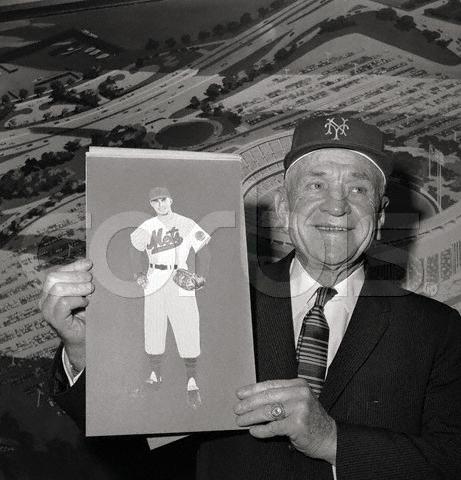
On the heels of our 1986-inspired tour of Mets unifalia, Paul Lukas of ESPN.com’s Uni Watch was kind enough to share a sample image of the Ol’ Perfesser himself showing what the original Mets uniform was supposed to look like (standing in front of what the original Flushing Meadows Municipal Stadium was supposed to look like, no less). The tail that almost nobody liked in 1993-94? Its ancestor was intended to drag out of the gate right behind the expansion Mets in 1962. No reason given for us not wearing tails from the start, though we can assume that Casey wuz gonna give one to Marvelous Marv, but wuz afraid he’d step on it.
by Greg Prince on 18 March 2006 9:36 pm Mike Pelfrey started. Billy Wagner finished. The Mets beat the Braves. Gary Cohen and Keith Hernandez told me all about it as I watched exactly what they were watching. And we're still getting a new ballpark.
Have I mentioned that life is good?
Spring training finally began this afternoon. The WBC, save for Reyes and Sanchez, is utterly irrelevant, semifinals or not. The NCAA…what's that? I had the Mets on television today. Not ESPN sterile television, not a technically difficult channel blocked by Cablevision television, but good, old-fashioned Channel 11 television. There were Mets on the field. Familiar Mets. Newish Mets. Mets who I remember as Cyclones unironically wearing 97. It felt like the real spring thing at last.
I'm out of the dumps. There will be baseball. There will be Mets baseball. I'm guessing that I will eventually have access to the sight of it every day and night but until then, the WPIX taste of SNY's production Saturday afternoon was a gorgeous lunch entrée.
Mark it down: Gary and Keith will be superstars. Not just superstars to us but superstars to the world at large. Together they are the best thing to happen to baseball on TV in New York since Tim McCarver told Ralph Kiner that baby, he loved it. They are a chemistry set with all the beakers measured to perfect proportion. Gary is Gary and Keith is benefiting. Keith has so much great stuff to offer and Gary is the first partner he's had who's jarred it out of him.
They showed themselves in so many ways big and small. Keith explaining the art of sunglass-wearing. Gary playfully excoriating the fan who nonchalanted a foul pop because he wouldn't sacrifice his malt beverage, Keith insisting the guy had to make a choice, Gary wondering which cost more, the ball or the beer and Keith sincerely guffawing. Keith coming out against players “Fancy Danning” their catches. Gary dropping his signature p-word (passel) into conversation. Keith only going into his weird sing-song lilt (that bizarre I'm going to TELL THE TEACHER tone) once as far as I heard. Gary drawing out Keith's story about Joe Torre showing him the ropes as a young Cardinal and Bob Gibson not being thrilled that he replaced McCarver (with Gary noting Keith had Met ties before he knew they were Met ties and Keith seeming surprised at the obvious-to-us observation). Gary and Keith jointly dissecting the emergence of Juan Perez as lefty reliever candidate. Fran Healy organizing his sock drawer somewhere outside of Worcester.
These guys are great together! The concerns expressed in some quarters that Gary would find a rough transition period going from radio to video seem downright silly. You put a picture in front of Gary, he talks over it. This is not Michael Kay still boring the spit out of everybody with his “interlocking NY” detail. Gary Cohen is a professional announcer and a budding video star. Keith Hernandez was a brilliant ballplayer who is being drawn out as a brilliant full-time analyst. I'm no longer rooting against the top of the seventh thinking Mex is gonna bolt. They're there and they're on the air. Man, I'm psyched!
Felt compelled to mix in a couple of minutes from the other team, Howie and Tom (though not in that “must drown out inane television voices with superior radio insights” mode of the past two years). They'll be fine. It finally struck me that Howie is now The Man where the FAN is concerned. Whatever Tom McCarthy becomes, this is Howie's booth. He will be, in all those situations where we will inevitably find ourselves tethered to a radio, the Voice of the Mets. I'm happy for him. To think of a guy who grew up rooting for and loving this ballclub and working as hard as he has to get that to that position — it just feels right.
And the Mets themselves looked pretty midseason. The big, impressive kid from Wichita continues to be big, impressive and different from all other phenoms before him; the latest one always is (besides, I have a predilection for those with Kansas ties). Julio Franco is chiseled. Anderson Hernandez is athletic. David Wright filled out. Carlos Beltran is home with a haircut. Billy Wags was having no problem with spring. There were Endy and Tike sightings. All the injuries we want to heal are healing; I'm sure of it. We lost the split-squad game in Viera, but Milledge homered, so who's counting wins and losses? Yet somehow the win in St. Lucie and on Channel 11 felt like a win. We're all winners when we can see our team play baseball.
Oh, and as far as Sheabbets Field goes, my Gotham colleague Mike McGann has some details and even an artist's rendering. Can't wait to sit myself inside the new joint…or queue up by a monitor in an open-air concourse to catch a few pitches as described by Gary and Keith while waiting for better-tasting beer and leaving a hand free to not so Fancily Dan a foul ball coming right at me.
Today, the Mets were on local TV. Today, anything is possible.
by Greg Prince on 18 March 2006 4:52 am Welcome to Flashback Friday, a weekly feature devoted to the 20th anniversary of the 1986 World Champion New York Mets.
Twenty years, 43 Fridays. This is one of them.
A couple of days ago, I had a doctor’s appointment fairly close to Roosevelt Field. Deciding that I deserved something akin to a lollipop for enduring whatever poking and prodding to which I was subject for my own good, I took the long way home and stopped by the mall, site of one of two remaining Mets Clubhouse Shops in the Metropolitan area.
If you’ve ever been to a Mets Clubhouse Shop, you know how disappointing it is. There’s not a soul among us who couldn’t stock it better if given the chance. The selection is limited, unimaginative and overpriced. But since when does that stop a true fan who’s wandering around in self-indulgence mode? I came away typically lighter in the wallet, having made two purchases, a pair of items I decided are connected to our theme du jour.
First, a new Mets cap. No, they haven’t added a special Thursday afternoon brim (cripes, I may have just given them an idea). I decided to replace my careworn 1998 black & blue model, a lid whose headband shrunk from the sweat of a season that came up one agonizing game short of the playoffs. When I’m a few weeks removed from my last haircut, it becomes a tight squeeze. After depriving myself of a better fit in the seven succeeding seasons, I decided to splurge.
That was all I was going to spend on until I saw the one thing that’s both pretty cool and pretty reasonable in Clubhouse Land. It’s a box of 100 Mets cards for 10 bucks. The kicker is that the cards are assorted Mets from throughout the ’80s and the ’90s. They’ve had these knocking around the store for a few years, which explains why there’s one “recent” card of a “star” near the top of the pile; in the case of the case I bought, it was a 2003 “Jeromy Burnitz” (that wasn’t the actual Jeromy Burnitz then, was it?).
Anyway, I always enjoy these purchases since my card-gathering grew rather lax after sixth grade and downright sporadic by college (that almost makes me sound like I was becoming an adult, but don’t be fooled) and it’s nice to catch up with the preoccupation I’ve never quite shaken and add to the accumulation it would never occur to me to discard. I’m always surprised to find out Mets got cards when I wasn’t looking. Aase…Musselman…Machado…I wonder if the 12-year-olds of 1990 were as happy to see them as I was to have greeted Gene Clines and Harry Parker a generation earlier.
Here’s something else that kind of grabbed my attention in those cards: The 1986 uniform wasn’t exclusively the 1986 uniform.
The 1986 uniform will reappear in the (or on the) flesh this August 20. The day after as many champion Mets can be enticed, paid off or bailed out to appear at Old Timers Night, the Mets will wear replicas of what they wore when we were kings. It might surprise you to be reminded that this won’t be the first time they’ve turned back the clock on this count.
In 2002, during the week or two in July when things were going deceptively well, the Mets were the first of a bunch of teams to indulge in a “Triumphant Glory” series as MLB dubbed it. Fans voted online for which era they wanted thrown back at them. 1986 (with my vote in tow) won in a presumable landslide.
The Mets romped in both games against the Marlins during that set. Mike Bacsik threw a gem before he gave me cause to designate him for Hellsignment. And they all looked sharp in victory.
It was the best turn-back promotion the Mets had ever executed. The unis fit, which they most assuredly didn’t that 1999 afternoon in St. Petersburg when they dressed up as the alleged ’69 Mets with flannels that appeared to have been in storage since ’39. No, the ’86es were authentic as could be, right down to the green underside of the caps that had quietly turned gray in the ensuing 16 years. The usually addled Shea A/V squad even got into the act, playing the hits of that blessed year over the loudspeaker (though I assume Howard Jones was identified as Howard Johnson on the “now playing” message).
For two evenings, it was almost as if the organization was proud of its best team and its best season. Then, of course, the Mets went back to looking and playing like their 2002 selves. Everything, not just the insides of the bills, turned gray for the duration.
But while that was the only field-of-play homage the Mets have given their most successful predecessors, it’s not like the ’86 uniform — the home version — was sent to Goodwill on 1/1/87. The basic ensemble that was sported in pursuit of a championship, the so-called racing stripe model, was the Mets’ uniform at Shea every year for 10 years.
The 1983 Mets showed the franchise’s first genuine signs of life in almost a decade when they debuted those uniforms. The 1992 Mets disgraced all that had come before them and poisoned much that would come after them in those uniforms. Every iteration of the Mets in between batted in the bottom of the first in those uniforms. Aase…Musselman…Machado…that was their uniform, too.
There were nips, tucks and alterations along the way, none more significant than the 25th-anniversary patch featured on the left sleeve in 1986. That confused me but good twenty Aprils ago. I was always pretty decent at arithmetic, so when I subtracted 1962 from 1986, I got 24 years. It wasn’t until I heard the rationalization that it was the 25th-anniversary season that I got it. I didn’t buy it, but I got it. It became sartorial coincidence that our two world championships would become easily distinguishable in still photos. If you see the MLB patch, you know you’re looking at a ’69 Met. If you see the two bats and the marketing-driven math patch, it’s ’86. Accept no substitutes.
(Before you get any cute ideas, a patch is not a prescription for glory, witness the World’s Fair patch of 1964 and 1965, the Bill Shea ‘S’ tribute patch of 1992, the Miracle Mets anniversary patch of 1994, the 40th-anniversary patch of 2002 and the Shea Stadium 40th-anniversary patch of 2004. All were worn throughout those seasons and all were worn in the service of losing records.)
The road, by the way, was a different story. It did change. How good was Game Six of the 1986 National League Championship Series? So good that they apparently had to burn the uniforms. After the 16th inning, the Mets never wore those roadsters in another National League game. They went to an overwrought script for one season then the Kraft American Cheese boring block letter NEW YORK in ’88. The Astros? They gave up the rainbow ghost once and for all once Kevin Bass swung and missed. Come to think of it, even the Pirates, our final regular-season opponents, stopped wearing their stayed-at-the-fair-too-long Bicentennial pillbox caps after Game 162. Thus, if you think playing the ’86 Mets didn’t take everything out of you in October, think again.
This subject goes right to the heart of one our favorite quotes around here, Celebrity Mets Fan No. 1 Jerry Seinfeld’s observation that fans root for the laundry. From 1983 through 1992, we rooted for a long blue stripe surrounded by two thinner orange stripes accenting the pinstripes and the script to which we’d become accustomed long before. We rooted for it before it went into the wash and we rooted for it when it came out of the dryer.
So what happened to it?
Prior to 1983, the Mets dressed in essentially three editions of the home uniform. The unnumbered pinstriped front (1962-1964), the numbered pinstriped front (1965-1977) and the numbered pinstriped front with blue and orange piping around the collar and the sleeves (1978-1982). The racing stripe was a rather mod update — cribbed from those futuristic Expos, I always thought — and wiped away the painful associations with the Mardie Cornejo Mets. The look remained true through ’92.
Then the Mets lost their freaking minds and their uniform hasn’t been stable since.
If you can recall the early ’90s, there was a movement back to the allegedly traditional uniform. Traditional, I wondered, to what tradition? Apparently baseball would feel better about itself if it wasn’t so gosh-darned modern. 1992 was the watershed year, especially in the N.L. East. The Phillies abandoned the large, wavy P they wore when they won their only championship in 1980. The Cardinals got rid of the synthetic look that adorned them en route to a title in 1982. The Expos gave up their racing stripe, the one that was so blurlike when they were challenging for first place in ’79, ’80 and ’81. The Mets must have been taking notes. They had abandoned the pullover for buttons in ’91, but that wasn’t enough. Come 1993, the one blue and two orange stripes were removed.
Howie Rose, for one, hailed the hell out of it. I’ve always wanted to meet him just so I could ask why he hated those racing stripes. Every time the subject filtered onto Mets Extra, he’d make like Zero Mostel and cry “Tradition!” For Howie, the tradition was his tradition, wanting the Mets back in the uniforms he remembered from his childhood. For me, I had just seen these racing stripes race to seven years of plenty. Yeah, Bobby Bonilla and Eddie Murray weren’t enhancing the look, but don’t blame the damn stripes.
Howie was disappointed when the Mets didn’t quite take his advice or follow the example of the Phillies and bring back their ’60s-era tops and bottoms. It was a case of Harazin meeting Hertz.
Did you get us those great retro togs I’ve been flogging on the air for years?
Not exactly.
The Mets of ’93 ripped off the racers, reinstated the late ’70s piping and, for bad measure, underscored the script Mets with a tail.
A tail? What the…? It didn’t portend 103 losses, but we should’ve known something was awry. A year later, the Mets tried to fix things in their own half-assed way and removed the piping, but kept the tail. If you don’t remember it, it’s because they went on strike rather than wear it. (Though the tail was nearly attached to our uniform body from the start, it seems.)
Then came 1995 and it was Howie Rose’s Met dream come to life. The uniforms of his youth and Gary Cohen’s youth and, I suppose, the early part of my youth, had returned. There were pinstripes. There was script. It wasn’t an exact match for the 1960s, but it was close enough to make the “traditionalist” dewy.
It lasted two seasons. Starting in 1997, the fiddling picked up at a pace neither seen nor heard since the devil went down to Georgia. That was the year of the ice cream cap (scroll down and check out my man Reeder) and the Sunday snow white uniforms. Somewhere along the way the cap was mercifully put out of its misery but the unis caught on. They slowly superceded the pinstripes. In ’98, those snow whites got company in the form of what we’ll call pitch blacks. The pinstripes receded (an unnecessary drop shadow was added to the script Mets logo, making them look, upon their rare re-emergence, like they didn’t fit right). By ’99, we had three home unis and two for the road: a black NEW YORK and a gray NEW YORK (the NEW YORK, at least, retained a sense of style after a couple of failed early ’90s attempts to mutilate it). With the new tops and new bottoms came new cap designs in which black became the predominant color and the NY had all kinds of splashes and tints. The royal blue caps of yore remained but didn’t see much action.
Geez, I never thought I’d go into a fashion show mode doing this, but if you’ve watched the Mets in the past 13 years and tried to stay current, you know it’s part of the package. (It’s all accounted for here in typically Ultimate depth.)
What’s it all mean?
Well, when the Mets of Wright and Floyd and Reyes trot out to their positions on August 20 in the professional clothes of Knight and Mitchell and Santana, it will be…is breathtaking too strong a word? It will be nice, at least. It was nice when the New Jersey Nets put on their ABA retros a few weeks ago to remind me of Dr. J and the Nassau Coliseum and the 1976 New York Nets, and it will be superswell to be reminded in the most visible terms possible of the 1986 Mets. If they want to keep wearing them, or throw them back on again once in a while, all right by me. I have no real attachment to the blend of one blue and two orange stripes except that those are what were on the laundry when a World Series was won and I got to watch every pitch. That makes them beautiful. Just like the ’69 duds were to Howie.
That said, I hope the 2006 Mets are weaving whatever combination of fabrics and tones they usually don into something special. I want to look at the black tops and the white pants and whatever sporting goods manufacturers logo they’ve got stitched here or there (go right to the source to follow such corporate capers) in 20 years and think, “man, they were wearing those when…” In this game, you have to keep making new memories, not just replenish the old ones.
Hence, I bought a new black and blue cap the other day to replace the beat-up one from 1998. I sense I’m in the minority of middle-aged Mets fans who accepted the onslaught of official team merchandise that’s been hurled at us since 1997-98 in good humor. I’ve got every cap they wear. I don’t buy too many jerseys, but I thought the black road one was pretty sharp and coughed up whatever that cost in 1999 when I came across it in Roosevelt Field.
I know, it’s heresy. The Mets are supposed to wear blue caps. And the addition of black to the pattern meddled with the primal forces of nature. On some level, I agree, but I do as I do, not as I say. The Mets wear blue? I wear blue. The Mets wear black? I wear black. As long as what is being worn is being worn by the Mets and is in good taste (nothing with swastikas or appleless top hats, for example), I will eventually and heartily endorse it and attempt to mimic it on my pathetic 43-year-old person.
That’s what rooting for the laundry is all about.
by Jason Fry on 17 March 2006 5:19 am Sorry to hear about your 5 o'clock vigil, hombre. I'll fill you in on Opening Night.
I arrived late — Joshua is sick and was on a mission to watch every episode of Harold and the Purple Crayon, so when I tuned in Mets pregame was beginning. So were AV mishaps. The picture kept garbling and cutting out, and the sound would degenerate into squealing and cut out as well. In classic Met fan/little brother fashion, I caught myself hoping this had happened on YES's first night as well. (In the News, Bob Raissman says it did. Whew.) Then the picture went black and you could hear the control-room guys discussing things with a fair amount of urgency, and I braced myself for inadvertent profanity and a horse-whipping in tomorrow's tabloids. (Hey, I would've been cussing, and it just happened to ESPN.) The control-room guys stayed cool under fire, but the sound never really recovered — it sounds gravelly and murky even now.
But you know what? That's OK. It's the first night. It's spring training. And I found myself thinking, with surprising pride, “Hey, this is our network. Cool!” I didn't think I'd care — it's only a TV network — but I did. This is ours, I thought, and I was happy.
Granted, we're the faithful. In a pre-satellite-radio age I drove through August nights in Georgia with the windows up and the air conditioning off so I could catch the faintest bits of WFAN through the buzz of distance, so a little gravel on the audio track ain't gonna throw me. Anyway, between parenting and a combination of iPod and treadmill, the sound was off in the Fry household for the first couple of hours. Watching a Mets telecast in silence — consider it my parting tip of the cap to Fran Healy.
When I did turn the volume up, Gary and Keith offered an excellent augury for the season. Cliff Floyd launched a home run, one of those Clifford blasts that seem to curl their way off the very end of his bat before vanishing deep in the night, as if he'd hit it with an oar. That prompted Gary to note that with his kidney woes apparently behind him (wood knocking!), Floyd is as happy as he's been.
Gary: …and that's what Cliff can do when he's happy.
(beat)
Keith: And when it's over the plate and down.
Low point: Seeing Derek Jeter. Repeatedly. I know ads pay the bills, but couldn't they run a warning so I could cover my eyes or hustle my child away from the set? Or ask 2KSports to film an alternate version in which a Josh Beckett fastball drops Jeter like a hot coal? (As for the Willie Randolph/Joe Torre Subway ads, I'm refusing to admit they exist.)
What's that? The game? Well….
* I know I've said this before, but Lastings Milledge has ridiculously fast hands. Please mark down his debut as a Why Would You Be Anywhere Else? night to get tickets.
* I'm already preparing my first, second and third posts moaning about why Jose Lima is our fifth starter. I know there's not much more than my paranoia to suggest he will be, but I sense the Ice Williams mistake all over again — if a guy's a veteran and a good clubhouse presence, so what if he has no apparent remaining ability to play baseball? Maybe Jose just needs more work — it's only St. Patrick's Day, and Roberto Hernandez didn't look great last spring. But what, honestly, can Lima do that Brian Bannister couldn't?
* Baseball is cruel. Just ask Jeff Keppinger. He had a pretty solid '04 for us, lost '05 to injury under tough circumstances, and has been treated dismissively, almost scornfully, by Randolph this spring for no apparent reason. Tonight Matsui injures his knee (you'd like to imagine everyone hopes he's OK), and suddenly people are actually paying attention to Keppinger. So of course he has to have a horrible game, doing nothing right at the plate, in the field, or on the basepaths.
Poor Keppinger. It's not such a funny game when it bites you in the hinder.
by Greg Prince on 16 March 2006 10:20 pm I thought I was onto something. I'd read the rumors that Cablevision would be a good-faith bargainer and begin airing SNY when it emerged from the video womb full-grown at 5 o'clock this afternoon. One nugget I'd divined was Channel 60 was being saved for the birth of Snigh. Then I was sure I'd stumbled onto the brightest sign of all. On my system, 60 is used for a fairly worthless scroll of channel listings. So is Channel 14. The only difference between them is the occasional extra hockey game that won't fit on the formerly useful MSG or FSN-NY winds up on 60. But today Channel 14 let it be known that it would be the home of tonight's Islanders-Thrashers showdown.
All right! The way has been paved! Cablevision is clearing the decks. Sometime today, we'll see a blurb telling us that Channel 60 will be SNY country. Didn't happen. That's OK, it's not launching 'til 5. I can wait. I sat down in front of the telly at 4:58 and watched listings scroll until, I figured, we'd see whoever and whatever this promising new outlet would air before tonight's game against the Braves.
Five O'Clock came. Five O'Clock went. It's now 5:19. There's no SNY, no Snigh, no sign, no nothin' except those dadburn listings. The game isn't till 7. Mets Weekly doesn't debut 'til Saturday. Opening Day is April 3. It's not imperative that Channel 60 magically morph to Mets right this very minute, but I'd feel better about things if it would.
Imagine that: Cablevision letting down a subscriber.
This is madness, madness I tell you! But for a little March Metness, flip the dial to Gotham Baseball.
|
|






