

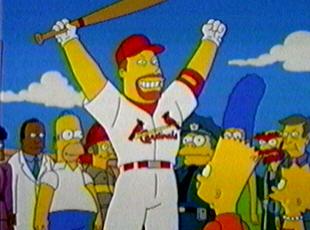
 Mark McGwire says he wishes he didn’t play in the Steroid Era. I have the same wish to a certain degree. From 1997 to 2001, McGwire hit 13 home runs against the Mets, batting .280 and getting on base in almost 39% of his plate appearances. Beating the Cardinals on any given day or night then would have been easier had he not produced those numbers. Hence, I wish Mark McGwire hadn’t played against the Mets in the Steroid Era. Conversely, I’m glad he played against the Braves, the Cubs, the Marlins and whoever else was keeping us out of the playoffs back then.
I could also have done without Sammy Sosa, Barry Bonds, Ken Caminiti…you name ’em facing the Mets. I wish the Mets had faced 9 Freddie Pateks (5′ 5″; 41 homers in 14 seasons) per lineup or 25 Harry Chappases (5′ 3″; 1 homer in 3 seasons) per roster. The Mets could have found a way to lose to Lilliputians, too, particularly at the end of 1998 when the snatching of defeat from the jaws of victory was a Metropolitan art, but I would have taken our chances with a less uniformly enhanced opposition.
Thing is, the new hitting coach of the St. Louis Cardinals did play when he played, as did the others who excelled as supernatural sluggers. Those seasons happened. The homers were hit, the numbers were posted. Mark McGwire really did hit 70 homers one year, 66 in another. He did whatever he did to the Mets, just as the Mets did whatever they did to the Cardinals when they showed down. Mets-Cubs games happened, with McGwire’s record-chasing shadow, Sammy Sosa, a major gate attraction at Shea — no matter how much less genuine Sosa’s statistics, like McGwire’s, appear in hindsight. Mets-Giants games featuring Barry Bonds happened, even if no one’s exactly waiting on a Barry Bonds outburst of qualified contrition to match McGwire’s.
Ken Caminiti, who died of a heart attack in 2004, gathered momentum toward a unanimous MVP award in 1996 after a particularly dramatic weekend against the Mets, recounted here by Baseball Library:
Caminiti’s toughness reached legendary proportions in August of 1996, when two liters of an IV solution and a Snickers bar helped him overcome dehydration, diarrhea, and nausea and hit two home runs […] against the New York Mets in Monterrey, Mexico. The 8-0 win tied San Diego with Los Angeles for first place in the NL West; Caminiti’s inspiring play eventually led the Padres to their first division title since 1984.
Caminiti admitted in 2002, after he retired, that he used steroids in his MVP year and in the years that followed. It doesn’t mean he didn’t find sustenance in a Snickers while in Mexico. It also doesn’t mean he didn’t help the Padres win a game and a division title. He, like many, played and succeeded in the Steroid Era.
More accurately, perhaps, where these players are concerned, they didn’t play in the Steroid Era — they composed the Steroid Era. That was the most darkly amusing component of McGwire’s confession Monday. He wishes he didn’t play in the Steroid Era? How does he suppose the period in question, the mid-’90s through the early ’00s, became the Steroid Era? Was it listed on a calendar in advance? Or was it because so many baseball players decided, for whatever reasons (McGwire says he was compelled by injury), to inject or ingest substances that weren’t altogether on the up and up where the old ballgame was concerned?
Mark McGwire was in full apology mode Monday, but he didn’t have to apologize to me as a baseball fan in 2010 for what he did in 1998. I saw him play at the height of the Steroid Era and it was quite entertaining. I watched him hit home runs on TV and I applauded from my couch when it didn’t harm the Mets’ Wild Card chances. When he hit what turned out to be his final Shea Stadium home run in 2001, I gave him a standing ovation because he was Mark McGwire, holder of the single-season home run record to that point, and to watch Mark McGwire hit a home run was to feel as if you were in on grandeur. Nobody really talked much about steroids then. Even if they had, they couldn’t erase what McGwire had achieved or accomplished — or just “did,” if his powerful feats no longer seem like achievements or accomplishments. As a partisan of the Mets, I didn’t want McGwire or Sosa or Bonds or Caminiti or their pumped-up brethren to do their damage against my team, but from the perspective of someone who loved baseball, I appreciated their ability to swing, connect and launch in ways that I had never seen consistently since I began watching the game.
I still sort of do, no matter how many asterisks public perception reasonably attaches to the bombs those sluggers detonated so explosively over so many National League fences. But they did what they did at the plate, however they went about doing it. That will not be erased. Those games in which they went incredibly deep took place. Boxscores are on file for all of them; I can probably dig up ticket stubs for a couple of them. The Mets lost to the Cardinals on August 12, 2001, when Big Mac hit his last Shea homer. The Mets’ record for 2001 is still 82-80. It won’t suddenly be 83-79 now. It won’t be 82-79-1. Nor should it be. I don’t know who else was juicing that day; I don’t know if McGwire was juicing that day, come to think of it. Mark McGwire may have been onto something in 2005 with his infamous “I’m not here to talk about the past” remark to Congress. You can talk about it all you want, but you can’t undo it.
Yet you can acknowledge that the past wasn’t passive, that eras didn’t innocently arise from the mists of unquantifiable intersections of time and space. The Steroid Era was the Steroid Era because Mark McGwire and an army of ballplayers who wished to Be Like Mark sought out steroids. These things don’t happen by accident.
He wishes he didn’t play then? Too late, pal.






I blame society.
It’s too early for me to get into the steroid argument (home runs and strikeouts make us happy, so whats the big deal?) so I’ll just say: great picture choice–particularly the context of it, if you remember the episode.
This is going to make all of us look really bad when Piazza admits to using steroids.
If the steroid issue was actually isolated to a small sample of players, these complains would be legitimate.
I don’t know about Piazza.
As he was getting older his home runs did not travel further and his throwing arm got weaker. Pudge Rodriguez could throw runners out while on his knees while Mike would have difficulty nipping Mo Vaughn. These are not signs of a player on roids or HGH.
It won’t make me look bad, it will make me feel quite disappointed. If he did, I would hope Mike would come clean and admit it on his own so he can at least retain some of his dignity.
There are plenty of articles and blogs that make a pretty good case for Piazza & steroids; allegations of back acne, the coincidence in timing of his sharp decline with baseball getting tougher on PEDs, how a 62nd round pick can become arguably the best offensive catcher in baseball history, and he-said she-said stuff.
I really hope he didn’t, but it is a reach saying he (or any other Met) never touched the stuff. The word seems to be that Selig pushed steroids and players, wanting to keep up for competitive and financial reasons, were left to either juice up or be passed by. I don’t have sympathy for McGwire, but I also think it’s being sort of dishonest to blame our defeats on his (or A-Rod’s, or Sosa’s, or whomever’s) steroid usage.
And about dignity, I’m not sure you can blame the players for taking advantage of a broken system. Hating the less proverbial player as opposed to the equally less proverbial game.
Blame it on ownership, players, the player’s union or Society, but don’t blame it on Roger Maris or Hank Aaron and restore those records to those who were cheated out of them and rightfully still deserve to be called the season and all-time home run kings. Don’t reward the guilty and penalize the victim.
Just because Maris or Aaron are older doesn’t mean they didn’t try whatever supplements were available at the time. It’s silly to try to analyze how much everything counted.
There was little McGuire was going to say that was really going to ..mean anything to us. Yeah, it’s the Era’s fault, as much as it is his. I interpreted that as regret at taking them, but knowing that given the opportunity to do it all over, he still would. All things considered he’d prefer a completely fair and balanced league, but he knows he was going to take any advantage he could get.
Whatever. Everyone was cheating. Whether amphetamines, HGH, steroids, etc. They were rampant. Andro was legal at the time anyway, but McGuire felt no particular guilt at taking it. He didn’t see it as cheating. no one did. He left it in his locker and one day a reporter saw it and started to make a connection. The Mitchell report supports that pretty much no one cared and cheating was everywhere. Lo Duca got shipments to Dodger Stadium for example.
If you haven’t read it already, read Buck O’Neil on steroids in Joe Posnanski’s The Soul of Baseball. Time and again, O’Neil is invited to decry steroids and cheating, and gently demurs, noting that in his day everybody did whatever they could to get an edge, and nothing much has changed.
Plus it’s incredibly moving and sublimely good.
Re Piazza and all the others, I am determined not to be surprised by anything from anybody. It’s the only sane course of action these days.
Being a competitor naturally means trying to get an edge over the others. Greenies just kept somebody awake. Advantages in medicine means someone today can have Tommy John surgery unlike those from earlier times whose careers ended due to rotar cuff injuries.
To compare that and supplments to roids or HGH is like comparing apples to oranges. The only player I know who benefited from drugs before the steroid era was Doc Ellis who was on LSD when he no-hit San Diego.
Exactly my thoughts, Greg. I may have even said, “Oh, so it’s the era’s fault?” in the car yesterday when I heard the audio clip. Today, on ESPN, I heard some more: McGwire commented that it was the evolution of his swing that produced increasingly-ridiculous HR numbers, rather than the juice. Joel Sherman, via Twitter, relays another McGwire comment that it was “the man upstairs” who deserves the credit. Are you serious?! Don’t blame other people for your mistakes, Mark. ESPN is praising him for “coming clean” and “taking it like a man”; is that what this really is? Yeah, sure, I was wrapped up in the HR chase back when McGwire was hitting ’em out of the park. We all were, as you said. Today, though, he makes me sick.
What really makes me want to puke is the sanctimoniousness of long-time sports media members on this issue. I’m sorry, but if you (general you) were being paid to cover baseball 10 or 12 years ago, you knew, and you said nothing, because keeping your plum job was more important to you than the Sanctity of the Sport. Which is fine, but at least admit it, and know that you, too, took any advantage you could get over people with far more raw talent than yourself.
Those people who broke the BALCO scandal, they risked everything to tell the truth. They can get up on their high horse if they like. The rest of them can go eat donut weights.
Great point Greg about Big Mac and others composing the Steroid Era. Him saying he wished he didn’t play in the Steroid Era makes as much sense as if President Clinton said he wished he wasn’t President during the Lewinsky scandal. Still I just can’t muster the outrage that a lot of people seem to generate instantaneously (http://tv.gawker.com/5445825/brian-williams-slams-mark-mcgwire-on-nbc-nightly-news-over-steroid-admission?autoplay=true) whenever Player X from the Steroid Era gets exposed/”comes clean.” It’s ultimately just sad. It’s no one’s and everyone’s fault. We’re all guilty