

Twenty-one years ago tomorrow, the surprisingly contending Mets did not look ready for what was hitting them at Shea Stadium, giving up six runs in the first inning. They’d do plenty of hitting themselves before the game was over, and Armando Benitez would come on to get the save, but the Mets didn’t do enough hitting, and Benitez by then was the closer for the Florida Marlins. Strange time capsule the box score of July 20, 2004, left us. Steve Trachsel started and kept starting despite a disastrous first inning, staying on through five. Future Mets Luis Castillo, Jeff Conine, and Damion Easley joined forces with former Mets Benitez and Josias Manzanillo in the 9-7 victory for the defending world champions. The Marlins, between fire sales, rose to 47-46, one game better than the Mets, each club part of a four-team scramble for first place in the NL East. The scramble would end within a couple of weeks, the Mets — and the Marlins, for that matter — altogether unscrambled from any October aspirations.
On the Met side, John Franco was sent out to pitch the sixth and gave up what would prove to be the winning runs. By the time Johnny was deployed (earlier than had been his custom in his long reign as hometown closer), the Mets had tied the Marlins at seven. Trachsel had settled down and the bats had come alive. Three runs were driven in by Richard Hidalgo, an acquisition in June who was on an all-time Met heater in July, homering ten times. Richard’s three-run bomb in the bottom of the third inning this Tuesday night is what evened the game at 7-7. Two batters earlier, first baseman Eric Valent had pulled the Mets to within 7-4. Valent wasn’t in the starting lineup. He subbed in the top of the second for Mike Piazza. Piazza had to exit after a collision on defense with Juan Pierre. Mike, an All-Star catcher trying his best to become a passable first baseman, was the victim of the baserunner and a throw from his third baseman arriving all at once in an awkward position. His left wrist took the worst of it. He’d be out for a week.
By the time he came back, there’d be a new third baseman for the New York Mets.
On July 21, as Piazza healed, the future arrived in the person of 21-year-old David Wright, hot stuff from Norfolk and at Norfolk, as big a part of the Mets’ plans as their current second baseman Jose Reyes loomed a year earlier. Reyes, 20, was the shortstop when he came up from Binghamton in 2003, but was moved to second in deference to the allegedly wondrous abilities of Kaz Matsui. The third baseman who threw the ball that resulted in the injury to the Mets’ marquee player was Ty Wigginton. Wiggy, as he was known, was only 25, and had attracted Rookie of the Year support in ’03, but his greatest asset as of July 21, 2004, was not youth or promise but versatility. With Mike out, Ty would be the first baseman.
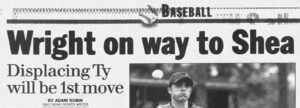 Nobody else would be the third baseman for a very long time now that David Wright was here. The box score of July 20, therefore, tells a story of less a lost world than one poised to change dramatically. Wigginton would be traded before the month was done. Franco and Todd Zeile (who took over for Valent on defense) would wave goodbye to an appreciative crowd on the last day of the season. Reyes would get shortstop back, a move that would compel the less than wondrous Matsui to learn second, a transition that never really took. Hidalgo would leave as a free agent. Piazza, already a legend in these parts, returned to catching and played out his contract before his own emotional goodbye at the end of 2005. Trachsel would keep getting starts through 2006. So would left fielder Cliff Floyd. Veterans Steve and Cliff would be in the lineup on September 18, 2006, about two years and two months hence, the night the Mets clinched their first division title since 1988. In the middle of the celebratory scene that unfolded that night were the young shortstop Reyes and the young third baseman Wright. Other than Trachsel and Floyd, nobody else from either July 20 or July 21 in 2004 was on hand.
The Mets’ world accelerated its evolution the minute Wright showed up. But there was a Mets world the night before. The tomorrow in that equation was better because it formally introduced us to the player who would, in short order, embody the Mets for the next fourteen years. David Wright started fielding, started swinging, started doing everything that became instantly and indelibly familiar. David Wright started giving us seasons like 2006 and did his best to keep giving us seasons like 2006, even if we wouldn’t see another year substantively like it until 2015. That was a totally if not tonally different Met season, but the one thing it had in common with its predecessor in champagne showers was David Wright played a lead role. Not the same kind of lead role — he wasn’t so young anymore and he wasn’t healthy enough to play that much — but the superstar had become The Captain, and The Captain led the Mets, in his way, to the World Series. That was supposed to happen in 2006. It took a while. Fortunately, David had a while after 2006, if not a whole lot of while remaining after 2015.
 All of David’s career, which was Mets and nothing but Mets, gets honored at Citi Field this afternoon. No. 5 rises to the rafters. The club Hall of Fame, conveniently located on pillars at the top of the Rotunda staircase, adds a plaque with his likeness. Mets from 2004 and Mets from well beyond will be in attendance, as will a ballpark full of fans who watched him debut, watched him blossom, watched him endure. “Every generation throws a hero up the pop charts,” Paul Simon said. A generation of Mets fans came of age with David Wright as its frontman. He is the first Met who came along in this century to be honored as Seaver, Piazza, Koosman, Hernandez, Mays, Gooden, and Strawberry have. He is the first Met to have a single digit retired. He is singular in our history. He rose from our farm system and never sought greener pastures. Our pastures were green enough for him. His considerable talents and endless efforts richly enhanced their periodic lushness.
It was fortuitous that the Mets won the first game of the David Wright Era, on July 21, 2004. The night before, they’re a mess. The next day, they’re winners. One can ride that thread only so far. David played in 1,585 games as a Met. Their record in them was 792-793. All the ups. All the downs. So many of both in terms of what surrounded him. Throw in the postseason games in which he played, however, and his Mets went 805-804. That looks a little more Wright, doesn’t it?
As if to presage David Wright’s arrival in official Met immortality, the Mets of July 18, 2025, used the game before his number-raising and plaque-installing to remind us of what it was like in Flushing on July 20, 2004, which is to say they lost. It’s a very different club here than it was twenty-one years ago. Our contention in the NL East is no surprise. We are in a division race that, unlike 2004’s, figures to last. We have Juan Soto, and he homered in the first. We have Brandon Nimmo and Jeff McNeil, the only two Mets remaining from the back end of Wright’s tenure, and McNeil drove in Nimmo in the second. And we have the gumption to manufacture a Fireworks Night rally in the ninth that evoked memories of the one Piazza capped in the eighth on June 30, 2000, when David was a year away from getting drafted by the Mets. On that night, Mike Hampton started versus the Braves. It didn’t go well, and we trailed, 8-1, before prevailing, 11-8. Hampton straightened himself out from that off outing and pitched the Mets to a pennant. When Mike chose free agency and signed with the Rockies, the Mets received a supplemental first-round pick. They used it to draft David Wright. You might say they won even more.
The ninth-inning rally from this Fireworks Night in the present, however, fizzled. The Mets fell Friday to the Reds, 8-4. Sean Manaea pitched far better than Steve Trachsel did on Wright’s Eve then, but for not as long. In his second post-IL start, Manaea worked four sharp innings before being pulled. The 2-1 lead he bequeathed to Alex Carrillo transformed into a 3-2 deficit in the fifth. It was 6-2 when Carrillo gave way to Brandon Waddell. It became 8-2 as Carlos Mendoza resolutely rested the remainder of his bullpen in this first game after the four-day All-Star break. Had Mendy had John Franco, Dan Wheeler, Ricky Bottalico, and Mike DeJean at his disposal as Art Howe did on July 20, 2004, he probably wouldn’t have used them, either. I never thought I’d say this, but score one for Art Howe.
The Mets’ comeback in the ninth showed promise — two runners in, bases loaded, Francisco Lindor coming to bat as the tying run — but no payoff, as Lindor popped out to clear the field for fireworks. The Reds played like they had something to prove. The Mets for too many innings seemed disengaged. Maybe the All-Star break needed to be five days.
Or maybe they just need to get a look at David Wright today and start turning things around for good.






DFA Carrillo.
Another excellent performance by Manaea wiped out by Mendoza’s truly inept bullpen management.
Mendy’s post-game remarks again neglected mention of his own errors in judgement.
Alex Carrillo thought the All-Star break was five days. He thought he was pitching in the swing off, or whatever that ridiculous tiebreaker was called.
In the world of the Mets, today is never as important as tomorrow or next month or next season. A chance to take over first place on July 18? Not as important as making sure to keep the bubble wrap on Sean Manaea after four innings, and turning the game over to someone who’s likely to be Rico Garcia’d by sometime next week.
They start the second half with what was essentially another bullpen game.
No amount of special events days, promising reports from Syracuse and Binghamton or Motown singalongs is going to save this team if their starting pitchers consistently come out before the sixth inning — through either their own inefficiency or the overprotective instincts of Stearns/Hefner/Mendoza.
And furthermore:
A.J. Minter, Danny Young, Dedniel Nunez, Brooks Raley, Manaea, Montas, Senga, and so on and on…,
It’s a good thing that the Mets crack training staff keeps everybody healthy (not).
What was the point of starting Manaea if it was just going to be another bullpen throwaway game? Why not save him for another day, since that seems to be all we do? You thought Jesus saves? He’s got nothing on Carlos Mendoza…
There’s still time.
But we’re only going to get out of this if Francisco Lindor leads the way with his bat.
It’s a lot of responsibility for one guy.