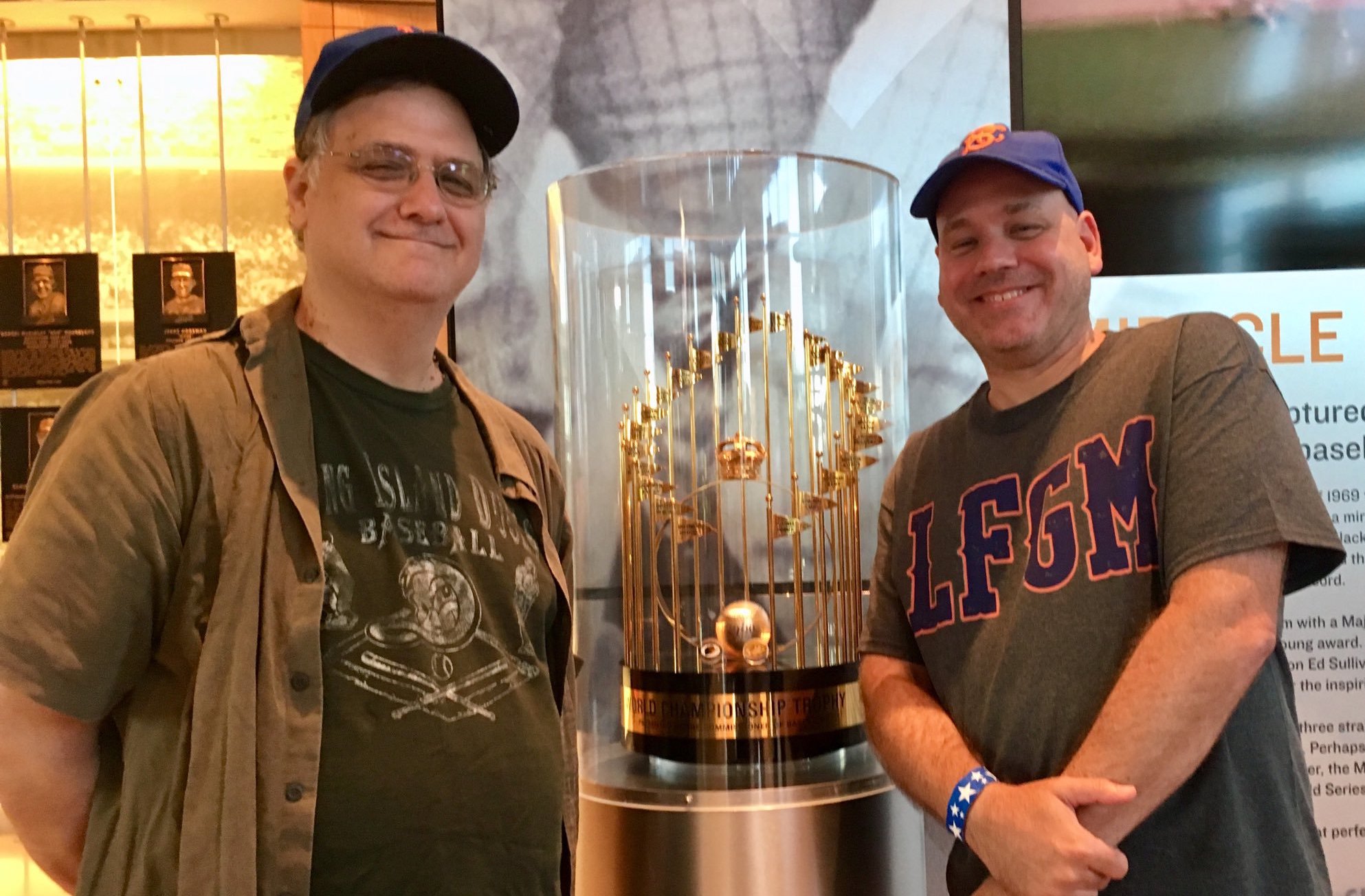
My primary rule for playing Sports Reference’s Immaculate Grid — my “self-imposed gamification,” as it’s been called — is I have to fill every box that can be filled by a Met with a Met. Does the Grid call for a Phillie who also played for the Pirates? Then I have to answer with a Met who played for the Phillies and the Pirates, which is when I’m suddenly delighted to recall Richie Hebner played for the Mets. If I need an Oriole who also played for the Giants, that means Armando Benitez is not a trigger for flashing back to late-season and postseason meltdowns, but a handy name to skim from the tip of my brain. Or I could use Hobie Landrith, because without the catcher the Mets chose first in the 1961 expansion draft, your Grid is going to have a lot of passed balls.
With the Milwaukee Brewers having swept the Los Angeles Dodgers to capture their first pennant in 44 years, not to mention their first as a National League representative, I thought it appropriate to honor them by naming some Brewers who were also Mets, specifically players who make for impeccable Immaculate Grid answers, which is to say players who played for the Brewers, the Mets, and a bunch of other teams. Having these kinds of guys top of mind is the key to filling boxes and keeping scores manageable. The more obscure the connection, the fewer of your fellow Gridders will pick him, the lower or better your score will be. I’m not a nut about getting the lowest score possible, but I like to avoid obvious answers. Obvious answers seem to include Nolan Ryan, Pedro Martinez, and Justin Verlander, to name three guys who seem to regularly check in as the most popular answers on a given day that they are boxworthy.
I’m getting in the weeds here. I want to get into the hops and barley, instead. I want to get into Brewers who were Mets.
1. Tommy Davis
Sports Reference is kind enough to let me know that by far my most deployed player in Immaculate Grid is Tom Seaver. I don’t mind that he’s an obvious answer when a Met is asked for. I don’t mind that he therefore drives my score up. He’s Tom Seaver. He’s my favorite player ever. I like typing his name in. But my favorite Immaculate Grid answer, and my second-most deployed player, is Tommy Davis. Tommy Davis had a spectacular Immaculate Grid kind of career. It was long, it was distinguished, and he played for a lot of teams. For my baseline purposes, he was a Met, in 1967. For the purposes of this feature, he was a Seattle Pilot, which in the eyes of Immaculate Grid qualifies him as a Milwaukee Brewer, for Immaculate Grid follows franchise bloodlines. The Grid asks for a Washington National, you can enter a Montreal Expo. The Grid asks for a Minnesota Twin, you can enter a Washington Senator from before 1961. The Grid asks for a Texas Ranger, you can enter a Washington Senator from 1961 to 1971. The Grid has a memory that way.
If you need a Met who was also a Brewer, Tommy Davis is your man. If you need a Met who was a Dodger, a White Sock, an Astro, an Athletic, a Cub, an Oriole, an Angel, or a Royal, Tommy Davis continues to be your man. If you need any combination of those teams, Tommy Davis is ready to bat. Also, if you need somebody who was at some point an All-Star, somebody who compiled a .300 season batting, somebody who collected 2,000 or more career hits, or somebody who played every position other than pitcher, catcher, or shortstop, (the Grid sometimes goes there), you will develop a profound appreciation of Tommy Davis. Not that you shouldn’t already have one.
2. Mike Marshall
That’s Mike Marshall, 1967-1981, not Mike Marshall, 1981-1991. The Grid is aware enough to differentiate them. You want the older Mike Marshall, the pitcher Mike Marshall. The Mets wanted Mike Marshall at the rear of his career, long after he’d been a Pilot/Brewer, before which he’d been a Tiger. He was also an Astro, but got famous as an Expo, pitching basically every day. The Dodgers traded for him, and he pitched even more, cresting at a record 106 appearances in 1974, which catapulted him to the Cy Young Award when relievers were just beginning to be taken seriously. Marshall had lots of opinions, which meant he’d be sent to lots of different teams once his previous employers tired of his input. He’d go on to be a Brave, a Ranger, and a Twin. For Minnesota he’d post a career high 32 saves at age 36; the Grid occasionally asks for a 30+ save guy. Mike’s Metsdom encompassed only the second half of split-season 1981, but he made it into the last 20 games of his career from the middle of August to the beginning of October, a workhorse to the end.
3. Jesse Orosco
Because Jesse Orosco holds such an outsize place in our consciousness for throwing his glove in the air following strikeouts that ended two notable sets of games in 1986, he might not leap to mind as the kind of journeyman who makes a great Grid answer. Ah, but after Jesse finished his tenure with us in 1987, he was off and journeying, evolving from 30+ save closer into the kind of lefty who could always hold down a place in somebody’s bullpen for a spell. To us he’s Jesse Orosco of the Mets. To the Grid, he’s also Jesse Orosco of the Brewers, not to mention Jesse Orosco of the (deep breath) Dodgers, Guardians neé Indians, Orioles, Cardinals, Padres, Yankees, and Twins. That last stop recognizes Jesse’s final handful of major league innings in 2003, though that same organization is where his minor league career began in 1978, just prior to the Mets accepting him as the player to be named later in exchange for Jerry Koosman. And here we are naming Jesse Orosco much later.
4. Ken Sanders
Baseball Digest brought Ken Sanders of the Brewers to my attention in 1972, spotlighting him as one of the American League’s best relievers on the heels of his AL-leading 31 saves in ’71. Naturally, I was excited the Mets got him in 1975, because as a kid, if I had one piece of statistical information to chew on, I let the flavor linger for years. In between he’d been a Twin, a pre-Guardian, and an Angel. Earlier he’d been an Athletic (separate tenures in Kansas City and Oakland) and a Red Sock. He’d end as a Royal. As a Met, Ken recorded six saves, and the only thing I really remember about his Shea stay was John Stearns hit him in the face with a ball the catcher was simply throwing back to the mound in the course of Ken warming up. I’m still excited we got him.
5. Skip Lockwood
I suppose I could think of Ken Sanders without thinking of Skip Lockwood, but I usually don’t. They were Brewer relievers together. They were Met relievers together. Lockwood was our closer when that job was called fireman. He started as an infielder for the Kansas City A’s, then became a pitcher for the Seattle Pilots, which meant, by lasting from 1969 to 1970, he became a pitcher for the Milwaukee Brewers. There’d be short stints for the Angels and Red Sox as well. I had the pleasure of meeting Skip in 2019. A very nice man with a very interesting book.
6. Doc Medich
I love that Doc Medich qualifies for my Grid needs all based on a single waiver-enabled Met appearance in 1977, in the final week of the season, kind of a free agent audition that didn’t go great, thus he went elsewhere. Perhaps my favorite statistic I’ve ever uncovered is Doc pitched for three teams in ’77, and every one of them — the Mets, the Mariners, and the A’s — lost 98 games. The future doctor his parents called George began the sporting side of his professional life with the Yankees. They traded the medical school student everybody else called Doc to the Pirates for a package that included Dock Ellis. Ellis pitched better for the Bombers than Medich did for the Bucs, leading to one of the great overheards in the Shea Stadium press box from a 1976 night that Medich struggled versus the Mets, shared by Roger Angell: “Ellis is a better doctor than this guy!” The Met detour preceded a contract from the Rangers, with whom he settled in from 1978 until the Brewers picked him up for the stretch drive of their first league championship season. Doc’s final operation on the mound came in the 1982 World Series.
7. Jeromy Burnitz
Jeromy Burnitz is my go-to Met who was a Brewer/Brewer who was a Met. I’m still sore Dallas Green wished to give up on him so quickly, instigating his trade to Cleveland (albeit for a decent haul of pitchers in Paul Byrd, Dave Mlicki, and Jerry Dipoto). The Indians gave up on him too soon, too, shipping him to the Brewers where Jeromy found his ideal situation. Burnitz flourished as a Brewer, walloping 163 homers over six seasons. I always assumed he was a perfect fit in Milwaukee because no Brewer this side of Gorman Thomas looked like he could make the Barrelman costume a second skin. Our former first-round draft choice returned to the Mets in 2002, and that went as well as those things usually do. In 2003, the Dodgers took him off our hands. In rapid succession, Jeromy joined the Rockies, the Cubs, and the Pirates, not knowing his journey was taking him up the Grid utility ladder.
8. Mike Cameron
My quaint 20th-century notion of a guy being too good to play for everybody crashes up against the realities of baseball players’ agency in the 21st. Shouldn’t somebody who was good for 278 home runs, 297 stolen bases, and three Gold Gloves as a sterling center fielder have found something approximating a forever home? Mike Cameron was a White Sock who became a Red; a Red who became a Mariner (Cincy had to give up somebody of quality to obtain Ken Griffey, Jr.); a Mariner who signed to become a Met before the Mets could convince Carlos Beltran to do the same; a Met who became a Padre once Beltran made Mike’s Metsiness obsolete; and a Padre before becoming a Brewer, which is one of those associations I would have forgotten about had I not gotten hooked in 2023 on doing Immaculate Grid every single day of my life. Oh, he was also a Red Sock and a Marlin. Cameron put up 46.7 in Baseball-Reference WAR over 17 seasons, which I note because the Grid likes to ask about career bWAR that tops 40.
9. Dana Eveland
I’m throwing in Dana Eveland here because I’d like him to stick to my Grid thought process. Relievers who travel are Grid gold, and I never remember to think about our 2014 lefty who started as a Brewer in 2005 and proceeded to also pitch for the Diamondbacks, A’s, Blue Jays, Pirates, Dodgers, Orioles, Braves, and Rays. I don’t believe I knew who Dana Eveland was before 2014 and I rarely revisited his career after 2014. In going about my Gridness, my head generally races to the era when Ken Sanders and Skip Lockwood strode major league mounds. Probably has something to do with being a kid, collecting baseball cards, and everything from then making an impression. Their successors down the corridors of time never left me a cardboard trail, and it’s been ages since my Baseball Digest subscription lapsed. But I know Dana Eveland was a Met, and I’ve decided to know he was a Brewer.
10. Jose Quintana
I loved this guy as Met in 2023 and 2024. I first grew familiar with him as a White Sock in the early 2010s. It never occurs to me while I make my Grid rounds that he pitched for the Cubs, the Angels, the Giants, the Pirates, the Cardinals, the Rockies, and, yes, the Brewers. Teams wanted Jose Quintana, a native of Colombia (the Grid sometimes asks about birth nations). I was tickled to have Jose Quintana. I really should fill his name in more often, yet my consciousness can retain only so many names in those minutes every morning when I’m taking my Grid swings.
I gotta stop somewhere. Cap tips are due to, among quite a few others, Gary Sheffield, Jose Cardenal, Jonathan Villar, Dwight Bernard, Willie Randolph, Nelson Figueroa, Lenny Harris, Francisco Rodriguez, Wayne Twitchell, Curtis Granderson, Ray Sadecki, Danny Frisella, Bill Pulsipher, Livàn Hernandez, Gary Sanchez, Mike DeJean, Glendon Rusch, Bob McClure, Tim Leary, Juan Acevedo, LaTroy Hawkins, Rick Cerone, Mark Canha, Neil Walker, Tony Fernandez, Darryl Hamilton, Jose Valentin, Mark Bomback, Fernando Viña, and Charlie O’Brien, all of whom are fine Met/Brewer options. Good luck to Milwaukee in its quest to celebrate a World Series title for the first time since the Braves brought one home in 1957. Milwaukee Braves don’t count in the scheme of Met/Brewer Grid answers, but they do for Mets/Braves. As do Mike Marshall, Dana Eveland, Gary Sheffield, Ray Sadecki, Danny Frisella, Rick Cerone, and Charlie O’Brien.
Big ups to Baseball-Reference’s Multiple Teams search tool, found on its Frivolities page, for its assist in reeling off those names at the end. I may be blessed with an expansive Met memory, but the top of my head ain’t THAT big.