

In the bottom of the first Thursday afternoon at Cleveland, Nolan McLean threw his first pitch and got his first out on a fly ball to left, making him the soul of efficiency. Then he threw eleven pitches to his next two batters, eight of them balls, giving him two baserunners to negotiate. The next batter singled to load the bases. The batter directly thereafter singled home the men on second and third, and he was in a 2-0 hole. Then there was a strikeout, a bases-reloading single, and a flyout to right field to escape further damage.
Twenty-six pitches. Two walks. One strikeout. An immediate deficit. Reasons for concern. Reasons for relief. Could have been worse. Could have been better. Not exactly the Nolan McLean Experience as envisioned when he made his major league debut almost a year ago, but not atypical of any Nolan McLean outing this year. He’s proven himself capable of piling up strikeouts. He’s shown himself prone to issuing a few too many walks. His stuff is rarely in question. His demeanor is advanced for someone who is still technically a rookie.
And his name is Nolan, which isn’t news. When he came up, it was hard not to meet Nolan McLean and not think, “Hey, a Mets pitcher named Nolan. Where have we heard that before?” It’s not unusual to latch onto something obvious early in player’s Met tenure. Little is more obvious than a player’s name. Nolan McLean didn’t have to pitch a damn thing like Nolan Ryan for us to make at least a cursory comparison. As if there’s any comparing Nolan Ryan to anybody who’s come along since him.
A Mets fan invoking Nolan Ryan is different from any other fan invoking Nolan Ryan. Those who knew him as an Angel, an Astro, or a Ranger know mainly the legend. Those who know him as a legend gloss over the details. Coincidentally, on Thursday night, hours after McLean and the Mets had completed their sweep of the Guardians via a 13-6 drubbing, I watched a program in which I did not expect Nolan Ryan’s name to come up. It was the Season Four premiere of Ted Lasso, and it involved a detour from the show’s familiar UK soccer turf to the Negro Leagues Baseball Museum in Kansas City — Missouri, not Kansas. While taking it all in, visiting Brit Leslie Higgins is informed of Satchel Paige’s greatness. How great was he? The museum’s de facto docent tells Higgins that Paige pitched on the level of Cy Young (pause)…Sandy Koufax (pause)…
I note the pauses, because I anticipated the rule of three being in effect. Once I heard Young and Koufax, I wondered who would be the third avatar of pitching cited. I hoped it would be Tom Seaver, but figured that was unlikely. Seaver is everything to us, but not the kind of legend-at-large a show like Ted Lasso would inject into its conversation to make a point about greatness. Before I could think further on the subject, I heard Nolan Ryan. Yeah, sure, Nolan Ryan. They would say that. I remember reading shortly after he finally retired that, judging by polling and/or national endorsements, Nolan Ryan remained the most popular baseball player in America. The name Nolan Ryan retains an outsize mystique that transcends statistics, including those which might not match the numbers put up by his contemporaries or his successors. You know what they say about printing the legend, or at least writing the legend into the script.
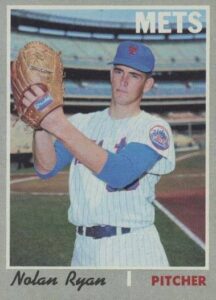 I’m just old enough to retain tangible memories of Nolan Ryan as a New York Met. Legend and greatness weren’t the words that came to mind when he pitched for us. Promise, yes. Potential, absolutely. Talent, undeniable. But man, was he frustrating. Seaver was my standard. Ryan wasn’t in Seaver’s league most starts. OK, nobody by my reckoning or universal understanding in the early 1970s was. Ryan also didn’t yield the same experience that watching Jerry Koosman or Gary Gentry or Jim McAndrew did. In short, none of those guys would lose the strike zone on a regular basis. None of them threw as hard as Nolan, but you tended to know where the ball was going to go once they released it. We didn’t know Nolan Ryan was going to go to Anaheim after the 1971 season, but regardless of the return the Mets accepted in exchange for his services, we couldn’t be surprised that the Mets were willing to say “enough” to waiting for his promise, potential, and talent to coalesce.
Because it was Nolan McLean making me think of Nolan Ryan after one inning on Thursday, I got curious to see if the granular results from a Nolan Ryan start for the Mets synced with my sense that what I was watching now was similar to something I had seen long before. I went to Baseball-Reference, called up Ryan’s 1971 game logs, and looked for a start from roughly the same part of the schedule we’re in now to see if McLean — highly touted in different ways from Ryan, and a lot more polished if not yet a finished product — was, in fact having a Nolan Ryan kind of outing…a Nolan Ryan Mets kind of outing.
On August 7, 1971, almost exactly 55 years prior to the day McLean was pitching in Cleveland, Ryan was indeed on the mound for the Mets. The game was in Atlanta. I recognized the circumstances. This was the game in which the Mets established their record for most runs scored in a nine-inning win, with a 20-6 thumping of the Braves. Twenty remained the franchise mark until the Mets crushed the Cubs, 23-10 in 1987, and that wouldn’t be topped until the Mets destroyed the Phillies, 24-4, in 2018. Whoever pitched that Saturday night at what was then called Atlanta Stadium wasn’t going to have to be that sharp to benefit from unprecedented Metropolitan offensive largesse. We put up three in the first, then seven in the second, capped by a Ken Boswell grand slam.
In between those explosive half-innings, Ryan was basically the Ryan I remember. After retiring Felix Millan on a grounder to start the home first, he walked Ralph Garr. A passed ball charged to Jerry Grote pushed Garr to second. Hank Aaron fouled out, but Mike Lum singled Garr home. Nolan hit Earl Williams with a pitch. Then he walked Sonny Jackson. The bases were loaded mainly on Ryan’s wildness. But then he struck out Zoilo Versalles to get out of the inning.
Two walks. One strikeout. Assorted angst. I don’t know how many pitches, because who counted, but Ryan, like McLean, eased himself out of too much ado, and with the nine-run lead he took into the bottom of the second, the angst dissipated. There’d be a walk apiece in the bottoms of the second and third, but Nolan left two men on in each frame. A 1-2-3 fourth preceded another Met outburst that raised the New York lead to 13-1. Maybe a smaller cushion would have meant a shorter leash for Ryan, but Gil Hodges and Rube Walker left him in through a rocky fifth. Four hits. One wild pitch. An RBI single for Williams. A three-run homer from Versalles. Now it was 13-5, Mets, which soon became 16-5, Mets. Ryan had his five innings. Barring a collapse of epic proportions, he was going to get the win. Today, he’d be done. This was 1971. He kept pitching. Gave up another run in the sixth, which the Mets got back and doubled in the seventh. With an 18-6 lead, Ryan stayed out there for the bottom of the seventh, when the only baserunner he allowed was on account of an error. One more walk, to Millan, to start the eighth, but Felix was erased on a double play. At 20-6, Ron Taylor was sent in to close out the rout.
Nolan Ryan’s line on August 7, 1971:
8 IP, 8 H, 6 R, 5 ER, 5 BB, 7 SO, 1 HR
Nolan McLean’s line on August 6, 2026
5 IP, 8 H, 5 R, 5 ER, 3 BB, 8 SO, 1 HR
Nolan the younger threw 94 pitches. Count is kept these days. Like Nolan the elder, McLean was off in his command, but when necessary, he could rear back and fire to optimal effect. There was a walk in the bottom of the second inning, along with a teal of second base, but there were two strikeouts and a grounder that put a halt to any threat. The bottoms of the third and fourth were Nolan McLean at his finest. Six up, six down, three Ks, two swinging. When the Mets went out for the fifth and built what was now a 6-2 lead, you felt pretty good about the youngster’s day. You were even willing to overlook some tentative Met baserunning, because a four-run edge is clearly going to be plenty for Nolan McLean.
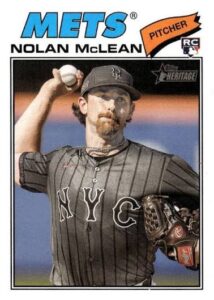 Clearly it wasn’t plenty. After striking out Travis Bazzana to start the fifth, the Guardians began to get the best of the Met starter. Chase DeLauter lined a single to right. Jose Ramirez added another single. Nathaniel Lowe, new to Cleveland, introduced himself emphatically to Progressive Field with a three-run bomb. Now it was 6-5. Now Nolan McLean was in hot water. Would he get out of it? When I saw him strike out Angel Martinez, I was sure he would. When he gave up back-to-back singles to Brayan Rocchio and Petey Halpin, I was kind of surprised he was left in to fend for himself. Surprised, but glad. I wanted the Mets to win the game and sweep the series, but mostly I wanted Nolan McLean to keep going, keep growing, keep becoming who we need him to become. Let’s see what he can do with runners on first and second while clinging to a one-run lead that until very recently had been a four-run lead.
We saw him ground out Patrick Bailey to end the inning. The Mets stayed ahead on McLean’s watch. There’d be a little more vexing Met baserunning, and the game would stay close following Nolan’s five innings, but all attendant anxieties wafted out to Lake Erie once Francisco Lindor reintroduced himself to Progressive Field with his own three-run bomb. The 9-5 lead (Luis Torrens and Marcus Semien had previously gone deep) meant Nolan McLean’s chance for the win appeared secure. Nate Lavender had pitched a scoreless sixth. Kodai Senga was about to pitch a scoreless seventh. The Guardian bullpen disintegrated in the eighth so thoroughly that Stephen Vogt’s best option to quell the Met attack became catcher Austin Hedges. By then, the Mets were up, 12-5, with two bases-loaded walks making an objective observer forget that the Met starter had control issues.
Each series the Mets have played the Guardians since 2019, five in all, has resulted in a sweep. The Guardians swept the Mets in August of 2025, and it encompassed three losses as devastating to our hopes as any we were dealt. All Met losses represented body blows in the wake of losing out on a playoff berth by a tiebreaker. We have no playoff race on the horizon in 2026. The Guardians have been in one, but losing three in a row to the last-place Mets from the other league kept them from forging progress at Progressive Field. With apologies to a very good friend of mine in the Midwest who loves his Guards like we love our Mets, their problem is not our problem. Nolan McLean was a little ragged around the edges in victory. Also not a problem, neither on Thursday nor in general, I believe. He’s gonna have outings where the five walks are going to tangibly bite him. And he’s gonna have outings where the eight strikeouts won’t be enough to save him when the Met attack is utterly quelled. He’s gonna have lots of outings as a New York Met, provided nobody accepts any ridiculous trade proposals in case his potential, promise, and talent show any signs of lagging.
When I think of Nolan Ryan as a New York Met, the legend is relative. When I think of Nolan McLean as a New York Met, the future is bright.






I think the Guardians sweep was in August 2025, right? And we have no playoff race on the horizon in 2026. It’s OK, I’m still writing 2025 on my checks (or I would be, if I ever wrote checks anymore).
You’ve heard of being on a seven-second delay. Mine tends to be set to one year.
It feels like we have the makings of a new core — some really good starting pitching, Benge and Ewing, and maybe even some decent bullpen arms. I guess things didn’t work out this season, but there is hope for the future.
I read that Nolan Ryan had a 10 and 0 record going through the first half of the 1971 season; he was truly outstanding during that stretch.
Unfortunately, he was very wild with his pitches during the second half of the season and manager Gil Hodges made Nolan Ryan the team’s fifth starter (who was occasionally bumped out of a start) pitching behind Tom Seaver, Jerry Koosman, Gary Gentry and Ray Sadecki.
Supposedly, Gil Hodges and Nolan Ryan repeatedly argued about Ryan’s status in the starting rotation, so Gil Hodges was not opposed to trading the very talented, but still very wild starting pitcher during the offseason.
Tragically, Gil Hodges died of a heart attack during spring training of 1972. So, we’ll never how how he would have reacted to Nolan Ryan’s tremendous success with the California Angels during the 1972 season and for many years after.
It must have broken legendary Met announcer Bob Murphy’s heart that he could no longer say dramatically and very frequently during a Nolan Ryan Met start, “It’s Ryan’s express!”
I would like to think that these new bullpen guys are actually auditioning for a future spot with the team. Unfortunately, I have the feeling that Stearns and his formulas have already pre-determined who will be on the 2027 roster, and who will not. Spin rates, options, and weird, useless stats may just be the determining factor, rather than what goes on, on the field. If a guy has 100 options left, Stearns will use them all.
If a guy throws 3 scoreless innings, he has just punched his card to Syracuse.
Sigh….
I was enjoying your recital of the 1971 Atlanta Braves lineup. Mike Lum, Sonny Jackson, Earl Williams….Zoilo Versailles????
I’m sure I was aware of the 20-6 Met Victory at the time, but Zoilo’s 3 Run HR and his brief tenure as an Atlanta Brave? Not at all. Thanks!
Speaking of the early 70’s Braves, my cousin is Frank Tepedino, and he was on base when Don Hahn and George Theodore (always recited in that order) collided, leaving Ralph Garr with an Inside-the-park HR, and The Stork with a dislocated hip. Incidentially, Phil Hennigan threw that pitch, in what would be his last game as a Met, July 7, 1973.