In retrospect, one wonders why so many teams scrambled to make the playoffs in 2026 when the outcome of those playoffs appears so inevitable in retrospect. If the goal was to simply qualify to play more baseball, that’s admirable (more baseball sounds fantastic knowing the sun is about to set a lot sooner and a lockout is about to set in soon). If the goal was to win a championship, all but one team was kidding itself.
This was the Milwaukee Brewers’ year. October was definitely the Milwaukee Brewers’ month. They beat everybody they came up against — the Padres, the Dodgers, and the Rays, probably the three best teams that weren’t the Brewers — as if there was little reason to think they wouldn’t, becoming world champions for the first time in their franchise history. They’d been knocking on the door for a while. Then they pounded on the door. The door is in shards now. Perhaps the fragments can be repurposed to fashion a beer barrel.
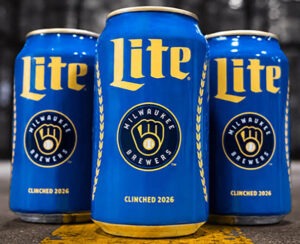
Drink up!
Swayed by empathy for the team whose stadium was about to be overwhelmed by visiting fans, along with a lingering soft spot for the area where I went to college, I pulled slightly for the Tampa Bay Rays in the World Series. I could have pulled like crazy and it wouldn’t have mattered. The Rays looked formidable coming out of the ALCS. I thought maybe the Brewers would gather rust waiting around after their NLCS sweep (it happened to us in 2015). Because they had so many days off after disposing of the Dodgers, I might have forgotten how rustproof the Brew Crew was. The Rays, like the Padres and Dodgers, were mostly competitive in the games they lost. But they all lost as if there was no chance the relentlessly solid Brewers wouldn’t win.
Of course the Brewers won. It was their year. They won the most games in baseball in 2026. They were the top seed in each of their postseason series and proceeded accordingly. Unlike their fans at Tropicana Field, they didn’t necessarily inundate the opposition along the way. They just went about their business, grinding down the other team. Everybody was “the other team” this month. The Brewers stood alone once October was over.
And though I wasn’t explicitly rooting for them, I never found myself exactly rooting against them. That was the beauty of a World Series between two franchises whose Commissioner’s Trophy cabinet had previously sat empty. Somebody was gonna be a totally new champion, and unless you had some compelling reason to view them with grudging contempt coming in, you knew you’d be happy for the winners.
I didn’t care for the Brewers swiping what could have been our Wild Card berth in 2008. I resented the Brewers attempting to trip up our OMG destiny in 2024. I’m beginning to suspect they were playing a long con in pawning David Stearns off on us. But overall, I have no beef with the Brewers. I did have a sausage of some sort in their old ballpark in 1994 and another at their current facility in 2007. Each was delicious — the sausages and the stadia.
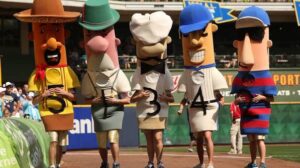
Eat up!
Before they switched leagues, the Milwaukee Brewers existed mostly on the periphery of my fandom. I remember reading how the Pilots were moving from Seattle just before the 1970 season began. I remember Henry Aaron returning to where he started to finish his career as a DH, one of the few instances of the designated hitter not seeming like a total affront to baseball’s beautiful balance of nine versus nine. I remember the rise of the Brewers to not quite the top of the AL East in the late ’70s, then their successful pennant run in 1982, when I did, in fact, root hard for them to win the World Series. Then they mostly faded from my consciousness.
The birth of the Tampa Bay Devil Rays and MLB’s preference for an even quantity of teams in each circuit — lest we be saddled with regular Interleague play — meant some AL entry had to move to the NL. Bud Selig, he who embodied conflict of interest as commissioner/club owner, volunteered Milwaukee for the assignment. Milwaukee had been a National League town from 1953 until 1965, when Braves ownership abandoned the market. By signing off on the Brewers’ unprecedented shift, Selig fancied himself fixing an error in the official scorebook of baseball life.
In 1998, the Brewers became an NL club. They stayed peripheral to my thinking, save for however many times a year we played them. I appreciated them taking two critical games against the Reds the final weekend of 1999, facilitating our last-minute lunge for that season’s Wild Card. We would usually beat them when we were good and they weren’t. Later, we would usually lose to them when they were good and we weren’t. When their presence in the playoffs had nothing to do with us, I tended to wish them well since they were usually facing somebody I begrudged. Listened to a lot of Bob Uecker and Jeff Levering over SiriusXM in October of 2018. Learned it takes a lot of sausage companies to sponsor Brewers radio.
Two memories came back to me in October of 2026. Twenty-one years ago, in the days when I subscribed to the Extra Innings package, I watched a late-season game in which the Brewers’ announcer positively burst with the calculation that the Crew had clinched or were on the verge of clinching their first non-losing season since 1992. I laughed a little at the enthusiasm for having reached or neared a goal that corresponded with mediocrity. The Brewers indeed finished precisely .500 in 2005, 81-81. It was something to aspire to when there’d been nothing better for so long.
The other thing that crossed my mind was a Mets-Brewers game I attended in the summer of 2011. The Brewers were splendid that year. They’d go on to win 96 games and an exciting NLDS versus the Diamondbacks before taking the Cardinals to six games in the NLCS. The game I went to wasn’t chosen because it involved the Brewers. If anything, Mets-Brewers games have traditionally been, all promotional considerations being equal, pretty easy gets in terms of tickets, what with no glamour attached to Milwaukee and no ongoing mutual enmity to speak of. Yet this game in 2011, a back-and-forth affair that eventually swung the visitors’ way, attracted scads of Brewers fans. Where the hell did they all come from, I wondered.
From Milwaukee, presumably. Maybe they in the city Alice Cooper taught us taught us during Wayne’s World carries the Algonquin name for “the good land” were waiting for a reason to hit the road to vociferously support their team. You gotta give even the most loyal fans a team that can be counted on to finish over .500 regularly before they’ll start booking trips. Brewers fans have gotten quality for most of the past decade. We saw the response in full in St. Pete and when they got back home for their championship parade. The phenomenon of “there are Brewers fans everywhere!” brushes up against the cringeworthy proliferation of Cubs types encountered when that Midwestern ballclub acts as a powerhouse, but the Brewers were never our enemy à la Chicago in 1969 or 1984, so I feel no need to cringe at their strength in numbers.
Not only did the best team win the World Series, the right team won the World Series. It wouldn’t have been wrong for the Rays had gone all the way, but this outcome arrived totally earned. The right team’s fans were rewarded for 57 seasons of waiting (58 if you’re a Pilots stickler). Pat Murphy was the right manager to hear from in interview after interview, not to mention little nothings he whispered when microphones were within listening distance. Three of Murphy’s coaches carried slight Met pedigrees: Daniel Vogelbach, who it seems was striking out for us just yesterday; Jim Henderson, an up-and-down righty reliever in 2016; and Charlie Greene, who caught in one game as a Met in 1996 and pinch-hit in another, and I was somehow at both of them. Compared to Charlie Greene, future Mets managers Dallas Green and Andy Green were Met mainstays as players, each of them having participated in four games as Mets long before taking on their skippering duties.
MOST GREEN(E) METS BY LEAST GAMES PLAYED
Charlie Greene, 1996: 2
Andy Green, 2009: 4
Dallas Green, 1966: 4
Pumpsie Green, 1963: 17
Sean Green, 2009-2010: 90
Shawn Green, 2006-2007: 164
Charlie Greene’s Met experience is fainter even than that of Gary Sanchez, Daniel Vogelbach’s teammate here for three games in 2023. As William Contreras’s backup, Sanchez gets a World Series ring, as does Trevor Megill, the brother of our guy Tylor, and, I suppose, Brandon Sproat, who started 19 games for the Brewers this year before being left off their postseason roster. The pitcher for whom we traded young Brandon, Freddy Peralta, saw far more October action than the kid we gave up. Strangely, that didn’t help us in the least.
Not everything is about us. This October was about the right team at last rewarding the people of the good land. Let the beer and sausage party continue.