The blog for Mets fans
who like to read
ABOUT US

Faith and Fear in Flushing made its debut on Feb. 16, 2005, the brainchild of two longtime friends and lifelong Met fans.
Greg Prince discovered the Mets when he was 6, during the magical summer of 1969. He is a Long Island-based writer, editor and communications consultant. Contact him here.
Jason Fry is a Brooklyn writer whose first memories include his mom leaping up and down cheering for Rusty Staub. Check out his other writing here.
Got something to say? Leave a comment, or email us at faithandfear@gmail.com. (Sorry, but we have no interest in ads, sponsored content or guest posts.)
Need our RSS feed? It's here.
Visit our Facebook page, or drop by the personal pages for Greg and Jason.
Or follow us on Twitter: Here's Greg, and here's Jason.
|
by Greg Prince on 28 May 2016 1:11 pm I gotta say, I am loving the 1986 vibe around our first-place Mets. True, it’s mostly a function of homecoming weekend (a concept I dared only dream of when Citi Field was no more than a branding exercise), but this wouldn’t work nearly as well without the Mets being in first place.
And did I mention the Mets are in first place? By an entire .004 over the Washington Nationals they are, gaining that decimalian advantage by not blowing Friday night’s game to the Los Angeles Dodgers or, more accurately, blowing it before blowing by them and grabbing it back.
That’s the teamwork that will make the dream work.
Twenty-four hours in advance of Jacob deGrom growing ever closer to resembling Jacob deGrom (seven three-hit, three-walk innings; one run, seven strikeouts, not bad at all in toto if not quite deGrominant in form); relative tween Julio Urias not being Fernando Valenzuela (yet); David Wright socking one deep to right center (talk about your throwbacks); Juan Lagares homering and driving in three (remember him?); and, after Jeurys Familia gave up a four-run lead, most of it to last October 10’s Worst Person in the World (closers in non-save situation ERA: a million-kajillion), Curtis Granderson reordering all narrative elements in a pleasing walkoff home run fashion (straight into Grandy’s Grove, formerly known as Utley’s Corner, a designation preferably applied to whatever spot in the visitors’ clubhouse Ol’ Chase will ball up into the fetal position after Noah Syndergaard finally takes care of him tonight), the 1986 Mets were dominating my thoughts much as Davey Johnson promised they’d dominate the N.L. East of their day.
 They’re always welcome back. That was the best part of 1986, the way the Mets conducted themselves as spring turned to summer and summer settled in and the Mets glided 20,000 leagues above the sea. I loved going to sleep with the Mets a dozen games ahead and waking up with them fifteen games ahead and reaching nightfall with them eighteen games ahead. You couldn’t unwillingly hum along to “Danger Zone” or “Who’s Johnny” or any of the hits of the year without the Mets picking up ground over the Cardinals or Expos or Phillies, whichever saps sat in the most inconsequential second place divisional play had ever seen. Of course that would all be Afterthought City thirty years later if not for what happened when the regular-season decks were cleared and the Mets proved themselves all over again versus Houston and Boston…which is when things got extraordinarily real.
The apex of human and Metsian existence came as October 25, 1986, tiptoed across midnight into October 26 and our beloved sports collective found itself on the edge of extinction. How close this came to disturbing reality was brought home Thursday night when WOR, bless its non-streaming soul, reaired Game Six of the 1986 World Series, just as it sounded over WHN (except with crummier fidelity, but never mind that right now). I’ve heard recordings of Bob Murphy and Gary Thorne calling the highlights countless times across three decades, but this was the first time I’d had the opportunity to listen as if it was happening live since Christmas Eve 1987, when an enterprising sports talk host on the new WFAN by the name of Howie Rose played it for us as a holiday gift.
It still holds up, not surprisingly. Murph was Murph, Thorne meshed beautifully with Bob and the content is Game Six of the 1986 World Series. If I wasn’t exactly on the edge of my seat in 2016, the ancient anxieties nonetheless reassembled as Dave Henderson took Rick Aguilera down the left field line, the Red Sox tacked on an additional run and — after Murphy announced “it’ll take a huge effort here” — neither Wally Backman nor Keith Hernandez could instigate an answering rally.
Two behind, two out, nobody on, the postseason about to go down and take the stillborn legacy of the 1986 Mets with it. There is no more WHN, no more Bob Murphy, no more Shea Stadium, no way a parachutist would sneak himself into heavily guarded airspace and I ain’t no 23-year-old no more, but the whole thing hung heavily in the balance anew nonetheless.
Then…well, you know. But even though you do know, geez. Y’know? Gary Carter singles. Kevin Mitchell singles. Ray Knight digs a hole (Murph: “now my friends, the New York Mets are down to their final strike”). Knight climbs straight up and out of it to drive in Kid and move World to third. Calvin Schiraldi is finally removed and John McNamara turns to Bob Stanley, and Bob Stanley crosses up Rich Gedman (or perhaps Rich Gedman just wasn’t agile enough to reach to his right; not our problem) and Mitchell crosses the plate with a tying run that is provisionally the most amazing thing that could have happened because at least it will get us to the eleventh inning, though Doug Sisk will be pitching and, well…
That’s neither here nor there in the granular there and then which felt like here and now on Thursday, because Mookie Wilson kept fighting off Stanley, and Stanley kept battling Mookie, and, at last, something was trickling.
A fair ball.
It got by Buckner.
Rounding third was Knight.
The Mets won the ballgame.
That’s about as calmly as I can replicate in the past tense what and how Murph reported what unfolded in an eyeblink. No need for the past tense where Game Six and 1986 are concerned, however. It is always with us. It is the milestone moment in franchise history and the best year a Mets team ever forged. It may not be the signature season of New York Mets baseball (1969 endures on that count), but the Mets were never greater and, no matter what they do in 2016 or any campaign down their long and winding road, never will be greater.
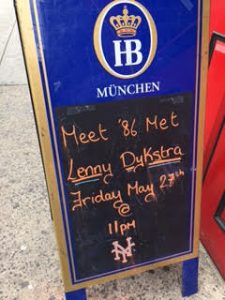
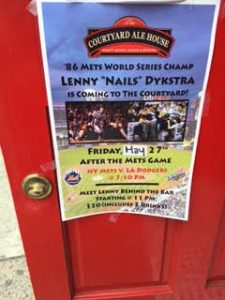 Yeah, even Lenny. The Mets were greatness incarnate in 1986. That’s why it’s so great to have them back this weekend. That’s why it’s so great that even a character of dubious distinction like Lenny Dykstra was slated to tend bar in Sunnyside Friday night after the Mets beat the Dodgers, 6-5, the same score by which the Mets beat the Red Sox in Game Six, the same score by which the Mets beat the Astros in Game Three, won by the man they call Nails, who ultimately gets a pass for everything because he hit one of the handful of walkoff home runs in Mets history to which all others must measure up.
Those throwback unis looked better against the Dodgers than they did against other comers so far this year. Maybe it had something to do with the starting pitcher’s litheness; Jake has the bod type/to rock the race stripe. Perhaps a night game is more natural milieu to stir memories of ’86, since most of those Mets were, to borrow a phrase from the book Roger Angell wrote with David Cone, night critters. However one processes it, 1986 is in the air, and as television voice of that generation Tim McCarver might put it, oh baby, I love it.
by Greg Prince on 25 May 2016 9:45 pm We now interrupt our collective, continuing Matt Harvey freakout to note Steven Matz is posting one of the best pitching seasons on the planet.
Yes, Steven Matz. Pay attention to him. Attention must be paid. Ought to be, at any rate.
I could see where you’d overlook him. Matz isn’t the most interesting member of the Met pitching staff. Matz isn’t even the most interesting member of his family. He’s surely no Grandpa Bert in the gesticulation department. Steven Matz may not even be as fascinating as the sandwich that’s named for Steven Matz. I haven’t had the sandwich, but it existed before Matz did in most of our consciousnesses, and I still find that fascinating.
None of this is intended to label Matz dull or boring. His demeanor is calming, his performance electric. We will not worry whether he speaks to the media after his starts. He will, but we won’t care what he has to say. He can leave colorful to his rotationmates.
Here’s what spoke volumes Wednesday afternoon in Washington: eight innings pitched, four hits, one walk, seven strikeouts, sixteen batters up and sixteen batters down during one expansive stretch of excellence and no runs allowed at all en route to a 2-0 victory against the first-place (by only half-a-game) archrival Nationals. Matz won his seventh consecutive start, the Mets took the series and, for a day or two, we can forget about Harvey’s travails.
Instead, we can dwell on Matz’s 7-1 record and 2.34 ERA that includes his awful first 2016 outing, one that feels as long ago as the 2013 prime of the Dark Knight. I’d look up how good Steven’s stats would be minus that uncharacteristic April drubbing, but really, how much better than 7-1, 2.34 ERA does a pitcher have to be to attract and maintain our notice?
(I just checked: 7-0, 1.13 ERA. Sweet Jerry Moses!)
We treat Harvey’s shortfalls as breaking news, yet Matz we view as less dog bites man than dog shuffles peaceably alongside man as they wait quietly at the light and cross at the green, not in between. It’s as if a pitcher who never loses is consigned to background noise. Really, Matz transcends “never loses”. In going 7-for-7, he matched a Met mark last mounted by Steve Trachsel in 2006. Trachsel in 2006 was no great shakes. He was luxuriously supported by a high-octane offense while pitching to a 4.43 ERA in his seven straight winning starts. He was OK, but, y’know…he was Steve Trachsel.
As Mets named Steven go, we’ve got the advanced model right here, right now in our star lefty. The latest deluxe feature to be added to the total Matz package is endurance. He’d never gone eight full innings before. To get there at Nationals Park, he had to go through a pinch-hitter named Bryce Harper. There were two out and one on in the eighth. Who were ya gonna call? Jerry Blevins? Yeah, maybe, but why not discern how much mettle the Met from Long Island is packing?
We did. Matz grounded Harper to Matt Reynolds at short and got out of the eighth. Jeurys Familia came on in the ninth, generated a few heebie-jeebies by surrendering back-to-back singles to start the inning, but then settled down to create his own slice of team history: 32 consecutive regular-season save opportunities successfully converted since the last instance he blew one (a rainy afternoon game against the Padres, it is vaguely recalled).
Other than those rare instances where a pitcher does all the hitting and all the hitting — Matz in his debut against the Reds, for example — it takes a village of Mets to raise a W. Familia contributed in Washington. So did David Wright with a first-inning solo homer off Tanner Roark. So did Reynolds, stepping in for a back-spasming Asdrubal Cabrera (the non-Cespedes, non-pitching MVP of this club to date) and collecting his first big league hit. Rene Rivera, as stealth an off-season acquisition as could be secretly imagined, delivered an enormous insurance run with his bat and cut down a potential threat with his gun for an arm when he threw out Michael Taylor trying to steal second in the third. Daniel Murphy also chipped in with a key error…oh wait, he’s with the other guys now, but he did help the Mets win.
I wouldn’t want to slight any Met or ex-Met who aided the greater good Wednesday, but I also don’t want to deflect too much of the spotlight from Matz, who deserves to bask in the glow of some serious accomplishments. Musslessly, fusslessly, professionally, he is consistently pitching at a level unattained by any of his rotationmates this season. Never mind the Dark Knight. Not even Thor the Norse God has unfurled quite the kind of roll the pride of Suffolk County is on.
Mind you, the Mets are in a race with the Nationals, not a contest with each other. We want every one of our golden boys to go to the mound every fifth day and never lose (including the onetime pacesetter who’s sort of out of fashion of late). But since one Met pitcher is living up to that description more than any other, let’s shove him front and center for a spell. For a refreshing change, let’s not be about Harvey who isn’t getting it done. Let’s be about Matz who is barely getting touched.
by Jason Fry on 25 May 2016 2:32 am I don’t know what’s wrong with Matt Harvey. Neither does Dan Warthen, or Terry Collins, or Sandy Alderson, or Kevin Plawecki, or Matt Harvey himself.
The weird thing is, suddenly that’s no longer as important as what happens next, which is that Matt Harvey be made to Go Away.
Not so long ago, Harvey had managed to navigate his way to a fairly happy ending after a tumultuous summer. He’d shut the door on his agent’s innings-limit controversy and brought the Mets to the brink of returning the World Series to Kansas City, with a puncher’s chance at riding Jacob deGrom and Noah Syndergaard to victory in seven games. It didn’t happen, but the blame went to Collins for letting his heart rule his head and Lucas Duda for a startled throw that went awry. The Mets were booted into winter, but Harvey had more than done his part to prevent that.
And now, just 10 starts after what looked like the final act of his redemption, he’s going to be exiled. His baseball Elba is to be determined. So’s the official reason for his being sent there. But it’s coming.
As with Monday’s game, Tuesday was a repeat engagement between pitchers: Harvey against Stephen Strasburg, tormented in better days at Citi by a spontaneous chant of “Har-vey’s bet-ter.” Strasburg was better at Citi last week, by a decent measure, and Tuesday night, alas, was no antimatter affair: Strasburg was better again.
Harvey had said the right things between starts, talking about fighting and not quitting, and in Tuesday’s early innings he looked OK — he even took a 1-0 lead into the fourth thanks to an Asdrubal Cabrera homer. After a couple of good plays were made behind him and a couple of flat pitches were popped up instead of driven out, I even dared myself to hope that the BABIP gods might be giving their whipping boy a break — perhaps a simple regression to the norm luckwise would get Harvey back on track.
But the early innings haven’t been in the problem this year. As if on cue, Harvey spit the bit in the fourth, and in depressing fashion: he threw a hovering change-up to Ryan Zimmerman that turned into a game-tying home run, then offered Anthony Rendon essentially the same ineffective pitch, with the same grim result. A fifth-inning sacrifice fly from Bryce Harper made it 3-1, and then Daniel Murphy simply demolished a flat fastball, hitting it on a line into the second deck in right field.
That made it 5-1, and Harvey’s night was officially a disaster — one he compounded by being absent for interrogation by the press corps a couple of hours later.
On that last point my sympathies lie more with Plawecki than with the scribes: the catcher had to follow a lousy night at the plate with helpless non-answers on behalf of a teammate, while the writers were handed free lighter fluid for their hot takes. Harvey ducking the firing squad has nothing to do with heart/grit/manitou/midichlorians or whatever other mystical substance Wednesday’s papers will insist he lacks — he has more or less the same amount of that as every other professional athlete, or he never would have reached this level. On the other hand, Harvey has now touched the same PR hot stove twice — and if he thinks the blister he got for his mumbling about innings limits in September was painful, the damage inflicted by Tuesday’s no-show will be worse.
Harvey has go somewhere in small measure to appease the mob but in larger measure to stop the machine that’s chewing him up, and that neither he nor anybody else can shut off right now. Maybe that place is the bullpen for side sessions and low-leverage assignments. Maybe it’s Port St. Lucie because of [insert vague ailment here]. Maybe it’s Las Vegas because everyone will be in a mood for truth-telling. I’m not sure it really matters or that I particularly care.
What I care more about is that we don’t know what part of the story we just read. Maybe it’s the bump in the road after the opening chapters, the setback that complicates the hero’s journey and forces him to learn something new about his quest and himself. That kind of story can end in triumph and adoration. That would be nice. Or maybe this is the fall into darkness closer to the end, the one where bad things happen to a character who turns out not to be the hero after all, but a supporting character undone by poor decisions or bad luck. I don’t particularly want to read that story, but you and I are the audience, not the narrator. All we can do is wait to discover what happens next, whether that’s in five days or 15 days or some date to be determined.
by Jason Fry on 24 May 2016 12:50 am Rain in the area, Gio Gonzalez and Bartolo Colon on the mound. One team scored seven. The other team scored one.
You remember, right? It was five days ago, just the other side of the Brewers Interregnum. Gio was masterful, except for a cannon shot lined into the stands by Yoenis Cespedes. Bartolo was not masterful. He walked more people than he typically does in a fortnight, the Mets didn’t hit, and by the middle innings the game was a fallen souffle that polite guests pretended didn’t exist.
With the Nationals now hosting, Monday’s first inning sure seemed like more of the same. The Mets put the first two runners on thanks to a Bryce Harper misplay on Curtis Granderson and an excuse-me pool shot up the third-base line by Juan Lagares. But then Gonzalez got David Wright to swing at a pitch that passed by his nose, got Cespedes to swing at a pitch that kicked up dirt six inches in front of the plate, Neil Walker grounded out to first and the Mets’ rally had fizzled.
Disheartening — and then in the bottom of the inning, Bartolo couldn’t corral the third out as Daniel Murphy and Ryan Zimmerman singled. Disheartening squared.
It was already 1-0 Bad Guys, and the discussion in the booth and on Twitter was about who’d play first with Lucas Duda felled by a stress fracture in the back for … well, let’s just say the foreseeable future, since this is the same injury that cost Wright 58 games in 2011. ( I don’t really get the mystery: unless the Mets are about to reacquire Kelly Johnson, Wilmer Flores will take over on Friday. Moving Wright across the diamond would be madness, as would forcing Michael Conforto or Walker to an unfamiliar position.)
Anyway, with all that swirling around us, we nearing compound-interest disheartening. A full-on Panic City sell-off hasn’t been seen in these parts since John Mayberry Jr. was batting cleanup, but it seemed somewhere between likely and inevitable.
Fortunately, it’s baseball. Traditionalists talk about fundamentals and instincts and red-light players and reaching down deep inside, but if they’re being honest they’ll tell you that on a given night nobody knows anything. Sabermetrics fans will talk small sample sizes and statistical noise and regressing to norms, but they’ll also tell you that on a given night nobody knows anything. Baseball is perverse, fickle and maddening, which is part of its charm.
In the top of the third, Gonzalez threw 22 pitches — not ideal for an inning, but by no means extraordinary. Twenty-two pitches often indicates nothing more than a spot of bother, perhaps a two-out walk after some stubborn fouls. Somehow, Gio threw those 22 pitches to eight batters. Two of them — Colon and Kevin Plawecki — saw five each, leading to an inning-starting K and an inning-ending groundout, respectively. Nobody else was waiting around: Granderson took the second pitch off his forearm, Lagares swatted the first one to right for a single, Wright hit the first one just over the glove of hairy annoyance Jayson Werth for a three-run homer, Cespedes singled on the third one, Walker singled on the first one, Asdrubal Cabrera hit the second one past Murphy for a run-scoring single, and Eric Campbell drove the second one to center field for a sac fly.
When things don’t go well, Gio has a grating habit of stalking around muttering to himself and casting his eyes heavenward, like a helicopter child whose instant affirmation is late. In that frame, though, no one could blame him — it was fluky crossed with ridiculous.
When the dust settled it was 5-1 Mets; in the fifth they added two more on back-to-back shots by Cespedes and Walker and the game had completed its weirdo transformation into the antimatter version of last Wednesday’s matchup.
Nobody paid much attention to anything else that happened, including the principals. In the bottom of the sixth, Zimmerman singled with two outs. With Anthony Rendon waiting on a 1-1 pitch, Zimmerman “broke” for second. You know how every bar has some doofus who assesses some lackluster performance on TV and insists that he could do that? Nine hundred ninety-nine times out of 1,000 that guy deserves the derision he never gets, but this was No. 1,000: Zimmerman took a walking lead that turned into a kind of shuffling jog and ended, uncontested, at second. Yes, doofus in the bar, you could have done that. Rendon, apparently mesmerized, watched strike two thud into Plawecki’s glove. Every one involved looked vaguely sheepish, particularly when Rendon then struck out a pitch later. Returning from break, the cameras supplied the missing piece of the puzzle: Colon had thrown the pitch from the windup because he’d forgotten Zimmerman was there.
Goofy, but it fit. Blowouts in tightly contested series are funny things, with a few taut early innings dissipating into lassitude better suited for a spring-training game. One team’s fans are sleepily content, the other team’s rooters are grumpily dismissive, but either way it’s footnote baseball that no one will remember. Well, until tomorrow, when you might be reminded that you can know everything that’s happened and still not have a clue what’s coming.
by Jason Fry on 22 May 2016 11:48 pm Greg and I divvy up recap duties by series — most often one series at a time, sometimes two or three. Usually we start by comparing schedules and subtracting evenings on which the world will interfere with baseball-centric life. Sometimes we put our hands up for a game because we’ll be in attendance.
And sometimes there are other factors. Before the Nats series, Greg raised his hand for Tuesday because he hadn’t chronicled “a Synderstaart” since our unrequested rematch with Kansas City.
Yes, Noah Syndergaard being on the mound is must-see TV and a happy-to-recap calendar item.
But not even Syndergaard can stand alone. He was phenomenal Sunday afternoon — 11 Ks, six singles, no walks, no earned runs — but perhaps the most impressive aspect of his performance was that he didn’t arrive with his usual arsenal. He wound up playing peekaboo with his pitches, his command coming and going in a perplexing manner. In the early innings the fastball was refusing to stick to the corners and the slider was off, so Syndergaard and Rene Rivera turned to improv, leaning on the curve and the change-up and coaxing the other two pitches along. That plan wouldn’t have succeeded last summer, but after a rough patch Syndergaard hit fast-forward on his 2015 pitching lessons, looking like a different pitcher in September and October. Today, the result of the Syndergaard-Rivera collaboration was a line most starters would kill to leave the park with.
Rivera did more than play co-strategist: in the seventh, he corralled a fastball in the dirt and gunned down Alex Presley on an ill-advised break for second with runners on first and third and no one out. Gifted an out, Syndergaard struck out Ramon Flores, got a ground ball from Aaron Hill and was home-free. Also chipping in was Syndergaard’s Upper East Side roommate Michael Conforto, whose first-inning home run extinguished a brief Brewer lead, and Asdrubal Cabrera, who lined a flat Chase Anderson curve over Hill’s head for the go-ahead run and a spot of insurance in the fourth.
The fly in the ointment? Not to be too Metsian, but it wasn’t that hard to spot: you’ll find a chronicle of all the scoring two sentences above. The Mets scored 11 runs in sweeping the Brewers, after scoring four in dropping two out of three to the Nats, nine in getting swept by the Rockies (and in Coors Field no less), 10 in four games split with the Dodgers, and 13 in a four-game split with the Padres. You have to go back one more series — the three-gamer against the wretched Braves — to find the last time the Mets averaged four runs a game.
That’s an unlikely formula for success against the Nats, whom the Mets will probably take on without Lucas Duda, leaving them deprived of Duda and Travis d’Arnaud and trying to figure out how to manage David Wright‘s woes. As for Syndergaard, he’s next scheduled to ply his trade on Saturday against the Dodgers. Must-see TV, of course — but what kind of performances will it follow?
by Greg Prince on 22 May 2016 2:30 am Here’s a fun fact: May 21 isn’t May 20. Came as news to me on May 20 when I looked at two tickets for what I thought were that night’s Mets-Brewers game and realized they said May 21, a.k.a. the next day. So I’m not going tonight, it dawned on me. I’m supposed to go tomorrow.
Except independent of the acceptance of these May 21 tickets that I somehow convinced myself were for May 20, I had made dreaded Other Plans for May 21, plans I couldn’t and didn’t want to break any more than I wouldn’t think of not using these May 21 tickets, which were for a special occasion above and beyond a meeting of the Mets and Brewers (as if that isn’t special enough). Having considered my conundrum, I resorted to the only answer I could conjure.
TWO PLACES! ONE TIME!
That’s not my leitmotif. I’m barely a one place at one time type of fellow, unless the Mets are involved. In fact, the Mets are pretty much all the place I make time for. But ya gotta do what ya gotta do if ya wanna do more than one thing at once. (This message is brought to you by Schaefer, the one beer to have when you’re doing more things than one.)
Thing One/Place One Saturday was indeed the Mets, specifically Sharon and Kevin Chapman celebrating their wedding anniversary by graciously gathering a group of their friends — Stephanie and me included — on the left field party deck. They did this last year when the deck had a different corporate-sponsored name, but they did it on May 20, which provided the root cause of my confusion this year. In brief, we couldn’t make it at the last minute on May 20, 2015, and it’s kind of haunted me since then, so we were determined to get there on May 20, 2016…until I realized it was set for May 21, 2016.
I guess I’ve already mentioned that, but it does explain why for only four-and-a-half innings we enjoyed the hell out of that deck. I’d never been up there before. It’s truly a marvel.
• You walk among and can’t help posing with the retired numbers.
• You wonder where they’re gonna fit 31 — between 41 and 42 for its Metness or after 42 and SHEA for its chronology.
• You eat and drink pretty well, with beverages and substantial noshing part of the deal (told ya our hosts were gracious).
• You are on the edge of the staging area for the Stolen Base Challenge or whatever that charming promotion is where they bring a kid on the field to run down the left field line. Every kid runs his or her heart out and we all applaud in earnest. Keep doing that; ditch the fake car race.
• You view your left fielder very up close…and you cringe to realize just how much Michael Conforto is learning on the job. His best route to any ball is in the batter’s box, but as Floyd the Barber said of Opie Taylor, “He’s just a kid, Andy.”
• You count pigeons that congregate on the outfield grass. We counted six.
• You actually see, by leaning over slightly, every speck of fair territory in the ballpark, something I’ve never managed from even the most centrally located seats behind home plate. Everything looked different and fresher, as if we were seeing a whole new ballpark. Maybe the Texas Rangers should build one of these party decks and then they wouldn’t think they need a whole new ballpark.
• You are gobsmacked to realize you sit in what was once fair territory. I mean the seats and the walkway used to be in the flight path of a double high off the Great Wall of Flushing. Jason Bay’s career died somewhere beneath our seats. Now we relax with our complimentary pretzels and exchange random disparagements of T#m Gl@v!ne (Saturday’s gripe: consigning Super Joe McEwing to No. 11 upon the Atlantan’s uncalled for arrival in 2003).
Even with a few spritzes and sprinkles and Jacob deGrom not so sharp — bucket hats can protect you from only so many elements — this was the place to be for four-and-a-half innings. I’ll go out on a limb, or perhaps a deck, and say it was the place to be for the full nine, except we were in TWO PLACES! ONE TIME! mode and four-and-a-half innings were all we could allow ourselves. Thus, we bade our fellow deckers goodbye and reluctantly became civilians in the bottom of the fifth.
You know, those sad folks who aren’t at a Mets game, which is most of the world’s population, which is swell when you don’t have a party deck ticket in your pocket and a party deck wristband on your wrist. What kind of people leave not just a Mets game in the fifth inning but the party deck?
Stephanie and I did that, because we thought May 21 was going to be May 20 and therefore told our comedian friend Jeff that we’d love to come to his show in Manhattan Saturday evening. He lives down around Washington and doesn’t do many gigs up here and it wasn’t like we were going to a Mets game that overlapped with it or anything.
Whoops.
To clear up any lingering urban myths about my fandom being infallible, I have left Mets games early in my life, though probably not in the fifth. I’ve missed a couple of spectacular endings (foreshadowing!), too, but the important thing is that the spectacular ending occurs. Please, Mets, don’t hold off winning on our account.
I followed the action by app and transistor on the 7. I more or less heard Yoenis Cespedes homer to tie the game at four while we were pulling into Queensboro Plaza. What I caught was Howie Rose announcing a ball had been hit down the line, but had to wait a moment, through static, to ascertain that it had not gone foul and that the Mets had indeed knotted matters at four.
It was a good note on which to slide under the East River. Due respect to Craig Counsell’s troops, but trailing the Brewers is a bad look. Who are these guys? They have a Flores, but not the one they tried to trade for last summer. They have a Scooter, but not the one convicted in the leaking of the covert identity of a CIA agent. Sixteen percent of them are ex-Mets who nobody will ever go out of their way to reunite for Two Thousand Whenever Weekend.
DeGrom gave up four runs to these guys and the Mets didn’t score more than two against them before we left. Thank goodness for Cespedes, huh? Fourteen homers, 35 RBIs, .297/.378/.659, and we mostly notice when he doesn’t run out a dropped strike three. WOR’s fadeout on the 7 notwithstanding, I wasn’t surprised when Yoenis went deep in the sixth. It’s what he does. What’s surprising is that we have a guy whose exploits can be casually encompassed with a “that’s what he does”.
Also not surprising that my optimistic forecast of waiting until the fifth to depart Citi Field for Jeff’s comedy date on the West Side would result in an on-time arrival by us turned out to be misguided. Weekend transit did its pokey thing and deposited us at 51st and 8th in plenty of time to see lots of talented comics, but not the one we aimed for. Jeff’s set was over by the time we found him. Another performer might have been miffed. Jeff, having commandeered a stool in the corner of a sweaty alcove off the main stage, was simply shocked.
“You left a Mets game before it was over?”
Like I said, it has happened despite my preference that it never does. I excused myself from Shea in 2003 to make an Off-Broadway curtain and missed a Mike Piazza walkoff homer. Later that year I had a crazy notion of taking in part of a Mets game and part of a Cyclones game and missed the scoreboard announcement that Bob Murphy had decided to retire (and never made it to Coney Island besides). A year after that, I couldn’t stay beyond Victor Diaz puncturing the Cubs’ playoff hopes and therefore didn’t get to witness Craig Brazell letting all of Chicago’s air out. There have also been more mundane exits and less memorable final frames that have escaped my personal observation.
But that’s why they make radios and digital devices. And that’s why Saturday’s game against the Brewers never left me. Jeff, you see, is a Mets fan first, a comic second and everything else third through infinity. He didn’t much care that we missed his jokes in the city. He was touched that we set aside the baseball in Queens. Really, though, he was mostly interested in whether the Mets could complete their comeback over Milwaukee.
The logistics of what transpired next are a little hard to explain. Though Jeff was done, his wife was still in the crowd, seated somewhere Jeff couldn’t easily find her let alone give her the high sign to vamoose; another friend of his (and ours) was also too polite to ditch the show in progress. Mix in professional protocol that generally demands a comic stick around after doing his bit so as to stay in the club’s good graces, which is what Jeff was doing when we found him. Hence, instead of leaving the club and finding a bar or restaurant with a TV, we huddled in that sweaty alcove corner, tracked the game on our phones and watched the seamy underbelly of standup comedy unfold before our very eyes.
Due respect to everybody’s setups and punchlines, we got a show most of the ticketholders never get to see. We saw comics and club management snarl at each other. We heard “I’m being disrespected!” countered with “I’m gonna call the cops!” We listened to one hopeful tell no one in particular, “I just vomited.” We avoided being seated in the main room — and being saddled with two-drink minimums — by resorting to the clever retort, “We’re with Jeff.”
Amid all that, we clung to Addison Reed in the top of the eighth; wondered who Tyler Thornburg was in the bottom of the eighth (the subject of an ABC miniseries was my best guess); invested our faith in Jeurys Familia for the top of the ninth; and hoped like hell the Mets could win this in the bottom of the ninth almost as much as we hoped Jeff’s wife would finally notice the many LEAVE NOW texts Jeff was sending her (the text count was approaching Jake’s pitch count).
“How about a walkoff?” Jeff asked rhetorically, until he noticed who was up to start the Met ninth: Eric Campbell, in there not for his bat but because he’s in less discomfort these days than Lucas Duda. Jeff’s instinctive dismissal was a reasonable reaction after three years of Soup simmering at a very low boil. Campbell and huff, sure, but Eric breathed unlikely life into the Met attack with a leadoff single. Kevin Plawecki, almost as inspirational an offensive figure, walked. Matt Reynolds, rockin’ the MLB .000 since his long-anticipated elevation from Las Vegas, successfully sacrificed himself at the altar of conventional strategy to move the runners up ninety feet. Curtis Granderson, who homered in the first and nothing-muched the rest of the day, was intentionally walked.
Bases loaded. One out. Up next to potentially untie the game was David Wright. The very same David Wright who Jeff was seriously considering dropping from his fantasy team. That’s admittedly a matter of concern to Jeff and nobody else, but it was symbolic enough to model Wright writ large. Jeff loves David. He’s his favorite Met. He’s everybody’s favorite Met in some sense. Cripes, it wasn’t that long ago that he was the Mets.
Which is to say if we didn’t already love David Wright, it wouldn’t occur to us to embrace him given the trajectory of his career at the moment. But it’s not about the moment when it comes to us and the Mets. It’s about the long haul. David Wright is as long-haul a Met as they come. Wright’s appearance at the most crucial juncture of a game the Mets could really use may not fill you with confidence like it used to, but you can’t reject it out of hand. Whether you’re getting rained on at Citi Field, huddling in a sweaty comedy club alcove or taking in the action in drier conditions, you need to line up behind your Captain for that critical at-bat that’s destined to decide the difference between an immediate win and an indeterminate outcome.
If you can’t do that much, there are 29 other teams and myriad other amusements that might better suit your needs.
David Wright, who we know all too well, took three balls from Michael Blazek, who I wouldn’t know if he was headlining the eight o’clock show at the Comedy Cellar. Who are these Brewers? Then, for a veritable eternity, we stared at our screen for the next pitch.
What’s this? “In play, run(s),” it said. I knew what that meant, but it always takes an extra beat to sink in. Hey, David Wright did something that wasn’t striking out. He swung on three-and-oh. He got a hit. The Mets scored a run. Instead of it being 4-4, it’s 5-4.
They won! It’s over!
Stephanie and I weren’t at the game anymore, David may still be cut from Jeff’s fantasy team (he needed to generate a grand slam to acquire immunity), we still couldn’t find Jeff’s wife (though when we did, she told us about the Spring Training trip to St. Pete when she shared an elevator ride with Bob Apodaca), it was still sweaty in the alcove and it was pouring outside, but none of that was an issue. The Captain came through. He swung at ball four, we’d learn in a little while, but he connected. That was a David Wright walkoff hit like he’d produced eight times before. That was David Wright like the one we’d always relied on, like the one we still have to believe in.
Two places. One time. Not bad.
by Jason Fry on 21 May 2016 1:28 am Well, that’s better.
Steven Matz was superb, watching a Chris Carter home run in the first and then allowing next to nothing after that. The Mets, meanwhile, didn’t exactly light up Wily Peralta, but they did enough to win and chase the blues away, at least for a night.
We’ll return to those blues in a minute. (Of course we will, we’re Mets fans.) For now, though, Matz becomes a more and more interesting story. He’s 10-1 in 13 regular-season starts, a beginning that in a different era would have the Mets trying to craft him into a face of the franchise. Instead, he’s almost an afterthought. Which I suppose is understandable: He doesn’t have the star presence of Matt Harvey (or the reversed-polarity epic misery of his current predicament), the jaw-dropping arsenal of Noah Syndergaard, or the track record and TV-friendly locks of Jacob deGrom. Matz is underwhelming to look at, a kid from Long Island who looks a bit like Joe DiMaggio.
Except that kid from Long Island is 10-1. Sure, none of his Matz’s pitches is as lethal as what his moundmates possess, but they’re all pretty good and come with natural movement, he has pinpoint control, he’s left-handed, and he seems to think about what he’s doing out there on the mound. Which is a pretty impressive combination. On Friday afternoon Matz was part of the avalanche of Metsian panic, having been shelved with elbow pain; by late Friday evening he’d become the soothing balm we desperately needed.
Still, it was a respite, not a resurgence. The Mets still look like they’re holding the bats wrong-side up; Wily Peralta’s been a tomato can all season, one of the few guys who’d gladly switch stats with Harvey, and he hung in there into the sixth inning, undone only by a windblown Michael Conforto flyball that flopped into the party deck and left Conforto himself looking mildly startled. Take that away and … well, let’s be glad we don’t have to.
What would change this? A better showing from Harvey would help, obviously — and if you want some optimism, here are two pieces from smart folks suggesting Harvey’s woes may be symptoms of the oldest baseball malady of all, bad luck. More than that, though, some consistent hitting would sure help. The late April Mets could simply bash away their troubles at the plate; the May Mets have been more problem than solution with bats in their hands.
We’ll see — it’s a long season. (Perhaps you’ve heard.) It’s far from crazy to think the luck will even out, guys will seek their historic means, Lucas Duda will go on another of his bipolar baseball rampages, Travis d’Arnaud will return, Neil Walker will find a happy medium between hitting like John Buck and hitting like the other John Buck, and the Mets will find someone (Wilmer Flores?) to partner with David Wright as the captain negotiates uncharted spinal-stenosian territory. Perhaps some of those things will happen but not others. Perhaps none of it will. Sometimes that happens too.
But that’s for the future. For a night, Matz was crisp and the Mets hit enough and we could all exhale. For a night.
by Greg Prince on 20 May 2016 10:20 am The clot in his bladder. The load of innings in 2015. The lack of innings in Spring Training. The to-be-expected second year after Tommy John trajectory. The residual mental strain from trying to be The Man in the deciding game of the World Series and famously not succeeding. A general psychological breakdown. Something physically wrong they’re not telling us about. A reticence to come inside. An arm angle. A footing problem. An overall mechanical issue. Not loose enough. Needs to work harder. Needs to ease off. Needs a night on the town. Needs to miss a start. Needs to go down to the minors. Needs a less vocal agent. Could use a pinch between the cheek and gums. Restore the hubris. Embrace humility. Lose the nickname while you’re at it. Maybe a wee bit off the waistline, too.
No, I don’t know what’s wrong with Matt Harvey, but I do know he pitched dreadfully in a 9-1 loss to the Washington Nationals at Citi Field on Wednesday night, a big game that ceased to be a big game once Matt drowned in the third inning, the frame in which the Nats scored seven runs and inspired their superstar to utterances of mercy. Harvey was undermined by a couple of episodes of poor fielding (Asdrubal Cabrera blowing a transfer at short, Michael Conforto taking up jai-alai in left), but baserunners were everywhere on his account.
When Matt trudged away from the mound with two outs in the third, having just surrendered a two-run triple to a .123 hitter — thus burying the Mets eight feet under — with him went the last shred of reflexive confidence that he’ll figure it out, he’ll come around, he’ll be fine.
Matt Harvey is not fine. It’s absurd to believe he never will be again, but it’s not a given that he’s one start away. He’s filed nine outings in 2016. One was very good. A couple were good enough. Most have been not so shy of decent that you couldn’t talk yourself down from terribly alarmed to merely concerned. Last night’s was too brutal to dismiss as an aberration considering everything that preceded it.
Every nine innings he pitches, he gives up 5.77 earned runs, and he’s not packing any other metric that suggests there’s a hidden value the naked eye is missing. The naked eye observes a pitcher easily undressed by opposing hitters. “Body language” can be folly to translate, for it presumes a slouch isn’t just a slouch and minds can be easily read, but does Matt Harvey look like Matt Harvey to you?
And while we’re rhetorically asking pressing questions of the day, do the Mets look like anything? They were no help to their pitcher on Thursday, pooling six singles for a lone run. Stephen Strasburg may have been unhittable, but it’s hard to tell when the lineup he’s facing hasn’t been hitting. Strasburg, Gio Gonzalez, Max Scherzer and assorted National relievers limited the Mets to four runs in 26 innings. Their counterparts in Colorado, Los Angeles and San Diego were similarly effective. The Mets have scored 49 runs in their past 18 games. Even with the Greatest Rotation Ever pitching up to its advance notices, that’s a lot of non-support to overcome.
And the Greatest Rotation Ever hasn’t pitching up to its advance notices.
So little is clicking these days. Yoenis Cespedes is hitting the ball exceedingly hard. Everybody else is flying or striking out at alarming rates. When the prime highlight of two nights against your archrival is your bullpen keeping a 9-1 deficit 9-1, perhaps you’re mostly battling yourself — and losing.
Bring on the Brewers. Bring on the next 122 games. There’s three quarters of a season remaining and the Mets are still very much contenders. It only feels like the end is nigh.
by Jason Fry on 19 May 2016 11:54 am From the Better Late Than Never Department:
The best thing about Wednesday night’s tilt with the Nationals, from my admittedly parochial perspective? It was getting to talk baseball with my blog partner, something we hadn’t done since the Daniel Murphy Game last October and hadn’t really done then, since at the time we were too busy being anxious and then inconsolable.
Games in May are better for that, even if they’re against your division rivals. Games that resolve themselves as pretty clearly not going your way might even be best. So what if you’re at the ballpark and getting blown out — you’re still at the ballpark, and while the baseball unfolding before you may not be what you requested, the conversation will take you off to better games and better times, as well as equally bad games and times now made less painful by being long ago.
We talked the oddities of baseball cards, the misfortunes of Steve Chilcott, the pros and cons of various baseball-seat physiologies, middle relievers and their maddening unpredictability, guys who wore 29 and why Rick Reed was superstitious about that number, replay and its discontents, when Citi Field existed only as a theme-parkesque “experience” within Shea, the twists and turns of Met prehistory, club strategies for escaping the sight of unoccupied expensive seats on TV, and a whole lot more.
Wednesday night had other pleasures as well:
- the fairly amazing seats granted us by a kind host. They even came with shelter from the less-than-kind elements.
- the bolt struck by Yoenis Cespedes that was obviously a home run before it passed over Danny Espinosa‘s head.
- the long Daniel Murphy drive that looked exceedingly perilous off the bat but wound up in the glove of Juan Lagares, facing the outfield wall as if Murphy were his personal Vic Wertz.
- the Mets’ new Coca-Cola sign. I don’t mean because it trumpets the virtues of Coke products — that’s a matter of one’s personal tastes — but because it’s programmed to turn into an American flag, become an orange and blue lava lamp, display fireworks and do other hey-lookit-that stuff. Whether we like it or not, modern ballparks are crammed with high-tech stuff and marketing; it’s nice to see that pairing done well.
So what wasn’t so good about Wednesday night?
- watching Mets’ pitchers walk the ballpark, adding in a few hit batsmen for good measure. No, that wasn’t good at all. If you put Jayson Werth and Bryce Harper on nine times in 10 plate appearances, you’re lucky if the final score’s only 7-1.
- The Mets scoring just one run and David Wright looking worryingly ineffectual.
- Citi Field’s new car race, featuring a taxi cab, cop car, black car and ambulance. I may have gotten those slightly wrong, but who cares. This one’s too pathetic to even mock.
In other words, everything else. But that happens sometimes in baseball — which is why we have memories and conversations to sustain us until a better game.
by Greg Prince on 18 May 2016 6:07 am I particularly liked the part where Bryce Harper struck out. That I have to be more specific than that I also particularly like.
I’m referring to the top of the fourth, one out, nobody on, the Mets ahead of the Nationals, 2-0. Noah Syndergaard is one-two on the consensus best player in the National League and…frozen. Syndergaard painted the black a shade of ebony ice. Harper didn’t know what to do with the most perfectly placed inside pitch you’ll ever see, so he stood and he took it for strike three. It was only the second out of the fourth inning, only the fifth of an eventual ten K’s unleashed by the Met starter, but it was surely a victory within a victory.
Great pitching had stopped great hitting. The law of the jungle had prevailed.
Baseball was fun again Tuesday night, which should have made Harper happy as heck, given that he pointedly referred to the sport as “tired” in Spring Training. Coincidentally, the Mets looked tired on their recent road trip to nowhere, especially its last leg, which, of course, never happened. Then they arrived home and woke up, starting their day with a nutritious breakfast consisting of sublime pitching and solo home runs.
You know, the breakfast of defending league champions.
Syndergaard ate up the Nationals with a spoon so as to get every drop: seven innings (apparently the modern-day equivalent of nine), four singles, one double, no walks, no runs and let’s not forget those ten strikeouts, including two of Harper. The line of Thor outpaced that of Max Scherzer, who went not quite as deep and failed to keep within the confines of Citi Field two fly balls to right. One was the very first pitch he delivered to Curtis Granderson, who in turn delivered it beyond the reach of Harper, who might tower over the game, yet isn’t tall enough to catch everything socked in his general direction. Granderson spent the bottom of every inning in which he batted as a baserunner of some sort, a happenstance that in 2015 tended to serve as gateway to triumph. Come the third, Michael Conforto also sent a ball suitably out of fielding range, another splendid sign.
That gave Noah a two-run lead, an edge that held up without obvious muss or fuss the rest of the way. Addison Reed and Jeurys Familia each threw perfect innings to seal a much-needed 2-0 win, a definitive first blow in the projected 19-round battle for National League East supremacy. It’s a little early to be determining a division champ, but it’s never too soon to capture what feels from the outset like a very big game.
Scherzer struck out 20 Tigers in previous start. He struck out half as many Mets this time around. Subtract a few feet from Granderson’s and Conforto’s respective efforts, and perhaps this affair would have encroached into West Coast start time. Mad Max was almost as good as Thor, but not as good. Thor was both dominant and efficient and, as a result, the Mets were winners in two hours and thirty-two minutes. Even with pair of replay reviews mixed in — both from the Nationals, including one triggered despite their not having any challenges remaining (go figure) — it was a deliciously brisk evening.
Only one National made it as far as third base. Harper didn’t get on base at all. Friendly Ghost of October Past Daniel Murphy, the focus of some well-deserved appreciation upon his reintroduction to Flushing, blooped one single (beyond the reach of Neil Walker, appropriately enough) but was stranded alongside his .399 batting average in the on-deck circle as Harper grounded out to surprise third base starter Matt Reynolds to conclude the contest.
That the Mets could top their first-place rivals behind Syndergaard is no surprise. That they could defeat Scherzer while featuring Reynolds in his major league debut at third and good old Soup Campbell at first, well, that’s the Power of Thor, a scintillating blend of heat, location and savoir faire. His second strikeout of Harper, in the sixth, consisted of a sinker, a changeup and a backdoor slider; talk about putting the Mjölnir down. Someone who can outduel another elite ace and make you forget the stiff backs of David Wright and Lucas Duda can really inspire you. After he fanned Harper in the fourth, I was ready to don appropriate headgear and parade through Times Square.
But then I would have missed Noah’s next four innings, and why would I want do that?
Heartfelt thanks to all who came out to Turn of the Corkscrew Books & Wine on Monday night for a pulsating evening of Mets talk. When in the greater Rockville Centre area, I heartily suggest visiting the independent bookseller on North Park Avenue. They stock some fairly Amazin’ items.
|
|






