The blog for Mets fans
who like to read
ABOUT US
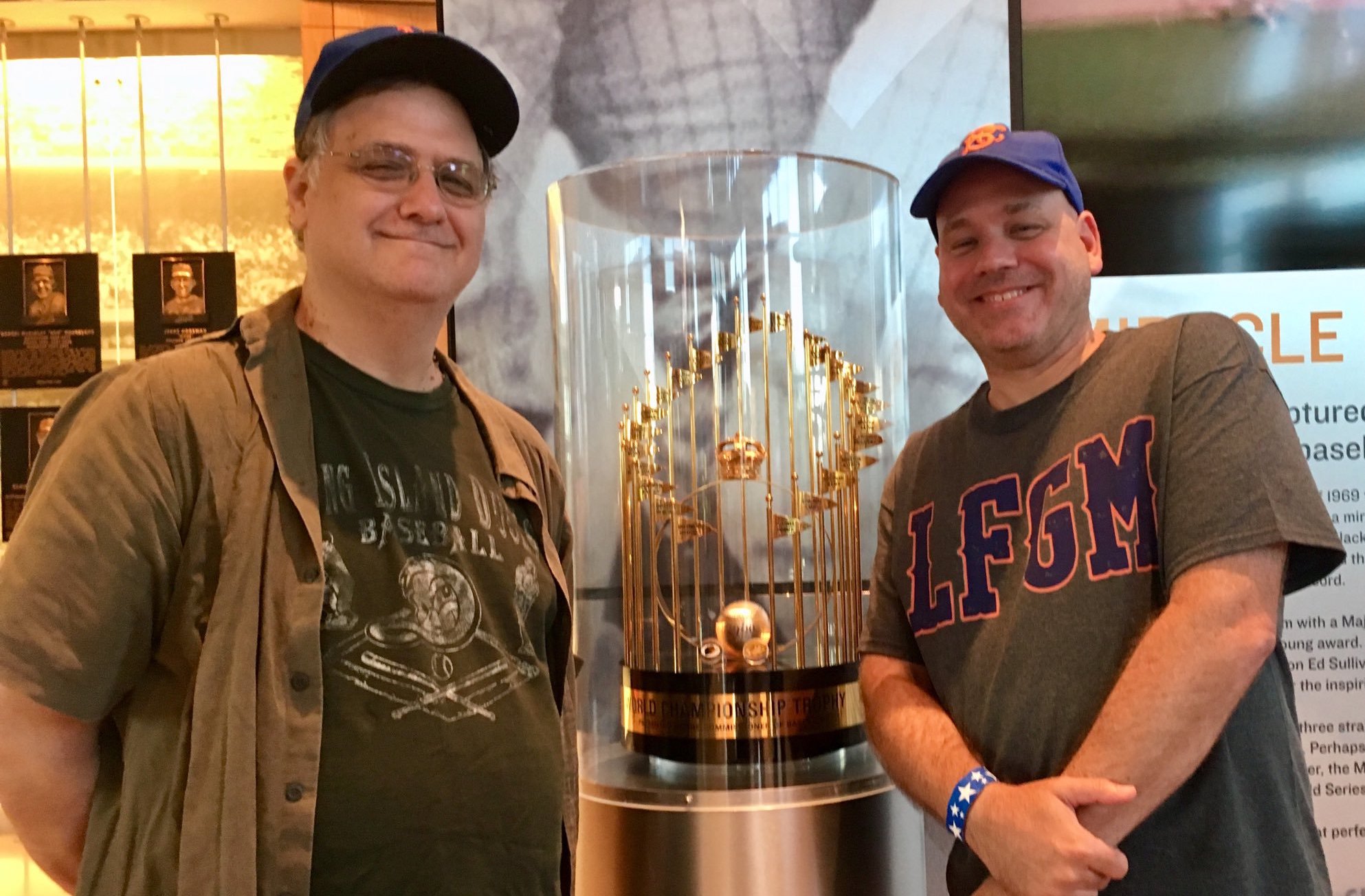
Faith and Fear in Flushing made its debut on Feb. 16, 2005, the brainchild of two longtime friends and lifelong Met fans.
Greg Prince discovered the Mets when he was 6, during the magical summer of 1969. He is a Long Island-based writer, editor and communications consultant. Contact him here.
Jason Fry is a Brooklyn writer whose first memories include his mom leaping up and down cheering for Rusty Staub. Check out his other writing here.
Got something to say? Leave a comment, or email us at faithandfear@gmail.com. (Sorry, but we have no interest in ads, sponsored content or guest posts.)
Need our RSS feed? It's here.
Visit our Facebook page, or drop by the personal pages for Greg and Jason.
Or follow us on Twitter: Here's Greg, and here's Jason.
|
by Greg Prince on 19 August 2015 2:55 am  Instead of settling an old score, the Orioles wound up losing by it to the Mets all over again. O’s, say, they could see. The O’s could see the first-place Mets coming. It was more twilight’s last gleaming than dawn’s early light, considering the overcast skies and 46-minute precautionary delay before a single pitch was thrown Tuesday night, but once a second pitch was thrown, the Mets led Baltimore in Baltimore, 1-0. Curtis Granderson’s seventh leadoff home run of 2015 had seen to that.
Baltimore had seen worse. Baltimore had been seeing worse since September of 1814, when the British attacked and the Americans defended and Francis Scott Key was inspired. Baltimore hung in there those nights. The town withstood 5,000 enemy troops and a royal bombardment. Surely a solo blast cheered by an invading 7 Line Army wasn’t necessarily cause for calamitous concern.
But modern-day Baltimore might never have anticipated anything so perilous as the pitching of Jacob deGrom, whose broad slider and bright fastball will take the fight out of any batting battalion. Backed by another Grandersonian rocket aimed squarely over Camden Yards’s ramparts — and aided by Jonathan Schoop’s less than gleaming defense — deGrom gallantly streamed to a 3-1 lead through seven-and-two-thirds innings, his ERA descending to the nearly unheard of depths of 1.98.
Jacob’s commander proceeded to nervously remove him from the Interleague fight, much to the Mets’ potential peril (Brigadier General Collins certainly drew my red glare). Tyler Clippard and Jeurys Familia each gave signs of bursting in air, but with the bullpen having been buttressed by another couple of runs in the top of the ninth, the scoreboard gave proof that our lead was still there.
In the end, the Mets defeated the Orioles, 5-3, the same glorious score by which the same combatants completed the final battle of their War of 1969. Oh, say, that championship banner did yet wave o’er the land of the Shea, where the Mets had ten days earlier secured a flag at home from the Braves. A new one so proudly we’d hail might wave somewhere nearby soon, but one baseball skirmish at a time.
History doesn’t always repeat itself, but sometimes it provides a damn fine echo.
by Greg Prince on 17 August 2015 2:18 am Hard to fathom that baseball grapples with a pace-of-game problem when a season that you could swear just started is almost three-quarters over.
It goes quickly, doesn’t it? There are 44 games remaining in this one, not counting anything that gets added on for good behavior. You know it was a veritable five minutes ago that we were counting down the days until Pitchers & Catchers, then the hours until Opening Day. By the end of this week, 75% of that same season for which we waited forever and a day to commence will have been crossed off the pocket schedule
This is a familiar August lament. Summer’s too short. Back to school ads (even for those of us decades removed from the looseleaf binder and pencil case demographic) beckon unbelievably quickly. Fall previews are churning out as we speak. It’s as predictable as it is sickening.
Yet let’s not kid ourselves, no matter our certainty that baseball and life whoosh too briskly by. It gets long out there. It’s a season that goes six months and 162 games and it tends to squeeze every drop of motion and emotion out of its contents.
As evidence, I present the first 118 games of the 2015 campaign.
• Opening Day. Mets win. They haven’t lost, ergo they can never lose.
• The first loss. Well, there goes the magic carpet ride.
• The third game, a.k.a. the first Harvey Day. Harvey’s back! Harvey’s unbeatable! We’re unbeatable!
• Two days later, two losses in the books. Groan, groan, groan.
• Eleven games later, the Mets literally can’t lose. How many World Series tickets should I order?
• Strangely enough, the Mets can lose and often do. Their eleven-game winning streak is snapped and their brand of unbeatable ball reverts to distressingly ordinary for a spell. Not much of a season, huh?
• We kicked the Phillies’ ass! We were swept by the Cubs! We scored ten runs in one inning versus the Brewers! We split with the big, bad Cardinals! We were swept by the Pirates! We swept the Phillies! We’re good! We’re bad! We’re…what are we?
• For a while we can’t hit, except when we can. We pitch like crazy, but what good is that if we can’t hit like professionals? Have you seen these lineups we’re trotting out? And now we can’t win at all. We’ve just lost seven in a row…DOOM!
• We swept the Reds. WE’RE BACK!
• We were swept by the Cubs. AGAIN.
• Oh crap, we have to go to California and play the Dodgers and Giants and that’s gonna be the end of us…hey, we won four out of six and THEN came home and swept the Diamondbacks. Maybe we’re not so bad!
• What a gauntlet after the All-Star break. Lose two in St. Louis, then win a really long game in St. Louis, but because it dragged so interminably, it didn’t really feel like much of a win, so we can’t count it as such. Then our all-or-nothing showdown in Washington, where Harvey (whatever happened to him?) gets lit up early and we split the first two and blow the third, and then it’s home to play Los Angeles and it will be more of the same.
• Until it’s not and we make some moves and we throttle the Dodgers one night and we come back against the Dodgers the next day and we shut down San Diego and everything’s great…except we lose to San Diego and ultimately inaccurate rumors swirl and the press is awkwardly briefed and we look ridiculous and we lose another to the Padres in embarrassing fashion, and what was going to be a good season is rapidly swirling down the drain unless that no-account GM of ours makes another move.
• That no-account GM of ours makes an astounding move just in time for another all-or-nothing showdown with Washington, and this one is real and it’s spectacular and there’s no stopping us, mostly, until the Pirates come to town and beat us two close ones and pull away in the third one, despite the gritty efforts of that Harvey fellow, who’s totally back.
All of these sea changes have occurred in the course of the very same baseball season. The Mets have led their division by as many as 4½ and they have trailed their division’s leader by as many as 4½. Strengths have been weaknesses and weaknesses have been strengths and foes thought formidable have proved flimsy and those we’ve wished to immediately dismiss have revived themselves nicely — same as us when we’ve considered ourselves practical goners.
A long season encompasses so much baseball and, with it, a surfeit of temporary permanents. Sunday the Mets gave little indication they’re a first-place club, but they remain a first-place club. As recently as Thursday they appeared invincible. As recently as Saturday they appeared comparable to the National League elites. It’s Monday and we’re hoping they can pull themselves together when next they play on Tuesday.
This is normal, this is natural, this is the way we are. Maybe the only hitch in our mood swing is that we don’t realize it. Seasons encompass twists, turns, spinouts and straightaways. You’re sure you’ve figured it out only to realize it eludes comprehension because there are 162 opportunities capable of completely baffling you.
The Mets, though, are a first-place club. They do lead the presumed mighty Nationals by 4½ games. The Nationals looked D.O.A. in April and resembled a lock by the Fourth of July. They are, as we speak, the hollowest of logs, the paperest of tigers. The Giants swept them like the Pirates swept us, except the Nats were barely present for their series, whereas the Mets didn’t mentally head for the exits this weekend until the vengeful Citi Field tarp briefly covered the infield with distressingly awful juju.
What I think we’ve seen, after 118 games, is that we root for a pretty good team capable of playing some very good ball, but also prone to exposing its flaws, which isn’t a crime, because flaws are inherent in both baseball players and human beings. Their primary rival is one enormous flaw wrapped like a rubber band around a wad of counterfeit hundred-dollar bills. We could’ve sworn the Nationals were legal tender. Maybe they still will be. It’s a long season for them, too.
In the meantime, the Mets could use a little tightening. Get Duda back, because Cespedes without Duda isn’t much better than Duda without Cespedes (and we saw how well that worked for four months). Get Wright back, because Uribe is a helluva fill-in but a little too irregular to be a regular at this stage of his career. Leave Parnell’s name off the travel manifest to Baltimore and beyond if at all possible. One hopes they minimize the flawfulness that’s going to arise in the course of 44 games and maximize the skill sets that set up them up pretty darn nicely across 118 games.
The first-place Mets are a reality. The division champion Mets can be a reality. But there’s still a long way to go.
by Jason Fry on 16 August 2015 1:13 am The good:
- A night after making solid contact but coming up short, Michael Conforto showed why he merits all the excitement, mashing a rising line drive off Charlie Morton that hissed over the fence above the Mo’s Zone. (Not sure it’s still called that; quite sure I don’t care.) That tied the game at 3 and allowed the Mets and Pirates to play on into the night. On and on and on into the night.
- Yoenis Cespedes uncorking an unbelievable throw from the deep outfield to nail a thoroughly startled Sean Rodriguez at third. If you missed it, don’t worry — you’ll be seeing it on highlight reels for a long time.
- The Mets’ bullpen gamely holding the fort while waiting for the offense to reappear, with Carlos Torres, Tyler Clippard, Jeurys Familia, Hansel Robles combining for six scoreless innings, followed by one by Sean Gilmartin (and one that, alas, was not scoreless).
- Jon Niese recovering from an early bout of Nieseness to pitch effectively, as he’s done for months now.
- The Giants continuing to whup the Nationals, who fell to .500 with their loss in San Francisco. Yes, the Mets have missed a chance to put even more space between themselves and the Nats these last two nights. But the Nats have lost something even more precious at this point in the season: time to fix whatever it is that’s ailing them.
The bad:
- Morton being even more effective than Niese, mixing a bowling-ball sinker with a darting curve and sending Met after Met departing home plate disconsolately.
- Gilmartin finally crumbling in the 14th, with an anti-assist to the Mets’ defense, plus a side of bad luck. Gilmartin’s been useful this year — certainly worth a Rule 5 pick — but that was unfortunate.
- Niese falling into old bad habits I’d persuaded myself he’d grown out of. Yes, the pitch Bob Davidson called ball four on Andrew McCutchen in the first should have been strike three and the end of the inning. But Niese then flipped in a nothing, call-this-a-ball fastball to Aramis Ramirez. Ramirez, not one to examine the dental work of the equine prize presented to him, walloped Niese’s pitch over the fence. It’s not fair to say it was the difference in the game, but it is fair to say that Niese lost his cool, his focus and a chance to escape the inning unscored on.
The ugly:
- Davidson’s wandering, approximately rectangular strike zone. Niese wasn’t the only one upset with him. Multiple players had reason to be.
- Whatever the hell Daniel Murphy thought he was doing in the 14th. Murph is an alternately entertaining and exasperating avatar of chaos, but not even he can rewrite the law of physics.
PSA from the proprietors:
We pride ourselves on having some of the smartest, best commenters in Met Blogland. But recently the tone of the comments has taken a turn we don’t like.
By all means debate, cite evidence/strong feelings and take issue with each other’s points. But don’t make it personal. We don’t do that here. We’re all Mets fans and can disagree while being friendly.
We’ve asked multiple times in recent weeks; we’re not going to ask again. Comments that cross the line and get personal will be deleted; commenters who can’t stay civil will be excused for a period ranging from a couple of days to eternity.
It’s no fun posting pissy notes like this, so please let this be the last time we have to do so.
by Greg Prince on 15 August 2015 11:46 am After I got home and watched the replay, Michael Conforto’s one-on, two-out, ninth-inning drive to left-center proved ordinary. It was a deep fly ball but quite catchable, and sure enough Andrew McCutchen caught it to send Friday’s Mets-Pirates game to the tenth inning, knotted at one.
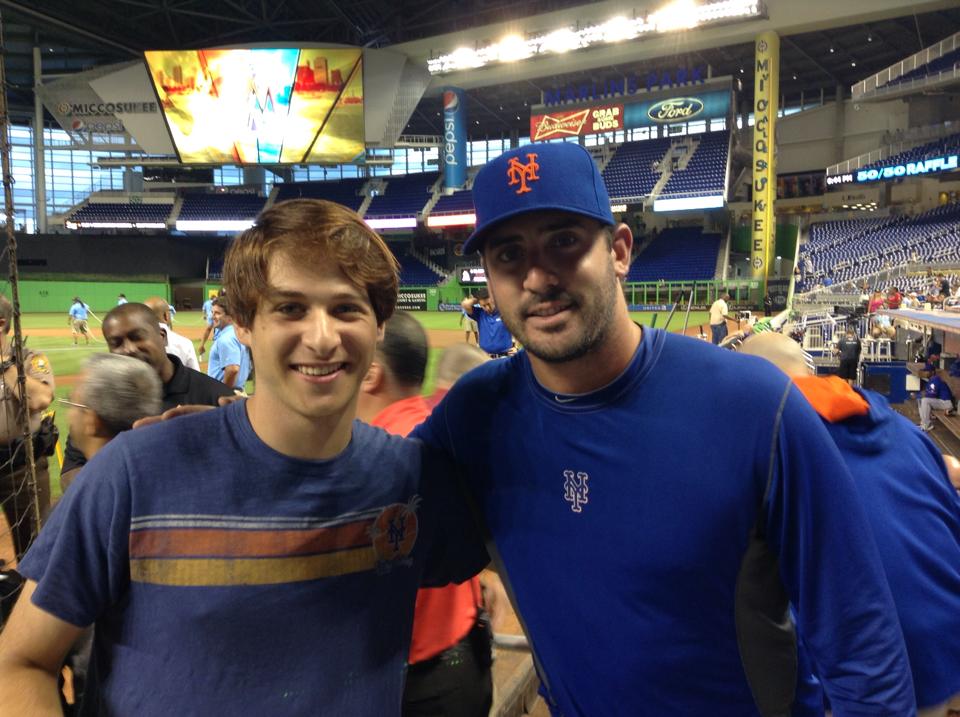
From Row 21 of Section 109, however, it looked perfect. Too perfect, in retrospect. Who wouldn’t want the Mets’ top draft pick of 2014 to deliver a signature blow and add another chapter to 2015’s improbable first-place story? And if you happened to be monitoring the flight of the ball alongside somebody who was wearing a recently purchased CONFORTO 30 t-shirt…somebody who had a few hours earlier posed for a picture with his shirt’s namesake…c’mon, who could ask for anything more?
So we — that would be me and Citi Field goodwill ambassador Skid (who swears he never wears shirts with players’ names normally, but on impulse he bought the rookie’s) and Mike, who’s visiting Skid from California — asked for simply that. We asked for Michael Conforto, in his fifteenth major league game and his second pinch-hitting appearance, to provide the proverbial storybook ending. The ball he hit appeared standsbound off the bat. We wished it and we hoped it toward the Party City Deck. We wanted it to be a gala ball.
But it wasn’t. It was an out. The rule about not always getting what you want held, just like the 1-1 score, at least until the tenth. Then Bobby Parnell came apart, which led to Pittsburgh taking a 3-1 lead that withstood a mild Met rally and resulted in a 3-2 defeat for the home team.
Which was an aggravating if not crying shame (save your tears for September devastations, if necessary). This was one of those games that sat there for the taking all night, yet it got left on the table. Once it sunk in that it was no longer within Metropolitan grasp, that instead the Pirates snatched it, absconded with it and ferried it into their clubhouse for their own nefarious purposes, the bastards, this game officially became the most frustrating loss in modern Citi Field history. Modern Citi Field history only dates back to the last Nationals series, so you might also say it was the only loss in modern Citi Field history.
I’ve seen the Mets lose in distressing fashion at Citi Field before, but what were the consequences prior to this year, exactly? That instead of languishing in fourth place, they’d languish slightly deeper in fourth place? Even horrible losses registered as late as July 30 of this year — like the one Jeurys Familia enabled between rain delays on that very date — tended to be suffered on their own demerits.
But now we’re in the Met Games Matter portion of Citi Field’s life. All Met games matter, but everything since July 31 is being played out in authentic pursuit of the playoffs. If you’re old enough to recall a time when the Mets chased pennants, you know a 3-2 loss in ten innings in August is different when it determines your immediate future, not just your draft positioning.
The Mets lost enough in 2013 to draft Conforto tenth overall in 2014. Smart move, losing those 88 games. Limited exposure to the left fielder shows us what a lively bat he carries and what a large clue he has when using it. Plus there’s a real spark to him, a twinkle in his eye, a sense that barely a year removed from college that he knows he belongs in the bigs.
Am I a scout? No.
Did I stay at a Holiday Inn Express last night? No (though I did fall asleep in a recliner around three in the morning).
But, because I’m lucky enough to know Skid, I was on the field for batting practice before Friday’s game. Skid won an MLB-sponsored contest of some sort that hinged, to a degree, on his excellent ballpark attendance record and his tenacity in “checking in” electronically. The powers that be provided him with field passes for BP. He invited Mike and me to join him.
You ever hang around watching city workers repair a pothole? That’s what BP is like up close, to be honest. There are various sets of barricades to keep gawkers at a safe distance from those who are going about their labors. They’re just trying to get their jobs done. If they wore orange vests and traversed asphalt, you wouldn’t give what they’re doing a second thought. But they’re wearing Mets gear and they’re on baseball field, so of course you gawk from behind your barricade and soak in the small miracle that is a ballpark coming to life.
You gawk at Jerry Blevins walking by with his left arm in a sling, neither slipping nor falling as he walked. How nice of Jerry to drop by and support his teammates and nod thanks to the fans who shout encouragement to get better soon. You have no idea at that moment that Jerry’s planning on ditching the sling and slinging four-seam fastballs before 2015 is over. From his arm and mouth to Dan Warthen’s ear, you suppose.
You gawk at Yoenis Cespedes dispatching baseballs far over the outfield fence, a phenomenon he’d repeat when the seats were occupied and the pitcher didn’t toss intentionally softly. I’ve been on the field for BP more than a dozen times over the years and I’ve never seen any Met mash a baseball like Yoenis did yesterday. That he did it against J.A. Happ when the scoreboard was lit was more important, but going yard in the empty yard was impressive on its own count.
You gawk at Curtis Granderson working the veritable rope line like a small-state governor seeking his third term. When it comes to fan relations, Curtis is running unopposed, yet takes nothing for granted. If you were eight years old and your teacher asked you to draw a “really good baseball player,” you’d draw Curtis Granderson. When Curtis Granderson was eight, I imagine, he started making lists of what he’d do when he became that really good baseball player. I’ve never seen anyone embrace those types of self-imposed responsibilities more diligently. He greets little kids as pals. He smiles broadly at ladies of a certain vintage. He signs anything and poses with everyone. He takes his time and is never perfunctory. It’s so beyond too good to be true it makes me cynically wonder what the hell he’s up to.
You gawk at Terry Collins taking a break from his Leader of Men duties to greet a handful of random well-wishers. Terry may or may not be an outstanding manager. He could have managed his bullpen a little quicker in the tenth last night, I thought (where’s Sparky Anderson’s legendarily quick hook when you need it?), but now and then I get a kick out of watching his self-awareness kick in. Like last night at the barricade as he made several civilians feel particularly valued for having been recognized by the skipper of their favorite ballclub. Like the last two Closing Days when he sprinted out to center to acknowledge the cheering endeavors of the 7 Line Army.
Those end-of-season’s greetings to the fans in the matching t-shirts reminded me of something Arnold Hano wrote about another set of fans in another set of bleachers at the end of another year. This was in September 1957, the last weekend the Giants would ever wind down a campaign at the Polo Grounds. Hano, covering the funereal proceedings for Sports Illustrated, met a woman named Freda Axler, who, between fits of inconsolability, pointed to the aisle near where she was stationed in Row D, Seat 20.
“See that?” she asked Hano. “D for Durocher,” the already erstwhile manager of the Giants. “Twenty. Two-oh. Durocher’s number was 2. When Leo was here, never a day went by he didn’t wave from the playing field and yell hello to Section 12.”
Freda Axler probably never forgot those waves, and those who Collins touched will long tell of the day they got to shake hands with the manager of the Mets. I usually get the sense Terry would be happier on a back field in Port St. Lucie advising some prospect to get a quicker prep step, but I appreciate his intermittently reaching out from behind his own barricade and filling the role of big city skipper with just enough aplomb.
My buddy Skid doesn’t seem the starstruck sort, but he’ll probably remember the day he decided to wear his Conforto tee and found himself a couple of feet from Conforto himself. At 22 and toting three weeks’ service time in the majors, young Michael probably doesn’t know he can just jog off the field when BP is over, that he doesn’t have to stop and chat with those regular people behind the barricade who are gawking at him. Or maybe he’s watched Curtis in action and is taking an encouraging cue. Or it could be they just teach excellent manners at Oregon State.
Regardless, Conforto lingered and Skid (once suitably nudged) couldn’t help himself. Look, he said to the Met on the other side of the barricade, I’m wearing your shirt. Conforto thought CONFORTO was quite cool. They had to pose for a picture. Ironically, Skid’s shirt has no number on the front and Michael’s BP warmup hid any evidence of a jersey, so their bond by garment is hidden in the photograph. What is easy to see is that unlike the other new, likely rented faces you had to gawk at twice to recognize fully during BP because they haven’t been Mets very long (and they, too, wore unnumbered warmups), Michael is slated to be a Met for years to come.
Conforto will drive other balls to deep left center. A few are bound to keep traveling.
The one in the ninth, though, wasn’t the bookend we wanted it to be. Skid and I were probably forcing the narrative: neat picture at 5:30, a walkoff highlight after the clock struck ten. Instead, it was — as Bruce Springsteen once tweaked a sitting president who claimed it was morning in America — “midnight, and, like, there’s a bad moon risin’.” In reality, the game was completed around 10:30, but our mood was pretty dark there at the end.
Argh, to put in Piratespeak. So frustrating. The Mets hit the ball well on and off all night, yet very little landed when and where we wanted it to after BP. Bartolo Colon, perhaps bucked up by the return of his gorgeous personal catcher Anthony Recker, pitched fairly beautifully for seven innings, allowing only one blemish in the form of Neil Walker’s home run in the top of the first. Happ, who’s been throwing baseballs at big leaguers roughly forever (yet ten years fewer than Bartolo), nixed every offensive effort the Mets generated, save for the one Yoenis took into his own hands to lead off the home sixth.
Tyler Clippard pitched a scoreless eighth. Familia pitched a scoreless ninth. Parnell couldn’t say the same in the tenth. Karma suggested this game was doomed once Conforto didn’t fully connect, but Bobby buried it for sure as soon as he appeared and showed absolutely nothing. Three consecutive Pirates made something of his nothing while we waited for Terry to send a lifeboat to the mound to rescue his drowning reliever. The S.S. Carlos Torres arrived a tad too late. The Mets attempted a bottom-of-the-tenth comeback, but like most of their offense Friday, it arrived ass-backwards, with never enough successful swings bunched together to meaningfully move a single needle. It was swell that Juan Lagares doubled off Mark Melancon, raced to third on a wild pitch and scored on Granderson’s sac fly, but you didn’t need to be Tim McCarver to tell yourself, “That run means nothing.”
This game meant something. This loss meant something, though thanks to Washington’s continued uncanny impression of the Cubs of ’69 (think Durocher waved to those kids at Camp Ojibwa, too?), it wasn’t felt in the immediate standings. The Mets’ N.L. East edge is still 4½, which is both considerable and shocking. Day by day I find myself in conversations regarding October, and not just to arrange leaf-peeping appointments. I try to tamp the tempting talk down as soon as I drift into it, for who are we, humble Mets fans, to be pitched “potential 2015 Postseason” ticket offers in the middle of August? Why, it’s as ridiculous as someone trying to sell you home heating oil while at a ballgame (that happened again last night).
But there those messages are, delivered brightly and confidently by Branden and Alexa on the 62% Larger Videoboard seemingly every other inning. And, all hard-earned common baseball sense notwithstanding, it doesn’t sound crazy in the context of the modern history of Citi Field. In the modern history of Citi Field, the Mets are a very good team. The Mets are a first-place team that doesn’t look fluky or transient sitting where they do, and the Mets fans — not just the stubbornly diehard but the ones whose heads were buried in texts or whose feet were planted in food lines only weeks ago — are fully absorbed.
It’s a tableau every bit as gorgeous as Anthony Recker.
There were more than 38,000 of us in the park last night, not counting the heating oil salesmen. The vast majority were all over this game, like they were all over the game I attended Wednesday night, because when you go to Citi Field to see the Mets play ball, nothing could be bigger than seeing the Mets play ball. This is not the Citi Field I once knew. This is a much better Citi Field. This is Citi Field breaking through the barricade of possibility and swarming toward the rope line of probability. Like Michael Conforto, we’re still getting used to being here, no matter how much we act as if we know what we’re doing.
That’s why the frustration was so enormous when we didn’t win in the ninth or keep from losing in the tenth. It was too perfect a night to not win.
by Greg Prince on 14 August 2015 1:41 pm Welcome to Flashback Friday, a dormant Faith and Fear in Flushing tradition revived this particular Friday in recognition of where we are now and how far we’ve come to get here.
If you have been to Citi Field in 2015 and been at your seat just before the home team’s lineup is formally introduced, perhaps you’ve noticed the slick trip through Mets history presented on the 62% Larger Videoboard. It starts with Bob Murphy’s voice and Casey Stengel’s face and it takes the attentive viewer on a journey through Met space and time, hitting most of the high points in franchise lore while gliding skillfully over most of the lesser moments.
That’s typical of how this team tells its story. It’s acceptable to acknowledge the losing years at the start. They’re colorful and they’re redeemed quickly enough. But then there are gaps. Eleven years are invisible between the clips of 1973 and the clips of 1984. The ’90s are absent until 1999. Mike Piazza’s September 2001 swing for the ages directly precedes the 2006 oasis of excellence as if they occurred during the same weekend. Then, save for evidence of a no-hitter in 2012, we’re on to basking in the accomplishments of our present-day Mets.
The spaces between make for curious voids. Unless you’re committed to telling a lovingly detailed story, you choose your spots. Grand Slam Singles and leaps at the left field wall are first-round draft choices for these sorts of productions. The seasons that yield little in the way of inarguably indelible images are left to fend for themselves in the collective memory.
On August 13, 2015, the New York Mets defeated the Colorado Rockies, 12-3, noteworthy enough in contemporary context given the Mets’ suddenly serious pursuit of a divisional title. From a historical perspective, we’ll find out in relatively short order if Thursday’s win represented one more step on a gilded path to greater glories or if it will stand an unwanted test of time akin to what happened the previous instance when Met wins outnumbered Met losses by precisely so many.
By sweeping the Rockies, the Mets moved to eleven games over .500 for the first time since June 27, 2010. Eleven games over .500 implies a good team is at work. If eleven games over .500 wasn’t emblematic of quality, it wouldn’t have proved an elusive milestone for more than five years of Mets baseball.
Yet the Met club that last moved that far above the break-even point doesn’t make so much as a cameo appearance in that Citi Field montage. With the exception of a couple of run-into-the-ground Mets Classics on SNY, you don’t see much evidence of the 2010 Mets a half-decade after the fact. No wonder, really. Nobody builds monuments to 79-83 campaigns.
The Mets don’t build literal monuments to much of their history (don’t try to meet me by the Tom Seaver statue tonight), but you know what I mean. 2010 lasted 162 games, and when it was over, it was done with. The Mets couldn’t have been any more definitive about putting it behind them when they justifiably dismissed their general manager and manager about two minutes after the season’s final out.
If 2015 is going to live on as “2015” — if it’s going to be a brand-name staple of video montages yet to come — maybe it’s not too early to mine a touch of vaguely wistful, reflexively self-effacing nostalgia for the years that made its emergence such a blessed event. Years like 2010. Credentials-enhancing years we maintained our Metsdom during while waiting to live and die in the middle of August, not just find our hopes dead. Character-building years we’ll look back on fuzzily, perhaps gauzily, and say, “I was here in the lean years. I was here in 2010. You wouldn’t believe what that was like.”
What was that like? Is too soon to remember? Is it too soon to have forgotten?
I’m not looking to make a case for 2010 as overly underappreciated, exactly. And I’m in too good a mood these days to shame the Mets’ generally amnesiac ways (plus the montage is a really well-produced video, regardless of omissions). But I am curious as to how seasons we lived in for six months at a time are allowed to slip away from our consciousness so easily.
Make no mistake about it: we lived in 2010. Of course we did. We live in every season as if it’s our permanent residence. We inhabit them fully. Each one is the most important season of our lives while it is in progress. Across the entirety of 2010, I sat at this very spot and, in concert with my blogging partner sitting in whatever spot he was in, set in type that entire April-to-October effort. It mattered to me. It mattered to you.
Then it mattered no more.
Weird how that happens. OK, maybe it’s not weird — 79-83, fourth place, all downhill from late June onward — but it happened…y’know? It happened to us. Every day of 2010, the Mets of 2010 were our cause, our concern, our pride, our bane. It feels fickle to not easily recall its highlights, to not substantively retain its content, to not willingly share its legends and lessons, such as they are.
Yet the montages go on without contributions from years like 1981 and 1995 and 2010, the last of which has aged just long enough to turn into the perennially neglected five-year-old who asks, as the franchise flips through the pages of its family album, “Hey, how come there are no pictures of me in there?”
Seems wrong somehow. So if you don’t mind, I’m going to unspool my own reel. (For what it’s worth, I’m working here strictly from memory; no archives, no Baseball-Reference.)
It’s Opening Day. Citi Field’s dimensions are still too expansive and its outfield walls are still too charcoal, but over in the Rotunda, there’s now a neat little team museum. The weather outside is unseasonably warm. The sun beats down on the Pepsi Porch. The Mets beat down on the Florida Marlins. Mike Jacobs, Gary Matthews and Frank Catalanotto dot the roster. The training and medical personnel are booed in a mostly good-natured vein. We were hurt in 2009. We’re reasonably healthy as 2010 gets going.
Ruben Tejada, 20, and Jenrry Mejia, 20, are among the newcomers. Jose Reyes, 26, returns a little late, but he’s back from his endless injuries at last and, for at least a few games, bats third.
There’s a Saturday in St. Louis that threatens to plod into Sunday. It goes 20 innings. Tony LaRussa employs position players as pitchers. The Mets win. It’s not impressive.
Two days later, Ike Davis appears. He is the future. He and Tejada and Reyes and David Wright hint that they will hold down the infield together for years to come.
Reyes is spotted tripling and leading off. Wright is homering consistently after doing no such thing in ’09. Big-ticket acquisition Jason Bay is off to kind of a slow start, but he’s a pro, he’ll get it together. Daniel Murphy, last year’s home run leader (12), isn’t around at all. He got hurt in Spring Training, went to the minors to learn second base and got hurt again. Good thing Tejada’s getting a shot, lest we be forced to get by solely with Alex Cora and Luis Castillo.
The Mets are suddenly unbeatable at home. Johan Santana is, as ever, The Man. Rod Barajas pours on the power. He and fellow grizzled backstop Henry Blanco end consecutive games with walkoff home runs. Ike is hitting and fielding. He flips over railings in pursuit of foul balls and he catches them as if by second-nature.
Catalanotto, Jacobs and Matthews disappear. Bay struggles. Oliver Perez and John Maine frustrate. Maine goes on the DL and never materializes again. He’s replaced by an itinerant knuckleballer named R.A. Dickey. Dickey impresses. So does Angel Pagan, blossoming after several seasons on the big league fringes. Pagan, playing plenty in place of an injured Carlos Beltran, runs out an inside-the-park home run one night in Washington, the same night he starts a triple play in the field behind Dickey. The Mets lose anyway.
Perez expends everybody’s patience. He belongs in Buffalo, but won’t accept a demotion. Jerry Manuel sentences him to the back of the bullpen. The rotation is now populated by Santana, Dickey, young Jon Niese (who tosses a one-hitter at the Padres), maturing Mike Pelfrey and import Hisanori Takahashi. Francisco Rodriguez is saving games. Pedro Feliciano is perpetually on call. The Mets are up and down, but definitely more up than down as the first half proceeds.
They hold big, bad Philadelphia scoreless for an entire series at Citi Field; Gary Cohen labels it the Goose Egg Sweep. They put on a gaudy, ultimately successful push to elect Wright to the All-Star team. They welcome Jerry Seinfeld to their TV booth. They sweep an Interleague road trip to the lesser precincts of the junior circuit. For a few hours one early evening, after Atlanta is beaten by the White Sox and before the Mets take on the Tigers, New York slides into first place. When Detroit prevails, New York slides right out.
Nevertheless, on June 27, they rise eleven games above .500 for the fourth time in 2010. Despite Bay never quite finding his footing, despite the money pit Perez has transformed into, despite Jeff Francoeur never having met a base he liked being on, it’s hard to not take the Mets seriously. They’re kind of contending for the playoffs.
Then they’re not. Their detachment from the pennant race is gradual, but the cracks surface. They lose three of four in Puerto Rico to the lousy Marlins. Tejada receives a game-ending pickoff throw at second to seal a victory over the lousy Nats on a Friday night, and Dickey outlasts phenomenal Stephen Strasburg in D.C. the next day, but K-Rod blows that one in the end. Johan hits a home run against Cincinnati, but the Reds take two of three in that series. The “buts” are beginning to have it.
After the All-Star Game — Jose accompanies David but doesn’t play as precaution against aggravating yet another nagging pain — the descent accelerates. Tim Lincecum beats Dickey at Phone Company Park (though not for postgame quotes). Bay’s head hits a wall at Dodger Stadium and it (and he) are done for the year. The Mets limp home from the West Coast barely standing straight. On the first night the Mets communications staff welcomes bloggers as media, they lose in thirteen innings. On the first day in eight years that the Mets induct new members into their Hall of Fame (Gooden, Strawberry, Cashen, D. Johnson), they lose by thirteen runs. Oliver Perez pitches in that one and is greeted accordingly.
As August unfolds, the Mets unravel. Whoever can be moved is moved. Barajas is sent to L.A. Frenchy Francoeur joins the Texas Rangers. Cora wanders off to the American League as well. K-Rod is provoked into throwing a punch at his de facto father-in-law. He’s arrested. Then he comes back. Then he gets hurt and is, like Bay, out for the year. So, by early September, is Santana, followed soon after by Mejia, who bounced from reliever to starter to good luck, kid, get better soon.
Youth is getting served now. Josh Thole starts behind the plate. Lucas Duda gets a look in the outfield. Dillon Gee is one of the starters, and a pretty promising one. Feliciano is still warming up in the pen. Beltran, aching but playing, takes an anonymous but public hit from management when he doesn’t show up at Walter Reed to greet veterans (he had another commitment). Yet it’s Beltran who slides hard against Philadelphia when no other Met wishes to retaliate for a cheap takeout slide against Tejada.
The final weeks of the season arrive. The Mets miss .500. They shuffle through the likes of Chris “The Animal” Carter, Joaquin Arias (no known nickname) and Mike Hessman, who hit a slew of home runs in the minors but exactly one as a Met. They continue to intermittently trot out Luis Castillo long past his best-used-by date. They give a shot to Luis Hernandez, a middle infielder of little renown. This Luis fouls a ball off his foot, then blasts a homer off the Braves. He limps around the bases and never hits in the majors again. The Mets lose.
Thole becomes their third catcher this year to slug a walkoff homer. Feliciano pitches in his 92nd game, breaking all his own crazy durability records. Dickey earns a three-year contract and approaches cult status. It takes fourteen increasingly chilly innings (accented by the unwanted presence of Oliver Perez when nobody else is available) to send these Mets into winter with a Closing Day loss. Our permanent residence reverts to the summer rental it was destined to be. The Mets improve by nine games over the previous season, but it’s not processed as momentum. Omar Minaya is replaced by Sandy Alderson. Jerry Manuel is replaced by Terry Collins. Inevitably, 2010 is replaced by 2011.
No doubt we’re in a better place now. Still, where we were then…it wasn’t all bad all the time. Surely there’s a picture around here somewhere.
by Jason Fry on 14 August 2015 1:47 am In the early innings Thursday I tweeted out what I hoped would be reassuring counsel to Mets fans unhappy that we weren’t going to sweep four from the Rockies without a fair amount of work:
As I noted, Noah Syndergaard is 22 — and he’s a young 22 at that. By comparison, Matt Harvey is 26, while Jacob deGrom is 27. Whether you’re a flame-throwing pitcher or an acquisitions clerk, there’s a big difference between 22 and 26. You’re going to become a substantially different person just by having increased your days spent on Earth by nearly 20%, and you’re also going to learn critical lessons about your chosen profession.
Flame-throwing pitchers, like the rest of us, have to learn about getting along with colleagues and bosses. They also have to learn more specialized things. Their workplaces may have odd and unwritten codes of conduct governing lunch, for instance. That’s a relatively easy lesson; a harder one is learning that not even ungodly stuff will permit you to pitch in predictable patterns. Syndergaaard led with his fastball to excess against Tampa Bay and got smacked around; the same thing happened in the first against Colorado — he threw 10 of 12 fastballs and watched two of them disappear over the fence.
All part of the learning process. And hence my tweet.
There were things I didn’t expect, though. Like Syndergaard taking the lesson to heart in a matter of innings instead of days, for once. He gave up a single to Daniel Descalso to open the second, but then erased Descalso on a double play. Kyle Parker singled, but Syndergaard blew away opposing pitcher Eddie Butler — and didn’t allow another hit until his work was done after seven. He fed the Rockies curves and change-ups early, getting them off-balance, then erased them with that annihilating fastball.
The lesson: It’s nice to have the Hammer of Thor at your disposal, but it’s better to have a whole divine toolkit to choose from. Syndergaard learned today that you can write some pretty satisfying myths using the Screwdriver and Socket Wrench of Thor as well.
Meanwhile, the Mets were hitting the luckless Mr. Butler early and often. A trio of doubles in the first (Daniel Murphy, Juan Uribe, Kelly Johnson) made the Rockies’ lead disappear, two more (Yoenis Cespedes and Johnson again) followed in the third, and Curtis Granderson‘s fourth-inning homer signaled that the rout was on and the sweep was a reality.
A little more than a month ago (which is a lifetime in this topsy-turvy season), I lamented what the Mets could be if only they were capable of scoring four runs a game. Twelve a game? That will do.
Yes, that will do very nicely.
by Jason Fry on 13 August 2015 1:20 am Citi Field is loud, and it’s wonderful.
I reflexively started to type “loud again,” then stopped myself. Because that wouldn’t have been true. Citi never has been loud. This is the first run of games in which the crowd is a factor, in which the buzz is focused on the field and the players are aware of it.
Citi Field started off dealt a lousy hand. It opened during a wrenching recession, the third pitch thrown in its official history became an enemy home run, management missteps alienated hardcore fans, and that first season began with months of weather that was lousy to the point of peculiar. By the time it warmed up, the Mets were broken and bad and the season was lost, leaving acres of those new green seats empty.
That was 2009, and the story hasn’t been fundamentally different at any point since. The Mets fixed some of their park’s flaws and we got used to some others, but the biggest problem came to seem intractable: the Mets were never good enough long enough for enough people to notice. That left Citi Field a reasonably nice place with lots of good food, a really big HD screen … and a baseball game somewhere in the middle of it.
Until now.
The party started with Yoenis Cespedes and the Nationals arriving and hasn’t stopped. But Wednesday night was my first chance to see it for myself. I was sitting with my pal Jeff in the second row of the Pepsi Porch, barely in foul territory, and marveling at the sights and sounds around me.
First of all, I could see people. People in their seats, watching baseball. Sure, there were a few swathes of seats mostly unoccupied, but the field level was nearly full, and above that you saw blue and orange gear, waving arms, people getting up when the game demanded it, and directing their attention at the field.
And you could hear those people. The ones around us were talking about our young pitchers, and Cespedes and his contract, and David Wright down in St. Lucie, and the adventures of Wilmer Flores, and how the Nats might fare against Clayton Kershaw. (They lost, 3-0!) They were talking baseball, and cheering for it down on the field — roaring for it down on the field, in fact.
When Jacob deGrom reached two strikes they were up and howling for a third. When Juan Uribe rifled a ball over Charlie Blackmon‘s head in center they were yelling for Juan Lagares to hurry home, and then they did the same for Uribe when Michael Cuddyer smacked a ball into center. They roared for Cespedes’s first Citi Field clout (while wearing a yellow sleeve to match the feathers of a confused parakeet who’d taken up residence among the A/V cables), and at the end they stood and exhorted Jeurys Familia across the finish line.
Baseball is a different experience depending on whether you’re in the park or in front of the TV. I was 380-odd feet away in the Pepsi Porch, so don’t ask me to say anything smart about deGrom’s pitches — all I know is they resulted in Rockie after Rockie trudging away from home plate with barely used lumber. But the tradeoff was being borne up by the noise and fervor when deGrom was in a tight spot and looking for a little more life on the fastball, and being buffeted by the joy at seeing him find it.
None of the above is particularly extraordinary; it’s fun watching a good baseball team on a nice summer night as part of a big crowd. But it’s new for Citi Field — new, and oh so welcome.
I shed no tears for the demise of Shea, a battered rattletrap that exuded decay and bred hostility. But I have mourned the new place’s failure to engage us collectively, to feel like more than a short-term rental. Some of that failure reflects a sea change in parks and they crowds they attract: different economics and a different audience, the distraction of myriad non-baseball options, and the fact that we all now have ludicrously powerful pocket computers competing for our attention. But the real problem has been a lack of anything to engage us, to make us look up from our tweets and text messages and decide some other evening would be better for standing in line for burgers.
That’s no longer true. Now our eyes are on these Mets and their improbable summer story. We’ve found something that’s got us … well, that’s got us hollering and cheering and jumping in our seats, whether we’re butchers or bakers, or consultants or content providers. Some part of me had feared that never would happen again, that it had been lost somehow. But it’s not so. It’s happening right now — and however overdue it may be, it’s wonderful to find yourself part of it again.
by Greg Prince on 12 August 2015 3:52 am Welcome to Tuesday night, Citi Field, Flushing, New York, August, the 2010s. It is not by chance we are here. We make a date. We make this date.
August 10, 2010
August 9, 2011
August 21, 2012
August 6, 2013
August 12, 2014
August 11, 2015
Did we ever have a meeting to decide? Did it go through committee? Did we take a vote? I don’t think we did. It was more a matter of nomination by acclamation. See you in Tuesday in August…seconded…any objections?
The ayes had it. Every August, on a Tuesday night, we meet for baseball. We meet for Mets baseball, of course, usually coincidentally played against the Colorado Rockies. They have a knack for being available in August, four of the last six, including this one.
So there we were, the Chasins — Rob, the dad; Ryder, the son — and the Princes — Stephanie, the wife; Greg, the husband as well as designated chronicler. That’s me. I take the minutes of the annual meeting.
 In action Tuesday night: Ryder Chasin, Matt Harvey. Let the record show the principals met in a light drizzle outside the little-known and even less-understood Payson entrance shortly after 5:30 PM. Our tickets were waiting at an unfamiliar window, left by someone you’d call “a player,” but not someone you’d find in your $5 scorecard, and let’s leave it at that.
The seats for the 2015 edition of our confab were outstanding (and, it’s worth noting, given the events of the night before, tightly fastened, albeit uncushioned). A dead-on sightline for the baseball fans. Sufficient cover for foes of precipitation. The shelter aspect turned into a non-issue as the drizzle that accompanied us at the Payson entrance dissipated by the time we u-turned for the more famous, better known Jackie Robinson Rotunda.
My bag was searched. My beverages were left intact. I have learned the secret of not having my half-drunk water confiscated. I will share it only when Citi Field is no more, lest the terrorists win.
No more than two minutes inside the building, we run into Skid from Monday night, Skid from every night. Skid is doing laps around the Field Level. When you’ve relocated your life to a Major League Baseball stadium, you avail yourself of every opportunity it presents. Skid gets his walking in at Citi Field.
We get our walking in, too. We stroll to Shake Shack. We are drawn to it, as if by medium-rare magnets. It wasn’t our planned destination, but when we find ourselves before it with a line that is barely longer than Parnell to Clippard to Familia, we do what all sentient people would do: we get on it. Or do we get in it? Stephanie long ago noticed New Yorkers stand on line, while the rest of America stands in line. Whose colloquialism is it anyway?
However we stand, we don’t stand for long. The Shake Shack line moves like Jose Reyes once did or Michael Cuddyer suddenly does now just around the corner from this slice of hamburger heaven. Oh, the wonders of showing up just early enough for a short Shake Shack line. Behind us the queue has begun to snake in earnest. But we have broken the tape just in time.
Ryder and Rob have to wait for their shakes, which is weird when you realize “Shake” is technically the headline attraction, but that’s less onerous than waiting to order. It just is.
Did you know you can get a great deal on home heating oil at Citi Field? This is an even less understood element than the Payson entrance. On Monday night, Skid and I were accosted by a home heating oil salesman on three separate pregame occasions. On Tuesday night, Ryder and I were pitched twice. Inexpensive home heating oil will be a wonderful thing this winter. Like postseason baseball tickets, it might be the sort of thing a person would be best served by signing up for well in advance of needing it. Unlike postseason baseball, you can be certain cold weather is coming.
But why is a home heating oil concern allowed to accost baseball fans repeatedly in the middle of August inside their favorite team’s ballpark? (Even Shea’s voracious credit card hawkers of yore were relegated to Casey Stengel Plaza.) We were just four baseball fans carrying their Shake Shack to a table elsewhere on the grounds. I can’t imagine anyone among the 25,611 on hand will be perusing his or her home heating bill come February and cursing himself or herself out for not making the switch to this particular oil concern while at a baseball game between the New York Mets and the Colorado Rockies.
I’m not saying this as a natural gas customer. I’m saying this as a baseball fan who simply wants to get to the Shake Shack stuff while it’s still warm.
The oil men went about their accosting as we rode the escalator to Caesars Club, which is named for a gambling enterprise that no longer sponsors the Mets. Perhaps it’s just as well the name sticks to the establishment. Once you start referring to something as something, it’s hard to start calling it something else. Just ask the Avenue of the Americas; it’s over on Sixth Avenue. Or just ask me what stop I get off at to attend ballgames. The MTA says it’s Mets-Willets Point. I still call it Shea.
I’ve only recently ceased thinking of Ryder as “my Bar Mitzvah boy,” though that’s sort of understandable, as it was Ryder’s legendary Citi Field Bar Mitzvah and our unforeseen attendance at it in November 2009 that set the Tuesday Night Baseball Club’s annual meetings in motion. Ryder is nearly 19, sports facial hair and attends Northwestern University. He is nobody’s Bar Mitzvah Boy at this stage of his burgeoning life. (In a related development, time flies.)
As for the limbo in which the name “Caesars Club” lingers, why not use their absence from the Met sponsorship depth chart as a chance to rebrand? I offer, as I’m pretty sure I have before, these alternatives:
Seavers Club
41 Club
The Stork Club, with portraits of George Theodore everywhere and George Theodore himself on the premises if he so desires a sinecure.
We tuck into our Shake Shack in the club currently known as Caesars, until otherwise dubbed. “Tuck” is one of those words I only see in Times profiles of celebrities and politicians who are inevitably interviewed over lunch in chi-chi locales. They’re always “tucking into” steaks or salads. I have never heard anybody in real life refer to anybody tucking into food otherwise. So let’s just say we ate our Shake Shack and we were quite satisfied.
I was so satisfied, I left my denim overshirt draped on the back of my chair as we left Caesars. “Overshirt” is how Stephanie and I refer to whatever shirt we schlep along when we think it might get a tad chilly, but not cold enough for a jacket, let alone heating oil. I pride myself on leaving no shirt behind, but somewhere between the national anthem and first pitch, I realize I have blundered. I must return to our old table at once and see if it’s still there. Rob accompanies me, presumably to calm my nerves.
“There’s nothing but Mets fans here,” he assures me. “They’d never steal anything.” And he’s right (hell, the Mets barely steal bases). My ratty denim shirt is still draped where I left it. I snatch it back without ceremony. When we get back to our sensationally sightlined seats, we tell Stephanie and Ryder that some big galoot was wearing it and I had to resort to weaponry to fully secure it. Then, because accuracy is everything when you’re tasked with taking the minutes of the meeting, we let them know we’re kidding, it was just sitting there, neglected and ignored, sort of like the Mets most Augusts, though certainly not this one.
Say, you know who else we saw Tuesday night at Citi Field? Matt Harvey. He sports facial hair, too. The Rockies and their beards were more hirsute than Harvey, but were no match otherwise. The Mets didn’t score for the longest time, but it barely occurred to me to worry they wouldn’t win. Even with a Terry-rigged lineup that lacked Granderson and was noticeably Duda-free, I figured our first-place team would find a run draped over its chair eventually, and as long as they did, Matt Harvey and his facial hair weren’t going to be touched.
That’s basically what happened in the actual game that you probably came here to read about while I’ve been going on impressionistically about mood and circumstance and my wife and our friends the Chasins. (The blog for Mets fans who like to digress!) Harvey was Harvey for eight innings and the Mets eked out a run in the sixth. They added three in the eighth to make the lead safe for Eric O’Flaherty as Woodrow Wilson once strove to make the world safe for democracy. It’s what a first-place team does, you know. Victories achieved by first-place teams in games pitched by their premier ace are by no means automatic, yet it’s delightful to believe they’re more probable than possible on any given Tuesday night.
Ryder and Rob and Stephanie and I, across all these August Tuesday nights, had seen a lot of Mets and a bunch of Rockies, but never a first-place team. Well, to be baseball-retentive about it, we saw a pretty powerful first-place team last August. It was the Washington Nationals, our Rockies substitute in 2014. The Nationals rattled Rafael Montero pretty badly that night. That seems like more than twelve months ago.
Five years ago when we — the Princes and the Chasins — first did this, we saw 25 different players take the field as either Mets or Rockies. Ryder dutifully kept score of each of their official activities, just as he tracked each of the 24 Rockies and Mets who played Tuesday night. Was there, we wondered, any overlap? It turns out that five years later, only four of those from our 2010 meeting joined us again: Carlos Gonzalez, Rafael Betancourt, Ruben Tejada and Jose Reyes. Reyes was the only one to change outfits in the interim.
Tuesday night, as Jose batted against Matt Harvey, I honestly forgot who was playing for who. This was early in the game, when Reyes was batting and I was focusing intently on him and somebody sitting behind us was invoking a classic Jose-Jose-Jose and somebody next to him marveled that the last pitch was 96 miles per hour. My honest thought was, “Who on the Rockies is throwing that hard to Jose?”
Then I looked at the mound and remembered what was actually going on. I will cop to my mind wandering and our four-way conversation wandering. What do you want from us? We only go to one ballgame together every year.
You already know the Mets won Tuesday night. A little while ago I checked and saw the Nationals lost in L.A. I don’t recall the last time I pumped my fist in the wee small hours of a Wednesday morning. A pennant race will do that to a person.
The Mets are 61-52, which appears too impressive to belong to the Mets, doesn’t it? That’s the record of a good team. This year it’s the record of a first-place team. Our first-place team. Our first-place team that leads second-place Washington by 2½.
Don’t you love half-games? What other sport has half-games? I suppose basketball, but stay with me on this one. I’ve paid at least modest attention to the NBA all my sentient life and I’ve never heard anyone get excited over leads or deficits involving half-games. That’s a baseball quirk. Baseball, at its best, is defined by its quirks.
Did you know that on Tuesday night every home team beat every road team? That, according to the Elias Sports Bureau (and doesn’t “bureau” make Elias’s mission sound that much more pulsating?), had never previously happened with a slate of 15 games. That’s pretty quirky right there. It means that in every MLB park across the continent, those people who made a special point of getting together because it’s what they do every year at this time came away very happy.
Not that we in our little Tuesday Night Baseball Club wouldn’t have enjoyed ourselves (albeit less) had the road team prevailed. That’s the whole idea behind these annual meetings. We are happy to get together, we are sorry to adjourn, we are eager to resume more or less a year from now in the very same place.
First.
by Greg Prince on 11 August 2015 3:18 am Perhaps you’ve heard about the butcher and the baker and the people on the streets, all of whom have gone to Meet The Mets. More than 27,000, whatever the vocation, did so Monday night, myself included. We gave ’em a yell, gave ’em a hand and let ’em know we were rootin’ in the stand.
Yes, “stand,” which is the official lyric submitted by Ruth Roberts and Bill Katz in 1961 for an authorized team song that would be played twice this particular 2015 evening at Citi Field, once around 7 o’clock as we leaned forward with anticipation, once a little after 9:30 as we practically pranced toward the exits. I always thought it should have been “stands,” but during the course of Monday’s game, I understood why “stand” must stand.
It’s explained several lines earlier when Roberts and Katz detail what we do when we go to meet the Mets. We’re hollerin’ and cheerin’ and jumpin’ in our seats. Seats are not made for jumpin’. Some seats, I learned, aren’t even made for sittin’.
Let me back up here, if not into my seat, for that would be an impossibility.
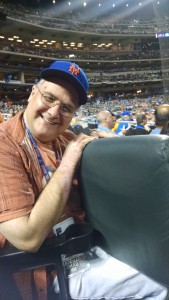 My seat and I reconcile after it abandoned me. It’s the middle of the game between the Mets and Rockies. I’m sittin’ — not jumpin’ — in my luxuriously padded Delta Sky 360 Charles Montgomery Burns Club seat, brought to me for the evening by my good friend Skid, who you’ll recall is the Mets fan from California who decided to move to New York for six (hopefully seven) months and join his team every time they open their gates. Skid was celebrating his birthday Monday and opted to make his accommodations relatively ritzy for the evening, purchasing two of these seats and graciously inviting me along to occupy one of them.
Really, this whole season has been a birthday celebration for Skid. I’m thinking he wished for this on some previous August 10, blew out the candles and got what he asked for: every day he gets to go to a baseball game. Maybe he wished extra hard that one time and asked for a first-place team. Skid wishes very well.
Anyway, game’s going on, we’re not yet winning, but we’re not necessarily worried. These are our first-place Mets. If you can’t find the faith to tolerate a temporary one-run deficit, then you’ve chosen the wrong year to go to Citi Field. Me, I was delighted that we finally have a right year to go to Citi Field. I never went to see a first-place home team at this ballpark this late in any year. It’s the one feature they forgot to install when they were busy padding all those seats.
Ah yes, the seats. Specifically, my nice seat. I’m sitting in mine when I decided I’d like a nice Diet Pepsi, so I ask for one from one of those nice people who come around to ask if you’d like anything brought to your nice seat. (Everything and everybody is nice when you’re in first place.) To effect one of these transactions, you give the person the money, and the person places your order, and — an inning or three later — you get your soda.
OK then, let me just dig my wallet out of my pocket, which I shall do by shifting slightly in my seat and…
The next thing I feel is a slow drop. I don’t mean like Luis Castillo’s agonizingly torpid pursuit of a fly ball a veritable baseball generation ago. I mean more like that sensation you get in a dream where you’re falling and you’re falling and, oh, it’s all right. It’s just a dream.
But this wasn’t a dream. This was my seat, less falling than sinking. I’m not sure how it managed to completely unhinge, but it sunk all the way to the ground.
With me in it.
Fancy seat, yes. Exquisite bolting, not so much.
From six or so inches above ground, I hand the nice person — who is trying very hard to not laugh uncontrollably at the PLOP! her customer has just taken — the money for the soda. I take no offense, for I’m laughing, too. As is Skid. This would be funnier if it happened to someone like Mr. Burns or the man from the Monopoly board, but it’s still funny, even though it happened to me. My rear end was safely guarded from cement and the bag I’d had under my seat withstood the blow (good thing I decided to leave my Ming vase home). Because the attendance was 27,000 and not 42,000, I didn’t have to stand in the stand for long. There was no problem finding a replacement seat right next to the one that had unseated me.
This had never happened to me at Shea Stadium. This had never happened to me at Citi Field, though it had happened to somebody in the row in front of us maybe an inning earlier. Perhaps not the comic thud, but the same idea, making it two high-roller seats too banged up to stay in the game. I’m pretty sure each had to go on the furniture DL. (Keep Ray Ramirez away from the upholstery if you ever want to see them again.)
Meanwhile, Jon Niese pitched seven strong innings, Travis d’Arnaud belted a home run, Curtis Granderson conveniently let himself get hit by a bases-loaded pitch and Daniel Murphy snuck a sharp grounder by Jose Reyes, who I couldn’t help but instinctively applaud most of the evening despite his insistence on wearing a bizarre purple uniform to our pennant race party. A 4-2 lead was placed into the hands of Tyler Clippard and Jeurys Familia and they handled it with care. If there are openings in the carpenters union, they might want to apply. Nothing fell apart on their watch, allowing Skid and I and everybody else to watch our first-place team maintain its first-place lead.
Have I mentioned the Mets are in first place? It bears repeating until it gets old, which I don’t believe it will as long as it retains the benefit of truth. Citi Field, of which I’ve never exactly been a roaring advocate, sounded like it knew exactly what place it was in when Murphy broke the 2-2 tie in the seventh. If it didn’t vibrate as I’m told it did during the Nationals series that Changed Everything, it surely echoed of the promise from April, when the environs began to feel tangibly engaged in a manner they never had. Then came May, June, most of July…not wholly terrible for wins and losses, but you know that dream where you’re sitting in your seat at a ballgame and the ballgame itself very slowly plummets to the ground and you laugh uncontrollably because you don’t know what else to do?
It’s August and things are different in the best sense of the word. I’ve known it for a fact because I’ve seen it on TV, but sometimes you need to get your Skid on and see it for yourself. Prior to Monday, I’d been to 200 regular-season games at Citi Field between April 16, 2009, and July 30, 2015, but none whose result would keep a diehard up nights on account of ecstasy or misery. Then the Nats stopped by; and the Mets stymied them; and from a distance it was a revelation.
But there was perceptible distance between me and Citi Field when it seemed to matter most. Two-hundred games in that joint, yet I managed to miss the three that altered its equation. I felt like Roger Angell recounting where he wasn’t during the heart of 1969’s seminal eleven-game winning streak:
MAY 30-JUNE 1: Mets sweep Giants 3 games while I waste Memorial Day weekend in country. Bad planning.
Until I communed personally with my first-place ballclub, my giddiness was on an emotional seven-second delay.
Was this actually happening?
Were the Mets truly the team ahead of everybody?
Does Citi Field got lungs and know how to use them?
I now understand it all to be genuine, every bit as genuine as Skid, who is an excellent role model for us all (and should be toasted heartily this Thanksgiving at his ticket rep’s house). Skid never strays far from the Mets of New York town when they’re in the vicinity and look what they’ve done for him. Look what they’ve done for all of us rootin’ in the stand or wherever we happen to be jumpin’ from joy. When they play as they have lately, seats — no matter how lavishly cushioned — are essentially superfluous.
by Jason Fry on 9 August 2015 10:33 pm For the second night in a row, the Mets lost a one-run game amid a relapse of Narcoleptic Offense Syndrome. On Saturday night the problem was compounded by Noah Syndergaard having an off-night; on Sunday Bartolo Colon was good enough to win, but the Mets’ attack against hyperactive Chris Archer (who must cover at least two miles a game scurrying around the rubber) consisted of a whole bunch of watching balls and a single swing by Daniel Murphy.
That was worrisome, and not just because I’d gotten used to enjoying winning baseball in a state of gentlemanly repose. But you know what? I’d still rather be us than the Nationals.
“I’d rather be us than them” is a mantra I use when things are threatening to get out of hand in the ninth and the closer’s hyperventilating. (For instance, that final game in Miami.) Sure, it’s runners on first and second and none out and the lead’s a lone run, but hey, the lead is still ours. The other guys still have to do something positive to draw even, so exhale, willya? It’s one of those things I tell myself that’s half superstition and half a reminder of how baseball works.
Sometimes it even makes me feel better.
I’m using it in a larger sense now, in sizing up the Mets and their pursuers, Bryce Harper & Co. (Not that the aforementioned gentleman gives a crap about what we’re doing, you understand.)
Why would I rather be us than them?
First, to state the obvious, we’re 1 1/2 games up.
Second, the Mets are going home while the Nats are about to hit the west coast, facing a buzzsaw of good pitchers in L.A. and San Francisco before swinging back through Colorado, which always seems to be a kick-us-when-we’re-down town for East Coast teams whose minds are on home. After that their schedule’s a lot softer, it’s true, but I keep eyeing that makeup game awaiting them in the final days when they’ll really want a breather. Plus they play six with us, which is no longer quite the source of optimism it once seemed to be. You never make assumptions based on opponents and road trips — the 2015 Mets have certainly taught me that — but the Mets’ schedule looks less daunting. (Though that Yankees series smack in the middle of September is an evil scheduling quirk.)
Third, the Mets could soon get some more reinforcements and a spiritual lift. David Wright is going to play a minor-league game tomorrow, and thinks he’ll need 20-odd at-bats to get ready, which is about a week’s worth. Granted, we have no idea if all or any of that go well, or what kind of player Wright will be when he returns. (That’s been a question since 2009, if we’re being honest about it.) But potentially it’s another big bat as well as the return of a clubhouse leader. Throw in the expected returns of Erik Goeddel to help a pen going through some issues and Steven Matz to provide another starting weapon and there’s reason for hope. Hell, even Michael Cuddyer may look a whole lot better once he’s in the complementary role envisioned for him.
Fourth, while this isn’t exactly science, the Nats don’t look right — and it’s not just Jayson Werth‘s usual ate-the-whole-lemon-tree demeanor that makes me say that. They look tight and tentative and demoralized, losing leads they ought to keep and watching comebacks wind up short. They have time to fix that, but every day they don’t is a day less in which to do it.
Fifth and finally, the Mets are playing with house money. They’re not the team everybody picked back in February to be last standing in October, but the one we all wrote off as fatally wounded by injuries/bad luck/financial constraints/being the Mets. Every time the Nats lose, it’s accompanied by muttering and questions about why they aren’t what people thought they would be. Every time the Mets win, it’s a pinch-me, do-you-believe-this moment — even now that the pursuer has become the pursued. The pressure’s on Bryce and his Not-So-Merry Band, not Murph’s Irregulars.
I don’t know how all this will end up — no one does. But I do know I’d rather be us than them.
|
|